Leave disk_usage_based_eviction above the current max usage in prod
(82%ish), so that deploying this commit won't trigger
disk_usage_based_eviction.

As indicated in the TODO, we'll decrease the value to 80% later.

Also update the staging YAMLs to use the anchor syntax for
`evictions_low_residence_duration_metric_threshold` like we do in the
prod YAMLs as of this patch.
This patch adds a pageserver-global background loop that evicts layers
in response to a shortage of available bytes in the $repo/tenants
directory's filesystem.

The loop runs periodically at a configurable `period`.

Each loop iteration uses `statvfs` to determine filesystem-level space
usage. It compares the returned usage data against two different types
of thresholds. The iteration tries to evict layers until app-internal
accounting says we should be below the thresholds. We cross-check this
internal accounting with the real world by making another `statvfs` at
the end of the iteration. We're good if that second statvfs shows that
we're _actually_ below the configured thresholds. If we're still above
one or more thresholds, we emit a warning log message, leaving it to the
operator to investigate further.

There are two thresholds:
- `max_usage_pct` is the relative available space, expressed in percent
of the total filesystem space. If the actual usage is higher, the
threshold is exceeded.
- `min_avail_bytes` is the absolute available space in bytes. If the
actual usage is lower, the threshold is exceeded.

The iteration evicts layers in LRU fashion with a reservation of up to
`tenant_min_resident_size` bytes of the most recent layers per tenant.
The layers not part of the per-tenant reservation are evicted
least-recently-used first until we're below all thresholds. The
`tenant_min_resident_size` can be overridden per tenant as
`min_resident_size_override` (bytes).

In addition to the loop, there is also an HTTP endpoint to perform one
loop iteration synchronous to the request. The endpoint takes an
absolute number of bytes that the iteration needs to evict before
pressure is relieved. The tests use this endpoint, which is a great
simplification over setting up loopback-mounts in the tests, which would
be required to test the statvfs part of the implementation. We will rely
on manual testing in staging to test the statvfs parts.

The HTTP endpoint is also handy in emergencies where an operator wants
the pageserver to evict a given amount of space _now. Hence, it's
arguments documented in openapi_spec.yml. The response type isn't
documented though because we don't consider it stable. The endpoint
should _not_ be used by Console but it could be used by on-call.

Co-authored-by: Joonas Koivunen <joonas@neon.tech>
Co-authored-by: Dmitry Rodionov <dmitry@neon.tech>
Co-authored-by: Heikki Linnakangas <heikki@neon.tech>
## Describe your changes
Get rid of the legacy labeling. Aslo `neon_region_slug` with the same
value as `neon_region` doesn't make much sense, so just drop it. This
allows us to drop the relabeling from zenith to neon in the log
collector.
## Describe your changes
https://neondb.slack.com/archives/C039YKBRZB4/p1679413279637059
## Issue ticket number and link

## Checklist before requesting a review
- [ ] I have performed a self-review of my code.
- [ ] If it is a core feature, I have added thorough tests.
- [ ] Do we need to implement analytics? if so did you add the relevant
metrics to the dashboard?
- [ ] If this PR requires public announcement, mark it with
/release-notes label and add several sentences in this section.
Create `safekeeper_pg_io_bytes_total` metric to track total amount of
bytes written/read in a postgres connections to safekeepers. This metric
has the following labels:
- `client_az` – availability zone of the connection initiator, or
`"unknown"`
- `sk_az` – availability zone of the safekeeper, or `"unknown"`
- `app_name` – `application_name` of the postgres client
- `dir` – data direction, either `"read"` or `"write"`
- `same_az` – `"true"`, `"false"` or `"unknown"`. Can be derived from
`client_az` and `sk_az`, exists purely for convenience.

This is implemented by passing availability zone in the connection
string, like this: `-c tenant_id=AAA timeline_id=BBB
availability-zone=AZ-1`.

Update ansible deployment scripts to add availability_zone argument
to safekeeper and pageserver in systemd service files.
## Describe your changes

## Issue ticket number and link

## Checklist before requesting a review
- [x] I have performed a self-review of my code.
- [ ] If it is a core feature, I have added thorough tests.
- [ ] Do we need to implement analytics? if so did you add the relevant
metrics to the dashboard?
- [ ] If this PR requires public announcement, mark it with
/release-notes label and add several sentences in this section.
## Describe your changes
We have previously changed the neon-proxy to use RollingUpdate. This
should be enabled in legacy proxy too in order to avoid breaking
connections for the clients and allow for example backups to run even
during deployment. (https://github.com/neondatabase/neon/pull/3683)

## Issue ticket number and link
https://github.com/neondatabase/neon/issues/3333
I moved management API v2 to ogen and the generated code seems to be
more strict about content type. Let's set it properly as it is json
after all

## Describe your changes

## Issue ticket number and link

## Checklist before requesting a review
- [x] I have performed a self-review of my code.
- [ ] If it is a core feature, I have added thorough tests.
- [ ] Do we need to implement analytics? if so did you add the relevant
metrics to the dashboard?
- [ ] If this PR requires public announcement, mark it with
/release-notes label and add several sentences in this section.
## Describe your changes
When we deploy the proxy with the default Recreate strategy, there's
always some downtime and existing connections will be shut down. Change
the strategy to RollingUpdate and delay the kill signal by one week. AWS
Network Loadbalancer keeps the existing connections alive for as long as
the pods are alive, but will direct new connections to new pods.


## Issue ticket number and link
https://github.com/neondatabase/neon/issues/3333
console-release.local is legacy manual CNAME to
neon-internal-api.aws.neon.tech in r53
We could use neon-internal-api.aws.neon.tech name directly

This already was deployed to staging in
https://github.com/neondatabase/neon/pull/3642
`console-staging.local` is legacy manual CNAME to
`neon-internal-api.aws.neon.build` in r53
We could use `neon-internal-api.aws.neon.build` name directly
Adds two new tags, `run-extra-build-macos` and `run-extra-build-stats`
to trigger corresponding build jobs on any PR.

On every build for `main` or PR with `run-extra-build-stats` tag, publish a GitHub commit status with the link to the `cargo build --all --release --timings` report.
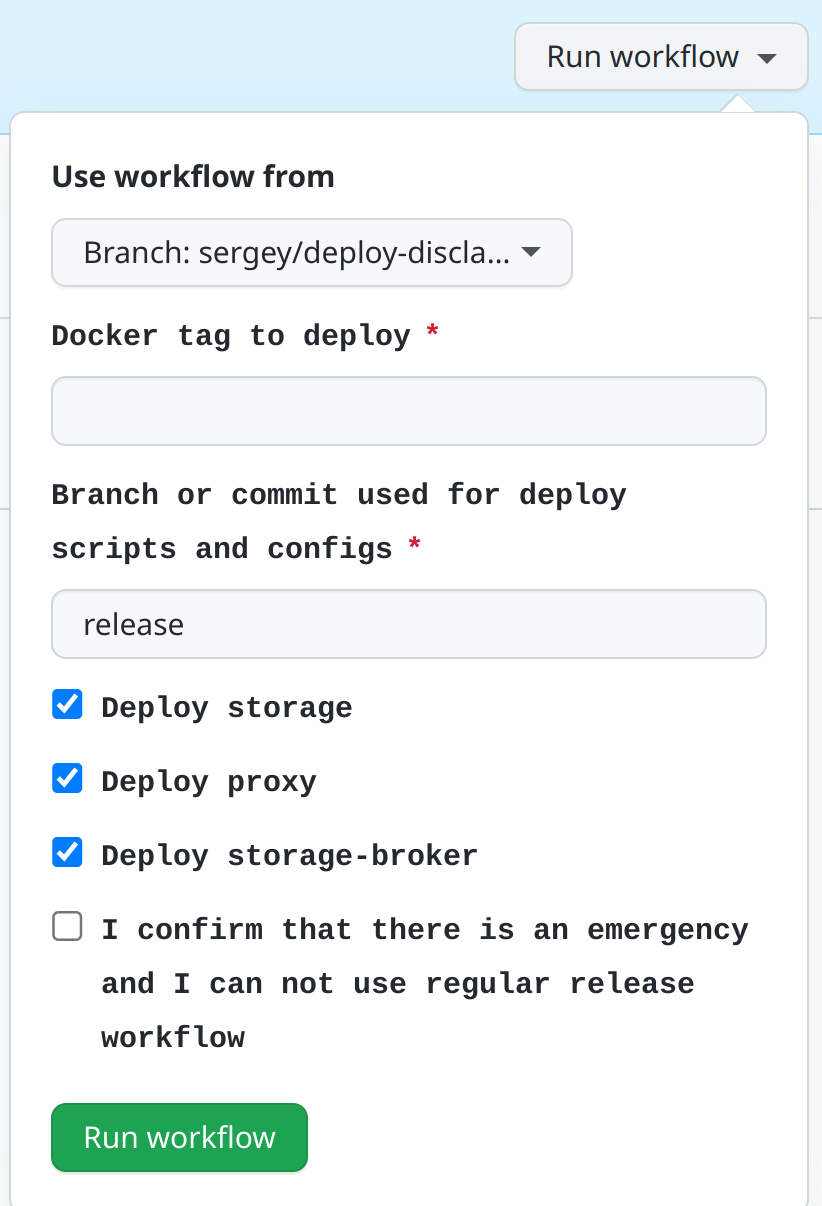
Add 'branch' input to specify commit for deploy scripts/configs. Commit
can't be passed to workflow as ref, and we need to pin configs to
specific commit for main/release deploys
Update deploy input descriptions to match GH interface
Extract deploy jobs from build_and_test.yml to deploy-dev and
deploy-prod workflows.
Add trigger to run this workflows after Neon is build and tested on main and
release branches.

This will allow us to redeploy/rollback/patch config without full
rebuild.
To fix `Error: The requested DurationSeconds exceeds the
MaxSessionDuration set for this role.`

Co-authored-by: Rory de Zoete <rdezoete@Rorys-Mac-Studio.fritz.box>