Replaces `Box<(dyn io::AsyncRead + Unpin + Send + Sync + 'static)>` with
`impl io::AsyncRead + Unpin + Send + Sync + 'static` usages in the
`RemoteStorage` interface, to make it closer to
[`#![feature(async_fn_in_trait)]`](https://blog.rust-lang.org/inside-rust/2022/11/17/async-fn-in-trait-nightly.html)
For `GenericRemoteStorage`, replaces `type Target = dyn RemoteStorage`
with another impl with `RemoteStorage` methods inside it.
We can reuse the trait, that would require importing the trait in every
file where it's used and makes us farther from the unstable feature.
After this PR, I've manged to create a patch with the changes:
https://github.com/neondatabase/neon/compare/kb/less-dyn-storage...kb/nightly-async-trait?expand=1
Current rust implementation does not like recursive async trait calls,
so `UnreliableWrapper` was removed: it contained a
`GenericRemoteStorage` that implemented the `RemoteStorage` trait, and
itself implemented the trait, which nightly rustc did not like and
proposed to box the future.
Similarly, `GenericRemoteStorage` cannot implement `RemoteStorage` for
nightly rustc to work, since calls various remote storages' methods from
inside.
I've compiled current `main` and the nightly branch both with `time env
RUSTC_WRAPPER="" cargo +nightly build --all --timings` command, and got
```
Finished dev [optimized + debuginfo] target(s) in 2m 04s
env RUSTC_WRAPPER="" cargo +nightly build --all --timings 1283.19s user 50.40s system 1074% cpu 2:04.15 total
for the new feature tried and
Finished dev [optimized + debuginfo] target(s) in 2m 40s
env RUSTC_WRAPPER="" cargo +nightly build --all --timings 1288.59s user 52.06s system 834% cpu 2:40.71 total
for the old async_trait approach.
```
On my machine, the `remote_storage` lib compilation takes ~10 less time
with the nightly feature (left) than the regular main (right).
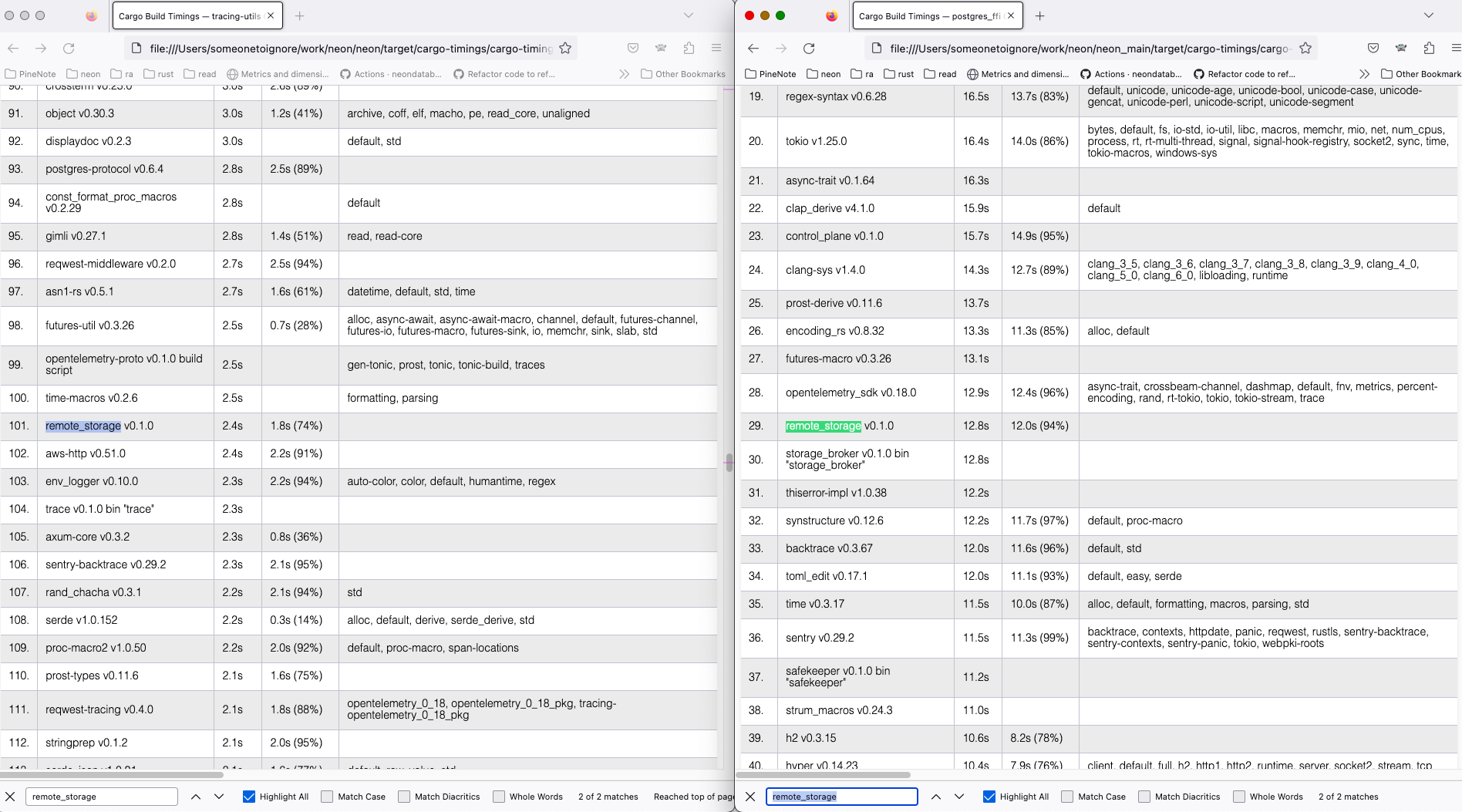
Full cargo reports are available at
[timings.zip](https://github.com/neondatabase/neon/files/11179369/timings.zip)
In S3, pageserver only lists tenants (prefixes) on S3, no other keys.
Remove the list operation from the API, since S3 impl does not seem to
work normally and not used anyway,
Remote operations fail sometimes due to network failures or other
external reasons. Add retry logic to all the remote downloads, so that
a transient failure at pageserver startup or tenant attach doesn't
cause the whole tenant to be marked as Broken.
Like in the uploads retry logic, we print the failure to the log as a
WARNing after three retries, but keep retrying. We will retry up to 10
times now, before returning the error to the caller.
To test the retries, I created a new RemoteStorage wrapper that simulates
failures, by returning an error for the first N times that a remote
operation is performed. It can be enabled by setting a new
"test_remote_failures" option in the pageserver config file.
Fixes#3112
Changes:

* Remove `RemoteObjectId` concept from remote_storage.
Operate directly on /-separated names instead.
These names are now represented by struct `RemotePath` which was renamed from struct `RelativePath`

* Require remote storage to operate on relative paths for its contents, thus simplifying the way to derive them in pageserver and safekeeper

* Make `IndexPart` to use `String` instead of `RelativePath` for its entries, since those are just the layer names
Part of https://github.com/neondatabase/neon/pull/2239

Regular, from scratch, timeline creation involves initdb to be run in a separate directory, data from this directory to be imported into pageserver and, finally, timeline-related background tasks to start.

This PR ensures we don't leave behind any directories that are not marked as temporary and that pageserver removes such directories on restart, allowing timeline creation to be retried with the same IDs, if needed.

It would be good to later rewrite the logic to use a temporary directory, similar what tenant creation does.
Yet currently it's harder than this change, so not done.
We had a pattern like this:

    match remote_storage {
        GenericRemoteStorage::Local(storage) => {
            let source = storage.remote_object_id(&file_path)?;
            ...
            storage
                .function(&source, ...)
                .await
       },
       GenericRemoteStorage::S3(storage) => {
	    ... exact same code as for the Local case ...
       },

This removes the code duplication, by allowing you to call the functions
directly on GenericRemoteStorage.

Also change RemoveObjectId to be just a type alias for String. Now that
the callers of GenericRemoteStorage functions don't know whether they're
dealing with the LocalFs or S3 implementation, RemoveObjectId must be the
same type for both.
The code correctly detected too short and too long inputs, but the error
message was bogus for the case the input stream was too long:

    Error: Provided stream has actual size 5 fthat is smaller than the given stream size 4

That check was only supposed to check for too small inputs, but it in
fact caught too long inputs too. That was good, because the check
below that that was supposed to check for too long inputs was in fact
broken, and never did anything. It tried to read input a buffer of
size 0, to check if there is any extra data, but reading to a
zero-sized buffer always returns 0.
download operations of all timelines for one tenant are now grouped
together so when attach is invoked pageserver downloads all of them
and registers them in a single apply_sync_status_update call so
branches can be used safely with attach/detach


