Add a simple disarmable dropguard to log if request is cancelled before
it is completed. We currently don't have this, and it makes for
difficult to know when the request was dropped.
This patch extends the libmetrics logging setup functionality with a
`tracing` layer that increments a Prometheus counter each time we log a
log message. We have the counter per tracing event level. This allows
for monitoring WARN and ERR log volume without parsing the log. Also, it
would allow cross-checking whether logs got dropped on the way into
Loki.

It would be nicer if we could hook deeper into the tracing logging
layer, to avoid evaluating the filter twice.
But I don't know how to do it.
Do several attempts to get spec from the control-plane and retry network
errors and all reasonable HTTP response codes. Do not hang waiting for
spec without confirmation from the control-plane that compute is known
and is in the `Empty` state.

Adjust the way we track `total_startup_ms` metric, it should be
calculated since the moment we received spec, not from the moment
`compute_ctl` started. Also introduce a new `wait_for_spec_ms` metric
to track the time spent sleeping and waiting for spec to be delivered
from control-plane.

Part of neondatabase/cloud#3533
See https://github.com/neondatabase/neon/pull/3991

Brings the changes back with the right way to use new `toml_edit` to
deserialize values and a unit test for this.

All non-trivial updates extracted into separate commits, also `carho hakari` data and its manifest format were updated.

3 sets of crates remain unupdated:

* `base64` — touches proxy in a lot of places and changed its api (by 0.21 version) quite strongly since our version (0.13).
* `opentelemetry` and `opentelemetry-*` crates

```
error[E0308]: mismatched types
  --> libs/tracing-utils/src/http.rs:65:21
   |
65 |     span.set_parent(parent_ctx);
   |          ---------- ^^^^^^^^^^ expected struct `opentelemetry_api::context::Context`, found struct `opentelemetry::Context`
   |          |
   |          arguments to this method are incorrect
   |
   = note: struct `opentelemetry::Context` and struct `opentelemetry_api::context::Context` have similar names, but are actually distinct types
note: struct `opentelemetry::Context` is defined in crate `opentelemetry_api`
  --> /Users/someonetoignore/.cargo/registry/src/github.com-1ecc6299db9ec823/opentelemetry_api-0.19.0/src/context.rs:77:1
   |
77 | pub struct Context {
   | ^^^^^^^^^^^^^^^^^^
note: struct `opentelemetry_api::context::Context` is defined in crate `opentelemetry_api`
  --> /Users/someonetoignore/.cargo/registry/src/github.com-1ecc6299db9ec823/opentelemetry_api-0.18.0/src/context.rs:77:1
   |
77 | pub struct Context {
   | ^^^^^^^^^^^^^^^^^^
   = note: perhaps two different versions of crate `opentelemetry_api` are being used?
note: associated function defined here
  --> /Users/someonetoignore/.cargo/registry/src/github.com-1ecc6299db9ec823/tracing-opentelemetry-0.18.0/src/span_ext.rs:43:8
   |
43 |     fn set_parent(&self, cx: Context);
   |        ^^^^^^^^^^

For more information about this error, try `rustc --explain E0308`.
error: could not compile `tracing-utils` due to previous error
warning: build failed, waiting for other jobs to finish...
error: could not compile `tracing-utils` due to previous error
```

`tracing-opentelemetry` of version `0.19` is not yet released, that is supposed to have the update we need.

* similarly, `rustls`, `tokio-rustls`, `rustls-*` and `tls-listener` crates have similar issue:

```
error[E0308]: mismatched types
   --> libs/postgres_backend/tests/simple_select.rs:112:78
    |
112 |     let mut make_tls_connect = tokio_postgres_rustls::MakeRustlsConnect::new(client_cfg);
    |                                --------------------------------------------- ^^^^^^^^^^ expected struct `rustls::client::client_conn::ClientConfig`, found struct `ClientConfig`
    |                                |
    |                                arguments to this function are incorrect
    |
    = note: struct `ClientConfig` and struct `rustls::client::client_conn::ClientConfig` have similar names, but are actually distinct types
note: struct `ClientConfig` is defined in crate `rustls`
   --> /Users/someonetoignore/.cargo/registry/src/github.com-1ecc6299db9ec823/rustls-0.21.0/src/client/client_conn.rs:125:1
    |
125 | pub struct ClientConfig {
    | ^^^^^^^^^^^^^^^^^^^^^^^
note: struct `rustls::client::client_conn::ClientConfig` is defined in crate `rustls`
   --> /Users/someonetoignore/.cargo/registry/src/github.com-1ecc6299db9ec823/rustls-0.20.8/src/client/client_conn.rs:91:1
    |
91  | pub struct ClientConfig {
    | ^^^^^^^^^^^^^^^^^^^^^^^
    = note: perhaps two different versions of crate `rustls` are being used?
note: associated function defined here
   --> /Users/someonetoignore/.cargo/registry/src/github.com-1ecc6299db9ec823/tokio-postgres-rustls-0.9.0/src/lib.rs:23:12
    |
23  |     pub fn new(config: ClientConfig) -> Self {
    |            ^^^

For more information about this error, try `rustc --explain E0308`.
error: could not compile `postgres_backend` due to previous error
warning: build failed, waiting for other jobs to finish...
```

* aws crates: I could not make new API to work with bucket endpoint overload, and console e2e tests failed.
Other our tests passed, further investigation is worth to be done in https://github.com/neondatabase/neon/issues/4008
Before this patch, if a tenant would override its eviction_policy
setting to use a lower LayerAccessThreshold::threshold than the
`evictions_low_residence_duration_metric_threshold`, the evictions done
for that tenant would count towards the
`evictions_with_low_residence_duration` metric.

That metric is used to identify pre-mature evictions, commonly triggered
by disk-usage-based eviction under disk pressure.

We don't want that to happen for the legitimate evictions of the tenant
that overrides its eviction_policy.

So, this patch
- moves the setting into TenantConf
- adds test coverage
- updates the staging & prod yamls

Forward Compatibility:
Software before this patch will ignore the new tenant conf field and use
the global one instead.
So we can roll back safely.

Backward Compatibility:
Parsing old configs with software as of this patch will fail in
`PageServerConf::parse_and_validate` with error
`unrecognized pageserver option 'evictions_low_residence_duration_metric_threshold'`
if the option is still present in the global section.
We deal with this by updating the configs in Ansible.

fixes https://github.com/neondatabase/neon/issues/3940
With this commit one can request compute reconfiguration
from the running `compute_ctl` with compute in `Running` state
by sending a new spec:
```shell
curl -d "{\"spec\": $(cat ./compute-spec-new.json)}" http://localhost:3080/configure
```
Internally, we start a separate configurator thread that is waiting on
`Condvar` for `ConfigurationPending` compute state in a loop. Then it does
reconfiguration, sets compute back to `Running` state and notifies other
waiters.
It will need some follow-ups, e.g. for retry logic for control-plane
requests, but should be useful for testing in the current state. This
shouldn't affect any existing environment, since computes are configured
in a different way there.
Resolvesneondatabase/cloud#4433
Reason and backtrace are added to the Broken state. Backtrace is automatically collected when tenant entered the broken state. The format for API, CLI and metrics is changed and unified to return tenant state name in camel case. Previously snake case was used for metrics and camel case was used for everything else. Now tenant state field in TenantInfo swagger spec is changed to contain state name in "slug" field and other fields (currently only reason and backtrace for Broken variant in "data" field). To allow for this breaking change state was removed from TenantInfo swagger spec because it was not used anywhere.
Please note that the tenant's broken reason is not persisted on disk so the reason is lost when pageserver is restarted.
Requires changes to grafana dashboard that monitors tenant states.
Closes#3001
---------
Co-authored-by: theirix <theirix@gmail.com>
All non-trivial updates extracted into separate commits, also `carho
hakari` data and its manifest format were updated.

3 sets of crates remain unupdated:

* `base64` — touches proxy in a lot of places and changed its api (by
0.21 version) quite strongly since our version (0.13).
* `opentelemetry` and `opentelemetry-*` crates

```
error[E0308]: mismatched types
  --> libs/tracing-utils/src/http.rs:65:21
   |
65 |     span.set_parent(parent_ctx);
   |          ---------- ^^^^^^^^^^ expected struct `opentelemetry_api::context::Context`, found struct `opentelemetry::Context`
   |          |
   |          arguments to this method are incorrect
   |
   = note: struct `opentelemetry::Context` and struct `opentelemetry_api::context::Context` have similar names, but are actually distinct types
note: struct `opentelemetry::Context` is defined in crate `opentelemetry_api`
  --> /Users/someonetoignore/.cargo/registry/src/github.com-1ecc6299db9ec823/opentelemetry_api-0.19.0/src/context.rs:77:1
   |
77 | pub struct Context {
   | ^^^^^^^^^^^^^^^^^^
note: struct `opentelemetry_api::context::Context` is defined in crate `opentelemetry_api`
  --> /Users/someonetoignore/.cargo/registry/src/github.com-1ecc6299db9ec823/opentelemetry_api-0.18.0/src/context.rs:77:1
   |
77 | pub struct Context {
   | ^^^^^^^^^^^^^^^^^^
   = note: perhaps two different versions of crate `opentelemetry_api` are being used?
note: associated function defined here
  --> /Users/someonetoignore/.cargo/registry/src/github.com-1ecc6299db9ec823/tracing-opentelemetry-0.18.0/src/span_ext.rs:43:8
   |
43 |     fn set_parent(&self, cx: Context);
   |        ^^^^^^^^^^

For more information about this error, try `rustc --explain E0308`.
error: could not compile `tracing-utils` due to previous error
warning: build failed, waiting for other jobs to finish...
error: could not compile `tracing-utils` due to previous error
```

`tracing-opentelemetry` of version `0.19` is not yet released, that is
supposed to have the update we need.

* similarly, `rustls`, `tokio-rustls`, `rustls-*` and `tls-listener`
crates have similar issue:

```
error[E0308]: mismatched types
   --> libs/postgres_backend/tests/simple_select.rs:112:78
    |
112 |     let mut make_tls_connect = tokio_postgres_rustls::MakeRustlsConnect::new(client_cfg);
    |                                --------------------------------------------- ^^^^^^^^^^ expected struct `rustls::client::client_conn::ClientConfig`, found struct `ClientConfig`
    |                                |
    |                                arguments to this function are incorrect
    |
    = note: struct `ClientConfig` and struct `rustls::client::client_conn::ClientConfig` have similar names, but are actually distinct types
note: struct `ClientConfig` is defined in crate `rustls`
   --> /Users/someonetoignore/.cargo/registry/src/github.com-1ecc6299db9ec823/rustls-0.21.0/src/client/client_conn.rs:125:1
    |
125 | pub struct ClientConfig {
    | ^^^^^^^^^^^^^^^^^^^^^^^
note: struct `rustls::client::client_conn::ClientConfig` is defined in crate `rustls`
   --> /Users/someonetoignore/.cargo/registry/src/github.com-1ecc6299db9ec823/rustls-0.20.8/src/client/client_conn.rs:91:1
    |
91  | pub struct ClientConfig {
    | ^^^^^^^^^^^^^^^^^^^^^^^
    = note: perhaps two different versions of crate `rustls` are being used?
note: associated function defined here
   --> /Users/someonetoignore/.cargo/registry/src/github.com-1ecc6299db9ec823/tokio-postgres-rustls-0.9.0/src/lib.rs:23:12
    |
23  |     pub fn new(config: ClientConfig) -> Self {
    |            ^^^

For more information about this error, try `rustc --explain E0308`.
error: could not compile `postgres_backend` due to previous error
warning: build failed, waiting for other jobs to finish...
```

* aws crates: I could not make new API to work with bucket endpoint
overload, and console e2e tests failed.
Other our tests passed, further investigation is worth to be done in
https://github.com/neondatabase/neon/issues/4008
Sometimes, it contained real values, sometimes just defaults if the
spec was not received yet. Make the state more clear by making it an
Option instead.

One consequence is that if some of the required settings like
neon.tenant_id are missing from the spec file sent to the /configure
endpoint, it is spotted earlier and you get an immediate HTTP error
response. Not that it matters very much, but it's nicer nevertheless.
TCP_KEEPALIVE is not enabled by default, so this prevents hanged up connections
in case of abrupt client termination. Add 'closed' flag to PostgresBackendReader
and pass it during handles join to prevent attempts to read from socket if we
errored out previously -- now with timeouts this is a common situation.

It looks like
2023-04-10T18:08:37.493448Z  INFO {cid=68}:WAL
receiver{ttid=59f91ad4e821ab374f9ccdf918da3a85/16438f99d61572c72f0c7b0ed772785d}:
terminated: timed out

Presumably fixes https://github.com/neondatabase/neon/issues/3971
This is in preparation of using compute_ctl to launch postgres nodes
in the neon_local control plane. And seems like a good idea to
separate the public interfaces anyway.

One non-mechanical change here is that the 'metrics' field is moved
under the Mutex, instead of using atomics. We were not using atomics
for performance but for convenience here, and it seems more clear to
not use atomics in the model for the HTTP response type.
Replaces `Box<(dyn io::AsyncRead + Unpin + Send + Sync + 'static)>` with
`impl io::AsyncRead + Unpin + Send + Sync + 'static` usages in the
`RemoteStorage` interface, to make it closer to
[`#![feature(async_fn_in_trait)]`](https://blog.rust-lang.org/inside-rust/2022/11/17/async-fn-in-trait-nightly.html)
For `GenericRemoteStorage`, replaces `type Target = dyn RemoteStorage`
with another impl with `RemoteStorage` methods inside it.
We can reuse the trait, that would require importing the trait in every
file where it's used and makes us farther from the unstable feature.
After this PR, I've manged to create a patch with the changes:
https://github.com/neondatabase/neon/compare/kb/less-dyn-storage...kb/nightly-async-trait?expand=1
Current rust implementation does not like recursive async trait calls,
so `UnreliableWrapper` was removed: it contained a
`GenericRemoteStorage` that implemented the `RemoteStorage` trait, and
itself implemented the trait, which nightly rustc did not like and
proposed to box the future.
Similarly, `GenericRemoteStorage` cannot implement `RemoteStorage` for
nightly rustc to work, since calls various remote storages' methods from
inside.
I've compiled current `main` and the nightly branch both with `time env
RUSTC_WRAPPER="" cargo +nightly build --all --timings` command, and got
```
Finished dev [optimized + debuginfo] target(s) in 2m 04s
env RUSTC_WRAPPER="" cargo +nightly build --all --timings 1283.19s user 50.40s system 1074% cpu 2:04.15 total
for the new feature tried and
Finished dev [optimized + debuginfo] target(s) in 2m 40s
env RUSTC_WRAPPER="" cargo +nightly build --all --timings 1288.59s user 52.06s system 834% cpu 2:40.71 total
for the old async_trait approach.
```
On my machine, the `remote_storage` lib compilation takes ~10 less time
with the nightly feature (left) than the regular main (right).
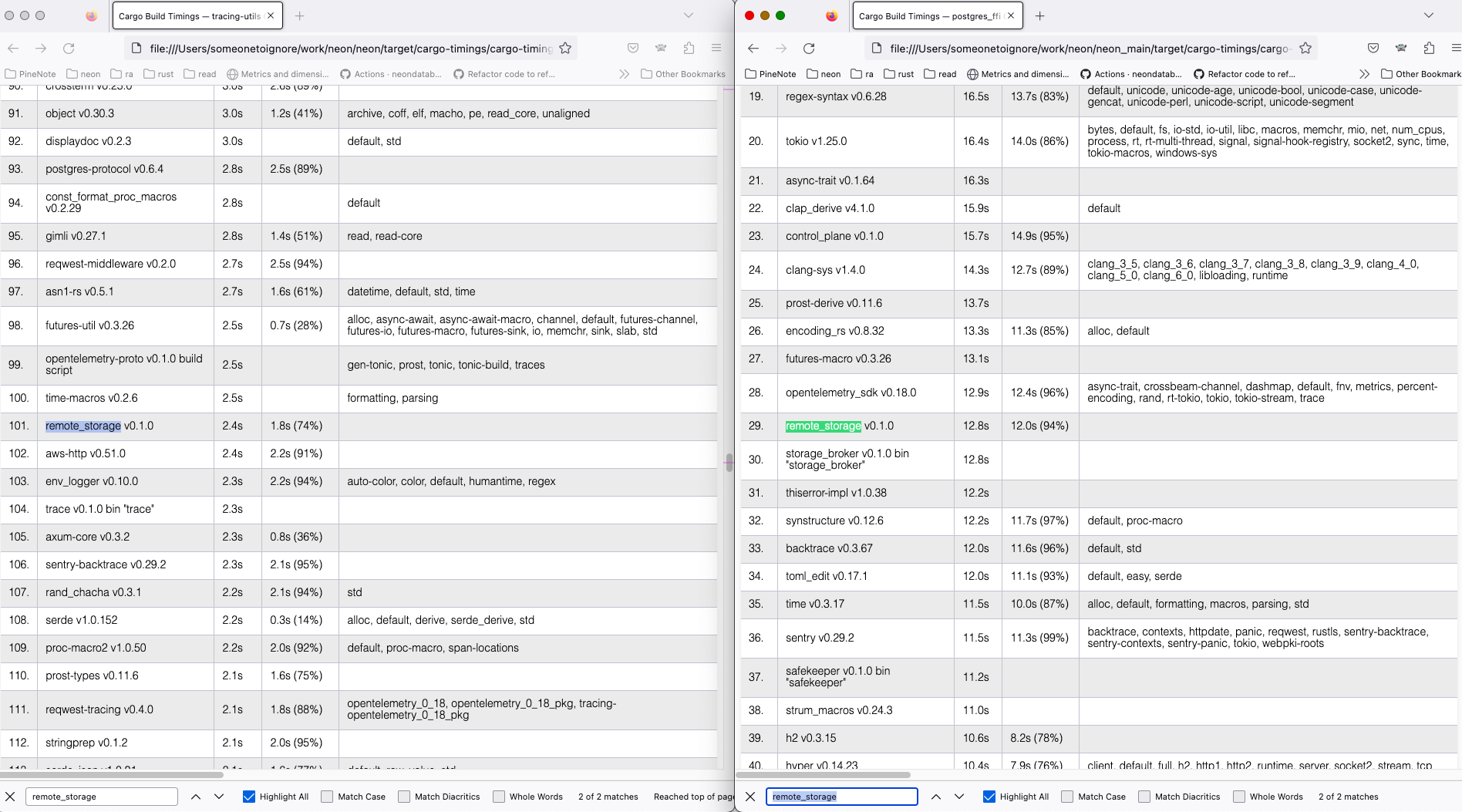
Full cargo reports are available at
[timings.zip](https://github.com/neondatabase/neon/files/11179369/timings.zip)
in real env testing we noted that the disk-usage based eviction sails 1
percentage point above the configured value, which might be a source of
confusion, so it might be better to get rid of that confusion now.

confusion: "I configured 85% but pageserver sails at 86%".

Co-authored-by: Christian Schwarz <christian@neon.tech>
In S3, pageserver only lists tenants (prefixes) on S3, no other keys.
Remove the list operation from the API, since S3 impl does not seem to
work normally and not used anyway,
This is the the feedback originating from pageserver, so change previous
confusing names to
s/ReplicationFeedback/PageserverFeedback
s/ps_writelsn/last_receive_lsn
s/ps_flushlsn/disk_consistent_lsn
s/ps_apply_lsn/remote_consistent_lsn

I haven't changed on the wire format to keep compatibility. However,
understanding of new field names is added to compute, so once all computes
receive this patch we can change the wire names as well. Safekeepers/pageservers
are deployed roughly at the same time and it is ok to live without feedbacks
during the short period, so this is not a problem there.
This patch adds a pageserver-global background loop that evicts layers
in response to a shortage of available bytes in the $repo/tenants
directory's filesystem.

The loop runs periodically at a configurable `period`.

Each loop iteration uses `statvfs` to determine filesystem-level space
usage. It compares the returned usage data against two different types
of thresholds. The iteration tries to evict layers until app-internal
accounting says we should be below the thresholds. We cross-check this
internal accounting with the real world by making another `statvfs` at
the end of the iteration. We're good if that second statvfs shows that
we're _actually_ below the configured thresholds. If we're still above
one or more thresholds, we emit a warning log message, leaving it to the
operator to investigate further.

There are two thresholds:
- `max_usage_pct` is the relative available space, expressed in percent
of the total filesystem space. If the actual usage is higher, the
threshold is exceeded.
- `min_avail_bytes` is the absolute available space in bytes. If the
actual usage is lower, the threshold is exceeded.

The iteration evicts layers in LRU fashion with a reservation of up to
`tenant_min_resident_size` bytes of the most recent layers per tenant.
The layers not part of the per-tenant reservation are evicted
least-recently-used first until we're below all thresholds. The
`tenant_min_resident_size` can be overridden per tenant as
`min_resident_size_override` (bytes).

In addition to the loop, there is also an HTTP endpoint to perform one
loop iteration synchronous to the request. The endpoint takes an
absolute number of bytes that the iteration needs to evict before
pressure is relieved. The tests use this endpoint, which is a great
simplification over setting up loopback-mounts in the tests, which would
be required to test the statvfs part of the implementation. We will rely
on manual testing in staging to test the statvfs parts.

The HTTP endpoint is also handy in emergencies where an operator wants
the pageserver to evict a given amount of space _now. Hence, it's
arguments documented in openapi_spec.yml. The response type isn't
documented though because we don't consider it stable. The endpoint
should _not_ be used by Console but it could be used by on-call.

Co-authored-by: Joonas Koivunen <joonas@neon.tech>
Co-authored-by: Dmitry Rodionov <dmitry@neon.tech>
Co-authored-by: Heikki Linnakangas <heikki@neon.tech>
neon_local sends SIGQUIT, which otherwise dumps core by default. Also, remove
obsolete install_shutdown_handlers; in all binaries it was overridden by
ShutdownSignals::handle later.

ref https://github.com/neondatabase/neon/issues/3847
The PR enforces current newest `index_part.json` format in the type
system (version `1`), not allowing any previous forms of it, that were
used in the past.
Similarly, the code to mitigate the
https://github.com/neondatabase/neon/issues/3024 issue is now also
removed.

Current code does not produce old formats and extra files in the
index_part.json, in the future we will be able to use
https://github.com/neondatabase/aversion or other approach to make
version transitions more explicit.

See https://neondb.slack.com/archives/C033RQ5SPDH/p1679134185248119 for
the justification on the breaking changes.
The control plane currently only supports EdDSA. We need to either teach
the storage to use EdDSA, or the control plane to use RSA. EdDSA is more
modern, so let's use that.

We could support both, but it would require a little more code and tests,
and we don't really need the flexibility since we control both sides.
Otherwise they get lost. Normally buffer is empty before proxy pass, but this is
not the case with pipeline mode of out npm driver; fixes connection hangup
introduced by b80fe41af3 for it.

fixes https://github.com/neondatabase/neon/issues/3822
- handle automatically fixable future clippies
- tune run-clippy.sh to remove macos specifics which we no longer have

Co-authored-by: Alexander Bayandin <alexander@neon.tech>
Previously, we only accepted RS256. Seems like a pointless limitation,
and when I was testing it with RS512 tokens, it took me a while to
understand why it wasn't working.
1) Remove allocation and data copy during each message read. Instead, parsing
functions now accept BytesMut from which data they form messages, with
pointers (e.g. in CopyData) pointing directly into BytesMut buffer. Accordingly,
move ConnectionError containing IO error subtype into framed.rs providing this
and leave in pq_proto only ProtocolError.

2) Remove anyhow from pq_proto.

3) Move FeStartupPacket out of FeMessage. Now FeStartupPacket::parse returns it
directly, eliminating dead code where user wants startup packet but has to match
for others.

proxy stream.rs is adapted to framed.rs with minimal changes. It also benefits
from framed.rs improvements described above.
- Add support for splitting async postgres_backend into read and write halfes.
  Safekeeper needs this for bidirectional streams. To this end, encapsulate
  reading-writing postgres messages to framed.rs with split support without any
  additional changes (relying on BufRead for reading and BytesMut out buffer for
  writing).
- Use async postgres_backend throughout safekeeper (and in proxy auth link
  part).
- In both safekeeper COPY streams, do read-write from the same thread/task with
  select! for easier error handling.
- Tidy up finishing CopyBoth streams in safekeeper sending and receiving WAL
  -- join split parts back catching errors from them before returning.

Initially I hoped to do that read-write without split at all, through polling
IO:
https://github.com/neondatabase/neon/pull/3522
However that turned out to be more complicated than I initially expected
due to 1) borrow checking and 2) anon Future types. 1) required Rc<Refcell<...>>
which is Send construct just to satisfy the checker; 2) can be workaround with
transmute. But this is so messy that I decided to leave split.
To untie cyclic dependency between sync and async versions of postgres_backend,
copy QueryError and some logging/error routines to postgres_backend.rs. This is
temporal glue to make commits smaller, sync version will be dropped by the
upcoming commit completely.
Adds a newtype that creates a span with request_id from
https://github.com/neondatabase/neon/pull/3708 for every HTTP request
served.

Moves request logging and error handlers under the new wrapper, so every request-related event now is logged under the request span.
For compatibility reasons, error handler is left on the general router, since not every service uses the new handler wrappers yet.
## Describe your changes

## Issue ticket number and link
#3479
## Checklist before requesting a review
- [x] I have performed a self-review of my code.
- [ ] If it is a core feature, I have added thorough tests.
- [ ] Do we need to implement analytics? if so did you add the relevant
metrics to the dashboard?
- [ ] If this PR requires public announcement, mark it with
/release-notes label and add several sentences in this section.
We started rather frequently scrap some apis for metadata. This includes
layer eviction tester, I believe console does that too.

It should eliminate these logs:
https://neonprod.grafana.net/goto/rr_ace1Vz?orgId=1 (Note the rate
around 2k messages per minute)
previously we applied the ratelimiting only up to receiving the headers
from s3, or somewhere near it. the commit adds an adapter which carries
the permit until the AsyncRead has been disposed.
fixes#3662.
Enables tracing panic hook in addition to pageserver introduced in
#3475:

- proxy
- safekeeper
- storage_broker

For proxy, a drop guard which resets the original std panic hook was
added on the first commit. Other binaries don't need it so they never
reset anything by `disarm`ing the drop guard.

The aim of the change is to make sure all panics a) have span
information b) are logged similar to other messages, not interleaved
with other messages as happens right now. Interleaving happens right now
because std prints panics to stderr, and other logging happens in
stdout. If this was handled gracefully by some utility, the log message
splitter would treat panics as belonging to the previous message because
it expects a message to start with a timestamp.

Cc: #3468
Refactor the tenant_size_model code. Segment now contains just the
minimum amount of information needed to calculate the size. Other
information that is useful for building up the segment tree, and for
display purposes, is now kept elsewhere. The code in 'main.rs' has a new
ScenarioBuilder struct for that.

Calculating which Segments are "needed" is now the responsibility of the
caller of tenant_size_mode, not part of the calculation itself. So it's
up to the caller to make all the decisions with retention periods for
each branch.

The output of the sizing calculation is now a Vec of SizeResults, rather
than a tree. It uses a tree representation internally, when doing the
calculation, but it's not exposed to the caller anymore.

Refactor the way the recursive calculation is performed.

Rewrite the code in size.rs that builds the Segment model. Get rid of
the intermediate representation with Update structs. Build the Segments
directly, with some local HashMaps and Vecs to track branch points to
help with that.

retention_period is now an input to gather_inputs(), rather than an
output.

Update pageserver http API: rename /size endpoint to /synthetic_size
with following parameters:
    - /synthetic_size?inputs_only to get debug info;
- /synthetic_size?retention_period=0 to override cutoff that is used to
calculate the size;
pass header -H "Accept: text/html" to get HTML output, otherwise JSON is
returned

Update python tests and openapi spec.

---------

Co-authored-by: Anastasia Lubennikova <anastasia@neon.tech>
Co-authored-by: Joonas Koivunen <joonas@neon.tech>
Clients may specify endpoint/project name via `options=project=...`,
so we should not only remove `project=` from `options` but also
drop `options` entirely, because connection pools don't support it.

Discussion: https://neondb.slack.com/archives/C033A2WE6BZ/p1676464382670119
This patch adds a per-timeline periodic task that executes an eviction
policy. The eviction policy is configurable per tenant.

Two policies exist:
- NoEviction (the default one)
- LayerAccessThreshold

The LayerAccessThreshold policy examines the last access timestamp per
layer in the layer map and evicts the layer if that last access is
further in the past than a configurable threshold value.
This policy kind is evaluated periodically at a configurable period.
It logs a summary statistic at `info!()` or `warn!()` level, depending
on whether any evictions failed.

This feature has no explicit killswitch since it's off by default.
This patch adds basic access statistics for historic layers
and exposes them in the management API's `LayerMapInfo`.

We record the accesses in the `{Delta,Image}Layer::load()` function
because it's the common path of
* page_service (`Timline::get_reconstruct_data()`)
* Compaction (`PersistentLayer::iter()` and `PersistentLayer::key_iter()`)

The stats survive residence status changes, and record these as well.

When scraping the layer map endpoint to record its evolution over time,
one must account for stat resets because they are in-memory only and
will reset on pageserver restart.
Use the launch timestamp header added by (#3527) to identify pageserver restarts.

This is PR https://github.com/neondatabase/neon/pull/3496
The PR adds an endpoint to show tenant's current config: `GET
/v1/tenant/:tenant_id/config`
Tenant's config consists of two parts: tenant overrides (could be
changed via other management API requests) and the default part,
substituting all missing overrides (constant, hardcoded in pageserver).
The API returns the custom overrides and the final tenant config, after
applying all the defaults.
Along the way, it had to fix two things in the config:
* allow to shorten the json version and omit all `null`'s (same as toml
serializer behaves by default), and to understand such shortened format
when deserialized. A unit test is added
* fix a bug, when `PUT /v1/tenant/config` endpoint rewritten the local
file with what had came in the request, but updating (not rewriting the
old values) the in-memory state instead.
That got uncovered during adjusting the e2e test and fixed to do the
replacement everywhere, otherwise there's no way to revert existing
overrides. Fixes#3471 (commit
https://github.com/neondatabase/neon/commit/dc688affe8f9daa601fb4af700998bcd6f21ea57)
* fixes https://github.com/neondatabase/neon/issues/3472 by reordering
the config saving operations
 Joonas Koivunen
 Christian Schwarz
 Alexey Kondratov
 Kirill Bulatov

 Dmitry Rodionovandtheirix
 Heikki Linnakangas
 Arseny Sher

 Arthur Petukhovsky
 Shany Pozin

 Dmitry Ivanov
