 stefan-gorules
cd6a3f3adb
* feat(engine): explicit evaluation context with now, timezone and seed

The compiled engine evaluates against an explicit EvaluationContext
instead of the host clock, host zone and an unseeded random source.

- zen_expression::context: EvaluationContext holds now (read once on
  first use, shared by every row of a batch), the time zone (supplied
  or the host zone cached per process), the locale, the seed (drawn on
  the first draw) and per-row and per-item random streams created only
  when a row or item draws. rows/picked/items/item/at narrow it with an
  Rc clone; at and item allocate nothing. RowContext is the borrowed
  per-row view builtins, kernels and function hosts read.
- the context is passed explicitly through the lane VM (LaneRunner,
  Session, kernels, cells, builtins), typed Program::run, graph state,
  rows, loops, sub-decisions, hosted rows, the columnar plan, policies
  and their plans. There are no thread-locals for context data.
- rand draws once per lane, row and item from the row's stream, so
  map(xs, rand(100)) draws per item. rand is never pure, folded,
  memoised or compiled into kernels as a constant; Math.random is no
  longer pure in the function purity analysis.
- function hosts (v1 and v2) install Date, Math.random and a minimal
  Intl.DateTimeFormat once per runtime and read a per-call slot:
  Date.now, new Date, local-time getters and setters, toString,
  toLocale*String and getTimezoneOffset use the context's now, zone and
  locale.
- EvaluationOptions and EvaluationSerializedOptions gain now, timezone,
  seed and locale (en-US by default). Workspace gains evaluate_pinned,
  evaluate_batch_pinned and evaluate_columns_pinned. In a batch, row i
  draws with row_seed(seed, i) and replays alone with that seed.
- bindings: Node and Python accept and validate now, timezone, seed and
  locale; C and uniffi pass them through and ignore invalid values.
- d('...') is folded at compile time only for texts with an explicit
  zone; an invalid __ZEN_MOCK_UTC_TIME is ignored by the context.
- the interpreted engine and the stack VM are unchanged and ignore the
  new options.

* refactor(engine): name evaluation context parameters ctx and context

* feat(engine): derive random draws from their location

A draw is now a pure function of (seed, stream, scope, field, site, n)
instead of a running counter per stream, so reordering, short-circuiting,
dead-code elimination or an extra rand elsewhere in a decision no longer
shifts other draws.

- site: occurrence index of rand( in source order, numbered at compile
  time and carried on the lane call op
- field: stable label from node/rule/column/key/statement/block ids,
  baked into multi-root programs at compile time or set on the context
  by per-source (session) paths
- scope: chained per sub-decision call (caller node + key) and per
  function node; JS Math.random uses a fixed site in that scope
- n: counter per (stream, address) for repeated evaluation only

Tables with draws run on the exact row path; fused cells and fused rules
refuse draws; object-literal expansion is skipped for drawing sources.

* refactor(expression): own the rand integer mapping

Map a draw to 0..=upper with Lemire multiply-shift and rejection, taking
further words from the same address on retry, so a dependency update can
never change rand(n) for a given seed. A negative upper bound now returns
"Invalid upper range" on both VMs instead of panicking, and the unseeded
root seed comes from a hashed counter, which drops fastrand.

* test(engine): keep evaluation context tests independent under cargo test

cargo test runs a crate's tests as threads of one process, so tests that
share process state raced:

- pinned.rs switched the global ZEN_CONFIG.compiled on and off; each
  decision now picks its engine with compiled_engine() / interpreted().
- clock_reads() counted reads from every thread; it now counts the
  current thread only.
- typed exact tests relied on __ZEN_MOCK_UTC_TIME, which is cached on the
  first clock read by any test; they now pin now in the context.

* ci: pin Rust 1.99 for the Windows Node and UniFFI builds

Rust 1.100 makes Cargo's new build-dir layout permanent: every
dependency gets its own directory and its own -L dependency= flag.
For zen-engine with --target x86_64-pc-windows-msvc the rustc command
line passes Windows' 32,767-character limit, and sccache fails to spawn
rustc with os error 206. Cargo itself falls back to an argument file,
but sccache does not.

Other matrix entries stay on stable. Remove the pin once sccache
handles long command lines.

* refactor(engine): remove locale from the evaluation context

The locale option did not make evaluations more reproducible: QuickJS has
no ICU, so function nodes never picked up a host locale. It only added
approximate locale-aware date formatting from a hand-written table, as new
public API in every binding.

Function nodes keep the time zone of the context. toLocaleString,
toLocaleDateString and toLocaleTimeString return QuickJS's fixed format in
that zone and ignore a locale argument, as before. Intl is reduced to
DateTimeFormat().resolvedOptions(), which reports the time zone.

Drops the icu_locale_core dependency.

* test(engine): compare interpreted draws with the pinned ones

The interpreted engine's Math.random is QuickJS's own, seeded from the
clock in microseconds when a context is created. On Windows the clock is
coarser, so two evaluations in a row can get the same seed and the same
numbers. Assert instead that the interpreted engine does not return the
compiled engine's draws for the same seed.
Python Rules Engine
Business logic humans can read and machines can run. One copy of your rules: the owner reads it, every system runs it.


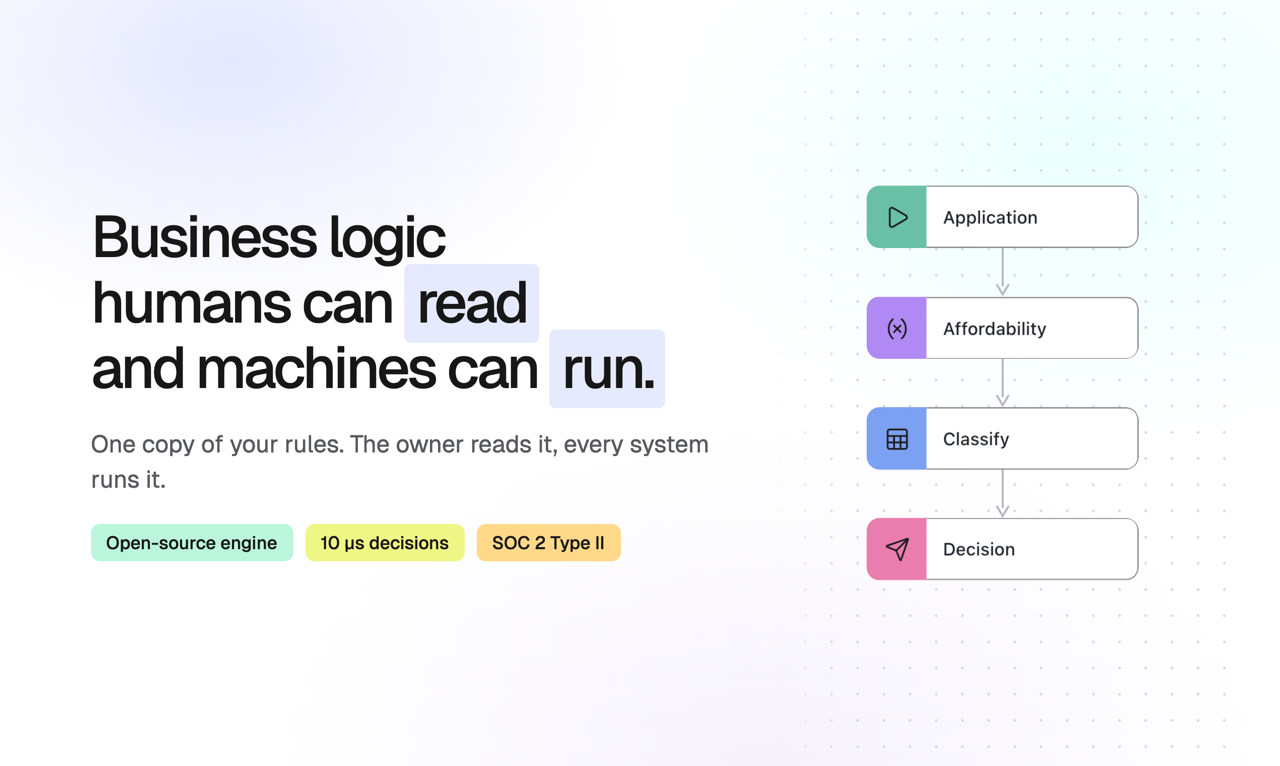
ZEN Engine is a cross-platform, open-source Business Rules Engine (BRE) written in Rust with native Python bindings, alongside Node.js, Go, Java, Kotlin and .NET. Decisions evaluate in microseconds, run identically on every platform, and are stored as portable JSON. Loading the JSON is up to you: file system, database or service call.
Try it in the free Online Editor with a built-in simulator, or embed the open-source React JDM Editor in your own product. Learn more about the Python rules engine on the GoRules website.
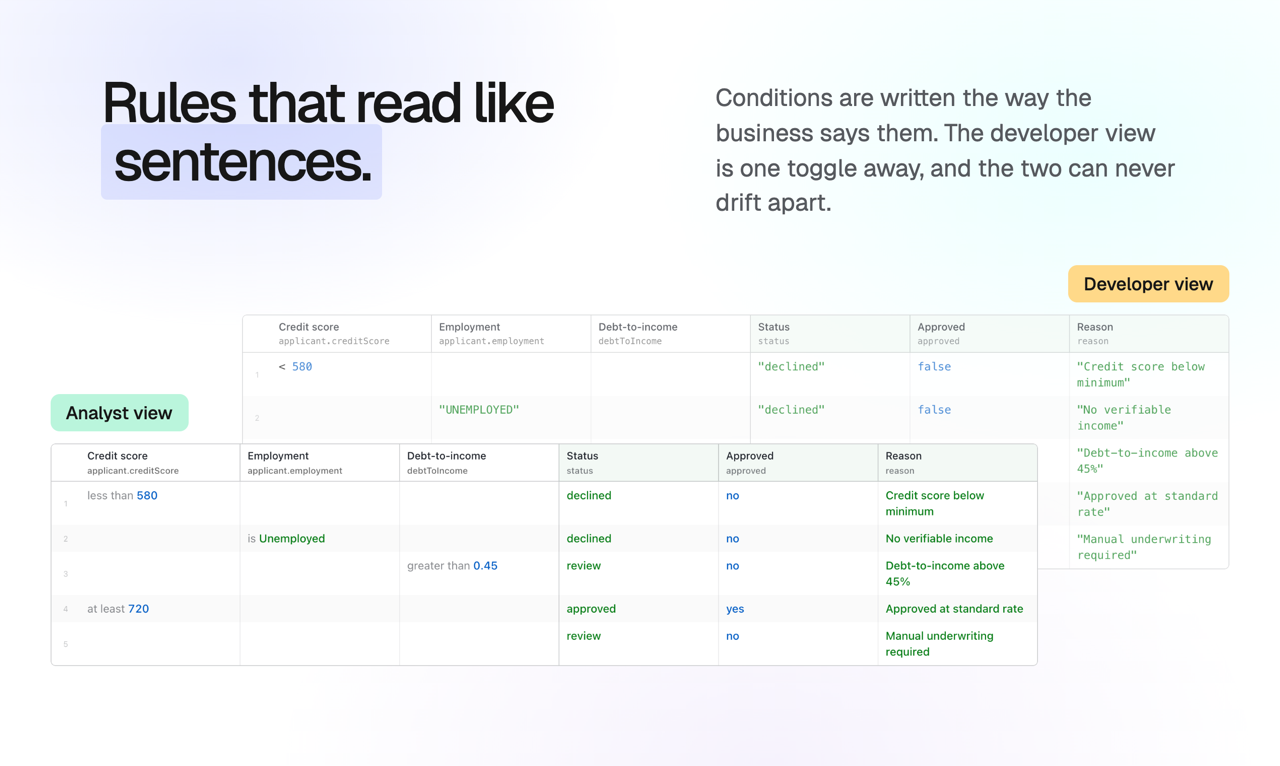
Rules that read like sentences
Conditions are written the way the business says them, in the ZEN Expression Language. The developer view is one toggle away, and the two can never drift apart: there is only one source of truth, and this engine runs it.
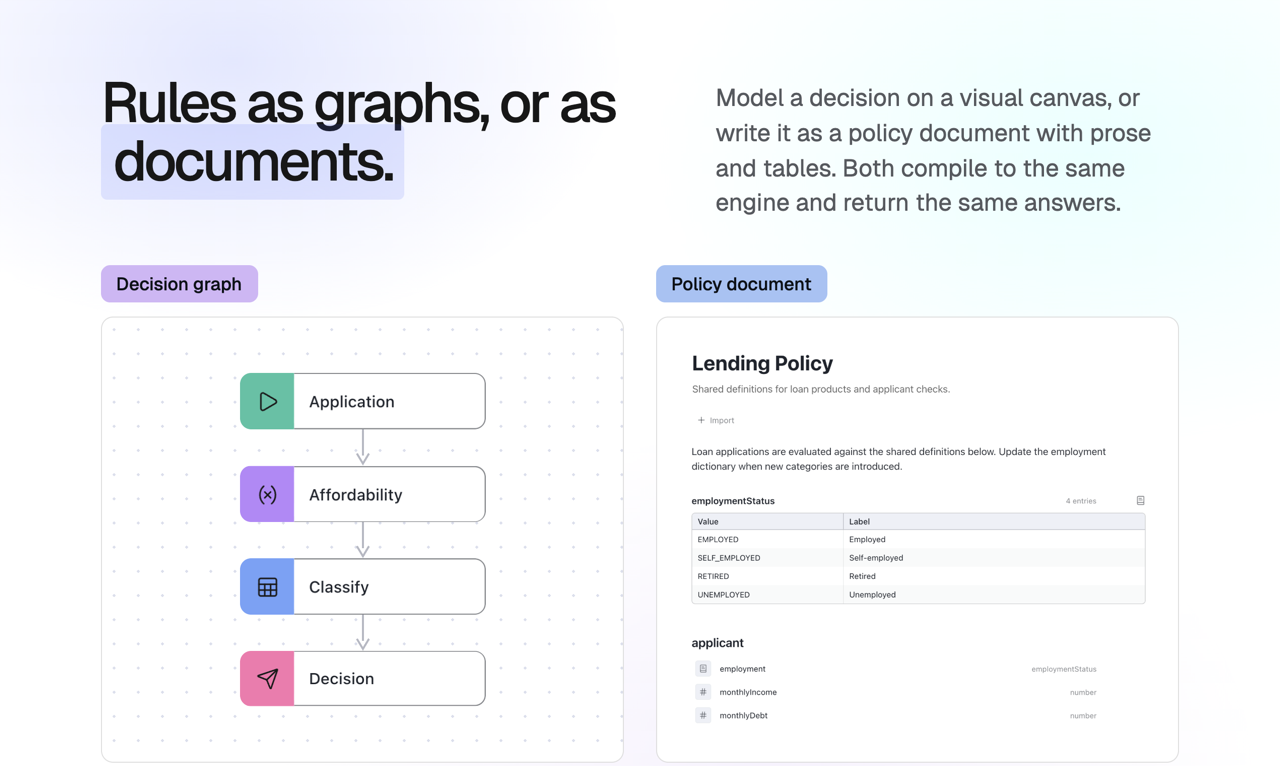
Rules as graphs, or as documents
Model a decision on a visual canvas of decision tables, switches, expressions, functions and reusable sub-decisions. Or write it as a policy document with prose, typed data models and tables. Both compile to the same engine and return the same answers.
To go deeper, see the Python SDK documentation, the decision graph guide and the ZEN Expression Language reference.
What's new in 2.0
Version 2.0 is the first stable release of the new engine line:
- Policy documents: model decisions as readable documents with typed data models, expressions, decision tables, match blocks and assertions. Policies compile to the same engine as graphs and return the same answers.
- Workspace analysis: static type checking across policies and graphs. Type flow, exhaustiveness checking, write-conflict detection and precise diagnostics, all available before anything runs.
- Per-column collect: decision table output columns can collect across all matching rows (
tags[]) while the rest of the table stays first-match. - Pre-compiled engine: decisions are parsed and compiled once at load; evaluation is allocation-light and repeat-safe.
- Hardened runtime: out-of-range numbers, arithmetic overflow and malformed inputs return errors or nulls instead of crashing the process.
- Unified bindings: configurable loaders, batch evaluation and consistent error envelopes across Node.js, Python, Go and FFI consumers.
Installation
pip install zen-engine
Prebuilt wheels ship for Linux, macOS and Windows; no Rust toolchain required.
Quickstart
import zen

with open("./jdm_graph.json", "r") as f:
    content = f.read()

engine = zen.ZenEngine()

decision = engine.create_decision(content)
result = decision.evaluate({"input": 15})
print(result)
Loaders
For more advanced use cases where you want to load multiple decisions and reuse them across evaluations you can build loaders. When engine.evaluate is invoked it calls the loader with a key, expecting the content of the JDM decision graph in return.
import zen

def loader(key):
    with open("./jdm_directory/" + key, "r") as f:
        return f.read()

engine = zen.ZenEngine({"loader": loader})
result = engine.evaluate("jdm_graph1.json", {"input": 5})
print(result)
The same pattern works for loading from a REST API, S3, a database, or anywhere else. Full guides, including multi-decision graphs and batch evaluation, are in the Python SDK documentation.
Other platforms
- Node.js - GitHub | Documentation | npm
- Python - GitHub | Documentation | PyPI
- Go - GitHub | Documentation
- Java / Kotlin - GitHub | Documentation | Maven Central
- .NET - GitHub | Documentation | NuGet
- Rust (Core) - GitHub | Documentation | crates.io
The GoRules platform
The engine is open at the core; GoRules is the platform around it. Managed cloud, self-hosted, or embedded with no network hop. SOC 2 Type II.
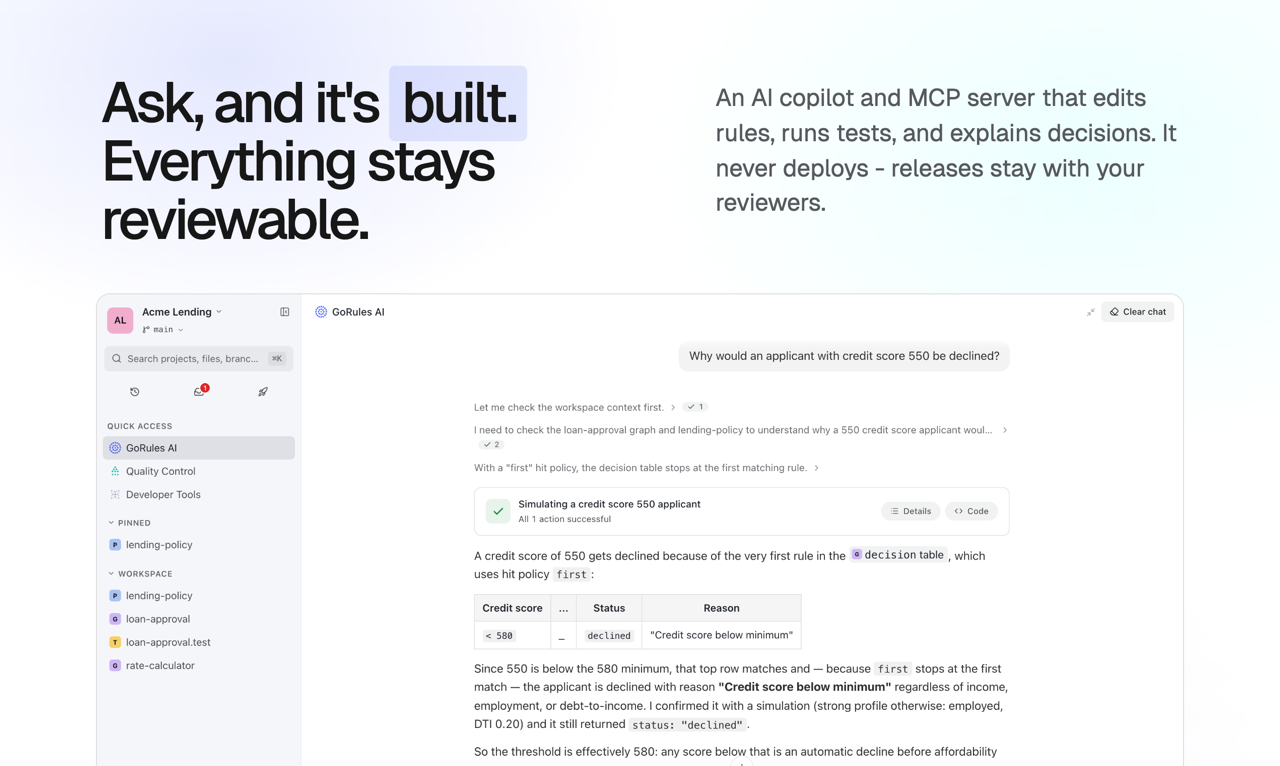
AI that builds rules, and stays reviewable
An AI copilot and MCP server that edits rules, runs tests and explains decisions. It never deploys. Releases stay with your reviewers.
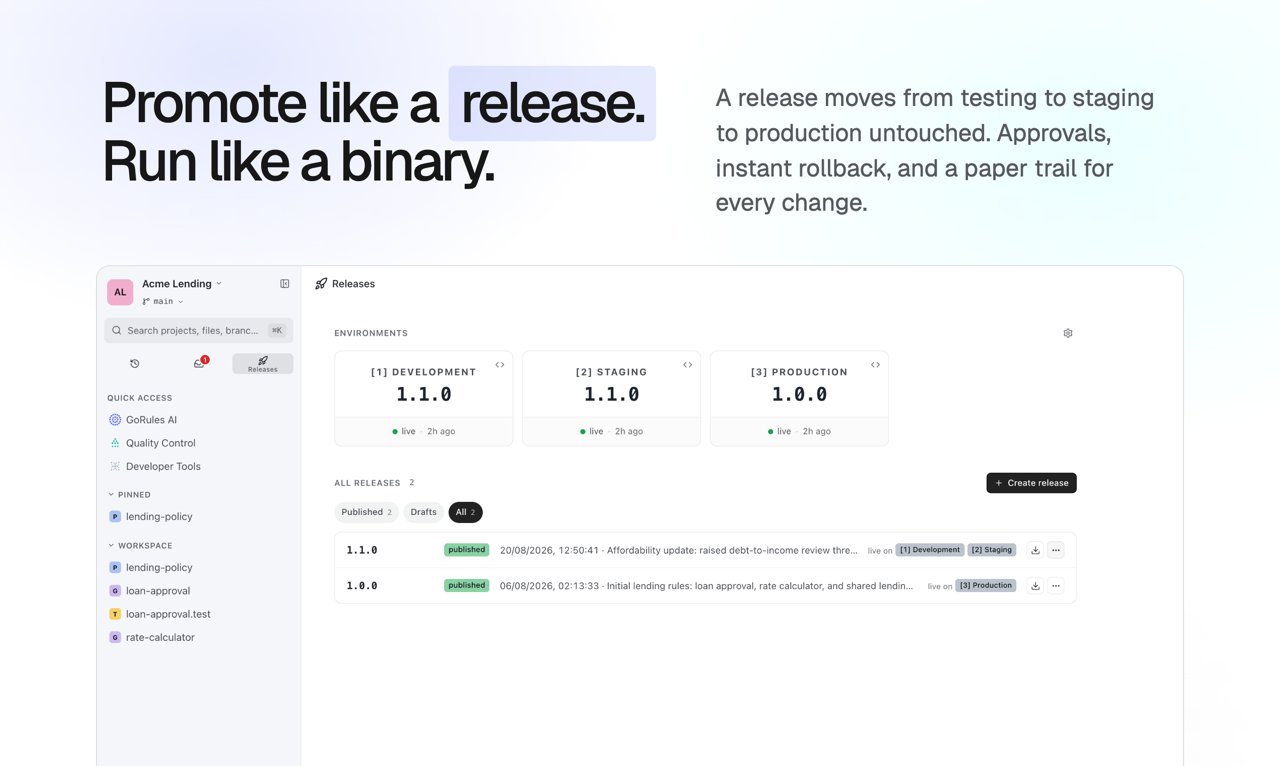
Promote like a release, run like a binary
A release moves from testing to staging to production untouched. Approvals, instant rollback, and a paper trail for every change.
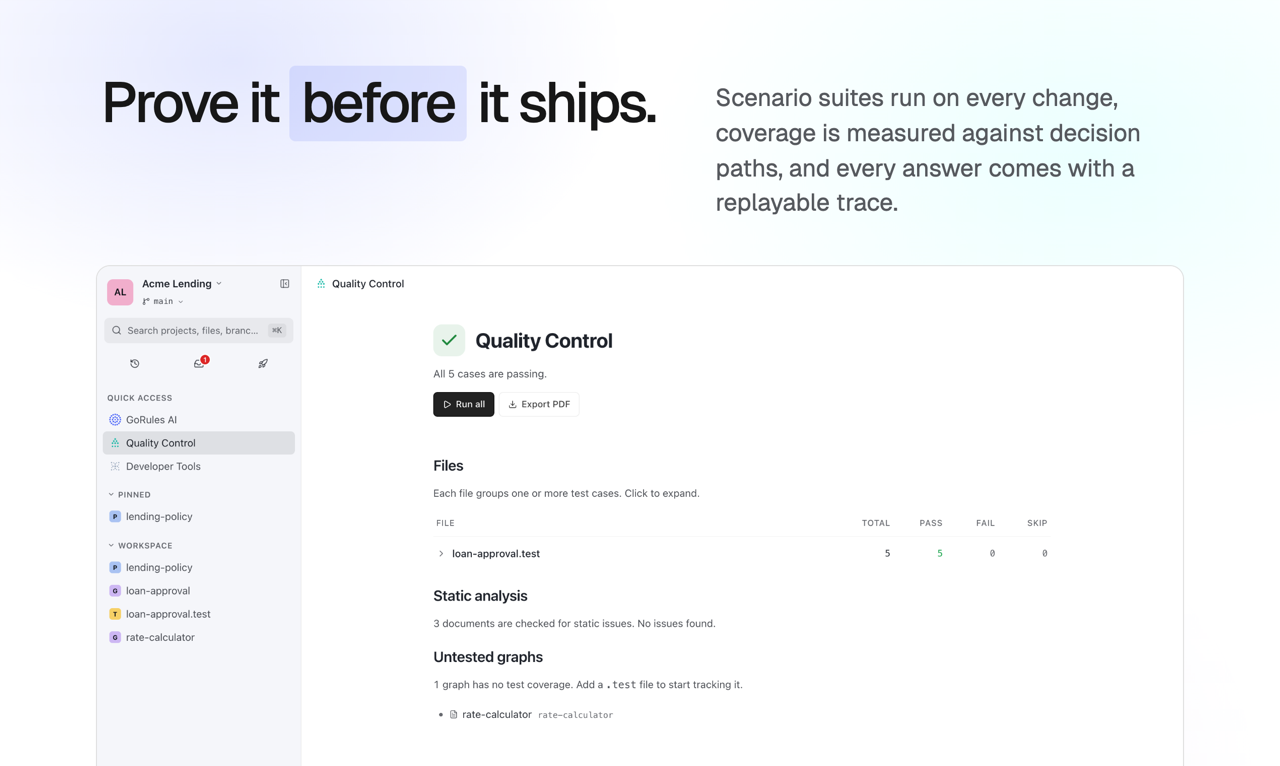
Prove it before it ships
Scenario suites run on every change, coverage is measured against decision paths, and every answer comes with a replayable trace.
Support matrix
| Arch | Python |
|---|---|
| linux-x64-gnu | ✔️ |
| linux-arm64-gnu | ✔️ |
| darwin-x64 | ✔️ |
| darwin-arm64 | ✔️ |
| win32-x64-msvc | ✔️ |
We do not support linux-musl currently.
Contribution
The JDM standard is growing and we need to keep tight control over its development and roadmap, as a number of companies use GoRules ZEN Engine and GoRules BRMS. For this reason we can't accept code contributions at this moment, apart from help with documentation and additional tests.