 stefan-gorules
e3d32a210d
* feat(trace): trace format v1 with TraceCollector on the compiled engine

Adds trace format v1 to the compiled engine, recorded by explicit trace
recorders and written natively. The interpreted engine keeps the legacy
trace.

- EvaluationOptions.trace is a TraceFormat (off, v1, legacy). Legacy
  traces are produced directly from the same recording.
- zen_engine::trace exposes convert, restore and inspect for
  stored documents, with redaction and truncation markers.
- The trace header takes evaluatedAt, timezone and seed from the
  evaluation context, so an evaluation replays from its own trace.
- Batch and columnar evaluations record events as columns and write one
  document per row.
- Bindings accept the trace format (true, 'v1', 'legacy'); the Node
  binding ships TypeScript types for the v1 document.
- Golden, fixture and damaged-document tests cover byte identity with the
  legacy trace, restore, interop with the reference fixtures and
  malformed input.

* perf(trace): build columnar request rows once with precomputed paths

* perf(trace): write a node's edits from its written columns

* perf(trace): capture node columns instead of row values in the columnar plan

* perf(trace): reuse a node's rendered body for rows with the same rule and cell values

* perf(trace): size the batch trace buffer up front, key node bodies on typed column words, share request rows as the input

* perf(trace): read the request from input columns and build request rows only on demand

* perf(trace): key node bodies on per-column codes and precompute node heads and result labels

* perf(trace): keep first-hit table facts and their referenced fields as columns

* perf(trace): write per-row expression results in the batch writer

* perf(columnar): write result rows as JSON straight from output columns

* perf(trace): keep collect-policy rule hits as columns and reuse hit text

* perf(trace): pack loop results from columns and resolve result column accessors once per batch

* perf(trace): share row-wise node outputs with the trace when nothing can alias them

* perf(trace): pack lists without a string per distinct item

* perf(trace): write new lists from columns and decide references by where a list came from

* perf(trace): write wide list items from columns while the list has never been built

* perf(trace): read list cells once while rendering

* feat(trace): list table inputs once per node and key rule cells by column id

* feat(trace): name matched policy table rows by rule id

* feat(trace): store loop results as one column per key

* build: optimise test builds
Python Rules Engine
Business logic humans can read and machines can run. One copy of your rules: the owner reads it, every system runs it.


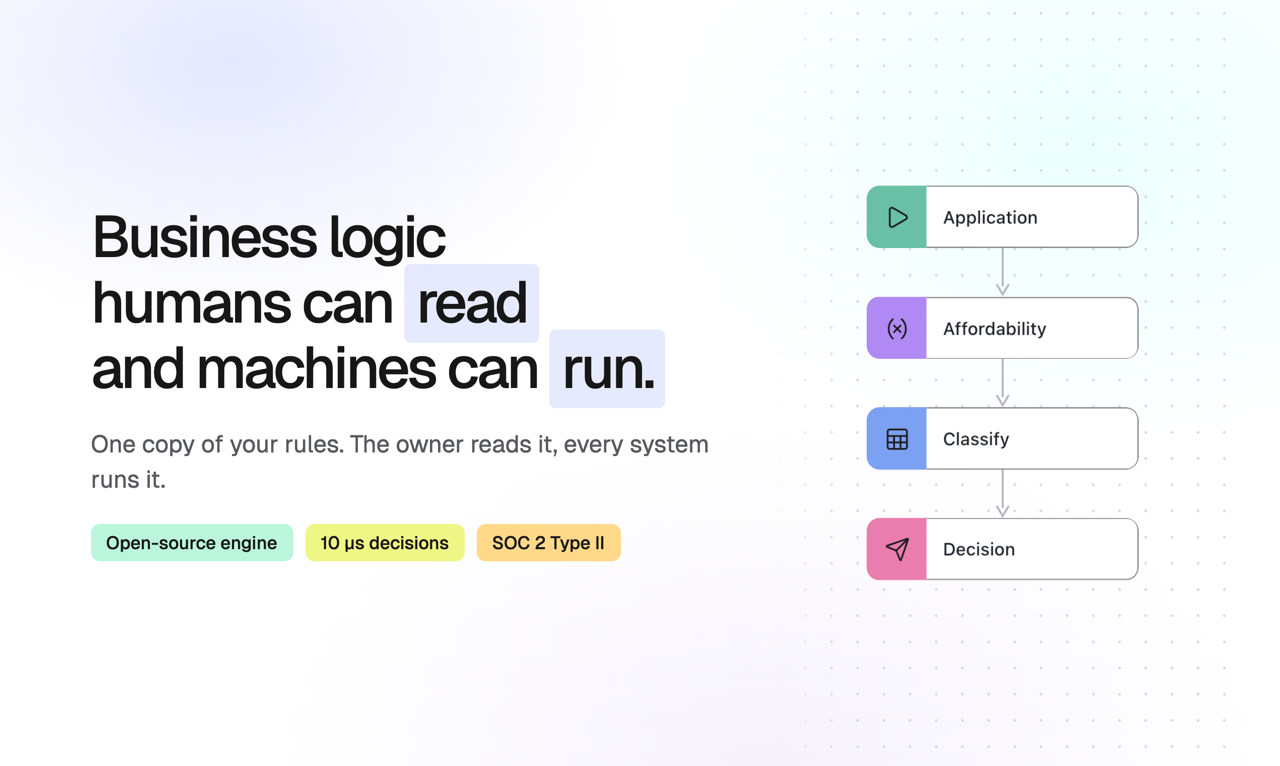
ZEN Engine is a cross-platform, open-source Business Rules Engine (BRE) written in Rust with native Python bindings, alongside Node.js, Go, Java, Kotlin and .NET. Decisions evaluate in microseconds, run identically on every platform, and are stored as portable JSON. Loading the JSON is up to you: file system, database or service call.
Try it in the free Online Editor with a built-in simulator, or embed the open-source React JDM Editor in your own product. Learn more about the Python rules engine on the GoRules website.
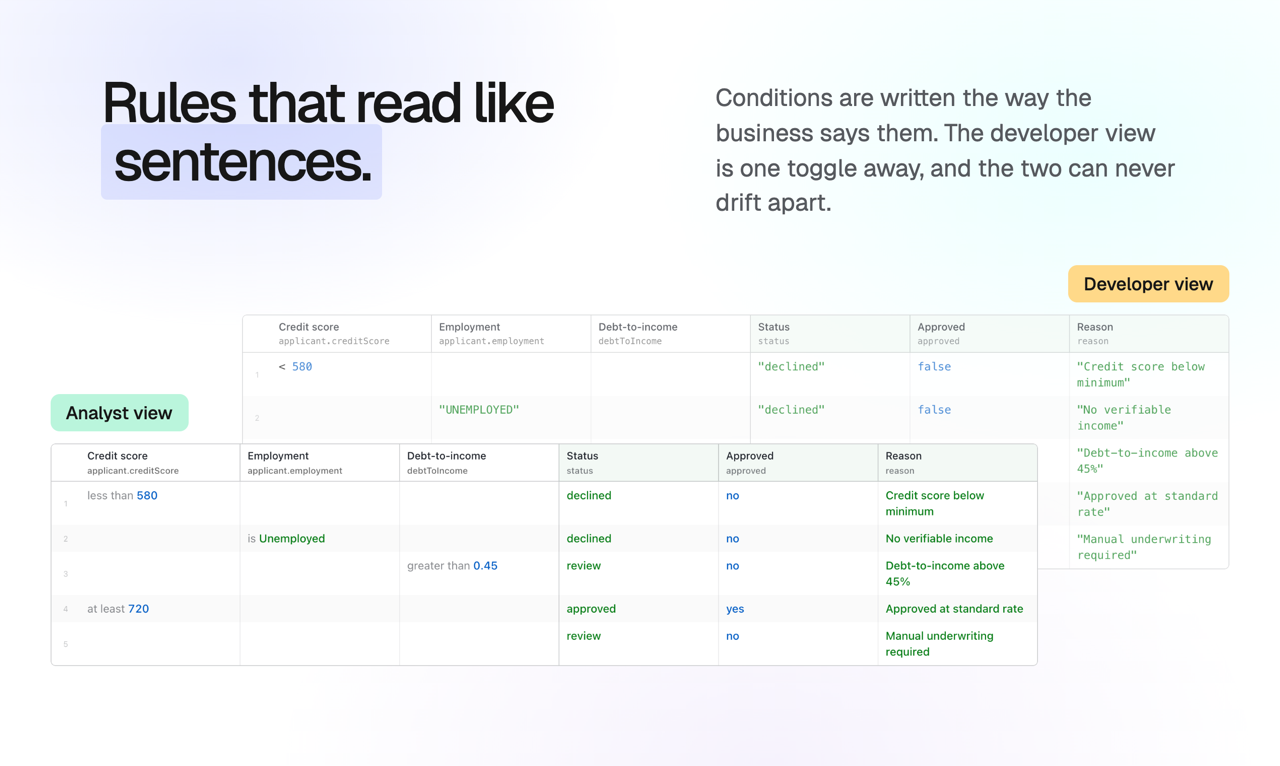
Rules that read like sentences
Conditions are written the way the business says them, in the ZEN Expression Language. The developer view is one toggle away, and the two can never drift apart: there is only one source of truth, and this engine runs it.
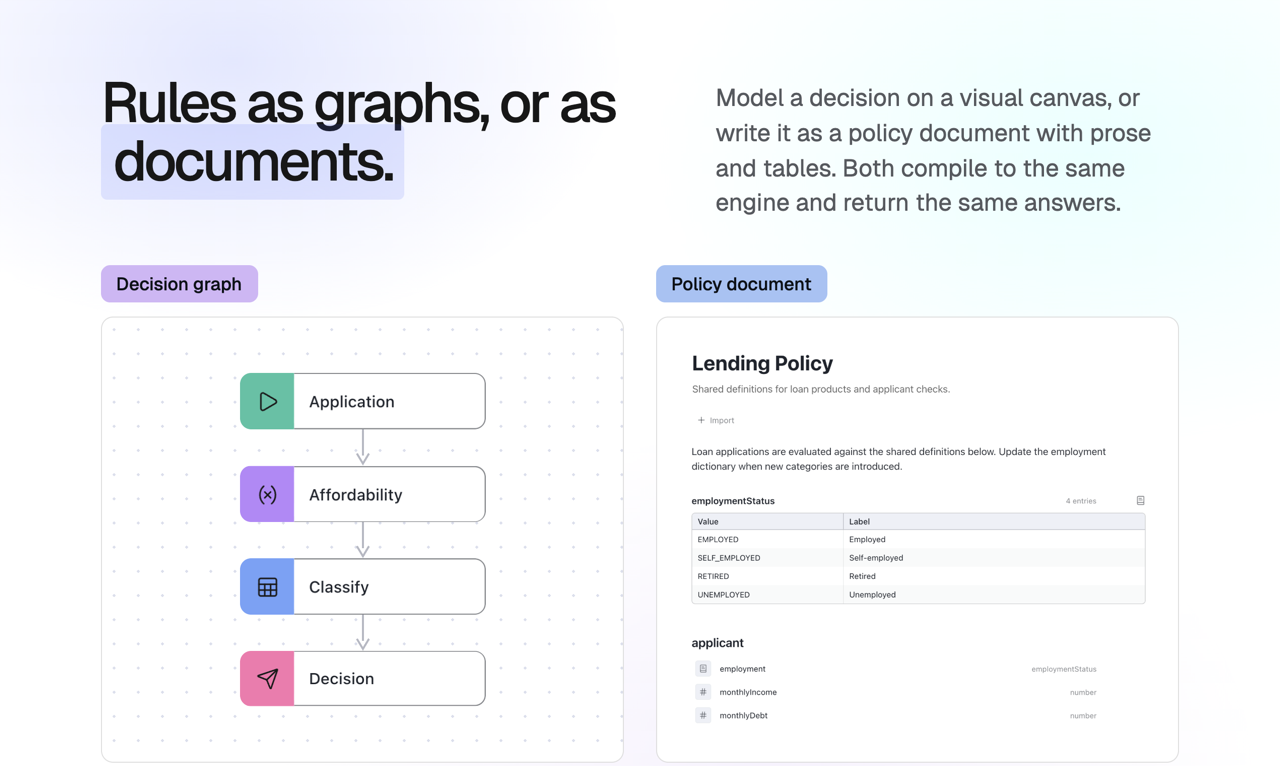
Rules as graphs, or as documents
Model a decision on a visual canvas of decision tables, switches, expressions, functions and reusable sub-decisions. Or write it as a policy document with prose, typed data models and tables. Both compile to the same engine and return the same answers.
To go deeper, see the Python SDK documentation, the decision graph guide and the ZEN Expression Language reference.
What's new in 2.0
Version 2.0 is the first stable release of the new engine line:
- Policy documents: model decisions as readable documents with typed data models, expressions, decision tables, match blocks and assertions. Policies compile to the same engine as graphs and return the same answers.
- Workspace analysis: static type checking across policies and graphs. Type flow, exhaustiveness checking, write-conflict detection and precise diagnostics, all available before anything runs.
- Per-column collect: decision table output columns can collect across all matching rows (
tags[]) while the rest of the table stays first-match. - Pre-compiled engine: decisions are parsed and compiled once at load; evaluation is allocation-light and repeat-safe.
- Hardened runtime: out-of-range numbers, arithmetic overflow and malformed inputs return errors or nulls instead of crashing the process.
- Unified bindings: configurable loaders, batch evaluation and consistent error envelopes across Node.js, Python, Go and FFI consumers.
Installation
pip install zen-engine
Prebuilt wheels ship for Linux, macOS and Windows; no Rust toolchain required.
Quickstart
import zen

with open("./jdm_graph.json", "r") as f:
    content = f.read()

engine = zen.ZenEngine()

decision = engine.create_decision(content)
result = decision.evaluate({"input": 15})
print(result)
Loaders
For more advanced use cases where you want to load multiple decisions and reuse them across evaluations you can build loaders. When engine.evaluate is invoked it calls the loader with a key, expecting the content of the JDM decision graph in return.
import zen

def loader(key):
    with open("./jdm_directory/" + key, "r") as f:
        return f.read()

engine = zen.ZenEngine({"loader": loader})
result = engine.evaluate("jdm_graph1.json", {"input": 5})
print(result)
The same pattern works for loading from a REST API, S3, a database, or anywhere else. Full guides, including multi-decision graphs and batch evaluation, are in the Python SDK documentation.
Other platforms
- Node.js - GitHub | Documentation | npm
- Python - GitHub | Documentation | PyPI
- Go - GitHub | Documentation
- Java / Kotlin - GitHub | Documentation | Maven Central
- .NET - GitHub | Documentation | NuGet
- Rust (Core) - GitHub | Documentation | crates.io
The GoRules platform
The engine is open at the core; GoRules is the platform around it. Managed cloud, self-hosted, or embedded with no network hop. SOC 2 Type II.
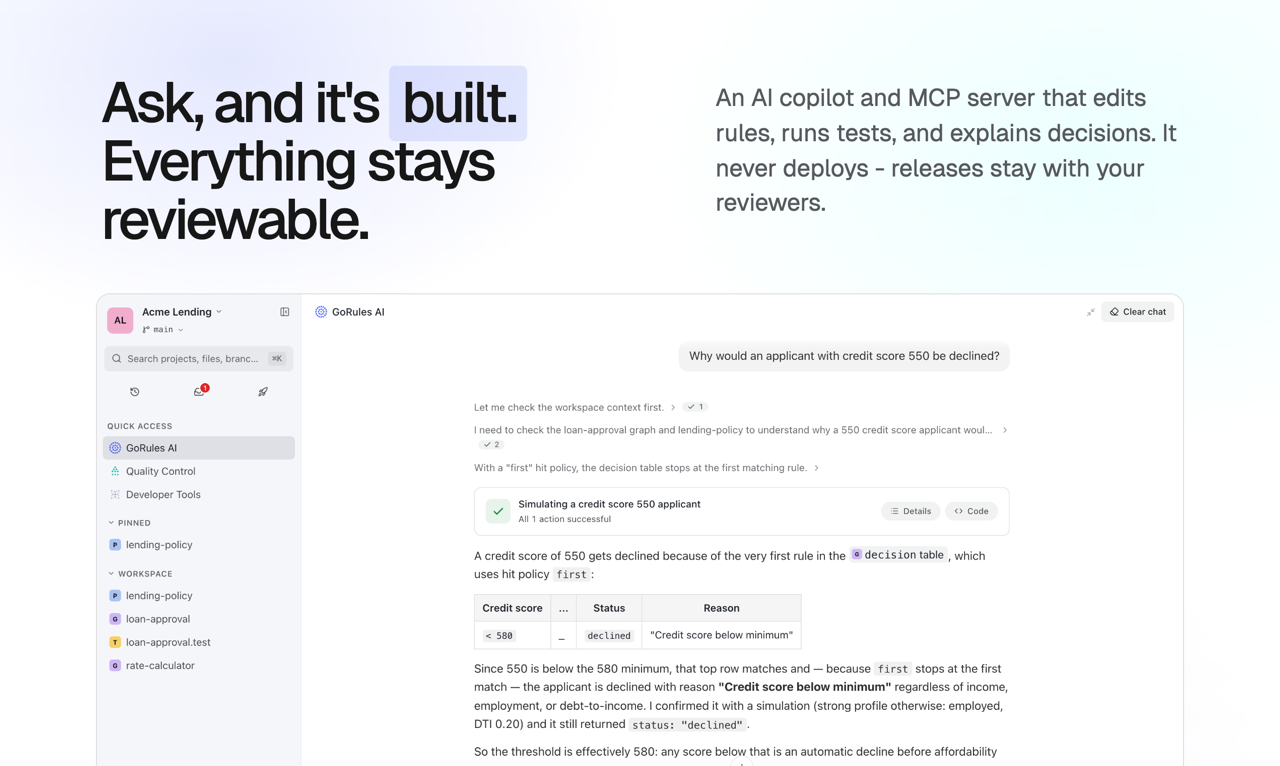
AI that builds rules, and stays reviewable
An AI copilot and MCP server that edits rules, runs tests and explains decisions. It never deploys. Releases stay with your reviewers.
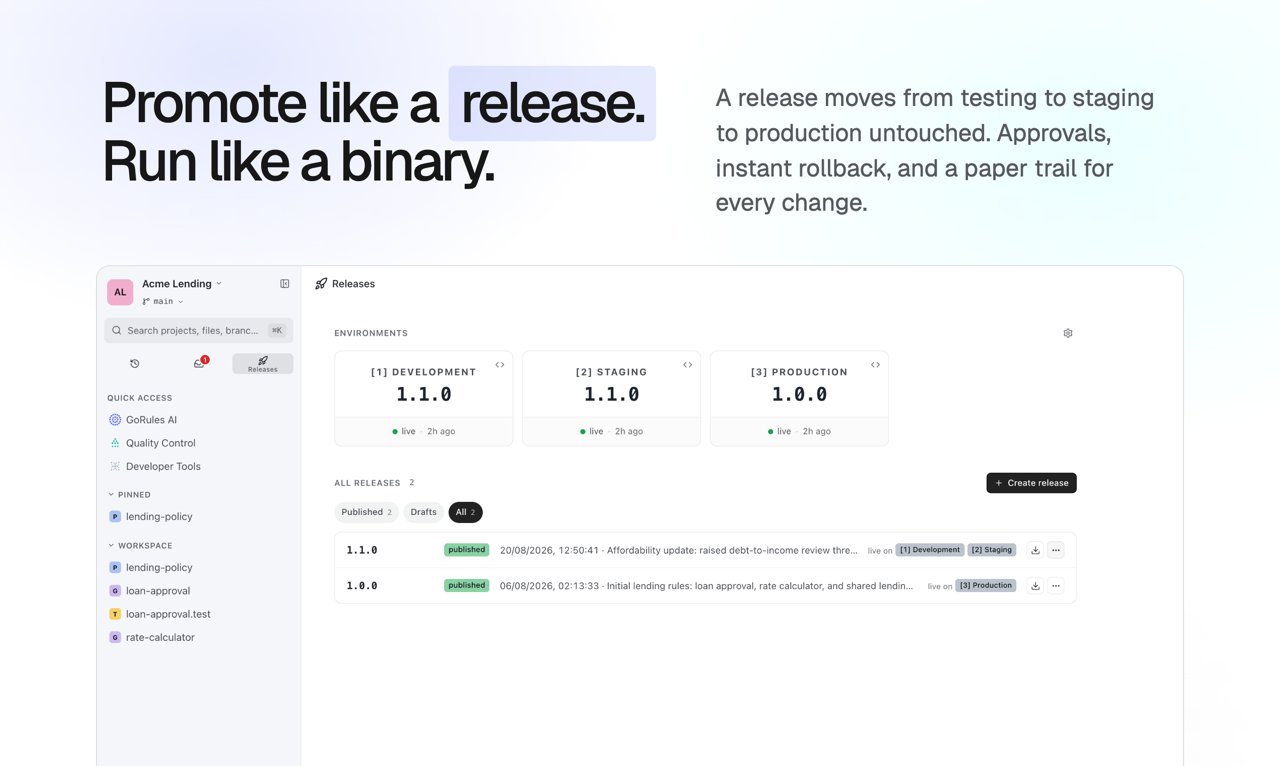
Promote like a release, run like a binary
A release moves from testing to staging to production untouched. Approvals, instant rollback, and a paper trail for every change.
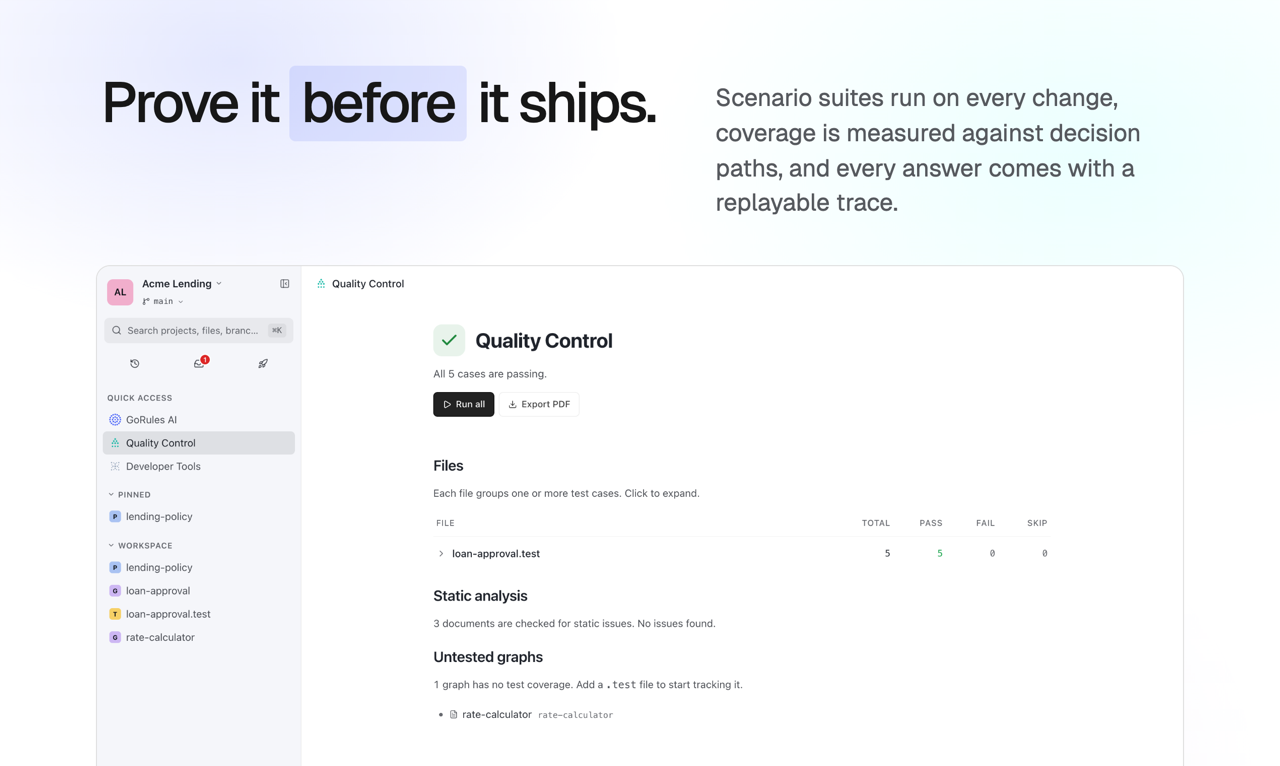
Prove it before it ships
Scenario suites run on every change, coverage is measured against decision paths, and every answer comes with a replayable trace.
Support matrix
| Arch | Python |
|---|---|
| linux-x64-gnu | ✔️ |
| linux-arm64-gnu | ✔️ |
| darwin-x64 | ✔️ |
| darwin-arm64 | ✔️ |
| win32-x64-msvc | ✔️ |
We do not support linux-musl currently.
Contribution
The JDM standard is growing and we need to keep tight control over its development and roadmap, as a number of companies use GoRules ZEN Engine and GoRules BRMS. For this reason we can't accept code contributions at this moment, apart from help with documentation and additional tests.