Closes#5106.
Python 3.10 reached end of life on 2026-10-01. This raises the minimum
to 3.11, following #2955 for 3.9. It's marked `chore!:` because it's a
breaking change for 3.10 users.
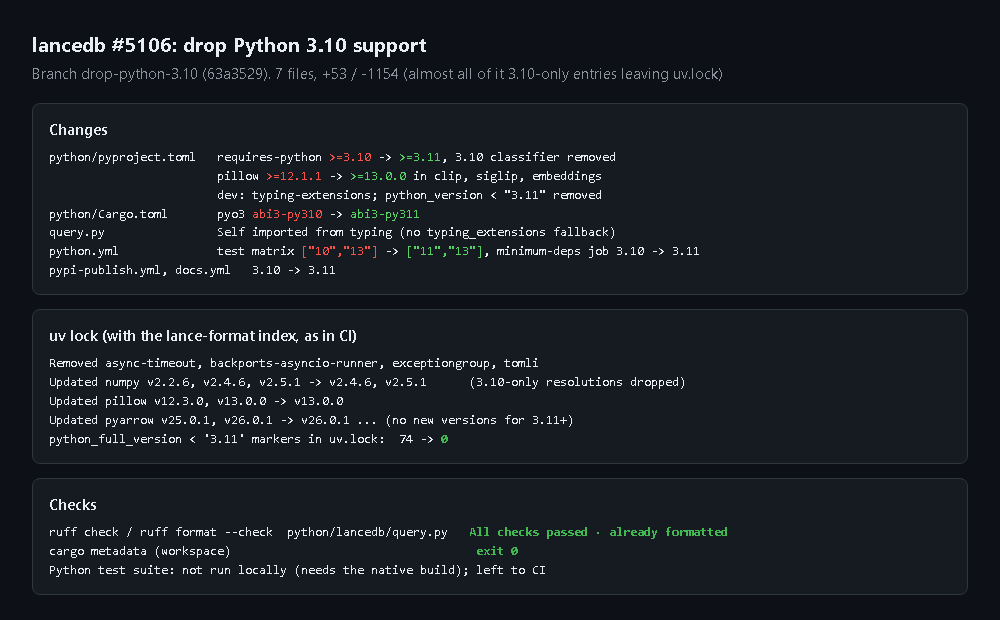
- `python/pyproject.toml`: `requires-python = ">=3.11"`, and the 3.10
classifier is removed. The `pillow` lower bound in the `clip`, `siglip`
and `embeddings` extras goes up to `>=13.0.0`, the release with the CVE
fixes, which needs 3.11+. The `typing-extensions; python_version <
"3.11"` dev dependency is removed, since it no longer applies.
- `python/Cargo.toml`: pyo3 `abi3-py310` becomes `abi3-py311`, so wheels
are built as `cp311-abi3`.
- `python/lancedb/query.py`: `Self` comes from `typing`, without the
`typing_extensions` fallback.
- CI: the Linux test matrix goes from `["10", "13"]` to `["11", "13"]`,
and the minimum-dependencies job, the release build (`pypi-publish.yml`)
and the docs build move from 3.10 to 3.11.
- `python/uv.lock`: regenerated with `uv lock --extra-index-url
https://pypi.fury.io/lance-format/`. The only changes are the 3.10-only
resolutions going away: all 74 `python_full_version < '3.11'` markers,
`async-timeout`, `backports-asyncio-runner`, `exceptiongroup`, `tomli`,
and the older numpy, scipy, pandas, pyarrow and pillow pins. No package
version changes for 3.11+.
Checks run locally: `ruff check` and `ruff format --check` pass, and
`cargo metadata` succeeds for the workspace. I haven't run the Python
test suite, which needs the native build, so I'm relying on CI for that.
pylance still declares `>=3.10`. As the issue says, lancedb can move
first because pylance is optional.
---------
Co-authored-by: Will Jones <willjones127@gmail.com>
Co-authored-by: Claude Opus 5.5 <noreply@anthropic.com>
Pin every remaining third-party action reference in `.github/` to a full
40-character commit SHA, with the intended version in a trailing comment
(`uses: owner/action@<sha> # vX.Y.Z`), following the pins already in
`cli.yml`, `typos.yml` and `make-release-commit.yml`. Fixes#3293.
53 references across 13 files change, covering 16 actions, including the
branch refs called out in the issue (`dtolnay/rust-toolchain@master`,
`@stable`) and `pypa/gh-action-pypi-publish@release/v1`. Each SHA is the
commit its current tag or branch resolves to today, so the code that
runs is unchanged. Comments name the most specific tag on that commit
(for example `v2.9.3` for `Swatinem/rust-cache@v2`); where no such tag
exists, they keep the original ref (`v1` for `srvaroa/labeler` and
`rui314/setup-mold`, `v3` for `addnab/docker-run-action`,
`stable`/`master` for `dtolnay/rust-toolchain`). The `stable` branch of
`dtolnay/rust-toolchain` defaults its `toolchain` input to `stable`, so
pinning its SHA keeps the `nodejs.yml` step that passes no toolchain on
stable.
GitHub-maintained `actions/*` references are left on their tags, as in
the existing pins. Keeping SHAs current through Dependabot is the
sibling issue and is not part of this change.
Validation:
- No third-party `uses:` reference in `.github/` is left without a
40-character SHA (53 before, 0 after).
- For all 23 distinct third-party pins in `.github/`, `git ls-remote`
against the upstream repository confirms the SHA is the commit that the
commented tag or branch points to. A deliberately altered SHA and a
reverted tag ref were both caught.
- `pre-commit run` on the changed files passes (check-yaml, end-of-file,
trailing whitespace, typos).
- actionlint 1.7.12 reports the same 35 findings on `main` and on this
branch, all of them existing ones (custom runner labels and composite
actions under `workflows/`). It reports none for this change.
The docs deploy workflow installs protobuf-compiler without refreshing
apt
lists first. Ubuntu noble-updates replaced `protobuf
3.21.12-8.2ubuntu0.3`
with `.0.4`, so stale package lists in older runner images make `apt
install`
fail with 404 and exit code 100. Run `apt update` before installing,
matching
the other workflows.
The bindings are built, installed and published with pnpm everywhere,
but a parallel npm dependency graph was still being maintained beside
it. This removes it, raises the supported Node floor to the versions we
actually test, and gives Dependabot the npm coverage it was missing.

## Dropping npm

`nodejs/package-lock.json` was regenerated by `ci/update_lockfiles.sh`
on every release commit and read by nothing — no workflow runs `npm ci`
or `npm install` in `nodejs/`, and npm never publishes a lockfile in a
package tarball. It could not even agree with the real install, since
npm does not see pnpm's `overrides`. Because GitHub's dependency graph
parses `package-lock.json`, it was also reporting vulnerabilities for a
tree we neither install nor ship.

`docs/package.json`, `docs/package-lock.json` and `docs/tsconfig.json`
go too. They depend on `file:../node` and
`file:../node/node_modules/apache-arrow` — the `node/` directory was
removed long ago — the tsconfig compiles `src/*.ts` where no TypeScript
files exist, and nothing installs any of it. `docs.yml` only referenced
the lockfile to configure an npm cache for an install it never ran.

Two `workflow_dispatch` workflows for regenerating those lockfiles are
removed as well. Both were already broken: they `uses:` composite
actions at `.github/workflows/update_package_lock{,_nodejs}` that do not
exist, so dispatching either failed immediately.

The remaining `npx` calls become direct `node_modules/.bin/...`
invocations. These were already running locally installed binaries
rather than resolving anything, but naming the binary removes the npm
CLI from the loop and does not depend on which Node version is active.
`dev.yml`'s commitlint check was the last place doing real npm
dependency resolution — an unpinned `npm install
@commitlint/config-conventional` that also bypassed the
`minimumReleaseAge` hold configured for `nodejs/` — and is now a pinned
`pnpm dlx`.

## Node support

Node 18 and 20 both reached end-of-life, in April 2025 and April 2026.
The matrix moves to 22, 24 and 26, and `engines` rises from `>= 18` to
`>= 22` so the declared floor is one the matrix actually covers. Node 22
is LTS until April 2027; 24 is LTS; 26 is Current and becomes LTS in
October 2026.

This also removes the reason the workflows reached for `npx` in the
first place: pnpm 11 requires Node >= 22.13, which every matrix version
now satisfies.

The prebuilt-binary smoke test in `npm-publish.yml` moves from Node 20
to Node 22 — the floor, where a napi ABI problem would surface first —
rather than fanning out across all three, to keep the publish matrix
from tripling.

## Dependabot

There were no npm-ecosystem entries at all, which is why the advisories
behind #4073 went unnoticed. Both pnpm lockfiles are now watched —
`nodejs/` and `nodejs/examples/`, which is a separate install — using
the same `lockfile-only` strategy as the existing cargo and pip entries,
so version ranges in `package.json` are left alone.

## Pre-commit biome

The hook ran `npx @biomejs/biome@1.8.3` while `nodejs/package.json`
resolved 1.9.4. The two disagree about formatting, so the hook rejected
code that `pnpm lint` accepts, and failed on unmodified `main` for
anyone touching `nodejs/`. It now uses the pnpm-managed biome, which
fixes the drift with no source changes.

## Testing

`dev.yml`'s commitlint job does not check out the repo, so it runs in an
empty workspace, and I could not verify `pnpm/action-setup` there
locally. It triggers on `pull_request_target`, so this PR exercises it
directly — worth confirming green before merge. I did verify the `pnpm
dlx` invocation itself locally: it accepts a conventional title and
rejects a non-conventional one with exit 1.

Node 26 is new enough that the examples job may surface gaps in prebuilt
native binaries (`onnxruntime-node`, `sharp`) before their maintainers
publish for it.

## Not included

`nodejs/examples/` still pins `sharp: "0.33.5"` and has its own audit
findings. Raising the Node floor unblocks that work — sharp 0.35
requires Node >= 20.9, which the matrix now satisfies — but it is a
dependency bump rather than tooling cleanup, so it is left separate.

## Breaking changes

`@lancedb/lancedb` now requires Node >= 22; previously >= 18. The
`@types/node` peer range moves from `>=18` to `>=22` to match. Users on
Node 18 or 20 must upgrade their runtime; both have been end-of-life for
some time. Existing installs are unaffected, since `engines` is only
checked on install.

---------

Co-authored-by: Claude Opus 5 (1M context) <noreply@anthropic.com>
## Summary

- Update dependencies across Rust, Python, Node.js, Java, Docker, and
docs
- Pin unpinned dependency lower bounds to prevent silent downgrades
- Bump CI actions to current major versions

🤖 Generated with [Claude Code](https://claude.com/claude-code)

---------

Co-authored-by: Claude Opus 4.6 <noreply@anthropic.com>
Based on https://github.com/lancedb/lance/pull/4984

1. Bump to 1.0.0-beta.2
2. Use DirectoryNamespace in lance to perform all testing in python and
rust for much better coverage
3. Refactor `ListingDatabase` to be able to accept location and
namespace. This is because we have to leverage listing database (local
lancedb connection) for using namespace, namespace only resolves the
location and storage options but we don't want to bind all the way to
rust since user will plug-in namespace from python side. And thus
`ListingDatabase` needs to be able to accept location and namespace that
are created from namespace connection.
4. For credentials vending, we also pass storage options provider all
the way to rust layer, and the rust layer calls back to the python
function to fetch next storage option. This is exactly the same thing we
did in pylance.
<!-- This is an auto-generated comment: release notes by coderabbit.ai
-->

## Summary by CodeRabbit

- **Chores**
- Improved CI workflow for documentation builds by optimizing Rust build
settings and updating the runner environment.
  - Fixed a typo in a workflow step name.
- Streamlined caching steps to reduce redundancy and improve efficiency.

<!-- end of auto-generated comment: release notes by coderabbit.ai -->


 Shu Chen
 Xuanwo
 Raphael Malikian
 Esteban GutierrezandClaude Opus 4.6
 Lei Xu
 Jack Ye
 Ayush Chaurasia
 Chang She
 Leon Yee
 Jai
