mirror of
https://github.com/lancedb/lancedb.git
synced 2026-11-26 20:44:00 +00:00
v0.42.0-beta.35
3740
Commits
| Author | SHA1 | Message | Date | |
|---|---|---|---|---|
 Lance Release |
0adfd22db1 | Bump version: 0.42.0-beta.34 → 0.42.0-beta.35 v0.42.0-beta.35 | ||
 LanceDB Robot |
c54d15ada1 |
chore: update lance dependency to v16.0.0-beta.2 (#5234)
Bump the Rust and Java Lance dependencies to v16.0.0-beta.2 and synchronize the Python pylance requirements and lockfile with 16.0.0b2. [Lance v16.0.0-beta.2 release](https://github.com/lance-format/lance/releases/tag/v16.0.0-beta.2) |
||
|
Lance Release
|
9adb403656 | Bump version: 0.42.0-beta.33 → 0.42.0-beta.34 v0.42.0-beta.34 | ||
 Xuanwo |
4a5c4a84a9 |
fix(python): preserve the requested package index on Function inspection (#5220)
Python callers inspecting a pinned Function version lose the explicit primary package index URL even when the server includes it. Preserve `runtime.environment.build.index_url` through `get_function` and canonical JSON. The requested build view contains only the explicit primary URL. Extra indexes, other sources, and service defaults can still apply when that view is absent. Compare the server's `runtime_digest` with the authored runtime's digest for identity. The inspection view can omit inputs to that digest. Typed registration rejects nonempty build settings before issuing a request. The existing decorator options and `refresh_lock` use the same registration path. Loopback Flight tests exercised sync and async pinned reads with a primary index plus an extra index, and with only an extra index. They also verified that typed submission rejects unsupported settings before sending a request and still submits ordinary decorator definitions with `refresh_lock`. A separate local replay verified pinned readback against a published version with a credential-free primary index. The focused suites passed 547 Python and 129 Rust tests, with three Rust tests marked ignored. |
||
|
Lance Release
|
7c3d68e951 | Bump version: 0.42.0-beta.32 → 0.42.0-beta.33 v0.42.0-beta.33 | ||
|
Xuanwo
|
cb7f1bad67 |
feat(rust): open a native table at a retained version (#5218)
Opening a table by URI and then checking out a retained version requires the latest manifest to be readable. A caller that persisted a version can now open that snapshot directly with `NativeTable::open_at_version(uri, name, version, params)`. The caller’s `ReadParams` apply during the open, and the returned table is pinned with the usual read-only checkout semantics. The regression covers reopening a retained version after a later manifest becomes unreadable. |
||
|
Lance Release
|
7e1478b547 | Bump version: 0.42.0-beta.31 → 0.42.0-beta.32 v0.42.0-beta.32 | ||
|
LanceDB RobotandXuanwo
|
17532bb8c3 |
chore: update lance dependency to v15.1.0-beta.2 (#5217)
Bump the Rust workspace and Java Lance dependencies to [Lance v15.1.0-beta.2](https://github.com/lance-format/lance/releases/tag/v15.1.0-beta.2) and pin the matching `pylance` beta in the Python test extra. Raise the Rust toolchain and minimum supported version to 1.98.0 as required by Lance, and address the new Clippy diagnostics. Co-authored-by: Xuanwo <github@xuanwo.io> |
||
|
Lance Release
|
8441dab874 | Bump version: 0.42.0-beta.30 → 0.42.0-beta.31 v0.42.0-beta.31 | ||
|
LanceDB RobotandXuanwo
|
da6aa8c779 |
chore: update lance dependency to v15.1.0-beta.1 (#5213)
Update the Rust workspace and Java dependencies to [Lance v15.1.0-beta.1](https://github.com/lance-format/lance/releases/tag/v15.1.0-beta.1). Pin the Python test extra to the matching pylance 15.1.0b1 release and refresh the lockfile. --------- Co-authored-by: Xuanwo <github@xuanwo.io> |
||
|
Xuanwo
|
3d558adc68 |
fix(remote): preserve blob snapshot identity across credential refresh (#5216)
## What Fix the refresh path for direct Blob handles opened from a SQL `blob_descriptor`. `open_blob_file` acquired the resolver's immutable snapshot identity, but the `PresignedBlobRangeRequester` used `blob_locations_context_for_source`, which only copied the table handle's `expected_query_snapshot`. For an ordinary table handle that is `None`, so a provider credential expiry and refresh could establish a different identity at the same numeric version. The refreshed handle could then accept replacement-table bytes. The refresh context now carries the identity acquired by the first resolver response, matching the whole-read, range-read and `fetch_blob_files` paths. ## Coverage Adds five focused tests through the normal `open_blob_file` entrypoint: - proactive refresh inside the 30s expiry skew before any object GET; - provider credentials expiring earlier than the advertised URL TTL (far-future `expires_at`, object store returns 403); - single-shot re-resolution: a second 403 after refresh fails without a third resolver call; - renewal with a different snapshot identity is rejected before accepting bytes; - renewal resolver `403` propagates as an auth failure. Existing `direct_blob_file_refreshes_expired_url_once` covered only reactive refresh with no advertised expiry. ## Signer contract The SDK treats object-store `401`/`403` as expiry and refreshes once. If the resolver signs the refreshed URL with still-expired provider credentials, the second object GET fails and the SDK fails closed. Signers should return an `expires_at` no later than the underlying credential expiry and use renewed credentials on re-resolution. ## Validation - `cargo test -p lancedb --quiet --features remote --lib remote::table::blobs::tests`: 70 passed. - `cargo check -p lancedb --quiet --features remote --tests`: run before the final test pass. - No Sophon signer or cloud resource changes. |
||
 Bruno Ramirez |
06e626238d |
feat(cli): package release binaries as lancedb-tools wheels (#5214)
Python users can install the LanceDB SDK today. This adds a separate `lancedb-tools` distribution so they can also run the standalone `lancedb` CLI with `uvx` or install it with `pipx`. The wheels bundle the same binaries shipped through GitHub Releases for Apple Silicon macOS, Linux ARM64, and Linux x86-64. The workflow uploads the wheels to GitHub Actions for testing. PyPI publication will wait for a stable release. This was accomplished with the following changes: - Verify the release archives against `SHA256SUMS` and bundle each binary with its license and third-party notices in a platform-specific wheel. - Add the `lancedb` entry point and document how to build and test wheels from a release tag. - Exercise each wheel with both `uvx` and `pipx` on a native runner. ### Testing All six installation checks passed against `v0.42.0-beta.30` (Python version `0.42.0b30`). On Apple Silicon macOS, Linux ARM64, and Linux x86-64, both `uvx` and `pipx` reported `lancedb 0.42.0-beta.30` and listed the built-in local profile. [Native test results and wheel artifacts](https://github.com/lancedb/lancedb/actions/runs/45680764524) Locally verified that all three wheels contain byte-for-byte copies of the released binary and license notices. All 38 tests in `ci/tests` discovered by Python unittest passed. |
||
|
Xuanwo
|
60519d42ce |
feat(remote): add presigned direct Blob V2 reads (#5210)
## What

Add a capability-gated client path for large Blob V2 reads over LanceDB
Enterprise:

- A successful `describe` advertises `x-lancedb-blob-locations: 1`; the
SDK then resolves pinned row locations through `POST
/v1/table/{id}/blob_locations/`.
- Whole reads (`fetch_blobs`) and seekable handles (`fetch_blob_files` /
`open_blob_file`) read presigned object-store URLs directly for eligible
values and ranges at or above a provisional internal 10 MiB threshold.
- Small ranges and `fetch_blob_ranges` stay on the existing proxy path,
including aggregate batches whose total exceeds the proxy byte limit.
- Shared `Packed` / `Managed` sidecars translate logical ranges to
physical offsets and validate the full numeric `Content-Range` tuple,
not just its start or total.
- Presigned traffic uses a separate HTTP client with no Enterprise
default headers, so service credentials never reach object storage.
- The first resolver response must carry a valid query-snapshot
identity. That identity is then required on every later partition and
preserved through object-URL refresh, proxy fallback and oversized
whole-value recovery. A resolver `503` falls back once to the proxy path
using any version and identity already pinned; other resolver errors
propagate. Object-store `503`s do not masquerade as resolver
unavailability.
- A read that starts without the capability reuses its supplied
`ReadSnapshot` if a later describe enables direct opening mid-operation.
- Version and query-snapshot pinning, NULL/order alignment and empty
values are preserved.

## Client network requirement

On Enterprise clusters that enable direct Blob reads, large values and
individual ranges may be fetched from short-lived object-store URLs
instead of the LanceDB proxy. Clients then need network access to the
object-store endpoint, including private endpoint routing, DNS, TLS
trust and egress rules, in addition to the LanceDB endpoint. Small reads
stay on the LanceDB proxy.

## Why

Large Blob V2 reads currently stream every payload byte through `Object
Store -> Plan Executor -> Query Node -> client`. That consumes internal
bandwidth, inflates PE/QN memory use and pollutes executor caches with
low-locality `.blob` data. This is the SDK half of ENT-4358; the server
implementation is in Sophon.

## Compatibility

No public SDK signatures change. Old clusters omit the capability header
and keep the existing proxy behaviour with zero extra round trips. The
10 MiB threshold is an internal prototype choice pending the paired
acceptance measurement; it is not a public knob.

## Validation

- `cargo check -p lancedb --quiet --features remote --tests` passes.
- `cargo test -p lancedb --quiet --features remote --lib
remote::table::blobs::tests` passes: 65 tests.
- New coverage includes direct whole reads, shared-sidecar physical
offsets and Content-Range rejection, small-range proxy routing, mixed
large/small range batches, resolver `503` fallback with pinned state, no
second resolver after fallback, object-store `503` not triggering proxy
fallback, missing/mismatched resolver identity rejection, resolver
identity preservation through refresh/proxy/oversized recovery,
supplied-snapshot reuse on mid-operation capability refresh, and
NULL/order/null-preserving paths.

A real-QN acceptance run with the candidate SDK binary is separate and
still pending deployment of the candidate server image.
|
||
 
|
147fdb25a0 |
feat(python): add two-phase shuffled reads (2PSR) to elastic dataloader (#5066)
Supersedes #4263, which I can no longer push to. This PR continues the same branch, so the review history is there. ## Summary Adds two-phase shuffled reads (2PSR) to `StreamingDataset`, enabled with `block_size`: 1. **Block shuffle:** contiguous blocks of `block_size` live rows are shuffled and assigned to splits. This replaces 1-phase's per-row take with mostly contiguous range scans, which are much cheaper on object storage. 2. **Bounded row shuffle:** each split shuffles rows over a rolling window of `window_blocks` blocks. `max_shuffle_distance` bounds how far a row can move. The feature also supports `filter` (sparse takes of live rows), `reshuffle_blocks_per_epoch`, resume and checkpointing, background block prefetch, and multi-worker DataLoaders. 2PSR stays opt-in: `block_size=None` keeps today's 1-phase behavior. Since the last review round: - **Fixed worker startup with small blocks.** The pickled dataset no longer grows with the number of blocks; the block order is rebuilt in `__setstate__`. Once that pickle passed the 64 KiB pipe buffer, spawned DataLoader workers started one at a time (~280 s with 128 workers at ≤2,048-row blocks). - **Fixed per-call block copies.** Each loaded block is combined into a single chunk. Before, `take` on a multi-chunk block concatenated the whole block on every call. - **Fixed early eviction.** Blocks are evicted only behind the contiguous prefix of rows already served. With `io_queue_depth > 1`, calls can arrive out of order and previously evicted blocks that were still needed, causing 5–40% extra reads. - **New default:** `window_blocks` now defaults to 8, and the docstring recommends `block_size=512` with DataLoader workers. None of these fixes changes which rows are read or their order. A check across 12 config, epoch and seed combinations on 8 ranks gave identical per-rank order before and after. ## Benchmarks Throughput was measured on EC2 i4i.32xlarge in us-west-2, reading a FineWeb-Edu table of 4,096 B rows. Each number is the median of 3 trials, and each trial is a full pass. 2PSR used 512-row blocks, 256 splits, 128 workers and `io_queue_depth=4`. 1-phase used 32 splits, 8 workers and `io_queue_depth=32`. | Storage | Rows | 2PSR | 1-phase | Speedup | |---|---|---|---|---| | S3 | 8.4M (34 GB) | 16.9 s | 230 s | 13.6× | | S3 | 33.6M (137 GB) | 45.6 s | 781 s | 17.1× | | S3 | 134M (550 GB) | 168 s | 3,098 s | 18.4× | | Local NVMe | 8.4M | 16.4 s | 116 s | 7.1× | On the 8.4M-row S3 table, 2PSR reads 1.5–2.0 GB/s at every block size from 128 to 65,536 rows. A fit across the three S3 sizes gives 2PSR about 7 s fixed cost plus 3.4 GB/s, and 1-phase about 39 s plus 0.18 GB/s. That puts the large-table limit near 19×. Quality was measured by pretraining GPT-2 124M on 2^21 FineWeb-Edu docs for 16 epochs on 8×H100. The table shows final validation loss, mean ± SD over 3 seeds: | Reader | Final val loss | |---|---| | 1-phase | 2.8464 ± 0.0006 | | 2PSR, `block_size=128`, msd 4,096 | 2.8457 ± 0.0011 | | 2PSR, `block_size=512`, msd 4,096 | 2.8457 ± 0.0007 | | 2PSR, `block_size=2048`, msd 32,768 | 2.8466 ± 0.0009 | | No shuffle (1 seed) | 2.8606 | Every 2PSR config is within seed noise of 1-phase. The 95% confidence intervals of the difference all include zero and are at most 13% of the no-shuffle penalty. Training throughput was the same for every reader (3.15–3.18M tok/s, GPU-bound). ## Testing - `test_elastic_dataloader.py` and `test_permutation.py`: all 324 tests pass after merging `main`. The new tests cover: - pickle size independent of block count; - single-chunk blocks; - no re-reads under out-of-order calls; - window defaults; - resume, filter, worker and checkpoint behavior. - `ruff check` and `ruff format --check` are clean. 🤖 Generated with [Claude Code](https://claude.com/claude-code) --------- Co-authored-by: Claude Opus 5 <noreply@anthropic.com> Co-authored-by: Xuanwo <github@xuanwo.io> |
||
|
Xuanwo
|
4d9fd358f8 |
feat(nodejs): expose Function failure recovery APIs (#5209)
TypeScript callers can now inspect and recover Function row failures through the native workflow. `functionErrors()` groups returned failures and can show retained attempt history. `functionErrorRows()` looks up current failed inputs using row IDs and physical row addresses represented as `bigint`. Older deployments can continue to use the existing error listing. `retryFailed()` selects the exact failed rows on the server, with optional error type and job filters. `upgradeColumn()` binds an existing immutable Function version and can recompute failed rows, all eligible rows, or no rows. Callers can quarantine and release failures, explicitly include quarantined rows in a retry, and use `functionProvenance()` to see which Function version produced a recorded value. The native operations reuse the existing Rust workflow v1 capability checks. The Function failures guide includes TypeScript examples for inspecting, retrying, upgrading, and quarantining failures. |
||
 Yang Cen |
757dcc0a6b |
feat(functions): declare multiple bindings in one add_columns call (#5202)
Allow Python callers to pass several registered Function applications to `add_columns`. Rust callers can use `function_bindings` to submit the same atomic declaration. An application can consume another output in the mapping, including one declared later. The SDK checks the Enterprise server's batch-declaration capability before sending the mutation. Single-binding callers continue to use the existing request shape. This change covers declaration only. Coverage includes Python mapping validation, the Rust HTTP request with dependent bindings, and older servers with missing or unknown capability values. Correctness tests run in CI. |
||
|
Lance Release
|
a709c6db1e | Bump version: 0.42.0-beta.29 → 0.42.0-beta.30 v0.42.0-beta.30 | ||
|
LanceDB Robot
|
73d44232d4 |
chore: update lance dependency to v15.0.0-beta.35 (#5201)
Bump the Rust Lance crates and Java lance-core to v15.0.0-beta.35, and pin the Python tests to pylance 15.0.0b35. The Cargo and Python lockfiles are refreshed for the [Lance tag](https://github.com/lance-format/lance/tree/v15.0.0-beta.35). |
||
|
LanceDB Robot
|
85522224f2 |
chore: update lance dependency to v15.0.0-beta.34 (#5199)
Updates the Rust and Java Lance dependencies to v15.0.0-beta.34 and pins the Python test dependency to pylance 15.0.0b34. See the [Lance release](https://github.com/lance-format/lance/releases/tag/v15.0.0-beta.34). |
||
 Tanay |
fc6dfca11a |
feat(python): add map() method to Permutation for dict-based transforms (#3264)
### Summary Adds `Permutation.map(fn, *, batched=False)`, a dict-based alternative to `with_transform` so users can write `fn(dict) -> dict` without touching `pyarrow.RecordBatch`. - `batched=False` (default): `fn` receives one row as a dict and returns a dict. - `batched=True`: `fn` receives the batch as `dict[str, list]` and returns the same shape, with one value per input row. - `map` calls can be chained. Callbacks run in order and the returned dict replaces the row, so the next callback only sees what the previous one returned. Unlike HuggingFace's `Dataset.map`, the output is not merged into the row. - A mapped permutation always yields `list[dict]`, whatever `batched` is, so it works with the default `DataLoader` collate. Rows keep their position, including duplicate offsets, and `take_offsets([])` returns `[]`. - `map` cannot be combined with an explicit `with_format` or `with_transform`, in either order. Doing so raises `ValueError` when the chain is built, whether or not the format's optional dependency is installed. - `select_columns`, `remove_columns` and `schema` describe the columns read from the base table, which are the input of the first callback. - The chain is stored in a module-level callable, so a mapped permutation can be pickled into `spawn` `DataLoader` workers as long as the callbacks themselves are picklable. - `with_transform` remains available for direct Arrow access. ### Documentation - Docstrings for `map`, `with_format` and `with_transform` cover the mixing rule, with a `DataLoader` + `collate_fn` example on `map`. - Adds a "Transforming rows with map" section to the Permutation guide. ### Testing - `test_permutation.py`: chaining, mixing errors in both orders, output validation, duplicate and empty offsets, projection and schema, and a pickle round-trip for both `batched` modes. - `test_permutation.py`: the mixing check with `polars` unimportable, with pickles written before the `explicit_transform` flag, and with a transform passed to the constructor. - `test_torch.py`: a map chain read through `DataLoader(..., multiprocessing_context="spawn", num_workers=1)`. Closes [#3246](https://github.com/lancedb/lancedb/issues/3246) |
||
 aevum |
b3dd2b0392 |
docs(search): clarify Hamming distance without a vector index (#5198)
## Why
The "Configure Distance Metric" section of
`docs/web/search/vector-search.mdx` says `hamming` is supported for
`IVF_FLAT` indexes only. That contradicts the runnable binary-vector
example on the same page, which searches packed binary vectors with
`distance_type("hamming")` and no index. A reader could think they must
build an index before using Hamming distance.

## What changed
- Say that `hamming` works for binary vectors without an index.
- Keep the note that `IVF_FLAT` is the index type for indexed Hamming
search.

## Scope
Docs only: one sentence in the evergreen user guide. The same wording
also appears in the saved Embedded v0.41.0 and Enterprise v1.12.0,
v1.13.0 and v1.14.0 doc editions. I left those alone in case maintainers
handle saved-edition corrections differently.

## Verification
- Ran the website's binary-vector example test and both SDK
binary-vector tests against the published `lancedb==0.41.0` wheel: `3
passed`. They confirm that unindexed Hamming search works.
- `git diff --check` is clean. I did not render the page locally.

This PR was prepared with AI assistance and reviewed before submission.
|
||
|
Bruno Ramirez
|
02eee69130 |
fix(sdk): validate materialized view job receipts (#5176)
Materialized-view create and refresh could return a registry handle for a whitespace-only job ID. A trailing empty Arrow batch could also erase `already_exists`, causing `CREATE MATERIALIZED VIEW IF NOT EXISTS` to fail after the server had reported a successful no-op. This follows #5175 and uses its single-row receipt logic for both operations. - Read the one status row through the end of the Flight stream. Empty batches may appear before or after it. - Preserve valid job IDs verbatim. An empty ID with `already_exists` completes create without a registry job. Refresh reports the create-only status as an error. - Use the existing query-backed handle when the server does not advertise early materialized-view handles. |
||
|
Bruno Ramirez
|
f5d1cd67c7 |
docs: add Homebrew installation to the CLI guide (#5197)
The public CLI guide covers the hosted installer, but users looking for a Homebrew install have to find the tap themselves. This adds the tap's install and upgrade commands alongside the shell installer. The shell example shows how to pin a release to `v0.42.0`. This was accomplished with the following changes: - Add Homebrew installation, version verification, and upgrade commands to `docs/web/tools/cli.mdx`. - Give the shell installer its own subsection under the existing Install heading. ### Testing The shell installer tests passed. Verified that the install instructions match the composed page in [docs#475](https://github.com/lancedb/docs/pull/475). |
||
 Brendan Clement |
27b7a248e4 |
docs: use refresh_column_async with wait on Enterprise pages (#5183)
## The problem
Several Python examples on Enterprise pages start a computed column
refresh with `table.refresh_column(...)`. On a LanceDB Enterprise
connection that call always fails:
```
NotImplementedError: not supported: a remote refresh runs as a server job; use refresh_column_async and wait on the returned handle
```
On Enterprise a refresh runs as a job on the server. Only
`refresh_column_async(...)` works there: it returns a job, and
`job.wait()` blocks until the job finishes. A reader following the
quickstart's Enterprise step, or the secrets or GPU examples, hits the
error. The same fix landed for the Sophon-owned page in
lancedb/sophon#10478.
## What this changes
- **The examples use the job form:** `job =
table.refresh_column_async(...)` then `job.wait()`. This covers
`curation/vend-secret.mdx`, `curation/create-function.mdx` and the
quickstart, plus the sentences that named the blocking call in
`enterprise/auto-refresh.mdx` and
`feature-engineering/add-computed-column.mdx`.
- **The quickstart example now comes from a test.** The
`PyQuickstartAddFeature` snippet is generated from the deployment test
in `docs/web-tests/py/test_quickstart.py`, and the separate
Enterprise-only snippet is folded into it. That test also asserts that
the blocking call raises an error naming `refresh_column_async`.
- **The GPU example only shows arguments the Enterprise table accepts
today.** `gpu_class` and `gpu_count` are dropped from `add_columns`, and
`gpu_count` from the refresh call, with a one-sentence note. See "Python
wrapper gap" below.
## How it was checked
Every Enterprise call the changed pages show was run through the Python
SDK (0.42.0b26, built from this branch) against a local stand-in for an
Enterprise server that returns canned responses:
- `table.refresh_column("embedding")` raises the error above and sends
no request.
- `job = table.refresh_column_async("embedding"); job.wait()` submits a
refresh job and returns its result.
- `table.refresh_column_async("embedding", gpu_class="h100",
total_gpu_count=8).wait()` is accepted, and the server receives both GPU
options.
- The removed forms fail as expected: `gpu_count` on
`refresh_column_async`, and `gpu_class` or `gpu_count` on `add_columns`,
raise `TypeError: unexpected keyword argument`.
Also: the committed quickstart snippet matches what the generator
produces from the test, and the five changed pages render with no
blocking call in a local preview.
**Not run:** the quickstart deployment test itself. It needs a real
Enterprise deployment and is skipped without credentials, which CI does
not have. Registering a Function also needs a real deployment, so that
line of the GPU example was not exercised.
## Python wrapper gap (to be fixed separately)
The Python `RemoteTable.refresh_column_async` and
`RemoteTable.add_columns` do not accept `gpu_count`, and `add_columns`
also does not accept `gpu_class`. The Rust remote table supports these
GPU placement options, so this looks like an oversight in the Python
layer. This PR makes no SDK change. Once the wrapper passes them
through, the GPU example can show them again.
## Risk
Low. Docs and docs tests only.
## Pipeline
Updates from [git push
no-mistakes](https://github.com/kunchenguid/no-mistakes)
<!-- no-mistakes-pipeline-attestation:v1
{"head_sha":"11ac1a260e8825dd406dea4e839f2498309e843b","steps":[{"step":"intent","status":"completed"},{"step":"rebase","status":"completed"},{"step":"review","status":"completed"},{"step":"test","status":"completed"},{"step":"document","status":"completed"},{"step":"lint","status":"completed"},{"step":"push","status":"completed"},{"step":"pr","status":"running"},{"step":"ci","status":"pending"}],"live_validation":{"verdict":"go","live":7,"total":9}}
-->
<details>
<summary>✅ **Intent** - passed</summary>
✅ No issues found.
</details>
<details>
<summary>✅ **Rebase** - passed</summary>
✅ No issues found.
</details>
<details>
<summary>✅ **Review** - passed</summary>
✅ No issues found.
</details>
<details>
<summary>⚠️ **Test** - 2 infos</summary>
- ⚠️ `docs/web/curation/create-function.mdx:546` - Not confirmed live.
The new example calls `table.refresh_column_async("embedding",
gpu_class="h100", gpu_count=4, total_gpu_count=8)`, but
`RemoteTable.refresh_column_async` in
python/python/lancedb/remote/table.py (line 1280) has no `gpu_count`
parameter (only `gpu_class` and `total_gpu_count`), while the abstract
`Table` and `LanceTable` do. If that reading holds, the documented call
raises `TypeError: unexpected keyword argument 'gpu_count'` on
Enterprise. The blocking `RemoteTable.refresh_column` has the same gap,
so this predates the change, but the page still shows a call that may
not run. Decision needed: drop `gpu_count=4` from the example, or add
the parameter to the Enterprise table (an SDK change beyond this docs
change).
- ⚠️ The intent asked whether the docs change can be validated by
running code. In this run it could not: the SDK build did not finish in
the time budget and no Enterprise deployment credentials are available,
so the only test covering the changed quickstart snippet
(`test_quickstart_derived_feature_on_a_deployment`) skips. The prepared
driver script in the evidence directory exercises the three documented
calls against a localhost emulator once the SDK is built.
- ⚠️ live validation verdict: inconclusive (4 of 7 scenarios were driven
live against the product); untested: On an Enterprise connection
(localhost emulator, synthetic responses) the documented `job =
table.refresh_column_async("embedding"); job.wait()` completes,
and the old blocking `table.refresh_column(...)` raises
NotImplementedError naming refresh_column_async, On an Enterprise
connection the create-function.mdx example
`table.refresh_column_async("embedding",
gpu_class="h100", gpu_count=4, total_gpu_count=8)` is accepted
and submits a job, `test_quickstart_derived_feature_on_a_deployment`
passes against a real LanceDB Enterprise deployment
- Live validation: ⚠️ inconclusive - 4 of 7 scenarios driven live
against the product
| Scenario | Result | Live | Evidence |
| --- | --- | --- | --- |
| Reader opens the six changed docs pages in the local Mintlify preview
and sees the job form (`refresh_column_async` + `job.wait()`) with no
blocking `table.refresh_column(` call left | ✅ pass | live |
Rendered-page check output (artifact 'Rendered docs check') and
saved HTML under
~/.no-mistakes/evidence/01M85TWQ599ZJ5NQ0DBASSFT91/rendered |
| Reader follows the new `refresh_column_async` link on the
computed-column page and lands on the 'Run a refresh on
Enterprise' section | ✅ pass | live | Rendered add-computed-column
page links to /feature-engineering/refresh-column#async; the rendered
refresh-column page (HTTP 200) contains an element with
id="async" |
| Quickstart page still renders after the Enterprise-only snippet import
was removed, and its feature step shows the job form | ✅ pass | live |
quickstart returns HTTP 200; page payload contains `job =
table.refresh_column_async("quality_score")\njob.wait()`; no
`PyQuickstartAddFeatureEnterprise` reference remains |
| Regenerating snippets from docs/web-tests/py/test_quickstart.py
reproduces the committed `PyQuickstartAddFeature` snippet | ✅ pass |
live | `mdx_snippets_gen.py` output in
~/.no-mistakes/evidence/01M85TWQ599ZJ5NQ0DBASSFT91/snippets-regen/quickstart.mdx
is identical to docs/web/snippets/quickstart.mdx for that export |
| On an Enterprise connection (localhost emulator, synthetic responses)
the documented `job = table.refresh_column_async("embedding");
job.wait()` completes, and the old blocking `table.refresh_column(.… |
⏸️ untested | no | Needs the Python SDK built from this worktree. `uv
run ... maturin develop` started from a cold cargo cache and was still
compiling after about 18 minutes, so I stopped it to stay inside the
30-minute… |
| On an Enterprise connection the create-function.mdx example
`table.refresh_column_async("embedding",
gpu_class="h100", gpu_count=4, total_gpu_count=8)` is accepted
and submits a job | ⏸️ untested | no | Blocked by the same unfinished
SDK build. The source suggests this call would raise TypeError (see
finding), but that was not executed. |
| `test_quickstart_derived_feature_on_a_deployment` passes against a
real LanceDB Enterprise deployment | ⏸️ untested | no | The test skips
unless LANCEDB_DOCS_TEST_DEPLOYMENT=1 and LANCEDB_URI,
LANCEDB_HOST_OVERRIDE and LANCEDB_API_KEY point at a deployment with a
Function catalog; a localhost emulator cannot stand in for… |
- <code>`cd docs/web && mint dev --port 3391 --no-open`, then
`curl http://localhost:3391/<page>` for quickstart,
curation/vend-secret, curation/create-function, enterprise/auto-refresh,
feature-engineering/add-computed-column,
feature-engineering/refresh-column (all HTTP 200), with a text check of
each rendered page</code>
- <code>`python3 docs/web-tests/mdx_snippets_gen.py -s docs/web-tests/py
-s docs/web-tests/ts -s docs/web-tests/rs -o
<evidence>/snippets-regen`, then diff of `PyQuickstartAddFeature`
against `docs/web/snippets/quickstart.mdx`</code>
- <code>`cd python && uv run --extra tests --extra dev maturin
develop --extras tests,dev` (started, not finished within budget,
stopped; no result)</code>
- <code>`chrome-devtools-axi` screenshots of the rendered pages (failed:
BRIDGE_NOT_READY)</code>
- <code>Source read of `python/python/lancedb/remote/table.py`
`refresh_column_async` signature against the create-function.mdx example
(not live)</code>
🔧 Fix applied.
2 infos still open:
- ℹ️ No screenshots of the rendered docs pages were captured.
`chrome-devtools-axi` failed with "Bridge failed to start within
30s" and headless Google Chrome hung until killed at 60s per page.
The pages were instead fetched as served HTML from a local `mint dev`
preview and saved under rendered-round2/. For the quickstart page the
job-form snippet is present only in the page's hydration payload,
not as rendered text, so its on-screen appearance was not seen.
- ℹ️ `docs/web-tests/py/test_quickstart.py:347` -
`test_quickstart_derived_feature_on_a_deployment`, the only test that
runs the changed quickstart snippet end to end, skips because no
Enterprise deployment credentials exist (LANCEDB_DOCS_TEST_DEPLOYMENT,
LANCEDB_URI, LANCEDB_HOST_OVERRIDE, LANCEDB_API_KEY). The same calls
were driven against a localhost emulator instead, which does not prove
real-deployment behaviour.
- Live validation: ✅ go - 7 of 9 scenarios driven live against the
product
| Scenario | Result | Live | Evidence |
| --- | --- | --- | --- |
| On an Enterprise connection (Python SDK, localhost emulator, synthetic
responses) the documented `job =
table.refresh_column_async("embedding"); job.wait()` submits a
refresh job and returns its resul… | ✅ pass | live |
driver-output-round2.txt: OK -> rows_assigned=3 ...; server received
POST /v1/table/test/backfill_column {'column':
'embedding'} |
| Adversarial: on the same Enterprise connection the old blocking
`table.refresh_column("embedding")` fails with
NotImplementedError naming refresh_column_async and sends no request | ✅
pass | live | driver-output-round2.txt: RAISED NotImplementedError: ...
use refresh_column_async and wait on the returned handle; requests sent:
[] |
| The create-function.mdx refresh example as now written,
`refresh_column_async("embedding", gpu_class="h100",
total_gpu_count=8)` then `job.wait()`, is accepted on Enterprise and
sends both GPU options | ✅ pass | live | driver-output-round2.txt:
server received {'gpu_class': 'h100',
'total_gpu_count': 8, 'column': 'embedding'} |
| The create-function.mdx `table.add_columns({"embedding":
<Function binding>}, total_gpu_count=8)` is accepted on Enterprise
and sends the fleet GPU ceiling | ✅ pass | live |
driver-output-round2.txt: OK -> AddColumnsResult(version=2); POST
/v1/table/test/add_columns/ body carries the Function binding and
'total_gpu_count': 8 |
| Adversarial: the GPU arguments removed from the create-function.mdx
example (`gpu_count` on refresh_column_async; `gpu_class`/`gpu_count` on
add_columns) are rejected by the Enterprise table, matching… | ✅ pass |
live | driver-output-round2.txt: TypeError unexpected keyword argument
'gpu_count' (refresh_column_async) and 'gpu_class'
(add_columns) |
| The committed `PyQuickstartAddFeature` snippet equals what the snippet
generator produces from docs/web-tests/py/test_quickstart.py | ✅ pass |
live | `mdx_snippets_gen.py` output in snippets-regen-round2; `diff -r`
against docs/web/snippets reports no difference for quickstart.mdx |
| A reader opening the five changed pages in a local Mintlify preview
sees the job form and no blocking `table.refresh_column(` call | ✅ pass
| live | rendered-round2-counts.txt and rendered-round2/*.html: all five
pages return 200 with zero blocking calls; job form present on each |
| `test_quickstart_derived_feature_on_a_deployment` passes against a
real LanceDB Enterprise deployment | ⏸️ untested | no | Ran the test; it
skips because no Enterprise deployment credentials exist here. A
localhost emulator cannot stand in: the test registers a Function over
Flight SQL and computes real values. To run it,… |
| `version = db.create_function(embed)` from the create-function.mdx
example registers a Function on Enterprise | ⏸️ untested | no | Tried it
against the emulator; the call goes over Flight SQL to a Function
catalog, which only a real Enterprise deployment provides. This line is
unchanged by the diff. Needs the same deployment cred… |
- <code>`~/.treehouse/lancedb-9ea8c9/1/lancedb/python/.venv/bin/python
drive_enterprise_refresh_v3.py` (lancedb 0.42.0b26 built at
|
||
|
Bruno Ramirez
|
09b8ec1134 |
ci: open Homebrew tap PRs for stable CLI releases (#5173)
Stable CLI releases already publish three binary archives and their checksums, but a maintainer would have to copy those checksums into the Homebrew formula for every release. This adds a job that opens a PR in the tap after GitHub publishes a stable release. Tap CI tests the published binaries and a maintainer merges the update. Before the first automated update, merge the initial [stable formula](https://github.com/lancedb/homebrew-tap/pull/1) and configure the GitHub App as described in `release_process.md`. This was accomplished with the following changes: - Read `SHA256SUMS` from the published tag and update the formula version and the hash for each matching platform archive. - Use a tap-scoped App token and a branch per release so retries update the same PR. Older release retries preserve newer formula versions. ### Testing All 38 CI-script tests passed locally, including checksum mapping, invalid or incomplete manifests, prerelease rejection, and retries. A dry run against the actual draft formula with a simulated stable manifest produced valid Ruby and a second run produced no changes. Live App authentication and tap PR creation require the installation credentials. |
||
|
Bruno Ramirez
|
90419814e1 |
fix(sdk): validate SQL job receipts consistently (#5175)
Compact and data PREWARM accepted whitespace-only job IDs that Cleanup rejected. All three remote SDK commands now use the same Flight SQL receipt reader to validate the registry ID before returning a job handle. This was accomplished with the following changes: - Read through the end of the stream, retaining at most one candidate row. Require exactly one row with a nonblank UTF-8 `job_id` and preserve the ID as returned. - Validate PREWARM’s additional non-null UInt64 table version and preserve each command’s SQL error diagnostics. - Build the handle from the registry ID without a status poll. A malformed receipt tells the caller to inspect jobs before retrying, since the server may already have accepted the submission. |
||
 Xuanwoandsaudademjj |
7a8661759d |
fix(python): skip OpenAI embedding requests when no valid text remains (#5195)
## Summary Follows up on #4005, which handled mixed batches in `OpenAIEmbeddings.generate_embeddings`. On `main`, when the input batch is empty (`[]`) or filtering leaves no valid texts (such as `[None, ""]`), `generate_embeddings` still imports the `openai` SDK and calls `embeddings.create(input=[], ...)`. - Return `[None] * len(texts)` early in `python/python/lancedb/embeddings/openai.py` when no valid texts remain (`[]` for empty input, one `None` per item when all inputs are filtered), before importing the `openai` SDK or sending a request. - Add regression tests in `python/python/tests/test_embeddings.py` covering empty batches, all-filtered batches, and native-backed `table.add(..., on_bad_vectors="null")` verifying rows are kept with null vectors and no OpenAI request is made. ## Attribution Successor to #3152. The early return and nullable ingestion test were originally contributed by @saudademjj in #3152. ## Verification - 3 new regression tests failed before the fix (observing `embeddings.create(input=[], ...)`) and passed after. - Related embedding test suite: `148 passed, 1 skipped, 9 deselected` (mocked client only; no live OpenAI API calls). - Ruff check and format checks are clean for the changed `python/` tree (scoped to `python/` only). Co-authored-by: saudademjj <128795969+saudademjj@users.noreply.github.com> Co-authored-by: saudademjj <128795969+saudademjj@users.noreply.github.com> |
||
 Sarwar BhuiyanandClaude Opus 5.5 |
5f87e18541 |
feat: create any registered Lance scalar index plugin by name (#5004)
Closes #4933 Adds a generic configuration for creating a scalar index of any type recognized by a registered database plugin, using its type name and optional JSON parameters. Index types without a dedicated SDK configuration can use the same API. - **Rust:** `Index::Plugin(PluginIndexBuilder)`, with JSON-object parameters through `.params(...)` or `.params_json(...)`. - **Python:** `ScalarPlugin(index_type, params=None)`, accepting a dict or JSON-object string. - **TypeScript:** `Index.plugin(indexType, params?)`, accepting an object or JSON-object string. - Type names are case-insensitive and surrounding whitespace is ignored. Empty names and non-object parameters are rejected. - Native index introspection preserves existing built-in types and exposes other registered plugin types through `Custom`. The guide and SDK references describe index creation, parameter ownership, and errors consistently. They recommend a dedicated configuration when one exists and refer readers to the plugin’s documentation for parameter names and defaults. The TypeScript reference is regenerated from its source JSDoc. ## Remote request format Generic requests use `index_type: "PLUGIN"` and a separate upper-cased `plugin_type`. Arbitrary parameters stay nested under `params`, preserving omitted parameters versus an explicit empty object. This separates the generic path from built-in handling and prevents parameters from overwriting request fields. ## Validation - 52 targeted tests passed: 15 Rust, 22 Python, and 15 TypeScript. - Two Rust plugin doctests passed. - Rust Clippy, the Node build and lint, changed-file Python lint, TypeDoc generation, Vale, and the MkDocs SDK-reference build passed. - Request tests cover Python sync/async calls, object and JSON-string inputs, normalization, omitted and empty parameters, and collisions with request metadata. - Repository-wide Ruff reports existing findings in untouched documentation examples. Strict Mintlify validation reports four missing snippet-export warnings, also reproduced on the unmodified commit. ## Follow-ups - Replace the built-in examples with a widely available custom plugin when one is available, as discussed in review. - Remote `list_indices()` and `index_stats()` still parse a fixed set of type names; accepting unrecognized plugin types through a `Custom` fallback remains separate. --------- Co-authored-by: Claude Opus 5.5 <noreply@anthropic.com> |
||
|
Xuanwo
|
ef59dcfe80 |
fix(java): upgrade Apache HttpClient 5 to 5.6.5 (#5194)
Supersedes #5185. ## Summary Upgrades `org.apache.httpcomponents.client5:httpclient5` from `5.2.1` to `5.6.5` in `java/lancedb-core/pom.xml`, and updates the inline dependency comment to reflect how the transport is used and resolved. ## Why 5.6.5 - [CVE-2026-64607](https://www.cve.org/CVERecord?id=CVE-2026-64607) affects the Apache HttpClient 5 classic transport and is fixed in `5.6.3`. - At `5.6.3`, the same exported `org.apache.httpcomponents.client5:httpclient5` Maven artifact remains affected by [CVE-2026-71290](https://www.cve.org/CVERecord?id=CVE-2026-71290), an async TLS hostname verification issue fixed in `5.6.4` (classic transport is unaffected). - `5.6.5` includes both fixes. ## Scope and Transport Resolution Only `java/lancedb-core/pom.xml` is modified: - `LanceDbRestClient` (constructed via `LanceDbNamespaceClientBuilder.buildRestClient()`) uses Apache HttpClient 5's classic transport directly. - `LanceDbNamespaceClientBuilder.build()` uses the JNI-backed `org.lance.namespace.RestNamespace` from `lance-core`, not the Apache HttpClient namespace transport. - Separately, the transitive `lance-namespace-apache-client` dependency (exposing `NamespaceApi` over Apache HttpClient 5's classic transport) declares `httpclient5` `5.2.1`. Declaring `5.6.5` directly on `lancedb-core` lets Maven's nearest-wins mediation select `5.6.5` over that transitive declaration for both `LanceDbRestClient` and `lance-namespace-apache-client`. ## Verification - **Dependency resolution (4 Maven trees: `lancedb-core` and standalone consumer, runtime and test scopes):** only `httpclient5` (`5.2.1` → `5.6.5`), `httpcore5` (`5.2` → `5.4.4`), and `httpcore5-h2` (`5.2` → `5.4.4`) changed; SLF4J and `commons-codec` versions were unchanged. - **Loopback HTTP tests (normal and gzip):** passed on both module and standalone consumer classpaths on Java 8, 11, and 17 for `LanceDbNamespaceClientBuilder.buildRestClient()` (classic POST) and `lance-namespace-apache-client` `NamespaceApi` (classic GET). `LanceDbNamespaceClientBuilder.build()` (JNI `RestNamespace`) GET was verified on Java 11 and 17. - **Bytecode compatibility:** the upgraded Apache HttpComponents JARs and packaged `lancedb-core` JAR remain Java 8 bytecode (classfile major version 52); the existing baseline `lance-core` dependency uses classfile major version 55, which limits JNI execution on Java 8. - **Build, test, and style:** all 37 CI-command tests passed on Java 11 and Java 17; Java 8 release-style `-DskipTests` packaging compiled both main and test sources; Checkstyle exited successfully with 34 existing non-blocking diagnostics. |
||
|
Xuanwo
|
5dd54822f4 |
chore(docs): upgrade mkdocs-material to 9.8.2 and mkdocstrings (#5192)
Supersedes #5179 (which only bumped `mkdocs-material` to `9.7.7` in `docs/requirements.txt`) by upgrading `mkdocs-material` to `9.8.2` together with compatible `mkdocstrings` tooling across both the SDK Pages workflow and the Python `docs` extra, while retaining external type cross-references. ## Changes - **`docs/requirements.txt`** (used by `.github/workflows/docs.yml`): pin `mkdocs-material==9.8.2`, update `mkdocstrings[python]>=1.0.7,<2` and `mkdocs-autorefs>=1.4`, remove the legacy `griffe>=0.40,<1.0` constraint so the Python handler selects its compatible Griffe dependency, and declare `pymdown-extensions>=11.0.1` explicitly (also required by Material `9.8.2` and loaded directly by the site's Markdown extensions). - **`python/pyproject.toml` & `python/uv.lock`**: raise the `docs` extra floors to `mkdocs-material>=9.8.2` and `mkdocstrings[python]>=1.0.7,<2`. Only `mkdocs-material` (`9.7.6` -> `9.8.2`) and `mkdocstrings` (`1.0.4` -> `1.0.7`) change in `python/uv.lock` (lock revision 3 preserved; other extras unchanged). - **`docs/mkdocs.yml`**: switch the `mkdocstrings` Python handler key from `import` to `inventories` so external type links remain active with `mkdocstrings-python` 2.x, and update the Pydantic inventory URL to the canonical `https://pydantic.dev/docs/validation/latest/objects.inv`. ## Verification - **SDK Pages workflow path (CPython 3.11.18)**: ran both `pip install` steps from `.github/workflows/docs.yml` (resolving `mkdocs-material 9.8.2`, `mkdocstrings 1.0.8`, `mkdocstrings-python 2.0.11`, `mkdocs-autorefs 1.4.5`, `griffelib 2.4.1`, `pymdown-extensions 13.1.2`), verified `python -m pip check`, and ran `PYTHONPATH=. mkdocs build` from `docs/` (exit 0 in 9.65s). - **Rendered HTML and links check**: inspected `docs/site/python/python/index.html` (188 API directive headings, 1,881 rendered signatures, 2,121 highlighted blocks). Verified internal cross-references for representative sync/async APIs and indices (`lancedb.connect`, `lancedb.connect_async`, `lancedb.table.Table.search`, `lancedb.table.AsyncTable.search`, `lancedb.query.BooleanQuery`, `lancedb.schema.blob_array`, `lancedb.index.FTS`), rendering of `lancedb.rerankers.TypeSafeReranker`, and external inventory links in the generated HTML (193 Arrow links including `pyarrow.Table`, 40 Pydantic links including `pydantic.BaseModel`; all three configured inventories—Arrow, Pandas, and Pydantic—loaded cleanly). - **Locked Python `docs` extra (CPython 3.11.18)**: verified `uv lock --check --python 3.11` and built docs in a separate `uv sync --locked --no-install-project --extra docs` environment (`mkdocs-material 9.8.2`, `mkdocstrings 1.0.7`, `mkdocstrings-python 2.0.5`, `pymdown-extensions 11.0.1`) with the Swagger and redirects plugins added; `uv pip check`, `PYTHONPATH=. mkdocs build`, and the HTML API/external link checks passed (188 headings, 1,880 signatures, 2,120 highlighted blocks, 197 Arrow and 40 Pydantic external links). - **Warnings**: the build is not warning-free; both `mkdocs build` runs exit 0 with pre-existing `mkdocs_autorefs` warnings for duplicate TypeScript `list` anchors and several unresolved Python docstring cross-references (and `uv lock --check` still reports the pre-existing yanked-version warning for `charset-normalizer==3.4.8`). |
||
|
Xuanwo
|
726a6f77a5 |
feat(embeddings): support Cohere v2 endpoints for Foundry text retrieval (#5193)
Continues #2519 (originally contributed by @1jamesthompson1) to address #2518 for text retrieval with Cohere Embed models deployed on Azure AI Foundry. ## Summary Adds an opt-in native Cohere Embed API v2 (`ClientV2`) path to the existing `cohere` embedding registry entry (`CohereEmbeddingFunction`) for text-only retrieval against custom endpoints such as Azure AI Foundry (`https://<resource>.services.ai.azure.com/providers/cohere`, where the Cohere SDK appends `/v2/embed`). ### Behavior and Defaults - **Opt-in v2 route (`base_url`)**: When `base_url` is set, requests use `cohere.ClientV2` (`POST <base_url>/v2/embed`) with `embedding_types=["float"]`, split inputs into batches of up to 96 texts, disable SDK-level retries, and validate returned vector counts and dimensions. Application retries use `retry_with_exponential_backoff` in `embeddings/utils.py`, which adds an optional `do_not_retry` predicate used only by Cohere v2 so `3xx` redirects fail immediately without backoff while transient failures such as `429` retry only the failed batch. Non-string inputs are rejected; this change covers text retrieval only. - **Fixed retrieval roles**: In `base_url` mode, document embeddings use `search_document` and query embeddings use `search_query`. Setting other `source_input_type` or `query_input_type` values is rejected. - **Explicit endpoint parameters**: Setting `base_url` requires explicit `name` (the deployed model name), `output_dimension` (`> 0`, used for both the Arrow vector column width and the v2 request `output_dimension`), and `api_key`. Setting `output_dimension` or `api_key` without `base_url` is rejected. - **Unchanged hosted path**: When `base_url` is omitted, existing behavior is preserved — `cohere.Client` (`/v1/embed`), `COHERE_API_KEY`, existing default model/role settings, legacy table metadata restoration, and the existing `cohere>=4.0` package floor. - **Runtime SDK requirement**: Opting into `base_url` checks `cohere>=5.15.0` at runtime and raises an `ImportError` on older SDK versions without raising the minimum requirement for hosted users. ### Credentials and Endpoint Trust - `api_key` is declared in `sensitive_keys()` and must be a registry `$var:` reference without an inline fallback default (`$var:<name>` only). Table metadata persists only the variable reference. - `base_url` must be an HTTP(S) URL without embedded credentials, query strings, or fragments, and is exposed through `endpoints()` so reopening a table in a new process requires explicit approval via `registry.allow_endpoint(...)`. - `ClientV2` is cached per embedding function instance (`@cached_property`) with `httpx.Client(follow_redirects=False, timeout=300)` so redirects cannot forward requests or credentials off the approved endpoint. Because Cohere v2 classifies `3xx` responses as non-retryable via `do_not_retry`, a redirected `table.add` or `table.search` call makes one `POST` with zero application backoff and no request to the `Location` target (`table.add` surfaces the `307` inside the existing Arrow/Rust `RuntimeError` wrapper; `table.search` surfaces the Cohere `ApiError`). ## Verification - **Loopback HTTP SDK tests (`test_cohere_embeddings.py`)**: Passed against local loopback HTTP fixtures with real Cohere SDK `5.15.0` (opt-in minimum), `7.0.5`, and `7.3.2`. Verified exact `/providers/cohere/v2/embed` path, bearer auth header, JSON payload, 256-dim vector schema, `table.add`/reopen, fresh-process `UntrustedEmbeddingConfigError` followed by `allow_endpoint(...)`, deterministic role-based ranking, 96-text batching with failed-batch-only `429` retry (single backoff), `307` redirect handling with retries enabled on both `table.add` (wrapped in Arrow/Rust `RuntimeError`) and `table.search` (Cohere `ApiError`) with one `POST`, zero application backoff, and no `Location` request, plus invalid input/dimension rejection. - **Adjacent embedding, retry, and trust suites (`cohere==7.3.2`)**: Passed across embedding, registry, trust (including the SDK-independent Cohere metadata restoration and endpoint authorization test in `test_embeddings_trust.py`), field metadata, NVIDIA embedding, and retry suites (OpenAI-key test skipped without a key). - **No-`cohere` environment**: Cohere config/legacy unit tests and SDK-independent `test_embeddings_trust.py` metadata restoration and endpoint authorization tests passed without `cohere` installed (real-SDK loopback tests skipped). - **Legacy SDK (`cohere==4.57`)**: Loopback wire check confirmed hosted document/query requests continue targeting `/v1/embed` and opt-in `base_url` usage raises `Cohere base_url requires cohere>=5.15.0`. - **Docs & lint**: Offline Foundry schema test (`test_embedding_cohere_foundry`), byte-identical regenerated snippet (`docs/web/snippets/integrations.mdx`), and `python/` Ruff format/lint checks passed. ### Scope of Verification All HTTP request, authentication, redirect, trust, and ranking checks were exercised against local loopback HTTP fixtures modeled on [Cohere's Azure Foundry workshop](https://github.com/cohere-ai/cohere-azure-workshops/tree/ca1c4cb162e2/lab-1-embed) and the [Cohere Embed v2 API reference](https://docs.cohere.com/v2/reference/embed). Acceptance against a live Azure AI Foundry service (real Foundry credentials and specific `output_dimension` overrides) has not been verified. |
||
|
Xuanwo
|
d605943e9b |
feat(python): add Bedrock image embeddings (#5190)
Continues #2320. Thank you @qingyuan18 for starting this work! ## Summary Adds the `bedrock-image` (`BedrockImage`) embedding function for AWS Bedrock image embeddings, exports it from `lancedb.embeddings`, updates the AWS Bedrock docs, and extracts shared Bedrock runtime client setup into `_BedrockEmbeddingFunction`. - **Models**: - `amazon.titan-embed-image-v1` (default, 1024 dims): PNG and JPEG source images. - `cohere.embed-v4:0` (1536 dims): PNG, JPEG, WebP, and GIF source images (`search_document` for ingestion, `search_query` for queries). Cohere v3 models remain text-only under `bedrock-text`. - **Input & search**: Source columns accept encoded image `bytes` or local file paths (`str`), with format detected from decoded bytes via Pillow and `None` entries yielding `None` embeddings. Queries accept text (`str`) or `PIL.Image.Image` (converted to RGB PNG); `AsyncTable.search` requires `query_type="vector"` for Pillow image queries. - **Credentials**: `bedrock-image` uses `boto3.Session()`'s default credential chain (e.g., `AWS_PROFILE` or the application's IAM role) and rejects `profile_name`, `assumed_role`, and `role_session_name` on both `create()` and metadata restore. `bedrock-text` retains its released `profile_name`, `assumed_role`, and `role_session_name` settings. ## Validation - Local Python tests cover the public `get_registry()` API, Arrow table creation and ingestion (`bytes` and local path sources), table reopen from persisted Arrow metadata, sync text and `PIL.Image` search, async `query_type="vector"` `PIL.Image` search, credential-option rejection on `bedrock-image` create/restore, and `bedrock-text` credential-setting restoration and Cohere v3 text requests. - SDK requests and payloads were validated at the `boto3`/`botocore` `bedrock-runtime` client boundary using `botocore.stub.Stubber`. No live AWS Bedrock service calls were run, so live IAM/STS credential resolution, region model availability, and Bedrock service-side validation are not covered. |
||
|
Lance Release
|
03b861f9a0 | Bump version: 0.42.0-beta.28 → 0.42.0-beta.29 v0.42.0-beta.29 | ||
|
LanceDB RobotandBubbleCal
|
c960c6f7ec |
chore: update lance dependency to v15.0.0-beta.32 (#5188)
Update the Rust workspace and Java lance-core to Lance v15.0.0-beta.32, and pin the Python test extra to pylance 15.0.0b32. Refresh both lockfiles for the [Lance release](https://github.com/lance-format/lance/releases/tag/v15.0.0-beta.32). The Java artifact finished publishing after the first CI attempt. On commit `75d11726c`, the Java 11 and Java 17 runners each downloaded the 241 MB `lance-core-15.0.0-beta.32.jar` from the Lance Maven repository and passed all 37 tests. [Java 11 build](https://github.com/lancedb/lancedb/actions/runs/45372396192/job/138372148863) · [Java 17 build](https://github.com/lancedb/lancedb/actions/runs/45372396192/job/138372148496) Co-authored-by: BubbleCal <bubble-cal@outlook.com> |
||
|
Xuanwo
|
c45a22e73a |
chore(java): align Log4j test dependencies to 2.25.5 (#5191)
Supersedes #5178 and #5184. Update `log4j-api`, `log4j-core`, and `log4j-slf4j2-impl` in `java/lancedb-core/pom.xml` together from `2.25.3` to `2.25.5` via a module-local `log4j.version` property, avoiding the mixed Log4j versions from the two partial updates proposed in #5178 and #5184. All three dependencies remain in `test` scope. The Maven runtime dependency tree for `lancedb-core` is unchanged, and a downstream consumer does not inherit Log4j. Validation: - Maven `dependency:tree`: runtime tree unchanged; test tree aligned on `2.25.5`; downstream consumer does not inherit Log4j - Java 11 and Java 17 clean install: 37 tests passed on each - Java 8 release-style package with tests skipped: compiled cleanly |
||
|
Xuanwo
|
0fb15fd178 |
docs: add Mastra integration guide (#5189)
## Summary Supersedes #2330 and brings the Mastra integration guide onto the current `docs/web` Mintlify documentation structure with verified LanceDB Embedded examples against the published `@mastra/lance` release. Credit to @vishesh-baghel for authoring the original LanceDB Mastra guide in #2330 and building the merged upstream Mastra storage and vector adapters in mastra-ai/mastra#3324. ### Changes - Add `docs/web/integrations/ai/mastra.mdx` covering LanceDB Embedded usage with `@mastra/lance`: - Node.js 22.13.0+ requirement and `npm install @mastra/lance @mastra/core`. - Runnable local `LanceVectorStore` quickstart (`create`, `createIndex`, `upsert`, `query`, `close`) with verified nearest-neighbor output (`lancedb 1`). - Explanation of the two-step native vector index behavior in `@mastra/lance` (first `createIndex()` initializes an empty table; calling `createIndex()` again after upserting at least 256 rows builds the native index on the `vector` column). - Pointer to `LanceStorage` noting the published three-argument `LanceStorage.create(id, name, uri)` signature and linking upstream Mastra references, without unverified cloud claims. - Register `integrations/ai/mastra` under **AI Platforms & Frameworks** in `docs/web/docs.json`. - Add the TypeScript example snippets to `docs/web-tests/ts/integrations.ts` and regenerate the corresponding exports (`TsFrameworksMastraQuickstart`, `TsFrameworksMastraNativeIndex`) in `docs/web/snippets/integrations.mdx`. ## Verification - Verified against published `@mastra/lance@1.6.1` and `@mastra/core@1.85.0` (resolving `@lancedb/lancedb@0.31.0` and `apache-arrow@18.1.0`): - Two-vector local quickstart returns `lancedb 1`. - Native `IVF_FLAT` index build after upserting 256 rows reports `vector_idx` with 256 indexed rows, 0 unindexed rows, and nearest-neighbor score `1`. - Confirmed `LanceStorage.create(id, name, uri)` succeeds with three arguments while the older two-argument call fails. |
||
|
Lance Release
|
abe829f4a3 | Bump version: 0.42.0-beta.27 → 0.42.0-beta.28 v0.42.0-beta.28 | ||
|
Yang Cen
|
c568f150c9 |
perf(query): avoid opening vector indexes during cosine ANN planning (#5186)
Planning a cosine ANN query opens each distinct index segment to determine its distance scale. Opening the index loads centroids and quantizer data even though the planner only needs the physical index type. Use Lance's batch physical-type lookup for the segment UUIDs in each ANN plan. The planner uses those types to select the existing distance conversion. Query execution still searches the selected segments. The lookup ships in [Lance v15.0.0-beta.31](https://github.com/lance-format/lance/releases/tag/v15.0.0-beta.31). This PR updates the Rust and Java dependencies and the Python test pin to that release. The regression test creates an IVF_RQ index, removes its auxiliary quantizer file, reopens the table in a fresh session, and verifies that a cosine ANN plan can still be built. Existing tests cover modern and legacy PQ scores and ordering across mixed tiers. |
||
|
Lance Release
|
f6bb017535 | Bump version: 0.42.0-beta.26 → 0.42.0-beta.27 v0.42.0-beta.27 | ||
|
LanceDB RobotandXuanwo
|
f800758117 |
chore: update lance dependency to v15.0.0-beta.29 (#5180)
Update the Rust and Java Lance dependencies to v15.0.0-beta.29 and pin the Python test extra to pylance 15.0.0b29. The Python lockfile includes all seven published wheels for the [Lance release](https://github.com/lance-format/lance/releases/tag/v15.0.0-beta.29). Co-authored-by: Xuanwo <github@xuanwo.io> |
||
 Jack Ye |
df1d3318df |
feat: add Azure storage account access key support to SDKs (#5177)
Add `azure_storage_account_access_key_secret` to the sync and async
Python storage integration APIs, with a matching Rust constructor. The
SDK sends a Secret reference in SQL and decodes the reference returned
by CREATE and DESCRIBE.

```python
info = db.create_storage_integration(
    "blobs", "az://customer-data/raw/",
    storage_provider="AZURE",
    azure_storage_account="customeraccount",
    azure_storage_account_access_key_secret="azure_key",
)
```

Azure requires a storage account and one authentication mode. The
account access key uses a single Secret. Service principal
authentication uses the existing three Secret references.
|
||
|
Xuanwo
|
a6cca1efb0 |
feat(python)!: declare streaming Blob outputs for Functions (#5171)
BREAKING CHANGE: Rust callers constructing `lancedb::function::FunctionOutput` with a struct literal now supply `blob_writer_paths`. Use `Vec::new()` for an output without writer-capable fields. LanceDB Functions that generate large Blob v2 values can declare their output with `BlobWriter` and write chunks during a computed column refresh in a compatible LanceDB Enterprise environment. Row-wise and vectorized callables use the same logical Blob schema. Named and nested outputs can mark specific leaves with `BlobWriter.field` while retaining ordinary binary siblings and nullable fields. The SDK preserves writer requirements through native registration and computed column binding. A distinct output kind lets earlier Enterprise versions reject registrations that require a writer. Existing bytes-only registrations retain their wire format and adapter. On SDK commit [`a19e7b87`](https://github.com/lancedb/lancedb/commit/a19e7b873c36aec865f092a368760be8846233ed), a rebuilt extension preserved nested writer paths through Flight SQL registration and version readback. Enterprise 1.14.1 rejected the writer registration before building the Function image. With the compatible runtime candidate, a real Flight SQL refresh published a 2 GiB + 137 byte value in each Blob layout against Moto. Independent reads verified length and SHA-256 before and after cleanup of an older version. The run also confirmed multipart abort and cumulative descriptor accounting. [Runtime evidence](https://linear.app/lancedb/issue/ENT-4209#comment-26e69e0e-faad-4aac-b148-3f4591181182) · [Descriptor accounting](https://linear.app/lancedb/issue/ENT-4209#comment-4d05e27a-8ff2-4003-804a-8af2f29ce2f4) This SDK change is part of the coordinated Enterprise delivery. [ENT-4209](https://linear.app/lancedb/issue/ENT-4209) |
||
|
Xuanwo
|
f183fe14c3 |
docs: explain storage reclamation after dropping columns (#5174)
Dropping a column can leave its data in files that the current table still needs. The schema guide now explains how compaction and retention determine when cleanup can reclaim those data files and their ordinary Blob v2 sidecars. |
||
|
Xuanwo
|
ea7b3d0203 |
ci: set up Python 3.11 for NodeJS workspace lint (#5181)
The NodeJS lint job runs `cargo clippy --profile ci --all --all-features` on Ubuntu 22.04, whose default `python3` is 3.10. The workspace includes the PyO3 bindings, which now require Python 3.11 or newer, so the build fails in `pyo3-ffi` before Clippy starts: ``` error: cannot set a minimum Python version 3.11 higher than the interpreter version 3.10 ``` Select Python 3.11, the SDK's minimum supported interpreter, before Rust compilation. Workspace, feature, and Node matrix coverage stay unchanged. The Rust workflow already lints on Ubuntu 24.04 with Python 3.12, so it needs no matching change. Validation: the workflow parses, and the Python setup step is ordered before `Lint Rust`; the Node 22/24/26 matrix is unchanged. The hosted NodeJS Lint run is linked from this PR's checks. |
||
 
|
52209f10c3 |
chore!: drop Python 3.10 support (#5172)
Closes #5106. Python 3.10 reached end of life on 2026-10-01. This raises the minimum to 3.11, following #2955 for 3.9. It's marked `chore!:` because it's a breaking change for 3.10 users. - `python/pyproject.toml`: `requires-python = ">=3.11"`, and the 3.10 classifier is removed. The `pillow` lower bound in the `clip`, `siglip` and `embeddings` extras goes up to `>=13.0.0`, the release with the CVE fixes, which needs 3.11+. The `typing-extensions; python_version < "3.11"` dev dependency is removed, since it no longer applies. - `python/Cargo.toml`: pyo3 `abi3-py310` becomes `abi3-py311`, so wheels are built as `cp311-abi3`. - `python/lancedb/query.py`: `Self` comes from `typing`, without the `typing_extensions` fallback. - CI: the Linux test matrix goes from `["10", "13"]` to `["11", "13"]`, and the minimum-dependencies job, the release build (`pypi-publish.yml`) and the docs build move from 3.10 to 3.11. - `python/uv.lock`: regenerated with `uv lock --extra-index-url https://pypi.fury.io/lance-format/`. The only changes are the 3.10-only resolutions going away: all 74 `python_full_version < '3.11'` markers, `async-timeout`, `backports-asyncio-runner`, `exceptiongroup`, `tomli`, and the older numpy, scipy, pandas, pyarrow and pillow pins. No package version changes for 3.11+. Checks run locally: `ruff check` and `ruff format --check` pass, and `cargo metadata` succeeds for the workspace. I haven't run the Python test suite, which needs the native build, so I'm relying on CI for that. pylance still declares `>=3.10`. As the issue says, lancedb can move first because pylance is optional. 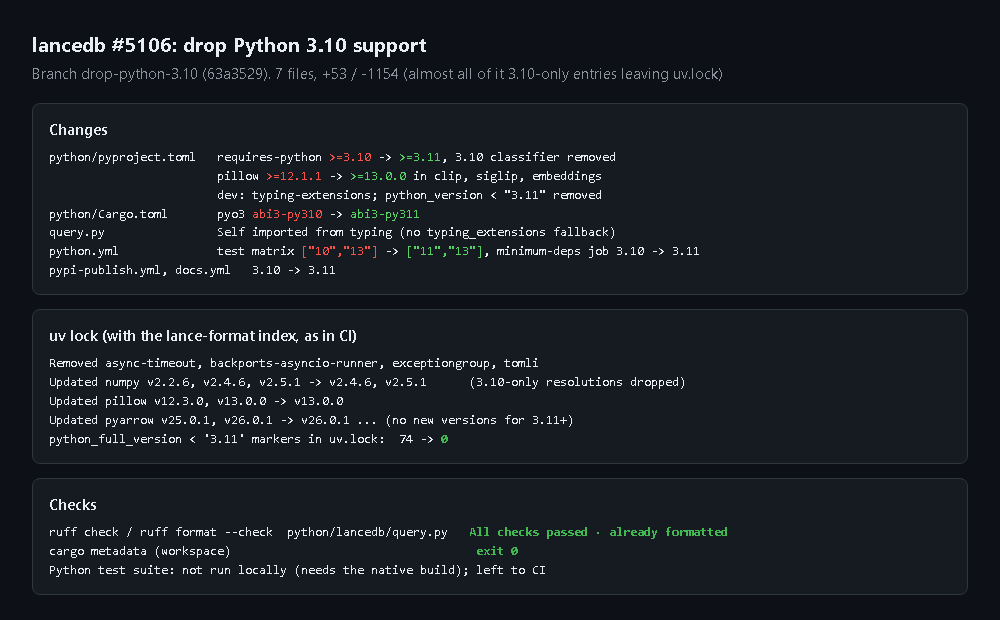 --------- Co-authored-by: Will Jones <willjones127@gmail.com> Co-authored-by: Claude Opus 5.5 <noreply@anthropic.com> |
||
|
Brendan Clement
|
fe2d2b33fc |
docs: restore setup in standalone Python examples (#4970)
Eight Python examples on the consistency, insert and merge-insert pages are presented as complete programs, but the published snippets started after the imports, temporary directory and connection, so they failed with NameError when run on their own. The snippet start markers had been moved below the setup in the test files. This moves them back above it and regenerates the snippets. |
||
 Aiman MalibandClaude Opus 5.5 |
0f648bbad4 |
fix: allow BTree indexes on LargeUtf8 columns (#5089)
## What changed `supported_btree_data_type` in `rust/lancedb/src/utils/mod.rs` now accepts `LargeUtf8` next to `Utf8`. This is the only code change, one line. Python and TypeScript have no BTree type check of their own and call into this function, so the fix covers all three SDKs. `Index::Auto` also picks BTree for `LargeUtf8` columns now, locally and in the remote client. ## Why Fixes #5088 Lance builds BTree indexes on `LargeUtf8`, but this check in lancedb rejected them with `A BTree index cannot be created on the field ... which has data type LargeUtf8`. pandas 3 stores text columns as `large_string`, so `create_index(col, config=BTree())` and `create_scalar_index(col)` fail on tables created from a plain DataFrame. #2297 removed a similar extra check for `FixedSizeBinary`. `Binary`, `LargeBinary` and `Utf8View` may also be supported by Lance but are left out of this PR. ## How it was tested Run in a `rust:1.97.0-bookworm` container with `--profile ci --locked --features remote`, on `main` at |
||
  Lucia CerchieandLucia Cerchie |
e9319c86bf |
fix: resolve agent plugin marketplace source (UAX-250) (#5170)
Looks like we have an issue with the plugin config pointing to a non-existent dir. Part of UAX-250. Related to UAX-245. Clicktest, can ask Chat for example to create a fresh disposable config. <img width="584" height="452" alt="Screenshot 2026-11-23 at 9 38 25 AM" src="https://github.com/user-attachments/assets/d359f9e2-bd3f-4cb8-993a-7db3b2b20342" /> Clicktesting: Use a disposable Claude configuration. Add this checkout as a marketplace, then install `lancedb@lancedb`. Confirm that installation fetches `lancedb/lancedb-agent-plugins` and exposes its skill. *original prompt:* "Work on Linear issue UAX-250:\ \ Suggested branch name: luciacerchie/uax-250-add-enterprise-functions-guidance-to\ \ \<issue identifier="UAX-250">\ \<title>Add Enterprise Functions guidance to the lancedb agent skill\</title>\ \<description>\ The public \`lancedb\` agent skill (\`lancedb/lancedb-agent-plugins\`, v0.1.0) has no guidance on LanceDB Enterprise Functions. It also routes "UDF / backfill" tasks to the Geneva/Ray path, which Functions is meant to replace. Agents using the skill steer users away from our newest product.\ \ \## Problem\ \ \* Nothing on \`@function\`, \`create_function\`, computed columns, \`refresh_column_async\`, secrets, GPU classes, chunkers, or function failure handling.\ \* The skill description does not trigger on Functions tasks.\ \* Function refresh jobs are not covered. \`remote_jobs.md\` only describes \`geneva_jobs\`.\ \* \`lancedb/lancedb\` \`.claude-plugin/marketplace.json\` points to \`./plugins/lancedb\`, which does not exist on main. Only \`lancedb-agent-plugins\` installs.\ \ \## Proposed fix\ \ A patch is ready (new \`references/functions.md\`, \`SKILL.md\` routing and description, \`remote_jobs.md\` note). Open a PR against \`lancedb-agent-plugins\` and fix the marketplace path in \`lancedb/lancedb\`.\ \ \## Acceptance\ \ \* A Functions prompt (register a function, bind a column, refresh, retry failed rows) loads \`functions.md\` before Geneva.\ \* Add Functions prompts to the agent eval suite (see \<issue id="08c7081c-2add-4ae6-b165-c9df1e23f1a5" label="UAX-245" href="https\://linear.app/lancedb/issue/UAX-245/automated-docs-loop-to-update-skills" /> for the docs-to-skills loop).\ \* Re-check the reference against each Enterprise release, since Functions is early access.\ \ \## Related product gaps (for triage, not part of this issue)\ \ Many-to-many transforms (dedup, clustering), multi-GPU per worker, refresh triggered on writes, per-row function version provenance, SQL/Python option parity, TypeScript and Rust authoring.\ \ \>>> Agent notes\ \ Source: Enterprise 1.14.0 docs (function-authoring, function-operations, function-failures, function-secrets, management/function, create-function, refresh-column, auto-refresh, incremental-refresh, chunking, sql/ddl/function). Needs the 0.42 preview client; stable 0.41 lacks these APIs. Local clone has the staged patch; no push access to \`lancedb-agent-plugins\` from the session.\ \ \>>>\ \</description>\ \<team name="UX/AX Engineering"/>\ \<label>LanceDB Functions › UI/UX\</label>\ \<project name="Functions: Next">Functions roadmap and follow-up work deferred from M3. Includes training integrations, application toolkits and Ray interoperability requests; these are outside the M3 bug-bash scope.\</project>\ \<issue-relations>\<related>\<issue-ref identifier="UAX-245" title="Automated docs loop to update skills"/>\</related>\</issue-relations>\ \</issue>" Co-authored-by: Lucia Cerchie <cerchie@Lucias-MacBook-Pro.local> |
||
|
Lance Release
|
de81c35ba0 | Bump version: 0.42.0-beta.25 → 0.42.0-beta.26 v0.42.0-beta.26 | ||
 wangshun |
a0e65400a9 |
fix(java): keep Maven coordinates in sync with release tags (#5151)
Fixes #4937 ## Summary The `v0.42.0-beta.21` release commit retained `0.42.0-beta.20` in both Java POMs, so its Maven build produced coordinates for the previous beta. The release bump used a Maven version hook whose final shell commands could return success after Maven failed, allowing the tag to be created with stale coordinates. [Issue #4937](https://github.com/lancedb/lancedb/issues/4937) Declare both Maven version fields in the shared version-bump configuration and align the checked-in POMs with the current release version. Preview and stable release bumps now apply the same version to the parent POM and the core module's parent reference before tagging. Package names, dependencies, and publication destinations are preserved. ## Verification Tests: `/bin/sh -c 'PATH=/tmp/osscout-release-venv/bin:$PATH bash ci/tests/test_bump_version.sh'`. Result: PATH=/tmp/osscout-release-venv/bin:$PATH bash ci/tests/test_bump_version.sh — base exit 1 with the tag/POM mismatch, patched exit 0 with both preview and stable cases passing. Result: python -m unittest discover -s ci/tests -v — base, 35 passed. Result: /tmp/osscout-release-venv/bin/python -m unittest discover -s ci/tests -v — patched, 35 passed. Result: bash ci/tests/test_cli_installer.sh — passed. Result: cd java && ./mvnw --batch-mode test -pl lancedb-core — base, 37 passed on JDK 25. Result: cd java && JAVA_HOME=/usr/lib/jvm/temurin-17-jdk-amd64 ./mvnw --batch-mode -Dspotless.skip=true clean test -pl lancedb-core — patched, 37 passed. Surefire XML reports are in java/lancedb-core/target/surefire-reports/. Result: osscout_base_work=$(mktemp -d) && git archive HEAD java | tar -xf - -C "$osscout_base_work" && cd "$osscout_base_work/java" && JAVA_HOME=/tmp/osscout-jdk8 ./mvnw --batch-mode -DskipTests -Dspotless.skip=true clean deploy -pl lancedb-core -am -P deploy-to-fury -DaltDeploymentRepository=fury::file:///tmp/osscout-fury-base — base build succeeded and emitted stale 0.42.0-beta.20 artifacts for the 0.42.0-beta.21 release sources. Result: cd java && JAVA_HOME=/tmp/osscout-jdk8 ./mvnw --batch-mode -DskipTests -Dspotless.skip=true clean deploy -pl lancedb-core -am -P deploy-to-fury -DaltDeploymentRepository=fury::file:///tmp/osscout-fury-deploy — patched build succeeded and emitted both 0.42.0-beta.21 POMs and the main, sources and Javadoc JARs. Regression coverage: `ci/tests/test_bump_version.sh`. <!-- oss-scout-job:job-d5fa2e08-6a6f-46ca-821c-d3a65d054055 --> Signed-off-by: wangshun <96341168+xixi-box@users.noreply.github.com> |
