We have one pretty serious MVCC visibility bug with hot standby
replicas. We incorrectly treat any transactions that are in progress
in the primary, when the standby is started, as aborted. That can
break MVCC for queries running concurrently in the standby. It can
also lead to hint bits being set incorrectly, and that damage can last
until the replica is restarted.
The fundamental bug was that we treated any replica start as starting
from a shut down server. The fix for that is straightforward: we need
to set 'wasShutdown = false' in InitWalRecovery() (see changes in the
postgres repo).
However, that introduces a new problem: with wasShutdown = false, the
standby will not open up for queries until it receives a running-xacts
WAL record from the primary. That's correct, and that's how Postgres
hot standby always works. But it's a problem for Neon, because:
* It changes the historical behavior for existing users. Currently,
the standby immediately opens up for queries, so if they now need to
wait, we can breka existing use cases that were working fine
(assuming you don't hit the MVCC issues).
* The problem is much worse for Neon than it is for standalone
PostgreSQL, because in Neon, we can start a replica from an
arbitrary LSN. In standalone PostgreSQL, the replica always starts
WAL replay from a checkpoint record, and the primary arranges things
so that there is always a running-xacts record soon after each
checkpoint record. You can still hit this issue with PostgreSQL if
you have a transaction with lots of subtransactions running in the
primary, but it's pretty rare in practice.
To mitigate that, we introduce another way to collect the
running-xacts information at startup, without waiting for the
running-xacts WAL record: We can the CLOG for XIDs that haven't been
marked as committed or aborted. It has limitations with
subtransactions too, but should mitigate the problem for most users.
See https://github.com/neondatabase/neon/issues/7236.
Co-authored-by: Konstantin Knizhnik <knizhnik@neon.tech>
This makes it much more convenient to use in the common case that you
want to flush all the WAL. (Passing pg_current_wal_insert_lsn() as the
argument doesn't work for the same reasons as explained in the
comments: we need to be back off to the beginning of a page if the
previous record ended at page boundary.)
I plan to use this to fix the issue that Arseny Sher called out at
https://github.com/neondatabase/neon/pull/7288#discussion_r1660063852
The 'running' boolean was replaced with a semaphore in commit
f0e2bb79b2, but this initialization was missed. Remove it so that if a
test tries to access it, you get an error rather than always claiming
that the endpoint is not running.
Spotted by Arseny at
https://github.com/neondatabase/neon/pull/7288#discussion_r1660068657
Whenever we see an XLOG_MULTIXACT_CREATE_ID WAL record, we need to
update the nextMulti and NextMultiOffset fields in the pageserver's
copy of the CheckPoint struct, to cover the new multi-XID. In
PostgreSQL, this is done by updating an in-memory struct during WAL
replay, but because in Neon you can start a compute node at any LSN,
we need to have an up-to-date value pre-calculated in the pageserver
at all times. We do the same for nextXid.
However, we had a bug in WAL ingestion code that does that: the
multi-XIDs will wrap around at 2^32, just like XIDs, so we need to do
the comparisons in a wraparound-aware fashion.
Fix that, and add tests.
Fixes issue #6520
Co-authored-by: Konstantin Knizhnik <knizhnik@neon.tech>
## Problem
At the start of do_tenant_shard_split, we drop any secondary location
for the parent shards. The reconciler uses presence of secondary
locations as a condition for enabling heatmaps.
On the pageserver, child shards inherit their configuration from
parents, but the storage controller assumes the child's ObservedState is
the same as the parent's config from the prepare phase. The result is
that some child shards end up with inaccurate ObservedState, and until
something next migrates or restarts, those tenant shards aren't
uploading heatmaps, so their secondary locations are downloading
everything that was resident at the moment of the split (including
ancestor layers which are often cleaned up shortly after the split).
Closes: https://github.com/neondatabase/neon/issues/8189
## Summary of changes
- Use PlacementPolicy to control enablement of heatmap upload, rather
than the literal presence of secondaries in IntentState: this way we
avoid switching them off during shard split
- test: during tenant split test, assert that the child shards have
heatmap uploads enabled.
## Problem
Very long running downloads can be wasteful, because the heatmap they're
using is outdated after a few minutes.
Closes: https://github.com/neondatabase/neon/issues/8182
## Summary of changes
- Impose a deadline on timeline downloads, using the same period as we
use for scheduling, and returning an UpdateError::Restart when it is
reached. This restart will involve waiting for a scheduling interval,
but that's a good thing: it helps let other tenants proceed.
- Refactor download_timeline so that the part where we update the state
for local layers is done even if we fall out of the layer download loop
with an error: this is important, especially for big tenants, because
only layers in the SecondaryDetail state will be considered for
eviction.
part of https://github.com/neondatabase/neon/issues/7418
I reviewed how the VirtualFile API's `read` methods look like and came
to the conclusion that we've been using `IoBufMut` / `BoundedBufMut` /
`Slice` wrong.
This patch rectifies the situation.
# Change 1: take `tokio_epoll_uring::Slice` in the read APIs
Before, we took an `IoBufMut`, which is too low of a primitive and while
it _seems_ convenient to be able to pass in a `Vec<u8>` without any
fuzz, it's actually very unclear at the callsite that we're going to
fill up that `Vec` up to its `capacity()`, because that's what
`IoBuf::bytes_total()` returns and that's what
`VirtualFile::read_exact_at` fills.
By passing a `Slice` instead, a caller that "just wants to read into a
`Vec`" is forced to be explicit about it, adding either `slice_full()`
or `slice(x..y)`, and these methods panic if the read is outside of the
bounds of the `Vec::capacity()`.
Last, passing slices is more similar to what the `std::io` APIs look
like.
# Change 2: fix UB in `virtual_file_io_engine=std-fs`
While reviewing call sites, I noticed that the
`io_engine::IoEngine::read_at` method for `StdFs` mode has been
constructing an `&mut[u8]` from raw parts that were uninitialized.
We then used `std::fs::File::read_exact` to initialize that memory, but,
IIUC we must not even be constructing an `&mut[u8]` where some of the
memory isn't initialized.
So, stop doing that and add a helper ext trait on `Slice` to do the
zero-initialization.
# Change 3: eliminate `read_exact_at_n`
The `read_exact_at_n` doesn't make sense because the caller can just
1. `slice = buf.slice()` the exact memory it wants to fill
2. `slice = read_exact_at(slice)`
3. `buf = slice.into_inner()`
Again, the `std::io` APIs specify the length of the read via the Rust
slice length.
We should do the same for the owned buffers IO APIs, i.e., via
`Slice::bytes_total()`.
# Change 4: simplify filling of `PageWriteGuard`
The `PageWriteGuardBuf::init_up_to` was never necessary.
Remove it. See changes to doc comment for more details.
---
Reviewers should probably look at the added test case first, it
illustrates my case a bit.
## Problem
For some time, we have created tenants with calls to location_conf. The
legacy "POST /v1/tenant" path was only used in some tests.
## Summary of changes
- Remove the API
- Relocate TenantCreateRequest to the controller API file (this used to
be used in both pageserver and controller APIs)
- Rewrite tenant_create test helper to use location_config API, as
control plane and storage controller do
- Update docker-compose test script to create tenants with
location_config API (this small commit is also present in
https://github.com/neondatabase/neon/pull/7947)
After https://github.com/neondatabase/neon/pull/8022 was deployed to
staging, I noticed many cases of timeouts. After inspecting the logs, I
realized that some operations are taking ~20 seconds and they're doing
while holding shared state lock. Usually it happens right after
redeploy, because compute reconnections put high load on disks. This
commit tries to improve observability around slow operations.
Non-observability changes:
- `TimelineState::finish_change` now skips update if nothing has changed
- `wal_residence_guard()` timeout is set to 30s
While investigating Pageserver logs from the cases where systemd hangs
during shutdown (https://github.com/neondatabase/cloud/issues/11387), I
noticed that even if Pageserver shuts down cleanly[^1], there are
lingering walredo processes.
[^1]: Meaning, pageserver finishes its shutdown procedure and calls
`exit(0)` on its own terms, instead of hitting the systemd unit's
`TimeoutSec=` limit and getting SIGKILLed.
While systemd should never lock up like it does, maybe we can avoid
hitting that bug by cleaning up properly.
Changes
-------
This PR adds a shutdown method to `WalRedoManager` and hooks it up to
tenant shutdown.
We keep track of intent to shutdown through the new `enum
ProcessOnceCell` stored inside the pre-existing `redo_process` field.
A gate is added to keep track of running processes, using the new type
`struct Process`.
Future Work
-----------
Requests that don't need the redo process will not observe the shutdown
(see doc comment).
Doing so would be nice for completeness sake, but doesn't provide much
benefit because `Tenant` and `Timeline` already shut down all walredo
users.
Testing
-------
I did manual testing to confirm that the problem exists before this PR
and that it's gone after.
Setup:
* `neon_local` with a single tenant, create some data using `pgbench`
* ensure walredo process is running, not pid
* watch `strace -e kill,wait4 -f -p "$(pgrep pageserver)"`
* `neon_local pageserver stop`
With this PR, we always observe
```
$ strace -e kill,wait4 -f -p "$(pgrep pageserver)"
...
[pid 591120] --- SIGTERM {si_signo=SIGTERM, si_code=SI_USER, si_pid=591215, si_uid=1000} ---
[pid 591134] kill(591174, SIGKILL) = 0
[pid 591134] wait4(591174, <unfinished ...>
[pid 591142] --- SIGCHLD {si_signo=SIGCHLD, si_code=CLD_KILLED, si_pid=591174, si_uid=1000, si_status=SIGKILL, si_utime=0, si_stime=0} ---
[pid 591134] <... wait4 resumed>[{WIFSIGNALED(s) && WTERMSIG(s) == SIGKILL}], 0, NULL) = 591174
...
+++ exited with 0 +++
```
Before this PR, we'd usually observe just
```
...
[pid 596239] --- SIGTERM {si_signo=SIGTERM, si_code=SI_USER, si_pid=596455, si_uid=1000} ---
...
+++ exited with 0 +++
```
Refs
----
refs https://github.com/neondatabase/cloud/issues/11387
## Problem
Background node operations take a long time for loaded nodes.
## Summary of changes
Increase number of concurrent reconciles an operation is allowed to
spawn.
This should make drain and fill operations faster and the new value is
still well below the total limit of concurrent reconciles.
## Problem
The cache keys that we use on CI are the same for X64 and ARM64
(`runner.arch`)
## Summary of changes
- Include `runner.arch` along with `runner.os` into cache keys
- Add --safekeepers option to neon_local reconfigure
- Add it to python Endpoint reconfigure
- Implement config reload in walproposer by restarting the whole bgw when
safekeeper list changes.
ref https://github.com/neondatabase/neon/issues/6341
## Problem
The fill requirement was not taken into account when looking through the
shards of a given node to fill from.
## Summary of Changes
Ensure that we do not fill a node past the recommendation from
`Scheduler::compute_fill_requirement`.
Also, modify the "neon_local timeline import" command so that it
doesn't create the endpoint any more. I don't see any reason to bundle
that in the same command, the "timeline create" and "timeline branch"
commands don't do that either.
I plan to add more tests similar to 'test_import_at_2bil', this will
help to reduce the copy-pasting.
## Problem
In https://github.com/neondatabase/neon/pull/5299, the new config-v1
tenant config file was added to hold the LocationConf type. We left the
old config file in place for forward compat, and because running without
generations (therefore without LocationConf) as still useful before the
storage controller was ready for prime-time.
Closes: https://github.com/neondatabase/neon/issues/5388
## Summary of changes
- Remove code for reading and writing the legacy config file
- Remove Generation::Broken: it was unused.
- Treat missing config file on disk as an error loading a tenant, rather
than defaulting it. We can now remove LocationConf::default, and thereby
guarantee that we never construct a tenant with a None generation.
- Update some comments + add some assertions to clarify that
Generation::None is only used in layer metadata, not in the state of a
running tenant.
- Update docker compose test to create tenants with a generation
Fixes https://github.com/neondatabase/neon/issues/6337
Add safekeeper support to switch between `Present` and
`Offloaded(flush_lsn)` states. The offloading is disabled by default,
but can be controlled using new cmdline arguments:
```
--enable-offload
Enable automatic switching to offloaded state
--delete-offloaded-wal
Delete local WAL files after offloading. When disabled, they will be left on disk
--control-file-save-interval <CONTROL_FILE_SAVE_INTERVAL>
Pending updates to control file will be automatically saved after this interval [default: 300s]
```
Manager watches state updates and detects when there are no actvity on
the timeline and actual partial backup upload in remote storage. When
all conditions are met, the state can be switched to offloaded.
In `timeline.rs` there is `StateSK` enum to support switching between
states. When offloaded, code can access only control file structure and
cannot use `SafeKeeper` to accept new WAL.
`FullAccessTimeline` is now renamed to `WalResidentTimeline`. This
struct contains guard to notify manager about active tasks requiring
on-disk WAL access. All guards are issued by the manager, all requests
are sent via channel using `ManagerCtl`. When manager receives request
to issue a guard, it unevicts timeline if it's currently evicted.
Fixed a bug in partial WAL backup, it used `term` instead of
`last_log_term` previously.
After this commit is merged, next step is to roll this change out, as in
issue #6338.
## Problem
We have seen numerous segfault and memory corruption issue for clients
using libpq and openssl 3.2.2. I don't know if this is a bug in openssl
or libpq. Downgrading to 1.1.1w fixes the issues for the storage
controller and pgbench.
## Summary of Changes:
Use openssl 1.1.1w instead of 3.2.2
I was looking for metrics on how many computes are still using protocol
version 1 and 2. This provides counters for that as "pagestream" and
"pagestream_v2" commands, but also all the other commands. The new
metrics are global for the whole pageserver instance rather than
per-tenant, so the additional metrics bloat should be fairly small.
I saw this compiler warning on my laptop:
pgxn/neon_walredo/walredoproc.c:178:10: warning: using the result of an
assignment as a condition without parentheses [-Wparentheses]
if (err = close_range_syscall(3, ~0U, 0)) {
~~~~^~~~~~~~~~~~~~~~~~~~~~~~~~~~~~~~
pgxn/neon_walredo/walredoproc.c:178:10: note: place parentheses around
the assignment to silence this warning
if (err = close_range_syscall(3, ~0U, 0)) {
^
( )
pgxn/neon_walredo/walredoproc.c:178:10: note: use '==' to turn this
assignment into an equality comparison
if (err = close_range_syscall(3, ~0U, 0)) {
^
==
1 warning generated.
I'm not sure what compiler version or options cause that, but it's a
good warning. Write the call a little differently, to avoid the warning
and to make it a little more clear anyway. (The 'err' variable wasn't
used for anything, so I'm surprised we were not seeing a compiler
warning on the unused value, too.)
## Problem
We install Postgres 14 in `build-tools` image, but we don't need
it. We use Postgres binaries, which we build ourselves.
## Summary of changes
- Remove Postgresql 14 installation from `build-tools` image
## Problem
Hard to debug the disconnection reason currently.
## Summary of changes
Keep track of error-direction, and therefore error source (client vs
compute) during passthrough.
A follow-up on https://github.com/neondatabase/neon/pull/8103/.
Previously, main branch fails with:
```
assertion `left == right` failed
left: b"value 3@0x10@0x30@0x28@0x40"
right: b"value 3@0x10@0x28@0x30@0x40"
```
This gets fixed after #8103 gets merged.
Signed-off-by: Alex Chi Z <chi@neon.tech>
This was a half-finished mechanism to allow a replica to enter hot
standby mode sooner, without waiting for a running-xacts record. It had
issues, and we are working on a better mechanism to replace it.
The control plane might still set the flag in the spec file, but
compute_ctl will simply ignore it.
In future we may want to run periodic tests on dedicated cloud instances
that are not GitHub action runners.
To allow these to download artifact binaries for a specific commit hash
we want to make the search by commit hash possible and prefix the S3
objects with
`artifacts/${GITHUB_SHA}/${GITHUB_RUN_ID}/${GITHUB_RUN_ATTEMPT}`
---------
Co-authored-by: Alexander Bayandin <alexander@neon.tech>
Adds manual compaction trigger; add gc compaction to test_gc_feedback
Part of https://github.com/neondatabase/neon/issues/8002
```
test_gc_feedback[debug-pg15].logical_size: 50 Mb
test_gc_feedback[debug-pg15].physical_size: 2269 Mb
test_gc_feedback[debug-pg15].physical/logical ratio: 44.5302
test_gc_feedback[debug-pg15].max_total_num_of_deltas: 7
test_gc_feedback[debug-pg15].max_num_of_deltas_above_image: 2
test_gc_feedback[debug-pg15].logical_size_after_bottom_most_compaction: 50 Mb
test_gc_feedback[debug-pg15].physical_size_after_bottom_most_compaction: 287 Mb
test_gc_feedback[debug-pg15].physical/logical ratio after bottom_most_compaction: 5.6312
test_gc_feedback[debug-pg15].max_total_num_of_deltas_after_bottom_most_compaction: 4
test_gc_feedback[debug-pg15].max_num_of_deltas_above_image_after_bottom_most_compaction: 1
```
## Summary of changes
* Add the manual compaction trigger
* Use in test_gc_feedback
* Add a guard to avoid running it with retain_lsns
* Fix: Do `schedule_compaction_update` after compaction
* Fix: Supply deltas in the correct order to reconstruct value
---------
Signed-off-by: Alex Chi Z <chi@neon.tech>
part of https://github.com/neondatabase/neon/issues/8002
## Summary of changes
This pull request adds the image layer iterator. It buffers a fixed
amount of key-value pairs in memory, and give developer an iterator
abstraction over the image layer. Once the buffer is exhausted, it will
issue 1 I/O to fetch the next batch.
Due to the Rust lifetime mysteries, the `get_stream_from` API has been
refactored to `into_stream` and consumes `self`.
Delta layer iterator implementation will be similar, therefore I'll add
it after this pull request gets merged.
---------
Signed-off-by: Alex Chi Z <chi@neon.tech>
## Problem
1. Proxy is retrying errors from cplane that shouldn't be retried
2. ~~Proxy is not using the retry_after_ms value~~
## Summary of changes
1. Correct the could_retry impl for ConsoleError.
2. ~~Update could_retry interface to support returning a fixed wait
duration.~~
## Problem
These APIs have been deprecated for some time, but were still used from
test code.
Closes: https://github.com/neondatabase/neon/issues/4282
## Summary of changes
- It is still convenient to do a "tenant_attach" from a test without
having to write out a location_conf body, so those test methods have
been retained with implementations that call through to their
location_conf equivalent.
Part of #7497, closes#8120.
## Summary of changes
This PR adds a metric to track the number of valid leases after `GCInfo`
gets refreshed each time.
Besides this metric, we should also track disk space and synthetic size
(after #8071 is closed) to make sure leases are used properly.
Signed-off-by: Yuchen Liang <yuchen@neon.tech>
## Problem
Storage controller runs into memory corruption issue on the drain/fill
code paths.
## Summary of changes
Update db related depdencies in the unlikely case that the issue was
fixed in diesel.
We did not recover the subtransaction IDs of prepared transactions when
starting a hot standby from a shutdown checkpoint. As a result, such
subtransactions were considered as aborted, rather than in-progress.
That would lead to hint bits being set incorrectly, and the
subtransactions suddenly becoming visible to old snapshots when the
prepared transaction was committed.
To fix, update pg_subtrans with prepared transactions's subxids when
starting hot standby from a shutdown checkpoint. The snapshots taken
from that state need to be marked as "suboverflowed", so that we also
check the pg_subtrans.
Discussion:
https://www.postgresql.org/message-id/6b852e98-2d49-4ca1-9e95-db419a2696e0%40iki.fi
NEON: cherry-picked from the upstream thread ahead of time, to unblock
https://github.com/neondatabase/neon/pull/7288. I expect this to be
committed to upstream in the next few days, superseding this. NOTE: I
did not include the new regression test on v15 and v14 branches, because
the test would need some adapting, and we don't run the perl tests on
Neon anyway.
Part of #7497, closes#8072.
## Problem
Currently the `get_lsn_by_timestamp` and branch creation pageserver APIs do not provide a pleasant client experience where the looked-up LSN might be GC-ed between the two API calls.
This PR attempts to prevent common races between GC and branch creation by making use of LSN leases provided in #8084. A lease can be optionally granted to a looked-up LSN. With the lease, GC will not touch layers needed to reconstruct all pages at this LSN for the duration of the lease.
Signed-off-by: Yuchen Liang <yuchen@neon.tech>
## Problem
- `test_storage_controller_many_tenants` can fail with warnings in the
storage controller about tenant creation holding a lock for too long,
because this test stresses the machine running the test with many
concurrent timeline creations
- `test_tenant_delete_smoke` can fail when synthetic remote storage
errors show up
## Summary of changes
- tolerate warnings about slow timeline creation in
test_storage_controller_many_tenants
- tolerate both possible errors during error_tolerant_delete
## Problem
This command was used in the very early days of sharding, before the
storage controller had anti-affinity + scheduling optimization to spread
out shards.
## Summary of changes
- Remove `storcon_cli tenant-scatter`
Part of https://github.com/neondatabase/neon/issues/8002
This pull request adds tests for bottom-most gc-compaction with delta
records. Also fixed a bug in the compaction process that creates
overlapping delta layers by force splitting at the original delta layer
boundary.
---------
Signed-off-by: Alex Chi Z <chi@neon.tech>
We now have a `vX` number in the file name, i.e.,
`000000067F0000000400000B150100000000-000000067F0000000400000D350100000000__00000000014B7AC8-v1-00000001`
The related pull request for new-style path was merged a month ago
https://github.com/neondatabase/neon/pull/7660
## Summary of changes
Fixed the draw timeline dir command to handle it.
---------
Signed-off-by: Alex Chi Z <chi@neon.tech>
Previously in safekeeper code, new segment file was opened without
truncate option. I don't think there is a reason to do it, this commit
replaces it with `File::create` to make it simpler and remove
`clippy::suspicious_open_options` linter warning.
## Problem
This test could occasionally trigger a "removing local file ... because
it has unexpected length log" when using the
`compact-shard-ancestors-persistent` failpoint is in use, which is
unexpected because that failpoint stops the process when the remote
metadata is in sync with local files.
It was because there are two shards on the same pageserver, and while
the one being compacted explicitly stops at the failpoint, another shard
was compacting in the background and failing at an unclean point. The
test intends to disable background compaction, but was mistakenly
revoking the value of `compaction_period` when it updated
`pitr_interval`.
Example failure:
https://neon-github-public-dev.s3.amazonaws.com/reports/pr-8123/9602976462/index.html#/testresult/7dd6165da7daef40
## Summary of changes
- Update `TENANT_CONF` in the test to use properly typed values, so that
it is usable in pageserver APIs as well as via neon_local.
- When updating tenant config with `pitr_interval`, retain the overrides
from the start of the test, so that there won't be any background
compaction going on during the test.
## Problem
`test_sharding_autosplit` is occasionally failing on warnings about
shard splits taking longer than expected (`Exclusive lock by ShardSplit
was held for`...)
It's not obvious which part is taking the time (I suspect remote storage
uploads).
Example:
https://neon-github-public-dev.s3.amazonaws.com/reports/main/9618788427/index.html#testresult/b395294d5bdeb783/
## Summary of changes
- Since shard splits are infrequent events, we can afford to be very
chatty: add a bunch of info-level logging throughout the process.
#8082 removed the legacy deletion path, but retained code for completing
deletions that were started before a pageserver restart. This PR cleans
up that remaining code, and removes all the pageserver code that dealt
with tenant deletion markers and resuming tenant deletions.
The release at https://github.com/neondatabase/neon/pull/8138 contains
https://github.com/neondatabase/neon/pull/8082, so we can now merge this
to `main`
Moves `RemoteStorageConfig` and related structs and functions into a
dedicated module. Also implements `Serialize` for the config structs
(requested in #8126).
Follow-up of #8126
## Problem
Fixes https://github.com/neondatabase/neon/issues/1287
## Summary of changes
tokio-postgres now supports arbitrary server params through the
`param(key, value)` method. Some keys are special so we explicitly
filter them out.
Adds a `Deserialize` impl to `RemoteStorageConfig`. We thus achieve the
same as #7743 but with less repetitive code, by deriving `Deserialize`
impls on `S3Config`, `AzureConfig`, and `RemoteStorageConfig`. The
disadvantage is less useful error messages.
The git history of this PR contains a state where we go via an
intermediate representation, leveraging the `serde_json` crate,
without it ever being actual json though.
Also, the PR adds deserialization tests.
Alternative to #7743 .
## Problem
While adapting the storage controller scale test to do graceful rolling
restarts via
drain and fill, I noticed that secondaries are also being rescheduled,
which, in turn,
caused the storage controller to optimise attachments.
## Summary of changes
* Introduce a transactional looking rescheduling primitive (i.e. "try to
schedule to this
secondary, but leave everything as is if you can't")
* Use it for the drain and fill stages to avoid calling into
`Scheduler::schedule` and having
secondaries move around.
## Problem
For testing, the storage controller has a built-in hack that loads
neon_local endpoint config from disk, and uses it to reconfigure
endpoints when the attached pageserver changes.
Some tests that stop an endpoint while the storage controller is running
could occasionally fail on log errors from the controller trying to use
its special test-mode calls into neon local Endpoint.
Example:
https://neon-github-public-dev.s3.amazonaws.com/reports/pr-8117/9592392425/index.html#/testresult/9d2bb8623d0d53f8
## Summary of changes
- Give NotifyError an explicit NeonLocal variant, to avoid munging these
into generic 500s (I don't want to ignore 500s in general)
- Allow-list errors related to the local notification hook.
The expectation is that tests using endpoints/workloads should be
independently checking that those endpoints work: if neon_local
generates an error inside the storage controller, that's ignorable.
## Problem
There's no way to cancel drain and fill operations.
## Summary of changes
Implement HTTP endpoints to allow cancelling of background operations.
When the operationis cancelled successfully, the node scheduling policy will revert to
`Active`.
In #7957 we enabled deletion without attachment, but retained the
old-style deletion (return 202, delete in background) for attached
tenants. In this PR, we remove the old-style deletion path, such that if
the tenant delete API is invoked while a tenant is detached, it is
simply detached before completing the deletion.
This intentionally doesn't rip out all the old deletion code: in case a
deletion was in progress at time of upgrade, we keep around the code for
finishing it for one release cycle. The rest of the code removal happens
in https://github.com/neondatabase/neon/pull/8091
Now that deletion will always be via the new path, the new path is also
updated to use some retries around remote storage operations, to
tripping up the control plane with 500s if S3 has an intermittent issue.
This is a preparation for #8022, to make the PR both backwards and
foward compatible.
This commit adds `eviction_state` field to control file. Adds support
for reading it, but writes control file in old format where possible, to
keep the disk format forward compatible.
Note: in `patch_control_file`, new field gets serialized to json like
this:
- `"eviction_state": "Present"`
- `"eviction_state": {"Offloaded": "0/8F"}`
## Problem
see https://github.com/neondatabase/neon/issues/8070
## Summary of changes
the neon_local subcommands to
- start neon
- start pageserver
- start safekeeper
- start storage controller
get a new option -t=xx or --start-timeout=xx which allows to specify a
longer timeout in seconds we wait for the process start.
This is useful in test cases where the pageserver has to read a lot of
layer data, like in pagebench test cases.
In addition we exploit the new timeout option in the python test
infrastructure (python fixtures) and modify the flaky testcase to
increase the timeout from 10 seconds to 1 minute.
Example from the test execution
```bash
RUST_BACKTRACE=1 NEON_ENV_BUILDER_USE_OVERLAYFS_FOR_SNAPSHOTS=1 DEFAULT_PG_VERSION=15 BUILD_TYPE=release ./scripts/pytest test_runner/performance/pageserver/pagebench/test_pageserver_max_throughput_getpage_at_latest_lsn.py
...
2024-06-19 09:29:34.590 INFO [neon_fixtures.py:1513] Running command "/instance_store/neon/target/release/neon_local storage_controller start --start-timeout=60s"
2024-06-19 09:29:36.365 INFO [broker.py:34] starting storage_broker to listen incoming connections at "127.0.0.1:15001"
2024-06-19 09:29:36.365 INFO [neon_fixtures.py:1513] Running command "/instance_store/neon/target/release/neon_local pageserver start --id=1 --start-timeout=60s"
2024-06-19 09:29:36.366 INFO [neon_fixtures.py:1513] Running command "/instance_store/neon/target/release/neon_local safekeeper start 1 --start-timeout=60s"
```
## Problem
These APIs have be unused for some time. They were superseded by
/location_conf: the equivalent of ignoring a tenant is now to put it in
secondary mode.
## Summary of changes
- Remove APIs
- Remove tests & helpers that used them
- Remove error variants that are no longer needed.
## Problem
The fill planner introduced in
https://github.com/neondatabase/neon/pull/8014 selects
tenant shards to promote strictly based on attached shard count load
(tenant shards on
nodes with the most attached shard counts are considered first). This
approach runs the
risk of migrating too many shards belonging to the same tenant on the
same primary node.
This is bad for availability and causes extra reconciles via the storage
controller's background
optimisations.
Also see
https://github.com/neondatabase/neon/pull/8014#discussion_r1642456241.
## Summary of changes
Refine the fill plan to avoid promoting too many shards belonging to the
same tenant on the same node.
We allow for `max(1, shard_count / node_count)` shards belonging to the
same tenant to be promoted.
## Problem
When creating a new shard the storage controller schedules via
Scheduler::schedule_shard. This does not take into account the number of
attached shards. What it does take into account is the node affinity:
when a shard is scheduled, all its nodes (primaries and secondaries) get
their affinity incremented.
For two node clusters and shards with one secondary we have a
pathological case where all primaries are scheduled on the same node.
Now that we track the count of attached shards per node, this is trivial
to fix. Still, the "proper" fix is to use the pageserver's utilization
score.
Closes https://github.com/neondatabase/neon/issues/8041
## Summary of changes
Use attached shard count when deciding which node to schedule a fresh
shard on.
part of Epic https://github.com/neondatabase/neon/issues/7386
# Motivation
The materialized page cache adds complexity to the code base, which
increases the maintenance burden and risk for subtle and hard to
reproduce bugs such as #8050.
Further, the best hit rate that we currently achieve in production is ca
1% of materialized page cache lookups for
`task_kind=PageRequestHandler`. Other task kinds have hit rates <0.2%.
Last, caching page images in Pageserver rewards under-sized caches in
Computes because reading from Pageserver's materialized page cache over
the network is often sufficiently fast (low hundreds of microseconds).
Such Computes should upscale their local caches to fit their working
set, rather than repeatedly requesting the same page from Pageserver.
Some more discussion and context in internal thread
https://neondb.slack.com/archives/C033RQ5SPDH/p1718714037708459
# Changes
This PR removes the materialized page cache code & metrics.
The infrastructure for different key kinds in `PageCache` is left in
place, even though the "Immutable" key kind is the only remaining one.
This can be further simplified in a future commit.
Some tests started failing because their total runtime was dependent on
high materialized page cache hit rates. This test makes them
fixed-runtime or raises pytest timeouts:
* test_local_file_cache_unlink
* test_physical_replication
* test_pg_regress
# Performance
I focussed on ensuring that this PR will not result in a performance
regression in prod.
* **getpage** requests: our production metrics have shown the
materialized page cache to be irrelevant (low hit rate). Also,
Pageserver is the wrong place to cache page images, it should happen in
compute.
* **ingest** (`task_kind=WalReceiverConnectionHandler`): prod metrics
show 0 percent hit rate, so, removing will not be a regression.
* **get_lsn_by_timestamp**: important API for branch creation, used by
control pane. The clog pages that this code uses are not
materialize-page-cached because they're not 8k. No risk of introducing a
regression here.
We will watch the various nightly benchmarks closely for more results
before shipping to prod.
## Problem
There are a couple of small CI cleanups that seem too small for dedicated PRs
## Summary of changes
- Create release PR with the title that matches the title in the description
- Tune error message for disallowing `ubuntu-latest` to explicitly
mention what to do
- Remove junit output from pytest, we use allure instead
## Problem
```
Unable to find image 'neondatabase/neon:9583413584' locally
docker: Error response from daemon: toomanyrequests: You have reached your pull rate limit. You may increase the limit by authenticating and upgrading: https://www.docker.com/increase-rate-limit.
```
## Summary of changes
- add `docker/login-action@v3` for `test-images` job
## Problem
Ahem, let's try this again.
https://github.com/neondatabase/neon/pull/8110 had a spooky failure in
test_multi_attach where a call to Endpoint.stop() timed out waiting for
a lock, even though we can see an earlier call completing and releasing
the lock. I suspect something weird is going on with the way pytest runs
tests across processes, or use of asyncio perhaps.
Anyway: the simplest fix is to just use a semaphore instead: if we don't
lock we can't deadlock.
## Summary of changes
- Make Endpoint.running a semaphore, where we add a unit to its counter
when starting the process and atomically decrement it when stopping.
Fixes https://github.com/neondatabase/neon/issues/7897
## Problem
`shard->delay_us` was potentially uninitialized when we connect to PS,
as it wasn't set to a non-0 value until we've first connected to the
shard's pageserver.
That caused the exponential backoff to use an initial value (multiplier)
of 0 for the first connection attempt to that pageserver, thus causing a
hot retry loop with connection attempts to the pageserver without
significant delay. That in turn caused attemmpts to reconnect to quickly
fail, rather than showing the expected 'wait until pageserver is
available' behaviour.
## Summary of changes
We initialize shard->delay_us before connection initialization if we
notice it is not initialized yet.
## Problem
`test_pageserver_max_throughput_getpage_at_latest_lsn` is a pagebench
testcase which creates several tenants/timelines to verify pageserver
performance.
The test swaps environments around in the tenant duplication stage, so
the storage controller uses two separate db instances (one in the
duplication stage and another one in the benchmarking stage).
In the benchmarking stage, the storage controller starts without any
knowledge of nodes, but with knowledge of tenants (via
attachments.json). When we re-attach and attempt to update the scheduler
stats, the scheduler rightfully complains
about the node not being known. The setup should preserve the storage
controller across the two envs, but i think it's fine to just allow list
the error in this case.
## Summary of changes
add the error message
`2024-06-19T09:38:27.866085Z ERROR Scheduler missing node 1``
to the list of allowed errors for storage_controller
## Problem
Some tasks are using around upwards of 10KB of memory at all times,
sometimes having buffers that swing them up to 30MB.
## Summary of changes
Split some of the async tasks in selective places and box them as
appropriate to try and reduce the constant memory usage. Especially in
the locations where the large future is only a small part of the total
runtime of the task.
Also, reduces the size of the CopyBuffer buffer size from 8KB to 1KB.
In my local testing and in staging this had a minor improvement. sadly
not the improvement I was hoping for :/ Might have more impact in
production
## Problem
Tests using the `Workload` helper would occasionally fail in a strange
way, where the endpoint appears to try and stop twice concurrently, and
the second stop fails because the pidfile is already gone.
`test_multi_attach` suffered from this.
Workload has a `__del__` that stops the endpoint, and python is
destroying this object in a different thread than NeonEnv.stop is
called, resulting in racing stop() calls. Endpoint has a `running`
attribute that avoids calling neon_local's stop twice, but that doesn't
help in the concurrent case.
## Summary of changes
- Make `Endpoint.stop` thread safe with a simple lock held across the
updates to `running` and the actual act of stopping it.
One could also work around this by letting Workload.endpoint outlive the
Workload, or making Workload a context manager, but this change feels
most robust, as it avoids all test code having to know that it must not
try and stop an endpoint from a destructor.
Before this PR, storage controller and broker would run in the
PWD of neon_local, i.e., most likely the checkout of neon.git.
With this PR, the shared infrastructure for background processes
sets the PWD.
Benefits:
* easy listing of processes in a repo dir using `lsof`, see added
comment in the code
* coredumps go in the right directory (next to the process)
* generally matching common expectations, I think
Changes:
* set the working directory in `background_process` module
* drive-by: fix reliance of storage_controller on NEON_REPO_DIR being
set by neon_local for the local compute hook to work correctly
## Problem
We have this set of test utilities which duplicate a tenant by copying
everything that's in remote storage and then attaching a tenant to the
pageserver and storage controller. When the "copied tenants" are created
on the storage controller, they start off from generation number 0. This
means that they can't see anything past that generation.
This issues has existed ever since generation numbers have been
introduced, but we've largely been lucky
for the generation to stay stable during the template tenant creation.
## Summary of Changes
Extend the storage controller debug attach hook to accept a generation
override. Use that in the tenant duplication logic to set the generation
number to something greater than the naturally reached generation. This
allows the tenants to see all layer files.
## Problem
Pageserver restarts cause read availablity downtime for tenants. See
`Motivation` section in the
[RFC](https://github.com/neondatabase/neon/pull/7704).
## Summary of changes
* Introduce a new `NodeSchedulingPolicy`: `PauseForRestart`
* Implement the first take of drain and fill algorithms
* Add a node status endpoint which can be polled to figure out when an
operation is done
The implementation follows the RFC, so it might be useful to peek at it
as you're reviewing.
Since the PR is rather chunky, I've made sure all commits build (with
warnings), so you can
review by commit if you prefer that.
RFC: https://github.com/neondatabase/neon/pull/7704
Related https://github.com/neondatabase/neon/issues/7387
## Problem
We want to have all released images in production ECR repository
## Summary of changes
Copy all docker images to production ECR repository
cc: https://github.com/neondatabase/cloud/issues/10177
The new image iterator and delta iterator uses an iterator-based API.
https://github.com/neondatabase/neon/pull/8006 / part of
https://github.com/neondatabase/neon/issues/8002
This requires the underlying thing (the btree) to have an iterator API,
and the iterator should have a type name so that it can be stored
somewhere.
```rust
pub struct DeltaLayerIterator {
index_iterator: BTreeIterator
}
```
versus
```rust
pub struct DeltaLayerIterator {
index_iterator: impl Stream<....>
}
```
(this requires nightly flag and still buggy in the Rust compiler)
There are multiple ways to achieve this:
1. Either write a BTreeIterator from scratch that provides `async next`.
This is the most efficient way to do that.
2. Or wrap the current `get_stream` API, which is the current approach
in the pull request.
In the future, we should do (1), and the `get_stream` API should be
refactored to use the iterator API. With (2), we have to wrap the
`get_stream` API with `Pin<Box<dyn Stream>>`, where we have the overhead
of dynamic dispatch. However, (2) needs a rewrite of the `visit`
function, which would take some time to write and review. I'd like to
define this iterator API first and work on a real iterator API later.
## Summary of changes
Add `DiskBtreeIterator` and related tests.
Signed-off-by: Alex Chi Z <chi@neon.tech>
Part of #7497, extracts from #7996, closes#8063.
## Problem
With the LSN lease API introduced in
https://github.com/neondatabase/neon/issues/7808, we want to implement
the real lease logic so that GC will
keep all the layers needed to reconstruct all pages at all the leased
LSNs with valid leases at a given time.
Signed-off-by: Yuchen Liang <yuchen@neon.tech>
- Relation size cache was moved to extension
- the changes in visibilitymap.c and freespace.c became unnecessary
with v16, thanks to changes in upstream code
- WALProposer was moved to extension
- The hack in ReadBuffer_common to not throw an error on unexpected
data beyond EOF was removed in v16 rebase. We haven't seen such
errors, so I guess that was some early issue that was fixed long
time ago.
- The ginfast.c diff was made unnecessary by upstream commit 56b662523f
- Make safekeeper read SAFEKEEPER_AUTH_TOKEN env variable with JWT
token to connect to other safekeepers.
- Set it in neon_local when auth is enabled.
- Create simple rust http client supporting it, and use it in pull_timeline
implementation.
- Enable auth in all pull_timeline tests.
- Make sk http_client() by default generate safekeeper wide token, it makes
easier enabling auth in all tests by default.
- Add /snapshot http endpoing streaming tar archive timeline contents up to
flush_lsn.
- Add check that term doesn't change, corresponding test passes now.
- Also prepares infra to hold off WAL removal during the basebackup.
- Sprinkle fsyncs to persist the pull_timeline result.
ref https://github.com/neondatabase/neon/issues/6340
## Problem
```
ERROR synthetic_size_worker: failed to calculate synthetic size for tenant ae449af30216ac56d2c1173f894b1122: Could not find size at 0/218CA70 in timeline d8da32b5e3e0bf18cfdb560f9de29638\n')
```
e.g.
https://neon-github-public-dev.s3.amazonaws.com/reports/main/9518948590/index.html#/testresult/30a6d1e2471d2775
This test had allow lists but was disrupted by
https://github.com/neondatabase/neon/pull/8051. In that PR, I had kept
an error path in fill_logical_sizes that covered the case where we
couldn't find sizes for some of the segments, but that path could only
be hit in the case that some Timeline was shut down concurrently with a
synthetic size calculation, so it makes sense to just leave the
segment's size None in this case: the subsequent size calculations do
not assume it is Some.
## Summary of changes
- Remove `CalculateSyntheticSizeError::LsnNotFound` and just proceed in
the case where we used to return it
- Remove defunct allow list entries in `test_metric_collection`
## Summary of changes
- Stop logging HealthCheck message passing at INFO level (moved to
DEBUG)
- Stop logging /status accesses at INFO (moved to DEBUG)
- Stop logging most occurances of
`missing config file "compute_ctl_temp_override.conf"`
- Log memory usage only when the data has changed significantly, or if
we've not recently logged the data, rather than always every 2 seconds.
## Problem
We don't rebuild `build-tools` image for changes in a workflow that
builds this image itself
(`.github/workflows/build-build-tools-image.yml`) or in a workflow that
determines which tag to use
(`.github/workflows/check-build-tools-image.yml`)
## Summary of changes
- Use a hash of `Dockerfile.build-tools` and workflow files as a
persistent tag instead of using a commit sha.
## Problem
A period of unavailability for all pageservers in a cluster produced the
following fallout in staging:
all tenants became detached and required manual operation to re-attach.
Manually restarting
the storage controller re-attached all tenants due to a consistency bug.
Turns out there are two related bugs which caused the issue:
1. Pageserver re-attach can be processed before the first heartbeat.
Hence, when handling
the availability delta produced by the heartbeater,
`Node::get_availability_transition` claims
that there's no need to reconfigure the node.
2. We would still attempt to reschedule tenant shards when handling
offline transitions even
if the entire cluster is down. This puts tenant shards into a state
where the reconciler believes
they have to be detached (no pageserver shows up in their intent state).
This is doubly wrong
because we don't mark the tenant shards as detached in the database,
thus causing memory vs
database consistency issues. Luckily, this bug allowed all tenant shards
to re-attach after restart.
## Summary of changes
* For (1), abuse the fact that re-attach requests do not contain an
utilisation score and use that
to differentiate from a node that replied to heartbeats.
* For (2), introduce a special case that skips any rescheduling if the
entire cluster is unavailable.
* Update the storage controller heartbeat test with an extra scenario
where the entire cluster goes
for lunch.
Fixes https://github.com/neondatabase/neon/issues/8044
cargo test (or nextest) might rebuild the binaries with different
features/flags, so do install immediately after the build. Triggered by the
particular case of nextest invocations missing $CARGO_FEATURES, which recompiled
safekeeper without 'testing' feature which made python tests needing
it (failpoints) not run in the CI.
Also add CARGO_FEATURES to the nextest runs anyway because there doesn't seem to
be an important reason not to.
## Problem
halfvec data type was introduced in pgvector 0.7.0 and is popular
because
it allows smaller vectors, smaller indexes and potentially better
performance.
So far we have not tested halfvec in our periodic performance tests.
This PR adds halfvec indexing and halfvec queries to the test.
## Problem
I've bumped `docker/setup-buildx-action` in #8042 because I wasn't able
to reproduce the issue from #7445.
But now the issue appears again in
https://github.com/neondatabase/neon/actions/runs/9514373620/job/26226626923?pr=8059
The steps to reproduce aren't clear, it required
`docker/setup-buildx-action@v3` and rebuilding the image without cache,
probably
## Summary of changes
- Downgrade `docker/setup-buildx-action@v3`
to `docker/setup-buildx-action@v2`
## Problem
rust 1.79 new enabled by default lints
## Summary of changes
* update to rust 1.79
* `s/default_features/default-features/`
* fix proxy dead code.
* fix pageserver dead code.
## Problem
This PR refactors some error handling to avoid log spam on
tenant/timeline shutdown.
- "ignoring failure to find gc cutoffs: timeline shutting down." logs
(https://github.com/neondatabase/neon/issues/8012)
- "synthetic_size_worker: failed to calculate synthetic size for tenant
...: Failed to refresh gc_info before gathering inputs: tenant shutting
down", for example here:
https://neon-github-public-dev.s3.amazonaws.com/reports/pr-8049/9502988669/index.html#suites/3fc871d9ee8127d8501d607e03205abb/1a074a66548bbcea
Closes: https://github.com/neondatabase/neon/issues/8012
## Summary of changes
- Refactor: Add a PageReconstructError variant to GcError: this is the
only kind of error that find_gc_cutoffs can emit.
- Functional change: only ignore shutdown PageReconstructError variant:
for other variants, treat it as a real error
- Refactor: add a structured CalculateSyntheticSizeError type and use it
instead of anyhow::Error in synthetic size calculations
- Functional change: while iterating through timelines gathering logical
sizes, only drop out if the whole tenant is cancelled: individual
timeline cancellations indicate deletion in progress and we can just
ignore those.
## Problem
This test could fail with a timeout waiting for tenant deletions.
Tenant deletions could get tripped up on nodes transitioning from
offline to online at the moment of the deletion. In a previous
reconciliation, the reconciler would skip detaching a particular
location because the node was offline, but then when we do the delete
the node is marked as online and can be picked as the node to use for
issuing a deletion request. This hits the "Unexpectedly still attached
path", which would still work if the caller kept calling DELETE, but if
a caller does a Delete,get,get,get poll, then it doesn't work because
the GET calls fail after we've marked the tenant as detached.
## Summary of changes
Fix the undesirable storage controller behavior highlighted by this test
failure:
- Change tenant deletion flow to _always_ wait for reconciliation to
succeed: it was unsound to proceed and return 202 if something was still
attached, because after the 202 callers can no longer GET the tenant.
Stabilize the test:
- Add a reconcile_until_idle to the test, so that it will not have
reconciliations running in the background while we mark a node online.
This test is not meant to be a chaos test: we should test that kind of
complexity elsewhere.
- This reconcile_until_idle also fixes another failure mode where the
test might see a None for a tenant location because a reconcile was
mutating it
(https://neon-github-public-dev.s3.amazonaws.com/reports/pr-7288/9500177581/index.html#suites/8fc5d1648d2225380766afde7c428d81/4acece42ae00c442/)
It remains the case that a motivated tester could produce a situation
where a DELETE gives a 500, when precisely the wrong node transitions
from offline to available at the precise moment of a deletion (but the
500 is better than returning 202 and then failing all subsequent GETs).
Note that nodes don't go through the offline state during normal
restarts, so this is super rare. We should eventually fix this by making
DELETE to the pageserver implicitly detach the tenant if it's attached,
but that should wait until nobody is using the legacy-style deletes (the
ones that use 202 + polling)
## Problem
We have some amount of outdated action in the CI pipeline, GitHub
complains about some of them.
## Summary of changes
- Update `actions/checkout@1` (a really old one) in
`vm-compute-node-image`
- Update `actions/checkout@3` in `build-build-tools-image`
- Update `docker/setup-buildx-action` in all workflows / jobs, it was
downgraded in https://github.com/neondatabase/neon/pull/7445, but it
it seems it works fine now
This failed once with `relation "test" does not exist` when trying to
run the query on the standby. It's possible that the standby is started
before the CREATE TABLE is processed in the pageserver, and the standby
opens up for queries before it has received the CREATE TABLE transaction
from the primary. To fix, wait for the standby to catch up to the
primary before starting to run the queries.
https://neon-github-public-dev.s3.amazonaws.com/reports/pr-8025/9483658488/index.html
## Problem
Some code paths during secondary mode download are returning Ok() rather
than UpdateError::Cancelled. This is functionally okay, but it means
that the end of TenantDownloader::download has a sanity check that the
progress is 100% on success, and prints a "Correcting drift..." warning
if not. This warning can be emitted in a test, e.g.
https://neon-github-public-dev.s3.amazonaws.com/reports/pr-8049/9503642976/index.html#/testresult/fff1624ba6adae9e.
## Summary of changes
- In secondary download cancellation paths, use
Err(UpdateError::Cancelled) rather than Ok(), so that we drop out of the
download function and do not reach the progress sanity check.
# Problem
Suppose our vectored get starts with an inexact materialized page cache
hit ("cached lsn") that is shadowed by a newer image layer image layer.
Like so:
```
<inmemory layers>
+-+ < delta layer
| |
-|-|----- < image layer
| |
| |
-|-|----- < cached lsn for requested key
+_+
```
The correct visitation order is
1. inmemory layers
2. delta layer records in LSN range `[image_layer.lsn,
oldest_inmemory_layer.lsn_range.start)`
3. image layer
However, the vectored get code, when it visits the delta layer, it
(incorrectly!) returns with state `Complete`.
The reason why it returns is that it calls `on_lsn_advanced` with
`self.lsn_range.start`, i.e., the layer's LSN range.
Instead, it should use `lsn_range.start`, i.e., the LSN range from the
correct visitation order listed above.
# Solution
Use `lsn_range.start` instead of `self.lsn_range.start`.
# Refs
discovered by & fixes https://github.com/neondatabase/neon/issues/6967
Co-authored-by: Vlad Lazar <vlad@neon.tech>
https://github.com/neondatabase/neon/issues/8002
We need mock WAL record to make it easier to write unit tests. This pull
request adds such a record. It has `clear` flag and `append` field. The
tests for legacy-enhanced compaction are not modified yet and will be
part of the next pull request.
---------
Signed-off-by: Alex Chi Z <chi@neon.tech>
If a standby is started right after switching to a new WAL segment, the
request in the SLRU download request would point to the beginning of the
segment (e.g. 0/5000000), while the not-modified-since LSN would point
to just after the page header (e.g. 0/5000028). It's effectively the
same position, as there cannot be any WAL records in between, but the
pageserver rightly errors out on any request where the request LSN <
not-modified since LSN.
To fix, round down the not-modified since LSN to the beginning of the
page like the request LSN.
Fixes issue #8030
Some test cases add random keys into the timeline, but it is not part of
the `collect_keyspace`, this will cause compaction remove the keys.
The pull request adds a field to supply extra keyspaces during unit
tests.
---------
Signed-off-by: Alex Chi Z <chi@neon.tech>
## Problem
Testcase page bench test_pageserver_max_throughput_getpage_at_latest_lsn
had been deactivated because it was flaky.
We now ignore copy fail error messages like in
270d3be507/test_runner/regress/test_pageserver_getpage_throttle.py (L17-L20)
and want to reactivate it to see it it is still flaky
## Summary of changes
- reactivate the test in CI
- ignore CopyFail error message during page bench test cases
## Checklist before requesting a review
- [ ] I have performed a self-review of my code.
- [ ] If it is a core feature, I have added thorough tests.
- [ ] Do we need to implement analytics? if so did you add the relevant
metrics to the dashboard?
- [ ] If this PR requires public announcement, mark it with
/release-notes label and add several sentences in this section.
## Checklist before merging
- [ ] Do not forget to reformat commit message to not include the above
checklist
## Problem
The previous code would attempt to drain to unavailable or unschedulable
nodes.
## Summary of Changes
Remove such nodes from the list of nodes to fill.
## Problem
The merging of #7818 caused the problem with the docker-compose file.
Running docker compose is now impossible due to the unavailability of
the neon-test-extensions:latest image
## Summary of changes
Fix the problem:
Add the latest tag to the neon-test-extensions image and use the
profiles feature of the docker-compose file to avoid loading the
neon-test-extensions container if it is not needed.
- Fix the dockerhub URLs
- `neondatabase/compute-node` image has been replaced with Postgres
version specific images like `neondatabase/compute-node-v16`
- Use TAG=latest in the example, rather than some old tag. That's a
sensible default for people to copy-past
- For convenience, use a Postgres connection URL in the `psql` example
that also includes the password. That way, there's no need to set up
.pgpass
- Update the image names in `docker ps` example to match what you get
when you follow the example
- Split the first and second parts of the test to two separate tests
- In the first test, disable the aggressive GC, compaction, and
autovacuum. They are only needed by the second test. I'd like to get the
first test to a point that the VM page is never all-zeros. Disabling
autovacuum in the first test is hopefully enough to accomplish that.
- Compare the full page images, don't skip page header. After fixing the
previous point, there should be no discrepancy. LSN still won't match,
though, because of commit 387a36874c.
Fixes issue https://github.com/neondatabase/neon/issues/7984
The S3 scrubber contains "S3" in its name, but we want to make it
generic in terms of which storage is used (#7547). Therefore, rename it
to "storage scrubber", following the naming scheme of already existing
components "storage broker" and "storage controller".
Part of #7547
## Problem
We need the ability to prepare a subset of storage controller managed
pageservers for decommisioning. The storage controller cannot currently
express this in terms of scheduling constraints (it's a pretty special
case, so I'm not sure it even should).
## Summary of Changes
A new `drain` command is added to `storcon_cli`. It takes a set of nodes
to drain and migrates primary attachments outside of said set. Simple
round robing assignment is used under the assumption that nodes outside
of the draining set are evenly balanced.
Note that secondary locations are not migrated. This is fine for
staging, but the migration API will have to be extended for prod in
order to allow migration of secondaries as well.
I've tested this out against a neon local cluster. The immediate use for
this command will be to migrate staging to ARM(Arch64) pageservers.
Related https://github.com/neondatabase/cloud/issues/14029
## Problem
The storage controller does not track the number of shards attached to a
given pageserver. This is a requirement for various scheduling
operations (e.g. draining and filling will use this to figure out if the
cluster is balanced)
## Summary of Changes
Track the number of shards attached to each node.
Related https://github.com/neondatabase/neon/issues/7387
A demo for a building block for compaction. The GC-compaction operation
iterates all layers below/intersect with the GC horizon, and do a full
layer rewrite of all of them. The end result will be image layer
covering the full keyspace at GC-horizon, and a bunch of delta layers
above the GC-horizon. This helps us collect the garbages of the
test_gc_feedback test case to reduce space amplification.
This operation can be manually triggered using an HTTP API or be
triggered based on some metrics. Actual method TBD.
The test is very basic and it's very likely that most part of the
algorithm will be rewritten. I would like to get this merged so that I
can have a basic skeleton for the algorithm and then make incremental
changes.
<img width="924" alt="image"
src="https://github.com/neondatabase/neon/assets/4198311/f3d49f4e-634f-4f56-986d-bfefc6ae6ee2">
---------
Signed-off-by: Alex Chi Z <chi@neon.tech>
We need unique tenant harness names in case you want to inspect the
results of the last failing run. We are not using any proc macros to get
the test name as there is no stable way of doing that, and there will
not be one in the future, so we need to fix these duplicates.
Also, clean up the duplicated tests to not mix `?` and `unwrap/assert`.
We've stored metadata as bytes within the `index_part.json` for
long fixed reasons. #7693 added support for reading out normal json
serialization of the `TimelineMetadata`.
Change the serialization to only write `TimelineMetadata` as json for
going forward, keeping the backward compatibility to reading the
metadata as bytes. Because of failure to include `alias = "metadata"` in
#7693, one more follow-up is required to make the switch from the old
name to `"metadata": <json>`, but that affects only the field name in
serialized format.
In documentation and naming, an effort is made to add enough warning
signs around TimelineMetadata so that it will receive no changes in the
future. We can add those fields to `IndexPart` directly instead.
Additionally, the path to cleaning up `metadata.rs` is documented in the
`metadata.rs` module comment. If we must extend `TimelineMetadata`
before that, the duplication suggested in [review comment] is the way to
go.
[review comment]:
https://github.com/neondatabase/neon/pull/7699#pullrequestreview-2107081558
## Problem
We need automated tests of extensions shipped with Neon to detect
possible problems.
## Summary of changes
A new image neon-test-extensions is added. Workflow changes to test the
shipped extensions are added as well.
Currently, the regression tests, shipped with extensions are in use.
Some extensions, i.e. rum, timescaledb, rdkit, postgis, pgx_ulid, pgtap,
pg_tiktoken, pg_jsonschema, pg_graphql, kq_imcx, wal2json_2_5 are
excluded due to problems or absence of internal tests.
---------
Co-authored-by: Alexander Bayandin <alexander@neon.tech>
Co-authored-by: Heikki Linnakangas <heikki@neon.tech>
The new features have deteriorated layer flushing, most recently with
#7927. Changes:
- inline `Timeline::freeze_inmem_layer` to the only caller
- carry the TimelineWriterState guard to the actual point of freezing
the layer
- this allows us to `#[cfg(feature = "testing")]` the assertion added in
#7927
- remove duplicate `flush_frozen_layer` in favor of splitting the
`flush_frozen_layers_and_wait`
- this requires starting the flush loop earlier for `checkpoint_distance
< initdb size` tests
Quite a few existing test cases create their own timelines instead of
using the default one. This pull request highlights that and hopefully
people can write simpler tests in the future.
Signed-off-by: Alex Chi Z <chi@neon.tech>
Co-authored-by: Yuchen Liang <70461588+yliang412@users.noreply.github.com>
As seen with the pgvector 0.7.0 index builds, we can receive large
batches of images, leading to very large L0 layers in the range of 1GB.
These large layers are produced because we are only able to roll the
layer after we have witnessed two different Lsns in a single
`DataDirModification::commit`. As the single Lsn batches of images can
span over multiple `DataDirModification` lifespans, we will rarely get
to write two different Lsns in a single `put_batch` currently.
The solution is to remember the TimelineWriterState instead of eagerly
forgetting it until we really open the next layer or someone else
flushes (while holding the write_guard).
Additional changes are test fixes to avoid "initdb image layer
optimization" or ignoring initdb layers for assertion.
Cc: #7197 because small `checkpoint_distance` will now trigger the
"initdb image layer optimization"
Reverts neondatabase/neon#7956
Rationale: compute incompatibilties
Slack thread:
https://neondb.slack.com/archives/C033RQ5SPDH/p1718011276665839?thread_ts=1718008160.431869&cid=C033RQ5SPDH
Relevant quotes from @hlinnaka
> If we go through with the current release candidate, but the compute
is pinned, people who create new projects will get that warning, which
is silly. To them, it looks like the ICU version was downgraded, because
initdb was run with newer version.
> We should upgrade the ICU version eventually. And when we do that,
users with old projects that use ICU will start to see that warning. I
think that's acceptable, as long as we do homework, notify users, and
communicate that properly.
> When do that, we should to try to upgrade the storage and compute
versions at roughly the same time.
A simple API to collect some statistics after compaction to easily
understand the result.
The tool reads the layer map, and analyze range by range instead of
doing single-key operations, which is more efficient than doing a
benchmark to collect the result. It currently computes two key metrics:
* Latest data access efficiency, which finds how many delta layers /
image layers the system needs to iterate before returning any key in a
key range.
* (Approximate) PiTR efficiency, as in
https://github.com/neondatabase/neon/issues/7770, which is simply the
number of delta files in the range. The reason behind that is, assume no
image layer is created, PiTR efficiency is simply the cost of collect
records from the delta layers, and the replay time. Number of delta
files (or in the future, estimated size of reads) is a simple yet
efficient way of estimating how much effort the page server needs to
reconstruct a page.
Signed-off-by: Alex Chi Z <chi@neon.tech>
## Problem
Due to the upcoming End of Life (EOL) for Debian 11, we need to upgrade
the base OS for Pageservers from Debian 11 to Debian 12 for security
reasons.
When deploying a new Pageserver on Debian 12 with the same binary built
on
Debian 11, we encountered the following errors:
```
could not execute operation: pageserver error, status: 500,
msg: Command failed with status ExitStatus(unix_wait_status(32512)):
/usr/local/neon/v16/bin/initdb: error while loading shared libraries:
libicuuc.so.67: cannot open shared object file: No such file or directory
```
and
```
could not execute operation: pageserver error, status: 500,
msg: Command failed with status ExitStatus(unix_wait_status(32512)):
/usr/local/neon/v14/bin/initdb: error while loading shared libraries:
libssl.so.1.1: cannot open shared object file: No such file or directory
```
These issues occur when creating new projects.
## Summary of changes
- To address these issues, we configured PostgreSQL build to use
statically linked OpenSSL and ICU libraries.
- This resolves the missing shared library errors when running the
binaries on Debian 12.
Closes: https://github.com/neondatabase/cloud/issues/12648
## Checklist before requesting a review
- [x] I have performed a self-review of my code.
- [ ] If it is a core feature, I have added thorough tests.
- [ ] Do we need to implement analytics? if so did you add the relevant
metrics to the dashboard?
- [ ] If this PR requires public announcement, mark it with
/release-notes label and add several sentences in this section.
## Checklist before merging
- [x] Do not forget to reformat commit message to not include the above
checklist
It makes them much easier to reason about, and allows other SQL tooling
to operate on them like language servers, formatters, etc.
I also brought back the removed migrations such that we can more easily
understand what they were. I included a "-- SKIP" comment describing why
those migrations are now skipped. We no longer skip migrations by
checking if it is empty, but instead check to see if the migration
starts with "-- SKIP".
## Problem
We don't carry run-* labels from external contributors' PRs to
ci-run/pr-* PRs. This is not really convenient.
Need to sync labels in approved-for-ci-run workflow.
## Summary of changes
Added the procedure of transition of labels from the original PR
## Checklist before requesting a review
- [x] I have performed a self-review of my code.
- [ ] If it is a core feature, I have added thorough tests.
- [ ] Do we need to implement analytics? if so did you add the relevant
metrics to the dashboard?
- [ ] If this PR requires public announcement, mark it with
/release-notes label and add several sentences in this section.
## Checklist before merging
- [ ] Do not forget to reformat commit message to not include the above
checklist
---------
Co-authored-by: Alexander Bayandin <alexander@neon.tech>
In #7927 I needed to fix this test case, but the fixes should be
possible to land irrespective of the layer ingestion code change.
The most important fix is the behavior if an image layer is found: the
assertion message formatting raises a runtime error, which obscures the
fact that we found an image layer.
We had a random sleep in the beginning of partial backup task, which was
needed for the first partial backup deploy. It helped with gradual
upload of segments without causing network overload. Now partial backup
is deployed everywhere, so we don't need this random sleep anymore.
We also had an issue related to this, in which manager task was not shut
down for a long time. The cause of the issue is this random sleep that
didn't take timeline cancellation into account, meanwhile manager task
waited for partial backup to complete.
Fixes https://github.com/neondatabase/neon/issues/7967
currently we warn even by going over a single byte. even that will be
hit much more rarely once #7927 lands, but get this in earlier.
rationale for 2*checkpoint_distance: anything smaller is not really
worth a warn.
we have an global allowed_error for this warning, which still cannot be
removed nor can it be removed with #7927 because of many tests with very
small `checkpoint_distance`.
M-series macOS has different alignments/size for some fields (which I
did not investigate in detail) and therefore this test cannot pass on
macOS. Fixed by using `<=` for the comparison so that we do not test for
an exact match.
observed by @yliang412
Signed-off-by: Alex Chi Z <chi@neon.tech>
This adds retries to the bulk deletion, because if there is a certain
chance n that a request fails, the chance that at least one of the
requests in a chain of requests fails increases exponentially.
We've had similar issues with the S3 DR tests, which in the end yielded
in adding retries at the remote_storage level. Retries at the top level
are not sufficient when one remote_storage "operation" is multiple
network requests in a trench coat, especially when there is no notion of
saving the progress: even if prior deletions had been successful, we'd
still need to get a 404 in order to continue the loop and get to the
point where we failed in the last iteration. Maybe we'll fail again but
before we've even reached it.
Retries at the bottom level avoid this issue because they have the
notion of progress and also when one network operation fails, only that
operation is retried.
First part of #7931.
Related to #7341 tenant deletion will end up shutting down timelines
twice, once before actually starting and the second time when per
timeline deletion is requested. Shutting down TimelineMetrics causes
underflows. Add an atomic boolean and only do the shutdown once.
Closes#7406.
## Problem
When a `get_lsn_by_timestamp` request is cancelled, an anyhow error is
exposed to handle that case, which verbosely logs the error. However, we
don't benefit from having the full backtrace provided by anyhow in this
case.
## Summary of changes
This PR introduces a new `ApiError` type to handle errors caused by
cancelled request more robustly.
- A new enum variant `ApiError::Cancelled`
- Currently the cancelled request is mapped to status code 500.
- Need to handle this error in proxy's `http_util` as well.
- Added a failpoint test to simulate cancelled `get_lsn_by_timestamp`
request.
Signed-off-by: Yuchen Liang <yuchen@neon.tech>
## Problem
As described in #7952, the controller's attempt to reconcile a tenant
before finally deleting it can get hung up waiting for the compute
notification hook to accept updates.
The fact that we try and reconcile a tenant at all during deletion is
part of a more general design issue (#5080), where deletion was
implemented as an operation on attached tenant, requiring the tenant to
be attached in order to delete it, which is not in principle necessary.
Closes: #7952
## Summary of changes
- In the pageserver deletion API, only do the traditional deletion path
if the tenant is attached. If it's secondary, then tear down the
secondary location, and then do a remote delete. If it's not attached at
all, just do the remote delete.
- In the storage controller, instead of ensuring a tenant is attached
before deletion, do a best-effort detach of the tenant, and then call
into some arbitrary pageserver to issue a deletion of remote content.
The pageserver retains its existing delete behavior when invoked on
attached locations. We can remove this later when all users of the API
are updated to either do a detach-before-delete. This will enable
removing the "weird" code paths during startup that sometimes load a
tenant and then immediately delete it, and removing the deletion markers
on tenants.
## Problem
Currently we serialize the `TimelineMetadata` into bytes to put it into
`index_part.json`. This `Vec<u8>` (hopefully `[u8; 512]`) representation
was chosen because of problems serializing TimelineId and Lsn between
different serializers (bincode, json). After #5335, the serialization of
those types became serialization format aware or format agnostic.
We've removed the pageserver local `metadata` file writing in #6769.
## Summary of changes
Allow switching from the current serialization format to plain JSON for
the legacy TimelineMetadata format in the future by adding a competitive
serialization method to the current one
(`crate::tenant::metadata::modern_serde`), which accepts both old bytes
and new plain JSON.
The benefits of this are that dumping the index_part.json with pretty
printing no longer produces more than 500 lines of output, but after
enabling it produces lines only proportional to the layer count, like:
```json
{
"version": ???,
"layer_metadata": { ... },
"disk_consistent_lsn": "0/15FD5D8",
"legacy_metadata": {
"disk_consistent_lsn": "0/15FD5D8",
"prev_record_lsn": "0/15FD5A0",
"ancestor_timeline": null,
"ancestor_lsn": "0/0",
"latest_gc_cutoff_lsn": "0/149FD18",
"initdb_lsn": "0/149FD18",
"pg_version": 15
}
}
```
In the future, I propose we completely stop using this legacy metadata
type and wasting time trying to come up with another version numbering
scheme in addition to the informative-only one already found in
`index_part.json`, and go ahead with storing metadata or feature flags
on the `index_part.json` itself.
#7699 is the "one release after" changes which starts to produce
metadata in the index_part.json as json.
fixes https://github.com/neondatabase/neon/issues/7790 (duplicating most
of the issue description here for posterity)
# Background
From the time before always-authoritative `index_part.json`, we had to
handle duplicate layers. See the RFC for an illustration of how
duplicate layers could happen:
a8e6d259cb/docs/rfcs/027-crash-consistent-layer-map-through-index-part.md (L41-L50)
As of #5198 , we should not be exposed to that problem anymore.
# Problem 1
We still have
1. [code in
Pageserver](82960b2175/pageserver/src/tenant/timeline.rs (L4502-L4521))
than handles duplicate layers
2. [tests in the test
suite](d9dcbffac3/test_runner/regress/test_duplicate_layers.py (L15))
that demonstrates the problem using a failpoint
However, the test in the test suite doesn't use the failpoint to induce
a crash that could legitimately happen in production.
What is does instead is to return early with an `Ok()`, so that the code
in Pageserver that handles duplicate layers (item 1) actually gets
exercised.
That "return early" would be a bug in the routine if it happened in
production.
So, the tests in the test suite are tests for their own sake, but don't
serve to actually regress-test any production behavior.
# Problem 2
Further, if production code _did_ (it nowawdays doesn't!) create a
duplicate layer, the code in Pageserver that handles the condition (item
1 above) is too little and too late:
* the code handles it by discarding the newer `struct Layer`; that's
good.
* however, on disk, we have already overwritten the old with the new
layer file
* the fact that we do it atomically doesn't matter because ...
* if the new layer file is not bit-identical, then we have a cache
coherency problem
* PS PageCache block cache: caches old bit battern
* blob_io offsets stored in variables, based on pre-overwrite bit
pattern / offsets
* => reading based on these offsets from the new file might yield
different data than before
# Solution
- Remove the test suite code pertaining to Problem 1
- Move & rename test suite code that actually tests RFC-27
crash-consistent layer map.
- Remove the Pageserver code that handles duplicate layers too late
(Problem 1)
- Use `RENAME_NOREPLACE` to prevent over-rename the file during
`.finish()`, bail with an error if it happens (Problem 2)
- This bailing prevents the caller from even trying to insert into the
layer map, as they don't even get a `struct Layer` at hand.
- Add `abort`s in the place where we have the layer map lock and check
for duplicates (Problem 2)
- Note again, we can't reach there because we bail from `.finish()` much
earlier in the code.
- Share the logic to clean up after failed `.finish()` between image
layers and delta layers (drive-by cleanup)
- This exposed that test `image_layer_rewrite` was overwriting layer
files in place. Fix the test.
# Future Work
This PR adds a new failure scenario that was previously "papered over"
by the overwriting of layers:
1. Start a compaction that will produce 3 layers: A, B, C
2. Layer A is `finish()`ed successfully.
3. Layer B fails mid-way at some `put_value()`.
4. Compaction bails out, sleeps 20s.
5. Some disk space gets freed in the meantime.
6. Compaction wakes from sleep, another iteration starts, it attempts to
write Layer A again. But the `.finish()` **fails because A already
exists on disk**.
The failure in step 5 is new with this PR, and it **causes the
compaction to get stuck**.
Before, it would silently overwrite the file and "successfully" complete
the second iteration.
The mitigation for this is to `/reset` the tenant.
## Problem
This was an oversight when adding heatmaps: because they are at the top
level of the tenant, they aren't included in the catch-all list & delete
that happens for timeline paths.
This doesn't break anything, but it leaves behind a few kilobytes of
garbage in the S3 bucket after a tenant is deleted, generating work for
the scrubber.
## Summary of changes
- During deletion, explicitly remove the heatmap file
- In test_tenant_delete_smoke, upload a heatmap so that the test would
fail its "remote storage empty after delete" check if we didn't delete
it.
RemoteTimelineClient maintains a copy of "next IndexPart" as a number of
fields which are like an IndexPart but this is not immediately obvious.
Instead of multiple fields, maintain a `dirty` ("next IndexPart") and
`clean` ("uploaded IndexPart") fields.
Additional cleanup:
- rename `IndexPart::disk_consistent_lsn` accessor
`duplicated_disk_consistent_lsn`
- no one except scrubber should be looking at it, even scrubber is a
stretch
- remove usage elsewhere (pagectl used by tests, metadata scan endpoint)
- serialize index part *before* the index upload operation
- avoid upload operation being retried because of serialization error
- serialization error is fatal anyway for timeline -- it can only make
transient local progress after that, at least the error is bubbled up
now
- gather exploded IndexPart fields into single actual
`UploadQueueInitialized::dirty` of which the uploaded snapshot is
serialized
- implement the long wished monotonicity check with the `clean`
IndexPart with an assertion which is not expected to fire
Continued work from #7860 towards next step of #6994.
in build logs we get a lot of lines for building the compute node images
because of verbose tar unpack. we know the sha256 so we don't need to
log the contents. my hope is that this will allow us more reliably use
the github live updating log view.
I suspected a wakeup could be lost with
`remote_storage::support::DownloadStream` if the cancellation and inner
stream wakeups happen simultaneously. The next poll would only return
the cancellation error without setting the wakeup. There is no lost
wakeup because the single future for getting the cancellation error is
consumed when the value is ready, and a new future is created for the
*next* value. The new future is always polled. Similarly, if only the
`Stream::poll_next` is being used after a `Some(_)` value has been
yielded, it makes no sense to have an expectation of a wakeup for the
*(N+1)th* stream value already set because when a value is wanted,
`Stream::poll_next` will be called.
A test is added to show that the above is true.
Additionally, there was a question of these cancellations and timeouts
flowing to attached or secondary tenant downloads. A test is added to
show that this, in fact, happens.
Lastly, a warning message is logged when a download stream is polled
after a timeout or cancellation error (currently unexpected) so we can
rule it out while troubleshooting.
## Problem
Page LSN is not set while VM update.
May be reason of test_vm_bits flukyness.
Buit more serious issues can be also caused by wrong LSN.
Related: https://github.com/neondatabase/neon/pull/7935
## Summary of changes
- In `apply_in_neon`, set the LSN bytes when applying records of type
`ClearVisibilityMapFlags`
## Problem
There was a bug in dynamic rate limiter, which exhausted CPU in proxy
and proxy wasn't able to accept any connections.
## Summary of changes
1. `if self.available > 1` -> `if self.available >= 1`
2. remove `timeout_at` to use just timeout
3. remove potential infinite loops which can exhaust CPUs.
## Problem
CreateImageLayersError and CompactionError had proper From
implementations, but compact_legacy was explicitly squashing all image
layer errors into an anyhow::Error anyway.
This led to errors like:
```
Error processing HTTP request: InternalServerError(timeline shutting down
Stack backtrace:
0: <<anyhow::Error as core::convert::From<pageserver::tenant::timeline::CreateImageLayersError>>::from as core::ops::function::FnOnce<(pageserver::tenant::timeline::CreateImageLayersError,)>>::call_once
at /rustc/9b00956e56009bab2aa15d7bff10916599e3d6d6/library/core/src/ops/function.rs:250:5
1: <core::result::Result<alloc::vec::Vec<pageserver::tenant::storage_layer::layer::ResidentLayer>, pageserver::tenant::timeline::CreateImageLayersError>>::map_err::<anyhow::Error, <anyhow::Error as core::convert::From<pageserver::tenant::timeline::CreateImageLayersError>>::from>
at /rustc/9b00956e56009bab2aa15d7bff10916599e3d6d6/library/core/src/result.rs:829:27
2: <pageserver::tenant::timeline::Timeline>::compact_legacy::{closure#0}
at pageserver/src/tenant/timeline/compaction.rs:125:36
3: <pageserver::tenant::timeline::Timeline>::compact::{closure#0}
at pageserver/src/tenant/timeline.rs:1719:84
4: pageserver::http::routes::timeline_checkpoint_handler::{closure#0}::{closure#0}
```
Closes: https://github.com/neondatabase/neon/issues/7861
The storage controller has 'drop' APIs for tenants and nodes, for use in
situations where something weird has happened:
- node-drop is useful until we implement proper node decom, or if we
have a partially provisioned node that somehow gets registered with the
storage controller but is then dead.
- tenant-drop is useful if we accidentally add a tenant that shouldn't
be there at all, or if we want to make the controller forget about a
tenant without deleting its data. For example, if one uses the
tenant-warmup command with a bad tenant ID and needs to clean that up.
The drop commands require an `--unsafe` parameter, to reduce the chance
that someone incorrectly assumes these are the normal/clean ways to
delete things.
This PR also adds a convenience command for setting the time based
eviction parameters on a tenant. This is useful when onboarding an
existing tenant that has high resident size due to storage amplification
in compaction: setting a lower time based eviction threshold brings down
the resident size ahead of doing a shard split.
Store logical replication origin in KV storage
## Problem
See #6977
## Summary of changes
* Extract origin_lsn from commit WAl record
* Add ReplOrigin key to KV storage and store origin_lsn
* In basebackup replace snapshot origin_lsn with last committed
origin_lsn at basebackup LSN
## Checklist before requesting a review
- [ ] I have performed a self-review of my code.
- [ ] If it is a core feature, I have added thorough tests.
- [ ] Do we need to implement analytics? if so did you add the relevant
metrics to the dashboard?
- [ ] If this PR requires public announcement, mark it with
/release-notes label and add several sentences in this section.
## Checklist before merging
- [ ] Do not forget to reformat commit message to not include the above
checklist
---------
Signed-off-by: Alex Chi Z <chi@neon.tech>
Co-authored-by: Konstantin Knizhnik <knizhnik@neon.tech>
Co-authored-by: Alex Chi Z <chi@neon.tech>
## Problem
Currently, we leave `index_part.json` objects from old generations
behind each time a pageserver restarts or a tenant is migrated. This
doesn't break anything, but it's annoying when a tenant has been around
for a long time and starts to accumulate 10s-100s of these.
Partially implements: #7043
## Summary of changes
- Add a new `pageserver-physical-gc` command to `s3_scrubber`
The name is a bit of a mouthful, but I think it makes sense:
- GC is the accurate term for what we are doing here: removing data that
takes up storage but can never be accessed.
- "physical" is a necessary distinction from the "normal" GC that we do
online in the pageserver, which operates at a higher level in terms of
LSNs+layers, whereas this type of GC is purely about S3 objects.
- "pageserver" makes clear that this command deals exclusively with
pageserver data, not safekeeper.
The keyspace utils like `is_rel_size_key` or `is_rel_fsm_block_key` and
many others are free functions and have to be either imported separately
or specified with the full path starting in `pageserver_api:🔑:`.
This is less convenient than if these functions were just inherent
impls.
Follow-up of #7890Fixes#6438
when running the regress tests locally without any environment variables
we use on CI, `test_pageserver_compaction_smoke` fails with division by
zero. fix it temporarily by allowing no vectored read happening. to be
cleaned when vectored get validation gets removed and the default value
can be changed.
Cc: https://github.com/neondatabase/neon/issues/7381
In issue #5590 it was proposed to implement metrics for Azure blob
storage. This PR implements them except for the part that performs the
rename, which is left for a followup.
Closes#5590
The general partial backup idea is that each safekeeper keeps only one
partial segment in remote storage at a time. Sometimes this is not true,
for example if we uploaded object to S3 but got an error when tried to
remove the previous upload. In this case we still keep a list of all
potentially uploaded objects in safekeeper state.
This commit prints a warning to logs if there is too many objects in
safekeeper state. This is not expected and we should try to fix this
state, we can do this by running gc.
I haven't seen this being an issue anywhere, but printing a warning is
something that I wanted to do and forgot in initial PR.
## Problem
- Because GC exposes all errors as an anyhow::Error, we have
intermittent issues with spurious log errors during shutdown, e.g. in
this failure of a performance test
https://neon-github-public-dev.s3.amazonaws.com/reports/main/9300804302/index.html#suites/07874de07c4a1c9effe0d92da7755ebf/214a2154f6f0217a/
```
Gc failed 1 times, retrying in 2s: shutting down
```
GC really doesn't do a lot of complicated IO: it doesn't benefit from
the backtrace capabilities of anyhow::Error, and can be expressed more
robustly as an enum.
## Summary of changes
- Add GcError type and use it instead of anyhow::Error in GC functions
- In `gc_iteration_internal`, return GcError::Cancelled on shutdown
rather than Ok(()) (we only used Ok before because we didn't have a
clear cancellation error variant to use).
- In `gc_iteration_internal`, skip past timelines that are shutting
down, to avoid having to go through another GC iteration if we happen to
see a deleting timeline during a GC run.
- In `refresh_gc_info_internal`, avoid an error case where a timeline
might not be found after being looked up, by carrying an Arc<Timeline>
instead of a TimelineId between the first loop and second loop in the
function.
- In HTTP request handler, handle Cancelled variants as 503 instead of
turning all GC errors into 500s.
## Problem
In all cases, AncestorStopping is equivalent to Cancelled.
This became more obvious in
https://github.com/neondatabase/neon/pull/7912#discussion_r1620582309
when updating these error types.
## Summary of changes
- Remove AncestorStopping, always use Cancelled instead
This pull request adds necessary interfaces to deterministically create
scenarios we want to test. Simplify some test cases to use this
interface to make it stable + reproducible.
Compaction test will be able to use this interface. Also the upcoming
delete tombstone tests will use this interface to make test
reproducible.
## Summary of changes
* `force_create_image_layer`
* `force_create_delta_layer`
* `force_advance_lsn`
* `create_test_timeline_with_states`
* `branch_timeline_test_with_states`
---------
Signed-off-by: Alex Chi Z <chi@neon.tech>
This is a preparation for
https://github.com/neondatabase/neon/issues/6337.
The idea is to add FullAccessTimeline, which will act as a guard for
tasks requiring access to WAL files. Eviction will be blocked on these
tasks and WAL won't be deleted from disk until there is at least one
active FullAccessTimeline.
To get FullAccessTimeline, tasks call `tli.full_access_guard().await?`.
After eviction is implemented, this function will be responsible for
downloading missing WAL file and waiting until the download finishes.
This commit also contains other small refactorings:
- Separate `get_tenant_dir` and `get_timeline_dir` functions for
building a local path. This is useful for looking at usages and finding
tasks requiring access to local filesystem.
- `timeline_manager` is now responsible for spawning all background
tasks
- WAL removal task is now spawned instantly after horizon is updated
## Problem
- Initial size calculations tend to fail with `Bad state (not active)`
Closes: https://github.com/neondatabase/neon/issues/7911
## Summary of changes
- In `wait_lsn`, return WaitLsnError::Cancelled rather than BadState
when the state is Stopping
- Replace PageReconstructError's `Other` variant with a specific
`BadState` variant
- Avoid returning anyhow::Error from get_ready_ancestor_timeline -- this
was only used for the case where there was no ancestor. All callers of
this function had implicitly checked that the ancestor timeline exists
before calling it, so they can pass in the ancestor instead of handling
an error.
epoch is a historical and potentially confusing name. It semantically means
lastLogTerm from the raft paper, so let's use it.
This commit changes only internal namings, not public interface (http).
## Problem
Looking at several noisy shutdown logs:
- In https://github.com/neondatabase/neon/issues/7861 we're hitting a
log error with `InternalServerError(timeline shutting down\n'` on the
checkpoint API handler.
- In the field, we see initial_logical_size_calculation errors on
shutdown, via DownloadError
- In the field, we see errors logged from layer download code
(independent of the error propagated) during shutdown
Closes: https://github.com/neondatabase/neon/issues/7861
## Summary of changes
The theme of these changes is to avoid propagating anyhow::Errors for
cases that aren't really unexpected error cases that we might want a
stacktrace for, and avoid "Other" error variants unless we really do
have unexpected error cases to propagate.
- On the flush_frozen_layers path, use the `FlushLayerError` type
throughout, rather than munging it into an anyhow::Error. Give
FlushLayerError an explicit from_anyhow helper that checks for timeline
cancellation, and uses it to give a Cancelled error instead of an Other
error when the timeline is shutting down.
- In logical size calculation, remove BackgroundCalculationError (this
type was just a Cancelled variant and an Other variant), and instead use
CalculateLogicalSizeError throughout. This can express a
PageReconstructError, and has a From impl that translates cancel-like
page reconstruct errors to Cancelled.
- Replace CalculateLogicalSizeError's Other(anyhow::Error) variant case
with a Decode(DeserializeError) variant, as this was the only kind of
error we actually used in the Other case.
- During layer download, drop out early if the timeline is shutting
down, so that we don't do an `error!()` log of the shutdown error in
this case.
Updates the `tokio-epoll-uring` dependency.
There is [only one change](342ddd197a...08ccfa94ff),
the adoption of linux-raw-sys for `statx` instead of using libc.
Part of #7889.
Consider the following sequence of migration:
```
1. user starts compute
2. force migrate to v2
3. user continues to write data
```
At the time of (3), the compute node is not aware that the page server
does not contain replication states any more, and might continue to
ingest neon-file records into the safekeeper. This will leave the
pageserver store a partial replication state and cause some errors. For
example, the compute could issue a deletion of some aux files in v1, but
this file does not exist in v2. Therefore, we should ignore all these
errors until everyone is migrated to v2.
Also note that if we see this warning in prod, it is likely because we
did not fully suspend users' compute when flipping the v1/v2 flag.
Signed-off-by: Alex Chi Z <chi@neon.tech>
Perf shows a significant amount of time is spent on `Keyspace::merge`.
This pull request postpones merging keyspace until retrieving the layer,
which contributes to a 30x improvement in aux keyspace basebackup time.
```
--- old
10000 files found in 0.580569459s
--- new
10000 files found in 0.02995075s
```
Signed-off-by: Alex Chi Z <chi@neon.tech>
field2 of metadata keys can be 0xFFFF because of the mapping. Allow
0xFFFF for `to_i128`. An alternative is to encode 0xFFFF as 0xFFFFFFFF
(which is allowed in the original `to_i128`). But checking the places
where field2 is referenced, the rest part of the system does not seem to
depend on this assertion.
Signed-off-by: Alex Chi Z <chi@neon.tech>
## Problem
#7371
## Summary of changes
* The VirtualFile::open, open_with_options, and create methods use
AsRef, similar to the standard library's std::fs APIs.
## Problem
proxy params being a `HashMap<String,String>` when it contains just
```
application_name: psql
database: neondb
user: neondb_owner
```
is quite wasteful allocation wise.
## Summary of changes
Keep the params in the wire protocol form, eg:
```
application_name\0psql\0database\0neondb\0user\0neondb_owner\0
```
Using a linear search for the map is fast enough at small sizes, which
is the normal case.
## Problem
We were rate limiting wake_compute in the wrong place
## Summary of changes
Move wake_compute rate limit to after the permit is acquired. Also makes
a slight refactor on normalize, as it caught my eye
## Problem
We use ubuntu-latest as a default OS for running jobs. It can cause
problems due to instability, so we should use the LTS version of Ubuntu.
## Summary of changes
The image ubuntu-latest was changed with ubuntu-22.04 in workflows.
## Checklist before requesting a review
- [x] I have performed a self-review of my code.
- [ ] If it is a core feature, I have added thorough tests.
- [ ] Do we need to implement analytics? if so did you add the relevant
metrics to the dashboard?
- [ ] If this PR requires public announcement, mark it with
/release-notes label and add several sentences in this section.
## Checklist before merging
- [ ] Do not forget to reformat commit message to not include the above
checklist
## Problem
See https://github.com/neondatabase/cloud/issues/10845
## Summary of changes
Do not report error if GIN page is not restored
## Checklist before requesting a review
- [ ] I have performed a self-review of my code.
- [ ] If it is a core feature, I have added thorough tests.
- [ ] Do we need to implement analytics? if so did you add the relevant
metrics to the dashboard?
- [ ] If this PR requires public announcement, mark it with
/release-notes label and add several sentences in this section.
## Checklist before merging
- [ ] Do not forget to reformat commit message to not include the above
checklist
---------
Co-authored-by: Konstantin Knizhnik <knizhnik@neon.tech>
## Problem
Computes that are healthy can manage many connection attempts at a time.
Unhealthy computes cannot. We initially handled this with a fixed
concurrency limit, but it seems this inhibits pgbench.
## Summary of changes
Support AIMD for connect_to_compute lock to allow varying the
concurrency limit based on compute health
Get rid of postgres-native-tls and openssl in favour of rustls in our
dependency tree.
Do further steps to completely remove native-tls and openssl.
Among other advantages, this allows us to do static musl builds more
easily: #7889
## Problem
In 4ce6e2d2fc we added a warning when progress stats don't look right at
the end of a secondary download pass.
This `Correcting drift in progress stats` warning fired in staging on a
pageserver that had been doing some disk usage eviction.
The impact is low because in the same place we log the warning, we also
fix up the progress values.
## Summary of changes
- When we skip downloading a layer because it was recently evicted,
update the progress stats to ensure they still reach a clean complete
state at the end of a download pass.
- Also add a log for evicting secondary location layers, for symmetry
with attached locations, so that we can clearly see when eviction has
happened for a particular tenant's layers when investigating issues.
This is a point fix -- the code would also benefit from being refactored
so that there is some "download result" type with a Skip variant, to
ensure that we are updating the progress stats uniformly for those
cases.
## Problem
We want to regularly verify the performance of pgvector HNSW parallel
index builds and parallel similarity search using HNSW indexes.
The first release that considerably improved the index-build parallelism
was pgvector 0.7.0 and we want to make sure that we do not regress by
our neon compute VM settings (swap, memory over commit, pg conf etc.)
## Summary of changes
Prepare a Neon project with 1 million openAI vector embeddings (vector
size 1536).
Run HNSW indexing operations in the regression test for the various
distance metrics.
Run similarity queries using pgbench with 100 concurrent clients.
I have also added the relevant metrics to the grafana dashboards pgbench
and olape
---------
Co-authored-by: Alexander Bayandin <alexander@neon.tech>
## Problem
After [0e4f182680] which introduce async
connect
Neon is not able to connect to page server.
## Summary of changes
Perform sync commit at MacOS/X
## Checklist before requesting a review
- [ ] I have performed a self-review of my code.
- [ ] If it is a core feature, I have added thorough tests.
- [ ] Do we need to implement analytics? if so did you add the relevant
metrics to the dashboard?
- [ ] If this PR requires public announcement, mark it with
/release-notes label and add several sentences in this section.
## Checklist before merging
- [ ] Do not forget to reformat commit message to not include the above
checklist
---------
Co-authored-by: Konstantin Knizhnik <knizhnik@neon.tech>
Do pull_timeline while WAL is being removed. To this end
- extract pausable_failpoint to utils, sprinkle pull_timeline with it
- add 'checkpoint' sk http endpoint to force WAL removal.
After fixing checking for pull file status code test fails so far which is
expected.
## Problem
Seems the websocket buffering was broken for large query responses only
## Summary of changes
Move buffering until after the underlying stream is ready.
Tested locally confirms this fixes the bug.
Also fixes the pg-sni-router missing metrics bug
## Problem
A title for automatic proxy release PRs is `Proxy release`, and for
storage & compute, it's just `Release`
## Summary of changes
- Amend PR title for Storage & Compute releases to "Storage & Compute
release"
## Problem
Ongoing hunt for secondary location shutdown hang issues.
## Summary of changes
- Revert the functional changes from #7675
- Tweak a log in secondary downloads to make it more apparent when we
drop out on cancellation
- Modify DownloadStream's behavior to always return an Err after it has
been cancelled. This _should_ not impact anything, but it makes the
behavior simpler to reason about (e.g. even if the poll function somehow
got called again, it could never end up in an un-cancellable state)
Related #https://github.com/neondatabase/cloud/issues/13576
## Problem
- After a shard split of a large existing tenant, child tenants can end
up with oversized historic layers indefinitely, if those layers are
prevented from being GC'd by branchpoints.
This PR follows https://github.com/neondatabase/neon/pull/7531, and adds
rewriting of layers that contain a mixture of needed & un-needed
contents, in addition to dropping un-needed layers.
Closes: https://github.com/neondatabase/neon/issues/7504
## Summary of changes
- Add methods to ImageLayer for reading back existing layers
- Extend `compact_shard_ancestors` to rewrite layer files that contain a
mixture of keys that we want and keys we do not, if unwanted keys are
the majority of those in the file.
- Amend initialization code to handle multiple layers with the same
LayerName properly
- Get rid of of renaming bad layer files to `.old` since that's now
expected on restarts during rewrites.
## Problem
One database is too limiting. We have agreed to raise this limit to 10.
## Checklist before requesting a review
- [x] I have performed a self-review of my code.
- [ ] If it is a core feature, I have added thorough tests.
- [ ] Do we need to implement analytics? if so did you add the relevant
metrics to the dashboard?
- [ ] If this PR requires public announcement, mark it with
/release-notes label and add several sentences in this section.
## Checklist before merging
- [ ] Do not forget to reformat commit message to not include the above
checklist
* Make PS connection startup use async APIs
This allows for improved query cancellation when we start connections
* Make PS connections have per-shard connection retry state.
Previously they shared global backoff state, which is bad for quickly
getting all connections started and/or back online.
* Make sure we clean up most connection state on failed connections.
Previously, we could technically leak some resources that we'd otherwise
clean up. Now, the resources are correctly cleaned up.
* pagestore_smgr.c now PANICs on unexpected response message types.
Unexpected responses are likely a symptom of having a desynchronized
view of the connection state. As a desynchronized connection state can
cause corruption, we PANIC, as we don't know what data may have been
written to buffers: the only solution is to fail fast & hope we didn't
write wrong data.
* Catch errors in sync pagestream request handling.
Previously, if a query was cancelled after a message was sent to
the pageserver, but before the data was received, the backend
could forget that it sent the synchronous request, and let others
deal with the repercussions. This could then lead to incorrect
responses, or errors such as "unexpected response from page
server with tag 0x68"
## Problem
## Summary of changes
## Checklist before requesting a review
- [ ] I have performed a self-review of my code.
- [ ] If it is a core feature, I have added thorough tests.
- [ ] Do we need to implement analytics? if so did you add the relevant
metrics to the dashboard?
- [ ] If this PR requires public announcement, mark it with
/release-notes label and add several sentences in this section.
## Checklist before merging
- [ ] Do not forget to reformat commit message to not include the above
checklist
Once upon a time, we used to have duplicated types for runtime IndexPart
and whatever we stored. Because of the serde fixes in #5335 we have no
need for duplicated IndexPart type anymore, but the `IndexLayerMetadata`
stayed.
- remove the type
- remove LayerFileMetadata::file_size() in favor of direct field access
Split off from #7833. Cc: #3072.
* Reduce the logging level for create image layers of metadata keys.
(question: is it possible to adjust logging levels at runtime?)
* Do a info logging of image layers only after the layer is created. Now
there are a lot of cases where we create the image layer writer but then
discarding that image layer because it does not contain any key.
Therefore, I changed the new image layer logging to trace, and create
image layer logging to info.
Signed-off-by: Alex Chi Z <chi@neon.tech>
Reduces duplication between tiered and legacy compaction by using the
`Timeline::create_image_layer_for_rel_blocks` function. This way, we
also use vectored get in tiered compaction, so the change has two
benefits in one.
fixes#7659
---------
Co-authored-by: Alex Chi Z. <iskyzh@gmail.com>
The list timeline API gives something like
`"wal_source_connstr":"PgConnectionConfig { host:
Domain(\"safekeeper-5.us-east-2.aws.neon.build\"), port: 6500, password:
Some(REDACTED-STRING) }"`, which is weird. This pull request makes it
somehow like a connection string. This field is not used at least in the
neon database, so I assume no one is reading or parsing it.
Signed-off-by: Alex Chi Z <chi@neon.tech>
We'd like to get some bits reserved in the length field of image layers
for future usage (compression). This PR bases on the assumption that we
don't have any blobs that require more than 28 bits (3 bytes + 4 bits)
to store the length, but as a preparation, before erroring, we want to
first emit warnings as if the assumption is wrong, such warnings are less
disruptive than errors.
A metric would be even less disruptive (log messages are more slow, if
we have a LOT of such large blobs then it would take a lot of time to
print them). At the same time, likely such 256 MiB blobs will occupy an
entire layer file, as they are larger than our target size. For layer
files we already log something, so there shouldn't be a large increase
in overhead.
Part of #5431
## Problem
By default, pgvector compiles with `-march=native` on some platforms for
best performance. However, this can lead to `Illegal instruction` errors
if trying to run the compiled extension on a different machine.
I had this problem when trying to run the Neon compute docker image on
MacOS with Apple Silicon with Rosetta.
see
ff9b22977e/README.md (L1021)
## Summary of changes
Pass OPTFLAGS="" to make.
I looked at the metrics from
https://github.com/neondatabase/neon/pull/7768 on staging and it seems
that manager does too many iterations. This is probably caused by
background job `remove_wal.rs` which iterates over all timelines and
tries to remove WAL and persist control file. This causes shared state
updates and wakes up the manager. The fix is to skip notifying about the
updates if nothing was updated.
## Problem
We've seen some strange behaviors when doing lots of migrations
involving secondary locations. One of these was where a tenant was
apparently stuck in the `Scheduler::running` list, but didn't appear to
be making any progress. Another was a shutdown hang
(https://github.com/neondatabase/cloud/issues/13576).
## Summary of changes
- Fix one issue (probably not the only one) where a tenant in the
`pending` list could proceed to `spawn` even if the same tenant already
had a running task via `handle_command` (this could have resulted in a
weird value of SecondaryProgress)
- Add various extra logging:
- log before as well as after layer downloads so that it would be
obvious if we were stuck in remote storage code (we shouldn't be, it has
built in timeouts)
- log the number of running + pending jobs from the scheduler every time
it wakes up to do a scheduling iteration (~10s) -- this is quite chatty,
but not compared with the volume of logs on a busy pageserver. It should
give us confidence that the scheduler loop is still alive, and
visibility of how many tasks the scheduler thinks are running.
## Problem
This test relied on some sleeps, and was failing ~5% of the time.
## Summary of changes
Use log-watching rather than straight waits, and make timeouts more
generous for the CI environment.
## Problem
Despite making password hashing async, it can still take time away from
the network code.
## Summary of changes
Introduce a custom threadpool, inspired by rayon. Features:
### Fairness
Each task is tagged with it's endpoint ID. The more times we have seen
the endpoint, the more likely we are to skip the task if it comes up in
the queue. This is using a min-count-sketch estimator for the number of
times we have seen the endpoint, resetting it every 1000+ steps.
Since tasks are immediately rescheduled if they do not complete, the
worker could get stuck in a "always work available loop". To combat
this, we check the global queue every 61 steps to ensure all tasks
quickly get a worker assigned to them.
### Balanced
Using crossbeam_deque, like rayon does, we have workstealing out of the
box. I've tested it a fair amount and it seems to balance the workload
accordingly
## Problem
If an existing user already has some aux v1 files, we don't want to
switch them to the global tenant-level config.
Part of #7462
---------
Signed-off-by: Alex Chi Z <chi@neon.tech>
Once all the computes in production have restarted, we can remove
protocol version 1 altogether.
See issue #6211.
This was done earlier already in commit 0115fe6cb2, but reverted before
it was released to production in commit bbe730d7ca because of issue
https://github.com/neondatabase/neon/issues/7692. That issue was fixed
in commit 22afaea6e1, so we are ready to change the default again.
Don't set last-written LSN of a page when the record is replayed, only
when the page is evicted from cache. For comparison, we don't update
the last-written LSN on every page modification on the primary either,
only when the page is evicted. Do update the last-written LSN when the
page update is skipped in WAL redo, however.
In neon_get_request_lsns(), don't be surprised if the last-written LSN
is equal to the record being replayed. Use the LSN of the record being
replayed as the request LSN in that case. Add a long comment
explaining how that can happen.
In neon_wallog_page, update last-written LSN also when Shutdown has
been requested. We might still fetch and evict pages for a while,
after shutdown has been requested, so we better continue to do that
correctly.
Enable the check that we don't evict a page with zero LSN also in
standby, but make it a LOG message instead of PANIC
Fixes issue https://github.com/neondatabase/neon/issues/7791
the gate was accidentially being dropped before the final blocking
phase, possibly explaining the resident physical size global problems
during deletions.
it could had caused more harm as well, but the path is not actively
being tested because cplane no longer puts locationconfigs with higher
generation number during normal operation which prompted the last wave
of fixes.
Cc: #7341.
## Problem
Safekeeper Timeline uses a channel for cancellation, but we have a
dedicated type for that.
## Summary of changes
- Use CancellationToken in Timeline
## Problem
We don't build our docker images for ARM arch, and that makes it harder
to run images on ARM (on MacBooks with Apple Silicon, for example).
## Summary of changes
- Build `neondatabase/neon` for ARM and create a multi-arch image
- Build `neondatabase/compute-node-vXX` for ARM and create a multi-arch
image
- Run `test-images` job on ARM as well
## Problem
Currently, `latest` tag is added to the images in several cases:
```
github.ref_name == 'main' || github.ref_name == 'release' || github.ref_name == 'release-proxy'
```
This leads to a race; the `latest` tag jumps back and forth depending on
the branch that has built images.
## Summary of changes
- Do not push `latest` images to prod ECR (we don't use it)
- Use `docker buildx imagetools` instead of `crane` for tagging images
- Unify `vm-compute-node-image` job with others and use dockerhub as a
first source for images (sync images with ECR)
- Tag images with `latest` only for commits in `main`
The openapi description with the error descriptions:
- 200 is used for "detached or has been detached previously"
- 400 is used for "cannot be detached right now" -- it's an odd thing,
but good enough
- 404 is used for tenant or timeline not found
- 409 is used for "can never be detached" (root timeline)
- 500 is used for transient errors (basically ill-defined shutdown
errors)
- 503 is used for busy (other tenant ancestor detach underway,
pageserver shutdown)
Cc: #6994
## Problem
`report-benchmarks-failures` got skipped if a dependent job fails.
## Summary of changes
- Fix the if-condition by adding `&& failures()` to it; it'll make the
job run if the dependent job fails.
"taking a fullbackup" is an ugly multi-liner copypasted in multiple
places, most recently with timeline ancestor detach tests. move it under
`PgBin` which is not a great place, but better than yet another utility
function.
Additionally:
- cleanup `psql_env` repetition (PgBin already configures that)
- move the backup tar comparison as a yet another free utility function
- use backup tar comparison in `test_import.py` where a size check was
done previously
- cleanup extra timeline creation from test
Cc: #7715
Using InvalidateBuffer is wrong, because if the page is concurrently
dirtied, it will throw away the dirty page without calling
smgwrite(). In Neon, that means that the last-written LSN update for
the page is missed.
In v16, use the new InvalidateVictimBuffer() function that does what
we need. In v15 and v14, backport the InvalidateVictimBuffer()
function.
Fixes issue https://github.com/neondatabase/neon/issues/7802
In the process_query function in page_service.rs there was some
redundant duplication. Remove it and create a vector of whitespace
separated parts at the start and then use `slice::strip_prefix`. Only
use `starts_with` in the places with multiple whitespace separated
parameters: here we want to preserve grep/rg ability.
Followup of #7815, requested in
https://github.com/neondatabase/neon/pull/7815#pullrequestreview-2068835674
In safekeepers we have several background tasks. Previously `WAL backup`
task was spawned by another task called `wal_backup_launcher`. That task
received notifications via `wal_backup_launcher_rx` and decided to spawn
or kill existing backup task associated with the timeline. This was
inconvenient because each code segment that touched shared state was
responsible for pushing notification into `wal_backup_launcher_tx`
channel. This was error prone because it's easy to miss and could lead
to deadlock in some cases, if notification pushing was done in the wrong
order.
We also had a similar issue with `is_active` timeline flag. That flag
was calculated based on the state and code modifying the state had to
call function to update the flag. We had a few bugs related to that,
when we forgot to update `is_active` flag in some places where it could
change.
To fix these issues, this PR adds a new `timeline_manager` background
task associated with each timeline. This task is responsible for
managing all background tasks, including `is_active` flag which is used
for pushing broker messages. It is subscribed for updates in timeline
state in a loop and decides to spawn/kill background tasks when needed.
There is a new structure called `TimelinesSet`. It stores a set of
`Arc<Timeline>` and allows to copy the set to iterate without holding
the mutex. This is what replaced `is_active` flag for the broker. Now
broker push task holds a reference to the `TimelinesSet` with active
timelines and use it instead of iterating over all timelines and
filtering by `is_active` flag.
Also added some metrics for manager iterations and active backup tasks.
Ideally manager should be doing not too many iterations and we should
not have a lot of backup tasks spawned at the same time.
Fixes#7751
---------
Co-authored-by: Arseny Sher <sher-ars@yandex.ru>
The logic added in the original PR (#7434) only worked before sudo was
used, because 'sudo foo' will only fail with NotFound if 'sudo' doesn't
exist; if 'foo' doesn't exist, then sudo will fail with a normal error
exit.
This means that compute_ctl may fail to restart if it exits after
successfully enabling swap.
We want to introduce a concept of temporary and expiring LSN leases.
This adds both a http API as well as one for the page service to obtain
temporary LSN leases.
This adds a dummy implementation to unblock integration work of this
API. A functional implementation of the lease feature is deferred to a
later step.
Fixes#7808
Co-authored-by: Joonas Koivunen <joonas@neon.tech>
detaching a timeline from its ancestor can leave the resulting timeline
with more L0 layers than the compaction threshold. most of the time, the
detached timeline has made progress, and next time the L0 -> L1
compaction happens near the original branch point and not near the
last_record_lsn.
add a test to ensure that inheriting the historical L0s does not change
fullbackup. additionally:
- add `wait_until_completed` to test-only timeline checkpoint and
compact HTTP endpoints. with `?wait_until_completed=true` the endpoints
will wait until the remote client has completed uploads.
- for delta layers, describe L0-ness with the `/layer` endpoint
Cc: #6994
## Problem
In `test_storage_controller_many_tenants` we
[occasionally](https://neon-github-public-dev.s3.amazonaws.com/reports/main/9155810417/index.html#/testresult/8fbdf57a0e859c2d)
see it hit the retry limit on serializable transactions. That's likely
due to a combination of relative slow fsync on the hetzner nodes running
the test, and the way the test does lots of parallel timeline creations,
putting high load on the drive.
Running the storage controller's db with fsync=off may help here.
## Summary of changes
- Set `fsync=off` in the postgres config for the database used by the
storage controller in tests
Previously we worked around file comparison issues by dropping unlogged
relations in the pg_regress tests, but this would lead to an unnecessary
diff when compared to upstream in our Postgres fork. Instead, we can
precompute the files that we know will be different, and ignore them.
Hot standby feedback xmins can be greater than next_xid due to sparse update of
nextXid on pageserver (to do less writes it advances next xid on
1024). ProcessStandbyHSFeedback ignores such xids from the future; to fix,
minimize received xmin to next_xid.
Co-authored-by: Konstantin Knizhnik <knizhnik@neon.tech>
To avoid pageserver gc'ing data needed by standby, propagate standby apply LSN
through standby -> safekeeper -> broker -> pageserver flow and hold off GC for
it. Iteration of GC resets the value to remove the horizon when standby goes
away -- pushes are assumed to happen at least once between gc iterations. As a
safety guard max allowed lag compared to normal GC horizon is hardcoded as 10GB.
Add test for the feature.
Co-authored-by: Konstantin Knizhnik <knizhnik@neon.tech>
## Problem
Noticed this issue in staging.
When a tenant is under somewhat heavy timeline creation/deletion
thrashing, it becomes quite common for secondary downloads to encounter
404s downloading layers. This is tolerated by design, because heatmaps
are not guaranteed to be up to date with what layers/timelines actually
exist.
However, we were not updating the SecondaryProgress structure in this
case, so after such a download pass, we would leave a SecondaryProgress
state with lower "downloaded" stats than "total" stats. This causes the
storage controller to consider this secondary location inelegible for
optimization actions such as we do after shard splits
This issue has relative low impact because a typical tenant will
eventually upload a heatmap where we do download all the layers and
thereby enable the controller to progress with migrations -- the heavy
thrashing of timeline creation/deletion is an artifact of our nightly
stress tests.
## Summary of changes
- In the layer 404 case, subtract the skipped layer's stats from the
totals, so that at the end of this download pass we should still end up
in a complete state.
- When updating `last_downloaded`, do a sanity check that our progress
is complete. In debug builds, assert out if this is not the case. In
prod builds, correct the stats and log a warning.
## Problem
We want to add alerts for when people's replication slots break, and
also metrics for retained WAL so that we can make warn customers when
their storage gets bloated.
## Summary of changes
Adds the metrics. Addresses
https://github.com/neondatabase/neon/issues/7593
## Problem
Part of https://github.com/neondatabase/neon/issues/7462
On metadata keyspace, vectored get will not stop if a key is not found,
and will read past the image layer. However, the semantics is different
from single get, because if a key does not exist in the image layer, it
means that the key does not exist in the past, or have been deleted.
This pull request fixed it by recording image layer coverage during the
vectored get process and stop when the full keyspace is covered by an
image layer. A corresponding test case is added to ensure generating
image layer reduces the number of delta layers.
This optimization (or bug fix) also applies to rel block keyspaces. If a
key is missing, we can know it's missing once the first image layer is
reached. Page server will not attempt to read lower layers, which
potentially incurs layer downloads + evictions.
---------
Signed-off-by: Alex Chi Z <chi@neon.tech>
Part of https://github.com/neondatabase/neon/issues/7462
Sparse keyspace does not generate image layers for now. This pull
request adds support for generating image layers for sparse keyspace.
## Summary of changes
* Use the scan interface to generate compaction data for sparse
keyspace.
* Track num of delta layers reads during scan.
* Read-trigger compaction: when a scan on the keyspace touches too many
delta files, generate an image layer. There are one hard-coded threshold
for now: max delta layers we want to touch for a scan.
* L0 compaction does not need to compute holes for metadata keyspace.
Know issue: the scan interface currently reads past the image layer,
which causes `delta_layer_accessed` keeps increasing even if image
layers are generated. The pull request to fix that will be separate, and
orthogonal to this one.
---------
Signed-off-by: Alex Chi Z <chi@neon.tech>
Upgrade pgvector to 0.7.0.
This PR is based on Heikki's PR #6753 and just uses pgvector 0.7.0
instead of 0.6.0
I have now done all planned manual tests.
The pull request is ready to be reviewed and merged and can be deployed
in production together / after swap enablement.
See (https://github.com/neondatabase/autoscaling/issues/800)
Fixes https://github.com/neondatabase/neon/issues/6516
Fixes https://github.com/neondatabase/neon/issues/7780
## Documentation input for usage recommendations
### maintenance_work_mem
In Neon
`maintenance_work_mem` is very small by default (depends on configured
RAM for your compute but can be as low as 64 MB).
To optimize pgvector index build time you may have to bump it up
according to your working set size (size of tuples for vector index
creation).
You can do so in the current session using
`SET maintenance_work_mem='10 GB';`
The target value you choose should fit into the memory of your compute
size and not exceed 50-60% of available RAM.
The value above has been successfully used on a 7CU endpoint.
### max_parallel_maintenance_workers
max_parallel_maintenance_workers is also small by default (2). For
efficient parallel pgvector index creation you have to bump it up with
`SET max_parallel_maintenance_workers = 7`
to make use of all the CPUs available, assuming you have configured your
endpoint to use 7CU.
## ID input for changelog
pgvector extension in Neon has been upgraded from version 0.5.1 to
version 0.7.0.
Please see https://github.com/pgvector/pgvector/ for documentation of
new capabilities in pgvector version 0.7.0
If you have existing databases with pgvector 0.5.1 already installed
there is a slight difference in behavior in the following corner cases
even if you don't run `ALTER EXTENSION UPDATE`:
### L2 distance from NULL::vector
For the following script, comparing the NULL::vector to non-null vectors
the resulting output changes:
```sql
SET enable_seqscan = off;
CREATE TABLE t (val vector(3));
INSERT INTO t (val) VALUES ('[0,0,0]'), ('[1,2,3]'), ('[1,1,1]'), (NULL);
CREATE INDEX ON t USING hnsw (val vector_l2_ops);
INSERT INTO t (val) VALUES ('[1,2,4]');
SELECT * FROM t ORDER BY val <-> (SELECT NULL::vector);
```
and now the output is
```
val
---------
[1,1,1]
[1,2,4]
[1,2,3]
[0,0,0]
(4 rows)
```
For the following script
```sql
SET enable_seqscan = off;
CREATE TABLE t (val vector(3));
INSERT INTO t (val) VALUES ('[0,0,0]'), ('[1,2,3]'), ('[1,1,1]'), (NULL);
CREATE INDEX ON t USING ivfflat (val vector_l2_ops) WITH (lists = 1);
INSERT INTO t (val) VALUES ('[1,2,4]');
SELECT * FROM t ORDER BY val <-> (SELECT NULL::vector);
```
the output now is
```
val
---------
[0,0,0]
[1,2,3]
[1,1,1]
[1,2,4]
(4 rows)
```
### changed error messages
If you provide invalid literals for datatype vector you may get
improved/changed error messages, for example:
```sql
neondb=> SELECT '[4e38,1]'::vector;
ERROR: "4e38" is out of range for type vector
LINE 1: SELECT '[4e38,1]'::vector;
^
```
---------
Co-authored-by: Heikki Linnakangas <heikki@neon.tech>
## Problem
The heatmap upload period is configurable, but secondary mode downloads
were using a fixed download period.
Closes: #6200
## Summary of changes
- Use the upload period in the heatmap to adjust the download period.
In practice, this will reduce the frequency of downloads from its
current 60 second period to what heatmaps use, which is 5-10m depending
on environment.
This is an improvement rather than being optimal: we could be smarter
about periods, and schedule downloads to occur around the time we expect
the next upload, rather than just using the same period, but that's
something we can address in future if it comes up.
## Summary of changes
Updates the parquet lib. one change left that we need is in an open PR
against upstream, hopefully we can remove the git dependency by 52.0.0
https://github.com/apache/arrow-rs/pull/5773
I'm not sure why the parquet files got a little bit bigger. I tested
them and they still open fine. 🤷
side effect of the update, chrono updated and added yet another
deprecation warning (hence why the safekeepers change)
The comment says that this checks if there's enough space on the page
for logical message *and* an XLOG_SWITCH. So the sizes of the logical
message and the XLOG_SWITCH record should be added together, not
subtracted.
I saw a panic in the test that led me to investigate and notice this
(https://neon-github-public-dev.s3.amazonaws.com/reports/pr-7803/9142396223/index.html):
RuntimeError: Run ['/tmp/neon/bin/wal_craft', 'in-existing', 'last_wal_record_xlog_switch_ends_on_page_boundary', "host=localhost port=16165 user=cloud_admin dbname=postgres options='-cstatement_timeout=120s '"] failed:
stdout:
stderr:
thread 'main' panicked at libs/postgres_ffi/wal_craft/src/lib.rs:370:27:
attempt to subtract with overflow
stack backtrace:
0: rust_begin_unwind
at /rustc/9b00956e56009bab2aa15d7bff10916599e3d6d6/library/std/src/panicking.rs:645:5
1: core::panicking::panic_fmt
at /rustc/9b00956e56009bab2aa15d7bff10916599e3d6d6/library/core/src/panicking.rs:72:14
2: core::panicking::panic
at /rustc/9b00956e56009bab2aa15d7bff10916599e3d6d6/library/core/src/panicking.rs:145:5
3: <wal_craft::LastWalRecordXlogSwitchEndsOnPageBoundary as wal_craft::Crafter>::craft::<postgres::client::Client>
at libs/postgres_ffi/wal_craft/src/lib.rs:370:27
4: wal_craft::main::{closure#0}
at libs/postgres_ffi/wal_craft/src/bin/wal_craft.rs:21:17
5: wal_craft::main
at libs/postgres_ffi/wal_craft/src/bin/wal_craft.rs:66:47
6: <fn() -> core::result::Result<(), anyhow::Error> as core::ops::function::FnOnce<()>>::call_once
at /rustc/9b00956e56009bab2aa15d7bff10916599e3d6d6/library/core/src/ops/function.rs:250:5
note: Some details are omitted, run with `RUST_BACKTRACE=full` for a verbose backtrace.
part of https://github.com/neondatabase/neon/issues/7462
## Summary of changes
This pull request adds two APIs to the pageserver management API:
list_aux_files and ingest_aux_files. The aux file pagebench is intended
to be used on an empty timeline because the data do not go through the
safekeeper. LSNs are advanced by 8 for each ingestion, to avoid
invariant checks inside the pageserver.
For now, I only care about space amplification / read amplification, so
the bench is designed in a very simple way: ingest 10000 files, and I
will manually dump the layer map to analyze.
---------
Signed-off-by: Alex Chi Z <chi@neon.tech>
Part of https://github.com/neondatabase/neon/issues/7462
## Summary of changes
Tenant config is not persisted unless it's attached on the storage
controller. In this pull request, we persist the aux file policy flag in
the `index_part.json`.
Admins can set `switch_aux_file_policy` in the storage controller or
using the page server API. Upon the first aux file gets written, the
write path will compare the aux file policy target with the current
policy. If it is switch-able, we will do the switch. Otherwise, the
original policy will be used. The test cases show what the admins can do
/ cannot do.
The `last_aux_file_policy` is stored in `IndexPart`. Updates to the
persisted policy are done via
`schedule_index_upload_for_aux_file_policy_update`. On the write path,
the writer will update the field.
---------
Signed-off-by: Alex Chi Z <chi@neon.tech>
Co-authored-by: Joonas Koivunen <joonas@neon.tech>
## Problem
Currently tenants are only split into multiple shards if a human being
calls the API to do it.
Issue: #7388
## Summary of changes
- Add a pageserver API for returning the top tenants by size
- Add a step to the controller's background loop where if there is no
reconciliation or optimization to be done, it looks for things to split.
- Add a test that runs pgbench on many tenants concurrently, and checks
that splitting happens as expected as tenants grow, without interrupting
the client I/O.
This PR is quite basic: there is a tasklist in
https://github.com/neondatabase/neon/issues/7388 for further work. This
PR is meant to be safe (off by default), and sufficient to enable our
staging environment to run lots of sharded tenants without a human
having to set them up.
## Problem
The storage controller generally assumes that things like updating
generation numbers are atomic: it should use a strict isolation level.
## Summary of changes
- Wrap all database operations in a SERIALIZABLE transaction.
- Retry serialization failures, as these do not indicate problems and
are normal when plenty of concurrent work is happening.
Using this isolation level for all reads is overkill, but much simpler
than reasoning about it on a per-operation basis, and does not hurt
performance.
Tested this with a modified version of storage_controller_many_tenants
test with 128k shards, to check that our performance is still fine: it
is.
## Problem
- When a layer with legacy local path format is evicted and then
re-downloaded, a panic happened because the path downloaded by remote
storage didn't match the path stored in Layer.
- While investigating, I also realized that secondary locations would
have a similar issue with evictions.
Closes: #7783
## Summary of changes
- Make remote timeline client take local paths as an input: it should
not have its own ideas about local paths, instead it just uses the layer
path that the Layer has.
- Make secondary state store an explicit local path, populated on scan
of local disk at startup. This provides the same behavior as for Layer,
that our local_layer_path is a _default_, but the layer path can
actually be anything (e.g. an old style one).
- Add tests for both cases.
by having 100 copy operations in flight twe climb up to 2500 requests
per min or 41/s. This is still probably less than is allowed, but fast
enough for our purposes.
Before this PR, the changed tests would overwrite the entire
`tenant_config` because `pageserver_config_override` is merged
non-recursively into the `ps_cfg`.
This meant they would override the
`PAGESERVER_DEFAULT_TENANT_CONFIG_COMPACTION_ALGORITHM`, impacting our
matrix build for `compaction_algorithm=Tiered|Legacy` in
https://github.com/neondatabase/neon/pull/7748.
I found the tests fixed in this PR using the
`NEON_PAGESERVER_PANIC_ON_UNSPECIFIED_COMPACTION_ALGORITHM` env var that
I added in #7748. Therefore, I think this is an exhaustive fix. This is
better than just searching the code base for `tenant_config`, which is
what I had sketched in #7747.
refs #7749
Tiered compaction employs two sliding windows over the keyspace:
`KeyspaceWindow` for the image layer generation and `Window` for the
delta layer generation. Do some fixes to both windows:
* The distinction between the two windows is not very clear. Do the
absolute minimum to mention where they are used in the rustdoc
description of the struct. Maybe we should rename them (say
`WindowForImage` and `WindowForDelta`) or merge them into one window
implementation.
* Require the keys to strictly increase. The `accum_key_values` already
combines the key, so there is no logic needed in `Window::feed` for the
same key repeating. This is a follow-up to address the request in
https://github.com/neondatabase/neon/pull/7671#pullrequestreview-2051995541
* In `choose_next_delta`, we claimed in the comment to use 1.25 as the
factor but it was 1.66 instead. Fix this discrepancy by using `*5/4` as
the two operations.
As of #6202 we support `AWS_PROFILE` as well, which is more convenient.
Change the docs to using it instead of `SSO_ACCOUNT_ID`. Also, remove
`SSO_ACCOUNT_ID` from BucketConfig as it is confusing to the code's
reader: it's not the "main" way of setting up authentication for the
scrubber any more.
It is a breaking change for the on-disk format as we persist `sso_account_id` to disk,
but it was quite inconsistent with the other methods which are not persistet. Also,
I don't think we want to support the case where one version writes the json and
another version reads it.
Related: #7667
## Problem
I wanted to do a deep dive of the tungstenite codebase.
tokio-tungstenite is incredibly convoluted... In my searching I found
[fastwebsockets by deno](https://github.com/denoland/fastwebsockets),
but it wasn't quite sufficient.
This also removes the default 16MB/64MB frame/message size limitation.
framed-websockets solves this by inserting continuation frames for
partially received messages, so the whole message does not need to be
entirely read into memory.
## Summary of changes
I took the fastwebsockets code as a starting off point and rewrote it to
be simpler, server-only, and be poll-based to support our Read/Write
wrappers.
I have replaced our tungstenite code with my framed-websockets fork.
<https://github.com/neondatabase/framed-websockets>
## Problem
There are two cloud's features that require extra compute endpoints.
1. We are running pg_dump to get DB schemas. Currently, we are using a
special service for this. But it would be great to execute pg_dump in an
isolated environment. And we already have such an environment, it's our
compute! And likely enough pg_dump already exists there too! (see
https://github.com/neondatabase/cloud/issues/11644#issuecomment-2084617832)
2. We need to have a way to get databases and roles from compute after
time travel (see https://github.com/neondatabase/cloud/issues/12109)
## Summary of changes
It adds two API endpoints to compute_ctl HTTP API that target both of
the aforementioned cases.
---------
Co-authored-by: Tristan Partin <tristan@neon.tech>
## Problem
This is tech debt from when shard splitting was implemented, to handle
more nicely the edge case of a client reconnect at the moment of the
split.
During shard splits, there were edge cases where we could incorrectly
return NotFound to a getpage@lsn request, prompting an unwanted
reconnect/backoff from the client.
It is already the case that parent shards during splits are marked
InProgress before child shards are created, so `resolve_attached_shard`
will not match on them, thereby implicitly preferring child shards
(good).
However, we were not doing any elegant handling of InProgress in
general: `get_active_tenant_with_timeout` was previously mostly dead
code: it was inspecting the slot found by `resolve_attached_shard` and
maybe waiting for InProgress, but that path is never taken because since
ef7c9c2ccc the resolve function only ever
returns attached slots.
Closes: https://github.com/neondatabase/neon/issues/7044
## Summary of changes
- Change return value of `resolve_attached_shard` to distinguish between
true NotFound case, and the case where we skipped slots that were
InProgress.
- Rework `get_active_tenant_with_timeout` to loop over calling
resolve_attached_shard, waiting if it sees an InProgress result.
The resulting behavior during a shard split is:
- If we look up a shard early in split when parent is InProgress but
children aren't created yet, we'll wait for the parent to be shut down.
This corresponds to the part of the split where we wait for LSNs to
catch up: so a small delay to the request, but a clean enough handling.
- If we look up a shard while child shards are already present, we will
match on those shards rather than the parent, as intended.
Adds a test that is a reproducer for many tiered compaction bugs,
both ones that have since been fixed as well as still unfxied ones:
* (now fixed) #7296
* #7707
* #7759
* Likely also #7244 but I haven't tried that.
The key ordering bug can be reproduced by switching to
`merge_delta_keys` instead of `merge_delta_keys_buffered`, so reverting
a big part of #7661, although it only sometimes reproduces (30-50% of
cases).
part of https://github.com/neondatabase/neon/issues/7554
refs https://github.com/neondatabase/neon/issues/7753
This PR is step (1) of removing sync walredo from Pageserver.
Changes:
* Remove the sync impl
* If sync is configured, warn! and use async instead
* Remove the metric that exposes `kind`
* Remove the tenant status API that exposes `kind`
Future Work
-----------
After we've released this change to prod and are sure we won't
roll back, we will
1. update the prod Ansible to remove the config flag from the prod
pageserver.toml.
2. remove the remaining `kind` code in pageserver
These two changes need no release inbetween.
See https://github.com/neondatabase/neon/issues/7753 for details.
## Problem
This is historical baggage from when the pageserver could be run with
local disk only: we had a bunch of places where we had to treat remote
storage as optional.
Closes: https://github.com/neondatabase/neon/issues/6890
## Changes
- Remove Option<> around remote storage (in
https://github.com/neondatabase/neon/pull/7722 we made remote storage
clearly mandatory)
- Remove code for deleting old metadata files: they're all gone now.
- Remove other references to metadata files when loading directories, as
none exist.
I checked last 14 days of logs for "found legacy metadata", there are no
instances.
## Problem
There are not enough arm runners and jobs in `neon-extra-builds` workflow
take about the same amount of time on a small-arm runner as on
large-arm.
## Summary of changes
- Switch `neon-extra-builds` workflow from `large-arm64` to
`small-arm64` runners
This PR allows setting the
`PAGESERVER_DEFAULT_TENANT_CONFIG_COMPACTION_ALGORITHM` env var to
override the `tenant_config.compaction_algorithm` field in the initial
`pageserver.toml` for all tests.
I tested manually that this works by halting a test using pdb and
inspecting the `effective_config` in the tenant status managment API.
If the env var is set, the tests are parametrized by the `kind` tag
field, allowing to do a matrix build in CI and let Allure summarize
everything in a nice report.
If the env var is not set, the tests are not parametrized. So, merging
this PR doesn't cause problems for flaky test detection. In fact, it
doesn't cause any runtime change if the env var is not set.
There are some tests in the test suite that set used to override
the entire tenant_config using
`NeonEnvBuilder.pageserver_config_override`.
Since config overrides are merged non-recursively, such overrides
that don't specify `kind = ` cause a fallback to pageserver's built-in
`DEFAULT_COMPACTION_ALGORITHM`.
Such cases can be found using
```
["']tenant_config\s*[='"]
```
We'll deal with these tests in a future PR.
closes https://github.com/neondatabase/neon/issues/7555
The [2.31.0 release](https://github.com/rui314/mold/releases/tag/v2.31.0) of mold
includes a 10% speed improvement for binaries with a lot of debug info.
As we have such, it might be useful to update mold to the latest
release. The jump is from 2.4.0 to 2.31.0, but it's not been many
releases in between as the version number was raised by the mold
maintainers to 2.30.0 after 2.4.1 [to avoid confusion for some
tools](https://github.com/rui314/mold/releases/tag/v2.30.0).
## Problem
Shards with number >0 could hang waiting for
`await_initial_logical_size`, as we don't calculate logical size on
these shards. This causes them to hold onto semaphore units and starve
other tenants out from proceeding with warmup activation.
That doesn't hurt availability (we still have on-demand activation), but
it does mean that some background tasks like consumption metrics would
omit some tenants.
## Summary of changes
- Skip waiting for logical size calculation on shards >0
- Upgrade unexpected code paths to use debug_assert!(), which acts as an
implicit regression test for this issue, and make the info() one into a
warn()
A test for https://github.com/neondatabase/neon/pull/7684.
This pull request checks if the pageserver version we specified is the
one actually running by comparing the git hash in forward compatibility
tests.
---------
Signed-off-by: Alex Chi Z <chi@neon.tech>
## Problem
`report-benchmarks-failures` job is triggered for any failure in the CI
pipeline, but we need it to be triggered only for failed `benchmarks`
job
## Summary of changes
- replace `failure()` with `needs.benchmarks.result == 'failure'` in the
condition
## Problem
Currently we do a large number of heatmap uploads for tiny tenants.
"tiny" in this context is defined as being less than a single layer in
size. These uploads are triggered by atime changes rather than changes
in the set of layers.
Uploading heatmaps for atime changes on small tenants isn't useful,
because even without bumping these atimes, disk usage eviction still
avoids evicting the largest resident layer of a tenant, which in
practice keeps tiny/empty tenants mostly resident irrespective of
atimes.
## Summary of changes
- For tenants smaller than one checkpoint interval, only upload heatmap
if the set of layers has changed, not if only the atimes have changed.
- Include the heatmap period in the uploaded heatmap, as a precursor to
implementing https://github.com/neondatabase/neon/issues/6200
(auto-adjusting download intervals to match upload intervals)
The new protocol version supports sending two LSNs to the pageserver:
request LSN and a "not_modified_since" hint. A primary always wants to
read the latest version of each page, so having two values was not
strictly necessary, and the old protocol worked fine with just the
"not_modified_since" LSN and a flag to request the latest page
version. Nevertheless, it seemed like a good idea to set the request
LSN to the current insert/flush LSN, because that's logically the page
version that the primary wants to read.
However, that made the test_gc_aggressive test case flaky. When the
primary requests a page with the last inserted or flushed LSN, it's
possible that by the time that the pageserver processes the request,
more WAL has been generated by other processes in the compute and
already digested by the pageserver. Furthermore, if the PITR horizon
in the pageserver is set to 0, and GC runs during that window, it's
possible that the GC horizon has advances past the request LSN, before
the pageserver processes the request. It is still correct to send the
latest page version in that case, because the compute either has the
page locked so the it cannot have been modified in the primary, or if
it's a prefetch request, and we will validate the LSNs when the
prefetch response is processed and discard it if the page has been
modified. But the pageserver doesn't know that and rightly complains.
To fix, modify the compute so that the primary always uses Lsn::MAX in
the requests. This reverts the primary's behavior to how the protocol
version 1 worked. In protocol version 1, there was only one LSN, the
"not_modified_since" hint, and a flag was set to read the latest page
version, whatever that might be. Requests from computes that are still
using protocol version 1 were already mapped to Lsn::MAX in the
pageserver, now we do the same with protocol version 2 for primary's
requests. (I'm a bit sad about losing the information in the
pageserver, what the last LSN was at the time that the request wa
made. We never had it with protocol version 1, but I wanted to make it
available for debugging purposes.)
Add another field, 'effective_request_lsn', to track what the flush
LSN was when the request was made. It's not sent to the pageserver,
Lsn::MAX is now used as the request LSN, but it's still needed
internally in the compute to track the validity of prefetch requests.
Fixes issue https://github.com/neondatabase/neon/issues/7692
We had a lot of code that passed around the two LSNs that are
associated with each GetPage request. Introduce a new struct to
encapsulate them. I'm about to add a third LSN to the struct in the
next commit, this is a mechanical refactoring in preparation for that.
In general, tiered compaction is splitting delta layers along the key
dimension, but this can only continue until a single key is reached: if
the changes from a single key don't fit into one layer file, we used to
create layer files of unbounded sizes.
This patch implements the method listed as TODO/FIXME in the source
code. It does the following things:
* Make `accum_key_values` take the target size and if one key's
modifications exceed it, make it fill `partition_lsns`, a vector of lsns
to use for partitioning.
* Have `retile_deltas` use that `partition_lsns` to create delta layers
separated by lsn.
* Adjust the `test_many_updates_for_single_key` to allow layer files
below 0.5 the target size. This situation can create arbitarily small
layer files: The amount of data is arbitrary that sits between having
just cut a new delta, and then stumbling upon the key that needs to be
split along lsn. This data will end up in a dedicated layer and it can
be arbitrarily small.
* Ignore single-key delta layers for depth calculation: in theory we
might have only single-key delta layers in a tier, and this might
confuse depth calculation as well, but this should be unlikely.
Fixes#7243
Part of #7554
---------
Co-authored-by: Heikki Linnakangas <heikki@neon.tech>
## Problem
Secondary downloads are a low priority task, and intentionally do not
try to max out download speeds. This is almost always fine when they are
used through the life of a tenant shard as a continuous "trickle" of
background downloads.
However, there are sometimes circumstances where we would like to
populate a secondary location as fast as we can, within the constraint
that we don't want to impact the activity of attached tenants:
- During node removal, where we will need to create replacements for
secondary locations on the node being removed
- After a shard split, we need new secondary locations for the new
shards to populate before the shards can be migrated to their final
location.
## Summary of changes
- Add an activity() function to the remote storage interface, enabling
callers to query how busy the remote storage backend is
- In the secondary download code, use a very modest amount of
concurrency, driven by the remote storage's state: we only use
concurrency if the remote storage semaphore is 75% free, and scale the
amount of concurrency used within that range.
This is not a super clever form of prioritization, but it should
accomplish the key goals:
- Enable secondary downloads to happen faster when the system is idle
- Make secondary downloads a much lower priority than attached tenants
when the remote storage is busy.
---------
Co-authored-by: Arpad Müller <arpad-m@users.noreply.github.com>
## Problem
When layer paths include generations, the lsn parsing does not work and
`pagectl` errors out.
## Summary of changes
If the last "word" of the layer path contains 8 characters, discard it
for the purpose of lsn parsing.
## Problem
In https://github.com/neondatabase/neon/pull/7531, I had a test flaky
because the GC API endpoint fails if the tenant happens not to be active
yet.
## Summary of changes
While adding that wait for the tenant to be active, I noticed that this
endpoint is kind of strange (spawns a TaskManager task) and has a
comment `// TODO: spawning is redundant now, need to hold the gate`, so
this PR cleans it up to just run the GC inline while holding a gate.
The GC code is updated to avoid assuming it runs inside a task manager
task. Avoiding checking the task_mgr cancellation token is safe, because
our timeline shutdown always cancels Timeline::cancel.
ref https://github.com/neondatabase/neon/issues/7443
## Summary of changes
This pull request adds a size estimator for aux files. Each timeline
stores a cached `isize` for the estimated total size of aux files. It
gets reset on basebackup, and gets updated for each aux file
modification. TODO: print a warning when it exceeds the size.
The size metrics is not accurate. Race between `on_basebackup` and other
functions could create a negative basebackup size, but the chance is
rare. Anyways, this does not impose any extra I/Os to the storage as
everything is computed in-memory.
The aux files are only stored on shard 0. As basebackups are only
generated on shard 0, only shard 0 will report this metrics.
---------
Signed-off-by: Alex Chi Z <chi@neon.tech>
The background task loop permit metrics do two of `with_label_values`
very often. Change the codepath to cache the counters on first access
into a `Lazy` with `enum_map::EnumMap`. The expectation is that this
should not fix for metric collection failures under load, but it doesn't
hurt.
Cc: #7161
## Problem
`benchmarks` job that we run on the main doesn't block anything, so it's
easy to miss its failure.
Ref https://github.com/neondatabase/cloud/issues/13087
## Summary of changes
- Add `report-benchmarks-failures` job that report failures of
`benchmarks` job to a Slack channel
## Problem
"John pointed out that the switch to protocol version 2 made
test_gc_aggressive test flaky:
https://github.com/neondatabase/neon/issues/7692.
I tracked it down, and that is indeed an issue. Conditions for hitting
the issue:
The problem occurs in the primary
GC horizon is set to a very low value, e.g. 0.
If the primary is actively writing WAL, and GC runs in the pageserver at
the same time that the primary sends a GetPage request, it's possible
that the GC advances the GC horizon past the GetPage request's LSN. I'm
working on a fix here: https://github.com/neondatabase/neon/pull/7708."
- Heikki
## Summary of changes
Use protocol version 1 as default.
## Problem
Closes
[test_lock_time_tracing](https://github.com/neondatabase/neon/issues/7691)
## Summary of changes
Taking a look at the execution of the same test in logs, it can be
concluded that the time we are holding the lock is sometimes not
enough(must be above 30s) to cause the second log to be shown by the
thread that is creating a timeline.
In the [successful
execution](https://neon-github-public-dev.s3.amazonaws.com/reports/pr-7663/9021247520/index.html#testresult/a21bce8c702b37f0)
it can be seen that the log `Operation TimelineCreate on key
5e088fc2dd14945020d0fa6d9efd1e36 has waited 30.000887709s for shared
lock` was on the edge of being logged, if it was below 30s it would not
be shown.
```
2024-05-09T18:02:32.552093Z WARN request{method=PUT path=/control/v1/tenant/5e088fc2dd14945020d0fa6d9efd1e36/policy request_id=af7e4a04-d181-4acb-952f-9597c8eba5a8}: Lock on UpdatePolicy was held for 31.001892592s
2024-05-09T18:02:32.552109Z INFO request{method=PUT path=/control/v1/tenant/5e088fc2dd14945020d0fa6d9efd1e36/policy request_id=af7e4a04-d181-4acb-952f-9597c8eba5a8}: Request handled, status: 200 OK
2024-05-09T18:02:32.552271Z WARN request{method=POST path=/v1/tenant/5e088fc2dd14945020d0fa6d9efd1e36/timeline request_id=d3af756e-dbb3-476b-89bd-3594f19bbb67}: Operation TimelineCreate on key 5e088fc2dd14945020d0fa6d9efd1e36 has waited 30.000887709s for shared lock
```
In the [failed
execution](https://neon-github-public-dev.s3.amazonaws.com/reports/pr-7663/9022743601/index.html#/testresult/deb90136aeae4fce):
```
2024-05-09T20:14:33.526311Z INFO request{method=POST path=/v1/tenant/68194ffadb61ca11adcbb11cbeb4ec6e/timeline request_id=1daa8c31-522d-4805-9114-68cdcffb9823}: Creating timeline 68194ffadb61ca11adcbb11cbeb4ec6e/f72185990ed13f0b0533383f81d877af
2024-05-09T20:14:36.441165Z INFO Heartbeat round complete for 1 nodes, 0 offline
2024-05-09T20:14:41.441657Z INFO Heartbeat round complete for 1 nodes, 0 offline
2024-05-09T20:14:41.535227Z INFO request{method=POST path=/upcall/v1/validate request_id=94a7be88-474e-4163-92f8-57b401473add}: Handling request
2024-05-09T20:14:41.535269Z INFO request{method=POST path=/upcall/v1/validate request_id=94a7be88-474e-4163-92f8-57b401473add}: handle_validate: 68194ffadb61ca11adcbb11cbeb4ec6e(gen 1): valid=true (latest Some(00000001))
2024-05-09T20:14:41.535284Z INFO request{method=POST path=/upcall/v1/validate request_id=94a7be88-474e-4163-92f8-57b401473add}: Request handled, status: 200 OK
2024-05-09T20:14:46.441854Z INFO Heartbeat round complete for 1 nodes, 0 offline
2024-05-09T20:14:51.441151Z INFO Heartbeat round complete for 1 nodes, 0 offline
2024-05-09T20:14:56.441199Z INFO Heartbeat round complete for 1 nodes, 0 offline
2024-05-09T20:15:01.440971Z INFO Heartbeat round complete for 1 nodes, 0 offline
2024-05-09T20:15:03.516320Z INFO request{method=PUT path=/control/v1/tenant/68194ffadb61ca11adcbb11cbeb4ec6e/policy request_id=0edfdb5b-2b05-486b-9879-d83f234d2f0d}: failpoint "tenant-update-policy-exclusive-lock": sleep done
2024-05-09T20:15:03.518474Z INFO request{method=PUT path=/control/v1/tenant/68194ffadb61ca11adcbb11cbeb4ec6e/policy request_id=0edfdb5b-2b05-486b-9879-d83f234d2f0d}: Updated scheduling policy to Stop tenant_id=68194ffadb61ca11adcbb11cbeb4ec6e shard_id=0000
2024-05-09T20:15:03.518512Z WARN request{method=PUT path=/control/v1/tenant/68194ffadb61ca11adcbb11cbeb4ec6e/policy request_id=0edfdb5b-2b05-486b-9879-d83f234d2f0d}: Scheduling is disabled by policy Stop tenant_id=68194ffadb61ca11adcbb11cbeb4ec6e shard_id=0000
2024-05-09T20:15:03.518540Z WARN request{method=PUT path=/control/v1/tenant/68194ffadb61ca11adcbb11cbeb4ec6e/policy request_id=0edfdb5b-2b05-486b-9879-d83f234d2f0d}: Lock on UpdatePolicy was held for 31.003712703s
2024-05-09T20:15:03.518570Z INFO request{method=PUT path=/control/v1/tenant/68194ffadb61ca11adcbb11cbeb4ec6e/policy request_id=0edfdb5b-2b05-486b-9879-d83f234d2f0d}: Request handled, status: 200 OK
2024-05-09T20:15:03.518804Z WARN request{method=POST path=/v1/tenant/68194ffadb61ca11adcbb11cbeb4ec6e/timeline request_id=1daa8c31-522d-4805-9114-68cdcffb9823}: Scheduling is disabled by policy Stop tenant_id=68194ffadb61ca11adcbb11cbeb4ec6e shard_id=0000
2024-05-09T20:15:03.518815Z INFO request{method=POST path=/v1/tenant/68194ffadb61ca11adcbb11cbeb4ec6e/timeline request_id=1daa8c31-522d-4805-9114-68cdcffb9823}: Creating timeline on shard 68194ffadb61ca11adcbb11cbeb4ec6e/f72185990ed13f0b0533383f81d877af, attached to node 1 (localhost)
```
we can see that the difference between starting to create timeline
`2024-05-09T20:14:33.526311Z` and creating timeline
`2024-05-09T20:15:03.518815Z` is not above 30s and will not cause any
logs to appear.
The proposed solution is to prolong how long we will pause to ensure
that the thread that creates the timeline waits above 30s.
## Problem
Since https://github.com/neondatabase/neon/pull/6769, the pageserver is
intentionally not usable without remote storage: it's purpose is to act
as a cache to an object store, rather than as a source of truth in its
own right.
## Summary of changes
- Make remote storage configuration mandatory: the pageserver will
refuse to start if it is not provided.
This is a precursor that will make it safe to subsequently remove all
the internal Option<>s
The test has been flaky since 2024-04-11 for unknown reason, and the
logging was off. Fix the logging and raise the limit a bit. The
problematic ratio reproduces with pg14 and added sleep (not included)
but not on pg15. The new ratio abs diff limit works for all inspected
examples.
Cc: #7536
In timeline detach ancestor tests there is no way to really be sure that
there were no subtle off-by one bugs. One such bug is demoed and
reverted. Add verifying fullbackup is equal before and after detaching
ancestor.
Fullbackup is expected to be equal apart from `zenith.signal`, which is
known to be good because endpoint can be started without the detached
branch receiving writes.
The first implementation #7456 did not include `index_part.json` changes
in an attempt to keep amount of changes down. Tracks the historic
reparentings and earlier detach in `index_part.json`.
- `index_part.json` receives a new field `lineage: Lineage`
- `Lineage` is queried through RemoteTimelineClient during basebackup,
creating `PREV LSN: none` for the invalid prev record lsn just as it
would had been created for a newly created timeline
- as `struct IndexPart` grew, it is now boxed in places
Cc: #6994
Split checkpoint_stats into two separate metrics: checkpoints_req and
checkpoints_timed
Fixes commit
21e1a496a3
---------
Co-authored-by: Peter Bendel <peterbendel@neon.tech>
The old test based on the immutable `target_file_size` that was a
parameter to the function.
It makes no sense to go further once `current_level_target_height` has
reached `u64::MAX`, as lsn's are u64 typed. In practice, we should only
run into this if there is a bug, as the practical lsn range usually ends
much earlier.
Testing on `target_file_size` makes less sense, it basically implements
an invocation mode that turns off the looping and only runs one
iteration of it.
@hlinnaka agrees that `current_level_target_height` is better here.
Part of #7554
While switching to use nextest with the repository in f28bdb6, we had
not noticed that it doesn't yet support running doctests. Run the doc
tests before other tests.
in addition to layer names, expand the input vocabulary to recognize
lines in the form of:
${kind}:${lsn}
where:
- kind in `gc_cutoff` or `branch`
- lsn is accepted in Lsn display format (x/y) or hex (as used in layer
names)
gc_cutoff and branch have different colors.
We had accidentally left two endpoints for `tenant`: `/synthetic_size`
and `/size`. Size had the more extensive description but has returned
404 since renaming. Remove the `/size` in favor of the working one and
describe the `text/html` output.
We didn't check permission in `"/v1/failpoints"` endpoint, it means that
everyone with per-tenant token could modify the failpoints. This commit
fixes that.
## Problem
Move from aws based arm64 runners to bare-metal based
## Summary of changes
Changes in GitHub action workflows where `runs-on: arm64` used. More
parallelism added, build time for `neon with extra platform builds`
workflow reduced from 45m to 25m
## Problem
This caused a variation of the stats bug fixed by
https://github.com/neondatabase/neon/pull/7662. That PR also fixed this
case, but we still shouldn't make redundant get calls.
## Summary of changes
- Only call get in the create image layers loop at the end of a range if
some keys have been accumulated
## Problem
There is no global per-ep rate limiter in proxy.
## Summary of changes
* Return global per-ep rate limiter back.
* Rename weak compute rate limiter (the cli flags were not used
anywhere, so it's safe to rename).
## Problem
https://github.com/neondatabase/neon/pull/7637 breaks forward compat
test.
On commit ea531d448e.
https://neon-github-public-dev.s3.amazonaws.com/reports/main/8988324349/index.html
```
test_create_snapshot
2024-05-07T16:03:11.331883Z INFO version: git-env:ea531d448eb65c4f58abb9ef7d8cd461952f7c5f failpoints: true, features: ["testing"] launch_timestamp: 2024-05-07 16:03:11.316131763 UTC build_tag: build_tag-env:5159
test_forward_compatibility
2024-05-07T16:07:02.310769Z INFO version: git-env:ea531d448eb65c4f58abb9ef7d8cd461952f7c5f failpoints: true, features: ["testing"] launch_timestamp: 2024-05-07 16:07:02.294676183 UTC build_tag: build_tag-env:5159
```
The forward compatibility test is actually using the same tag as the
current build.
The commit before that,
https://neon-github-public-dev.s3.amazonaws.com/reports/main/8988126011/index.html
```
test_create_snapshot
2024-05-07T15:47:21.900796Z INFO version: git-env:2dbd1c1ed5cd0458933e8ffd40a9c0a5f4d610b8 failpoints: true, features: ["testing"] launch_timestamp: 2024-05-07 15:47:21.882784185 UTC build_tag: build_tag-env:5158
test_forward_compatibility
2024-05-07T15:50:48.828733Z INFO version: git-env:c4d7d5982553d2cf66634d1fbf85d95ef44a6524 failpoints: true, features: ["testing"] launch_timestamp: 2024-05-07 15:50:48.816635176 UTC build_tag: build_tag-env:release-5434
```
This pull request patches the bin path so that the new neon_local will
use the old binary.
---------
Signed-off-by: Alex Chi Z <chi@neon.tech>
This PR does two things:
First, it fixes a bug with tiered compaction's k-merge implementation.
It ignored the lsn of a key during ordering, so multiple updates of the
same key could be read in arbitrary order, say from different layers.
For example there is layers `[(a, 2),(b, 3)]` and `[(a, 1),(c, 2)]` in
the heap, they might return `(a,2)` and `(a,1)`.
Ultimately, this change wasn't enough to fix the ordering issues in
#7296, in other words there is likely still bugs in the k-merge. So as
the second thing, we switch away from the k-merge to an in-memory based
one, similar to #4839, but leave the code around to be improved and
maybe switched to later on.
Part of #7296
## Problem
Storage controller was using a zero layer count in SecondaryProgress as
a proxy for "not initialized". However, in tenants with zero timelines
(a legitimate state), the layer count remains zero forever.
This caused https://github.com/neondatabase/neon/pull/7583 to
destabilize the storage controller scale test, which creates lots of
tenants, some of which don't get any timelines.
## Summary of changes
- Use a None mtime instead of zero layer count to determine if a
SecondaryProgress should be ignored.
- Adjust the test to use a shorter heatmap upload period to let it
proceed faster while waiting for scheduling optimizations to complete.
Before this PR, using the AWS SDK profile feature for running against
minio didn't work because
* our SDK versions were too old and didn't include
https://github.com/awslabs/aws-sdk-rust/issues/1060 and
* we didn't massage the s3 client config builder correctly.
This PR
* udpates all the AWS SDKs we use to, respectively, the latest version I
could find on crates.io (Is there a better process?)
* changes the way remote_storage constructs the S3 client, and
* documents how to run the test suite against real S3 & local minio.
Regarding the changes to `remote_storage`: if one reads the SDK docs, it
is clear that the recommended way is to use `aws_config::from_env`, then
customize.
What we were doing instead is to use the `aws_sdk_s3` builder directly.
To get the `local-minio` in the added docs working, I needed to update
both the SDKs and make the changes to the `remote_storage`. See the
commit history in this PR for details.
Refs:
* byproduct: https://github.com/smithy-lang/smithy-rs/pull/3633
* follow-up on deprecation:
https://github.com/neondatabase/neon/issues/7665
* follow-up for scrubber S3 setup:
https://github.com/neondatabase/neon/issues/7667
For aux file keys (v1 or v2) the vectored read path does not return an
error when they're missing. Instead they are omitted from the resulting
btree (this is a requirement, not a bug). Skip updating the metric in
these cases to avoid infinite results.
## Problem
See #6714, #6967
## Summary of changes
Completely ignore page header when comparing VM pages.
## Checklist before requesting a review
- [ ] I have performed a self-review of my code.
- [ ] If it is a core feature, I have added thorough tests.
- [ ] Do we need to implement analytics? if so did you add the relevant
metrics to the dashboard?
- [ ] If this PR requires public announcement, mark it with
/release-notes label and add several sentences in this section.
## Checklist before merging
- [ ] Do not forget to reformat commit message to not include the above
checklist
Co-authored-by: Konstantin Knizhnik <knizhnik@neon.tech>
- Rename "filename" types which no longer map directly to a filename
(LayerFileName -> LayerName)
- Add a -v1- part to local layer paths to smooth the path to future
updates (we anticipate a -v2- that uses checksums later)
- Rename methods that refer to the string-ized version of a LayerName to
no longer be called "filename"
- Refactor reconcile() function to use a LocalLayerFileMetadata type
that includes the local path, rather than carrying local path separately
in a tuple and unwrap()'ing it later.
The test utils should only be used during tests. Users should not be
able to create this extension on their own.
Signed-off-by: Alex Chi Z <chi@neon.tech>
## Problem
We currently have no way to see what the current LSN of a compute its,
and in case of read replicas, we don't know what the difference in LSNs
is.
## Summary of changes
Adds these metrics
Fixes flaky test `test_gc_of_remote_layers`, which was failing because
of the `Nothing to GC` pageserver log.
I looked into the fails, it seems that backround `gc_loop` sometimes
started GC for initial tenant, which wasn't
configured to disable GC. The fix is to not create initial tenant with
enabled gc at all.
Fixes#7538
Before this PR, `neon_local` would store a copy of a subset of the
initial `pageserver.toml` in its `.neon/config`, e.g, `listen_pg_addr`.
That copy is represented as `struct PageServerConf`.
This copy was used to inform e.g., `neon_local endpoint` and other
commands that depend on Pageserver about which port to connect to.
The problem with that scheme is that the duplicated information in
`.neon/config` can get stale if `pageserver.toml` is changed.
This PR fixes that by eliminating populating `struct PageServerConf`
from the `pageserver.toml`s.
The `[[pageservers]]` TOML table in the `.neon/config` is obsolete.
As of this PR, `neon_local` will fail to start and print an error
informing about this change.
Code-level changes:
- Remove the `--pg-version` flag, it was only used for some checks
during `neon_local init`
- Remove the warn-but-continue behavior for when auth key creation fails
but auth keys are not required. It's just complexity that is unjustified
for a tool like `neon_local`.
- Introduce a type-system-level distinction between the runtime state
and the two (!) toml formats that are almost the same but not quite.
- runtime state: `struct PageServerConf`, now without `serde` derives
- toml format 1: the state in `.neon/config` => `struct OnDiskState`
- toml format 2: the `neon_local init --config TMPFILE` that, unlike
`struct OnDiskState`, allows specifying `pageservers`
- Remove `[[pageservers]]` from the `struct OnDiskState` and load the
data from the individual `pageserver.toml`s instead.
Improves the tiered compaction tests:
* Adds a new test that is a simpler version of the ignored
`test_many_updates_for_single_key` test.
* Reduces the amount of data that `test_many_updates_for_single_key`
processes to make it execute more quickly.
* Adds logging support.
Adds ordering asserts to the output of the delta key iterator
`MergeDeltaKeys` that implements a k-merge.
Part of #7296 : the asserts added by this PR get hit in the reproducers
of #7296 as well, but they are earlier in the pipeline.
## Problem
If a permit cannot be acquired to connect to compute, the cache is
invalidated. This had the observed affect of sending more traffic to
ProxyWakeCompute on cplane.
## Summary of changes
Make sure that permit acquire failures are marked as "should not
invalidate cache".
This does to `neon_local` what
https://github.com/neondatabase/aws/pull/1322 does to our production
deployment.
After both are merged, there are no users of `pageserver --init` /
`pageserver --config-override` left, and we can remove those flags
eventually.
Part of applying the changes from #7600. This piece *technically* can
change the semantics because now the context guard is held before
process_cli, but... the difference is likely quite small.
Co-authored-by: Heikki Linnakangas <heikki@neon.tech>
This commit is intentionally designed to have as small a diff as
possible. To that end, the basic idea is that each distinct "chunk" of
the previous main() has been wrapped in its own function, with the
return values from each function being passed directly into the next.
The structure of main() is now visible from its contents, which have a
handful of smaller functions.
There's a lot of other work that can / should(?) be done beyond this,
but I figure that's more opinionated, and this should be a solid start.
Co-authored-by: Heikki Linnakangas <heikki@neon.tech>
## Problem
Some HTTP client connections can stay open for quite a long time.
## Summary of changes
When there are too many HTTP client connections, pick a random
connection and gracefully cancel it.
## Problem
In https://github.com/neondatabase/neon/pull/7531, we would like to be
able to rewrite layers safely. One option is to make `Layer` able to
rewrite files in place safely (e.g. by blocking evictions/deletions for
an old Layer while a new one is created), but that's relatively fragile.
It's more robust in general if we simply never overwrite the same local
file: we can do that by putting the generation number in the filename.
## Summary of changes
- Add `local_layer_path` (counterpart to `remote_layer_path`) and
convert all locations that manually constructed a local layer path by
joining LayerFileName to timeline path
- In the layer upload path, construct remote paths with
`remote_layer_path` rather than trying to build them out of a local
path.
- During startup, carry the full path to layer files through
`init::reconcile`, and pass it into `Layer::for_resident`
- Add a test to make sure we handle upgrades properly.
- Comment out the generation part of `local_layer_path`, since we need
to maintain forward compatibility for one release. A tiny followup PR
will enable it afterwards.
We could make this a bit simpler if we bulk renamed existing layers on
startup instead of carrying literal paths through init, but that is
operationally risky on existing servers with millions of layer files. We
can always do a renaming change in future if it becomes annoying, but
for the moment it's kind of nice to have a structure that enables us to
change local path names again in future quite easily.
We should rename `LayerFileName` to `LayerName` or somesuch, to make it
more obvious that it's not a literal filename: this was already a bit
confusing where that type is used in remote paths. That will be a
followup, to avoid polluting this PR's diff.
This pull request adds the new basebackup read path + aux file write
path. In the regression test, all logical replication tests are run with
matrix aux_file_v2=false/true.
Also fixed the vectored get code path to correctly return missing key
error when being called from the unified sequential get code path.
---------
Signed-off-by: Alex Chi Z <chi@neon.tech>
Preceding PR https://github.com/neondatabase/neon/pull/7613 reduced the
usage of `--pageserver-config-override`.
This PR builds on top of that work and fully removes the `neon_local
--pageserver-config-override`.
Tests that need a non-default `pageserver.toml` control it using two
options:
1. Specify `NeonEnvBuilder.pageserver_config_override` before
`NeonEnvBuilder.init_start()`. This uses a new `neon_local init
--pageserver-config` flag.
2. After `init_start()`: `env.pageserver.stop()` +
`NeonPageserver.edit_config_toml()` + `env.pageserver.start()`
A few test cases were using
`env.pageserver.start(overrides=("--pageserver-config-override...",))`.
I changed them to use one of the options above.
Future Work
-----------
The `neon_local init --pageserver-config` flag still uses `pageserver
--config-override` under the hood. In the future, neon_local should just
write the `pageserver.toml` directly.
The `NeonEnvBuilder.pageserver_config_override` field should be renamed
to `pageserver_initial_config`. Let's save this churn for a separate
refactor commit.
RemoteTimelineClient has a lot of mandatory cloning. By using a single
way of creating IndexPart out of UploadQueueInitialized we can simplify
things and also avoid cloning the latest files for each
`index_part.json` upload (the contents will still be cloned).
The `test_forward_compatibility` test runs the old production binaries,
but is supposed to always run the latest neon_local binary.
I think commit 6acbee23 broke that by accident because in that commit,
`from_repo_dir` is introduced and runs an `init_start()` before the
`test_forward_compatibility` gets a chance to patch up the
neon_local_binpath.
## Problem
Ref https://neondb.slack.com/archives/C036U0GRMRB/p1688122168477729
## Summary of changes
- Add sha from postgres repo into postgres version string (via
`--with-extra-version`)
- Add a test that Postgres version matches the expected one
- Remove build-time hard check and allow only related tests to fail
## Problem
Timelines cannot be deleted if they have children. In many production
cases, a branch or a timeline has been created off the main branch for
various reasons to the effect of having now a "new main" branch. This
feature will make it possible to detach a timeline from its ancestor by
inheriting all of the data before the branchpoint to the detached
timeline and by also reparenting all of the ancestor's earlier branches
to the detached timeline.
## Summary of changes
- Earlier added copy_lsn_prefix functionality is used
- RemoteTimelineClient learns to adopt layers by copying them from
another timeline
- LayerManager adds support for adding adopted layers
-
`timeline::Timeline::{prepare_to_detach,complete_detaching}_from_ancestor`
and `timeline::detach_ancestor` are added
- HTTP PUT handler
Cc: #6994
Co-authored-by: Christian Schwarz <christian@neon.tech>
## Problem
After a shard split of a large existing tenant, child tenants can end up
with oversized historic layers indefinitely, if those layers are
prevented from being GC'd by branchpoints.
This PR is followed by https://github.com/neondatabase/neon/pull/7531
Related issue: https://github.com/neondatabase/neon/issues/7504
## Summary of changes
- Add a new compaction phase `compact_shard_ancestors`, which identifies
layers that are no longer needed after a shard split.
- Add a Timeline->LayerMap code path called `rewrite_layers` , which is
currently only used to drop layers, but will later be used to rewrite
them as well in https://github.com/neondatabase/neon/pull/7531
- Add a new test that compacts after a split, and checks that something
is deleted.
Note that this doesn't have much impact on a tenant's resident size
(since unused layers would end up evicted anyway), but it:
- Makes index_part.json much smaller
- Makes the system easier to reason about: avoid having tenants which
are like "my physical size is 4TiB but don't worry I'll never actually
download it", instead have tenants report the real physical size of what
they might download.
Why do we remove these layers in compaction rather than during the
split? Because we have existing split tenants that need cleaning up. We
can add it to the split operation in future as an optimization.
## Problem
Usually, the connection itself is quite fast (bellow 10ms for p999:
https://neonprod.grafana.net/goto/aOyn8vYIg?orgId=1).
It doesn't make a lot of sense to wait for a lot of time for the lock,
if it takes a lot of time to acquire it, probably, something goes wrong.
We also spawn a lot of retries, but they are not super helpful (0 means
that it was connected successfully, 1, most probably, that it was
re-request of the compute node address
https://neonprod.grafana.net/goto/J_8VQvLIR?orgId=1). Let's try to keep
a small number of retries.
## Problem
There's allegedly a bug where if we connect a subscriber before WAL is
downloaded from the safekeeper, it creates an error.
## Summary of changes
Adds support for pausing safekeepers from sending WAL to computes, and
then creates a compute and attaches a subscriber while it's in this
paused state. Fails to reproduce the issue, but probably a good test to
have
---------
Co-authored-by: Arseny Sher <sher-ars@yandex.ru>
Changes parameters to fix the flakiness of `test_ts_of_lsn_api`. Already
now, the amount of flakiness of the test is pretty low. With this, it's
even lower.
cc #5768
## Problem
The current `tenant_slots` metric becomes less useful once we have lots
of secondaries, because we can't tell how many tenants are really
attached (without doing a sum() on some other metric).
## Summary of changes
- Add a `mode` label to this metric
- Update the metric with `slot_added` and `slot_removed` helpers that
are called at all the places we mutate the tenants map.
- Add a debug assertion at shutdown that checks the metrics add up to
the right number, as a cheap way of validating that we're calling the
metric hooks in all the right places.
## Problem
In testing of the earlier fix for OOMs under heavy write load
(https://github.com/neondatabase/neon/pull/7218), we saw that the limit
on ephemeral layer size wasn't being reliably enforced. That was
diagnosed as being due to overwhelmed compaction loops: most tenants
were waiting on the semaphore for background tasks, and thereby not
running the function that proactively rolls layers frequently enough.
Related: https://github.com/neondatabase/neon/issues/6939
## Summary of changes
- Create a new per-tenant background loop for "ingest housekeeping",
which invokes maybe_freeze_ephemeral_layer() without taking the
background task semaphore.
- Downgrade to DEBUG a log line in maybe_freeze_ephemeral_layer that had
been INFO, but turns out to be pretty common in the field.
There's some discussion on the issue
(https://github.com/neondatabase/neon/issues/6939#issuecomment-2083554275)
about alternatives for calling this maybe_freeze_epemeral_layer
periodically without it getting stuck behind compaction. A whole task
just for this feels like kind of a big hammer, but we may in future find
that there are other pieces of lightweight housekeeping that we want to
do here too.
Why is it okay to call maybe_freeze_ephemeral_layer outside of the
background tasks semaphore?
- this is the same work we would do anyway if we receive writes from the
safekeeper, just done a bit sooner.
- The period of the new task is generously jittered (+/- 5%), so when
the ephemeral layer size tips over the threshold, we shouldn't see an
excessively aggressive thundering herd of layer freezes (and only layers
larger than the mean layer size will be frozen)
- All that said, this is an imperfect approach that relies on having a
generous amount of RAM to dip into when we need to freeze somewhat
urgently. It would be nice in future to also block compaction/GC when we
recognize resource stress and need to do other work (like layer
freezing) to reduce memory footprint.
Previously its segment header and page header of first record weren't
initialized because compute streams data only since first record LSN. Also, fix
a bug in the existing code for initialization: xlp_rem_len must not include page
header.
These changes make first segment pg_waldump'able.
- On a non-pooled start, do not reset the 'start_time' after launching
the HTTP service. In a non-pooled start, it's fair to include that in
the total startup time.
- When setting wait_for_spec_ms and resetting start_time, call
Utc::now() only once. It's a waste of cycles to call it twice, but also,
it ensures the time between setting wait_for_spec_ms and resetting
start_time is included in one or the other time period.
These differences should be insignificant in practice, in the
microsecond range, but IMHO it seems more logical and readable this way
too. Also fix and clarify some of the surrounding comments.
(This caught my eye while reviewing PR #7577)
Part of neondatabase/cloud#12047. Resolves#7239.
In short, this PR:
1. Adds `ComputeSpec.swap_size_bytes: Option<u64>`
2. Adds a flag to compute_ctl: `--resize-swap-on-bind`
3. Implements running `/neonvm/bin/resize-swap` with the value from the
compute spec before starting postgres, if both the value in the spec
*AND* the flag are specified.
4. Adds `sudo` to the final image
5. Adds a file in `/etc/sudoers.d` to allow `compute_ctl` to resize swap
Various bits of reasoning about design decisions in the added comments.
In short: We have both a compute spec field and a flag to make rollout
easier to implement. The flag will most likely be removed as part of
cleanups for neondatabase/cloud#12047.
This is the first step towards representing all of Pageserver
configuration as clean `serde::Serialize`able Rust structs in
`pageserver_api`.
The `neon_local` code will then use those structs instead of the crude
`toml_edit` / string concatenation that it does today.
refs https://github.com/neondatabase/neon/issues/7555
---------
Co-authored-by: Alex Chi Z <iskyzh@gmail.com>
## Problem
Too many connect_compute attempts can overwhelm postgres, getting the
connections stuck.
## Summary of changes
Limit number of connection attempts that can happen at a given time.
This pull request adds the scan interface. Scan operates on a sparse
keyspace and retrieves all the key-value pairs from the keyspaces.
Currently, scan only supports the metadata keyspace, and by default do
not retrieve anything from the ancestor branch. This should be fixed in
the future if we need to have some keyspaces that inherits from the
parent.
The scan interface reuses the vectored get code path by disabling the
missing key errors.
This pull request also changes the behavior of vectored get on aux file
v1/v2 key/keyspace: if the key is not found, it is simply not included in the
result, instead of throwing a missing key error.
TODOs in future pull requests: limit memory consumption, ensure the
search stops when all keys are covered by the image layer, remove
`#[allow(dead_code)]` once the code path is used in basebackups / aux
files, remove unnecessary fine-grained keyspace tracking in vectored get
(or have another code path for scan) to improve performance.
---------
Signed-off-by: Alex Chi Z <chi@neon.tech>
## Problem
The logic in Service::optimize_all would sometimes choose to migrate a
tenant to a secondary location that was only recently created, resulting
in Reconciler::live_migrate hitting its 5 minute timeout warming up the
location, and proceeding to attach a tenant to a location that doesn't
have a warm enough local set of layer files for good performance.
Closes: #7532
## Summary of changes
- Add a pageserver API for checking download progress of a secondary
location
- During `optimize_all`, connect to pageservers of candidate
optimization secondary locations, and check they are warm.
- During shard split, do heatmap uploads and start secondary downloads,
so that the new shards' secondary locations start downloading ASAP,
rather than waiting minutes for background downloads to kick in.
I have intentionally not implemented this by continuously reading the
status of locations, to avoid dealing with the scale challenge of
efficiently polling & updating 10k-100k locations status. If we
implement that in the future, then this code can be simplified to act
based on latest state of a location rather than fetching it inline
during optimize_all.
We keep the practice of keeping the compiler up to date, pointing to the
latest release. This is done by many other projects in the Rust
ecosystem as well.
Release notes: https://blog.rust-lang.org/2024/05/02/Rust-1.78.0.html
Prior update was in #7198
## Problem
After some time the load from heatmap uploads gets rather spiky. They're
unintentionally synchronising.
Chart (does this make a _boing_ sound in anyone else's head?):

## Summary of changes
- Add a helper `period_jitter` and apply a 5% jitter from downloader and
heatmap_uploader when updating the next runtime at the end of an
interation.
- Refactor existing places that we pick a startup interval into
`period_warmup`, so that the intent is obvious.
The current implementation of finding timeline gc cutoff Lsn(s) is done
while holding `Tenant::gc_cs`. In recent incidents long create branch
times were caused by holding the `Tenant::gc_cs` over extremely long
`Timeline::find_lsn_by_timestamp`. The fix is to find the GC cutoff
values before taking the `Tenant::gc_cs` lock. This change is safe to do
because the GC cutoff values and the branch points have no dependencies
on each other. In the case of `Timeline::find_gc_cutoff` taking a long
time with this change, we should no longer see `Tenant::gc_cs`
interfering with branch creation.
Additionally, the `Tenant::refresh_gc_info` is now tolerant of timeline
deletions (or any other failures to find the pitr_cutoff). This helps
with the synthetic size calculation being constantly completed instead
of having a break for a timely timeline deletion.
Fixes: #7560Fixes: #7587
## Problem
We were matching on `/tenant/:tenant_id` and
`/tenant/:tenant_id/timeline*`, but not non-timeline tenant sub-paths.
There aren't many: this was only noticeable when using the
synthetic_size endpoint by hand.
## Summary of changes
- Change the wildcard from `/tenant/:tenant_id/timeline*` to
`/tenant/:tenant_id/*`
- Add test lines that exercise this
## Problem
This test triggers layer download failures on demand. It is possible to
modify the failpoint
during a `Timeline::get_vectored` right between the vectored read and
it's validation read.
This means that one of the reads can fail while the other one succeeds
and vice versa.
## Summary of changes
These errors are expected, so allow them to happen.
Split `GcInfo` and replace `Timeline::update_gc_info` with a method that
simply finds gc cutoffs `Timeline::find_gc_cutoffs` to be combined as
`Timeline::gc_info` at the caller.
This change will be followed up with a change that finds the GC cutoff
values before taking the `Tenant::gc_cs` lock.
Cc: #7560
## Problem
Issues around operation and tenant locks would have been hard to debug
since there was little observability around them.
## Summary of changes
- As suggested in the issue, a wrapper was added around
`OwnedRwLockWriteGuard` called `IdentifierLock` that removes the
operation currently holding the exclusive lock when it's dropped.
- The value in `IdLockMap` was extended to hold a pair of locks and
operations that can be accessed and locked independently.
- When requesting an exclusive lock besides returning the lock on that
resource, an operation is changed if the lock is acquired.
Closes https://github.com/neondatabase/neon/issues/7108
The main challenge was in the second commit, as `DownloadStream`
requires the inner to be Sync but the stream returned by the Azure SDK
wasn't Sync.
This left us with three options:
* Change the Azure SDK to return Sync streams. This was abandoned after
we realized that we couldn't just make `TokenCredential`'s returned
future Sync: it uses the `async_trait` macro and as the
`TokenCredential` trait is used in dyn form, one can't use Rust's new
"async fn in Trait" feature.
* Change `DownloadStream` to not require `Sync`. This was abandoned
after it turned into a safekeeper refactoring project.
* Put the stream into a `Mutex` and make it obtain a lock on every poll.
This adds some performance overhead but locks that actually don't do
anything should be comparatively cheap.
We went with the third option in the end as the change still represents
an improvement.
Follow up of #5446 , fixes#5563
As discussed in https://github.com/neondatabase/autoscaling/pull/895, we
want to have a separate sql_exporter for simple metrics to avoid
overload the database because the autoscaling agent needs to scrape at a
higher interval. The new exporter is exposed at port 9499. I didn't do
any testing for this pull request but given it's just a configuration
change I assume this works.
Signed-off-by: Alex Chi Z <chi@neon.tech>
This allows passing a humantime string in the CLI to configure the
initial wait for the database.
It defaults to the previously hard-coded value of 5 seconds.
Some part of the code requires missing key error to be propagated to the
code path correctly (i.e., aux key range scan). Currently, it's an
anyhow error.
* remove `stuck_lsn` from the missing key error.
* as a result, when matching missing key, we do not distinguish the case
`stuck_lsn = false/true`.
* vectored get now use the unified missing key error.
---------
Signed-off-by: Alex Chi Z <chi@neon.tech>
Instead of showing the full path of layer traversal, we now only show
tenant (in tracing context)+timeline+filename.
---------
Signed-off-by: Alex Chi Z <chi@neon.tech>
We had an incident where pageserver requests timed out because
pageserver couldn't fetch WAL from safekeepers. This incident was caused
by a bug in safekeeper logic for timeline activation, which prevented
pageserver from finding safekeepers.
This bug was since fixed, but there is still a chance of a similar bug
in the future due to overall complexity.
We add a new broker message to "signal interest" for timeline. This
signal will be sent by pageservers `wait_lsn`, and safekeepers will
receive this signal to start broadcasting broker messages. Then every
broker subscriber will be able to find the safekeepers and connect to
them (to start fetching WAL).
This feature is not limited to pageservers and any service that wants to
download WAL from safekeepers will be able to use this discovery
request.
This commit changes pageserver's connection_manager (walreceiver) to
send a SafekeeperDiscoveryRequest when there is no information about
safekeepers present in memory. Current implementation will send these
requests only if there is an active wait_lsn() call and no more often
than once per 10 seconds.
Add `test_broker_discovery` to test this: safekeepers started with
`--disable-periodic-broker-push` will not push info to broker so that
pageserver must use a discovery to start fetching WAL.
Add task_stats in safekeepers broker module to log a warning if there is
no message received from the broker for the last 10 seconds.
Closes#5471
---------
Co-authored-by: Christian Schwarz <christian@neon.tech>
## Problem
The current Makefile assumes that homebrew is used on macos. There are
other ways to install dependencies on MacOS (nix, macports, "manually").
It would be great to allow the one who wants to use other options to
disable homebrew integration.
## Summary of changes
It adds DISABLE_HOMEBREW variable that if set skips extra
homebrew-specific configuration steps.
## Problem
This test became flaky recently with failures like:
```
AssertionError: Log errors on storage_controller: (129, '2024-04-29T16:41:03.591506Z ERROR request{method=PUT path=/control/v1/tenant/b38c0447fbdbcf4e1c023f00b0f7c221/shard_split request_id=34df4975-2ef3-4ed8-b167-2956650e365c}: Error processing HTTP request: InternalServerError(Reconcile error on shard b38c0447fbdbcf4e1c023f00b0f7c221-0002: Cancelled\n')
```
Likely due to #7508 changing how errors are reported from Reconcilers.
## Summary of changes
- Tolerate `Reconcile error.*Cancelled` log errors
## Problem
Storage controller was observed to have unexpectedly large memory
consumption when loaded with many thousands of shards.
This was recently fixed:
- https://github.com/neondatabase/neon/pull/7493
...but we need a general test that the controller is well behaved with
thousands of shards.
Closes: https://github.com/neondatabase/neon/issues/7460
Closes: https://github.com/neondatabase/neon/issues/7463
## Summary of changes
- Add test test_storage_controller_many_tenants to exercise the system's
behaviour with a more substantial workload. This test measures memory
consumption and reproduces #7460 before the other changes in this PR.
- Tweak reconcile_all's return value to make it nonzero if it spawns no
reconcilers, but _would_ have spawned some reconcilers if they weren't
blocked by the reconcile concurrency limit. This makes the test's
reconcile_until_idle behave as expected (i.e. not complete until the
system is nice and calm).
- Fix an issue where tenant migrations would leave a spurious secondary
location when migrated to some location that was not already their
secondary (this was an existing low-impact bug that tripped up the
test's consistency checks).
On the test with 8000 shards, the resident memory per shard is about
20KiB. This is not really per-shard memory: the primary source of memory
growth is the number of concurrent network/db clients we create.
With 8000 shards, the test takes 125s to run on my workstation.
- pageserver_id in project details is now is optional, fix it
- add active_timeline_count guard/stat similar to active_tenant_count
- fix safekeeper prefix
- count and log deleted keys
It works by listing postgres table with memory dump of safekeepers state. s3
contents for each timeline are checked then against timeline_start_lsn and
backup_lsn. If inconsistency is found, before complaining timeline (branch) is
checked at control plane; it might have been deleted between the dump take and
s3 check.
Makes two of the tests work with the tiered compaction that I had to
ignore in #7283.
The issue was that tiered compaction actually created image layers, but
the keys didn't appear in them as `collect_keyspace` didn't include
them. Not a compaction problem, but due to how the test is structured.
Fixes#7287
## Problem
`init_tenant_mgr` blocks the rest of pageserver startup, including
starting the admin API.
This was noticeable in #7475 , where the init_tenant_mgr runtime could
be long enough to trip the controller's 30 second heartbeat timeout.
## Summary of changes
- When detaching tenants during startup, spawn the background deletes as
background tasks instead of doing them inline
- Write all configs before spawning any tenants, so that the config
writes aren't fighting tenants for system resources
- Write configs with some concurrency (16) rather than writing them all
sequentially.
extracted (and tested) from
https://github.com/neondatabase/neon/pull/7468, part of
https://github.com/neondatabase/neon/issues/7462.
The current codebase assumes the keyspace is dense -- which means that
if we have a keyspace of 0x00-0x100, we assume every key (e.g., 0x00,
0x01, 0x02, ...) exists in the storage engine. However, the assumption
does not hold any more in metadata keyspace. The metadata keyspace is
sparse. It is impossible to do per-key check.
Ideally, we should not have the assumption of dense keyspace at all, but
this would incur a lot of refactors. Therefore, we split the keyspaces
we have to dense/sparse and handle them differently in the code for now.
At some point in the future, we should assume all keyspaces are sparse.
## Summary of changes
* Split collect_keyspace to return dense+sparse keyspace.
* Do not allow generating image layers for sparse keyspace (for now --
will fix this next week, we need image layers anyways).
* Generate delta layers for sparse keyspace.
---------
Signed-off-by: Alex Chi Z <chi@neon.tech>
Not sure if this should actually be a link pointing to the
`persistence.rs` file but following the conventions of the rest of the
file, change `persistence.rs` reference to simply be a file name
mention.
## Problem
Followup to https://github.com/neondatabase/neon/pull/6776
While #6776 makes compaction safe on sharded tenants, the logic for
keyspace partitioning remains inefficient: it assumes that the size of
data on a pageserver can be calculated simply as the range between start
and end of a Range -- this is not the case in sharded tenants, where
data within a range belongs to a variety of shards.
Closes: https://github.com/neondatabase/neon/issues/6774
## Summary of changes
I experimented with using a sharding-aware range type in KeySpace to
replace all the Range<Key> uses, but the impact on other code was quite
large (many places use the ranges), and not all of them need this
property of being able to approximate the physical size of data within a
key range.
So I compromised on expressing this as a ShardedRange type, but only
using that type selctively: during keyspace repartition, and in tiered
compaction when accumulating key ranges.
- keyspace partitioning methods take sharding parameters as an input
- new `ShardedRange` type wraps a Range<Key> and a shard identity
- ShardedRange::page_count is the shard-aware replacement for
key_range_size
- Callers that don't need to be shard-aware (e.g. vectored get code that
just wants to count the number of keys in a keyspace) can use
ShardedRange::raw_size to get the faster, shard-naive code (same as old
`key_range_size`)
- Compaction code is updated to carry a shard identity so that it can
use shard aware calculations
- Unit tests for the new fragmentation logic.
- Add a test for compaction on sharded tenants, that validates that we
generate appropriately sized image layers (this fails before fixing
keyspace partitioning)
previously in https://github.com/neondatabase/neon/pull/7375, we
observed that for in-memory layers, we will need to iterate every key in
the key space in order to get the result. The operation can be more
efficient if we use BTreeMap as the in-memory layer representation, even
if we are doing vectored get in a dense keyspace. Imagine a case that
the in-memory layer covers a very little part of the keyspace, and most
of the keys need to be found in lower layers. Using a BTreeMap can
significantly reduce probes for nonexistent keys.
## Summary of changes
* Use BTreeMap as in-memory layer representation.
* Optimize the vectored get flow to utilize the range scan functionality
of BTreeMap.
Signed-off-by: Alex Chi Z <chi@neon.tech>
## Problem
Sequential get runs after vectored get, so it is possible for the later
to time out while waiting for its ancestor's Lsn to become ready and for
the former to succeed (it essentially has a doubled wait time).
## Summary of Changes
Relax the validation to allow for such rare cases.
## Problem
Benchmarks don't use the vectored read path.
## Summary of changes
* Update the benchmarks to use the vectored read path for both singular
and vectored gets.
* Disable validation for the benchmarks
## Problem
It's not possible to get the duration of the session from proxy events.
## Summary of changes
* Added a separate events folder in s3, to record disconnect events.
* Disconnect events are exactly the same as normal events, but also have
`disconnect_timestamp` field not empty.
* @oruen suggested to fill it with the same information as the original
events to avoid potentially heavy joins.
## Problem
Downloading tenant data for analysis/debug with `aws s3 cp` works well
for small tenants, but for larger tenants it is unlikely that one ends
up with an index that matches layer files, due to the time taken to
download.
## Summary of changes
- Add a `tenant-snapshot` command to the scrubber, which reads timeline
indices and then downloads the layers referenced in the index, even if
they were deleted. The result is a snapshot of the tenant's remote
storage state that should be usable when imported (#7399 ).
## Problem
Previously, we try to send compute notifications in startup_reconcile
before completing that function, with a time limit. Any notifications
that don't happen within the time limit result in tenants having their
`pending_compute_notification` flag set, which causes them to spawn a
Reconciler next time the background reconciler loop runs.
This causes two problems:
- Spawning a lot of reconcilers after startup caused a spike in memory
(this is addressed in https://github.com/neondatabase/neon/pull/7493)
- After https://github.com/neondatabase/neon/pull/7493, spawning lots of
reconcilers will block some other operations, e.g. a tenant creation
might fail due to lack of reconciler semaphore units while the
controller is busy running all the Reconcilers for its startup compute
notifications.
When the code was first written, ComputeHook didn't have internal
ordering logic to ensure that notifications for a shard were sent in the
right order. Since that was added in
https://github.com/neondatabase/neon/pull/7088, we can use it to avoid
waiting for notifications to complete in startup_reconcile.
Related to: https://github.com/neondatabase/neon/issues/7460
## Summary of changes
- Add a `notify_background` method to ComputeHook.
- Call this from startup_reconcile instead of doing notifications inline
- Process completions from `notify_background` in `process_results`, and
if a notification failed then set the `pending_compute_notification`
flag on the shard.
The result is that we will only spawn lots of Reconcilers if the compute
notifications _fail_, not just because they take some significant amount
of time.
Test coverage for this case is in
https://github.com/neondatabase/neon/pull/7475
## Problem
Sometimes we have test data in the form of S3 contents that we would
like to run live in a neon_local environment.
## Summary of changes
- Add a storage controller API that imports an existing tenant.
Currently this is equivalent to doing a create with a high generation
number, but in future this would be something smarter to probe S3 to
find the shards in a tenant and find generation numbers.
- Add a `neon_local` command that invokes the import API, and then
inspects timelines in the newly attached tenant to create matching
branches.
extracted from https://github.com/neondatabase/neon/pull/7468, part of
https://github.com/neondatabase/neon/issues/7462.
In the page server, we use i128 (instead of u128) to do the integer
representation of the key, which indicates that the highest bit of the
key should not be 1. This constraints our keyspace to <= 0x7F.
Also fix the bug of `to_i128` that dropped the highest 4b. Now we keep
3b of them, dropping the sign bit.
And on that, we shrink the metadata keyspace to 0x60-0x7F for now, and
once we add support for u128, we can have a larger metadata keyspace.
---------
Signed-off-by: Alex Chi Z <chi@neon.tech>
Changing metadata format is not easy. This pull request adds a
tenant-level flag on whether to enable aux file v2. As long as we don't
roll this out to the user and guarantee our staging projects can persist
tenant config correctly, we can test the aux file v2 change with setting
this flag. Previous discussion at
https://github.com/neondatabase/neon/pull/7424.
Signed-off-by: Alex Chi Z <chi@neon.tech>
Implements an approach different from the one #7488 chose: We now return
`past` instead of `present` (or`future`) when encountering the edge case
where commit_lsn < min_lsn. In my opinion, both `past` and `present` are
correct responses, but past is slightly better as the lsn returned by
`present` with #7488 is one too "new". In practice, this shouldn't
matter much, but shrug.
We agreed in slack that this is the better approach:
https://neondb.slack.com/archives/C03F5SM1N02/p1713871064147029
## Problem
PR #7230 attempted to introduce a WAL ingest threshold for checking
whether enough deltas are stacked to warrant creating a new image layer.
However, this check was incorrectly performed at the compaction
partition level instead of the timeline level. Hence, it inhibited GC
for any keys outside of the first partition.
## Summary of Changes
Hoist the check up to the timeline level.
part of https://github.com/neondatabase/neon/issues/7124
# Problem
(Re-stating the problem from #7124 for posterity)
The `test_bulk_ingest` benchmark shows about 2x lower throughput with
`tokio-epoll-uring` compared to `std-fs`.
That's why we temporarily disabled it in #7238.
The reason for this regression is that the benchmark runs on a system
without memory pressure and thus std-fs writes don't block on disk IO
but only copy the data into the kernel page cache.
`tokio-epoll-uring` cannot beat that at this time, and possibly never.
(However, under memory pressure, std-fs would stall the executor thread
on kernel page cache writeback disk IO. That's why we want to use
`tokio-epoll-uring`. And we likely want to use O_DIRECT in the future,
at which point std-fs becomes an absolute show-stopper.)
More elaborate analysis:
https://neondatabase.notion.site/Why-test_bulk_ingest-is-slower-with-tokio-epoll-uring-918c5e619df045a7bd7b5f806cfbd53f?pvs=4
# Changes
This PR increases the buffer size of `blob_io` and `EphemeralFile` from
PAGE_SZ=8k to 64k.
Longer-term, we probably want to do double-buffering / pipelined IO.
# Resource Usage
We currently do not flush the buffer when freezing the InMemoryLayer.
That means a single Timeline can have multiple 64k buffers alive, esp if
flushing is slow.
This poses an OOM risk.
We should either bound the number of frozen layers
(https://github.com/neondatabase/neon/issues/7317).
Or we should change the freezing code to flush the buffer and drop the
allocation.
However, that's future work.
# Performance
(Measurements done on i3en.3xlarge.)
The `test_bulk_insert.py` is too noisy, even with instance storage. It
varies by 30-40%. I suspect that's due to compaction. Raising amount of
data by 10x doesn't help with the noisiness.)
So, I used the `bench_ingest` from @jcsp 's #7409 .
Specifically, the `ingest-small-values/ingest 128MB/100b seq` and
`ingest-small-values/ingest 128MB/100b seq, no delta` benchmarks.
| | | seq | seq, no delta |
|-----|-------------------|-----|---------------|
| 8k | std-fs | 55 | 165 |
| 8k | tokio-epoll-uring | 37 | 107 |
| 64k | std-fs | 55 | 180 |
| 64k | tokio-epoll-uring | 48 | 164 |
The `8k` is from before this PR, the `64k` is with this PR.
The values are the throughput reported by the benchmark (MiB/s).
We see that this PR gets `tokio-epoll-uring` from 67% to 87% of `std-fs`
performance in the `seq` benchmark. Notably, `seq` appears to hit some
other bottleneck at `55 MiB/s`. CC'ing #7418 due to the apparent
bottlenecks in writing delta layers.
For `seq, no delta`, this PR gets `tokio-epoll-uring` from 64% to 91% of
`std-fs` performance.
part of https://github.com/neondatabase/neon/issues/7124
Changes
-------
This PR replaces the `EphemeralFile::write_blob`-specifc `struct Writer`
with re-use of `owned_buffers_io::write::BufferedWriter`.
Further, it restructures the code to cleanly separate
* the high-level aspect of EphemeralFile's write_blob / read_blk API
* the page-caching aspect
* the aspect of IO
* performing buffered write IO to an underlying VirtualFile
* serving reads from either the VirtualFile or the buffer if it hasn't
been flushed yet
* the annoying "feature" that reads past the end of the written range
are allowed and expected to return zeroed memory, as long as one remains
within one PAGE_SZ
These are testability/logging improvements spun off from #7475
- Don't log warnings for shutdown errors in compute hook
- Revise logging around heartbeats and reconcile_all so that we aren't
emitting such a large volume of INFO messages under normal quite
conditions.
- Clean up the `last_error` of TenantShard to hold a ReconcileError
instead of a String, and use that properly typed error to suppress
reconciler cancel errors during reconcile_all_now. This is important for
tests that iteratively call that, as otherwise they would get 500 errors
when some reconciler in flight was cancelled (perhaps due to a state
change on the tenant shard starting a new reconciler).
Before PR #7377, on-demand SLRU download always used the basebackup's
LSN in the SLRU download, but that LSN might get garbage-collected away
in the pageserver. We should request the latest LSN, like with GetPage
requests, with the LSN just indicating that we know that the page hasn't
been changed since the LSN (since the basebackup in this case).
Add test to demonstrate the problem. Without the fix, it fails with
"tried to request a page version that was garbage collected" error from
the pageserver.
I wrote this test as part of earlier PR #6693, but that fell through
the cracks and was never applied. PR #7377 superseded the fix from
that older PR, but the test is still valid.
Instead of thinking in terms of 'latest' and 'lsn' of the request,
each request has two LSNs: the request LSN and 'not_modified_since'
LSN. The request is nominally made at the request LSN, that determines
what page version we want to see. But as a hint, we also include
'not_modified_since'. It tells the pageserver that the page has not
been modified since that LSN, which allows the pageserver to skip
waiting for newer WAL to arrive, and could allow more optimizations in
the future.
Refactor the internal functions to calculate the request LSN to
calculate both LSNs.
Sending two LSNs to the pageserver requires using the new protocol
version 2. The previous commit added the server support for it, but we
still default to the old protocol for compatibility with old
pageservers. The 'neon.protocol_version' GUC can be used to use the
new protocol.
The new protocol addresses one cause of issue #6211, although you can
still get the same error if you have a standby that is lagging behind
so that the page version it needs is genuinely GC'd away.
In the old protocol version, the client sent with each request:
- latest: bool. If true, the client requested the latest page
version, and the 'lsn' was just a hint of when the page was last
modified
- lsn: Lsn, the page version to return
This protocol didn't allow requesting a page at a particular
non-latest LSN and *also* sending a hint on when the page was last
modified. That put a read only compute into an awkward position where
it had to either request each page at the replay-LSN, which could be
very close to the last LSN written in the primary and therefore
require the pageserver to wait for it to arrive, or an older LSN which
could already be garbage collected in the pageserver, resulting in an
error. The new protocol version fixes that by allowing a read only
compute to send both LSNs.
To use the new protocol version, use "pagestream_v2" command instead
of just "pagestream". The old protocol version is still supported, for
compatibility with old computes (and in fact there is no client
support yet, it is added by the next commit).
The 'latest' argument was passed to the functions in
pgdatadir_mapping.rs to know when they can update the relsize
cache. Commit e69ff3fc00 changed how the relsize cache is updated,
making the 'latest' argument unused.
## Problem
Start switching from the global redis to the regional one
## Summary of changes
* Publish cancellations to the regional redis
* Listen notifications from both: global and regional
## Problem
We are currently supporting two read paths. No bueno.
## Summary of changes
High level: use vectored read path to serve get page requests - gated by
`get_impl` config
Low level:
1. Add ps config, `get_impl` to specify which read path to use when
serving get page requests
2. Fix base cached image handling for the vectored read path. This was
subtly broken: previously we
would not mark keys that went past their cached lsn as complete. This is
a self standing change which
could be its own PR, but I've included it here because writing separate
tests for it is tricky.
3. Fork get page to use either the legacy or vectored implementation
4. Validate the use of vectored read path when serving get page requests
against the legacy implementation.
Controlled by `validate_vectored_get` ps config.
5. Use the vectored read path to serve get page requests in tests (with
validation).
## Note
Since the vectored read path does not go through the page cache to read
buffers, this change also amounts to a removal of the buffer page cache. Materialized page cache
is still used.
## Problem
The `WithClientIp` AsyncRead/Write abstraction never filled me with much
joy. I would just rather read the protocol header once and then get the
remaining buf and reader.
## Summary of changes
* Replace `WithClientIp::wait_for_addr` with `read_proxy_protocol`.
* Replace `WithClientIp` with `ChainRW`.
* Optimise `ChainRW` to make the standard path more optimal.
## Problem
Storage controller memory can spike very high if we have many tenants
and they all try to reconcile at the same time.
Related:
- https://github.com/neondatabase/neon/issues/7463
- https://github.com/neondatabase/neon/issues/7460
Not closing those issues in this PR, because the test coverage for them
will be in https://github.com/neondatabase/neon/pull/7475
## Summary of changes
- Add a CLI arg `--reconciler-concurrency`, defaulted to 128
- Add a semaphore to Service with this many units
- In `maybe_reconcile_shard`, try to acquire semaphore unit. If we can't
get one, return a ReconcileWaiter for a future sequence number, and push
the TenantShardId onto a channel of delayed IDs.
- In `process_result`, consume from the channel of delayed IDs if there
are semaphore units available and call maybe_reconcile_shard again for
these delayed shards.
This has been tested in https://github.com/neondatabase/neon/pull/7475,
but will land that PR separately because it contains other changes &
needs the test stabilizing. This change is worth merging sooner, because
it fixes a practical issue with larger shard counts.
Currently we move data to the intended storage class via lifecycle
rules, but those are a daily batch job so data first spends up to a day
in standard storage.
Therefore, make it possible to specify the storage class used for
uploads to S3 so that the data doesn't have to be migrated
automatically.
The advantage of this is that it gives cleaner billing reports.
Part of https://github.com/neondatabase/cloud/issues/11348
## Problem
If the previous step of the vectored left no further keyspace to
investigate (i.e. keyspace remains empty after removing keys completed in the previous step),
then we'd still grab the layers lock, potentially add an in-mem layer to the fringe
and at some further point read its index without reading any values from it.
## Summary of changes
If there's nothing left in the current keyspace, then skip the search
and just select the next item from the fringe as usual.
When running `test_pg_regress[release-pg16]` with the vectored read path
for singular gets this improved perf drastically (see PR cover letter).
## Correctness
Since no keys remained from the previous range (i.e. we are on a leaf
node) there's nothing that search can find in deeper nodes.
## Problem
Vectored and non-vectored read paths don't publish the same set of
metrics. Metrics parity is needed for coalescing the read paths.
## Summary of changes
* Publish reconstruct time and fetching data for reconstruct time from
the vectored read path
* Remove pageserver_getpage_reconstruct_seconds{res="err"} - wasn't used
anyway
As seen with a recent incident, eviction tasks can cause pageserver-wide
permit starvation on the background task semaphore when synthetic size
calculation takes a long time for a tenant that has more than our permit
number of timelines or multiple tenants that have slow synthetic size
and total number of timelines exceeds the permits. Metric links can be
found in the internal [slack thread].
As a solution, release the permit while waiting for the state guarding
the synthetic size calculation. This will most likely hurt the eviction
task eviction performance, but that does not matter because we are
hoping to get away from it using OnlyImitiate policy anyway and rely
solely on disk usage-based eviction.
[slack thread]:
https://neondb.slack.com/archives/C06UEMLK7FE/p1713810505587809?thread_ts=1713468604.508969&cid=C06UEMLK7FE
There was an edge case where
`get_lsn_by_timestamp`/`find_lsn_for_timestamp` could have returned an
lsn that is before the limits we enforce: when we did find SLRU entries
with timestamps before the one we search for.
The API contract of `get_lsn_by_timestamp` is to not return something
before the anchestor lsn.
cc https://neondb.slack.com/archives/C03F5SM1N02/p1713871064147029
## Problem
We already made a change in #6407 to make pitr_interval authoritative
for synthetic size calculations (do not charge users for data retained
due to gc_horizon), but that change didn't cover the case where someone
entirely disables time-based retention by setting pitr_interval=0
Relates to: https://github.com/neondatabase/neon/issues/6374
## Summary of changes
When pitr_interval is zero, do not set `pitr_cutoff` based on
gc_horizon.
gc_horizon is still enforced, but separately (its value is passed
separately, there was never a need to claim pitr_cutoff to gc_horizon)
## More detail
### Issue 1
Before this PR, we would skip the update_gc_info for timelines with
last_record_lsn() < gc_horizon.
Let's call such timelines "tiny".
The rationale for that presumably was that we can't GC anything in the
tiny timelines, why bother to call update_gc_info().
However, synthetic size calculation relies on up-to-date
update_gc_info() data.
Before this PR, tiny timelines would never get an updated
GcInfo::pitr_horizon (it remained Lsn(0)).
Even on projects with pitr_interval=0d.
With this PR, update_gc_info is always called, hence
GcInfo::pitr_horizon is always updated, thereby
providing synthetic size calculation with up-to-data data.
### Issue 2
Before this PR, regardless of whether the timeline is "tiny" or not,
GcInfo::pitr_horizon was clamped to at least last_record_lsn -
gc_horizon, even if the pitr window in terms of LSN range was shorter
(=less than) the gc_horizon.
With this PR, that clamping is removed, so, for pitr_interval=0, the
pitr_horizon = last_record_lsn.
## Problem
Split off from https://github.com/neondatabase/neon/pull/7399, which is
the first piece of code that does a WithDelimiter object listing using a
prefix that isn't a full directory name.
## Summary of changes
- Revise list function to not append a `/` to the prefix -- prefixes
don't have to end with a slash.
- Fix local_fs implementation of list to not assume that WithDelimiter
case will always use a directory as a prerfix.
- Remove `list_files`, `list_prefixes` wrappers, as they add little
value and obscure the underlying list function -- we need callers to
understand the semantics of what they're really calling (listobjectsv2)
Extracted from https://github.com/neondatabase/neon/pull/7375. We assume
everything >= 0x80 are metadata keys. AUX file keys are part of the
metadata keys, and we use `0x90` as the prefix for AUX file keys.
The AUX file encoding is described in the code comment. We use xxhash128
as the hash algorithm. It seems to be portable according to the
introduction,
> xxHash is an Extremely fast Hash algorithm, processing at RAM speed
limits. Code is highly portable, and produces hashes identical across
all platforms (little / big endian).
...though whether the Rust version follows the same convention is
unknown and might need manual review of the library. Anyways, we can
always change the hash algorithm before rolling it out in
staging/end-user, and I made a quick decision to use xxhash here because
it generates 128b hash + portable. We can save the discussion of which
hash algorithm to use later.
---------
Signed-off-by: Alex Chi Z <chi@neon.tech>
## Problem
In some dev/test environments, there aren't health checks to guarantee
the database is available before starting the controller. This creates
friction for the developer.
## Summary of changes
- Wait up to 5 seconds for the database to become available on startup
## Problem
We recently went through an incident where compaction was inhibited by a
bug. We didn't observe this until quite late because we did not have alerting
on deep reads.
## Summary of changes
+ Tweak an existing metric that tracks the depth of a read on the
non-vectored read path:
* Give it a better name
* Track all layers
* Larger buckets
+ Add a similar metric for the vectored read path
+ Add a compaction smoke test which uses these metrics. This test would
have caught
the compaction issue mentioned earlier.
Related https://github.com/neondatabase/neon/issues/7428
## Problem
Vectored get would descend into ancestor timelines for aux files.
This is not the behaviour of the legacy read path and blocks cutting
over to the vectored read path.
Fixes https://github.com/neondatabase/neon/issues/7379
## Summary of Changes
Treat non inherited keys specially in vectored get. At the point when
we want to descend into the ancestor mark all pending non inherited keys
as errored out at the key level. Note that this diverges from the
standard vectored get behaviour for missing keys which is a top level
error. This divergence is required to avoid blocking compaction in case
such an error is encountered when compaction aux files keys. I'm pretty
sure the bug I just described predates the vectored get implementation,
but it's still worth fixing.
## Problem
The `export_import_between_pageservers` script us to do major storage format changes
in the past. If we have to do such breaking changes in the future this approach
wouldn't be suitable because:
1. It doesn't scale to the current size of the fleet
2. It loses history
## Summary of changes
Remove the script and its associated test.
Keep `fullbasebackup` and friends because it's useful for debugging.
Closes https://github.com/neondatabase/cloud/issues/11648
Instead of trusting that a request with latest == true means that the
request LSN was at least last_record_lsn, remember explicitly when the
relation cache was initialized.
Incidentally, this allows updating the relation size cache also on reads
from read-only endpoints, when the endpoint is at a relatively recent
LSN (more recent than the end of the timeline when the timeline was
loaded in the pageserver).
Add a comment to wait_or_get_last_lsn() that it might be better to use
an older LSN when possible. Note that doing that would be unsafe,
without the relation cache changes in this commit!
As part of https://github.com/neondatabase/neon/pull/7375 and to improve
the current vectored get implementation, we separate the missing key
error out. This also saves us several Box allocations in the get page
implementation.
## Summary of changes
* Create a caching field of layer traversal id for each of the layer.
* Remove box allocations for layer traversal id retrieval and implement
MissingKey error message as before. This should be a little bit faster.
* Do not format error message until `Display`.
* For in-mem layer, the descriptor is different before/after frozen. I'm
using once lock for that.
---------
Signed-off-by: Alex Chi Z <chi@neon.tech>
## Problem
- #7451
INIT_FORKNUM blocks must be stored on shard 0 to enable including them
in basebackup.
This issue can be missed in simple tests because creating an unlogged
table isn't sufficient -- to repro I had to create an _index_ on an
unlogged table (then restart the endpoint).
Closes: #7451
## Summary of changes
- Add a reproducer for the issue.
- Tweak the condition for `key_is_shard0` to include anything that isn't
a normal relation block _and_ any normal relation block whose forknum is
INIT_FORKNUM.
- To enable existing databases to recover from the issue, add a special
case that omits relations if they were stored on the wrong INITFORK.
This enables postgres to start and the user to drop the table and
recreate it.
## Problem
Currently we cannot configure retries, also, we don't really have
visibility of what's going on there.
## Summary of changes
* Added cli params
* Improved logging
* Decrease the number of retries: it feels like most of retries doesn't
help. Once there would be better errors handling, we can increase it
back.
Before, we asserted that a layer would only be loaded by the timeline
that initially created it. Now, with the ancestor detach, we will want
to utilize remote copy as much as possible, so we will need to open
other timeline layers as our own.
Cc: #6994
Currently, any `Timeline::schedule_uploads` will generate a fresh
`TimelineMetadata` instead of updating the values, which it means to
update. This makes it impossible for #6994 to work while `Timeline`
receives layer flushes by overwriting any configured new
`ancestor_timeline_id` and possible `ancestor_lsn`.
The solution is to only make full `TimelineMetadata` "updates" from one
place: branching. At runtime, update only the three fields, same as
before in `Timeline::schedule_updates`.
There were two issues with the test at page boundaries:
1. If the first logical message with 10 bytes payload crossed a page
boundary, the calculated 'base_size' was too large because it included
the page header.
2. If it was inserted near the end of a page so that there was not
enough room for another one, we did "remaining_lsn += XLOG_BLCKSZ" but
that didn't take into account the page headers either.
As a result, the test would fail if the WAL insert position at the
beginning of the test was too close to the end of a WAL page. Fix the
calculations by repeating the 10-byte logical message if the starting
position is not suitable.
I bumped into this with PR #7377; it changed the arguments of a few SQL
functions in neon_test_utils extension, which changed the WAL positions
slightly, and caused a test failure.
This is similar to https://github.com/neondatabase/neon/pull/7436, but
for different test.
As noted in the comment, the craft_internal() function fails if the
inserted WAL happens to land at page boundary. I bumped into that with
PR #7377; it changed the arguments of a few SQL functions in
neon_test_utils extension, which changed the WAL positions slightly, and
caused a test failure.
## Problem
`cargo deny check` is complaining about our rustls versions, causing
CI to fail:
```
error[vulnerability]: `rustls::ConnectionCommon::complete_io` could fall into an infinite loop based on network input
┌─ /__w/neon/neon/Cargo.lock:395:1
│
395 │ rustls 0.21.9 registry+https://github.com/rust-lang/crates.io-index
│ ------------------------------------------------------------------- security vulnerability detected
│
= ID: RUSTSEC-2024-0336
= Advisory: https://rustsec.org/advisories/RUSTSEC-2024-0336
= If a `close_notify` alert is received during a handshake, `complete_io`
does not terminate.
Callers which do not call `complete_io` are not affected.
`rustls-tokio` and `rustls-ffi` do not call `complete_io`
and are not affected.
`rustls::Stream` and `rustls::StreamOwned` types use
`complete_io` and are affected.
= Announcement: https://github.com/rustls/rustls/security/advisories/GHSA-6g7w-8wpp-frhj
= Solution: Upgrade to >=0.23.5 OR >=0.22.4, <0.23.0 OR >=0.21.11, <0.22.0 (try `cargo update -p rustls`)
error[vulnerability]: `rustls::ConnectionCommon::complete_io` could fall into an infinite loop based on network input
┌─ /__w/neon/neon/Cargo.lock:396:1
│
396 │ rustls 0.22.2 registry+https://github.com/rust-lang/crates.io-index
│ ------------------------------------------------------------------- security vulnerability detected
│
= ID: RUSTSEC-2024-0336
= Advisory: https://rustsec.org/advisories/RUSTSEC-2024-0336
= If a `close_notify` alert is received during a handshake, `complete_io`
does not terminate.
Callers which do not call `complete_io` are not affected.
`rustls-tokio` and `rustls-ffi` do not call `complete_io`
and are not affected.
`rustls::Stream` and `rustls::StreamOwned` types use
`complete_io` and are affected.
= Announcement: https://github.com/rustls/rustls/security/advisories/GHSA-6g7w-8wpp-frhj
= Solution: Upgrade to >=0.23.5 OR >=0.22.4, <0.23.0 OR >=0.21.11, <0.22.0 (try `cargo update -p rustls`)
```
## Summary of changes
`cargo update -p rustls@0.21.9 -p rustls@0.22.2`
- Cleanup part for `docker/setup-buildx-action` started to fail with the following error (for no obvious reason):
```
/nvme/actions-runner/_work/_actions/docker/setup-buildx-action/v3/webpack:/docker-setup-buildx/node_modules/@actions/cache/lib/cache.js:175
throw new Error(`Path Validation Error: Path(s) specified in the action for caching do(es) not exist, hence no cache is being saved.`);
^
Error: Path Validation Error: Path(s) specified in the action for caching do(es) not exist, hence no cache is being saved.
at Object.rejected (/nvme/actions-runner/_work/_actions/docker/setup-buildx-action/v3/webpack:/docker-setup-buildx/node_modules/@actions/cache/lib/cache.js:175:1)
at Generator.next (<anonymous>)
at fulfilled (/nvme/actions-runner/_work/_actions/docker/setup-buildx-action/v3/webpack:/docker-setup-buildx/node_modules/@actions/cache/lib/cache.js:29:1)
```
- Downgrade `docker/setup-buildx-action` from v3 to v2
## Problem
When we migrate a large existing tenant, we would like to be able to
ensure it has pre-loaded layers onto a pageserver managed by the storage
controller.
## Summary of changes
- Add `storcon_cli tenant-warmup`, which configures the tenant into
PlacementPolicy::Secondary (unless it's already attached), and then
polls the secondary download API reporting progress.
- Extend a test case to check that when onboarding with a secondary
location pre-created, we properly use that location for our first
attachment.
## Problem
Vectored read path may return an image that's newer than the request lsn
under certain circumstances.
```
LSN
^
|
|
500 | ------------------------- -> branch point
400 | X
300 | X
200 | ------------------------------------> requested lsn
100 | X
|---------------------------------> Key
Legend:
* X - page images
```
The vectored read path inspects each ancestor timeline one by one
starting from the current one.
When moving into the ancestor timeline, the current code resets the
current search lsn (called `cont_lsn` in code)
to the lsn of the ancestor timeline
([here](d5708e7435/pageserver/src/tenant/timeline.rs (L2971))).
For instance, if the request lsn was 200, we would:
1. Look into the current timeline and find nothing for the key
2. Descend into the ancestor timeline and set `cont_lsn=500`
3. Return the page image at LSN 400
Myself and Christian find it very unlikely for this to have happened in
prod since the vectored read path
is always used at the last record lsn.
This issue was found by a regress test during the work to migrate get
page handling to use the vectored
implementation. I've applied my fix to that wip branch and it fixed the
issue.
## Summary of changes
The fix is to set the current search lsn to the min between the
requested LSN and the ancestor lsn.
Hence, at step 2 above we would set the current search lsn to 200 and
ignore the images above that.
A test illustrating the bug is also included. Fails without the patch
and passes with it.
#7030 introduced an annoying papercut, deeming a failure to acquire a
strong reference to `LayerInner` from `DownloadedLayer::drop` as a
canceled eviction. Most of the time, it wasn't that, but just timeline
deletion or tenant detach with the layer not wanting to be deleted or
evicted.
When a Layer is dropped as part of a normal shutdown, the `Layer` is
dropped first, and the `DownloadedLayer` the second. Because of this, we
cannot detect eviction being canceled from the `DownloadedLayer::drop`.
We can detect it from `LayerInner::drop`, which this PR adds.
Test case is added which before had 1 started eviction, 2 canceled. Now
it accurately finds 1 started, 1 canceled.
## Problem
External contributors need information on how to use the storage
controller.
## Summary of changes
- Background content on what the storage controller is.
- Deployment information on how to use it.
This is not super-detailed, but should be enough for a well motivated
third party to get started, with an occasional peek at the code.
## Problem
Some tenants were observed to stop doing downloads after some time
## Summary of changes
- Fix a rogue `<` that was incorrectly scheduling work when `now` was
_before_ the scheduling target, rather than after. This usually resulted
in too-frequent execution, but could also result in never executing, if
the current time has advanced ahead of `next_download` at the time we
call `schedule()`.
- Fix in-memory list of timelines not being amended after timeline
deletion: the resulted in repeated harmless logs about the timeline
being removed, and redundant calls to remove_dir_all for the timeline
path.
- Add a log at startup to make it easier to see a particular tenant
starting in secondary mode (this is for parity with the logging that
exists when spawning an attached tenant). Previously searching on tenant
ID didn't provide a clear signal as to how the tenant was started during
pageserver start.
- Add a test that exercises secondary downloads using the background
scheduling, whereas existing tests were using the API hook to invoke
download directly.
For "timeline ancestor merge" or "timeline detach," we need to "cut"
delta layers at particular LSN. The name "truncate" is not used as it
would imply that a layer file changes, instead of what happens: we copy
keys with Lsn less than a "cut point".
Cc: #6994
Add the "copy delta layer prefix" operation to DeltaLayerInner, re-using
some of the vectored read internals. The code is `cfg(test)` until it
will be used later with a more complete integration test.
## Problem
Sometimes rejected metric might record invalid events.
## Summary of changes
* Only record it `rejected` was explicitly set.
* Change order in logs.
* Report metrics if not under high-load.
## Problem
This trace is emitted whenever a vectored read touches the end of a
delta layer file. It's a perfectly normal case, but I expected it to be
more rare when implementing the code.
## Summary of changes
Demote log to debug.
## Problem
When calling `./neon_local timeline` a confusing error message pops up:
`command failed: no tenant subcommand provided`
## Summary of changes
Add `add-help-for-timeline-arg` for timeline commands so when no
argument for the timeline is provided help is printed.
## Problem
There is an unused dead code.
## Summary of changes
Let's remove it. In case we would need it in the future, we can always
return it back.
Also removed cli arguments. They shouldn't be used by anyone but us.
## Problem
For PRs, by default, we check out a phantom merge commit (merge a branch
into the main), but using a real branches head when finding `build-tools`
image tag.
## Summary of changes
- Change `COMMIT_SHA` to use `${{ github.sha }}` instead of `${{
github.event.pull_request.head.sha }}` for PRs
## Checklist before requesting a review
- [x] I have performed a self-review of my code.
- [ ] If it is a core feature, I have added thorough tests.
- [ ] Do we need to implement analytics? if so did you add the relevant
metrics to the dashboard?
- [ ] If this PR requires public announcement, mark it with
/release-notes label and add several sentences in this section.
## Checklist before merging
- [ ] Do not forget to reformat commit message to not include the above
checklist
Leftover from my LFC benchmarks. Safekeepers only listen on `127.0.0.1`
for `neon_local`. This pull request adds support for listening on other
address. To specify a custom address, modify `.neon/config`.
```
[[safekeepers]]
listen_addr = "192.168.?.?"
```
Endpoints created by neon_local still use 127.0.0.1 and I will fix them
later. I didn't fix it in the same pull request because my benchmark
setting does not use neon_local to create compute nodes so I don't know
how to fix it yet -- maybe replacing a few `127.0.0.1`s.
Signed-off-by: Alex Chi Z <chi@neon.tech>
## Problem
We specify a bunch of possible error codes in the pageserver api swagger
spec. This is error prone and annoying to work with.
https://github.com/neondatabase/cloud/pull/11907 introduced generic
error handling on the control plane side, so we can now clean up the
spec.
## Summary of changes
* Remove generic error codes from swagger spec
* Update a couple route handlers which would previously return an error
without a `msg` field in the response body.
Tested via https://github.com/neondatabase/cloud/pull/12340
Related https://github.com/neondatabase/cloud/issues/7238
## Problem
Many users have access to ipv6 subnets (eg a /64). That gives them 2^64
addresses to play with
## Summary of changes
Truncate the address to /64 to reduce the attack surface.
Todo:
~~Will NAT64 be an issue here? AFAIU they put the IPv4 address at the
end of the IPv6 address. By truncating we will lose all that detail.~~
It's the same problem as a host sharing IPv6 addresses between clients.
I don't think it's up to us to solve. If a customer is getting DDoSed,
then they likely need to arrange a dedicated IP with us.
## Problem
- https://github.com/neondatabase/neon/issues/7355
The optimize_secondary function calls schedule_shard to check for
improvements, but if there are exactly the same number of nodes as there
are replicas of the shard, it emits some scary looking logs about no
nodes being elegible.
Closes https://github.com/neondatabase/neon/issues/7355
## Summary of changes
- Add a mode to SchedulingContext that controls logging: this should be
useful in future any time we add a log to the scheduling path, to avoid
it becoming a source of spam when the scheduler is called during
optimization.
## Problem
test_sharding_smoke recently got an added section that checks deletion
of a sharded tenant. The storage controller does a retry loop for
deletion, waiting for a 404 response. When deletion is a bit slow (debug
builds), the retry of deletion was getting a 500 response -- this caused
the test to become flaky (example failure:
https://neon-github-public-dev.s3.amazonaws.com/reports/release-proxy/8659801445/index.html#testresult/b4cbf5b58190f60e/retries)
There was a false comment in the code:
```
match tenant.current_state() {
TenantState::Broken { .. } | TenantState::Stopping { .. } => {
- // If a tenant is broken or stopping, DeleteTenantFlow can
- // handle it: broken tenants proceed to delete, stopping tenants
- // are checked for deletion already in progress.
```
If the tenant is stopping, DeleteTenantFlow does not in fact handle it,
but returns a 500-yielding errror.
## Summary of changes
Before calling into DeleteTenantFlow, if the tenant is in
stopping|broken state then return 202 if a deletion is in progress. This
makes the API friendlier for retries.
The historic AlreadyInProgress (409) response still exists for if we
enter DeleteTenantFlow and unexpectedly see the tenant stopping. That
should go away when we implement #5080 . For the moment, callers that
handle 409s should continue to do so.
Before this PR, the `nix::poll::poll` call would stall the executor.
This PR refactors the `walredo::process` module to allow for different
implementations, and adds a new `async` implementation which uses
`tokio::process::ChildStd{in,out}` for IPC.
The `sync` variant remains the default for now; we'll do more testing in
staging and gradual rollout to prod using the config variable.
Performance
-----------
I updated `bench_walredo.rs`, demonstrating that a single `async`-based
walredo manager used by N=1...128 tokio tasks has lower latency and
higher throughput.
I further did manual less-micro-benchmarking in the real pageserver
binary.
Methodology & results are published here:
https://neondatabase.notion.site/2024-04-08-async-walredo-benchmarking-8c0ed3cc8d364a44937c4cb50b6d7019?pvs=4
tl;dr:
- use pagebench against a pageserver patched to answer getpage request &
small-enough working set to fit into PS PageCache / kernel page cache.
- compare knee in the latency/throughput curve
- N tenants, each 1 pagebench clients
- sync better throughput at N < 30, async better at higher N
- async generally noticable but not much worse p99.X tail latencies
- eyeballing CPU efficiency in htop, `async` seems significantly more
CPU efficient at ca N=[0.5*ncpus, 1.5*ncpus], worse than `sync` outside
of that band
Mental Model For Walredo & Scheduler Interactions
-------------------------------------------------
Walredo is CPU-/DRAM-only work.
This means that as soon as the Pageserver writes to the pipe, the
walredo process becomes runnable.
To the Linux kernel scheduler, the `$ncpus` executor threads and the
walredo process thread are just `struct task_struct`, and it will divide
CPU time fairly among them.
In `sync` mode, there are always `$ncpus` runnable `struct task_struct`
because the executor thread blocks while `walredo` runs, and the
executor thread becomes runnable when the `walredo` process is done
handling the request.
In `async` mode, the executor threads remain runnable unless there are
no more runnable tokio tasks, which is unlikely in a production
pageserver.
The above means that in `sync` mode, there is an implicit concurrency
limit on concurrent walredo requests (`$num_runtimes *
$num_executor_threads_per_runtime`).
And executor threads do not compete in the Linux kernel scheduler for
CPU time, due to the blocked-runnable-ping-pong.
In `async` mode, there is no concurrency limit, and the walredo tasks
compete with the executor threads for CPU time in the kernel scheduler.
If we're not CPU-bound, `async` has a pipelining and hence throughput
advantage over `sync` because one executor thread can continue
processing requests while a walredo request is in flight.
If we're CPU-bound, under a fair CPU scheduler, the *fixed* number of
executor threads has to share CPU time with the aggregate of walredo
processes.
It's trivial to reason about this in `sync` mode due to the
blocked-runnable-ping-pong.
In `async` mode, at 100% CPU, the system arrives at some (potentially
sub-optiomal) equilibrium where the executor threads get just enough CPU
time to fill up the remaining CPU time with runnable walredo process.
Why `async` mode Doesn't Limit Walredo Concurrency
--------------------------------------------------
To control that equilibrium in `async` mode, one may add a tokio
semaphore to limit the number of in-flight walredo requests.
However, the placement of such a semaphore is non-trivial because it
means that tasks queuing up behind it hold on to their request-scoped
allocations.
In the case of walredo, that might be the entire reconstruct data.
We don't limit the number of total inflight Timeline::get (we only
throttle admission).
So, that queue might lead to an OOM.
The alternative is to acquire the semaphore permit *before* collecting
reconstruct data.
However, what if we need to on-demand download?
A combination of semaphores might help: one for reconstruct data, one
for walredo.
The reconstruct data semaphore permit is dropped after acquiring the
walredo semaphore permit.
This scheme effectively enables both a limit on in-flight reconstruct
data and walredo concurrency.
However, sizing the amount of permits for the semaphores is tricky:
- Reconstruct data retrieval is a mix of disk IO and CPU work.
- If we need to do on-demand downloads, it's network IO + disk IO + CPU
work.
- At this time, we have no good data on how the wall clock time is
distributed.
It turns out that, in my benchmarking, the system worked fine without a
semaphore. So, we're shipping async walredo without one for now.
Future Work
-----------
We will do more testing of `async` mode and gradual rollout to prod
using the config flag.
Once that is done, we'll remove `sync` mode to avoid the temporary code
duplication introduced by this PR.
The flag will be removed.
The `wait()` for the child process to exit is still synchronous; the
comment [here](
655d3b6468/pageserver/src/walredo.rs (L294-L306))
is still a valid argument in favor of that.
The `sync` mode had another implicit advantage: from tokio's
perspective, the calling task was using up coop budget.
But with `async` mode, that's no longer the case -- to tokio, the writes
to the child process pipe look like IO.
We could/should inform tokio about the CPU time budget consumed by the
task to achieve fairness similar to `sync`.
However, the [runtime function for this is
`tokio_unstable`](`https://docs.rs/tokio/latest/tokio/task/fn.consume_budget.html).
Refs
----
refs #6628
refs https://github.com/neondatabase/neon/issues/2975
No functional changes, this is a comments/naming PR.
While merging sharding changes, some cleanup of the shard.rs types was
deferred.
In this PR:
- Rename `is_zero` to `is_shard_zero` to make clear that this method
doesn't literally mean that the entire object is zeros, just that it
refers to the 0th shard in a tenant.
- Pull definitions of types to the top of shard.rs and add a big comment
giving an overview of which type is for what.
Closes: https://github.com/neondatabase/neon/issues/6072
## Problem
`create-test-report` job takes more than 8 minutes, the longest step is
uploading Allure report to S3:
Before:
```
+ aws s3 cp --recursive --only-show-errors /tmp/pr-7362-1712847045/report s3://neon-github-public-dev/reports/pr-7362/8647730612
real 6m10.572s
user 6m37.717s
sys 1m9.429s
```
After:
```
+ s5cmd --log error cp '/tmp/pr-7362-1712858221/report/*' s3://neon-github-public-dev/reports/pr-7362/8650636861/
real 0m9.698s
user 1m9.438s
sys 0m6.419s
```
## Summary of changes
- Add `s5cmd`(https://github.com/peak/s5cmd) to build-tools image
- Use `s5cmd` instead of `aws s3` for uploading Allure reports
## Problem
possible for the database connections to not close in time.
## Summary of changes
force the closing of connections if the client has hung up
## Problem
Actually read redis events.
## Summary of changes
This is revert of https://github.com/neondatabase/neon/pull/7350 +
fixes.
* Fixed events parsing
* Added timeout after connection failure
* Separated regional and global redis clients.
## Problem
My benchmarks show that prometheus is not very good.
https://github.com/conradludgate/measured
We're already using it in storage_controller and it seems to be working
well.
## Summary of changes
Replace prometheus with my new measured crate in proxy only.
Apologies for the large diff. I tried to keep it as minimal as I could.
The label types add a bit of boiler plate (but reduce the chance we
mistype the labels), and some of our custom metrics like CounterPair and
HLL needed to be rewritten.
## Problem
`build-build-tools-image` workflow is designed to be run only in one
example per the whole repository. Currently, the job gets cancelled if a
newer one is scheduled, here's an example:
https://github.com/neondatabase/neon/actions/runs/8419610607
## Summary of changes
- Explicitly set `cancel-in-progress: false` for all jobs that aren't
supposed to be cancelled
## Problem
We are seeing some mysterious long waits when sending requests.
## Summary of changes
- To eliminate risk that we are incurring some unreasonable overheads
from setup, e.g. DNS, use a single Client (internally a pool) instead of
repeatedly constructing a fresh one.
- To make it clearer where a timeout is occurring, apply a 10 second
timeout to requests as we send them.
## Problem
See https://neondb.slack.com/archives/C03QLRH7PPD/p1712529369520409
In case of statements CREATE TABLE AS SELECT... or INSERT FROM SELECT...
we are fetching data from source table and storing it in destination
table. It cause problems with prefetch last-written-lsn is known for the
pages of source table
(which for example happens after compute restart). In this case we get
get global value of last-written-lsn which is changed frequently as far
as we are writing pages of destination table. As a result request-isn
for the prefetch and request-let when this page is actually needed are
different and we got exported prefetch request. So it actually disarms
prefetch.
## Summary of changes
Proposed simple patch stores last-written LSN for the page when it is
not found. So next time we will request last-written LSN for this page,
we will get the same value (certainly if the page was not changed).
## Checklist before requesting a review
- [ ] I have performed a self-review of my code.
- [ ] If it is a core feature, I have added thorough tests.
- [ ] Do we need to implement analytics? if so did you add the relevant
metrics to the dashboard?
- [ ] If this PR requires public announcement, mark it with
/release-notes label and add several sentences in this section.
## Checklist before merging
- [ ] Do not forget to reformat commit message to not include the above
checklist
---------
Co-authored-by: Konstantin Knizhnik <knizhnik@neon.tech>
Part of neondatabase/cloud#12047.
The basic idea is that for our VMs, we want to enable swap and disable
Linux memory overcommit. Alongside these, we should set postgres'
dynamic_shared_memory_type to mmap, but we want to avoid setting it to
mmap if swap is not enabled.
Implementing this in the control plane would be fiddly, but it's
relatively straightforward to add to compute_ctl.
## Problem
hyper1 offers control over the HTTP connection that hyper0_14 does not.
We're blocked on switching all services to hyper1 because of how we use
tonic, but no reason we can't switch proxy over.
## Summary of changes
1. hyper0.14 -> hyper1
1. self managed server
2. Remove the `WithConnectionGuard` wrapper from `protocol2`
2. Remove TLS listener as it's no longer necessary
3. include first session ID in connection startup logs
Adds another tool to the DR toolbox: ability in pagectl to
recover arbitrary prefixes in remote storage. Requires remote storage config,
the prefix, and the travel-to timestamp parameter
to be specified as cli args.
The done-if-after parameter is also supported.
Example invocation (after `aws login --profile dev`):
```
RUST_LOG=remote_storage=debug AWS_PROFILE=dev cargo run -p pagectl time-travel-remote-prefix 'remote_storage = { bucket_name = "neon-test-bucket-name", bucket_region = "us-east-2" }' wal/3aa8fcc61f6d357410b7de754b1d9001/641e5342083b2235ee3deb8066819683/ 2024-04-05T17:00:00Z
```
This has been written to resolve a customer recovery case:
https://neondb.slack.com/archives/C033RQ5SPDH/p1712256888468009
There is validation of the prefix to prevent accidentially specifying
too generic prefixes, which can cause corruption and data
loss if used wrongly. Still, the validation is not perfect and it is
important that the command is used with caution.
If possible, `time_travel_remote_storage` should
be used instead which has additional checks in place.
Problem
Currently, we base our time based layer rolling decision on the last
time we froze a layer. This means that if we roll a layer and then go
idle for longer than the checkpoint timeout the next layer will be
rolled after the first write. This is of course not desirable.
Summary of changes
Record the timepoint of the first write to an open layer and use that
for time based layer rolling decisions. Note that I had to keep
`Timeline::last_freeze_ts` for the sharded tenant disk consistent lsn
skip hack.
Fixes#7241
## Problem
Proxy doesn't know about existing endpoints.
## Summary of changes
* Added caching of all available endpoints.
* On the high load, use it before going to cplane.
* Report metrics for the outcome.
* For rate limiter and credentials caching don't distinguish between
`-pooled` and not
TODOs:
* Make metrics more meaningful
* Consider integrating it with the endpoint rate limiter
* Test it together with cplane in preview
## Problem
```
Could not resolve host: console.stage.neon.tech
```
## Summary of changes
- replace `console.stage.neon.tech` with `console-stage.neon.build`
## Problem
After switching the default pageserver io-engine to `tokio-epoll-uring`
on CI, we tuned a query that finds flaky tests (in
https://github.com/neondatabase/neon/pull/7077).
It has been almost a month since then, additional query tuning is not
required anymore.
## Summary of changes
- Remove extra condition from flaky tests query
- Also return back parameterisation to the query
## Problem
Some awkwardness in the measured API.
Missing process metrics.
## Summary of changes
Update measured to use the new convenience setup features.
Added measured-process lib.
Added measured support for libmetrics
## Problem
We have two places that use a helper (`ser_rfc3339_millis`) to get serde
to stringify SystemTimes into the desired format.
## Summary of changes
Created a new module `utils::serde_system_time` and inside it a wrapper
type `SystemTime` for `std::time::SystemTime` that
serializes/deserializes to the RFC3339 format.
This new type is then used in the two places that were previously using
the helper for serialization, thereby eliminating the need to decorate
structs.
Closes#7151.
This PR is an off-by-default revision v2 of the (since-reverted) PR
#6555 / commit `3220f830b7fbb785d6db8a93775f46314f10a99b`.
See that PR for details on why running with a single runtime is
desirable and why we should be ready.
We reverted #6555 because it showed regressions in prodlike cloudbench,
see the revert commit message `ad072de4209193fd21314cf7f03f14df4fa55eb1`
for more context.
This PR makes it an opt-in choice via an env var.
The default is to use the 4 separate runtimes that we have today, there
shouldn't be any performance change.
I tested manually that the env var & added metric works.
```
# undefined env var => no change to before this PR, uses 4 runtimes
./target/debug/neon_local start
# defining the env var enables one-runtime mode, value defines that one runtime's configuration
NEON_PAGESERVER_USE_ONE_RUNTIME=current_thread ./target/debug/neon_local start
NEON_PAGESERVER_USE_ONE_RUNTIME=multi_thread:1 ./target/debug/neon_local start
NEON_PAGESERVER_USE_ONE_RUNTIME=multi_thread:2 ./target/debug/neon_local start
NEON_PAGESERVER_USE_ONE_RUNTIME=multi_thread:default ./target/debug/neon_local start
```
I want to use this change to do more manualy testing and potentially
testing in staging.
Future Work
-----------
Testing / deployment ergonomics would be better if this were a variable
in `pageserver.toml`.
It can be done, but, I don't need it right now, so let's stick with the
env var.
It's just unnecessary to use spawn_blocking there, and with
https://github.com/neondatabase/neon/pull/7331 , it will result in
really just one executor thread when enabling one-runtime with
current_thread executor.
We can currently underflow `pageserver_resident_physical_size_global`,
so the used disk bytes would show `u63::MAX` by mistake. The assumption
of the API (and the documented behavior) was to give the layer files
disk usage.
Switch to reporting numbers that match `df` output.
Fixes: #7336
This is the other main failure mode called out in #6092 , that the test
can shut down the pageserver while it has "future layers" in the index,
and that this results in unexpected stats after restart.
We can avoid this nondeterminism by shutting down the endpoint, flushing
everything from SK to PS, checkpointing, and then waiting for that final
LSN to be uploaded. This is more heavyweight than most of our tests
require, but useful in the case of tests that expect a particular
behavior after restart wrt layer deletions.
## Problem
- Previously, an async mutex was held for the duration of
`ComputeHook::notify`. This served multiple purposes:
- Ensure updates to a given tenant are sent in the proper order
- Prevent concurrent calls into neon_local endpoint updates in test
environments (neon_local is not safe to call concurrently)
- Protect the inner ComputeHook::state hashmap that is used to calculate
when to send notifications.
This worked, but had the major downside that while we're waiting for a
compute hook request to the control plane to succeed, we can't notify
about any other tenants. Notifications block progress of live
migrations, so this is a problem.
## Summary of changes
- Protect `ComputeHook::state` with a sync lock instead of an async lock
- Use a separate async lock ( `ComputeHook::neon_local_lock` ) for
preventing concurrent calls into neon_local, and only take this in the
neon_local code path.
- Add per-tenant async locks in ShardedComputeHookTenant, and use these
to ensure that only one remote notification can be sent at once per
tenant. If several shards update concurrently, their updates will be
coalesced.
- Add an explicit semaphore that limits concurrency of calls into the
cloud control plane.
## Problem
Ingest filtering wasn't being applied to timeline creations, so a
timeline created on a sharded tenant would use 20MB+ on each shard (each
shard got a full copy). This didn't break anything, but is inefficient
and leaves the system in a harder-to-validate state where shards
initially have some data that they will eventually drop during
compaction.
Closes: https://github.com/neondatabase/neon/issues/6649
## Summary of changes
- in `import_rel`, filter block-by-block with is_key_local
- During test_sharding_smoke, check that per-shard physical sizes are as
expected
- Also extend the test to check deletion works as expected (this was an
outstanding tech debt task)
## Problem
As https://github.com/neondatabase/neon/issues/6092 points out, this
test was (ab)using a failpoint!() with 'pause', which was occasionally
causing index uploads to get hung on a stuck executor thread, resulting
in timeouts waiting for remote_consistent_lsn.
That is one of several failure modes, but by far the most frequent.
## Summary of changes
- Replace the failpoint! with a `sleep_millis_async`, which is not only
async but also supports clean shutdown.
- Improve debugging: log the consistent LSN when scheduling an index
upload
- Tidy: remove an unnecessary checkpoint in the test code, where
last_flush_lsn_upload had just been called (this does a checkpoint
internally)
The binary etc were renamed some time ago, but the path in the source
tree remained "attachment_service" to avoid disruption to ongoing PRs.
There aren't any big PRs out right now, so it's a good time to cut over.
- Rename `attachment_service` to `storage_controller`
- Move it to the top level for symmetry with `storage_broker` & to avoid
mixing the non-prod neon_local stuff (`control_plane/`) with the storage
controller which is a production component.
## Problem
Would be nice to have a bit more info on cold start metrics.
## Summary of changes
* Change connect compute latency to include `cold_start_info`.
* Update `ColdStartInfo` to include HttpPoolHit and WarmCached.
* Several changes to make more use of interned strings
Updates the `test-context` dev-dependency of the `remote_storage` crate
to 0.3. This removes a lot of `async_trait` instances.
Related earlier work: #6305, #6464
Found these logs on staging safekeepers:
```
INFO Partial backup{ttid=X/Y}: failed to upload 000000010000000000000000_173_0000000000000000_0000000000000000_sk56.partial: Failed to open file "/storage/safekeeper/data/X/Y/000000010000000000000000.partial" for wal backup: No such file or directory (os error 2)
INFO Partial backup{ttid=X/Y}:upload{name=000000010000000000000000_173_0000000000000000_0000000000000000_sk56.partial}: starting upload PartialRemoteSegment { status: InProgress, name: "000000010000000000000000_173_0000000000000000_0000000000000000_sk56.partial", commit_lsn: 0/0, flush_lsn: 0/0, term: 173 }
```
This is because partial backup tries to upload zero segment when there
is no data in timeline. This PR fixes this bug introduced in #6530.
This test was occasionally flaky: it already allowed the log for the
scheduler complaining about Stop state, but not the log for
maybe_reconcile complaining.
## Problem
When a location_conf request was repeated with no changes, we failed to
build the list of shards in the result.
## Summary of changes
Remove conditional that only generated a list of updates if something
had really changed. This does some redundant database updates, but it is
preferable to having a whole separate code path for no-op changes.
---------
Co-authored-by: Arpad Müller <arpad-m@users.noreply.github.com>
## Problem
The API client was written around the same time as some of the server
APIs changed from TenantId to TenantShardId
Closes: https://github.com/neondatabase/neon/issues/6154
## Summary of changes
- Refactor mgmt_api timeline_info and keyspace methods to use
TenantShardId to match the server
This doesn't make pagebench sharding aware, but it paves the way to do
so later.
## Problem
In the test for https://github.com/neondatabase/neon/pull/6776, a test
cases uses tiny layer sizes and tiny stripe sizes. This hits a scenario
where a shard's checkpoint interval spans a region where none of the
content in the WAL is ingested by this shard. Since there is no layer to
flush, we do not advance disk_consistent_lsn, and this causes the test
to fail while waiting for LSN to advance.
## Summary of changes
- Pass an LSN through `layer_flush_start_tx`. This is the LSN to which
we have frozen at the time we ask the flush to flush layers frozen up to
this point.
- In the layer flush task, if the layers we flush do not reach
`frozen_to_lsn`, then advance disk_consistent_lsn up to this point.
- In `maybe_freeze_ephemeral_layer`, handle the case where
last_record_lsn has advanced without writing a layer file: this ensures
that disk_consistent_lsn and remote_consistent_lsn advance anyway.
The net effect is that the disk_consistent_lsn is allowed to advance
past regions in the WAL where a shard ingests no data, and that we
uphold our guarantee that remote_consistent_lsn always eventually
reaches the tip of the WAL.
The case of no layer at all is hard to test at present due to >0 shards
being polluted with SLRU writes, but I have tested it locally with a
branch that disables SLRU writes on shards >0. We can tighten up the
testing on this in future as/when we refine shard filtering (currently
shards >0 need the SLRU because they use it to figure out cutoff in GC
using timestamp-to-lsn).
Some time ago, we had an issue where a deletion queue hang was also
causing timeline deletions to hang.
This was unnecessary because the timeline deletion doesn't _need_ to
flush the deletion queue, it just does it as a pleasantry to make the
behavior easier to understand and test.
In this PR, we wrap the flush calls in a 10 second timeout (typically
the flush takes milliseconds) so that in the event of issues with the
deletion queue, timeline deletions are slower but not entirely blocked.
Closes: https://github.com/neondatabase/neon/issues/6440
part of #6628
Before this PR, we used a std::sync::RwLock to coalesce multiple
callers on one walredo spawning. One thread would win the write lock
and others would queue up either at the read() or write() lock call.
In a scenario where a compute initiates multiple getpage requests
from different Postgres backends (= different page_service conns),
and we don't have a walredo process around, this means all these
page_service handler tasks will enter the spawning code path,
one of them will do the spawning, and the others will stall their
respective executor thread because they do a blocking
read()/write() lock call.
I don't know exactly how bad the impact is in reality because
posix_spawn uses CLONE_VFORK under the hood, which means that the
entire parent process stalls anyway until the child does `exec`,
which in turn resumes the parent.
But, anyway, we won't know until we fix this issue.
And, there's definitely a future way out of stalling the
pageserver on posix_spawn, namely, forking template walredo processes
that fork again when they need to be per-tenant.
This idea is tracked in
https://github.com/neondatabase/neon/issues/7320.
Changes
-------
This PR fixes that scenario by switching to use `heavier_once_cell`
for coalescing. There is a comment on the struct field that explains
it in a bit more nuance.
### Alternative Design
An alternative would be to use tokio::sync::RwLock.
I did this in the first commit in this PR branch,
before switching to `heavier_once_cell`.
Performance
-----------
I re-ran the `bench_walredo` and updated the results, showing that
the changes are neglible.
For the record, the earlier commit in this PR branch that uses
`tokio::sync::RwLock` also has updated benchmark numbers, and the
results / kinds of tiny regression were equivalent to
`heavier_once_cell`.
Note that the above doesn't measure performance on the cold path, i.e.,
when we need to launch the process and coalesce. We don't have a
benchmark
for that, and I don't expect any significant changes. We have metrics
and we log spawn latency, so, we can monitor it in staging & prod.
Risks
-----
As "usual", replacing a std::sync primitive with something that yields
to
the executor risks exposing concurrency that was previously implicitly
limited to the number of executor threads.
This would be the first one for walredo.
The risk is that we get descheduled while the reconstruct data is
already there.
That could pile up reconstruct data.
In practice, I think the risk is low because once we get scheduled
again, we'll
likely have a walredo process ready, and there is no further await point
until walredo is complete and the reconstruct data has been dropped.
This will change with async walredo PR #6548, and I'm well aware of it
in that PR.
## Problem
Currently, using `storcon-cli` requires user to select a token with
either `pageserverapi` or `admin` scope depending on which endpoint
they're using.
## Summary of changes
- In check_permissions, permit access with the admin scope even if the
required scope is missing. The effect is that an endpoint that required
`pageserverapi` now accepts either `pageserverapi` or `admin`, and for
the CLI one can simply use an `admin` scope token for everything.
## Problem
Running test_pageserver_restarts_under_workload in POR #7275 I get the
following assertion failure in prefetch:
```
#5 0x00005587220d4bf0 in ExceptionalCondition (
conditionName=0x7fbf24d003c8 "(ring_index) < MyPState->ring_unused && (ring_index) >= MyPState->ring_last",
fileName=0x7fbf24d00240 "/home/knizhnik/neon.main//pgxn/neon/pagestore_smgr.c", lineNumber=644)
at /home/knizhnik/neon.main//vendor/postgres-v16/src/backend/utils/error/assert.c:66
#6 0x00007fbf24cebc9b in prefetch_set_unused (ring_index=1509) at /home/knizhnik/neon.main//pgxn/neon/pagestore_smgr.c:644
#7 0x00007fbf24cec613 in prefetch_register_buffer (tag=..., force_latest=0x0, force_lsn=0x0)
at /home/knizhnik/neon.main//pgxn/neon/pagestore_smgr.c:891
#8 0x00007fbf24cef21e in neon_prefetch (reln=0x5587233b7388, forknum=MAIN_FORKNUM, blocknum=14110)
at /home/knizhnik/neon.main//pgxn/neon/pagestore_smgr.c:2055
(gdb) p ring_index
$1 = 1509
(gdb) p MyPState->ring_unused
$2 = 1636
(gdb) p MyPState->ring_last
$3 = 1636
```
## Summary of changes
Check status of `prefetch_wait_for`
## Checklist before requesting a review
- [ ] I have performed a self-review of my code.
- [ ] If it is a core feature, I have added thorough tests.
- [ ] Do we need to implement analytics? if so did you add the relevant
metrics to the dashboard?
- [ ] If this PR requires public announcement, mark it with
/release-notes label and add several sentences in this section.
## Checklist before merging
- [ ] Do not forget to reformat commit message to not include the above
checklist
---------
Co-authored-by: Konstantin Knizhnik <knizhnik@neon.tech>
## Problem
`test_empty_tenant_size` was marked `xfail` and a few other tests were
skipped.
## Summary of changes
Stabilise `test_empty_tenant_size`. This test attempted to disable
checkpointing for the postgres instance
and expected that the synthetic size remains stable for an empty tenant.
When debugging I noticed that
postgres *was* issuing a checkpoint after the transaction in the test
(perhaps something changed since the
test was introduced). Hence, I relaxed the size check to allow for the
checkpoint key written on the pageserver.
Also removed the checks for synthetic size inputs since the expected
values differ between postgres versions.
Closes https://github.com/neondatabase/neon/issues/7138
This PR is a fallout from work on #7062.
# Changes
- Unify the freeze-and-flush and hard shutdown code paths into a single
method `Timeline::shutdown` that takes the shutdown mode as an argument.
- Replace `freeze_and_flush` bool arg in callers with that mode
argument, makes them more expressive.
- Switch timeline deletion to use `Timeline::shutdown` instead of its
own slightly-out-of-sync copy.
- Remove usage of `task_mgr::shutdown_watcher` /
`task_mgr::shutdown_token` where possible
# Future Work
Do we really need the freeze_and_flush?
If we could get rid of it, then there'd be no need for a specific
shutdown order.
Also, if you undo this patch's changes to the `eviction_task.rs` and
enable RUST_LOG=debug, it's easy to see that we do leave some task
hanging that logs under span `Connection{...}` at debug level. I think
it's a pre-existing issue; it's probably a broker client task.
## Problem
For reasons unrelated to this PR, I would like to make use of the tenant
conf in the `InMemoryLayer`. Previously, this was not possible without
copying and manually updating the copy to keep it in sync with updates.
## Summary of Changes:
Replace the `Arc<RwLock<AttachedTenantConf>>` with
`Arc<ArcSwap<AttachedTenantConf>>` (how many `Arc(s)` can one fit in a
type?). The most interesting part of this change is the updating of the
tenant config (`set_new_tenant_config` and
`set_new_location_config`). In theory, these two may race, although the
storage controller should prevent this via the tenant exclusive op lock.
Particular care has been taken to not "lose" a location config update by
using the read-copy-update approach when updating only the config.
Add support for backing up partial segments to remote storage. Disabled
by default, can be enabled with `--partial-backup-enabled`.
Safekeeper timeline has a background task which is subscribed to
`commit_lsn` and `flush_lsn` updates. After the partial segment was
updated (`flush_lsn` was changed), the segment will be uploaded to S3 in
about 15 minutes.
The filename format for partial segments is
`Segment_Term_Flush_Commit_skNN.partial`, where:
- `Segment` – the segment name, like `000000010000000000000001`
- `Term` – current term
- `Flush` – flush_lsn in hex format `{:016X}`, e.g. `00000000346BC568`
- `Commit` – commit_lsn in the same hex format
- `NN` – safekeeper_id, like `1`
The full object name example:
`000000010000000000000002_2_0000000002534868_0000000002534410_sk1.partial`
Each safekeeper will keep info about remote partial segments in its
control file. Code updates state in the control file before doing any S3
operations. This way control file stores information about all
potentially existing remote partial segments and can clean them up after
uploading a newer version.
Closes#6336
## Problem
(Follows https://github.com/neondatabase/neon/pull/7237)
Some API users will query a tenant to wait for it to activate.
Currently, we return the current status of the tenant, whatever that may
be. Under heavy load, a pageserver starting up might take a long time to
activate such a tenant.
## Summary of changes
- In `tenant_status` handler, call wait_to_become_active on the tenant.
If the tenant is currently waiting for activation, this causes it to
skip the queue, similiar to other API handlers that require an active
tenant, like timeline creation. This avoids external services waiting a
long time for activation when polling GET /v1/tenant/<id>.
Tiered compaction hasn't scheduled the upload of image layers. In the
`test_gc_feedback.py` test this has caused warnings like with tiered
compaction:
```
INFO request[...] Deleting layer [...] not found in latest_files list, never uploaded?
```
Which caused errors like:
```
ERROR layer_delete[...] was unlinked but was not dangling
```
Fixes#7244
We want to move the code base away from task_mgr.
This PR refactors the walreceiver code such that it doesn't use
`task_mgr` anymore.
# Background
As a reminder, there are three tasks in a Timeline that's ingesting WAL.
`WalReceiverManager`, `WalReceiverConnectionHandler`, and
`WalReceiverConnectionPoller`.
See the documentation in `task_mgr.rs` for how they interact.
Before this PR, cancellation was requested through
task_mgr::shutdown_token() and `TaskHandle::shutdown`.
Wait-for-task-finish was implemented using a mixture of
`task_mgr::shutdown_tasks` and `TaskHandle::shutdown`.
This drawing might help:
<img width="300" alt="image"
src="https://github.com/neondatabase/neon/assets/956573/b6be7ad6-ecb3-41d0-b410-ec85cb8d6d20">
# Changes
For cancellation, the entire WalReceiver task tree now has a
`child_token()` of `Timeline::cancel`. The `TaskHandle` no longer is a
cancellation root.
This means that `Timeline::cancel.cancel()` is propagated.
For wait-for-task-finish, all three tasks in the task tree hold the
`Timeline::gate` open until they exit.
The downside of using the `Timeline::gate` is that we can no longer wait
for just the walreceiver to shut down, which is particularly relevant
for `Timeline::flush_and_shutdown`.
Effectively, it means that we might ingest more WAL while the
`freeze_and_flush()` call is ongoing.
Also, drive-by-fix the assertiosn around task kinds in `wait_lsn`. The
check for `WalReceiverConnectionHandler` was ineffective because that
never was a task_mgr task, but a TaskHandle task. Refine the assertion
to check whether we would wait, and only fail in that case.
# Alternatives
I contemplated (ab-)using the `Gate` by having a separate `Gate` for
`struct WalReceiver`.
All the child tasks would use _that_ gate instead of `Timeline::gate`.
And `struct WalReceiver` itself would hold an `Option<GateGuard>` of the
`Timeline::gate`.
Then we could have a `WalReceiver::stop` function that closes the
WalReceiver's gate, then drops the `WalReceiver::Option<GateGuard>`.
However, such design would mean sharing the WalReceiver's `Gate` in an
`Arc`, which seems awkward.
A proper abstraction would be to make gates hierarchical, analogous to
CancellationToken.
In the end, @jcsp and I talked it over and we determined that it's not
worth the effort at this time.
# Refs
part of #7062
The latest failures of test_secondary_downloads are spooky: layers are
missing on disk according to the test, but present according to the
pageserver logs:
- Make the pageserver assert that layers are really present on disk and
log the full path (debug mode only)
- Make the test dump a full listing on failure of the assert that failed
the last two times
Related: #6966
## Problem
https://github.com/neondatabase/cloud/issues/11051
additionally, I felt like the http logic was a bit complex.
## Summary of changes
1. Removes timeout for HTTP requests.
2. Split out header parsing to a `HttpHeaders` type.
3. Moved db client handling to `QueryData::process` and
`BatchQueryData::process` to simplify the logic of `handle_inner` a bit.
## Problem
During incidents, we may need to quickly access the storage controller's
API without trying API client code or crafting `curl` CLIs on the fly. A
basic CLI client is needed for this.
## Summary of changes
- Update storage controller node listing API to only use public types in
controller_api.rs
- Add a storage controller API for listing tenants
- Add a basic test that the CLI can list and modify nodes and tenants.
## Problem
The vectored read path holds the layer map lock while visiting a
timeline.
## Summary of changes
* Rework the fringe order to hold `Layer` on `Arc<InMemoryLayer>`
handles instead of descriptions that are resolved by the layer map at
the time of read. Note that previously `get_values_reconstruct_data` was
implemented for the layer description which already knew the lsn range
for the read. Now it is implemented on the new `ReadableLayer` handle
and needs to get the lsn range as an argument.
* Drop the layer map lock after updating the fringe.
Related https://github.com/neondatabase/neon/issues/6833
- Cleanup from
https://github.com/neondatabase/neon/pull/7040#discussion_r1521120263 --
in that PR, we needed to let compat tests manually register a node,
because it would run an old binary that doesn't self-register.
- Cleanup vectored get config workaround
- Cleanup a log allow list for which the underlying log noise has been
fixed.
## Problem
During Nightly Benchmarks, we want to collect pgbench results for
sharded tenants as well.
## Summary of changes
- Add pre-created sharded project for pgbench
## Problem
## Summary of changes
`cargo update -p tokio`.
The only risky change I could see is the `tokio::io::split` moving from
a spin-lock to a mutex but I think that's ok.
Fix#7278
## Summary of changes
* Explicitly create the extension download directory and assign correct
permissoins.
* Fix the problem that the extension download failure will cause all
future downloads to fail.
Signed-off-by: Alex Chi Z <chi@neon.tech>
## Problem
- When we scheduled locations, we were doing it without any context
about other shards in the same tenant
- After a shard split, there wasn't an automatic mechanism to migrate
the attachments away from the split location
- After a shard split and the migration away from the split location,
there wasn't an automatic mechanism to pick new secondary locations so
that the end state has no concentration of locations on the nodes where
the split happened.
Partially completes: https://github.com/neondatabase/neon/issues/7139
## Summary of changes
- Scheduler now takes a `ScheduleContext` object that can be populated
with information about other shards
- During tenant creation and shard split, we incrementally build up the
ScheduleContext, updating it for each shard as we proceed.
- When scheduling new locations, the ScheduleContext is used to apply a
soft anti-affinity to nodes where a tenant already has shards.
- The background reconciler task now has an extra phase `optimize_all`,
which runs only if the primary `reconcile_all` phase didn't generate any
work. The separation is that `reconcile_all` is needed for availability,
but optimize_all is purely "nice to have" work to balance work across
the nodes better.
- optimize_all calls into two new TenantState methods called
optimize_attachment and optimize_secondary, which seek out opportunities
to improve placment:
- optimize_attachment: if the node where we're currently attached has an
excess of attached shard locations for this tenant compared with the
node where we have a secondary location, then cut over to the secondary
location.
- optimize_secondary: if the node holding our secondary location has an
excessive number of locations for this tenant compared with some other
node where we don't currently have a location, then create a new
secondary location on that other node.
- a new debug API endpoint is provided to run background tasks
on-demand. This returns a number of reconciliations in progress, so
callers can keep calling until they get a `0` to advance the system to
its final state without waiting for many iterations of the background
task.
Optimization is run at an implicitly low priority by:
- Omitting the phase entirely if reconcile_all has work to do
- Skipping optimization of any tenant that has reconciles in flight
- Limiting the total number of optimizations that will be run from one
call to optimize_all to a constant (currently 2).
The idea of that low priority execution is to minimize the operational
risk that optimization work overloads any part of the system. It happens
to also make the system easier to observe and debug, as we avoid running
large numbers of concurrent changes. Eventually we may relax these
limitations: there is no correctness problem with optimizing lots of
tenants concurrently, and optimizing multiple shards in one tenant just
requires housekeeping changes to update ShardContext with the result of
one optimization before proceeding to the next shard.
## Problem
Part of the legacy (but current) compaction algorithm is to find a stack
of overlapping delta layers which will be turned
into an image layer. This operation is exponential in terms of the
number of matching layers and we do it roughly every 20 seconds.
## Summary of changes
Only check if a new image layer is required if we've ingested a certain
amount of WAL since the last check.
The amount of wal is expressed in terms of multiples of checkpoint
distance, with the intuition being that
that there's little point doing the check if we only have two new L1
layers (not enough to create a new image).
## Problem
- Control plane can deadlock if it calls into a function that requires
reconciliation to complete, while refusing compute notification hooks
API calls.
## Summary of changes
- Fail faster in the notify path in 438 errors: these were originally
expected to be transient, but in practice it's more common that a 438
results from an operation blocking on the currently API call, rather
than something happening in the background.
- In ensure_attached, relax the condition for spawning a reconciler:
instead of just the general maybe_reconcile path, do a pre-check that
skips trying to reconcile if the shard appears to be attached. This
avoids doing work in cases where the tenant is attached, but is dirty
from a reconciliation point of view, e.g. due to a failed compute
notification.
## Problem
Proxy release to a preprod automatically triggers a deployment of storage
controller (`deployStorageController=true` by default)
## Summary of changes
- Set `deployStorageController=false` for proxy releases to preprod
- Set explicitly `deployStorageController=true` for storage releases to
preprod and prod
## Problem
During this week's deployment we observed panics due to the blobs
for certain keys not fitting in the vectored read buffers. The likely
cause of this is a bloated AUX_FILE_KEY caused by logical replication.
## Summary of changes
This pr fixes the issue by allocating a buffer big enough to fit
the widest read. It also has the benefit of saving space if all keys
in the read have blobs smaller than the max vectored read size.
If the soft limit for the max size of a vectored read is violated,
we print a warning which includes the offending key and lsn.
A randomised (but deterministic) end to end test is also added for
vectored reads on the delta layer.
## Problem
In the event of bugs with scheduling or reconciliation, we need to be
able to switch this off at a per-tenant granularity.
This is intended to mitigate risk of issues with
https://github.com/neondatabase/neon/pull/7181, which makes scheduling
more involved.
Closes: #7103
## Summary of changes
- Introduce a scheduling policy per tenant, with API to set it
- Refactor persistent.rs helpers for updating tenants to be more general
- Add tests
Many tests like `test_live_migration` or
`test_timeline_deletion_with_files_stuck_in_upload_queue` set
`compaction_threshold` to 1, to create a lot of changes/updates. The
compaction threshold was passed as `fanout` parameter to the
tiered_compaction function, which didn't support values of 1 however.
Now we change the assert to support it, while still retaining the
exponential nature of the increase in range in terms of lsn that a layer
is responsible for.
A large chunk of the failures in #6964 was due to hitting this issue
that we now resolved.
Part of #6768.
## Problem
See https://github.com/neondatabase/cloud/issues/11559
If we have multiple shards, we need to reset connections to all shards
involved in prefetch (having active prefetch requests) if connection
with any of them is lost.
## Summary of changes
In `prefetch_on_ps_disconnect` drop connection to all shards with active
page requests.
## Checklist before requesting a review
- [ ] I have performed a self-review of my code.
- [ ] If it is a core feature, I have added thorough tests.
- [ ] Do we need to implement analytics? if so did you add the relevant
metrics to the dashboard?
- [ ] If this PR requires public announcement, mark it with
/release-notes label and add several sentences in this section.
## Checklist before merging
- [ ] Do not forget to reformat commit message to not include the above
checklist
Co-authored-by: Konstantin Knizhnik <knizhnik@neon.tech>
## Problem
We don't want to run an excessive e2e test suite on neonvm if there are
no relevant changes.
## Summary of changes
- Check PR diff and if there are no relevant compute changes (in
`vendor/`, `pgxn/`, `libs/vm_monitor` or `Dockerfile.compute-node`
- Switch job from `small` to `ubuntu-latest` runner to make it possible
to use GitHub CLI
# Problem
As pointed out through doc-comments in this PR, `drop_old_connection` is
not cancellation-safe.
This means we can leave a `handle_walreceiver_connection` tokio task
dangling during Timeline shutdown.
More details described in the corresponding issue #7062.
# Solution
Don't cancel-by-drop the `connection_manager_loop_step` from the
`tokio::select!()` in the task_mgr task.
Instead, transform the code to use a `CancellationToken` ---
specifically, `task_mgr::shutdown_token()` --- and make code responsive
to it.
The `drop_old_connection()` is still not cancellation-safe and also
doesn't get a cancellation token, because there's no point inside the
function where we could return early if cancellation were requested
using a token.
We rely on the `handle_walreceiver_connection` to be sensitive to the
`TaskHandle`s cancellation token (argument name: `cancellation`).
Currently it checks for `cancellation` on each WAL message. It is
probably also sensitive to `Timeline::cancel` because ultimately all
that `handle_walreceiver_connection` does is interact with the
`Timeline`.
In summary, the above means that the following code (which is found in
`Timeline::shutdown`) now might **take longer**, but actually ensures
that all `handle_walreceiver_connection` tasks are finished:
```rust
task_mgr::shutdown_tasks(
Some(TaskKind::WalReceiverManager),
Some(self.tenant_shard_id),
Some(self.timeline_id)
)
```
# Refs
refs #7062
## Problem
https://github.com/neondatabase/cloud/issues/9642
## Summary of changes
1. Make `EndpointRateLimiter` generic, renamed as `BucketRateLimiter`
2. Add support for claiming multiple tokens at once
3. Add `AuthRateLimiter` alias.
4. Check `(Endpoint, IP)` pair during authentication, weighted by how
many hashes proxy would be doing.
TODO: handle ipv6 subnets. will do this in a separate PR.
## Problem
This is a refactor.
This PR was a precursor to a much smaller change
e5bd602dc1,
where as I was writing it I found that we were not far from getting rid
of the last non-deprecated code paths that use `mgr::` scoped functions
to get at the TenantManager state.
We're almost done cleaning this up as per
https://github.com/neondatabase/neon/issues/5796. The only significant
remaining mgr:: item is `get_active_tenant_with_timeout`, which is
page_service's path for fetching tenants.
## Summary of changes
- Remove the bool argument to get_attached_tenant_shard: this was almost
always false from API use cases, and in cases when it was true, it was
readily replacable with an explicit check of the returned tenant's
status.
- Rather than letting the timeline eviction task query any tenant it
likes via `mgr::`, pass an `Arc<Tenant>` into the task. This is still an
ugly circular reference, but should eventually go away: either when we
switch to exclusively using disk usage eviction, or when we change
metadata storage to avoid the need to imitate layer accesses.
- Convert all the mgr::get_tenant call sites to use
TenantManager::get_attached_tenant_shard
- Move list_tenants into TenantManager.
## Problem
https://github.com/neondatabase/neon/pull/7227 destabilized various
tests in the performance suite, with log errors during shutdown. It's
because we switched shutdown order to stop the storage controller before
the pageservers.
## Summary of changes
- Tolerate "connection failed" errors from pageservers trying to
validation their deletion queue.
## Problem
- Creations were not idempotent (unique key violation)
- Creations waited for reconciliation, which control plane blocks while
an operation is in flight
## Summary of changes
- Handle unique key constraint violation as an OK situation: if we're
creating the same tenant ID and shard count, it's reasonable to assume
this is a duplicate creation.
- Make the wait for reconcile during creation tolerate failures: this is
similar to location_conf, where the cloud control plane blocks our
notification calls until it is done with calling into our API (in future
this constraint is expected to relax as the cloud control plane learns
to run multiple operations concurrently for a tenant)
## Problem
Follows: https://github.com/neondatabase/neon/pull/7182
- Sufficient concurrent writes could OOM a pageserver from the size of
indices on all the InMemoryLayer instances.
- Enforcement of checkpoint_period only happened if there were some
writes.
Closes: https://github.com/neondatabase/neon/issues/6916
## Summary of changes
- Add `ephemeral_bytes_per_memory_kb` config property. This controls the
ratio of ephemeral layer capacity to memory capacity. The weird unit is
to enable making the ratio less than 1:1 (set this property to 1024 to
use 1MB of ephemeral layers for every 1MB of RAM, set it smaller to get
a fraction).
- Implement background layer rolling checks in
Timeline::compaction_iteration -- this ensures we apply layer rolling
policy in the absence of writes.
- During background checks, if the total ephemeral layer size has
exceeded the limit, then roll layers whose size is greater than the mean
size of all ephemeral layers.
- Remove the tick() path from walreceiver: it isn't needed any more now
that we do equivalent checks from compaction_iteration.
- Add tests for the above.
---------
Co-authored-by: Arpad Müller <arpad-m@users.noreply.github.com>
## Problem
Currently, we return 409 (Conflict) in two cases:
- Temporary: Timeline creation cannot proceed because another timeline
with the same ID is being created
- Permanent: Timeline creation cannot proceed because another timeline
exists with different parameters but the same ID.
Callers which time out a request and retry should be able to distinguish
these cases.
Closes: #7208
## Summary of changes
- Expose `AlreadyCreating` errors as 429 instead of 409
## Problem
We currently hold the layer map read lock while doing IO on the read
path. This is not required for correctness.
## Summary of changes
Drop the layer map lock after figuring out which layer we wish to read
from.
Why is this correct:
* `Layer` models the lifecycle of an on disk layer. In the event the
layer is removed from local disk, it will be on demand downloaded
* `InMemoryLayer` holds the `EphemeralFile` which wraps the on disk
file. As long as the `InMemoryLayer` is in scope, it's safe to read from it.
Related https://github.com/neondatabase/neon/issues/6833
## Problem
- https://github.com/neondatabase/neon/issues/6966
This test occasionally failed with some layers unexpectedly not present
on the secondary pageserver. The issue in that failure is the attached
pageserver uploading heatmaps that refer to not-yet-uploaded layers.
## Summary of changes
After uploading heatmap, drain upload queue on attached pageserver, to
guarantee that all the layers referenced in the haetmap are uploaded.
## Problem
While most forms of split rollback don't interrupt clients, there are a
couple of cases that do -- this interruption is brief, driven by the
time it takes the controller to kick off Reconcilers during the async
abort of the split, so it's operationally fine, but can trip up a test.
- #7148
## Summary of changes
- Relax test check to require that the tenant is eventually available
after split failure, rather than immediately. In the vast majority of
cases this will pass on the first iteration.
This test had two flaky failure modes:
- pageserver log error for timeline not found: this resulted from
changes for DR when timeline destroy/create was added, but endpoint was
left running during that operation.
- storage controller log error because the test was running for long
enough that a background reconcile happened at almost the exact moment
of test teardown, and our test fixtures tear down the pageservers before
the controller.
Closes: #7224
Postgres can always write some more WAL, so previous checks that WAL doesn't
change after something had been crafted were wrong; remove them. Add comments
here and there.
should fix https://github.com/neondatabase/neon/issues/4691
## Problem
Large quantities of ephemeral layer data can lead to excessive memory
consumption (https://github.com/neondatabase/neon/issues/6939). We
currently don't have a way to know how much ephemeral layer data is
present on a pageserver.
Before we can add new behaviors to proactively roll layers in response
to too much ephemeral data, we must calculate that total.
Related: https://github.com/neondatabase/neon/issues/6916
## Summary of changes
- Create GlobalResources and GlobalResourceUnits types, where timelines
carry a GlobalResourceUnits in their TimelineWriterState.
- Periodically update the size in GlobalResourceUnits:
- During tick()
- During layer roll
- During put() if the latest value has drifted more than 10MB since our
last update
- Expose the value of the global ephemeral layer bytes counter as a
prometheus metric.
- Extend the lifetime of TimelineWriterState:
- Instead of dropping it in TimelineWriter::drop, let it remain.
- Drop TimelineWriterState in roll_layer: this drops our guard on the
global byte count to reflect the fact that we're freezing the layer.
- Ensure the validity of the later in the writer state by clearing the
state in the same place we freeze layers, and asserting on the
write-ability of the layer in `writer()`
- Add a 'context' parameter to `get_open_layer_action` so that it can
skip the prev_lsn==lsn check when called in tick() -- this is needed
because now tick is called with a populated state, where
prev_lsn==Some(lsn) is true for an idle timeline.
- Extend layer rolling test to use this metric
- Remove code for using AWS secrets manager, as we're deploying with
k8s->env vars instead
- Load each secret independently, so that one can mix CLI args with
environment variables, rather than requiring that all secrets are loaded
with the same mechanism.
- Add a 'strict mode', enabled by default, which will refuse to start if
secrets are not loaded. This avoids the risk of accidentially disabling
auth by omitting the public key, for example
## Problem
We recently introduced log file validation for the storage controller.
The heartbeater will WARN when it fails
for a node, hence the test fails.
Closes https://github.com/neondatabase/neon/issues/7159
## Summary of changes
* Warn only once for each set of heartbeat retries
* Allow list heartbeat warns
Before this PR, each core had 3 executor threads from 3 different
runtimes. With this PR, we just have one runtime, with one thread per
core. Switching to a single tokio runtime should reduce that effective
over-commit of CPU and in theory help with tail latencies -- iff all
tokio tasks are well-behaved and yield to the runtime regularly.
Are All Tasks Well-Behaved? Are We Ready?
-----------------------------------------
Sadly there doesn't seem to be good out-of-the box tokio tooling to
answer this question.
We *believe* all tasks are well behaved in today's code base, as of the
switch to `virtual_file_io_engine = "tokio-epoll-uring"` in production
(https://github.com/neondatabase/aws/pull/1121).
The only remaining executor-thread-blocking code is walredo and some
filesystem namespace operations.
Filesystem namespace operations work is being tracked in #6663 and not
considered likely to actually block at this time.
Regarding walredo, it currently does a blocking `poll` for read/write to
the pipe file descriptors we use for IPC with the walredo process.
There is an ongoing experiment to make walredo async (#6628), but it
needs more time because there are surprisingly tricky trade-offs that
are articulated in that PR's description (which itself is still WIP).
What's relevant for *this* PR is that
1. walredo is always CPU-bound
2. production tail latencies for walredo request-response
(`pageserver_wal_redo_seconds_bucket`) are
- p90: with few exceptions, low hundreds of micro-seconds
- p95: except on very packed pageservers, below 1ms
- p99: all below 50ms, vast majority below 1ms
- p99.9: almost all around 50ms, rarely at >= 70ms
- [Dashboard
Link](https://neonprod.grafana.net/d/edgggcrmki3uof/2024-03-walredo-latency?orgId=1&var-ds=ZNX49CDVz&var-pXX_by_instance=0.9&var-pXX_by_instance=0.99&var-pXX_by_instance=0.95&var-adhoc=instance%7C%21%3D%7Cpageserver-30.us-west-2.aws.neon.tech&var-per_instance_pXX_max_seconds=0.0005&from=1711049688777&to=1711136088777)
The ones below 1ms are below our current threshold for when we start
thinking about yielding to the executor.
The tens of milliseconds stalls aren't great, but, not least because of
the implicit overcommit of CPU by the three runtimes, we can't be sure
whether these tens of milliseconds are inherently necessary to do the
walredo work or whether we could be faster if there was less contention
for CPU.
On the first item (walredo being always CPU-bound work): it means that
walredo processes will always compete with the executor threads.
We could yield, using async walredo, but then we hit the trade-offs
explained in that PR.
tl;dr: the risk of stalling executor threads through blocking walredo
seems low, and switching to one runtime cleans up one potential source
for higher-than-necessary stall times (explained in the previous
paragraphs).
Code Changes
------------
- Remove the 3 different runtime definitions.
- Add a new definition called `THE_RUNTIME`.
- Use it in all places that previously used one of the 3 removed
runtimes.
- Remove the argument from `task_mgr`.
- Fix failpoint usage where `pausable_failpoint!` should have been used.
We encountered some actual failures because of this, e.g., hung
`get_metric()` calls during test teardown that would client-timeout
after 300s.
As indicated by the comment above `THE_RUNTIME`, we could take this
clean-up further.
But before we create so much churn, let's first validate that there's no
perf regression.
Performance
-----------
We will test this in staging using the various nightly benchmark runs.
However, the worst-case impact of this change is likely compaction
(=>image layer creation) competing with compute requests.
Image layer creation work can't be easily generated & repeated quickly
by pagebench.
So, we'll simply watch getpage & basebackup tail latencies in staging.
Additionally, I have done manual benchmarking using pagebench.
Report:
https://neondatabase.notion.site/2024-03-23-oneruntime-change-benchmarking-22a399c411e24399a73311115fb703ec?pvs=4
Tail latencies and throughput are marginally better (no regression =
good).
Except in a workload with 128 clients against one tenant.
There, the p99.9 and p99.99 getpage latency is about 2x worse (at
slightly lower throughput).
A dip in throughput every 20s (compaction_period_ is clearly visible,
and probably responsible for that worse tail latency.
This has potential to improve with async walredo, and is an edge case
workload anyway.
Future Work
-----------
1. Once this change has shown satisfying results in production, change
the codebase to use the ambient runtime instead of explicitly
referencing `THE_RUNTIME`.
2. Have a mode where we run with a single-threaded runtime, so we
uncover executor stalls more quickly.
3. Switch or write our own failpoints library that is async-native:
https://github.com/neondatabase/neon/issues/7216
## Problem
stack overflow in blanket impl for `CancellationPublisher`
## Summary of changes
Removes `async_trait` and fixes the impl order to make it non-recursive.
## Problem
The service that receives consumption metrics has lower availability
than S3. Writing metrics to S3 improves their availability.
Closes: https://github.com/neondatabase/cloud/issues/9824
## Summary of changes
- The same data as consumption metrics POST bodies is also compressed
and written to an S3 object with a timestamp-formatted path.
- Set `metric_collection_bucket` (same format as `remote_storage`
config) to configure the location to write to
## Problem
We want to deploy releases to a preprod region first to perform required
checks
## Summary of changes
- Deploy `release-XXX` / `release-proxy-YYY` docker tags to a preprod region
## Problem
I noticed code coverage for auth_quirks was pretty bare
## Summary of changes
Adds 3 happy path unit tests for auth_quirks
* scram
* cleartext (websockets)
* cleartext (password hack)
A test was added which exercises secondary locations more, and there was
a location in the secondary downloader that warned on ephemeral files.
This was intended to be fixed in this faulty commit:
8cea866adf
## Problem
Support of IAM Roles for Service Accounts for authentication.
## Summary of changes
* Obtain aws 15m-long credentials
* Retrieve redis password from credentials
* Update every 1h to keep connection for more than 12h
* For now allow to have different endpoints for pubsub/stream redis.
TODOs:
* PubSub doesn't support credentials refresh, consider using stream
instead.
* We need an AWS role for proxy to be able to connect to both: S3 and
elasticache.
Credentials obtaining and connection refresh was tested on xenon
preview.
https://github.com/neondatabase/cloud/issues/10365
Release notes: https://blog.rust-lang.org/2024/03/21/Rust-1.77.0.html
Thanks to #6886 the diff is reasonable, only for one new lint
`clippy::suspicious_open_options`. I added `truncate()` calls to the
places where it is obviously the right choice to me, and added allows
everywhere else, leaving it for followups.
I had to specify cargo install --locked because the build would fail otherwise.
This was also recommended by upstream.
See the updated `bench_walredo.rs` module comment.
tl;dr: we measure avg latency of single redo operations issues against a
single redo manager from N tokio tasks.
part of https://github.com/neondatabase/neon/issues/6628
## Problem
for HTTP/WS/password hack flows we imitate SCRAM to validate passwords.
This code was unnecessarily complicated.
## Summary of changes
Copy in the `pbkdf2` and 'derive keys' steps from the
`postgres_protocol` crate in our `rust-postgres` fork. Derive the
`client_key`, `server_key` and `stored_key` from the password directly.
Use constant time equality to compare the `stored_key` and `server_key`
with the ones we are sent from cplane.
This change improves the resilience of the system to unclean restarts.
Previously, re-attach responses only included attached tenants
- If the pageserver had local state for a secondary location, it would
remain, but with no guarantee that it was still _meant_ to be there.
After this change, the pageserver will only retain secondary locations
if the /re-attach response indicates that they should still be there.
- If the pageserver had local state for an attached location that was
omitted from a re-attach response, it would be entirely detached. This
is wasteful in a typical HA setup, where an offline node's tenants might
have been re-attached elsewhere before it restarts, but the offline
node's location should revert to a secondary location rather than being
wiped. Including secondary tenants in the re-attach response enables the
pageserver to avoid throwing away local state unnecessarily.
In this PR:
- The re-attach items are extended with a 'mode' field.
- Storage controller populates 'mode'
- Pageserver interprets it (default is attached if missing) to construct
either a SecondaryTenant or a Tenant.
- A new test exercises both cases.
## Problem
If a shutdown happens when a tenant is attaching, we were logging at
ERROR severity and with a backtrace. Yuck.
## Summary of changes
- Pass a flag into `make_broken` to enable quietening this non-scary
case.
Stacks on:
- https://github.com/neondatabase/neon/pull/7165
Fixes while working on background optimization of scheduling after a
split:
- When a tenant has secondary locations, we weren't detaching the parent
shards' secondary locations when doing a split
- When a reconciler detaches a location, it was feeding back a
locationconf with `Detached` mode in its `observed` object, whereas it
should omit that location. This could cause the background reconcile
task to keep kicking off no-op reconcilers forever (harmless but
annoying).
- During shard split, we were scheduling secondary locations for the
child shards, but no reconcile was run for these until the next time the
background reconcile task ran. Creating these ASAP is useful, because
they'll be used shortly after a shard split as the destination locations
for migrating the new shards to different nodes.
## Problem
Storage controller had basically no metrics.
## Summary of changes
1. Migrate the existing metrics to use Conrad's
[`measured`](https://docs.rs/measured/0.0.14/measured/) crate.
2. Add metrics for incoming http requests
3. Add metrics for outgoing http requests to the pageserver
4. Add metrics for outgoing pass through requests to the pageserver
5. Add metrics for database queries
Note that the metrics response for the attachment service does not use
chunked encoding like the rest of the metrics endpoints. Conrad has
kindly extended the crate such that it can now be done. Let's leave it
for a follow-up since the payload shouldn't be that big at this point.
Fixes https://github.com/neondatabase/neon/issues/6875
## Problem
The current implementation of struct Layer supports canceled read
requests, but those will leave the internal state such that a following
`Layer::keep_resident` call will need to repair the state. In
pathological cases seen during generation numbers resetting in staging
or with too many in-progress on-demand downloads, this repair activity
will need to wait for the download to complete, which stalls disk
usage-based eviction. Similar stalls have been observed in staging near
disk-full situations, where downloads failed because the disk was full.
Fixes#6028 or the "layer is present on filesystem but not evictable"
problems by:
1. not canceling pending evictions by a canceled
`LayerInner::get_or_maybe_download`
2. completing post-download initialization of the `LayerInner::inner`
from the download task
Not canceling evictions above case (1) and always initializing (2) lead
to plain `LayerInner::inner` always having the up-to-date information,
which leads to the old `Layer::keep_resident` never having to wait for
downloads to complete. Finally, the `Layer::keep_resident` is replaced
with `Layer::is_likely_resident`. These fix#7145.
## Summary of changes
- add a new test showing that a canceled get_or_maybe_download should
not cancel the eviction
- switch to using a `watch` internally rather than a `broadcast` to
avoid hanging eviction while a download is ongoing
- doc changes for new semantics and cleanup
- fix `Layer::keep_resident` to use just `self.0.inner.get()` as truth
as `Layer::is_likely_resident`
- remove `LayerInner::wanted_evicted` boolean as no longer needed
Builds upon: #7185. Cc: #5331.
`pgxn/` also contains WAL proposer code, so modifications to this
directory should be able to be approved by the safekeeper team.
Signed-off-by: Alex Chi Z <chi@neon.tech>
Before this PR, cancellation for `LayerInner::get_or_maybe_download`
could occur so that we have downloaded the layer file in the filesystem,
but because of the cancellation chance, we have not set the internal
`LayerInner::inner` or initialized the state. With the detached init
support introduced in #7135 and in place in #7152, we can now initialize
the internal state after successfully downloading in the spawned task.
The next PR will fix the remaining problems that this PR leaves:
- `Layer::keep_resident` is still used because
- `Layer::get_or_maybe_download` always cancels an eviction, even when
canceled
Split off from #7030. Stacked on top of #7152. Cc: #5331.
- Enable debug logs for this test
- Add some debug logging detail in downloader.rs
- Add an info-level message in scheduler.rs that makes it obvious if a
command is waiting for an existing task rather than spawning a new one.
The second part of work towards fixing `Layer::keep_resident` so that it
does not need to repair the internal state. #7135 added a nicer API for
initialization. This PR uses it to remove a few indentation levels and
the loop construction. The next PR #7175 will use the refactorings done
in this PR, and always initialize the internal state after a download.
Cc: #5331
Since #6115 with more often used get_value_reconstruct_data and friends,
we should not have needless INFO level span creation near hot paths. In
our prod configuration, INFO spans are always created, but in practice,
very rarely anything at INFO level is logged underneath.
`ResidentLayer::load_keys` is only used during compaction so it is not
that hot, but this aligns the access paths and their span usage.
PR changes the span level to debug to align with others, and adds the
layer name to the error which was missing.
Split off from #7030.
## Problem
faster sha2 hashing.
## Summary of changes
enable asm feature for sha2. this feature will be default in sha2 0.11,
so we might as well lean into it now. It provides a noticeable speed
boost on macos aarch64. Haven't tested on x86 though
Warm-up (and the "tenant startup complete" metric update) happens in
a background tokio task. The tenant map is eagerly updated (can happen
before the task finishes).
The test assumed that if the tenant map was updated, then the metric
should reflect that. That's not the case, so we tweak the test to wait
for the metric.
Fixes https://github.com/neondatabase/neon/issues/7158
This is a mixed bag of changes split out for separate review while
working on other things, and batched together to reduce load on CI
runners. Each commits stands alone for review purposes:
- do_tenant_shard_split was a long function and had a synchronous
validation phase at the start that could readily be pulled out into a
separate function. This also avoids the special casing of
ApiError::BadRequest when deciding whether an abort is needed on errors
- Add a 'describe' API (GET on tenant ID) that will enable storcon-cli
to see what's going on with a tenant
- the 'locate' API wasn't really meant for use in the field. It's for
tests: demote it to the /debug/ prefix
- The `Single` placement policy was a redundant duplicate of Double(0),
and Double was a bad name. Rename it Attached.
(https://github.com/neondatabase/neon/issues/7107)
- Some neon_local commands were added for debug/demos, which are now
replaced by commands in storcon-cli (#7114 ). Even though that's not
merged yet, we don't need the neon_local ones any more.
Closes https://github.com/neondatabase/neon/issues/7107
## Backward compat of Single/Double -> `Attached(n)` change
A database migration is used to convert any existing values.
e2e tests cannot run on macOS unless the file engine env var is
supplied.
```
./scripts/pytest test_runner/regress/test_neon_superuser.py -s
```
will fail with tokio-epoll-uring not supported.
This is because we persist the file engine config by default. In this
pull request, we only persist when someone specifies it, so that it can
use the default platform-variant config in the page server.
---------
Signed-off-by: Alex Chi Z <chi@neon.tech>
## Problem
As with the pageserver, we should fail tests that emit unexpected log
errors/warnings.
## Summary of changes
- Refactor existing log checks to be reusable
- Run log checks for attachment_service
- Add allow lists as needed.
Add shard_number to PageserverFeedback and parse it on the compute side.
When compute receives a new ps_feedback, it calculates min LSNs among
feedbacks from all shards, and uses those LSNs for backpressure.
Add `test_sharding_backpressure` to verify that backpressure slows down
compute to wait for the slowest shard.
Manual testing of the changes in #7160 revealed that, if the
thread-local destructor ever runs (it apparently doesn't in our test
suite runs, otherwise #7160 would not have auto-merged), we can
encounter an `abort()` due to a double-panic in the tracing code.
This github comment here contains the stack trace:
https://github.com/neondatabase/neon/pull/7160#issuecomment-2003778176
This PR reverts #7160 and uses a atomic counter to identify the
thread-local in log messages, instead of the memory address of the
thread local, which may be re-used.
with `immediate_gc` the span only covered the `gc_iteration`, make it
cover the whole needless spawned task, which also does waiting for layer
drops and stray logging in tests.
also clarify some comments while we are here.
Fixes: #6910
The PR #7141 added log message
```
ThreadLocalState is being dropped and id might be re-used in the future
```
which was supposed to be emitted when the thread-local is destroyed.
Instead, it was emitted on _each_ call to `thread_local_system()`,
ie.., on each tokio-epoll-uring operation.
Testing
-------
Reproduced the issue locally and verified that this PR fixes the issue.
## Problem
Followup to https://github.com/neondatabase/neon/pull/6725
In that PR, code for purging local files from a tenant shard was
duplicated.
## Summary of changes
- Refactor detach code into TenantManager
- `spawn_background_purge` method can now be common between detach and
split operations
refs https://github.com/neondatabase/neon/issues/7136
Problem
-------
Before this PR, we were using
`tokio_epoll_uring::thread_local_system()`,
which panics on tokio_epoll_uring::System::launch() failure
As we've learned in [the
past](https://github.com/neondatabase/neon/issues/6373#issuecomment-1905814391),
some older Linux kernels account io_uring instances as locked memory.
And while we've raised the limit in prod considerably, we did hit it
once on 2024-03-11 16:30 UTC.
That was after we enabled tokio-epoll-uring fleet-wide, but before
we had shipped release-5090 (c6ed86d3d0)
which did away with the last mass-creation of tokio-epoll-uring
instances as per
commit 3da410c8fe
Author: Christian Schwarz <christian@neon.tech>
Date: Tue Mar 5 10:03:54 2024 +0100
tokio-epoll-uring: use it on the layer-creating code paths (#6378)
Nonetheless, it highlighted that panicking in this situation is probably
not ideal, as it can leave the pageserver process in a semi-broken
state.
Further, due to low sampling rate of Prometheus metrics, we don't know
much about the circumstances of this failure instance.
Solution
--------
This PR implements a custom thread_local_system() that is
pageserver-aware
and will do the following on failure:
- dump relevant stats to `tracing!`, hopefully they will be useful to
understand the circumstances better
- if it's the locked memory failure (or any other ENOMEM): abort() the
process
- if it's ENOMEM, retry with exponential back-off, capped at 3s.
- add metric counters so we can create an alert
This makes sense in the production environment where we know that
_usually_, there's ample locked memory allowance available, and we know
the failure rate is rare.
## Problem
The existing secondary download API relied on the caller to wait as long
as it took to complete -- for large shards that could be a long time, so
typical clients that might have a baked-in ~30s timeout would have a
problem.
## Summary of changes
- Take a `wait_ms` query parameter to instruct the pageserver how long
to wait: if the download isn't complete in this duration, then 201 is
returned instead of 200.
- For both 200 and 201 responses, include response body describing
download progress, in terms of layers and bytes. This is sufficient for
the caller to track how much data is being transferred and log/present
that status.
- In storage controller live migrations, use this API to apply a much
longer outer timeout, with smaller individual per-request timeouts, and
log the progress of the downloads.
- Add a test that injects layer download delays to exercise the new
behavior
# Problem
On-demand downloads are still using `tokio::fs`, which we know is
inefficient.
# Changes
- Add `pagebench ondemand-download-churn` to quantify on-demand download
throughput
- Requires dumping layer map, which required making `history_buffer`
impl `Deserialize`
- Implement an equivalent of `tokio::io::copy_buf` for owned buffers =>
`owned_buffers_io` module and children.
- Make layer file download sensitive to `io_engine::get()`, using
VirtualFile + above copy loop
- For this, I had to move some code into the `retry_download`, e.g.,
`sync_all()` call.
Drive-by:
- fix missing escaping in `scripts/ps_ec2_setup_instance_store`
- if we failed in retry_download to create a file, we'd try to remove
it, encounter `NotFound`, and `abort()` the process using
`on_fatal_io_error`. This PR adds treats `NotFound` as a success.
# Testing
Functional
- The copy loop is generic & unit tested.
Performance
- Used the `ondemand-download-churn` benchmark to manually test against
real S3.
- Results (public Notion page):
https://neondatabase.notion.site/Benchmarking-tokio-epoll-uring-on-demand-downloads-2024-04-15-newer-code-03c0fdc475c54492b44d9627b6e4e710?pvs=4
- Performance is equivalent at low concurrency. Jumpier situation at
high concurrency, but, still less CPU / throughput with
tokio-epoll-uring.
- It’s a win.
# Future Work
Turn the manual performance testing described in the above results
document into a performance regression test:
https://github.com/neondatabase/neon/issues/7146
## Problem
Tenant deletion had a couple of TODOs where we weren't using proper
cancellation tokens that would have aborted the deletions during process
shutdown.
## Summary of changes
- Refactor enough that deletion/shutdown code has access to the
TenantManager's cancellation toke
- Use that cancellation token in tenant deletion instead of dummy
tokens.
fixes https://github.com/neondatabase/neon/issues/7116
Changes:
- refactor PageServerConfigBuilder: support not-set values
- implement runtime feature test
- use runtime feature test to determine `virtual_file_io_engine` if not
explicitly configured in the config
- log the effective engine at startup
- drive-by: improve assertion messages in `test_pageserver_init_node_id`
This needed a tiny bit of tokio-epoll-uring work, hence bumping it.
Changelog:
```
git log --no-decorate --oneline --reverse 868d2c42b5d54ca82fead6e8f2f233b69a540d3e..342ddd197a060a8354e8f11f4d12994419fff939
c7a74c6 Bump mio from 0.8.8 to 0.8.11
4df3466 Bump mio from 0.8.8 to 0.8.11 (#47)
342ddd1 lifecycle: expose `LaunchResult` enum (#49)
```
## Problem
See:
- https://github.com/neondatabase/neon/issues/6374
## Summary of changes
Whereas previously we calculated synthetic size from the gc_horizon or
the pitr_interval (whichever is the lower LSN), now we ignore gc_horizon
and exclusively start from the `pitr_interval`. This is a more generous
calculation for billing, where we do not charge users for data retained
due to gc_horizon.
These test runs usually take 20-30 minutes. if something hangs, we see
actions proceeding for several hours: it's more convenient to have them
time out sooner so that we notice that something has hung faster.
Aiming for the design where `heavier_once_cell::OnceCell` is initialized
by a future factory lead to awkwardness with how
`LayerInner::get_or_maybe_download` looks right now with the `loop`. The
loop helps with two situations:
- an eviction has been scheduled but has not yet happened, and a read
access should cancel the eviction
- a previous `LayerInner::get_or_maybe_download` that canceled a pending
eviction was canceled leaving the `heavier_once_cell::OnceCell`
uninitialized but needing repair by the next
`LayerInner::get_or_maybe_download`
By instead supporting detached initialization in
`heavier_once_cell::OnceCell` via an `OnceCell::get_or_detached_init`,
we can fix what the monolithic #7030 does:
- spawned off download task initializes the
`heavier_once_cell::OnceCell` regardless of the download starter being
canceled
- a canceled `LayerInner::get_or_maybe_download` no longer stops
eviction but can win it if not canceled
Split off from #7030.
Cc: #5331
Split off from #7030:
- each early exit is counted as canceled init, even though it most
likely was just `LayerInner::keep_resident` doing the no-download repair
check
- `downloaded_after` could had been accounted for multiple times, and
also when repairing to match on-disk state
Cc: #5331
Switched the order; doing https://github.com/neondatabase/neon/pull/6139
first then can remove uninit marker after.
## Problem
Previously, existence of a timeline directory was treated as evidence of
the timeline's logical existence. That is no longer the case since we
treat remote storage as the source of truth on each startup: we can
therefore do without this mark file.
The mark file had also been used as a pseudo-lock to guard against
concurrent creations of the same TimelineId -- now that persistence is
no longer required, this is a bit unwieldy.
In #6139 the `Tenant::timelines_creating` was added to protect against
concurrent creations on the same TimelineId, making the uninit mark file
entirely redundant.
## Summary of changes
- Code that writes & reads mark file is removed
- Some nearby `pub` definitions are amended to `pub(crate)`
- `test_duplicate_creation` is added to demonstrate that mutual
exclusion of creations still works.
## Problem
These fields were only optional for the convenience of the `local_fs`
test helper -- real remote storage backends provide them. It complicated
any code that actually wanted to use them for anything.
## Summary of changes
- Make these fields non-optional
- For azure/S3 it is an error if the server doesn't provide them
- For local_fs, use random strings as etags and the file's mtime for
last_modified.
We need to shard our Tenants to support larger databases without those
large databases dominating our pageservers and/or requiring dedicated
pageservers.
This RFC aims to define an initial capability that will permit creating
large-capacity databases using a static configuration
defined at time of Tenant creation.
Online re-sharding is deferred as future work, as is offloading layers
for historical reads. However, both of these capabilities would be
implementable without further changes to the control plane or compute:
this RFC aims to define the cross-component work needed to bootstrap
sharding end-to-end.
## Problem
We have no regression tests for websocket flow
## Summary of changes
Add a hacky implementation of the postgres protocol over websockets just
to verify the protocol behaviour does not regress over time.
This pull request disables neon extension auto upgrade to help the next
compute image upgrade smooth.
## Summary of changes
We have two places to auto-upgrade neon extension: during compute spec
update, and when the compute node starts. The compute spec update logic
is always there, and the compute node start logic is added in
https://github.com/neondatabase/neon/pull/7029. In this pull request, we
disable both of them, so that we can still roll back to an older version
of compute before figuring out the best way of extension
upgrade-downgrade. https://github.com/neondatabase/neon/issues/6936
We will enable auto-upgrade in the next release following this release.
There are no other extension upgrades from release 4917 and therefore
after this pull request, it would be safe to revert to release 4917.
Impact:
* Project created after unpinning the compute image -> if we need to
roll back, **they will stuck**, because the default neon extension
version is 1.3. Need to manually pin the compute image version if such
things happen.
* Projects already stuck on staging due to not downgradeable -> I don't
know their current status, maybe they are already running the latest
compute image?
* Other projects -> can be rolled back to release 4917.
Signed-off-by: Alex Chi Z <chi@neon.tech>
We have been using #5681 for quite some time, and at least since #6931
the tests have assumed `cargo-nextest` to work around our use of global
statics. Unlike the `cargo test`, the `cargo nextest run` runs each test
as a separate process that can be timeouted.
Add a mention of using `cargo-nextest` in the top-level README.md.
Sub-crates can still declare they support `cargo test`, like
`compute_tools/README.md` does.
A node with a bad DNS configuration can register itself with the storage
controller, and the controller will try and schedule work onto the node,
but never succeed because it can't reach the node.
The DNS case is a special case of asymmetric network issues. The general
case isn't covered here -- but might make sense to tighten up after
#6844 merges -- then we can avoid assuming a node is immediately
available in re_attach.
## Problem
If a pageserver was offline when the storage controller started, there
was no mechanism to update the
storage controller state when the pageserver becomes active.
## Summary of changes
* Add a heartbeater module. The heartbeater must be driven by an
external loop.
* Integrate the heartbeater into the service.
- Extend the types used by the service and scheduler to keep track of a
nodes' utilisation score.
- Add a background loop to drive the heartbeater and update the state
based on the deltas it generated
- Do an initial round of heartbeats at start-up
# Problem
While investigating #7124, I noticed that the benchmark was always using
the `DEFAULT_*` `virtual_file_io_engine` , i.e., `tokio-epoll-uring` as
of https://github.com/neondatabase/neon/pull/7077.
The fundamental problem is that the `control_plane` code has its own
view of `PageServerConfig`, which, I believe, will always be a subset of
the real pageserver's `pageserver/src/config.rs`.
For the `virtual_file_io_engine` and `get_vectored_impl` parametrization
of the test suite, we were constructing a dict on the Python side that
contained these parameters, then handed it to
`control_plane::PageServerConfig`'s derived `serde::Deserialize`.
The default in serde is to ignore unknown fields, so, the Deserialize
impl silently ignored the fields.
In consequence, the fields weren't propagated to the `pageserver --init`
call, and the tests ended up using the
`pageserver/src/config.rs::DEFAULT_` values for the respective options
all the time.
Tests that explicitly used overrides in `env.pageserver.start()` and
similar were not affected by this.
But, it means that all the test suite runs where with parametrization
didn't properly exercise the code path.
# Changes
- use `serde(deny_unknown_fields)` to expose the problem
- With this change, the Python tests that override
`virtual_file_io_engine` and
`get_vectored_impl` fail on `pageserver --init`, exposing the problem.
- use destructuring to uncover the issue in the future
- fix the issue by adding the missing fields to the `control_plane`
crate's `PageServerConf`
- A better solution would be for control plane to re-use a struct
provided
by the pageserver crate, so that everything is in one place in
`pageserver/src/config.rs`, but, our config parsing code is (almost)
beyond repair anyways.
- fix the `pageserver_virtual_file_io_engine` to be responsive to the
env var
- => required to make parametrization work in benchmarks
# Testing
Before merging this PR, I re-ran the regression tests & CI with the full
matrix of `virtual_file_io_engine` and `tokio-epoll-uring`, see
9c7ea364e0
## Problem
Shard splits worked, but weren't safe against failures (e.g. node crash
during split) yet.
Related: #6676
## Summary of changes
- Introduce async rwlocks at the scope of Tenant and Node:
- exclusive tenant lock is used to protect splits
- exclusive node lock is used to protect new reconciliation process that
happens when setting node active
- exclusive locks used in both cases when doing persistent updates (e.g.
node scheduling conf) where the update to DB & in-memory state needs to
be atomic.
- Add failpoints to shard splitting in control plane and pageserver
code.
- Implement error handling in control plane for shard splits: this
detaches child chards and ensures parent shards are re-attached.
- Crash-safety for storage controller restarts requires little effort:
we already reconcile with nodes over a storage controller restart, so as
long as we reset any incomplete splits in the DB on restart (added in
this PR), things are implicitly cleaned up.
- Implement reconciliation with offline nodes before they transition to
active:
- (in this context reconciliation means something like
startup_reconcile, not literally the Reconciler)
- This covers cases where split abort cannot reach a node to clean it
up: the cleanup will eventually happen when the node is marked active,
as part of reconciliation.
- This also covers the case where a node was unavailable when the
storage controller started, but becomes available later: previously this
allowed it to skip the startup reconcile.
- Storage controller now terminates on panics. We only use panics for
true "should never happen" assertions, and these cases can leave us in
an un-usable state if we keep running (e.g. panicking in a shard split).
In the unlikely event that we get into a crashloop as a result, we'll
rely on kubernetes to back us off.
- Add `test_sharding_split_failures` which exercises a variety of
failure cases during shard split.
## Problem
hyper auto-cancels the request futures on connection close.
`sql_over_http::handle` is not 'drop cancel safe', so we need to do some
other work to make sure connections are queries in the right way.
## Summary of changes
1. tokio::spawn the request handler to resolve the initial cancel-safety
issue
2. share a cancellation token, and cancel it when the request `Service`
is dropped.
3. Add a new log span to be able to track the HTTP connection lifecycle.
## Problem
Before this PR, `Timeline::get_vectored` would be throttled twice if the
sequential option was enabled or if validation was enabled.
Also, `pageserver_get_vectored_seconds` included the time spent in the
throttle, which turns out to be undesirable for what we use that metric
for.
## Summary of changes
Double-throttle:
* Add `Timeline::get0` method which is unthrottled.
* Use that method from within the `Timeline::get_vectored` code path.
Metric:
* return throttled time from `throttle()` method
* deduct the value from the observed time
* globally rate-limited logging of duration subtraction errors, like in
all other places that do the throttled-time deduction from observations
The `tenant_id` in `TenantLocationConfigRequest` in the
`location_config` endpoint was only used in the storage
controller/attachment service, and there it was only used for assertions
and the creation part.
Currently, the flushing operation could flush multiple frozen layers to
the disk and store the aggregate time in the histogram. The result is a
bimodal distribution with short and over 1000-second flushes. Change it
so that we record how long one layer flush takes.
## Problem
Currently cplane communication is a part of the latency monitoring. It
doesn't allow to setup the proper alerting based on proxy latency.
## Summary of changes
Added dimension to exclude cplane latency.
## Problem
* quotes in serialized string
* no status if connection is from local cache
## Summary of changes
* remove quotes
* report warm if connection if from local cache
## Problem
Missing error classification for SQL-over-HTTP queries.
Not respecting `UserFacingError` for SQL-over-HTTP queries.
## Summary of changes
Adds error classification.
Adds user facing errors.
## Summary
- Currently we can set stripe size at tenant creation, but it doesn't
mean anything until we have multiple shards
- When onboarding an existing tenant, it will always get a default shard
stripe size, so we would like to be able to pick the actual stripe size
at the point we split.
## Why do this inline with a split?
The alternative to this change would be to have a separate endpoint on
the storage controller for setting the stripe size on a tenant, and only
permit writes to that endpoint when the tenant has only a single shard.
That would work, but be a little bit more work for a client, and not
appreciably simpler (instead of having a special argument to the split
functions, we'd have a special separate endpoint, and a requirement that
the controller must sync its config down to the pageserver before
calling the split API). Either approach would work, but this one feels a
bit more robust end-to-end: the split API is the _very last moment_ that
the stripe size is mutable, so if we aim to set it before splitting, it
makes sense to do it as part of the same operation.
## Summary of changes
The problem it fixes is when `request_lsn` is `u64::MAX-1` the
`cont_lsn` becomes `u64::MAX` which is the same as `prev_lsn` which
stops the loop.
Closes https://github.com/neondatabase/neon/issues/6812
## Problem
Currently we manually register nodes with the storage controller, and
use a script during deploy to register with the cloud control plane.
Rather than extend that script further, nodes should just register on
startup.
## Summary of changes
- Extend the re-attach request to include an optional
NodeRegisterRequest
- If the `register` field is set, handle it like a normal node
registration before executing the normal re-attach work.
- Update tests/neon_local that used to rely on doing an explicit
register step that could be enabled/disabled.
---------
Co-authored-by: Christian Schwarz <christian@neon.tech>
## Problem
Now that we have tls-listener vendored, we can refactor and remove a lot
of bloated code and make the whole flow a bit simpler
## Summary of changes
1. Remove dead code
2. Move the error handling to inside the `TlsListener` accept() function
3. Extract the peer_addr from the PROXY protocol header and log it with
errors
Previously we aggregated ps_feedback on each safekeeper and sent it to
walproposer with every AppendResponse. This PR changes it to send
ps_feedback to walproposer right after receiving it from pageserver,
without aggregating it in memory. Also contains some preparations for
implementing backpressure support for sharding.
## Problem
On HTTP query timeout, we should try and cancel the current in-flight
SQL query.
## Summary of changes
Trigger a cancellation command in postgres once the timeout is reach
Not a user-facing change, but can break any existing `.neon` directories
created by neon_local, as the name of the database used by the storage
controller changes.
This PR changes all the locations apart from the path of
`control_plane/attachment_service` (waiting for an opportune moment to
do that one, because it's the most conflict-ish wrt ongoing PRs like
#6676 )
This test occasionally fails with a difference in "pg_xact/0000" file
between the local and restored datadirs. My hypothesis is that
something changed in the database between the last explicit checkpoint
and the shutdown. I suspect autovacuum, it could certainly create
transactions.
To fix, be more precise about the point in time that we compare. Shut
down the endpoint first, then read the last LSN (i.e. the shutdown
checkpoint's LSN), from the local disk with pg_controldata. And use
exactly that LSN in the basebackup.
Closes#559
The walproposer pretends to be a walsender in many ways. It has a
WalSnd slot, it claims to be a walsender by calling
MarkPostmasterChildWalSender() etc. But one different to real
walsenders was that the postmaster still treated it as a bgworker
rather than a walsender. The difference is that at shutdown,
walsenders are not killed until the very end, after the checkpointer
process has written the shutdown checkpoint and exited.
As a result, the walproposer always got killed before the shutdown
checkpoint was written, so the shutdown checkpoint never made it to
safekeepers. That's fine in principle, we don't require a clean
shutdown after all. But it also feels a bit silly not to stream the
shutdown checkpoint. It could be useful for initializing hot standby
mode in a read replica, for example.
Change postmaster to treat background workers that have called
MarkPostmasterChildWalSender() as walsenders. That unfortunately
requires another small change in postgres core.
After doing that, walproposers stay alive longer. However, it also
means that the checkpointer will wait for the walproposer to switch to
WALSNDSTATE_STOPPING state, when the checkpointer sends the
PROCSIG_WALSND_INIT_STOPPING signal. We don't have the machinery in
walproposer to receive and handle that signal reliably. Instead, we
mark walproposer as being in WALSNDSTATE_STOPPING always.
In commit 568f91420a, I assumed that shutdown will wait for all the
remaining WAL to be streamed to safekeepers, but before this commit
that was not true, and the test became flaky. This should make it
stable again.
Some tests wrongly assumed that no WAL could have been written between
pg_current_wal_flush_lsn and quick pg stop after it. Fix them by introducing
flush_ep_to_pageserver which first stops the endpoint and then waits till all
committed WAL reaches the pageserver.
In passing extract safekeeper http client to its own module.
## Problem
Returning from PG_TRY is a bug, and we currently do that
## Summary of changes
Make it break and then return false. This should also help stabilize
test_bad_connection.py
This is a follow-up to #7051 where `LayerInner::drop` and
`LayerInner::evict_blocking` were not noticed to require a gate before
the file deletion. The lack of entering a gate opens up a similar
possibility of deleting a layer file which a newer Timeline instance has
already checked out to be resident in a similar case as #7051.
Tenant::shutdown or Timeline::shutdown completes and becomes externally
observable before the corresponding Tenant/Timeline object is dropped.
For example, after observing a Tenant::shutdown to complete, we could
attach the same tenant_id again. The shut down Tenant object might still
be around at the time of the attach.
The race is then the following:
- old object's metrics are still around
- new object uses with_label_values
- old object calls remove_label_values
The outcome is that the new object will have the metric objects (they're
an Arc internall) but the metrics won't be part of the internal registry
and hence they'll be missing in `/metrics`.
Later, when the new object gets shut down and tries to
remove_label_value, it will observe an error because
the metric was already removed by the old object.
Changes
-------
This PR moves metric removal to `shutdown()`.
An alternative design would be to multi-version the metrics using a
distinguishing label, or, to use a better metrics crate that allows
removing metrics from the registry through the locally held metric
handle instead of interacting with the (globally shared) registry.
refs https://github.com/neondatabase/neon/pull/7051
All of production is using it now as of
https://github.com/neondatabase/aws/pull/1121
The change in `flaky_tests.py` resets the flakiness detection logic.
The alternative would have been to repeat the choice of io engine in
each test name, which would junk up the various test reports too much.
---------
Co-authored-by: Alexander Bayandin <alexander@neon.tech>
result_tx and compute_hook were in ServiceState (i.e. behind a sync
mutex), but didn't need to be.
Moving them up into Service removes a bunch of boilerplate clones.
While we're here, create a helper `Service::maybe_reconcile_shard` which
avoids writing out all the `&self.` arguments to
`TenantState::maybe_reconcile` everywhere we call it.
Otherwise, it might happen that we never get to witness the same state
on subsequent restarts, thus the time series will show the value from a
few restarts ago.
The actual case here was that "Activating" was showing `3` while I was
doing tenant migration testing on staging. The number 3 was however from
a startup that happened some time ago which had been interrupted by
another deployment.
## Problem
`422 Unprocessable Entity: compute time quota of non-primary branches is
exceeded` being marked as a control plane error.
## Summary of changes
Add the manual checks to make this a user error that should not be
retried.
## Problem
Before this PR, it was possible that on-demand downloads were started
after `Timeline::shutdown()`.
For example, we have observed a walreceiver-connection-handler-initiated
on-demand download that was started after `Timeline::shutdown()`s final
`task_mgr::shutdown_tasks()` call.
The underlying issue is that `task_mgr::shutdown_tasks()` isn't sticky,
i.e., new tasks can be spawned during or after
`task_mgr::shutdown_tasks()`.
Cc: https://github.com/neondatabase/neon/issues/4175 in lieu of a more
specific issue for task_mgr. We already decided we want to get rid of it
anyways.
Original investigation:
https://neondb.slack.com/archives/C033RQ5SPDH/p1709824952465949
## Changes
- enter gate while downloading
- use timeline cancellation token for cancelling download
thereby, fixes#7054
Entering the gate might also remove recent "kept the gate from closing"
in staging.
## Problem
When we start compute with newer version of extension (i.e. 1.2) and
then rollback the release, downgrading the compute version, next compute
start will try to update extension to the latest version available in
neon.control (i.e. 1.1).
Thus we need to provide downgrade scripts like neon--1.2--1.1.sql
These scripts must revert the changes made by the upgrade scripts in the
reverse order. This is necessary to ensure that the next upgrade will
work correctly.
In general, we need to write upgrade and downgrade scripts to be more
robust and add IF EXISTS / CREATE OR REPLACE clauses to all statements
(where applicable).
## Summary of changes
Adds downgrade scripts.
Adds test cases for extension downgrade/upgrade.
fixes#7066
This is a follow-up for
https://app.incident.io/neondb/incidents/167?tab=follow-ups
Signed-off-by: Alex Chi Z <chi@neon.tech>
Co-authored-by: Alex Chi Z <iskyzh@gmail.com>
Co-authored-by: Anastasia Lubennikova <anastasia@neon.tech>
## Problem
Tenants created via the storage controller have a `PlacementPolicy` that
defines their HA/secondary/detach intent. For backward compat we can
just set it to Single, for onboarding tenants using /location_conf it is
automatically set to Double(1) if there are at least two pageservers,
but for freshly created tenants we didn't have a way to specify it.
This unblocks writing tests that create HA tenants on the storage
controller and do failure injection testing.
## Summary of changes
- Add optional fields to TenantCreateRequest for specifying
PlacementPolicy. This request structure is used both on pageserver API
and storage controller API, but this method is only meaningful for the
storage controller (same as existing `shard_parameters` attribute).
- Use the value from the creation request in tenant creation, if
provided.
## Problem
For the ephemeral endpoint feature, it's not really too helpful to keep
them around in the connection pool. This isn't really pressing but I
think it's still a bit better this way.
## Summary of changes
Add `is_ephemeral` function to `NeonOptions`. Allow
`serverless::ConnInfo::endpoint_cache_key()` to return an `Option`.
Handle that option appropriately
## Problem
We reverted https://github.com/neondatabase/neon/pull/6661 a few days
ago. The change led to OOMs in
benchmarks followed by large WAL reingests.
The issue was that we removed [this
code](d04af08567/pageserver/src/tenant/timeline/walreceiver/walreceiver_connection.rs (L409-L417)).
That call may trigger a roll of the open layer due to
the keepalive messages received from the safekeeper. Removing it meant
that enforcing
of checkpoint timeout became even more lax and led to using up large
amounts of memory
for the in memory layer indices.
## Summary of changes
Piggyback on keep alive messages to enforce checkpoint timeout. This is
a hack, but it's exactly what
the current code is doing.
## Alternatives
Christhian, Joonas and myself sketched out a timer based approach
[here](https://github.com/neondatabase/neon/pull/6940). While discussing
it further, it became obvious that's also a bit of a hack and not the
desired end state. I chose not
to take that further since it's not what we ultimately want and it'll be
harder to rip out.
Right now it's unclear what the ideal system behaviour is:
* early flushing on memory pressure, or ...
* detaching tenants on memory pressure
## Problem
It seems that even though we have a retry on basebackup, it still
sometimes fails to fetch it with the failpoint enabled, resulting in a
test error.
## Summary of changes
If we fail to get the basebackup, disable the failpoint and try again.
## Problem
Closes: https://github.com/neondatabase/neon/issues/6847
Closes: https://github.com/neondatabase/neon/issues/7006
## Summary of changes
- Pageserver API calls are wrapped in timeout/retry logic: this prevents
a reconciler getting hung on a pageserver API hang, and prevents
reconcilers having to totally retry if one API call returns a retryable
error (e.g. 503).
- Add a cancellation token to `Node`, so that when we mark a node
offline we will cancel any API calls in progress to that node, and avoid
issuing any more API calls to that offline node.
- If the dirty locations of a shard are all on offline nodes, then don't
spawn a reconciler
- In re-attach, if we have no observed state object for a tenant then
construct one with conf: None (which means "unknown"). Then in
Reconciler, implement a TODO for scanning such locations before running,
so that we will avoid spuriously incrementing a generation in the case
of a node that was offline while we started (this is the case that
tripped up #7006)
- Refactoring: make Node contents private (and thereby guarantee that
updates to availability mode reliably update the cancellation token.)
- Refactoring: don't pass the whole map of nodes into Reconciler (and
thereby remove a bunch of .expect() calls)
Some of this was discovered/tested with a new failure injection test
that will come in a separate PR, once it is stable enough for CI.
## Problem
When vectored get encountered a portion of the key range that could
not be mapped to any layer in the current timeline it would incorrectly
bail out of the current timeline. This is incorrect since we may have
had layers queued for a visit in the fringe.
## Summary of changes
* Add a repro unit test
* Remove the early bail out path
* Simplify range search return value
We have a benchmark for creating a lot of branches, but it does random
things, and the branch count is not what we is the largest maximum we
aim to support. If this PR would stabilize the benchmark total duration
it means that there are some structures which are very much slower than
others. Then we should add a seed-outputting variant to help find and
reproduce such cases.
Additionally, record for the benchmark:
- shutdown duration
- startup metrics once done (on restart)
- duration of first compaction completion via debug logging
## Problem
The storage controller binary still has its historic
`attachment_service` name -- it will be painful to change this later
because we can't atomically update this repo and the helm charts used to
deploy.
Companion helm chart change:
https://github.com/neondatabase/helm-charts/pull/70
## Summary of changes
- Change the name of the binary to `storage_controller`
- Skipping renaming things in the source right now: this is just to get
rid of the legacy name in external interfaces.
---------
Co-authored-by: Arpad Müller <arpad-m@users.noreply.github.com>
## Problem
We attempted validation for cancelled errors under the assumption that
if vectored get fails, sequential get will too.
That's not right 100% of times though because sequential get may have
the values cached and slip them through
even when shutting down.
## Summary of changes
Don't validate if either search impl failed due to tenant shutdown.
## Problem
Fix https://github.com/neondatabase/neon/issues/7003. Fix
https://github.com/neondatabase/neon/issues/6982. Currently, neon
extension is only upgraded when new compute spec gets applied, for
example, when creating a new role or creating a new database. This also
resolves `neon.lfc_stat` not found warnings in prod.
## Summary of changes
This pull request adds the logic to spawn a background thread to upgrade
the neon extension version if the compute is a primary. If for whatever
reason the upgrade fails, it reports an error to the console and does
not impact compute node state.
This change can be further applied to 3rd-party extension upgrades. We
can silently upgrade the version of 3rd party extensions in the
background in the future.
Questions:
* Does alter extension takes some kind of lock that will block user
requests?
* Does `ALTER EXTENSION` writes to the database if nothing needs to be
upgraded? (may impact storage size).
Otherwise it's safe to land this pull request.
Signed-off-by: Alex Chi Z <chi@neon.tech>
## Problem
Collection of small changes, batched together to reduce CI overhead.
## Summary of changes
- Layer download messages include size -- this is useful when watching a
pageserver hydrate its on disk cache in the log.
- Controller migrate API could put an invalid NodeId into TenantState
- Scheduling errors during tenant create could result in creating some
shards and not others.
- Consistency check could give hard-to-understand failures in tests if a
reconcile was in process: explicitly fail the check if reconciles are in
progress instead.
## Problem
- The storage controller is the source of truth for a tenant's stripe
size, but doesn't currently have a way to propagate that to compute:
we're just using the default stripe size everywhere.
Closes: https://github.com/neondatabase/neon/issues/6903
## Summary of changes
- Include stripe size in `ComputeHookNotifyRequest`
- Include stripe size in `LocationConfigResponse`
The stripe size is optional: it will only be advertised for
multi-sharded tenants. This enables the controller to defer the choice
of stripe size until we split a tenant for the first time.
## Problem
If large numbers of shards are attached to a pageserver concurrently,
for example after another node fails, it can cause excessive I/O queue
depths due to all the newly attached shards trying to calculate logical
sizes concurrently.
#6907 added the `lazy` flag to handle this.
## Summary of changes
- Use `lazy=true` from all /location_config calls in the storage
controller Reconciler.
Moves some of the (legacy) compaction code to compaction.rs. No
functional changes, just moves of code.
Before, compaction.rs was only for the new tiered compaction mechanism,
now it's for both the old and new mechanisms.
Part of #6768
## Problem
Branch/project and coldStart were not populated to data events.
## Summary of changes
Populate it. Also added logging for the coldstart info.
## Problem
ref https://github.com/neondatabase/neon/issues/6188
## Summary of changes
This pull request fixes `-Wmissing-prototypes` for the neon extension.
Note that (1) the gcc version in CI and macOS is different, therefore
some of the warning does not get reported when developing the neon
extension locally. (2) the CI env variable `COPT = -Werror` does not get
passed into the docker build process, therefore warnings are not treated
as errors on CI.
e62baa9704/.github/workflows/build_and_test.yml (L22)
There will be follow-up pull requests on solving other warnings. By the
way, I did not figure out the default compile parameters in the CI env,
and therefore this pull request is tested by manually adding
`-Wmissing-prototypes` into the `COPT`.
Signed-off-by: Alex Chi Z <chi@neon.tech>
part of https://github.com/neondatabase/neon/issues/5899
Problem
-------
Before this PR, the time spent waiting on the throttle was charged
towards the higher-level page_service metrics, i.e.,
`pageserver_smgr_query_seconds`.
The metrics are the foundation of internal SLIs / SLOs.
A throttled tenant would cause the SLI to degrade / SLO alerts to fire.
Changes
-------
- don't charge time spent in throttle towards the page_service metrics
- record time spent in throttle in RequestContext and subtract it from
the elapsed time
- this works because the page_service path doesn't create child context,
so, all the throttle time is recorded in the parent
- it's quite brittle and will break if we ever decide to spawn child
tasks that need child RequestContexts, which would have separate
instances of the `micros_spent_throttled` counter.
- however, let's punt that to a more general refactoring of
RequestContext
- add a test case that ensures that
- throttling happens for getpage requests; this aspect of the test
passed before this PR
- throttling delays aren't charged towards the page_service metrics;
this aspect of the test only passes with this PR
- drive-by: make the throttle log message `info!`, it's an expected
condition
Performance
-----------
I took the same measurements as in #6706 , no meaningful change in CPU
overhead.
Future Work
-----------
This PR enables us to experiment with the throttle for select tenants
without affecting the SLI metrics / triggering SLO alerts.
Before declaring this feature done, we need more work to happen,
specifically:
- decide on whether we want to retain the flexibility of throttling any
`Timeline::get` call, filtered by TaskKind
- versus: separate throttles for each page_service endpoint, potentially
with separate config options
- the trouble here is that this decision implies changes to the
TenantConfig, so, if we start using the current config style now, then
decide to switch to a different config, it'll be a breaking change
Nice-to-haves but probably not worth the time right now:
- Equivalent tests to ensure the throttle applies to all other
page_service handlers.
## Problem
Last weeks enablement of vectored get generated a number of panics.
From them, I diagnosed two issues in the delta layer index traversal
logic
1. The `key >= range.start && lsn >= lsn_range.start`
was too aggressive. Lsns are not monotonically increasing in the delta
layer index (keys are though), so we cannot assert on them.
2. Lsns greater or equal to `lsn_range.end` were not skipped. This
caused the query to consider records newer than the request Lsn.
## Summary of changes
* Fix the issues mentioned above inline
* Refactor the layer traversal logic to make it unit testable
* Add unit test which reproduces the failure modes listed above.
## Problem
The value reconstruct of AUX_FILES_KEY from records is not deterministic
since it uses a hash map under the hood. This caused vectored get validation
failures when enabled in staging.
## Summary of changes
Deserialise AUX_FILES_KEY blobs comparing. All other keys should
reconstruct deterministically, so we simply compare the blobs.
Before this PR, the layer file download code would fsync the inode after
rename instead of the timeline directory. That is not in line with what
a comment further up says we're doing, and it's obviously not achieving
the goal of making the rename durable.
part of https://github.com/neondatabase/neon/issues/6663
`std` has had `pin!` macro for some time, there is no need for us to use
the older alternatives. Cannot disallow `tokio::pin` because tokio
macros use that.
part of #6663
See that epic for more context & related commits.
Problem
-------
Before this PR, the layer-file-creating code paths were using
VirtualFile, but under the hood these were still blocking system calls.
Generally this meant we'd stall the executor thread, unless the caller
"knew" and used the following pattern instead:
```
spawn_blocking(|| {
Handle::block_on(async {
VirtualFile::....().await;
})
}).await
```
Solution
--------
This PR adopts `tokio-epoll-uring` on the layer-file-creating code paths
in pageserver.
Note that on-demand downloads still use `tokio::fs`, these will be
converted in a future PR.
Design: Avoiding Regressions With `std-fs`
------------------------------------------
If we make the VirtualFile write path truly async using
`tokio-epoll-uring`, should we then remove the `spawn_blocking` +
`Handle::block_on` usage upstack in the same commit?
No, because if we’re still using the `std-fs` io engine, we’d then block
the executor in those places where previously we were protecting us from
that through the `spawn_blocking` .
So, if we want to see benefits from `tokio-epoll-uring` on the write
path while also preserving the ability to switch between
`tokio-epoll-uring` and `std-fs` , where `std-fs` will behave identical
to what we have now, we need to ***conditionally* use `spawn_blocking +
Handle::block_on`** .
I.e., in the places where we use that know, we’ll need to make that
conditional based on the currently configured io engine.
It boils down to investigating all the places where we do
`spawn_blocking(... block_on(... VirtualFile::...))`.
Detailed [write-up of that investigation in
Notion](https://neondatabase.notion.site/Surveying-VirtualFile-write-path-usage-wrt-tokio-epoll-uring-integration-spawn_blocking-Handle-bl-5dc2270dbb764db7b2e60803f375e015?pvs=4
), made publicly accessible.
tl;dr: Preceding PRs addressed the relevant call sites:
- `metadata` file: turns out we could simply remove it (#6777, #6769,
#6775)
- `create_delta_layer()`: made sensitive to `virtual_file_io_engine` in
#6986
NB: once we are switched over to `tokio-epoll-uring` everywhere in
production, we can deprecate `std-fs`; to keep macOS support, we can use
`tokio::fs` instead. That will remove this whole headache.
Code Changes In This PR
-----------------------
- VirtualFile API changes
- `VirtualFile::write_at`
- implement an `ioengine` operation and switch `VirtualFile::write_at`
to it
- `VirtualFile::metadata()`
- curiously, we only use it from the layer writers' `finish()` methods
- introduce a wrapper `Metadata` enum because `std::fs::Metadata` cannot
be constructed by code outside rust std
- `VirtualFile::sync_all()` and for completeness sake, add
`VirtualFile::sync_data()`
Testing & Rollout
-----------------
Before merging this PR, we ran the CI with both io engines.
Additionally, the changes will soak in staging.
We could have a feature gate / add a new io engine
`tokio-epoll-uring-write-path` to do a gradual rollout. However, that's
not part of this PR.
Future Work
-----------
There's still some use of `std::fs` and/or `tokio::fs` for directory
namespace operations, e.g. `std::fs::rename`.
We're not addressing those in this PR, as we'll need to add the support
in tokio-epoll-uring first. Note that rename itself is usually fast if
the directory is in the kernel dentry cache, and only the fsync after
rename is slow. These fsyncs are using tokio-epoll-uring, so, the impact
should be small.
## Problem
Fix https://github.com/neondatabase/neon/issues/6498
## Summary of changes
Only re-authenticate with zenith_admin if authentication fails.
Otherwise, directly return the error message.
---------
Signed-off-by: Alex Chi Z <chi@neon.tech>
tokio 1.36 has been out for a month.
Release notes don't indicate major changes.
Skimming through their issue tracker, I can't find open `C-bug` issues
that would affect us.
(My personal motivation for this is `JoinSet::try_join_next`.)
As pointed out in the comments added in this PR:
the in-memory state of the filesystem already has the layer file in its
final place.
If the fsync fails, but pageserver continues to execute, it's quite easy
for subsequent pageserver code to observe the file being there and
assume it's durable, when it really isn't.
It can happen that we get ENOSPC during the fsync.
However,
1. the timeline dir is small (remember, the big layer _file_ has already
been synced).
Small data means ENOSPC due to delayed allocation races etc are less
likely.
2. what else are we going to do in that case?
If we decide to bubble up the error, the file remains on disk.
We could try to unlink it and fsync after the unlink.
If that fails, we would _definitely_ need to error out.
Is it worth the trouble though?
Side note: all this logic about not carrying on after fsync failure
implies that we `sync` the filesystem successfully before we restart
the pageserver. We don't do that right now, but should (=>
https://github.com/neondatabase/neon/issues/6989)
part of https://github.com/neondatabase/neon/issues/6663
## Problem
The current implementation of `deploy-prod` workflow doesn't allow to
run parallel deploys on Storage and Proxy.
## Summary of changes
- Call `deploy-proxy-prod` workflow that deploys only Proxy components,
and that can be run in parallel with `deploy-prod` for Storage.
Usually RFC documents are not modified, but the vast mentions of
"zenith" in early RFC documents make it desirable to update the product
name to today's name, to avoid confusion.
## Problem
Early RFC documents use the old "zenith" product name a lot, which is
not something everyone is aware of after the product was renamed.
## Summary of changes
Replace occurrences of "zenith" with "neon".
Images are excluded.
---------
Co-authored-by: Andreas Scherbaum <andreas@neon.tech>
The `writer.finish()` methods already fsync the inode, using
`VirtualFile::sync_all()`.
All that the callers need to do is fsync their directory, i.e., the
timeline directory.
Note that there's a call in the new compaction code that is apparently
dead-at-runtime, so, I couldn't fix up any fsyncs there
[Link](502b69b33b/pageserver/src/tenant/timeline/compaction.rs (L204-L211)).
Note that layer durability still matters somewhat, even after #5198
which made remote storage authoritative.
We do have the layer file length as an indicator, but no checksums on
the layer file contents.
So, a series of overwrites without fsyncs in the middle, plus a
subsequent crash, could cause us to end up in a state where the file
length matches but the contents are garbage.
part of https://github.com/neondatabase/neon/issues/6663
## Problem
Actually it's good idea to distinguish between cases when it's a cold
start, but we took the compute from the pool
## Summary of changes
Updated to enum.
## Problem
- #6966
- Existing logs aren't pointing to a cause: it looks like heatmap upload
and download are happening, but for some reason the evicted layer isn't
removed on the secondary location.
## Summary of changes
- Assert evicted layer is gone from heatmap before checking its gone
from local disk: this will give clarity on whether the issue is with the
uploads or downloads.
- On assertion failures, log the contents of heatmap.
## Problem
- Walredo errors, e.g. during image creation, mention the LSN affected
but not the key.
## Summary of changes
- Add key to "error applying ... WAL records" log message
During onboarding, the control plane may attempt ad-hoc creation of a
secondary location to facilitate live migration. This gives us two
problems to solve:
- Accept 'Secondary' mode in /location_config and use it to put the
tenant into secondary mode on some physical pageserver, then pass
through /tenant/xyz/secondary/download requests
- Create tenants with no generation initially, since the initial
`Secondary` mode call will not provide us a generation.
This PR also fixes modification of a tenant's TenantConf during
/location_conf, which was previously ignored, and refines the flow for
config modification:
- avoid bumping generations when the only reason we're reconciling an
attached location is a config change
- increment TenantState.sequence when spawning a reconciler: usually
schedule() does this, but when we do config changes that doesn't happen,
so without this change waiters would think reconciliation was done
immediately. `sequence` is a bit of a murky thing right now, as it's
dual-purposed for tracking waiters, and for checking if an existing
reconciliation is already making updates to our current sequence. I'll
follow up at some point to clarify it's purpose.
- test config modification at the end of onboarding test
## Problem
At high ingest rates, pageservers spuriously disconnect from safekeepers
because stats updates don't come in frequently enough to keep the
broker/safekeeper LSN delta under the wal lag limit.
## Summary of changes
- Increase DEFAULT_MAX_WALRECEIVER_LSN_WAL_LAG from 10MiB to 1GiB. This
should be enough for realistic per-timeline throughputs.
## Problem
PR #6837 fixed secondary locations to avoid spamming log warnings on
temp files, but we also have ".temp_download" files to consider.
## Summary of changes
- Give temp_download files the same behavior as temp files.
- Refactor the relevant helper to pub(crate) from pub
Nightly has added a bunch of compiler and linter warnings. There is also
two dependencies that fail compilation on latest nightly due to using
the old `stdsimd` feature name. This PR fixes them.
## Problem
https://github.com/neondatabase/neon/pull/6661 changed the layer
flushing logic and led to OOMs in staging.
The issue turned out to be holding on to in-memory layers for too long.
After OOMing we'd need to replay potentially
a lot of WAL.
## Summary of changes
Test that open layers get flushed after the `checkpoint_timeout` config
and do not require WAL reingest upon restart.
The workload creates a number of timelines and writes some data to each,
but not enough to trigger flushes via the `checkpoint_distance` config.
I ran this test against https://github.com/neondatabase/neon/pull/6661
and it was indeed failing.
## Problem
PR https://github.com/neondatabase/neon/pull/6851 implemented new output
in PostgreSQL explain.
this is a test case for the new function.
## Summary of changes
## Checklist before requesting a review
- [x] I have performed a self-review of my code.
- [x] If it is a core feature, I have added thorough tests.
- [no ] Do we need to implement analytics? if so did you add the
relevant metrics to the dashboard?
- [no] If this PR requires public announcement, mark it with
/release-notes label and add several sentences in this section.
## Checklist before merging
- [ ] Do not forget to reformat commit message to not include the above
checklist
## Problem
shard_id in span is repeated:
- https://github.com/neondatabase/neon/issues/6723Closes: #6723
## Summary of changes
- Only add shard_id to the span when fetching a cached timeline, as it
is already added when loading an uncached timeline.
Extracted from https://github.com/neondatabase/neon/pull/6953
Part of https://github.com/neondatabase/neon/issues/5899
Core Change
-----------
In #6953, we need the ability to scan the log _after_ a specific line
and ignore anything before that line.
This PR changes `log_contains` to returns a tuple of `(matching line,
cursor)`.
Hand that cursor to a subsequent `log_contains` call to search the log
for the next occurrence of the pattern.
Other Changes
-------------
- Inspect all the callsites of `log_contains` to handle the new tuple
return type.
- Above inspection unveiled many callers aren't using `assert
log_contains(...) is not None` but some weaker version of the code that
breaks if `log_contains` ever returns a not-None but falsy value. Fix
that.
- Above changes unveiled that `test_remote_storage_upload_queue_retries`
was using `wait_until` incorrectly; after fixing the usage, I had to
raise the `wait_until` timeout. So, maybe this will fix its flakiness.
Because of bugs evictions could hang and pause disk usage eviction task.
One such bug is known and fixed#6928. Guard each layer eviction with a
modest timeout deeming timeouted evictions as failures, to be
conservative.
In addition, add logging and metrics recording on each eviction
iteration:
- log collection completed with duration and amount of layers
- per tenant collection time is observed in a new histogram
- per tenant layer count is observed in a new histogram
- record metric for collected, selected and evicted layer counts
- log if eviction takes more than 10s
- log eviction completion with eviction duration
Additionally remove dead code for which no dead code warnings appeared
in earlier PR.
Follow-up to: #6060.
## Summary of changes
Calculate number of unique page accesses at compute.
It can be used to estimate working set size and adjust cache size
(shared_buffers or local file cache).
Approximation is made using HyperLogLog algorithm.
It is performed by local file cache and so is available only when local
file cache is enabled.
This calculation doesn't take in account access to the pages present in
shared buffers, but includes pages available in local file cache.
This information can be retrieved using
approximate_working_set_size(reset bool) function from neon extension.
reset parameter can be used to reset statistic and so collect unique
accesses for the particular interval.
Below is an example of estimating working set size after pgbench -c 10
-S -T 100 -s 10:
```
postgres=# select approximate_working_set_size(false);
approximate_working_set_size
------------------------------
19052
(1 row)
postgres=# select pg_table_size('pgbench_accounts')/8192;
?column?
----------
16402
(1 row)
```
## Checklist before requesting a review
- [ ] I have performed a self-review of my code.
- [ ] If it is a core feature, I have added thorough tests.
- [ ] Do we need to implement analytics? if so did you add the relevant
metrics to the dashboard?
- [ ] If this PR requires public announcement, mark it with
/release-notes label and add several sentences in this section.
## Checklist before merging
- [ ] Do not forget to reformat commit message to not include the above
checklist
---------
Co-authored-by: Konstantin Knizhnik <knizhnik@neon.tech>
Add off-by-default support for lazy queued tenant activation on attach.
This should be useful on bulk migrations as some tenants will be
activated faster due to operations or endpoint startup. Eventually all
tenants will get activated by reusing the same mechanism we have at
startup (`PageserverConf::concurrent_tenant_warmup`).
The difference to lazy attached tenants to startup ones is that we leave
their initial logical size calculation be triggered by WalReceiver or
consumption metrics.
Fixes: #6315
Co-authored-by: Arpad Müller <arpad-m@users.noreply.github.com>
## Problem
Sometimes folks prefer not to expose secrets as CLI args.
## Summary of changes
- Add ability to load secrets from environment variables.
We can eventually remove the AWS SM code path here if nobody is using it
-- we don't need to maintain three ways to load secrets.
## Problem
We build compute-tools binary twice — in `compute-node` and in
`compute-tools` jobs, and we build them slightly differently:
- `cargo build --locked --profile release-line-debug-size-lto`
(previously in `compute-node`)
- `mold -run cargo build -p compute_tools --locked --release`
(previously in `compute-tools`)
Before:
- compute-node: **6m 34s**
- compute-tools (as a separate job): **7m 47s**
After:
- compute-node: **7m 34s**
- compute-tools (as a separate step, within compute-node job): **5s**
## Summary of changes
- Move compute-tools image creation to `Dockerfile.compute-node`
- Delete `Dockerfile.compute-tools`
## Problem
Callers of the timeline creation API may issue timeline GETs ahead of
creation to e.g. check if their intended timeline already exists, or to
learn the LSN of a parent timeline.
Although the timeline creation API already triggers activation of a
timeline if it's currently waiting to activate, the GET endpoint
doesn't, so such callers will encounter 503 responses for several
minutes after a pageserver restarts, while tenants are lazily warming
up.
The original scope of which APIs will activate a timeline was quite
small, but really it makes sense to do it for any API that needs a
particular timeline to be active.
## Summary of changes
- In the timeline detail GET handler, use wait_to_become_active, which
triggers immediate activation of a tenant if it was currently waiting
for the warmup semaphore, then waits up to 5 seconds for the activation
to complete. If it doesn't complete promptly, we return a 503 as before.
- Modify active_timeline_for_active_tenant to also use
wait_to_become_active, which indirectly makes several other
timeline-scope request handlers fast-activate a tenant when called. This
is important because a timeline creation flow could also use e.g.
get_lsn_for_timestamp as a precursor to creating a timeline.
- There is some risk to this change: an excessive number of timeline GET
requests could cause too many tenant activations to happen at the same
time, leading to excessive queue depth to the S3 client. However, this
was already the case for e.g. many concurrent timeline creations.
## Problem
`pin-build-tools-image` job doesn't have access to secrets and thus
fails. Missed in the original PR[0]
- [0] https://github.com/neondatabase/neon/pull/6795
## Summary of changes
- pass secrets to `pin-build-tools-image` job
## Problem
The "z" and "y" letters are switched on the English keyboard, and I'm
used to a German keyboard. Very embarrassing.
## Summary of changes
Fix syntax error in README
Co-authored-by: Andreas Scherbaum <andreas@neon.tech>
## Problem
Hard to find error reasons by endpoint for HTTP flow.
## Summary of changes
I want all root spans to have session id and endpoint id. I want all
root spans to be consistent.
## Problem
Currently, after updating `Dockerfile.build-tools` in a PR, it requires
a manual action to make it `pinned`, i.e., the default for everyone. It
also makes all opened PRs use such images (even created in the PR and
without such changes).
This PR overhauls the way we build and use `build-tools` image (and uses
the image from Docker Hub).
## Summary of changes
- The `neondatabase/build-tools` image gets tagged with the latest
commit sha for the `Dockerfile.build-tools` file
- Each PR calculates the tag for `neondatabase/build-tools`, tries to
pull it, and rebuilds the image with such tag if it doesn't exist.
- Use `neondatabase/build-tools` as a default image
- When running on `main` branch — create a `pinned` tag and push it to
ECR
- Use `concurrency` to ensure we don't build `build-tools` image for the
same commit in parallel from different PRs
## Problem
The vectored read path proposed in
https://github.com/neondatabase/neon/pull/6576 seems
to be functionally correct, but in my testing (see below) it is about 10-20% slower than the naive
sequential vectored implementation.
## Summary of changes
There's three parts to this PR:
1. Supporting vectored blob reads. This is actually trickier than it
sounds because on disk blobs are prefixed with a variable length size header.
Since the blobs are not necessarily fixed size, we need to juggle the offsets
such that the callers can retrieve the blobs from the resulting buffer.
2. Merge disk read requests issued by the vectored read path up to a
maximum size. Again, the merging is complicated by the fact that blobs
are not fixed size. We keep track of the begin and end offset of each blob
and pass them into the vectored blob reader. In turn, the reader will return
a buffer and the offsets at which the blobs begin and end.
3. A benchmark for basebackup requests against tenant with large SLRU
block counts is added. This required a small change to pagebench and a new config
variable for the pageserver which toggles the vectored get validation.
We can probably optimise things further by adding a little bit of
concurrency for our IO. In principle, it's as simple as spawning a task which deals with issuing
IO and doing the serialisation and handling on the parent task which receives input via a
channel.
This reverts commits 587cb705b8 (PR #6661)
and fcbe9fb184 (PR #6842).
Conflicts:
pageserver/src/tenant.rs
pageserver/src/tenant/timeline.rs
The conflicts were with
* pageserver: adjust checkpoint distance for sharded tenants (#6852)
* pageserver: add vectored get implementation (#6576)
Also we had to keep the `allowed_errors` to make `test_forward_compatibility` happy,
see the PR thread on GitHub for details.
## Problem
Starting up the pageserver before the storage controller is ready can
lead
to a round of reconciliation, which leads to the previous tenant being
shut down.
This disturbs some tests.
## Summary of changes
Wait for the storage controller to become ready on neon env start-up.
Closes https://github.com/neondatabase/neon/issues/6724
Not allowing evicting wanted deleted layers is something I've forgotten
to implement on #5645. This PR makes it possible to evict such layers,
which should reduce the amount of hanging evictions.
Fixes: #6928
Co-authored-by: Christian Schwarz <christian@neon.tech>
## Problem
After commit [840abe3954] (store AUX files
as deltas) we avoid quadratic growth of storage size when storing LR
snapshots but get quadratic slowdown of reconstruct time.
As a result storing 70k snapshots at my local Neon instance took more
than 3 hours and starting node (creation of basecbackup): ~10 minutes.
In prod 70k AUX files cause increase of startup time to 40 minutes:
https://neondb.slack.com/archives/C03F5SM1N02/p1708513010480179
## Summary of changes
Enforce storing full AUX directory (some analog of FPI) each 1024 files.
Time of creation 70k snapshots is reduced to 6 minutes and startup time
- to 1.5 minutes (100 seconds).
## Checklist before requesting a review
- [ ] I have performed a self-review of my code.
- [ ] If it is a core feature, I have added thorough tests.
- [ ] Do we need to implement analytics? if so did you add the relevant
metrics to the dashboard?
- [ ] If this PR requires public announcement, mark it with
/release-notes label and add several sentences in this section.
## Checklist before merging
- [ ] Do not forget to reformat commit message to not include the above
checklist
---------
Co-authored-by: Konstantin Knizhnik <knizhnik@neon.tech>
## Problem
This is a precursor to adding a convenience CLI for the storage
controller.
## Summary of changes
- move controller api structs into pageserver_api::controller_api to
make them visible to other crates
- rename pageserver_api::control_api to pageserver_api::upcall_api to
match the /upcall/v1/ naming in the storage controller.
Why here rather than a totally separate crate? It's convenient to have
all the pageserver-related stuff in one place, and if we ever wanted to
move it to a different crate it's super easy to do that later.
Rebased version of #5234, part of #6768
This consists of three parts:
1. A refactoring and new contract for implementing and testing
compaction.
The logic is now in a separate crate, with no dependency on the
'pageserver' crate. It defines an interface that the real pageserver
must implement, in order to call the compaction algorithm. The interface
models things like delta and image layers, but just the parts that the
compaction algorithm needs to make decisions. That makes it easier unit
test the algorithm and experiment with different implementations.
I did not convert the current code to the new abstraction, however. When
compaction algorithm is set to "Legacy", we just use the old code. It
might be worthwhile to convert the old code to the new abstraction, so
that we can compare the behavior of the new algorithm against the old
one, using the same simulated cases. If we do that, have to be careful
that the converted code really is equivalent to the old.
This inclues only trivial changes to the main pageserver code. All the
new code is behind a tenant config option. So this should be pretty safe
to merge, even if the new implementation is buggy, as long as we don't
enable it.
2. A new compaction algorithm, implemented using the new abstraction.
The new algorithm is tiered compaction. It is inspired by the PoC at PR
#4539, although I did not use that code directly, as I needed the new
implementation to fit the new abstraction. The algorithm here is less
advanced, I did not implement partial image layers, for example. I
wanted to keep it simple on purpose, so that as we add bells and
whistles, we can see the effects using the included simulator.
One difference to #4539 and your typical LSM tree implementations is how
we keep track of the LSM tree levels. This PR doesn't have a permanent
concept of a level, tier or sorted run at all. There are just delta and
image layers. However, when compaction starts, we look at the layers
that exist, and arrange them into levels, depending on their shapes.
That is ephemeral: when the compaction finishes, we forget that
information. This allows the new algorithm to work without any extra
bookkeeping. That makes it easier to transition from the old algorithm
to new, and back again.
There is just a new tenant config option to choose the compaction
algorithm. The default is "Legacy", meaning the current algorithm in
'main'. If you set it to "Tiered", the new algorithm is used.
3. A simulator, which implements the new abstraction.
The simulator can be used to analyze write and storage amplification,
without running a test with the full pageserver. It can also draw an SVG
animation of the simulation, to visualize how layers are created and
deleted.
To run the simulator:
cargo run --bin compaction-simulator run-suite
---------
Co-authored-by: Heikki Linnakangas <heikki@neon.tech>
## Problem
## Summary of changes
Updates the neon.tech link to point to a /github page in order to
correctly attribute visits originating from the repo.
## Problem
Data team cannot distinguish between cold start and not cold start.
## Summary of changes
Report `is_cold_start` to analytics.
---------
Co-authored-by: Conrad Ludgate <conrad@neon.tech>
Noticed that we are failing to handle `Result::Err` when entering a gate
for logical size calculation. Audited rest of the gate enters, which
seem fine, unified two instances.
Noticed that the gate guard allows to remove a failpoint, then noticed
that adjacent failpoint was blocking the executor thread instead of
using `pausable_failpoint!`, fix both.
eviction_task.rs now maintains a gate guard as well.
Cc: #4733
## Problem
We want to show connection counts to console users.
## Summary of changes
Start exporting connection counts grouped by database name and
connection state.
## Problem
LFC has high impact on Neon application performance but there is no way
for user to check efficiency of its usage
## Summary of changes
Show LFC statistic in EXPLAIN ANALYZE
## Description
**Local file cache (LFC)**
A layer of caching that stores frequently accessed data from the storage
layer in the local memory of the Neon compute instance. This cache helps
to reduce latency and improve query performance by minimizing the need
to fetch data from the storage layer repeatedly.
**Externalization of LFC in explain output**
Then EXPLAIN ANALYZE output is extended to display important counts for
local file cache (LFC) hits and misses.
This works both, for EXPLAIN text and json output.
**File cache: hits**
Whenever the Postgres backend retrieves a page/block from SGMR, it is
not found in shared buffer but the page is already found in the LFC this
counter is incremented.
**File cache: misses**
Whenever the Postgres backend retrieves a page/block from SGMR, it is
not found in shared buffer and also not in then LFC but the page is
retrieved from Neon storage (page server) this counter is incremented.
Example (for explain text output)
```sql
explain (analyze,buffers,prefetch,filecache) select count(*) from pgbench_accounts;
QUERY PLAN
--------------------------------------------------------------------------------------------------------------------------------------------------------------------------------------------
Finalize Aggregate (cost=214486.94..214486.95 rows=1 width=8) (actual time=5195.378..5196.034 rows=1 loops=1)
Buffers: shared hit=178875 read=143691 dirtied=128597 written=127346
Prefetch: hits=0 misses=1865 expired=0 duplicates=0
File cache: hits=141826 misses=1865
-> Gather (cost=214486.73..214486.94 rows=2 width=8) (actual time=5195.366..5196.025 rows=3 loops=1)
Workers Planned: 2
Workers Launched: 2
Buffers: shared hit=178875 read=143691 dirtied=128597 written=127346
Prefetch: hits=0 misses=1865 expired=0 duplicates=0
File cache: hits=141826 misses=1865
-> Partial Aggregate (cost=213486.73..213486.74 rows=1 width=8) (actual time=5187.670..5187.670 rows=1 loops=3)
Buffers: shared hit=178875 read=143691 dirtied=128597 written=127346
Prefetch: hits=0 misses=1865 expired=0 duplicates=0
File cache: hits=141826 misses=1865
-> Parallel Index Only Scan using pgbench_accounts_pkey on pgbench_accounts (cost=0.43..203003.02 rows=4193481 width=0) (actual time=0.574..4928.995 rows=3333333 loops=3)
Heap Fetches: 3675286
Buffers: shared hit=178875 read=143691 dirtied=128597 written=127346
Prefetch: hits=0 misses=1865 expired=0 duplicates=0
File cache: hits=141826 misses=1865
```
The json output uses the following keys and provides integer values for
those keys:
```
...
"File Cache Hits": 141826,
"File Cache Misses": 1865
...
```
## Checklist before requesting a review
- [ ] I have performed a self-review of my code.
- [ ] If it is a core feature, I have added thorough tests.
- [ ] Do we need to implement analytics? if so did you add the relevant
metrics to the dashboard?
- [ ] If this PR requires public announcement, mark it with
/release-notes label and add several sentences in this section.
## Checklist before merging
- [ ] Do not forget to reformat commit message to not include the above
checklist
---------
Co-authored-by: Konstantin Knizhnik <knizhnik@neon.tech>
fixes https://github.com/neondatabase/neon/issues/6889
# Problem
The failure in the last 3 flaky runs on `main` is
```
test_runner/regress/test_remote_storage.py:460: in test_remote_timeline_client_calls_started_metric
churn("a", "b")
test_runner/regress/test_remote_storage.py:457: in churn
assert gc_result["layers_removed"] > 0
E assert 0 > 0
```
That's this code
cd449d66ea/test_runner/regress/test_remote_storage.py (L448-L460)
So, the test expects GC to remove some layers but the GC doesn't.
# Fix
My impression is that the VACUUM isn't re-using pages aggressively
enough, but I can't really prove that. Tried to analyze the layer map
dump but it's too complex.
So, this PR:
- Creates more churn by doing the overwrite twice.
- Forces image layer creation.
It also drive-by removes the redundant call to timeline_compact,
because, timeline_checkpoint already does that internally.
## Problem
Attachment service does not do auth based on JWT scopes.
## Summary of changes
Do JWT based permission checking for requests coming into the attachment
service.
Requests into the attachment service must use different tokens based on
the endpoint:
* `/control` and `/debug` require `admin` scope
* `/upcall` requires `generations_api` scope
* `/v1/...` requires `pageserverapi` scope
Requests into the pageserver from the attachment service must use
`pageserverapi` scope.
## Problem
README.md is missing cleanup instructions
## Summary of changes
Add cleanup instructions
Add instructions how to handle errors during initialization
---------
Co-authored-by: Andreas Scherbaum <andreas@neon.tech>
Use the remote_timeline_client metrics instead, they work for layer file
uploads and are reasonable close to what the
`pageserver_created_persistent_*` metrics were.
Should we wait for empty upload queue before calling `report_size()`?
part of https://github.com/neondatabase/neon/issues/6737
## Problem
Customers should be able to determine the size of their workload's
working set to right size their compute.
Since Neon uses Local file cache (LFC) instead of shared buffers on
bigger compute nodes to cache pages we need to externalize a means to
determine LFC hit ratio in addition to shared buffer hit ratio.
Currently the following end user documentation
fb7cd3af0e/content/docs/manage/endpoints.md (L137)
is wrong because it describes how to right size a compute node based on
shared buffer hit ratio.
Note that the existing functionality in extension "neon" is NOT
available to end users but only to superuser / cloud_admin.
## Summary of changes
- externalize functions and views in neon extension to end users
- introduce a new view `NEON_STAT_FILE_CACHE` with the following DDL
```sql
CREATE OR REPLACE VIEW NEON_STAT_FILE_CACHE AS
WITH lfc_stats AS (
SELECT
stat_name,
count
FROM neon_get_lfc_stats() AS t(stat_name text, count bigint)
),
lfc_values AS (
SELECT
MAX(CASE WHEN stat_name = 'file_cache_misses' THEN count ELSE NULL END) AS file_cache_misses,
MAX(CASE WHEN stat_name = 'file_cache_hits' THEN count ELSE NULL END) AS file_cache_hits,
MAX(CASE WHEN stat_name = 'file_cache_used' THEN count ELSE NULL END) AS file_cache_used,
MAX(CASE WHEN stat_name = 'file_cache_writes' THEN count ELSE NULL END) AS file_cache_writes,
-- Calculate the file_cache_hit_ratio within the same CTE for simplicity
CASE
WHEN MAX(CASE WHEN stat_name = 'file_cache_misses' THEN count ELSE 0 END) + MAX(CASE WHEN stat_name = 'file_cache_hits' THEN count ELSE 0 END) = 0 THEN NULL
ELSE ROUND((MAX(CASE WHEN stat_name = 'file_cache_hits' THEN count ELSE 0 END)::DECIMAL /
(MAX(CASE WHEN stat_name = 'file_cache_hits' THEN count ELSE 0 END) + MAX(CASE WHEN stat_name = 'file_cache_misses' THEN count ELSE 0 END))) * 100, 2)
END AS file_cache_hit_ratio
FROM lfc_stats
)
SELECT file_cache_misses, file_cache_hits, file_cache_used, file_cache_writes, file_cache_hit_ratio from lfc_values;
```
This view can be used by an end user as follows:
```sql
CREATE EXTENSION NEON;
SELECT * from neon. NEON_STAT_FILE_CACHE"
```
The output looks like the following:
```
select * from NEON_STAT_FILE_CACHE;
file_cache_misses | file_cache_hits | file_cache_used | file_cache_writes | file_cache_hit_ratio
-------------------+-----------------+-----------------+-------------------+----------------------
2133643 | 108999742 | 607 | 10767410 | 98.08
(1 row)
```
## Checklist before requesting a review
- [x ] I have performed a self-review of my code.
- [x ] If it is a core feature, I have added thorough tests.
- [ ] Do we need to implement analytics? if so did you add the relevant
metrics to the dashboard?
- [x ] If this PR requires public announcement, mark it with
/release-notes label and add several sentences in this section.
## Checklist before merging
- [ ] Do not forget to reformat commit message to not include the above
checklist
## Problem
We want to report how much cache was used and what the limit was.
## Summary of changes
Added one more query to sql_exporter to expose
`neon.file_cache_size_limit`.
* decreases checkpointing and compaction targets for even more layer
files
* write 10 thousand rows 2 times instead of writing 20 thousand rows 1
time so that there is more to GC. Before it was noisily jumping between
1 and 0 layer files, now it's jumping between 19 and 20 layer files. The
0 caused an assertion error that gave the test most of its flakiness.
* larger timeout for the churn while failpoints are active thread: this
is mostly so that the test is more robust on systems with more load
Fixes#3051
## Problem
Previously we always wrote out both legacy and modern tenant config
files. The legacy write enabled rollbacks, but we are long past the
point where that is needed.
We still need the legacy format for situations where someone is running
tenants without generations (that will be yanked as well eventually),
but we can avoid writing it out at all if we do have a generation number
set. We implicitly also avoid writing the legacy config if our mode is
Secondary (secondary mode is newer than generations).
## Summary of changes
- Make writing legacy tenant config conditional on there being no
generation number set.
This PR enforces aspects of `Timeline::repartition` that were already
true at runtime:
- it's not called concurrently, so, bail out if it is anyway (see
comment why it's not called concurrently)
- the `lsn` should never be moving backwards over the lifetime of a
Timeline object, because last_record_lsn() can only move forwards
over the lifetime of a Timeline object
The switch to tokio::sync::Mutex blows up the size of the `partitioning`
field from 40 bytes to 72 bytes on Linux x86_64.
That would be concerning if it was a hot field, but, `partitioning` is
only accessed every 20s by one task, so, there won't be excessive cache
pain on it.
(It still sucks that it's now >1 cache line, but I need the Send-able
MutexGuard in the next PR)
part of https://github.com/neondatabase/neon/issues/6861
It's been dead-code-at-runtime for 9 months, let's remove it.
We can always re-introduce it at a later point.
Came across this while working on #6861, which will touch
`time_for_new_image_layer`. This is an opporunity to make that function
simpler.
## Problem
Since the location config API was added, the attach and detach endpoints
are deprecated. Hiding them from consumers of the swagger definition is
a precursor to removing them
Neon's cloud no longer uses this api since
https://github.com/neondatabase/cloud/pull/10538
Fully removing the APIs will implicitly make use of generation numbers
mandatory, and should happen alongside
https://github.com/neondatabase/neon/issues/5388, which will happen once
we're happy that the storage controller is ready for prime time.
## Summary of changes
- Remove /attach and /detach from pageserver's swagger file
Reverts neondatabase/neon#6765 , bringing back #6731
We concluded that #6731 never was the root cause for the instability in
staging.
More details:
https://neondb.slack.com/archives/C033RQ5SPDH/p1708011674755319
However, the massive amount of concurrent `spawn_blocking` calls from
the `save_metadata` calls during startups might cause a performance
regression.
So, we'll merge this PR here after we've stopped writing the metadata
#6769).
## Problem
In the original PR[0], I've missed a couple of `release` occurrences
that should also be handled for `release-proxy` branch
- [0] https://github.com/neondatabase/neon/pull/6797
## Summary of changes
- Add handling for `release-proxy` branch to allure report
- Add handling for `release-proxy` branch to e2e tests malts.com
We set it for neon replica, if primary is running.
Postgres uses this GUC at the start,
to determine if replica should wait for
RUNNING_XACTS from primary or not.
Corresponding cloud PR is
https://github.com/neondatabase/cloud/pull/10183
* Add test hot-standby replica startup.
* Extract oldest_running_xid from XlRunningXits WAL records.
---------
Co-authored-by: Konstantin Knizhnik <knizhnik@neon.tech>
Co-authored-by: Konstantin Knizhnik <knizhnik@garret.ru>
Co-authored-by: Heikki Linnakangas <heikki@neon.tech>
## Problem
To "build" a compute image that doesn't have anything new, kaniko takes
13m[0], docker buildx does it in 5m[1].
Also, kaniko doesn't fully support bash expressions in the Dockerfile
`RUN`, so we have to use different workarounds for this (like `bash -c
...`).
- [0]
https://github.com/neondatabase/neon/actions/runs/8011512414/job/21884933687
- [1]
https://github.com/neondatabase/neon/actions/runs/8008245697/job/21874278162
## Summary of changes
- Use docker buildx to build `compute-node` images
- Use docker buildx to build `neon-image` image
- Use docker buildx to build `compute-tools` image
- Use docker hub for image cache (instead of ECR)
## Problem
Following up https://github.com/neondatabase/neon/pull/6884, hopefully,
a real final fix for https://github.com/neondatabase/neon/issues/6236.
## Summary of changes
`handle_migrations` is done over the main `postgres` db connection.
Therefore, the privileges assigned here do not work with databases
created later (i.e., `neondb`). This pull request moves the grants to
`handle_grants`, so that it runs for each DB created. The SQL is added
into the `BEGIN/END` block, so that it takes only one RTT to apply all
of them.
Signed-off-by: Alex Chi Z <chi@neon.tech>
PR #6655 turned out to be not enough to prevent .snap files bloat; some
subscribers just don't ack flushed position, thus never advancing the
slot. Probably other bloating scenarios are also possible, so add a more direct
restriction -- drop all slots if too many .snap files has been discovered.
## Problem
See https://neondb.slack.com/archives/C04DGM6SMTM/p1708363190710839
## Summary of changes
Flush logical message with snapshot and origin state
## Checklist before requesting a review
- [ ] I have performed a self-review of my code.
- [ ] If it is a core feature, I have added thorough tests.
- [ ] Do we need to implement analytics? if so did you add the relevant
metrics to the dashboard?
- [ ] If this PR requires public announcement, mark it with
/release-notes label and add several sentences in this section.
## Checklist before merging
- [ ] Do not forget to reformat commit message to not include the above
checklist
---------
Co-authored-by: Konstantin Knizhnik <knizhnik@neon.tech>
## Problem
## Summary of changes
## Checklist before requesting a review
- [ ] I have performed a self-review of my code.
- [ ] If it is a core feature, I have added thorough tests.
- [ ] Do we need to implement analytics? if so did you add the relevant
metrics to the dashboard?
- [ ] If this PR requires public announcement, mark it with
/release-notes label and add several sentences in this section.
## Checklist before merging
- [ ] Do not forget to reformat commit message to not include the above
checklist
## Problem
Following up on https://github.com/neondatabase/neon/pull/6845, we did
not make the default privileges grantable before, and therefore, even if
the users have full privileges, they are not able to grant them to
others.
Should be a final fix for
https://github.com/neondatabase/neon/issues/6236.
## Summary of changes
Add `WITH GRANT` to migrations so that neon_superuser can grant the
permissions.
---------
Signed-off-by: Alex Chi Z <chi@neon.tech>
## Problem
We want to release Proxy at a different cadence.
## Summary of changes
- build-and-test workflow:
- Handle the `release-proxy` branch
- Tag images built on this branch with `release-proxy-XXX` tag
- Trigger deploy workflow with `deployStorage=true` &
`deployStorageBroker=true` on `release` branch
- Trigger deploy workflow with `deployPgSniRouter=true` &
`deployProxy=true` on `release-proxy` branch
- release workflow (scheduled creation of release branch):
- Schedule Proxy releases for Thursdays (a random day to make it
different from Storage releases)
- Some checks weren't properly returning an error when they failed
- TenantState::to_persistent wasn't setting generation_pageserver
properly
- Changes to node scheduling policy weren't being persisted.
Stacks on https://github.com/neondatabase/neon/pull/6823
- Pending a heartbeating mechanism (#6844 ), use /re-attach calls as a
cue to mark an offline node as active, so that a node which is
unavailable during controller startup doesn't require manual
intervention if it later starts/restarts.
- Tweak scheduling logic so that when we schedule the attached location
for a tenant, we prefer to select from secondary locations rather than
picking a fresh one.
This is an interim state until we implement #6844 and full chaos testing
for handling failures.
The `refill_interval` switched from a milliseconds usize to a Duration
during a review follow-up, hence this slipped through manual testing.
Part of https://github.com/neondatabase/neon/issues/5899
PR adds a simple at most 1Hz refreshed informational API for querying
pageserver utilization. In this first phase, no actual background
calculation is performed. Instead, the worst possible score is always
returned. The returned bytes information is however correct.
Cc: #6835
Cc: #5331
- Add some context to logs
- Add tests for pageserver restarts when managed by storage controller
- Make /location_config tolerate compute hook failures on shard
creations, not just modifications.
## Problem
When a secondary mode location starts up, it scans local layer files.
Currently it warns on any layers whose names don't parse as a
LayerFileName, generating warning spam from perfectly normal tempfiles.
## Summary of changes
- Refactor local vars to build a Utf8PathBuf for the layer file
candidate
- Use the crate::is_temporary check to identify + clean up temp files.
---------
Co-authored-by: Christian Schwarz <christian@neon.tech>
## Problem
fix https://github.com/neondatabase/neon/issues/6236 again
## Summary of changes
This pull request adds a setup command in compute spec to modify default
privileges of public schema to have full permission on table/sequence
for neon_superuser. If an extension upgrades to superuser during
creation, the tables/sequences they create in the public schema will be
automatically granted to neon_superuser.
Questions:
* does it impose any security flaws? public schema should be fine...
* for all extensions that create tables in schemas other than public, we
will need to manually handle them (e.g., pg_anon).
* we can modify some extensions to remove their superuser requirement in
the future.
* we may contribute to Postgres to allow for the creation of extensions
with a specific user in the future.
---------
Signed-off-by: Alex Chi Z <chi@neon.tech>
## Problem
For PRs from external contributors, we're still running `actionlint` and
`neon_extra_builds` workflows (which could fail due to lack of
permissions to secrets).
## Summary of changes
- Extract `check-permissions` job to a separate reusable workflow
- Depend all jobs from `actionlint` and `neon_extra_builds` workflows on
`check-permissions`
curl_global_init() with an IPv6 enabled curl build on macOS will cause
the calling program to become multithreaded. Unfortunately for
shared_preload_libraries, that means the postmaster becomes
multithreaded, which CANNOT happen. There are checks in Postgres to make
sure that this is not the case.
Add `--walsenders-keep-horizon` argument to safekeeper cmdline. It will
prevent deleting WAL segments from disk if they are needed by the active
START_REPLICATION connection.
This is useful for sharding. Without this option, if one of the shard
falls behind, it starts to read WAL from S3, which is much slower than
disk. This can result in huge shard lagging.
## Problem
Accidentally merged #6852 without this test stability change. The test
as-written could sometimes fail on debug-pg14.
## Summary of changes
- Write more data so that the test can more reliably assert on the ratio
of total layers to small layers
- Skip the test in debug mode, since writing any more than a tiny bit of
data tends to result in a flaky test in the much slower debug
environment.
## Problem
PR #6834 introduced an assertion that the sets of metric labels on
finished operations should equal those on started operations, which is
not true if no operations have finished yet for a particular set of
labels.
## Summary of changes
- Instead of asserting out, wait and re-check in the case that finished
metrics don't match started
## Problem
- Current file has ambiguous ownership for some paths
- The /control_plane/attachment_service is storage specific & updates
there don't need to request reviews from other teams.
## Summary of changes
- Define a single owning team per path, so that we can make reviews by
that team mandatory in future.
- Remove the top-level /control_plane as no one specific team owns
neon_local, and we would rarely see a PR that exclusively touches that
path.
- Add an entry for /control_plane/attachment_service, which is newer
storage-specific code.
The sharding service didn't have support for S3 disaster recovery.
This PR adds a new endpoint to the attachment service, which is slightly
different from the endpoint on the pageserver, in that it takes the
shard count history of the tenant as json parameters: we need to do
time travel recovery for both the shard count at the target time and the
shard count at the current moment in time, as well as the past shard
counts that either still reference.
Fixes#6604, part of https://github.com/neondatabase/cloud/issues/8233
---------
Co-authored-by: John Spray <john@neon.tech>
As noticed in #6836 some occurances of error conversions were missed in
#6697:
- `std::io::Error` popped up by `tokio::io::copy_buf` containing
`DownloadError` was turned into `DownloadError::Other`
- similarly for secondary downloader errors
These changes come at the loss of pathname context.
Cc: #6096
## Problem
Where the stripe size is the same order of magnitude as the checkpoint
distance (such as with default settings), tenant shards can easily pass
through `checkpoint_distance` bytes of LSN without actually ingesting
anything. This results in emitting many tiny L0 delta layers.
## Summary of changes
- Multiply checkpoint distance by shard count before comparing with LSN
distance. This is a heuristic and does not guarantee that we won't emit
small layers, but it fixes the issue for typical cases where the writes
in a (checkpoint_distance * shard_count) range of LSN bytes are somewhat
distributed across shards.
- Add a test that checks the size of layers after ingesting to a sharded
tenant; this fails before the fix.
---------
Co-authored-by: Joonas Koivunen <joonas@neon.tech>
## Problem
## Summary of changes
1. Classify further cplane API errors
2. add 'serviceratelimit' and make a few of the timeout errors return
that.
3. a few additional minor changes
## Problem
During startup_reconcile we do a couple of potentially-slow things:
- Calling out to all nodes to read their locations
- Calling out to the cloud control plane to notify it of all tenants'
attached nodes
The read of node locations was not being done concurrently across nodes,
and neither operation was bounded by a well defined deadline.
## Summary of changes
- Refactor the async parts of startup_reconcile into separate functions
- Add concurrency and deadline to `scan_node_locations`
- Add deadline to `compute_notify_many`
- Run `cleanup_locations` in the background: there's no need for
startup_reconcile to wait for this to complete.
This PR introduces a new vectored implementation of the read path.
The search is basically a DFS if you squint at it long enough.
LayerFringe tracks the next layers to visit and acts as our stack.
Vertices are tuples of (layer, keyspace, lsn range). Continuously
pop the top of the stack (most recent layer) and do all the reads
for one layer at once.
The search maintains a fringe (`LayerFringe`) which tracks all the
layers that intersect the current keyspace being searched. Continuously
pop the top of the fringe (layer with highest LSN) and get all the data
required from the layer in one go.
Said search is done on one timeline at a time. If data is still required for
some keys, then search the ancestor timeline.
Apart from the high level layer traversal, vectored variants have been
introduced for grabbing data from each layer type. They still suffer from
read amplification issues and that will be addressed in a different PR.
You might notice that in some places we duplicate the code for the
existing read path. All of that code will be removed when we switch
the non-vectored read path to proxy into the vectored read path.
In the meantime, we'll have to contend with the extra cruft for the sake
of testing and gentle releasing.
This pull request adds two flags: `--update-catalog true` for `endpoint
create`, and `--create-test-user true` for `endpoint start`. The former
enables catalog updates for neon_superuser permission and many other
things, while the latter adds the user `test` and the database `neondb`
when setting up the database. A combination of these two flags will
create a Postgres similar to the production environment so that it would
be easier for us to test if extensions behave correctly when added to
Neon Postgres.
Example output:
```
❯ cargo neon endpoint start main --create-test-user true
Finished dev [unoptimized + debuginfo] target(s) in 0.22s
Running `target/debug/neon_local endpoint start main --create-test-user true`
Starting existing endpoint main...
Starting postgres node at 'postgresql://cloud_admin@127.0.0.1:55432/postgres'
Also at 'postgresql://user@127.0.0.1:55432/neondb'
```
---------
Signed-off-by: Alex Chi Z <chi@neon.tech>
## Problem
A set of small changes that are too small to open a separate for each.
A notable change is adding `pytest-repeat` plugin, which can help to
ensure that a flaky test is fixed by running such a test several times.
## Summary of changes
- Update Allure from 2.24.0 to 2.27.0
- Update Ruff from 0.1.11 to 0.2.2 (update `[tool.ruff]` section of
`pyproject.toml` for it)
- Install pytest-repeat plugin
587cb705b8
changed the layer rolling logic to more closely obey the
`checkpoint_distance` config. Previously, this test was getting
layers significantly larger than the 8K it was asking for. Now the
payload in the layers is closer to 8K (which means more layers in
total).
Tweak the `checkpoint_distance` to get a number of layers more
reasonable for this test. Note that we still get more layers than
before (~8K vs ~5K).
this is to speed up suspends, see
https://github.com/neondatabase/cloud/issues/10284
## Problem
## Summary of changes
## Checklist before requesting a review
- [ ] I have performed a self-review of my code.
- [ ] If it is a core feature, I have added thorough tests.
- [ ] Do we need to implement analytics? if so did you add the relevant
metrics to the dashboard?
- [ ] If this PR requires public announcement, mark it with
/release-notes label and add several sentences in this section.
## Checklist before merging
- [ ] Do not forget to reformat commit message to not include the above
checklist
refs #6737
# Problem
Before this PR, on-demand downloads weren't measured per tenant_id.
This makes root-cause analysis of latency spikes harder, requiring us to
resort to log scraping for
```
{neon_service="pageserver"} |= `downloading on-demand` |= `$tenant_id`
```
which can be expensive when zooming out in Grafana.
Context: https://neondb.slack.com/archives/C033RQ5SPDH/p1707809037868189
# Solution / Changes
- Remove the calls_started histogram
- I did the dilegence, there are only 2 dashboards using this histogram,
and in fact only one uses it as a histogram, the other just as a
a counter.
- [Link
1](8115b54d9f/neonprod/dashboards/hkXNF7oVz/dashboard-Z31XmM24k.yaml (L1454)):
`Pageserver Thrashing` dashboard, linked from playbook, will fix.
- [Link
2](8115b54d9f/neonprod/dashboards/CEllzAO4z/dashboard-sJqfNFL4k.yaml (L599)):
one of my personal dashboards, unused for a long time, already broken in
other ways, no need to fix.
- replace `pageserver_remote_timeline_client_calls_unfinished` gauge
with a counter pair
- Required `Clone`-able `IntCounterPair`, made the necessary changes in
the `libs/metrics` crate
- fix tests to deal with the fallout
A subsequent PR will remove a timeline-scoped metric to compensate.
Note that we don't need additional global counters for the per-timeline
counters affected by this PR; we can use the `remote_storage` histogram
for those, which, conveniently, also include the secondary-mode
downloads, which aren't covered by the remote timeline client metrics
(should they?).
## Problem
`download_retry` correctly uses a fatal check to avoid retrying forever
on cancellations and NotFound cases. However, `download_layer_file` was
casting all download errors to "Other" in order to attach an
anyhow::Context.
Noticed this issue in the context of secondary downloads, where requests
to download layers that might not exist are issued intentionally, and
this resulted in lots of error spam from retries that shouldn't have
happened.
## Summary of changes
- Remove the `.context()` so that the original DownloadError is visible
to backoff::retry
refs https://github.com/neondatabase/neon/issues/4112
amends https://github.com/neondatabase/neon/pull/6687
Since my last PR #6687 regarding this test, the type of flakiness that
has been observed has shifted to the beginning of the test, where we
create the layers:
```
timed out while waiting for remote_consistent_lsn to reach 0/411A5D8, was 0/411A5A0
```
[Example Allure
Report](https://neon-github-public-dev.s3.amazonaws.com/reports/pr-6789/7932503173/index.html#/testresult/ddb877cfa4062f7d)
Analysis
--------
I suspect there was the following race condition:
- endpoints push out some tiny piece of WAL during their
endpoints.stop_all()
- that WAL reaches the SK (it's just one SK according to logs)
- the SKs send it into the walreceiver connection
- the SK gets shut down
- the checkpoint is taken, with last_record_lsn = 0/411A5A0
- the PS's walreceiver_connection_handler processes the WAL that was
sent into the connection by the SKs; this advances
last_record_lsn to 0/411A5D8
- we get current_lsn = 0/411A5D8
- nothing flushes a layer
Changes
-------
There's no testing / debug interface to shut down / server all
walreceiver connections.
So, this PR restarts pageserver to achieve it.
Also, it lifts the "wait for image layer uploads" further up, so that
after this first
restart, the pageserver really does _nothing_ by itself, and so, the
origianl physical size mismatch issue quoted in #6687 should be fixed.
(My initial suspicion hasn't changed that it was due to the tiny chunk
of endpoint.stop_all() WAL being ingested after the second PS restart.)
Before this PR, if remote storage is configured, `load_layer_map`'s call
to `RemoteTimelineClient::schedule_layer_file_deletion` would schedule
an empty UploadOp::Delete for each timeline.
It's jsut CPU overhead, no actual interaction with deletion queue
on-disk state or S3, as far as I can tell.
However, it shows up in the "RemoteTimelineClient calls started
metrics", which I'm refining in an orthogonal PR.
## Problem
Proxy already supported HTTP2, but I expect no one is using it because
we don't advertise it in the TLS handshake.
## Summary of changes
#6335 without the websocket changes.
## Problem
Timeline creation is meant to be very fast: it should only take
approximately on S3 PUT latency. When we have many shards in a tenant,
we should preserve that responsiveness.
## Summary of changes
- Issue create/delete pageserver API calls concurrently across all >0
shards
- During tenant deletion, delete shard zero last, separately, to avoid
confusing anything using GETs on the timeline.
- Return 201 instead of 200 on creations to make cloud control plane
happy
---------
Co-authored-by: Arpad Müller <arpad-m@users.noreply.github.com>
## Problem
We use a bunch of deprecated actions.
See https://github.com/neondatabase/neon/actions/runs/7958569728
(Annotations section)
```
Node.js 16 actions are deprecated. Please update the following actions to use Node.js 20: actions/checkout@v3, actions/setup-java@v3, actions/cache@v3, actions/github-script@v6. For more information see: https://github.blog/changelog/2023-09-22-github-actions-transitioning-from-node-16-to-node-20/.
```
## Summary of changes
- `actions/cache@v3` -> `actions/cache@v4`
- `actions/checkout@v3` -> `actions/checkout@v4`
- `actions/github-script@v6` -> `actions/github-script@v7`
- `actions/setup-java@v3` -> `actions/setup-java@v4`
- `actions/upload-artifact@v3` -> `actions/upload-artifact@v4`
This PR stacks on https://github.com/neondatabase/neon/pull/6814
Observability:
- Because we only persist a subset of our state, and our external API is
pretty high level, it can be hard to get at the detail of what's going
on internally (e.g. the IntentState of a shard).
- Add debug endpoints for getting a full dump of all TenantState and
SchedulerNode objects
- Enrich the /control/v1/node listing endpoint to include full in-memory
detail of `Node` rather than just the `NodePersistence` subset
Consistency checks:
- The storage controller maintains separate in-memory and on-disk
states, by design. To catch subtle bugs, it is useful to occasionally
cross-check these.
- The Scheduler maintains reference counts for shard->node
relationships, which could drift if there was a bug in IntentState:
exhausively cross check them in tests.
## Problem
When investigating test failures
(https://github.com/neondatabase/neon/issues/6813) I noticed we were
doing a bunch of Reconciler runs right after splitting a tenant.
It's because the splitting test does a pageserver restart, and there was
a bug in /re-attach handling, where we would update the generation
correctly in the database and intent state, but not observed state,
thereby triggering a reconciliation on the next call to maybe_reconcile.
This didn't break anything profound (underlying rules about generations
were respected), but caused the storage controller to do an un-needed
extra round of bumping the generation and reconciling.
## Summary of changes
- Start adding metrics to the storage controller
- Assert on the number of reconciles done in test_sharding_split_smoke
- Fix /re-attach to update `observed` such that we don't spuriously
re-reconcile tenants.
Often times the tenants we want to (WAL) DR are the ones which the
pageserver marks as broken. Therefore, we should allow initdb
preservation also for broken tenants.
Fixes#6781.
## Problem
Sharded tenants could panic during compaction when they try to generate
an L1 delta layer for a region that contains no keys on a particular
shard.
This is a variant of https://github.com/neondatabase/neon/issues/6755,
where we attempt to save a delta layer with no keys. It is harder to
reproduce than the case of image layers fixed in
https://github.com/neondatabase/neon/pull/6776.
It will become even less likely once
https://github.com/neondatabase/neon/pull/6778 tweaks keyspace
generation, but even then, we should not rely on keyspace partitioning
to guarantee at least one stored key in each partition.
## Summary of changes
- Move construction of `writer` in `compact_level0_phase1`, so that we
never leave a writer constructed but without any keys.
## Problem
One of the major shortcuts in the initial version of this code was to
construct a fresh `Scheduler` each time we need it, which is an O(N^2)
cost as the tenant count increases.
## Summary of changes
- Keep `Scheduler` alive through the lifetime of ServiceState
- Use `IntentState` as a reference tracking helper, updating Scheduler
refcounts as nodes are added/removed from the intent.
There is an automated test that checks things don't get pathologically
slow with thousands of shards, but it's not included in this PR because
tests that implicitly test the runner node performance take some thought
to stabilize/land in CI.
## Problem
Secondary mode locations keep a local copy of the heatmap, which needs
cleaning up during deletion.
Closes: https://github.com/neondatabase/neon/issues/6802
## Summary of changes
- Extend test_live_migration to reproduce the issue
- Remove heatmap-v1.json during tenant deletion
1) `scram::password` was used in tests only. can be replaced with
`postgres_protocol::password`.
2) `postgres_protocol::authentication::sasl` provides a client impl of
SASL which improves our ability to test
## Problem
One WAL record can actually produce an arbitrary amount of key value pairs.
This is problematic since it might cause our frozen layers to bloat past the
max allowed size of S3 single shot uploads.
[#6639](https://github.com/neondatabase/neon/pull/6639) introduced a "should roll"
check after every batch of `ingest_batch_size` (100 WAL records by default). This helps,
but the original problem still exists.
## Summary of changes
This patch moves the responsibility of rolling the currently open layer
to the `TimelineWriter`. Previously, this was done ad-hoc via calls
to `check_checkpoint_distance`. The advantages of this approach are:
* ability to split one batch over multiple open layers
* less layer map locking
* remove ad-hoc check_checkpoint_distance calls
More specifically, we track the current size of the open layer in the
writer. On each `put` check whether the current layer should be closed
and a new one opened. Keeping track of the currently open layer results
in less contention on the layer map lock. It only needs to be acquired
on the first write and on writes that require a roll afterwards.
Rolling the open layer can be triggered by:
1. The distance from the last LSN we rolled at. This bounds the amount
of WAL that the safekeepers need to store.
2. The size of the currently open layer.
3. The time since the last roll. It helps safekeepers to regard
pageserver as caught up and suspend activity.
Closes#6624
## Problem
test_sharding_split_unsharded was flaky with log errors from tenants not
being active. This was happening when the split function enters
wait_lsn() while the child shard might still be activating. It's flaky
rather than an outright failure because activation is usually very fast.
This is also a real bug fix, because in realistic scenarios we could
proceed to detach the parent shard before the children are ready,
leading to an availability gap for clients.
## Summary of changes
- Do a short wait_to_become_active on the child shards before proceeding
to wait for their LSNs to advance
---------
Co-authored-by: Arpad Müller <arpad-m@users.noreply.github.com>
## Problem
`test_create_snapshot` is flaky[0] on CI and fails constantly on macOS,
but with a slightly different error:
```
shutil.Error: [('/Users/bayandin/work/neon/test_output/test_create_snapshot[release-pg15-1-100]/repo/endpoints/ep-1/pgdata/pg_dynshmem', '/Users/bayandin/work/neon/test_output/compatibility_snapshot_pgv15/repo/endpoints/ep-1/pgdata/pg_dynshmem', "[Errno 2] No such file or directory: '/Users/bayandin/work/neon/test_output/test_create_snapshot[release-pg15-1-100]/repo/endpoints/ep-1/pgdata/pg_dynshmem'")]
```
Also (on macOS) `repo/endpoints/ep-1/pgdata/pg_dynshmem` is a symlink
to `/dev/shm/`.
- [0] https://github.com/neondatabase/neon/issues/6784
## Summary of changes
Ignore `pg_dynshmem` directory while copying a snapshot
## Problem
Sharded tenants would sometimes try to write empty image layers during
compaction: this was more noticeable on larger databases.
- https://github.com/neondatabase/neon/issues/6755
**Note to reviewers: the last commit is a refactor that de-intents a
whole block, I recommend reviewing the earlier commits one by one to see
the real changes**
## Summary of changes
- Fix a case where when we drop a key during compaction, we might fail
to write out keys (this was broken when vectored get was added)
- If an image layer is empty, then do not try and write it out, but
leave `start` where it is so that if the subsequent key range meets
criteria for writing an image layer, we will extend its key range to
cover the empty area.
- Add a compaction test that configures small layers and compaction
thresholds, and asserts that we really successfully did image layer
generation. This fails before the fix.
## Problem
See https://github.com/neondatabase/cloud/issues/10268
## Summary of changes
Add pg_ivm extension
## Checklist before requesting a review
- [ ] I have performed a self-review of my code.
- [ ] If it is a core feature, I have added thorough tests.
- [ ] Do we need to implement analytics? if so did you add the relevant
metrics to the dashboard?
- [ ] If this PR requires public announcement, mark it with
/release-notes label and add several sentences in this section.
## Checklist before merging
- [ ] Do not forget to reformat commit message to not include the above
checklist
---------
Co-authored-by: Konstantin Knizhnik <knizhnik@neon.tech>
Co-authored-by: Alexander Bayandin <alexander@neon.tech>
This reverts commit 9ad940086c.
This pull request reverts #6733 to avoid incompatibility with pgvector
and I will push further fixes later. Note that after reverting this pull
request, the postgres submodule will point to some detached branches.
## Problem
Even if you're not enforcing auth, the JwtAuth middleware barfs on
scopes it doesn't know about.
Add `generations_api` scope, which was invented in the cloud control
plane for the pageserver's /re-attach and /validate upcalls: this will
be enforced in storage controller's implementation of these in a later
PR.
Unfortunately the scope's naming doesn't match the other scope's naming
styles, so needs a manual serde decorator to give it an underscore.
## Summary of changes
- Add `Scope::GenerationsApi` variant
- Update pageserver + safekeeper auth code to print appropriate message
if they see it.
## Problem
`test_pageserver_max_throughput_getpage_at_latest_lsn` is flaky which
makes CI status red pretty frequently. `benchmarks` is not a blocking
job (doesn't block `deploy`), so having it red might hide failures in
other jobs
Ref: https://github.com/neondatabase/neon/issues/6724
## Summary of changes
- Disable `test_pageserver_max_throughput_getpage_at_latest_lsn` on CI
until it fixed
## Problem
Now that the storage controller is working end to end, we start burning
down the robustness aspects.
## Summary of changes
- Add a background task that periodically calls `reconcile_all`. This
ensures that if earlier operations couldn't succeed (e.g. because a node
was unavailable), we will eventually retry. This is a naive initial
implementation can start an unlimited number of reconcile tasks:
limiting reconcile concurrency is a later item in #6342
- Add a number of tracing spans in key locations: each background task,
each reconciler task.
- Add a top level CancellationToken and Gate, and use these to implement
a graceful shutdown that waits for tasks to shut down. This is not
bulletproof yet, because within these tasks we have remote HTTP calls
that aren't wrapped in cancellation/timeouts, but it creates the
structure, and if we don't shutdown promptly then k8s will kill us.
- To protect shard splits from background reconciliation, expose the `SplitState`
in memory and use it to guard any APIs that require an attached tenant.
## Problem
The ShardCount type has a magic '0' value that represents a legacy
single-sharded tenant, whose TenantShardId is formatted without a
`-0001` suffix (i.e. formatted as a traditional TenantId).
This was error-prone in code locations that wanted the actual number of
shards: they had to handle the 0 case specially.
## Summary of changes
- Make the internal value of ShardCount private, and expose `count()`
and `literal()` getters so that callers have to explicitly say whether
they want the literal value (e.g. for storing in a TenantShardId), or
the actual number of shards in the tenant.
---------
Co-authored-by: Arpad Müller <arpad-m@users.noreply.github.com>
This fixes issues where `neon-pg-ext-clean-vYY` is used as target and
resolves using the `neon-pg-ext-%` template with `$*` resolving as `clean-vYY`, for
older versions of GNU Make, rather than `neon-pg-ext-clean-%` using `$*` = `vYY`
## Problem
```
$ make clean
...
rm -f pg_config_paths.h
Compiling neon clean-v14
mkdir -p /Users/<user>/neon-build//pg_install//build/neon-clean-v14
/Applications/Xcode.app/Contents/Developer/usr/bin/make PG_CONFIG=/Users/<user>/neon-build//pg_install//clean-v14/bin/pg_config CFLAGS='-O0 -g3 ' \
-C /Users/<user>/neon-build//pg_install//build/neon-clean-v14 \
-f /Users/<user>/neon-build//pgxn/neon/Makefile install
make[1]: /Users/<user>/neon-build//pg_install//clean-v14/bin/pg_config: Command not found
make[1]: *** No rule to make target `install'. Stop.
make: *** [neon-pg-ext-clean-v14] Error 2
```
## Problem
Currently, we don't store `PLATFORM` for Nightly Benchmarks. It
causes them to be merged as reruns in Allure report (because they have
the same test name).
## Summary of changes
- Parametrize benchmarks by
- Postgres Version (14/15/16)
- Build Type (debug/release/remote)
- PLATFORM (neon-staging/github-actions-selfhosted/...)
---------
Co-authored-by: Bodobolero <peterbendel@neon.tech>
close https://github.com/neondatabase/neon/issues/6236
This pull request bumps neon postgres dependencies. The corresponding
postgres commits fix the checks for superuser permission when creating
an extension. Also, for creating native functinos, it now allows
neon_superuser only in the extension creation process.
---------
Signed-off-by: Alex Chi Z <chi@neon.tech>
Co-authored-by: Heikki Linnakangas <heikki@neon.tech>
## Problem
- We weren't deleting parent shard contents once the split was done
- Re-downloading layers into child shards is wasteful
## Summary of changes
- Hard-link layers into child chart local storage during split
- Delete parent shards content at the end
---------
Co-authored-by: Joonas Koivunen <joonas@neon.tech>
Cancellation and timeouts are handled at remote_storage callsites, if
they are. However they should always be handled, because we've had
transient problems with remote storage connections.
- Add cancellation token to the `trait RemoteStorage` methods
- For `download*`, `list*` methods there is
`DownloadError::{Cancelled,Timeout}`
- For the rest now using `anyhow::Error`, it will have root cause
`remote_storage::TimeoutOrCancel::{Cancel,Timeout}`
- Both types have `::is_permanent` equivalent which should be passed to
`backoff::retry`
- New generic RemoteStorageConfig option `timeout`, defaults to 120s
- Start counting timeouts only after acquiring concurrency limiter
permit
- Cancellable permit acquiring
- Download stream timeout or cancellation is communicated via an
`std::io::Error`
- Exit backoff::retry by marking cancellation errors permanent
Fixes: #6096Closes: #4781
Co-authored-by: arpad-m <arpad-m@users.noreply.github.com>
## Problem
Building on #5875 to add handy test functions for autoscaling.
Resolves#5609
## Summary of changes
This PR makes the following changes to #5875:
- Enable `neon_test_utils` extension in the compute node docker image,
so we could use it in the e2e tests (as discussed with @kelvich).
- Removed test functions related to disk as we don't use them for
autoscaling.
- Fix the warning with printf-ing unsigned long variables.
---------
Co-authored-by: Heikki Linnakangas <heikki@neon.tech>
The canonical release artifact of neon.git is the Docker image with all
the binaries in them:
```
docker pull neondatabase/neon:release-4854
docker create --name extract neondatabase/neon:release-4854
docker cp extract:/usr/local/bin/pageserver ./pageserver.release-4854
chmod +x pageserver.release-4854
cp -a pageserver.release-4854 ./target/release/pageserver
```
Before this PR, these artifacts didn't expose the `keyspace` API,
thereby preventing `pagebench get-page-latest-lsn` from working.
Having working pagebench is useful, e.g., for experiments in staging.
So, expose the API, but don't document it, as it's not part of the
interface with control plane.
## Problem
Aux files were stored with an O(N^2) cost, since on each modification
the entire map is re-written as a page image.
This addresses one axis of the inefficiency in logical replication's use
of storage (https://github.com/neondatabase/neon/issues/6626). It will
still be writing a large amount of duplicative data if writing the same
slot's state every 15 seconds, but the impact will be O(N) instead of
O(N^2).
## Summary of changes
- Introduce `NeonWalRecord::AuxFile`
- In `DatadirModification`, if the AUX_FILES_KEY has already been set,
then write a delta instead of an image
context: https://github.com/neondatabase/neon/issues/6663
Building atop #6664, this PR switches `write_all_at` to take owned
buffers.
The main challenge here is the `EphemeralFile::mutable_tail`, for which
I'm picking the ugly solution of an `Option` that is `None` while the IO
is in flight.
After this, we will be able to switch `write_at` to take owned buffers
and call tokio-epoll-uring's `write` function with that owned buffer.
That'll be done in #6378.
Some callers of `VirtualFile::crashsafe_overwrite` call it on the
executor thread, thereby potentially stalling it.
Others are more diligent and wrap it in `spawn_blocking(...,
Handle::block_on, ... )` to avoid stalling the executor thread.
However, because `crashsafe_overwrite` uses
VirtualFile::open_with_options internally, we spawn a new thread-local
`tokio-epoll-uring::System` in the blocking pool thread that's used for
the `spawn_blocking` call.
This PR refactors the situation such that we do the `spawn_blocking`
inside `VirtualFile::crashsafe_overwrite`. This unifies the situation
for the better:
1. Callers who didn't wrap in `spawn_blocking(..., Handle::block_on,
...)` before no longer stall the executor.
2. Callers who did it before now can avoid the `block_on`, resolving the
problem with the short-lived `tokio-epoll-uring::System`s in the
blocking pool threads.
A future PR will build on top of this and divert to tokio-epoll-uring if
it's configures as the IO engine.
Changes
-------
- Convert implementation to std::fs and move it into `crashsafe.rs`
- Yes, I know, Safekeepers (cc @arssher ) added `durable_rename` and
`fsync_async_opt` recently. However, `crashsafe_overwrite` is different
in the sense that it's higher level, i.e., it's more like
`std::fs::write` and the Safekeeper team's code is more building block
style.
- The consequence is that we don't use the VirtualFile file descriptor
cache anymore.
- I don't think it's a big deal because we have plenty of slack wrt
production file descriptor limit rlimit (see [this
dashboard](https://neonprod.grafana.net/d/e4a40325-9acf-4aa0-8fd9-f6322b3f30bd/pageserver-open-file-descriptors?orgId=1))
- Use `tokio::task::spawn_blocking` in
`VirtualFile::crashsafe_overwrite` to call the new
`crashsafe::overwrite` API.
- Inspect all callers to remove any double-`spawn_blocking`
- spawn_blocking requires the captures data to be 'static + Send. So,
refactor the callers. We'll need this for future tokio-epoll-uring
support anyway, because tokio-epoll-uring requires owned buffers.
Related Issues
--------------
- overall epic to enable write path to tokio-epoll-uring: #6663
- this is also kind of relevant to the tokio-epoll-uring System creation
failures that we encountered in staging, investigation being tracked in
#6667
- why is it relevant? Because this PR removes two uses of
`spawn_blocking+Handle::block_on`
## Problem
In a recent refactor, we accidentally dropped the cancel session early
## Summary of changes
Hold the cancel session during proxy passthrough
Cherry-pick Upstream commit fbf9a7ac4d to neon stable branches. We'll
get it in the next PostgreSQL minor release anyway, but we need it
now, if we want to start using the 'mmap' implementation.
See https://github.com/neondatabase/autoscaling/issues/800 for the
plans on doing that.
There is O(n^2) issues due to how we store these directories (#6626), so
it's good to keep an eye on them and ensure the numbers stay low.
The new per-timeline metric `pageserver_directory_entries_count`
isn't perfect, namely we don't calculate it every time we attach
the timeline, but only if there is an actual change.
Also, it is a collective metric over multiple scalars. Lastly,
we only emit the metric if it is above a certain threshold.
However, the metric still give a feel for the general size of the timeline.
We care less for small values as the metric is mainly there to
detect and track tenants with large directory counts.
We also expose the directory counts in `TimelineInfo` so that one can
get the detailed size distribution directly via the pageserver's API.
Related: #6642 , https://github.com/neondatabase/cloud/issues/10273
## Problem
See https://github.com/neondatabase/neon/issues/6674
Current implementation of `neon_redo_read_buffer_filter` performs fast
exist for catalog pages:
```
/*
* Out of an abundance of caution, we always run redo on shared catalogs,
* regardless of whether the block is stored in shared buffers. See also
* this function's top comment.
*/
if (!OidIsValid(NInfoGetDbOid(rinfo)))
return false;
*/
as a result last written lsn and relation size for FSM fork are not correctly updated for catalog relations.
## Summary of changes
Do not perform fast path return for catalog relations.
## Checklist before requesting a review
- [ ] I have performed a self-review of my code.
- [ ] If it is a core feature, I have added thorough tests.
- [ ] Do we need to implement analytics? if so did you add the relevant metrics to the dashboard?
- [ ] If this PR requires public announcement, mark it with /release-notes label and add several sentences in this section.
## Checklist before merging
- [ ] Do not forget to reformat commit message to not include the above checklist
Co-authored-by: Konstantin Knizhnik <knizhnik@neon.tech>
## Problem
Test sometimes fails with `used_blocks > total_blocks`, because when
using mocked statvfs with the total blocks set to the size of data on
disk before starting, we are implicitly asserting that nothing at all
can be written to disk between startup and calling statvfs.
Related: https://github.com/neondatabase/neon/issues/6511
## Summary of changes
- Use HTTP API to invoke disk usage eviction instead of mocked statvfs
This PR contains the first version of a
[FoundationDB-like](https://www.youtube.com/watch?v=4fFDFbi3toc)
simulation testing for safekeeper and walproposer.
### desim
This is a core "framework" for running determenistic simulation. It
operates on threads, allowing to test syncronous code (like walproposer).
`libs/desim/src/executor.rs` contains implementation of a determenistic
thread execution. This is achieved by blocking all threads, and each
time allowing only a single thread to make an execution step. All
executor's threads are blocked using `yield_me(after_ms)` function. This
function is called when a thread wants to sleep or wait for an external
notification (like blocking on a channel until it has a ready message).
`libs/desim/src/chan.rs` contains implementation of a channel (basic
sync primitive). It has unlimited capacity and any thread can push or
read messages to/from it.
`libs/desim/src/network.rs` has a very naive implementation of a network
(only reliable TCP-like connections are supported for now), that can
have arbitrary delays for each package and failure injections for
breaking connections with some probability.
`libs/desim/src/world.rs` ties everything together, to have a concept of
virtual nodes that can have network connections between them.
### walproposer_sim
Has everything to run walproposer and safekeepers in a simulation.
`safekeeper.rs` reimplements all necesary stuff from `receive_wal.rs`,
`send_wal.rs` and `timelines_global_map.rs`.
`walproposer_api.rs` implements all walproposer callback to use
simulation library.
`simulation.rs` defines a schedule – a set of events like `restart <sk>`
or `write_wal` that should happen at time `<ts>`. It also has code to
spawn walproposer/safekeeper threads and provide config to them.
### tests
`simple_test.rs` has tests that just start walproposer and 3 safekeepers
together in a simulation, and tests that they are not crashing right
away.
`misc_test.rs` has tests checking more advanced simulation cases, like
crashing or restarting threads, testing memory deallocation, etc.
`random_test.rs` is the main test, it checks thousands of random seeds
(schedules) for correctness. It roughly corresponds to running a real
python integration test in an environment with very unstable network and
cpu, but in a determenistic way (each seed results in the same execution
log) and much much faster.
Closes#547
---------
Co-authored-by: Arseny Sher <sher-ars@yandex.ru>
## Problem
Not really a problem, just refactoring.
## Summary of changes
Separate authenticate from wake compute.
Do not call wake compute second time if we managed to connect to
postgres or if we got it not from cache.
In #6079 it was found that there is no test that executes the scrubber.
We now add such a test, which does the following things:
* create a tenant, write some data
* run the scrubber
* remove the tenant
* run the scrubber again
Each time, the scrubber runs the scan-metadata command. Before #6079 we
would have errored, now we don't.
Fixes#6080
Refactor out layer accesses so that we can have easy access to resident
layers, which are needed for number of cases instead of layers for
eviction. Simplifies the heatmap building by only using Layers, not
RemoteTimelineClient.
Cc: #5331
## Problem
hard to see where time is taken during HTTP flow.
## Summary of changes
add a lot more for query state. add a conn_id field to the sql-over-http
span
This PR refactors the `blob_io` code away from using slices towards
taking owned buffers and return them after use.
Using owned buffers will eventually allow us to use io_uring for writes.
part of https://github.com/neondatabase/neon/issues/6663
Depends on https://github.com/neondatabase/tokio-epoll-uring/pull/43
The high level scheme is as follows:
- call writing functions with the `BoundedBuf`
- return the underlying `BoundedBuf::Buf` for potential reuse in the
caller
NB: Invoking `BoundedBuf::slice(..)` will return a slice that _includes
the uninitialized portion of `BoundedBuf`_.
I.e., the portion between `bytes_init()` and `bytes_total()`.
It's a safe API that actually permits access to uninitialized memory.
Not great.
Another wrinkle is that it panics if the range has length 0.
However, I don't want to switch away from the `BoundedBuf` API, since
it's what tokio-uring uses.
We can always weed this out later by replacing `BoundedBuf` with our own
type.
Created an issue so we don't forget:
https://github.com/neondatabase/tokio-epoll-uring/issues/46
## Problem
`tokio::io::copy_bidirectional` doesn't close the connection once one of
the sides closes it. It's not really suitable for the postgres protocol.
## Summary of changes
Fork `copy_bidirectional` and initiate a shutdown for both connections.
---------
Co-authored-by: Conrad Ludgate <conradludgate@gmail.com>
The smaller changes I found while looking around #6584.
- rustfmt was not able to format handle_timeline_create
- fix Generation::get_suffix always allocating
- Generation was missing a `#[track_caller]` for panicky method
- attach has a lot of issues, but even with this PR it cannot be
formatted by rustfmt
- moved the `preload` span to be on top of `attach` -- it is awaited
inline
- make disconnected panic! or unreachable! into expect, expect_err
@problame noticed that the `tokio::sync::AcquireError` branch assertion
can be hit like in the added test. We haven't seen this yet in
production, but I'd prefer not to see it there. There `take_and_deinit`
is being used, but this race must be quite timing sensitive.
Rework of earlier: #6652.
VanillaPostgres constructor prints the "port={port}" line to the
config file, no need to do it in the callers.
The TODO comment that it would be nice if VanillaPostgres could pick
the port by itself is still valid though.
Commit 9a6c0be823 removed the code that printed these warnings:
marking {} as locally complete, while it doesnt exist in remote index
No timelines to attach received
Remove those warnings from all the allowlists in tests.
## Problem
When debugging/supporting this service, we sometimes need it to just
forget about a tenant or node, e.g. because of an issue cleanly tearing
them down. For example, if I create a tenant with a PlacementPolicy that
can't be scheduled on the nodes we have, we would never be able to
schedule it for a DELETE to work.
## Summary of changes
- Add APIs for dropping nodes and tenants that do no teardown other than
removing the entity from the DB and removing any references to it.
Turn the warning into an error, if there is garbage after the end of
imported tar file. However, it's normal for 'tar' to append extra
empty blocks to the end, so tolerate those without warnings or errors.
This PR reverts
- https://github.com/neondatabase/neon/pull/6589
- https://github.com/neondatabase/neon/pull/6652
because there's a performance regression that's particularly visible at
high layer counts.
Most likely it's because the switch to RwLock inflates the
```
inner: heavier_once_cell::OnceCell<ResidentOrWantedEvicted>,
```
size from 48 to 88 bytes, which, by itself is almost a doubling of the
cache footprint, and probably the fact that it's now larger than a cache
line also doesn't help.
See this chat on the Neon discord for more context:
https://discord.com/channels/1176467419317940276/1204714372295958548/1205541184634617906
I'm reverting 6652 as well because it might also have perf implications,
and we're getting close to the next release. We should re-do its changes
after the next release, though.
cc @koivunej
cc @ivaxer
## Problem
usernames and passwords can be URL 'percent' encoded in the connection
string URL provided by serverless driver.
## Summary of changes
Decode the parameters when getting conn info
Do list-delete operations in batches instead of doing full list first, to ensure
deletion makes progress even if there are a lot of files to remove.
To this end, add max_keys limit to remote storage list_files.
## Problem
Taking my ideas from https://github.com/neondatabase/neon/pull/6283 and
doing a bit less radical changes. smaller commits.
We currently don't report error classifications in proxy as the current
error handling made it hard to do so.
## Summary of changes
1. Add a `ReportableError` trait that all errors will implement. This
provides the error classification functionality.
2. Handle Client requests a strongly typed error
* this error is a `ReportableError` and is logged appropriately
3. The handle client error only has a few possible error types, to
account for the fact that at this point errors should be returned to the
user.
## Problem
In https://github.com/neondatabase/neon/pull/6637, we remove the need to
run migrations externally, but for compat tests to work we can't remove
those invocations from the neon_local binary.
Once that previous PR merges, we can make the followup changes without
upsetting compat tests.
The test was supposed to reproduce the bug fixed in commit 66fa176cc8,
i.e. that the clearing of the VM bit was not replayed in the
pageserver on HEAP_LOCK records. But it was broken in many ways and
failed to reproduce the original problem if you reverted the fix:
- The comparison of XIDs was broken. The test read the XID in to a
variable in python, but it was treated as a string rather than an
integer. As a result, e.g. "999" > "1000".
- The test accessed the locked tuple too early, in the loop. Accessing
it early, before the pg_xact page had been removed, set the hint bits.
That masked the problem on subsequent accesses.
- The on-demand SLRU download that was introduced in commit 9a9d9beaee
hid the issue. Even though an SLRU segment was removed by Postgres,
when it later tried to access it, it could still download it from
the pageserver. To ensure that doesn't happen, shorten the GC period
and compact and GC aggressively in the test.
I also added a more direct check that the VM page is updated, using
the get_page_at_lsn() debugging function. Right after locking the row,
we now fetch the VM page from pageserver and directly compare it with
the VM page in the page cache. They should match. That assertion is
more robust to things like on-demand SLRU download that could mask the
bug.
In neon_local, the default mode is now always 'fast', regardless of
'destroy'. You can override it with the "neon_local endpoint stop
--mode=immediate" flag.
In python tests, we still default to 'immediate' mode when using the
stop_and_destroy() function, and 'fast' with plain stop(). I kept that
to avoid changing behavior in existing tests. I don't think existing
tests depend on it, but I wasn't 100% certain.
## Problem
This test was a subset of the larger sharding test, and it missed the
validate() call on workload that was implicitly waiting for a tenant to
become active before trying to split it. It could therefore fail to
split due to tenant not yet being active.
## Summary of changes
- Insert .validate() call, and move the Workload setup to after the
check of shard ID (as the shard ID check should pass immediately)
This PR is preliminary cleanups and refactoring around `remote_storage`
for next PR which will move the timeouts and cancellation into
`remote_storage`.
Summary:
- smaller drive-by fixes
- code simplification
- refactor common parts like `DownloadError::is_permanent`
- align error types with `RemoteStorage::list_*` to use more
`download_retry` helper
Cc: #6096
if anon is in shared_preload_libraries.
Users cannot install it themselves, because superuser is required.
GRANT all priveleged needed to use it to db_owner
We use the neon fork of the extension, because small change to sql file
is needed to allow db_owner to use it.
This feature is behind a feature flag AnonExtension,
so it is not enabled by default.
## Problem
Drizzle needs to be able to configure the array_mode flag per query.
## Summary of changes
Adds an array_mode flag to the query data json that will otherwise
default to the header flag.
## Problem
Previous test started with a new-style TenantShardId with a non-zero
ShardCount. We also need to handle the case of a ShardCount() (aka
`unsharded`) parent shard.
**A followup PR will refactor ShardCount to make its inner value private
and thereby make this kind of mistake harder**
## Summary of changes
- Fix a place we were incorrectly treating a ShardCount as a number of
shards rather than as thing that can be zero or the number of shards.
- Add a test for this case.
This test occasionally fails with a difference in "pg_xact/0000" file
between the local and restored datadirs. My hypothesis is that something
changed in the database between the last explicit checkpoint and the
shutdown. I suspect autovacuum, it could certainly create transactions.
To fix, be more precise about the point in time that we compare. Shut
down the endpoint first, then read the last LSN (i.e. the shutdown
checkpoint's LSN), from the local disk with pg_controldata. And use
exactly that LSN in the basebackup.
Closes#559.
I'm proposing this as an alternative to
https://github.com/neondatabase/neon/pull/6662.
## Problem
test_lfc_resize sometimes filed with assertion failure when require lock
in write operation:
```
if (lfc_ctl->generation == generation)
{
Assert(LFC_ENABLED());
```
## Summary of changes
Increment generation when 0 is assigned to neon.file_cache_size_limit
## Checklist before requesting a review
- [ ] I have performed a self-review of my code.
- [ ] If it is a core feature, I have added thorough tests.
- [ ] Do we need to implement analytics? if so did you add the relevant
metrics to the dashboard?
- [ ] If this PR requires public announcement, mark it with
/release-notes label and add several sentences in this section.
## Checklist before merging
- [ ] Do not forget to reformat commit message to not include the above
checklist
Co-authored-by: Konstantin Knizhnik <knizhnik@neon.tech>
@problame noticed that the `tokio::sync::AcquireError` branch assertion
can be hit like in the first commit. We haven't seen this yet in
production, but I'd prefer not to see it there. There `take_and_deinit`
is being used, but this race must be quite timing sensitive.
- Automatically set a node's availability to Active if it is responsive
in startup_reconcile
- Impose a 5s timeout of HTTP request to list location conf, so that an
unresponsive node can't hang it for minutes
- Do several retries if the request fails with a retryable error, to be
tolerant of concurrent pageserver & storage controller restarts
- Add a readiness hook for use with k8s so that we can tell when the
startup reconciliaton is done and the service is fully ready to do work.
- Add /metrics to the list of un-authenticated endpoints (this is
unrelated but we're touching the line in this PR already, and it fixes
auth error spam in deployed container.)
- A test for the above.
Closes: #6670
## Problem
One doesn't know at tenant creation time how large the tenant will grow.
We need to be able to dynamically adjust the shard count at runtime.
This is implemented as "splitting" of shards into smaller child shards,
which cover a subset of the keyspace that the parent covered.
Refer to RFC: https://github.com/neondatabase/neon/pull/6358
Part of epic: #6278
## Summary of changes
This PR implements the happy path (does not cleanly recover from a crash
mid-split, although won't lose any data), without any optimizations
(e.g. child shards re-download their own copies of layers that the
parent shard already had on local disk)
- Add `/v1/tenant/:tenant_shard_id/shard_split` API to pageserver: this
copies the shard's index to the child shards' paths, instantiates child
`Tenant` object, and tears down parent `Tenant` object.
- Add `splitting` column to `tenant_shards` table. This is written into
an existing migration because we haven't deployed yet, so don't need to
cleanly upgrade.
- Add `/control/v1/tenant/:tenant_id/shard_split` API to
attachment_service,
- Add `test_sharding_split_smoke` test. This covers the happy path:
future PRs will add tests that exercise failure cases.
## Problem
See #6626
If there is inactive replication slot then Postgres will not bw able to
shrink WAL and delete unused snapshots.
If she other active subscription is present, then snapshots created each
15 seconds will overflow AUX_DIR.
Setting `max_slot_wal_keep_size` doesn't solve the problem, because even
small WAL segment will be enough to overflow AUX_DIR if there is no
other activity on the system.
## Summary of changes
If there are active subscriptions and some logical replication slots are
not used during `neon.logical_replication_max_time_lag` interval, then
unused slot is dropped.
## Checklist before requesting a review
- [ ] I have performed a self-review of my code.
- [ ] If it is a core feature, I have added thorough tests.
- [ ] Do we need to implement analytics? if so did you add the relevant
metrics to the dashboard?
- [ ] If this PR requires public announcement, mark it with
/release-notes label and add several sentences in this section.
## Checklist before merging
- [ ] Do not forget to reformat commit message to not include the above
checklist
Co-authored-by: Konstantin Knizhnik <knizhnik@neon.tech>
## Problem
The password check logic for the sql-over-http is a bit non-intuitive.
## Summary of changes
1. Perform scram auth using the same logic as for websocket cleartext
password.
2. Split establish connection logic and connection pool.
3. Parallelize param parsing logic with authentication + wake compute.
4. Limit the total number of clients
## Problem
Copyright notice is outdated
## Summary of changes
Replace the initial year `2022` with `2022 - 2024`, after brief
discussion with Stas about the format
Co-authored-by: Andreas Scherbaum <andreas@neon.tech>
## Problem
The existing behavior isn't exactly incorrect, but is operationally
risky: if the control plane compute hook breaks, then all the control
plane operations trying to call /location_config will end up retrying
forever, which could put more load on the system.
## Summary of changes
- Treat 404s as fatal errors to do fewer retries: a 404 either indicates
we have the wrong URL, or some control plane bug is failing to recognize
our tenant ID as existing.
- Do not return an error on reconcilation errors in a non-creating
/location_config response: this allows the control plane to finish its
Operation (and we will eventually retry the compute notification later)
This PR adds an API to live-reconfigure the VirtualFile io engine.
It also adds a flag to `pagebench get-page-latest-lsn`, which is where I
found this functionality to be useful: it helps compare the io engines
in a benchmark without re-compiling a release build, which took ~50s on
the i3en.3xlarge where I was doing the benchmark.
Switching the IO engine is completely safe at runtime.
## Problem
We have finite amount of runners and intermediate results are often
wanted before a PR is ready for merging. Currently all PRs get e2e tests
run and this creates a lot of throwaway e2e results which may or may not
get to start or complete before a new push.
## Summary of changes
1. Skip e2e test when PR is in draft mode
2. Run e2e when PR status changes from draft to ready for review (change
this to having its trigger in below PR and update results of build and
test)
3. Abstract e2e test in a Separate workflow and call it from the main
workflow for the e2e test
5. Add a label, if that label is present run e2e test in draft
(run-e2e-test-in-draft)
6. Auto add a label(approve to ci) so that all the external contributors
PR , e2e run in draft
7. Document the new label changes and the above behaviour
Draft PR : https://github.com/neondatabase/neon/actions/runs/7729128470
Ready To Review :
https://github.com/neondatabase/neon/actions/runs/7733779916
Draft PR with label :
https://github.com/neondatabase/neon/actions/runs/7725691012/job/21062432342
and https://github.com/neondatabase/neon/actions/runs/7733854028
## Checklist before requesting a review
- [x] I have performed a self-review of my code.
- [ ] If it is a core feature, I have added thorough tests.
- [ ] Do we need to implement analytics? if so did you add the relevant
metrics to the dashboard?
- [ ] If this PR requires public announcement, mark it with
/release-notes label and add several sentences in this section.
## Checklist before merging
- [ ] Do not forget to reformat commit message to not include the above
checklist
---------
Co-authored-by: Alexander Bayandin <alexander@neon.tech>
## Problem
This is mainly to limit our concurrency, rather than to speed up
requests (I was doing some sanity checks on performance of the service
with thousands of shards)
## Summary of changes
- Enable the `diesel:r2d2` feature, which provides an async connection
pool
- Acquire a connection before entering spawn_blocking for a database
transaction (recall that diesel's interface is sync)
- Set a connection pool size of 99 to fit within default postgres limit
(100)
- Also set the tokio blocking thread count to accomodate the same number
of blocking tasks (the only thing we use spawn_blocking for is database
calls).
## Problem
See
https://neondb.slack.com/archives/C04DGM6SMTM/p1707149618314539?thread_ts=1707081520.140049&cid=C04DGM6SMTM
## Summary of changes
Perform checkpoint check after processing `ingest_batch_size` (default
100) WAL records.
## Checklist before requesting a review
- [ ] I have performed a self-review of my code.
- [ ] If it is a core feature, I have added thorough tests.
- [ ] Do we need to implement analytics? if so did you add the relevant
metrics to the dashboard?
- [ ] If this PR requires public announcement, mark it with
/release-notes label and add several sentences in this section.
## Checklist before merging
- [ ] Do not forget to reformat commit message to not include the above
checklist
---------
Co-authored-by: Konstantin Knizhnik <knizhnik@neon.tech>
## Problem
We use an outdated version of Python (3.9.2)
## Summary of changes
- Update Python to the latest patch version (3.9.18)
- Unify the usage of python caches where possible
It's awkward to point to a file when doing some kinds of ad-hoc
deployment (like right now, when I'm hacking a helm chart having not
quite hooked up secrets properly yet). We take all the rest of the
secrets as CLI args directly, so let's do the same for public key.
create_neon_superuser runs the first queries in the database after cold
start. Traces suggest that those first queries can make up a significant
fraction of the cold start time. Make it more visible by adding an
explict tracing span to it; currently you just have to deduce it by
looking at the time spent in the parent 'apply_config' span subtracted
by all the other child spans.
## Problem
We've got several issues with the current `benchmarks` job setup:
- `benchmark_durations.json` file (that we generate in runtime to
split tests into several jobs[0]) is not consistent between these
jobs (and very not consistent with the file if we rerun the job). I.e.
test selection for each job can be different, which could end up in
missed tests in a test run.
- `scripts/benchmark_durations` doesn't fetch all tests from the
database (it doesn't expect any extra directories inside
`test_runner/performance`)
- For some reason, currently split into 4 groups ends up with the 4th
group has no tests to run, which fails the job[1]
- [0] https://github.com/neondatabase/neon/pull/4683
- [1] https://github.com/neondatabase/neon/issues/6629
## Summary of changes
- Generate `benchmark_durations.json` file once before we start
`benchmarks` jobs (this makes it consistent across the jobs) and pass
the file content through the GitHub Actions input (this makes it
consistent for reruns)
- `scripts/benchmark_durations` fix SQL query for getting all required
tests
- Split benchmarks into 5 jobs instead of 4 jobs.
When we'll later introduce a global pool of pre-spawned walredo
processes (https://github.com/neondatabase/neon/issues/6581), this
refactoring avoids plumbing through the reference to the pool to all the
places where we create a broken tenant.
Builds atop the refactoring in #6583
Fix several test flakes:
- test_sharding_service_smoke had log failures on "Dropped LSN updates"
- test_emergency_mode had log failures on a deletion queue shutdown
check, where the check was incorrect because it was expecting channel
receiver to stay alive after cancellation token was fired.
- test_secondary_mode_eviction had racing heatmap uploads because the
test was using a live migration hook to set up locations, where that
migration was itself uploading heatmaps and generally making the
situation more complex than it needed to be.
These are the failure modes that I saw when spot checking the last few
failures of each test.
This will mostly/completely address #6511, but I'll leave that ticket
open for a couple days and then check if either of the tests named in
that ticket are flaky.
Related #6511
## Problem
the idea is to keep compute up and running if there are any active
logical replication subscriptions.
### Rationale
Rationale:
- The Write-Ahead Logging (WAL) files, which contain the data changes,
will need to be retained on the publisher side until the subscriber is
able to connect again and apply these changes. This could potentially
lead to increased disk usage on the publisher - and we do not want to
disrupt the source - I think it is more pain for our customer to resolve
storage issues on the source than to pay for the compute at the target.
- Upon resuming the compute resources, the subscriber will start
consuming and applying the changes from the retained WAL files. The time
taken to catch up will depend on the volume of changes and the
configured vCPUs.
we can avoid explaining complex situations where we lag behind (in
extreme cases we could lag behind hours, days or even months)
- I think an important use case for logical replication from a source is
a one-time migration or release upgrade. In this case the customer would
not mind if we are not suspended for the duration of the migration.
We need to document this in the release notes and the documentation in
the context of logical replication where Neon is the target (subscriber)
### See internal discussion here
https://neondb.slack.com/archives/C04DGM6SMTM/p1706793400746539?thread_ts=1706792628.701279&cid=C04DGM6SMTM
Fix cloning the serialized heatmap on every attempt by just turning it
into `bytes::Bytes` before clone so it will be a refcounted instead of
refcounting a vec clone later on.
Also fixes one cancellation token cloning I had missed in #6618.
Cc: #6096
## Problem
We don't have a neat way to carry around migration .sql files during
deploy, and in any case would prefer to avoid depending on diesel CLI to
deploy.
## Summary of changes
- Use `diesel_migrations` crate to embed migrations in our binary
- Run migrations on startup
- Drop the diesel dependency in the `neon_local` binary, as the
attachment_service binary just needs the database to exist. Do database
creation with a simple `createdb`.
Co-authored-by: Arpad Müller <arpad-m@users.noreply.github.com>
The solution we ended up for `backoff::retry` requires always cloning of
cancellation tokens even though there is just `.await`. Fix that, and
also turn the return type into `Option<Result<T, E>>` avoiding the need
for the `E::cancelled()` fn passed in.
Cc: #6096
## Problem
This change was left out of #6585 accidentally -- just forgot to push
the very last version of my branch.
Now that we can load database url from Secrets Manager, we don't always
need it on the CLI any more. We should let the user omit it instead of
passing `--database-url ""`
## Summary of changes
- Make `--database-url` optional
Cleanups from https://github.com/neondatabase/neon/pull/6394
- There was a rogue `*` breaking the `GET /tenant/:tenant_id`, which
passes through to shard zero
- There was a duplicate migrate endpoint
- There are un-prefixed API endpoints that were only needed for compat
tests and can now be removed.
## Problem
Running some memory profiling with high concurrent request rate shows
seemingly some memory fragmentation.
## Summary of changes
Eventually, we will want to separate global memory (caches) from local
memory (per connection handshake and per passthrough).
Using a string interner for project info cache helps reduce some of the
fragmentation of the global cache by having a single heap dedicated to
project strings, and not scattering them throughout all a requests.
At the same time, the interned key is 4 bytes vs the 24 bytes that
`SmolStr` offers.
Important: we should only store verified strings in the interner because
there's no way to remove them afterwards. Good for caching responses
from console.
Before tenant migration it made sense to leak broken tenants in the
metrics until restart. Nowdays it makes less sense because on
cancellations we set the tenant broken. The set metric still allows
filterable alerting.
Fixes: #6507
## Problem
We were archiving the pref benchmarks to
- neon DB
- git repo `zenith-perf-data`
As the pref batch ran in parallel when the uploading of results to
zenith-perf-data` git repo resulted in merge conflicts.
Which made the run flaky and as a side effect the build started failing
.
The problem is been expressed in
https://github.com/neondatabase/neon/issues/5160
## Summary of changes
As the results were not used from the git repo it was redundant hence in
this PR cleaning up the results uploading of of perf results to git repo
The shell script `generate_and_push_perf_report.sh` was using a py
script
[git-upload](https://github.com/neondatabase/neon/compare/remove-perf-benchmark-git-upload?expand=1#diff-c6d938e7f060e487367d9dc8055245c82b51a73c1f97956111a495a8a86e9a33)
and
[scripts/generate_perf_report_page.py](https://github.com/neondatabase/neon/pull/6590/files#diff-81af2147e72d07e4cf8ee4395632596d805d6168ba75c71cab58db2659956ef8)
which are not used anywhere else in repo hence also cleaning that up
## Checklist before requesting a review
- [ ] I have performed a self-review of my code.
- [ ] If it is a core feature, I have added thorough tests.
- [ ] Do we need to implement analytics? if so did you add the relevant
metrics to the dashboard?
- [ ] If this PR requires public announcement, mark it with
/release-notes label and add several sentences in this section.
## Checklist before merging
- [ ] Do not forget to reformat the commit message to not include the
above checklist
There is currently no cleanup done after a delta layer creation error,
so delta layers can accumulate. The problem gets worse as the operation
gets retried and delta layers accumulate on the disk. Therefore, delete
them from disk (if something has been written to disk).
I was getting an error:
/home/heikki/git-sandbox/neon//pgxn/neon_walredo/walredoproc.c:161:5: error: conflicting types for ‘close_range’; have ‘int(unsigned int, unsigned int, unsigned int)’
161 | int close_range(unsigned int start_fd, unsigned int count, unsigned int flags) {
| ^~~~~~~~~~~
In file included from /usr/include/x86_64-linux-gnu/bits/sigstksz.h:24,
from /usr/include/signal.h:328,
from /home/heikki/git-sandbox/neon//pgxn/neon_walredo/walredoproc.c:50:
/usr/include/unistd.h:1208:12: note: previous declaration of ‘close_range’ with type ‘int(unsigned int, unsigned int, int)’
1208 | extern int close_range (unsigned int __fd, unsigned int __max_fd,
| ^~~~~~~~~~~
The discrepancy is in the 3rd argument. Apparently in the glibc
wrapper it's signed.
As a quick fix, rename our close_range() function, the one that calls
syscall() directly, to avoid the clash with the glibc wrapper. In the
long term, an autoconf test would be nice, and some equivalent on
macOS, see issue #6580.
I was on-call this week, these would had made me understand more/faster
of the system:
- move stray attaching start logging inside the span it starts, add
generation
- log ancestor timeline_id or bootstrapping in the beginning of timeline
creation
The issue is still unsolved because of shmem size in VMs. Need to figure it out before applying this patch.
For more details:
```
ERROR: could not resize shared memory segment "/PostgreSQL.2892504480" to 16774205952 bytes: No space left on device
```
As an example, the same issue in community pgvector/pgvector#453.
This includes a compatibility patch that is needed because pgvector
now skips WAL-logging during the index build, and WAL-logs the index
only in one go at the end. That's how GIN, GiST and SP-GIST index
builds work in core PostgreSQL too, but we need some Neon-specific
calls to mark the beginning and end of those build phases.
pgvector is the first index AM that does that with parallel workers,
so I had to modify those functions in the Neon extension to be aware
of parallel workers. Only the leader needs to create the underlying
file and perform the WAL-logging. (In principle, the parallel workers
could participate in the WAL-logging too, but pgvector doesn't do
that. This will need some further work if that changes).
The previous attempt at this (#6592) missed that parallel workers
needed those changes, and segfaulted in parallel build that spilled to
disk.
Testing
-------
We don't have a place for regression tests of extensions at the
moment. I tested this manually with the following script:
```
CREATE EXTENSION IF NOT EXISTS vector;
DROP TABLE IF EXISTS tst;
CREATE TABLE tst (i serial, v vector(3));
INSERT INTO tst (v) SELECT ARRAY[random(), random(), random()] FROM generate_series(1, 15000) g;
-- Serial build, in memory
ALTER TABLE tst SET (parallel_workers=0);
SET maintenance_work_mem='50 MB';
CREATE INDEX idx ON tst USING hnsw (v vector_l2_ops);
-- Test that the index works. (The table contents are random, and the
-- search is approximate anyway, so we cannot check the exact values.
-- For now, just eyeball that they look reasonable)
set enable_seqscan=off;
explain SELECT * FROM tst ORDER BY v <-> ARRAY[0, 0, 0]::vector LIMIT 5;
SELECT * FROM tst ORDER BY v <-> ARRAY[0, 0, 0]::vector LIMIT 5;
DROP INDEX idx;
-- Serial build, spills to on disk
ALTER TABLE tst SET (parallel_workers=0);
SET maintenance_work_mem='5 MB';
CREATE INDEX idx ON tst USING hnsw (v vector_l2_ops);
SELECT * FROM tst ORDER BY v <-> ARRAY[0, 0, 0]::vector LIMIT 5;
DROP INDEX idx;
-- Parallel build, in memory
ALTER TABLE tst SET (parallel_workers=4);
SET maintenance_work_mem='50 MB';
CREATE INDEX idx ON tst USING hnsw (v vector_l2_ops);
SELECT * FROM tst ORDER BY v <-> ARRAY[0, 0, 0]::vector LIMIT 5;
DROP INDEX idx;
-- Parallel build, spills to disk
ALTER TABLE tst SET (parallel_workers=4);
SET maintenance_work_mem='5 MB';
CREATE INDEX idx ON tst USING hnsw (v vector_l2_ops);
SELECT * FROM tst ORDER BY v <-> ARRAY[0, 0, 0]::vector LIMIT 5;
DROP INDEX idx;
```
## Problem
I didn't know about `wait_until` and was relying on `sleep` to wait for
stuff. This caused some tests to be flaky.
https://github.com/neondatabase/neon/issues/6561
## Summary of changes
Switch to `wait_until`, this should make it tests less flaky
At the end of ApplyRecord(), we called pfree on the decoded record, if
it was "oversized". However, we had alread linked it to the "decode
queue" list in XLogReaderState. If we later called XLogBeginRead(), it
called ResetDecoder and tried to free the same record again.
The conditions to hit this are:
- a large WAL record (larger than aboue 64 kB I think, per
DEFAULT_DECODE_BUFFER_SIZE), and
- another WAL record processed by the same WAL redo process after the
large one.
I think the reason we haven't seen this earlier is that you don't get
WAL records that large that are sent to the WAL redo process, except
when logical replication is enabled. Logical replication adds data to
the WAL records, making them larger.
To fix, allocate the buffer ourselves, and don't link it to the decode
queue. Alternatively, we could perhaps have just removed the pfree(),
but frankly I'm a bit scared about the whole queue thing.
## Problem
When we change which physical pageservers a tenant is attached to, we
must update the control plane so that it can update computes. This will
be done via an HTTP hook, as described in
https://www.notion.so/neondatabase/Sharding-Service-Control-Plane-interface-6de56dd310a043bfa5c2f5564fa98365#1fe185a35d6d41f0a54279ac1a41bc94
## Summary of changes
- Optional CLI args `--control-plane-jwt-token` and `-compute-hook-url`
are added. If these are set, then we will use this HTTP endpoint,
instead of trying to use neon_local LocalEnv to update compute
configuration.
- Implement an HTTP-driven version of ComputeHook that calls into the
configured URL
- Notify for all tenants on startup, to ensure that we don't miss
notifications if we crash partway through a change, and carry a
`pending_compute_notification` flag at runtime to allow notifications to
fail without risking never sending the update.
- Add a test for all this
One might wonder: why not do a "forever" retry for compute hook
notifications, rather than carrying a flag on the shard to call
reconcile() again later. The reason is that we will later limit
concurreny of reconciles, when dealing with larger numbers of shards,
and if reconcile is stuck waiting for the control plane to accept a
notification request, it could jam up the whole system and prevent us
making other changes. Anyway: from the perspective of the outside world,
we _do_ retry forever, but we don't retry forever within a given
Reconciler lifetime.
The `pending_compute_notification` logic is predicated on later adding a
background task that just calls `Service::reconcile_all` on a schedule
to make sure that anything+everything that can fail a
Reconciler::reconcile call will eventually be retried.
This test became flaky when postgres retry handling was fixed to use
backoff delays -- each iteration in this test's loop was taking much
longer because pgbench doesn't fail until postgres has given up on
retrying to the pageserver.
We are just removing it, because the condition it tests is no longer
risky: we reload all metadata from remote storage on restart, so
crashing directly between making local changes and doing remote uploads
isn't interesting any more.
Closes: https://github.com/neondatabase/neon/issues/2856
Closes: https://github.com/neondatabase/neon/issues/5329
in `test_statvfs_pressure_{usage,min_avail_bytes}` we now race against
initial logical size calculation on-demand downloading the layers. first
wait out the initial logical sizes, then change the final asserts to be
"eventual", which is not great but it is faster than failing and
retrying.
this issue seems to happen only in debug mode tests.
Fixes: #6510
## Problem
Passing secrets in via CLI/environment is awkward when using helm for
deployment, and not ideal for security (secrets may show up in ps,
/proc).
We can bypass these issues by simply connecting directly to the AWS
Secrets Manager service at runtime.
## Summary of changes
- Add dependency on aws-sdk-secretsmanager
- Update other aws dependencies to latest, to match transitive
dependency versions
- Add `Secrets` type in attachment service, using AWS SDK to load if
secrets are not provided on the command line.
## Problem
not really any problem, just some drive-by changes
## Summary of changes
1. move wake compute
2. move json processing
3. move handle_try_wake
4. move test backend to api provider
5. reduce wake-compute concerns
6. remove duplicate wake-compute loop
## Problem
Sharded tenants only maintain accurate relation sizes on shard 0.
Therefore logical size can only be calculated on shard 0. Fortunately it
is also only _needed_ on shard 0, to provide Safekeeper feedback and to
send consumption metrics.
Closes: #6307
## Summary of changes
- Send 0 for logical size to safekeepers on shards !=0
- Skip logical size warmup task on shards !=0
- Skip imitate_layer_accesses on shards !=0
## Problem
The 5 second activation timeout is appropriate for production
environments, where we want to give a prompt response to the cloud
control plane, and if we fail it will retry the call. In tests however,
we don't want every call to e.g. timeline create to have to come with a
retry wrapper.
This issue has always been there, but it is more apparent in sharding
tests that concurrently attach several tenant shards.
Closes: https://github.com/neondatabase/neon/issues/6563
## Summary of changes
When `testing` feature is enabled, make `ACTIVE_TENANT_TIMEOUT` 30
seconds instead of 5 seconds.
Adds an endpoint to the pageserver to S3-recover an entire tenant to a
specific given timestamp.
Required input parameters:
* `travel_to`: the target timestamp to recover the S3 state to
* `done_if_after`: a timestamp that marks the beginning of the recovery
process. retries of the query should keep this value constant. it *must*
be after `travel_to`, and also after any changes we want to revert, and
must represent a point in time before the endpoint is being called, all
of these time points in terms of the time source used by S3. these
criteria need to hold even in the face of clock differences, so I
recommend waiting a specific amount of time, then taking
`done_if_after`, then waiting some amount of time again, and only then
issuing the request.
Also important to note: the timestamps in S3 work at second accuracy, so
one needs to add generous waits before and after for the process to work
smoothly (at least 2-3 seconds).
We ignore the added test for the mocked S3 for now due to a limitation
in moto: https://github.com/getmoto/moto/issues/7300 .
Part of https://github.com/neondatabase/cloud/issues/8233
## Problem
Follow up to #5461
In my memory usage/fragmentation measurements, these metrics came up as
a large source of small allocations. The replacement metric has been in
use for a long time now so I think it's good to finally remove this.
Per-endpoint data is still tracked elsewhere
## Summary of changes
remove the per-client bytes metrics
A description was written as a follow-on to a section line, rather than
in the proper `description:` part. This caused swagger parsers to
rightly reject it.
This was very useful in debugging the bugs fixed in #6410 and #6502.
There's a lot more we could do. This only adds the printing to delta
layers, not image layers, for example, and it might be useful to print
details of more record types. But this is a good start.
The rust stdlib uses the efficient `posix_spawn` by default.
However, before this PR, pageserver used `pre_exec()` in our
`close_fds()` ext trait.
This PR moves the work that `close_fds()` did to the walredo C code.
I verified manually using `gdb` that we're now forking out the walredo
process using `posix_spawn`.
refs https://github.com/neondatabase/neon/issues/6565
- log when we start walredo process
- include tenant shard id in walredo argv
- dump some basic walredo state in tenant details api
- more suitable walredo process launch histogram buckets
- avoid duplicate tracing labels in walredo launch spans
## Problem
Currently we have no retry mechanism for fetching basebackup. If there's
an unstable connection, starting compute will just fail.
## Summary of changes
Adds an exponential backoff with 7 retries to get the basebackup.
Don't require AWS access keys (AWS_ACCESS_KEY_ID and
AWS_SECRET_ACCESS_KEY) for S3 usage in the pytests, and also allow
AWS_PROFILE to be passed.
One of the two methods is required however.
This allows local development like:
```
aws sso login --profile dev
export ENABLE_REAL_S3_REMOTE_STORAGE=nonempty REMOTE_STORAGE_S3_REGION=eu-central-1 REMOTE_STORAGE_S3_BUCKET=neon-github-ci-tests AWS_PROFILE=dev
cargo build_testing && RUST_BACKTRACE=1 ./scripts/pytest -k debug-pg16 test_runner/regress/test_tenant_delete.py::test_tenant_delete_smoke
```
related earlier PR for the cargo unit tests of the `remote_storage` crate: #6202
---------
Co-authored-by: Alexander Bayandin <alexander@neon.tech>
## Problem
Initially spotted on macOS. When building `attachment_service`, it might
get linked with system `libpq`:
```
$ otool -L target/debug/attachment_service
target/debug/attachment_service:
/opt/homebrew/opt/libpq/lib/libpq.5.dylib (compatibility version 5.0.0, current version 5.16.0)
/System/Library/Frameworks/Security.framework/Versions/A/Security (compatibility version 1.0.0, current version 61040.61.1)
/System/Library/Frameworks/CoreFoundation.framework/Versions/A/CoreFoundation (compatibility version 150.0.0, current version 2202.0.0)
/usr/lib/libiconv.2.dylib (compatibility version 7.0.0, current version 7.0.0)
/usr/lib/libSystem.B.dylib (compatibility version 1.0.0, current version 1336.61.1)
```
After this PR:
```
$ otool -L target/debug/attachment_service
target/debug/attachment_service:
/Users/bayandin/work/neon/pg_install/v16/lib/libpq.5.dylib (compatibility version 5.0.0, current version 5.16.0)
/System/Library/Frameworks/Security.framework/Versions/A/Security (compatibility version 1.0.0, current version 61040.61.1)
/System/Library/Frameworks/CoreFoundation.framework/Versions/A/CoreFoundation (compatibility version 150.0.0, current version 2202.0.0)
/usr/lib/libiconv.2.dylib (compatibility version 7.0.0, current version 7.0.0)
/usr/lib/libSystem.B.dylib (compatibility version 1.0.0, current version 1336.61.1)
```
## Summary of changes
- Set `PQ_LIB_DIR` to bundled Postgres 16 lib dir
## Problem
We have switched to new test results and new coverage results, so no
need to collect these data in old formats.
## Summary of changes
- Remove "Upload coverage report" for old coverage report
- Remove "Store Allure test stat in the DB" for old test results format
This commit adds a function to `KeySpace` which updates a key key space
by removing all overlaps with a second key space. This can involve
splitting or removing of existing ranges.
The implementation is not particularly efficient: O(M * N * log(N))
where N is the number of ranges in the current key space and M is the
number of ranges in the key space we are checking against. In practice,
this shouldn't matter much since, in the short term, the only caller of
this function will be the vectored read path and the number of key
spaces invovled will be small. This follows from the upper bound placed
on the number of keys accepted by the vectored read path.
A couple other small utility functions are added. They'll be used by the
vectored search path as well.
When the read path needs to follow a key into the ancestor timeline, it
needs to wait for said ancestor to become active and aware of it's
branching lsn. The logic is lifted into a separate function with it's
own new error type.
This is done because the vectored read path needs the same logic. It's
also the reason for the newly introduced error type.
When we'll switch the read path to proxy into `get_vectored`, we can
remove the duplicated variants from `PageReconstructError`.
This refactoring makes it easier to experimentally replace
BACKGROUND_RUNTIME with a single-threaded runtime. Found this useful
[during benchmarking](https://github.com/neondatabase/neon/pull/6555).
## Problem
Right now if get_role_secret response wasn't cached (e.g. cache already
reached max size) it will send the second (exactly the same request).
## Summary of changes
Avoid needless request.
changes:
- two messages instead of message every second when gate was closing
- replace the gate name string by using a pointer
- slow GateGuards are likely to log who they were (see example)
example found in regress tests: <https://github.com/neondatabase/neon/pull/6542#issuecomment-1919009256>
## Problem
See https://github.com/neondatabase/cloud/issues/8673
## Summary of changes
Download missed SLRU segments from page server
## Checklist before requesting a review
- [ ] I have performed a self-review of my code.
- [ ] If it is a core feature, I have added thorough tests.
- [ ] Do we need to implement analytics? if so did you add the relevant
metrics to the dashboard?
- [ ] If this PR requires public announcement, mark it with
/release-notes label and add several sentences in this section.
## Checklist before merging
- [ ] Do not forget to reformat commit message to not include the above
checklist
---------
Co-authored-by: Konstantin Knizhnik <knizhnik@neon.tech>
Co-authored-by: Heikki Linnakangas <heikki@neon.tech>
## Problem
The `--path` argument is only used in testing, for compat tests that use
a JSON snapshot of state rather than the postgres database. In regular
deployments, it should be omitted (currently one has to specify `--path
""`)
## Summary of changes
Make `--path` optional.
Some tests which are unit test alike do not need to run on different pg
versions. Logging test is one of them which I found for unrelated
reasons.
Co-authored-by: Alexander Bayandin <alexander@neon.tech>
Depends on: https://github.com/neondatabase/neon/pull/6468
## Problem
The sharding service will be used as a "virtual pageserver" by the
control plane -- so it needs the set of pageserver APIs that the control
plane uses, and to present them under identical URLs, including prefix
(/v1).
## Summary of changes
- Add missing APIs:
- Tenant deletion
- Timeline deletion
- Node list (used in test now, later in tools)
- `/location_config` API (for migrating tenants into the sharding
service)
- Rework attachment service URLs:
- `/v1` prefix is used for pageserver-compatible APIs
- `/upcall/v1` prefix is used for APIs that are called by the pageserver
(re-attach and validate)
- `/debug/v1` prefix is used for endpoints that are for testing
- `/control/v1` prefix is used for new sharding service APIs that do not
mimic a pageserver API, such as registering and configuring nodes.
- Add test_sharding_service. The sharding service already had some
collateral coverage from its use in general tests, but this is the first
dedicated testing for it.
## Problem
See https://neondb.slack.com/archives/C04DGM6SMTM/p1706531433057289
## Summary of changes
1. Do not decrease reconnect timeout until maximal interval value (1
second) is reached
2. Compute reconnect time after connection attempt is taken to exclude
connect time itself from the interval measurement.
So now backend should not perform more than 4 reconnect attempts per
second.
But please notice that backoff is performed locally in each backend and
so if there are many active backends,
then connection (and so error) rate may be much higher.
## Checklist before requesting a review
- [ ] I have performed a self-review of my code.
- [ ] If it is a core feature, I have added thorough tests.
- [ ] Do we need to implement analytics? if so did you add the relevant
metrics to the dashboard?
- [ ] If this PR requires public announcement, mark it with
/release-notes label and add several sentences in this section.
## Checklist before merging
- [ ] Do not forget to reformat commit message to not include the above
checklist
---------
Co-authored-by: Konstantin Knizhnik <knizhnik@neon.tech>
## Problem
We currently can't create subscriptions in PG14 and PG15 because only
superusers can, and PG16 requires adding roles to
pg_create_subscription.
## Summary of changes
I added changes to PG14 and PG15 that allow neon_superuser to bypass the
superuser requirement. For PG16, I didn't do that but added a migration
that adds neon_superuser to pg_create_subscription. Also added a test to
make sure it works.
## Problem
PR #6500 has removed the limiting by number of versions/deletions for
time travel calls. We never get informed about how many versions there
are, and thus the call would just hang without any indication of
progress.
## Summary of changes
We improve the pageserver's behaviour with large prefixes, i.e. those
with many keys, removed or currently still available.
* Add a hard limit of 100k versions/deletions. For the reasoning see
https://github.com/neondatabase/cloud/issues/8233#issuecomment-1915021625
, but TLDR it will roughly support tenants of 2 TiB size, of course
depending on general write activity and duration of the s3 retention
window. The goal is to have a limit at all so that the process doesn't
accumulate increasing numbers of versions until an eventual crash.
* Lower the RAM footprint for the `VerOrDelete` datastructure. This
means we now don't cache a lot of redundant metadata in RAM like the
owner ID. The top level datastructure's footprint goes down from 264
bytes to 80 (but it contains strings that are not counted in there).
Follow-up of #6500, part of https://github.com/neondatabase/cloud/issues/8233
---------
Co-authored-by: Joonas Koivunen <joonas@neon.tech>
Since fdatasync is used for flushing WAL, changing file size is unsafe. Make
segment creation atomic by using tmp file + rename to avoid using partially
initialized segments.
fixes https://github.com/neondatabase/neon/issues/6402
It hanged if file size is less than of a normal segment. Normally that doesn't
happen, but it might in case of crash during segment init. We're going to fix
that half initialized segment by durably renaming it after cooking, so this fix
won't be needed, but better avoid busy loop anyway.
fixes https://github.com/neondatabase/neon/issues/6401
Before this patch, when requesting basebackup for a not-found tenant or
timeline, we'd emit an ERROR-level log entry with a huge stack trace.
See #6366 "Details" section for an example
With this patch, we log at INFO level and only a single line.
Example:
```
2024-01-19T14:16:11.479800Z INFO page_service_conn_main{peer_addr=127.0.0.1:43448}: query handler for 'basebackup d69a536d529a68fcf85bc070030cdf4b 035484e9c28d8d0138a492caadd03ffd 0/2204340 --gzip' entity not found: Tenant d69a536d529a68fcf85bc070030cdf4b not found
2024-01-19T14:19:35.807819Z INFO page_service_conn_main{peer_addr=127.0.0.1:48862}: query handler for 'basebackup d69a536d529a68fcf85bc070030cdf4a 035484e9c28d8d0138a492caadd03ffd 0/2204340 --gzip' entity not found: Timeline d69a536d529a68fcf85bc070030cdf4a/035484e9c28d8d0138a492caadd03ffd was not found
```
fixes https://github.com/neondatabase/neon/issues/6366
Changes
-------
- Change `handle_basebackup_request` to return a `QueryError`
- The new `impl From<WaitLsnError> for QueryError` is needed so the `?`
at `wait_lsn()` call in `handle_basebackup_request` works again. It's
duplicating `impl From<WaitLsnError> for PageStreamError`.
- Remove hard-to-spot conversion of `handle_basebackup_request` return
value to anyhow::Result (the place where I replaced `anyhow::Ok` with
`Result::<(), QueryError>::Ok(())`
- Add forgotten distinguished handling for "Tenant not found" case in
`impl From<GetActiveTenantError> for QueryError`
This was not at all pleasant, and I find it very hard to follow the
various error conversions.
It took me a while to spot the hard-to-spot `anyhow::Ok` thing above.
It would have been caught by the compiler if we weren't auto-converting
`anyhow::Error` into `QueryError::Other`.
We should move away from that, in my opinion, instead forcing each
`.context()` site to become `.context().map_err(QueryError::Other)`.
But that's for a future PR.
When using spawn + wait_with_output instead of
std::process::Command::output or tokio::process::Command::output we must
configure the redirection.
Fixes: #6523 by discarding the stdout completely, we only care about
stderr if any.
## Problem
Taking my ideas from https://github.com/neondatabase/neon/pull/6283 and
doing a bit less radical changes. smaller commits.
Proxy flow was quite deeply nested, which makes adding more interesting
error handling quite tricky.
## Summary of changes
I recommend reviewing commit by commit.
1. move handshake logic into a separate file
2. move passthrough logic into a separate file
3. no longer accept a closure in CancelMap session logic
4. Remove connect_to_db, copy logic into handle_client
5. flatten auth_and_wake_compute in authenticate
6. record info for link auth
## Problem
The tenants we want to recover might have tens of thousands of keys, or
more. At that point, the AWS API returns a paginated response.
## Summary of changes
Support paginated responses for `list_object_versions` requests.
Follow-up of #6155, part of https://github.com/neondatabase/cloud/issues/8233
## Problem
Creating sharded tenants will require an instance of the sharding
service -- the initial goal is to deploy one of these in a staging
region (https://github.com/neondatabase/cloud/issues/9718). It will run
as a kubernetes container, similar to the storage broker, so needs to be
built into the container image.
## Summary of changes
Add `attachment_service` binary to container image
## Problem
There's no efficient way of querying the layer map for a range.
## Summary of changes
Introduce a range query for the layer map (`LayerMap::range_search`).
There's two broad steps to it:
1. Find all coverage changes for layers that intersect the queried range
(see `LayerCoverage::range_overlaps`).
The slightly tricky part is dealing with the start of the range. We can
either be aligned with a layer or not and we need
to treat these cases differently.
2. Iterate over the coverage changes and collect the result. For this we
use a two pointer approach: the trailing pointer tracks the start of the
current range (current location in the key space) and the forward
pointer tracks the next coverage change.
Plugging the range search into the read path is deferred to a future PR.
## Performance
I adapted the layer map benchmarks on a local branch. Range searches are
between 2x and 2.5x slower than point searches. That's in line with what I
expected since we query thelayer map twice.
Since `Timeline::get` will proxy to `Timeline::get_vectored` we can
special case the one element layer map range search
at that point.
This is the "partial revert" of #6384. The summaries turned out to be
expensive due to naive vec usage, but also inconclusive because of the
additional context required. In addition to removing summary traces,
small refactoring is done.
## Problem
Measuring cardinality using logs is expensive and slow.
## Summary of changes
Implement a pre-aggregated HyperLogLog-based cardinality estimate.
HyperLogLog estimates the cardinality of a set by using the probability
that the uniform hash of a value will have a run of n 0s at the end is
`1/2^n`, therefore, having observed a run of `n` 0s suggests we have
measured `2^n` distinct values. By using multiple shards, we can use the
harmonic mean to get a more accurate estimate.
We record this into a Prometheus time-series. HyperLogLog counts can be
merged by taking the `max` of each shard. We can apply a `max_over_time`
in order to find the estimate of cardinality of distinct values over
time
## Problem
See https://neondb.slack.com/archives/C06F5UJH601/p1706373716661439
## Summary of changes
Use None instead of 0 as initial accumulator value for calculating
maximal multixact XID.
## Checklist before requesting a review
- [ ] I have performed a self-review of my code.
- [ ] If it is a core feature, I have added thorough tests.
- [ ] Do we need to implement analytics? if so did you add the relevant
metrics to the dashboard?
- [ ] If this PR requires public announcement, mark it with
/release-notes label and add several sentences in this section.
## Checklist before merging
- [ ] Do not forget to reformat commit message to not include the above
checklist
---------
Co-authored-by: Konstantin Knizhnik <knizhnik@neon.tech>
Co-authored-by: Heikki Linnakangas <heikki@neon.tech>
## Problem
http-over-sql allowes host to be in format api.aws.... however it's not
the case for the websocket flow.
## Summary of changes
Relax endpoint check for the ws serverless connections.
PR #5824 introduced the concept of io engines in pageserver and
implemented `tokio-epoll-uring` in addition to our current method,
`std-fs`.
We used `tokio-epoll-uring` in CI for a day to get more exposure to
the code. Now it's time to switch CI back so that we test with `std-fs`
as well, because that's what we're (still) using in production.
## Problem
Spun off from https://github.com/neondatabase/neon/pull/6394 -- this PR
is just the persistence parts and the changes that enable it to work
nicely
## Summary of changes
- Revert #6444 and #6450
- In neon_local, start a vanilla postgres instance for the attachment
service to use.
- Adopt `diesel` crate for database access in attachment service. This
uses raw SQL migrations as the source of truth for the schema, so it's a
soft dependency: we can switch libraries pretty easily.
- Rewrite persistence.rs to use postgres (via diesel) instead of JSON.
- Preserve JSON read+write at startup and shutdown: this enables using
the JSON format in compatibility tests, so that we don't have to commit
to our DB schema yet.
- In neon_local, run database creation + migrations before starting
attachment service
- Run the initial reconciliation in Service::spawn in the background, so
that the pageserver + attachment service don't get stuck waiting for
each other to start, when restarting both together in a test.
The top level retries weren't enough, probably because we do so many
network requests. Fine grained retries ensure that there is higher
potential for the entire test to succeed.
To demonstrate this, consider the following example: let's assume that
each request has 5% chance of failing and we do 10 requests. Then
chances of success without any retries is 0.95^10 = 0.6. With 3 top
level retries it is 1-0.4^3 = 0.936. With 3 fine grained retries it is
(1-0.05^3)^10 = 0.9988 (roundings implicit). So chances of failure are
6.4% for the top level retry vs 0.12% for the fine grained retry.
Follow-up of #6155
## Problem
- `docker.io/neondatabase/build-tools:pinned` image is frequently
outdated on Docker Hub because there's no automated way to update it.
- `update_build_tools_image.yml` workflow contains legacy roll-back
logic, which is not required anymore because it updates only a single
image.
## Summary of changes
- Make `update_build_tools_image.yml` workflow push images to both ECR
and Docker Hub
- Remove unneeded roll-back logic
## Problem
The support for sharding in the pageserver was written before
https://github.com/neondatabase/neon/pull/6205 landed, so when it landed
we couldn't directly test sharding.
## Summary of changes
- Add `test_sharding_smoke` which tests the basics of creating a
sharding tenant, creating a timeline within it, checking that data
within it is distributed.
- Add modes to pg_regress tests for running with 4 shards as well as
with 1.
This patch introduces a new set of grafana metrics for a histogram:
pageserver_get_vectored_seconds_bucket{task_kind="Compaction|PageRequestHandler"}.
While it has a `task_kind` label, only compaction and SLRU fetches are
tracked. This reduces the increase in cardinality to 24.
The metric should allow us to isolate performance regressions while the
vectorized get is being implemented. Once the implementation is
complete, it'll also allow us to quantify the improvements.
## Problem
Triggered `e2e-tests` job is not cancelled along with other jobs in a PR
if the PR get new commits. We can improve the situation by setting
`concurrency_group` for the remote workflow
(https://github.com/neondatabase/cloud/pull/9622 adds
`concurrency_group` group input to the remote workflow).
Ref https://neondb.slack.com/archives/C059ZC138NR/p1706087124297569
Cloud's part added in https://github.com/neondatabase/cloud/pull/9622
## Summary of changes
- Set `concurrency_group` parameter when triggering `e2e-tests`
- At the beginning of a CI pipeline, trigger Cloud's
`cancel-previous-in-concurrency-group.yml` workflow which cancels
previously triggered e2e-tests
refs https://github.com/neondatabase/neon/issues/6473
Before this PR, if process_started() didn't return Ok(true) until we
ran out of retries, we'd return an error but leave the process running.
Try it by adding a 20s sleep to the pageserver `main()`, e.g., right
before we claim the pidfile.
Without this PR, output looks like so:
```
(.venv) cs@devvm-mbp:[~/src/neon-work-2]: ./target/debug/neon_local start
Starting neon broker at 127.0.0.1:50051.
storage_broker started, pid: 2710939
.
attachment_service started, pid: 2710949
Starting pageserver node 1 at '127.0.0.1:64000' in ".neon/pageserver_1".....
pageserver has not started yet, continuing to wait.....
pageserver 1 start failed: pageserver did not start in 10 seconds
No process is holding the pidfile. The process must have already exited. Leave in place to avoid race conditions: ".neon/pageserver_1/pageserver.pid"
No process is holding the pidfile. The process must have already exited. Leave in place to avoid race conditions: ".neon/safekeepers/sk1/safekeeper.pid"
Stopping storage_broker with pid 2710939 immediately.......
storage_broker has not stopped yet, continuing to wait.....
neon broker stop failed: storage_broker with pid 2710939 did not stop in 10 seconds
Stopping attachment_service with pid 2710949 immediately.......
attachment_service has not stopped yet, continuing to wait.....
attachment service stop failed: attachment_service with pid 2710949 did not stop in 10 seconds
```
and we leak the pageserver process
```
(.venv) cs@devvm-mbp:[~/src/neon-work-2]: ps aux | grep pageserver
cs 2710959 0.0 0.2 2377960 47616 pts/4 Sl 14:36 0:00 /home/cs/src/neon-work-2/target/debug/pageserver -D .neon/pageserver_1 -c id=1 -c pg_distrib_dir='/home/cs/src/neon-work-2/pg_install' -c http_auth_type='Trust' -c pg_auth_type='Trust' -c listen_http_addr='127.0.0.1:9898' -c listen_pg_addr='127.0.0.1:64000' -c broker_endpoint='http://127.0.0.1:50051/' -c control_plane_api='http://127.0.0.1:1234/' -c remote_storage={local_path='../local_fs_remote_storage/pageserver'}
```
After this PR, there is no leaked process.
Adds a new `time_travel_recover` function to the `RemoteStorage` trait
that allows time travel like functionality for S3 buckets, regardless of
their content (it is not even pageserver related). It takes a different
approach from [this
post](https://aws.amazon.com/blogs/storage/point-in-time-restore-for-amazon-s3-buckets/)
that is more complicated.
It takes as input a prefix a target timestamp, and a limit timestamp:
* executes [`ListObjectVersions`](https://docs.aws.amazon.com/AmazonS3/latest/API/API_ListObjectVersions.html)
* obtains the latest version that comes before the target timestamp
* copies that latest version to the same prefix
* if there is versions newer than the limit timestamp, it doesn't do
anything for the file
The limit timestamp is meant to be some timestamp before the start of
the recovery operation and after any changes that one wants to revert.
For example, it might be the time point after a tenant was detached from
all involved pageservers. The limiting mechanism ensures that the
operation is idempotent and can be retried without causing additional
writes/copies.
The approach fulfills all the requirements laid out in 8233, and is a
recoverable operation. Nothing is deleted permanently, only new entries
added to the version log.
I also enable [nextest retries](https://nexte.st/book/retries.html) to
help with some general S3 flakiness (on top of low level retries).
Part of https://github.com/neondatabase/cloud/issues/8233
Filter what we log on compaction task. Per discussion in last triage
call, fixing these by introducing and inspecting the root cause within
anyhow::Error instead of rolling out proper conversions.
Fixes: #6365Fixes: #6367
refer #5508
replaces #5837
## Problem
This PR implements sharding support at compute side. Relations are
splinted in stripes and `get_page` requests are redirected to the
particular shard where stripe is located. All other requests (i.e. get
relation or database size) are always send to shard 0.
## Summary of changes
Support of sharding at compute side include three things:
1. Make it possible to specify and change in runtime connection to more
retain one page server
2. Send `get_page` request to the particular shard (determined by hash
of page key)
3. Support multiple servers in prefetch ring requests
## Checklist before requesting a review
- [ ] I have performed a self-review of my code.
- [ ] If it is a core feature, I have added thorough tests.
- [ ] Do we need to implement analytics? if so did you add the relevant
metrics to the dashboard?
- [ ] If this PR requires public announcement, mark it with
/release-notes label and add several sentences in this section.
## Checklist before merging
- [ ] Do not forget to reformat commit message to not include the above
checklist
---------
Co-authored-by: Konstantin Knizhnik <knizhnik@neon.tech>
Co-authored-by: John Spray <john@neon.tech>
Co-authored-by: Heikki Linnakangas <heikki@neon.tech>
Refactor out test_disk_usage_eviction tenant creation and add a custom
case with 4 tenants, 3 made with pgbench scale=1 and 1 made with pgbench
scale=4.
Because the tenants are created in order of scales [1, 1, 1, 4] this is
simple enough to demonstrate the problem with using absolute access
times, because on a disk usage based eviction run we will
disproportionally target the *first* scale=1 tenant(s), and the later
larger tenant does not lose anything.
This test is not enough to show the difference between `relative_equal`
and `relative_spare` (the fudge factor); much larger scale will be
needed for "the large tenant", but that will make debug mode tests
slower.
Cc: #5304
## Problem
For #6423, creating a reproducer turned out to be very easy, as an
extension to test_ondemand_activation.
However, before I had diagnosed the issue, I was starting with a more
brute force approach of running creation API calls in the background
while restarting a pageserver, and that shows up a bunch of other
interesting issues.
In this PR:
- Add the reproducer for #6423 by extending `test_ondemand_activation`
(confirmed that this test fails if I revert the fix from
https://github.com/neondatabase/neon/pull/6430)
- In timeline creation, return 503 responses when we get an error and
the tenant's cancellation token is set: this covers the cases where we
get an anyhow::Error from something during timeline creation as a result
of shutdown.
- While waiting for tenants to become active during creation, don't
.map_err() the result to a 500: instead let the `From` impl map the
result to something appropriate (this includes mapping shutdown to 503)
- During tenant creation, we were calling `Tenant::load_local` because
no Preload object is provided. This is usually harmless because the
tenant dir is empty, but if there are some half-created timelines in
there, bad things can happen. Propagate the SpawnMode into
Tenant::attach, so that it can properly skip _any_ attempt to load
timelines if creating.
- When we call upsert_location, there's a SpawnMode that tells us
whether to load from remote storage or not. But if the operation is a
retry and we already have the tenant, it is not correct to skip loading
from remote storage: there might be a timeline there. This isn't
strictly a correctness issue as long as the caller behaves correctly
(does not assume that any timelines are persistent until the creation is
acked), but it's a more defensive position.
- If we shut down while the task in Tenant::attach is running, it can
end up spawning rogue tasks. Fix this by holding a GateGuard through
here, and in upsert_location shutting down a tenant after calling
tenant_spawn if we can't insert it into tenants_map. This fixes the
expected behavior that after shutdown_all_tenants returns, no tenant
tasks are running.
- Add `test_create_churn_during_restart`, which runs tenant & timeline
creations across pageserver restarts.
- Update a couple of tests that covered cancellation, to reflect the
cleaner errors we now return.
Makes the `RemoteStorage` trait not be based on `async_trait` any more.
To avoid recursion in async (not supported by Rust), we made
`GenericRemoteStorage` generic on the "Unreliable" variant. That allows
us to have the unreliable wrapper never contain/call itself.
related earlier work: #6305
## Problem
too many string based IDs. easy to mix up ID types.
## Summary of changes
Add a bunch of `SmolStr` wrappers that provide convenience methods but
are type safe
Fixes: #6459 by formatting full causes of an error to log, while keeping
the top level string for end-user.
Changes user visible error detail from:
```
-DETAIL: page server returned error: Read error: Failed to reconstruct a page image:
+DETAIL: page server returned error: Read error
```
However on pageserver logs:
```
-ERROR page_service_conn_main{...}: error reading relation or page version: Read error: Failed to reconstruct a page image:
+ERROR page_service_conn_main{...}: error reading relation or page version: Read error: reconstruct a page image: launch walredo process: spawn process: Permission denied (os error 13)
```
## Problem
The initdb cancellation added in #5921 is not sufficient to reliably
abort the entire initdb process. Initdb also spawns children. The tests
added by #6310 (#6385) and #6436 now do initdb cancellations on a more
regular basis.
In #6385, I attempted to issue `killpg` (after giving it a new process
group ID) to kill not just the initdb but all its spawned subprocesses,
but this didn't work. Initdb doesn't take *that* long in the end either,
so we just wait until it concludes.
## Summary of changes
* revert initdb cancellation support added in #5921
* still return `Err(Cancelled)` upon cancellation, but this is just to
not have to remove the cancellation infrastructure
* fixes to the `test_tenant_delete_races_timeline_creation` test to make
it reliably pass
Fixes#6385
## Problem
The API for detaching things wasn't implement yet, but one could hit
this case indirectly from tests when using attach-hook, and find tenants
unexpectedly attached again because their policy remained Single.
## Summary of changes
Add PlacementPolicy::Detached, and:
- add the behavior for it in schedule()
- in tenant_migrate, refuse if the policy is detached
- automatically set this policy in attach-hook if the caller has
specified pageserver=null.
The pagebench integration PR (#6214) issues attachment requests in
parallel.
We observed corrupted attachments.json from time to time, especially in
the test cases with high tenant counts.
The atomic overwrite added in #6444 exposed the root cause cleanly:
the `.commit()` calls of two request handlers could interleave or
be reordered.
See also:
https://github.com/neondatabase/neon/pull/6444#issuecomment-1906392259
This PR makes changes to the `persistence` module to fix above race:
- mpsc queue for PendingWrites
- one writer task performs the writes in mpsc queue order
- request handlers that need to do writes do it using the
new `mutating_transaction` function.
`mutating_transaction`, while holding the lock, does the modifications,
serializes the post-modification state, and pushes that as a
`PendingWrite` into the mpsc queue.
It then release the lock and `await`s the completion of the write.
The writer tasks executes the `PendingWrites` in queue order.
Once the write has been executed, it wakes the writing tokio task.
The pagebench integration PR (#6214) is the first to SIGQUIT & then
restart attachment_service.
With many tenants (100), we have found frequent failures on restart in
the CI[^1].
[^1]:
[Allure](https://neon-github-public-dev.s3.amazonaws.com/reports/pr-6214/7615750160/index.html#suites/e26265675583c610f99af77084ae58f1/851ff709578c4452/)
```
2024-01-22T19:07:57.932021Z INFO request{method=POST path=/attach-hook request_id=2697503c-7b3e-4529-b8c1-d12ef912d3eb}: Request handled, status: 200 OK
2024-01-22T19:07:58.898213Z INFO Got SIGQUIT. Terminating
2024-01-22T19:08:02.176588Z INFO version: git-env:d56f31639356ed8e8ce832097f132f27ee19ac8a, launch_timestamp: 2024-01-22 19:08:02.174634554 UTC, build_tag build_tag-env:7615750160, state at /tmp/test_output/test_pageserver_max_throughput_getpage_at_latest_lsn[10-13-30]/repo/attachments.json, listening on 127.0.0.1:15048
thread 'main' panicked at /__w/neon/neon/control_plane/attachment_service/src/persistence.rs:95:17:
Failed to load state from '/tmp/test_output/test_pageserver_max_throughput_getpage_at_latest_lsn[10-13-30]/repo/attachments.json': trailing characters at line 1 column 8957 (maybe your .neon/ dir was written by an older version?)
stack backtrace:
0: rust_begin_unwind
at /rustc/82e1608dfa6e0b5569232559e3d385fea5a93112/library/std/src/panicking.rs:645:5
1: core::panicking::panic_fmt
at /rustc/82e1608dfa6e0b5569232559e3d385fea5a93112/library/core/src/panicking.rs:72:14
2: attachment_service::persistence::PersistentState::load_or_new::{{closure}}
at ./control_plane/attachment_service/src/persistence.rs:95:17
3: attachment_service::persistence::Persistence:🆕:{{closure}}
at ./control_plane/attachment_service/src/persistence.rs:103:56
4: attachment_service::main::{{closure}}
at ./control_plane/attachment_service/src/main.rs:69:61
5: tokio::runtime::park::CachedParkThread::block_on::{{closure}}
at ./.cargo/registry/src/index.crates.io-6f17d22bba15001f/tokio-1.34.0/src/runtime/park.rs:282:63
6: tokio::runtime::coop::with_budget
at ./.cargo/registry/src/index.crates.io-6f17d22bba15001f/tokio-1.34.0/src/runtime/coop.rs:107:5
7: tokio::runtime::coop::budget
at ./.cargo/registry/src/index.crates.io-6f17d22bba15001f/tokio-1.34.0/src/runtime/coop.rs:73:5
8: tokio::runtime::park::CachedParkThread::block_on
at ./.cargo/registry/src/index.crates.io-6f17d22bba15001f/tokio-1.34.0/src/runtime/park.rs:282:31
9: tokio::runtime::context::blocking::BlockingRegionGuard::block_on
at ./.cargo/registry/src/index.crates.io-6f17d22bba15001f/tokio-1.34.0/src/runtime/context/blocking.rs:66:9
10: tokio::runtime::scheduler::multi_thread::MultiThread::block_on::{{closure}}
at ./.cargo/registry/src/index.crates.io-6f17d22bba15001f/tokio-1.34.0/src/runtime/scheduler/multi_thread/mod.rs:87:13
11: tokio::runtime::context::runtime::enter_runtime
at ./.cargo/registry/src/index.crates.io-6f17d22bba15001f/tokio-1.34.0/src/runtime/context/runtime.rs:65:16
12: tokio::runtime::scheduler::multi_thread::MultiThread::block_on
at ./.cargo/registry/src/index.crates.io-6f17d22bba15001f/tokio-1.34.0/src/runtime/scheduler/multi_thread/mod.rs:86:9
13: tokio::runtime::runtime::Runtime::block_on
at ./.cargo/registry/src/index.crates.io-6f17d22bba15001f/tokio-1.34.0/src/runtime/runtime.rs:350:50
14: attachment_service::main
at ./control_plane/attachment_service/src/main.rs:99:5
15: core::ops::function::FnOnce::call_once
at /rustc/82e1608dfa6e0b5569232559e3d385fea5a93112/library/core/src/ops/function.rs:250:5
note: Some details are omitted, run with `RUST_BACKTRACE=full` for a verbose backtrace.
```
The attachment_service handles SIGQUIT by just exiting the process.
In theory, the SIGQUIT could come in while we're writing out the
`attachments.json`.
Now, in above log output, there's a 1 second gap between the last
request completing
and the SIGQUIT coming in. So, there must be some other issue.
But, let's have this change anyways, maybe it helps uncover the real
cause for the test failure.
1. Introduce a naive `Timeline::get_vectored` implementation
The return type is intended to be flexible enough for various types of
callers. We return the pages in a map keyed by `Key` such that the
caller doesn't have to map back to the key if it needs to know it. Some
callers can ignore errors
for specific pages, so we return a separate `Result<Bytes,
PageReconstructError>` for each page and an overarching
`GetVectoredError` for API misuse. The overhead of the mapping will be
small and bounded since we enforce a maximum key count for the
operation.
2. Use the `get_vectored` API for SLRU segment reconstruction and image
layer creation.
## Problem
Parsing the IP address at check time is a little wasteful.
## Summary of changes
Parse the IP when we get it from cplane. Adding a `None` variant to
still allow malformed patterns
## Problem
There are a lot of responses with 404 role not found error, which are
not getting cached in proxy.
## Summary of changes
If there was returned an empty secret but with the project_id, store it
in cache.
## Problem
There is "neon.pageserver_connstring" GUC with PGC_SIGHUP option,
allowing to change it using
pg_reload_conf(). It is used by control plane to update pageserver
connection string if page server is crashed,
relocated or new shards are added.
It is copied to shared memory because config can not be loaded during
query execution and we need to
reestablish connection to page server.
## Summary of changes
Copying connection string to shared memory is done by postmaster. And
other backends
should check update counter to determine of connection URL is changed
and connection needs to be reestablished.
We can not use standard Postgres LW-locks, because postmaster has proc
entry and so can not wait
on this primitive. This is why lockless access algorithm is implemented
using two atomic counters to enforce
consistent reading of connection string value from shared memory.
## Checklist before requesting a review
- [ ] I have performed a self-review of my code.
- [ ] If it is a core feature, I have added thorough tests.
- [ ] Do we need to implement analytics? if so did you add the relevant
metrics to the dashboard?
- [ ] If this PR requires public announcement, mark it with
/release-notes label and add several sentences in this section.
## Checklist before merging
- [ ] Do not forget to reformat commit message to not include the above
checklist
---------
Co-authored-by: Konstantin Knizhnik <knizhnik@neon.tech>
Co-authored-by: Heikki Linnakangas <heikki@neon.tech>
The idea is to achieve separation between keyspace layout definition
and operating on said keyspace. I've inlined all these function since
they're small and we don't use LTO in the storage release builds
at the moment.
Closes https://github.com/neondatabase/neon/issues/6347
Before this patch, we would update the `tenant_state.intent` in memory
but not persist the detachment to disk.
I noticed this in https://github.com/neondatabase/neon/pull/6214 where
we stop, then restart, the attachment service.
## Problem
When a tenant is in Attaching state, and waiting for the
`concurrent_tenant_warmup` semaphore, it also listens for the tenant
cancellation token. When that token fires, Tenant::attach drops out.
Meanwhile, Tenant::set_stopping waits forever for the tenant to exit
Attaching state.
Fixes: https://github.com/neondatabase/neon/issues/6423
## Summary of changes
- In the absence of a valid state for the tenant, it is set to Broken in
this path. A more elegant solution will require more refactoring, beyond
this minimal fix.
## Problem
If you build the compute-node dockerfile with the PG_VERSION argument
passed in (e.g. `docker build -f Dockerfile.compute-node --build-arg
PG_VERSION=v15 .`, it fails, as some of stages doesn't have the
PG_VERSION arg defined.
## Summary of changes
Added the PG_VERSION arg to the plv8-build, neon-pg-ext-build, and
pg-embedding-pg-build stages of Dockerfile.compute-node
## Problem
See https://neondb.slack.com/archives/C06F5UJH601/p1705731304237889
Adding 1 to xid in `update_next_xid` can cause overflow in debug mode.
0xffffffff is valid transaction ID.
## Summary of changes
Use `wrapping_add`
## Checklist before requesting a review
- [ ] I have performed a self-review of my code.
- [ ] If it is a core feature, I have added thorough tests.
- [ ] Do we need to implement analytics? if so did you add the relevant
metrics to the dashboard?
- [ ] If this PR requires public announcement, mark it with
/release-notes label and add several sentences in this section.
## Checklist before merging
- [ ] Do not forget to reformat commit message to not include the above
checklist
---------
Co-authored-by: Konstantin Knizhnik <knizhnik@neon.tech>
Co-authored-by: Heikki Linnakangas <heikki@neon.tech>
## Problem
In https://github.com/neondatabase/neon/pull/6283 I did a couple changes
that weren't directly related to the goal of extracting the state
machine, so I'm putting them here
## Summary of changes
- move postgres vs console provider into another enum
- reduce error cases for link auth
- slightly refactor link flow
## Problem
Currently we store in cache even if the project is undefined. That makes
invalidation impossible.
## Summary of changes
Do not store if project id is empty.
update_next_xid() doesn't have any special treatment for the invalid or
other special XIDs, so it will treat InvalidTransactionId (0) as a
regular XID. If old nextXid is smaller than 2^31, 0 will look like a
very old XID, and nothing happens. But if nextXid is greater than 2^31 0
will look like a very new XID, and update_next_xid() will incorrectly
bump up nextXID.
configures nextest to kill tests after 1 minute. slow period is set to
20s which is how long our tests currently take in total, there will be 2
warnings and then the test will be killed and it's output logged.
Cc: #6361
Cc: #6368 -- likely this will be enough for longer time, but it will be
counter productive when we want to attach and debug; the added line
would have to be commented out.
## Problem
Some fields were missed in the initial spec.
## Summary of changes
Adds a success boolean (defaults to false unless specifically marked as
successful).
Adds a duration_us integer that tracks how many microseconds were taken
from session start through to request completion.
From #6037 on, until this patch, if the client opens the connection but
doesn't send a `PagestreamFeMessage` within the first 10ms, we'd close
the connection because `self.timeline_cancelled()` returns.
It returns because `self.shard_timelines` is still empty at that point:
it gets filled lazily within the handlers for the incoming messages.
Changes
-------
The question is: if we can't check for timeline cancellation, what else
do we need to be cancellable for? `tenant.cancel` is also a bad choice
because the `tenant` (shard) we pick at the top of handle_pagerequests
might indeed go away over the course of the connection lifetime, but
other shards may still be there.
The correct solution, I think, is to be responsive to task_mgr
cancellation, because the connection handler runs in a task_mgr task and
it is already the current canonical way how we shut down a tenant's /
timelin's page_service connections (see `Tenant::shutdown` /
`Timeline::shutdown`).
So, rename the function and make it sensitive to task_mgr cancellation.
In the most straightforward way; safekeeper performs it in DELETE endpoint
implementation, with no coordination between sks.
delete_force endpoint in the code is renamed to delete as there is only one way
to delete.
## Problem
For PRs with `run-benchmarks` label, we don't upload results to the db,
making it harder to debug such tests. The only way to see some
numbers is by examining GitHub Action output which is really
inconvenient.
This PR adds zenbenchmark metrics to Allure reports.
## Summary of changes
- Create a json file with zenbenchmark results and attach it to allure
report
In
7f828890cf
we changed the logic for persisting control_files. Previously it was
updated if `peer_horizon_lsn` jumped more than one segment, which made
`peer_horizon_lsn` initialized on disk as soon as safekeeper has
received a first `AppendRequest`.
This caused an issue with `truncateLsn`, which now can be zero
sometimes. This PR fixes it, and now `truncateLsn/peer_horizon_lsn` can
never be zero once we know `timeline_start_lsn`.
Closes https://github.com/neondatabase/neon/issues/6248
With testing the new eviction order there is a problem of all of the
(currently rare) disk usage based evictions being rare and unique; this
PR adds a human readable summary of what absolute order would had done
and what the relative order does. Assumption is that these loggings will
make the few evictions runs in staging more useful.
Cc: #5304 for allowing testing in the staging
## Problem
Use [NEON_SMGR] for all log messages produced by neon extension.
## Summary of changes
## Checklist before requesting a review
- [ ] I have performed a self-review of my code.
- [ ] If it is a core feature, I have added thorough tests.
- [ ] Do we need to implement analytics? if so did you add the relevant
metrics to the dashboard?
- [ ] If this PR requires public announcement, mark it with
/release-notes label and add several sentences in this section.
## Checklist before merging
- [ ] Do not forget to reformat commit message to not include the above
checklist
---------
Co-authored-by: Konstantin Knizhnik <knizhnik@neon.tech>
- Start pgbouncer in VM from postgres user, to allow connection to
pgbouncer admin console.
- Remove unused compute_ctl options --pgbouncer-connstr
and --pgbouncer-ini-path.
- Fix and cleanup code of connection to pgbouncer, add retries
because pgbouncer may not be instantly ready when compute_ctl starts.
## Problem
tenant_id/timeline_id is no longer a full identifier for metrics from a
`Tenant` or `Timeline` object.
Closes: https://github.com/neondatabase/neon/issues/5953
## Summary of changes
Include `shard_id` label everywhere we have `tenant_id`/`timeline_id`
label.
I just failed to see this earlier on #6136. layer counts are used as an
abstraction, and each of the two tenants lose proportionally about the
same amount of layers. sadly there is no difference in between
`relative_spare` and `relative_equal` as both of these end up evicting
the exact same amount of layers, but I'll try to add later another test
for those.
Cc: #5304
## Problem
Currently relation hash size is limited by "neon.relsize_hash_size" GUC
with default value 64k.
64k relations is not so small number... but it is enough to create 376
databases to exhaust it.
## Summary of changes
Use LRU replacement algorithm to prevent hash overflow
## Checklist before requesting a review
- [ ] I have performed a self-review of my code.
- [ ] If it is a core feature, I have added thorough tests.
- [ ] Do we need to implement analytics? if so did you add the relevant
metrics to the dashboard?
- [ ] If this PR requires public announcement, mark it with
/release-notes label and add several sentences in this section.
## Checklist before merging
- [ ] Do not forget to reformat commit message to not include the above
checklist
---------
Co-authored-by: Konstantin Knizhnik <knizhnik@neon.tech>
## Problem
To test sharding, we need something to control it. We could write python
code for doing this from the test runner, but this wouldn't be usable
with neon_local run directly, and when we want to write tests with large
number of shards/tenants, Rust is a better fit efficiently handling all
the required state.
This service enables automated tests to easily get a system with
sharding/HA without the test itself having to set this all up by hand:
existing tests can be run against sharded tenants just by setting a
shard count when creating the tenant.
## Summary of changes
Attachment service was previously a map of TenantId->TenantState, where
the principal state stored for each tenant was the generation and the
last attached pageserver. This enabled it to serve the re-attach and
validate requests that the pageserver requires.
In this PR, the scope of the service is extended substantially to do
overall management of tenants in the pageserver, including
tenant/timeline creation, live migration, evacuation of offline
pageservers etc. This is done using synchronous code to make declarative
changes to the tenant's intended state (`TenantState.policy` and
`TenantState.intent`), which are then translated into calls into the
pageserver by the `Reconciler`.
Top level summary of modules within
`control_plane/attachment_service/src`:
- `tenant_state`: structure that represents one tenant shard.
- `service`: implements the main high level such as tenant/timeline
creation, marking a node offline, etc.
- `scheduler`: for operations that need to pick a pageserver for a
tenant, construct a scheduler and call into it.
- `compute_hook`: receive notifications when a tenant shard is attached
somewhere new. Once we have locations for all the shards in a tenant,
emit an update to postgres configuration via the neon_local `LocalEnv`.
- `http`: HTTP stubs. These mostly map to methods on `Service`, but are
separated for readability and so that it'll be easier to adapt if/when
we switch to another RPC layer.
- `node`: structure that describes a pageserver node. The most important
attribute of a node is its availability: marking a node offline causes
tenant shards to reschedule away from it.
This PR is a precursor to implementing the full sharding service for
prod (#6342). What's the difference between this and a production-ready
controller for pageservers?
- JSON file persistence to be replaced with a database
- Limited observability.
- No concurrency limits. Marking a pageserver offline will try and
migrate every tenant to a new pageserver concurrently, even if there are
thousands.
- Very simple scheduler that only knows to pick the pageserver with
fewest tenants, and place secondary locations on a different pageserver
than attached locations: it does not try to place shards for the same
tenant on different pageservers. This matters little in tests, because
picking the least-used pageserver usually results in round-robin
placement.
- Scheduler state is rebuilt exhaustively for each operation that
requires a scheduler.
- Relies on neon_local mechanisms for updating postgres: in production
this would be something that flows through the real control plane.
---------
Co-authored-by: Arpad Müller <arpad-m@users.noreply.github.com>
## Problem
The `/v1/tenant` listing API only applies to attached tenants.
For an external service to implement a global reconciliation of its list
of shards vs. what's on the pageserver, we need a full view of what's in
TenantManager, including secondary tenant locations, and InProgress
locations.
Dependency of https://github.com/neondatabase/neon/pull/6251
## Summary of changes
- Add methods to Tenant and SecondaryTenant to reconstruct the
LocationConf used to create them.
- Add `GET /v1/location_config` API
Previously, if we:
1. created a new timeline B from a different timeline's A initdb
2. deleted timeline A
the initdb for timeline B would be gone, at least in a world where we
are deleting initdbs upon timeline deletion. This world is imminent
(#6226).
Therefore, if the pageserver is instructed to load the initdb from a
different timeline ID, copy it to the newly created timeline's directory
in S3. This ensures that we can disaster recover the new timeline as
well, regardless of whether the original timeline was deleted or not.
Part of https://github.com/neondatabase/neon/issues/5282.
The remote_storage crate contains two copies of each test, one for azure
and one for S3. The repetition is not necessary and makes the tests more
prone to drift, so we remove it by moving the tests into a shared
module.
The module has a different name depending on where it is included, so
that each test still has "s3" or "azure" in its full path, allowing you
to just test the S3 test or just the azure tests.
Earlier PR that removed some duplication already: #6176Fixes#6146.
This implements the `copy` operation for azure blobs, added to S3 by
#6091, and adds tests both to s3 and azure ensuring that the copy
operation works.
Follows #6123
Closes: https://github.com/neondatabase/neon/issues/5342
The approach here is to avoid using `Layer` from secondary tenants, and
instead make the eviction types (e.g. `EvictionCandidate`) have a
variant that carries a Layer for attached tenants, and a different
variant for secondary tenants.
Other changes:
- EvictionCandidate no longer carries a `Timeline`: this was only used
for providing a witness reference to remote timeline client.
- The types for returning eviction candidates are all in
disk_usage_eviction_task.rs now, whereas some of them were in
timeline.rs before.
- The EvictionCandidate type replaces LocalLayerInfoForDiskUsageEviction
type, which was basically the same thing.
## Problem
In #5980 the page service connection handler gets a simple piece of
logic for finding the right Timeline: at connection time, it picks an
arbitrary Timeline, and then when handling individual page requests it
checks if the original timeline is the correct shard, and if not looks
one up.
This is pretty slow in the case where we have to go look up the other
timeline, because we take the big tenants manager lock.
## Summary of changes
- Add a `shard_timelines` map of ShardIndex to Timeline on the page
service connection handler
- When looking up a Timeline for a particular ShardIndex, consult
`shard_timelines` to avoid hitting the TenantsManager unless we really
need to.
- Re-work the CancellationToken handling, because the handler now holds
gateguards on multiple timelines, and so must respect cancellation of
_any_ timeline it has in its cache, not just the timeline related to the
request it is currently servicing.
---------
Co-authored-by: Vlad Lazar <vlad@neon.tech>
The theme of the changes in this PR is that they're enablers for #6251
which are superficial struct/api changes.
This is a spinoff from #6251:
- Various APIs + clients thereof take TenantShardId rather than TenantId
- The creation API gets a ShardParameters member, which may be used to
configure shard count and stripe size. This enables the attachment
service to present a "virtual pageserver" creation endpoint that creates
multiple shards.
- The attachment service will use tenant size information to drive shard
splitting. Make a version of `TenantHistorySize` that is usable for
decoding these API responses.
- ComputeSpec includes a shard stripe size.
## Problem
Se.e
https://github.com/orgs/neondatabase/projects/49/views/13?pane=issue&itemId=48282912
## Summary of changes
Do not suspend compute if there are active auto vacuum workers
## Checklist before requesting a review
- [ ] I have performed a self-review of my code.
- [ ] If it is a core feature, I have added thorough tests.
- [ ] Do we need to implement analytics? if so did you add the relevant
metrics to the dashboard?
- [ ] If this PR requires public announcement, mark it with
/release-notes label and add several sentences in this section.
## Checklist before merging
- [ ] Do not forget to reformat commit message to not include the above
checklist
---------
Co-authored-by: Konstantin Knizhnik <knizhnik@neon.tech>
Fixes the race condition between timeline creation and tenant deletion
outlined in #6255.
Related: #5914, which is a similar race condition about the uninit
marker file.
Fixes#6255
Generally useful when debugging / troubleshooting.
I found this useful when manually duplicating a tenant from a script[^1]
where I can't use `neon_fixtures.Pageserver.tenant_attach`'s automatic
integration with the neon_local's attachment_service.
[^1]: https://github.com/neondatabase/neon/pull/6349
## Problem
Currently, activity monitor in `compute_ctl` has 500 ms polling
interval. It also looks on the list of current client backends looking
for an active one or one with the most recent state change. This means
we can miss short-living connections.
Yet, during testing this PR I realized that it's usually not a problem
with pooled connection, as pgbouncer maintains connections to Postgres
even though client connection are short-living. We can still miss direct
connections.
## Summary of changes
This commit introduces another way to detect user activity on the
compute. It polls a sum of `active_time` and sum of `sessions` from all
non-system databases in the `pg_stat_database` [1]. If user runs some
queries or just open a direct connection, it will rise; if user will
drop db, it can go down, but it's still a change and will be detected as
activity.
New statistic-based logic seems to be working fine. Yet, after having it
running for a couple of hours I've seen several odd cases with
connections via pgbouncer:
1. Sometimes, if you run just `psql pooler_connstr -c 'select 1;'`
`active_time` could be not updated immediately, and it may take a couple
of dozens of seconds. This doesn't seem critical, though.
2. Same query with pooler, `active_time` can be bumped a bit, then
pgbouncer keeps open connection to Postgres for ~10 minutes, then it
disconnects, and `active_time` *could be* bumped a bit again. 'Could be'
because I've seen it once, but it didn't reproduce for a second try.
I think this can create false-positives (hopefully rare), when we will
not suspend some computes because of lagged statistics update OR because
some non-user processes will try to connect to user databases.
Currently, we don't touch them outside of startup and
`postgres_exporter` is configured to do not discover other databases,
but this can change in the future.
New behavior is covered by feature flag `activity_monitor_experimental`,
which should be provided by control plane via neondatabase/cloud#9171
[1] https://www.postgresql.org/docs/current/monitoring-stats.html#MONITORING-PG-STAT-DATABASE-VIEW
Related to neondatabase/cloud#7966, neondatabase/cloud#7198
## Problem
When creating a timeline on a sharded tenant, we call into each shard.
We don't need to upload the initdb from every shard: only do it on shard
zero.
## Summary of changes
- Move the initdb upload into a function, and only call it on shard
zero.
## Problem
Occasional test failures with QueryError::Other errors saying
"cancelled" that get logged at error severity.
## Summary of changes
Avoid casting GetActiveTenantError::Cancelled into QueryError::Other --
it should be QueryError::Shutdown, which is not logged as an error.
Also shuts down `Broker`, which, before this PR, we did start in
`start()` but relied on the fixture to stop. Do it a bit earlier so
that, after `NeonEnv.stop()` returns, there are no child processes using
`repo_dir`.
Also, drive-by-fixes inverted logic around `ps_assert_metric_no_errors`,
missed during https://github.com/neondatabase/neon/pull/6295
---------
Co-authored-by: Alexander Bayandin <alexander@neon.tech>
safekeeper.rs is mostly about consensus, but state is wider. Also form
SafekeeperState which encapsulates persistent part + in memory layer with API
for atomic updates.
Moves remote_consistent_lsn back to SafekeeperMemState, fixes its absense from
memory dump.
Also renames SafekeeperState to TimelinePersistentState, as TimelineMemState and
TimelinePersistent state are created.
## Problem
Previously, `GET /v1/tenant/:tenant_id/timeline` and `GET
/v1/tenant/:tenant_id/timeline/:timeline_id`
would bump the priority of the background task which computes the
initial logical size by cancelling
the wait on the synchronisation semaphore. However, the request would
still return an approximate
logical size. It's undesirable to force background work for a status
request.
## Summary of changes
This PR updates the priority used by the timeline status request such
that they don't do priority boosting
by default anymore. An optional query parameter,
`force-await-initial-logical-size`, is added for both
mentioned endpoints. When set to true, it will skip the concurrency
limiting semaphore and wait
for the background task to complete before returning the exact logical
size.
In order to exercise this behaviour in a test I had to add an extra
failpoint. If you think it's too intrusive,
it can be removed.
Also fixeda small bug where the cancellation of a download is reported as an
opaque download failure upstream. This caused `test_location_conf_churn`
to fail at teardown due to a WARN log line.
Closes https://github.com/neondatabase/neon/issues/6168
## Problem
HTTP connection pool was not respecting the PitR options.
## Summary of changes
1. refactor neon_options a bit to allow easier access to cache_key
2. make HTTP not go through `StartupMessageParams`
3. expose SNI processing to replace what was removed in step 2.
Random find while looking at an idle 20k tenant pageserver where each
tenant
has 9 tiny L0 layers and compaction produces no new L1s / image layers.
The aggregate CPU cost of running this every 20s for 20k tenants is
actually substantial, due to the use of `spawn_blocking`.
This reverts commit ab1f37e908.
Thereby
fixes#5479
Updated Analysis
================
The problem with the original patch was that it, for the first time,
exposed the `VirtualFile` code to tokio task concurrency instead of just
thread-based concurrency. That caused the VirtualFile file descriptor
cache to start thrashing, effectively grinding the system to a halt.
Details
-------
At the time of the original patch, we had a _lot_ of runnable tasks in
the pageserver.
The symptom that prompted the revert (now being reverted in this PR) is
that our production systems fell into a valley of zero goodput, high
CPU, and zero disk IOPS shortly after PS restart.
We lay out the root cause for that behavior in this subsection.
At the time, there was no concurrency limit on the number of concurrent
initial logical size calculations.
Initial size calculation was initiated for all timelines within the
first 10 minutes as part of consumption metrics collection.
On a PS with 20k timelines, we'd thus have 20k runnable tasks.
Before the original patch, the `VirtualFile` code never returned
`Poll::Pending`.
That meant that once we entered it, the calling tokio task would not
yield to the tokio executor until we were done performing the
VirtualFile operation, i.e., doing a blocking IO system call.
The original patch switched the VirtualFile file descriptor cache's
synchronization primitives to those from `tokio::sync`.
It did not change that we were doing synchronous IO system calls.
And the cache had more slots than we have tokio executor threads.
So, these primitives never actually needed to return `Poll::Pending`.
But, the tokio scheduler makes tokio sync primitives return `Pending`
*artificially*, as a mechanism for the scheduler to get back into
control more often
([example](https://docs.rs/tokio/1.35.1/src/tokio/sync/batch_semaphore.rs.html#570)).
So, the new reality was that VirtualFile calls could now yield to the
tokio executor.
Tokio would pick one of the other 19999 runnable tasks to run.
These tasks were also using VirtualFile.
So, we now had a lot more concurrency in that area of the code.
The problem with more concurrency was that caches started thrashing,
most notably the VirtualFile file descriptor cache: each time a task
would be rescheduled, it would want to do its next VirtualFile
operation. For that, it would first need to evict another (task's)
VirtualFile fd from the cache to make room for its own fd. It would then
do one VirtualFile operation before hitting an await point and yielding
to the executor again. The executor would run the other 19999 tasks for
fairness before circling back to the first task, which would find its fd
evicted.
The other cache that would theoretically be impacted in a similar way is
the pageserver's `PageCache`.
However, for initial logical size calculation, it seems much less
relevant in experiments, likely because of the random access nature of
initial logical size calculation.
Fixes
=====
We fixed the above problems by
- raising VirtualFile cache sizes
- https://github.com/neondatabase/cloud/issues/8351
- changing code to ensure forward-progress once cache slots have been
acquired
- https://github.com/neondatabase/neon/pull/5480
- https://github.com/neondatabase/neon/pull/5482
- tbd: https://github.com/neondatabase/neon/issues/6065
- reducing the amount of runnable tokio tasks
- https://github.com/neondatabase/neon/pull/5578
- https://github.com/neondatabase/neon/pull/6000
- fix bugs that caused unnecessary concurrency induced by connection
handlers
- https://github.com/neondatabase/neon/issues/5993
I manually verified that this PR doesn't negatively affect startup
performance as follows:
create a pageserver in production configuration, with 20k
tenants/timelines, 9 tiny L0 layer files each; Start it, and observe
```
INFO Startup complete (368.009s since start) elapsed_ms=368009
```
I further verified in that same setup that, when using `pagebench`'s
getpage benchmark at as-fast-as-possible request rate against 5k of the
20k tenants, the achieved throughput is identical. The VirtualFile cache
isn't thrashing in that case.
Future Work
===========
We will still exposed to the cache thrashing risk from outside factors,
e.g., request concurrency is unbounded, and initial size calculation
skips the concurrency limiter when we establish a walreceiver
connection.
Once we start thrashing, we will degrade non-gracefully, i.e., encounter
a valley as was seen with the original patch.
However, we have sufficient means to deal with that unlikely situation:
1. we have dashboards & metrics to monitor & alert on cache thrashing
2. we can react by scaling the bottleneck resources (cache size) or by
manually shedding load through tenant relocation
Potential systematic solutions are future work:
* global concurrency limiting
* per-tenant rate limiting => #5899
* pageserver-initiated load shedding
Related Issues
==============
This PR unblocks the introduction of tokio-epoll-uring for asynchronous
disk IO ([Epic](#4744)).
Postgres can write multiline logs, and they are difficult to handle
after they are mixed with other logs. This PR combines multiline logs
from postgres into a single line, where previous line breaks are
replaced with unicode zero-width spaces. Then postgres logs are written
to stderr with `PG:` prefix.
It makes it easy to distinguish postgres logs from all other compute
logs with a simple grep, e.g. `|= "PG:"`
## Problem
Current cache doesn't support any updates from the cplane.
## Summary of changes
* Added redis notifier listner.
* Added cache which can be invalidated with the notifier. If the
notifier is not available, it's just a normal ttl cache.
* Updated cplane api.
The motivation behind this organization of the data is the following:
* In the Neon data model there are projects. Projects could have
multiple branches and each branch could have more than one endpoint.
* Also there is one special `main` branch.
* Password reset works per branch.
* Allowed IPs are the same for every branch in the project (except,
maybe, the main one).
* The main branch can be changed to the other branch.
* The endpoint can be moved between branches.
Every event described above requires some special processing on the
porxy (or cplane) side.
The idea of invalidating for the project is that whenever one of the
events above is happening with the project, proxy can invalidate all
entries for the entire project.
This approach also requires some additional API change (returning
project_id inside the auth info).
PR #6266 broke the getpage_latest_lsn benchmark.
Before this patch, we'd fail with
```
not implemented: split up range
```
because `r.start = rel size key` and `r.end = rel size key + 1`.
The filtering of the key ranges in that loop is a bit ugly, but,
I measured:
* setup with 180k layer files (20k tenants * 9 layers).
* total physical size is 463GiB
* 5k tenants, the range filtering takes `0.6 seconds` on an
i3en.3xlarge.
That's a tiny fraction of the overall time it takes for pagebench to get
ready to send requests. So, this is good enough for now / there are
other bottlenecks that are bigger.
## Problem
The code for tenant create and tenant attach was just a special case of
what upsert_location does.
## Summary of changes
- Use `upsert_location` for create and attach APIs
- Clean up error handling in upsert_location so that it can generate
appropriate HTTP response codes
- Update tests that asserted the old non-idempotent behavior of attach
- Rework the `test_ignore_while_attaching` test, and fix tenant shutdown
during activation, which this test was supposed to cover, but it was
actually just waiting for activation to complete.
This uses the [newly stable](https://blog.rust-lang.org/2023/12/21/async-fn-rpit-in-traits.html)
async trait feature for three internal traits. One requires `Send`
bounds to be present so uses `impl Future<...> + Send` instead.
Advantages:
* less macro usage
* no extra boxing
Disadvantages:
* impl syntax needed for `Send` bounds is a bit more verbose (but only
required in one place)
Part of #5771
Extracted from https://github.com/neondatabase/neon/pull/6214
This PR makes the test suite sensitive to the new env var
`NEON_ENV_BUILDER_FROM_REPO_DIR_USE_OVERLAYFS`.
If it is set, `NeonEnvBuilder.from_repo_dir` uses overlayfs
to duplicate the the snapshot repo dir contents.
Since mounting requires root privileges, we use sudo to perform
the mounts. That, and macOS support, is also why copytree remains
the default.
If we ever run on a filesystem with copy reflink support, we should
consider that as an alternative.
This PR can be tried on a Linux machine on the
`test_backward_compatiblity` test, which uses `from_repo_dir`.
During a previous incident, we noticed that this particular line can be
repeatedly logged every 100ms if the memory usage continues is
persistently high enough to warrant upscaling.
Per the added comment: Ideally we'd still like to include this log line,
because it's useful information, but the simple way to include it
produces far too many log lines, and the more complex ways to
deduplicate the log lines while still including the information are
probably not worth the effort right now.
This fixes the clippy lint firing on macOS on the conversion which
needed for portability. For some reason, the logic in
https://github.com/rust-lang/rust-clippy/pull/11669 to avoid an overlap
is not working.
## Summary of changes
### RequestMonitoring
We want to add an event stream with information on each request for
easier analysis than what we can do with diagnostic logs alone
(https://github.com/neondatabase/cloud/issues/8807). This
RequestMonitoring will keep a record of the final state of a request. On
drop it will be pushed into a queue to be uploaded.
Because this context is a bag of data, I don't want this information to
impact logic of request handling. I personally think that weakly typed
data (such as all these options) makes for spaghetti code. I will
however allow for this data to impact rate-limiting and blocking of
requests, as this does not _really_ change how a request is handled.
### Parquet
Each `RequestMonitoring` is flushed into a channel where it is converted
into `RequestData`, which is accumulated into parquet files. Each file
will have a certain number of rows per row group, and several row groups
will eventually fill up the file, which we then upload to S3.
We will also upload smaller files if they take too long to construct.
This is a lightweight change to keep the scrubber providing sensible
output when using sharding.
- The timeline count was wrong when using sharding
- When checking for tenant existence, we didn't re-use results between
different shards in the same tenant
Closes: https://github.com/neondatabase/neon/issues/5929
These functions don't need updating for sharding: it's fine for them to
remain shard-naive, as they're only used in the context of dumping a
layer file. The sharding metadata doesn't live in the layer file, it
lives in the index.
## Problem
Noticed while making other changes that there were `pub` items that were
unused.
## Summary of changes
- Make everything `pub(crate)` in metrics.rs, apart from items used from
`bin/`
- Fix the timelines eviction metric: it was never being incremented
- Remove an unused ephemeral_bytes counter.
## Problem
`black` is slow sometimes, we can replace it with `ruff format` (a new
feature in 0.1.2 [0]), which produces pretty similar to black style [1].
On my local machine (MacBook M1 Pro 16GB):
```
# `black` on main
$ hyperfine "BLACK_CACHE_DIR=/dev/null poetry run black ."
Benchmark 1: BLACK_CACHE_DIR=/dev/null poetry run black .
Time (mean ± σ): 3.131 s ± 0.090 s [User: 5.194 s, System: 0.859 s]
Range (min … max): 3.047 s … 3.354 s 10 runs
```
```
# `ruff format` on the current PR
$ hyperfine "RUFF_NO_CACHE=true poetry run ruff format"
Benchmark 1: RUFF_NO_CACHE=true poetry run ruff format
Time (mean ± σ): 300.7 ms ± 50.2 ms [User: 259.5 ms, System: 76.1 ms]
Range (min … max): 267.5 ms … 420.2 ms 10 runs
```
## Summary of changes
- Replace `black` with `ruff format` everywhere
- [0] https://docs.astral.sh/ruff/formatter/
- [1] https://docs.astral.sh/ruff/formatter/#black-compatibility
Before this PR, `is_rel_block_key` returns true for the blknum
`0xffffffff`,
which is a blknum that's actually never written by Postgres, but used by
Neon Pageserver to store the relsize.
Quoting @MMeent:
> PostgreSQL can't extend the relation beyond size of 0xFFFFFFFF blocks,
> so block number 0xFFFFFFFE is the last valid block number.
This PR changes the definition of the function to exclude blknum
0xffffffff.
My motivation for doing this change is to fix the `pagebench` getpage
benchmark, which uses `is_rel_block_key` to filter the keyspace for
valid pages to request from page_service.
fixes https://github.com/neondatabase/neon/issues/6210
I checked other users of the function.
The first one is `key_is_shard0`, which already had added an exemption
for 0xffffffff. So, there's no functional change with this PR.
The second one is `DatadirModification::flush`[^1]. With this PR,
`.flush()` will skip the relsize key, whereas it didn't
before. This means we will pile up all the relsize key-value pairs
`(Key,u32)`
in `DatadirModification::pending_updates` until `.commit()` is called.
The only place I can think of where that would be a problem is if we
import from a full basebackup, and don't `.commit()` regularly,
like we currently don't do in `import_basebackup_from_tar`.
It exposes us to input-controlled allocations.
However, that was already the case for the other keys that are skipped,
so, one can argue that this change is not making the situation much
worse.
[^1]: That type's `flush()` and `commit()` methods are terribly named,
but,
that's for another time
Implement API for cloning a single timeline inside a safekeeper. Also
add API for calculating a sha256 hash of WAL, which is used in tests.
`/copy` API works by copying objects inside S3 for all but the last
segments, and the last segments are copied on-disk. A special temporary
directory is created for a timeline, because copy can take a lot of
time, especially for large timelines. After all files segments have been
prepared, this directory is mounted to the main tree and timeline is
loaded to memory.
Some caveats:
- large timelines can take a lot of time to copy, because we need to
copy many S3 segments
- caller should wait for HTTP call to finish indefinetely and don't
close the HTTP connection, because it will stop the process, which is
not continued in the background
- `until_lsn` must be a valid LSN, otherwise bad things can happen
- API will return 200 if specified `timeline_id` already exists, even if
it's not a copy
- each safekeeper will try to copy S3 segments, so it's better to not
call this API in-parallel on different safekeepers
## Problem
- When a client requests a key that isn't found in any shard on the node
(edge case that only happens if a compute's config is out of date), we
should prompt them to reconnect (as this includes a backoff), since they
will not be able to complete the request until they eventually get a
correct pageserver connection string.
- QueryError::Other is used excessively: this contains a type-ambiguous
anyhow::Error and is logged very verbosely (including backtrace).
## Summary of changes
- Introduce PageStreamError to replace use of anyhow::Error in request
handlers for getpage, etc.
- Introduce Reconnect and NotFound variants to QueryError
- Map the "shard routing error" case to PageStreamError::Reconnect ->
QueryError::Reconnect
- Update type conversions for LSN timeouts and tenant/timeline not found
errors to use PageStreamError::NotFound->QueryError::NotFound
Previously, we would wait for the LSN to be visible on whichever
timeline we happened to load at the start of the connection, then
proceed to look up the correct timeline for the key and do the read.
If the timeline holding the key was behind the timeline we used
for the LSN wait, then we might serve an apparently-successful read result
that actually contains data from behind the requested lsn.
If there is some secondary shard for a tenant on the same
node as an attached shard, the secondary shard could trip up
this code and cause page_service to incorrectly
get an error instead of finding the attached shard.
It has caveats such as creating half empty segment which can't be
offloaded. Instead we'll pursue approach of pull_timeline, seeding new state
from some peer.
## Problem
We need to add one more patch to pgbouncer (for
https://github.com/neondatabase/neon/issues/5801). I've decided to
cherry-pick all required patches to a pgbouncer fork
(`neondatabase/pgbouncer`) and use it instead.
See
https://github.com/neondatabase/pgbouncer/releases/tag/pgbouncer_1_21_0-neon-1
## Summary of changes
- Revert the previous patch (for deallocate/discard all) — the fork
already contains it.
- Remove `libssl-dev` dependency — we build pgbouncer without `openssl`
support.
- Clone git tag and build pgbouncer from source code.
## Problem
For context, this problem was observed in a research project where we
try to make neon run in multiple regions and I was asked by @hlinnaka to
make this PR.
In our project, we use the pageserver in a non-conventional way such
that we would send a larger number of requests to the pageserver than
normal (imagine postgres without the buffer pool). I measured the time
from the moment a WAL record left the safekeeper to when it reached the
pageserver
([code](e593db1f5a/pageserver/src/tenant/timeline/walreceiver/walreceiver_connection.rs (L282-L287)))
and observed that when the number of get_page_at_lsn requests was high,
the wal receiving time increased significantly (see the left side of the
graphs below).
Upon further investigation, I found that the delay was caused by this
line
d2ca410919/pageserver/src/tenant/timeline.rs (L2348)
The `get_layer_for_write` method is called for every value during WAL
ingestion and it tries to acquire layers write lock every time, thus
this results in high contention when read lock is acquired more
frequently.


## Summary of changes
It is unnecessary to call `get_layer_for_write` repeatedly for all
values in a WAL message since they would end up in the same memory layer
anyway, so I created the batched versions of `InMemoryLayer::put_value`,
`InMemoryLayer ::put_tombstone`, `Timeline::put_value`, and
`Timeline::put_tombstone`, that acquire the locks once for a batch of
values.
Additionally, `DatadirModification` is changed to store multiple
versions of uncommitted values, and `WalIngest::ingest_record()` can now
ingest records without immediately committing them.
With these new APIs, the new ingestion loop can be changed to commit for
every `ingest_batch_size` records. The `ingest_batch_size` variable is
exposed as a config. If it is set to 1 then we get the same behavior
before this change. I found that setting this value to 100 seems to work
the best, and you can see its effect on the right side of the above
graphs.
---------
Co-authored-by: John Spray <john@neon.tech>
## Problem
The version of pytest we were using emits a number of
DeprecationWarnings on latest python: these are fixed in latest release.
boto3 and python-dateutil also have deprecation warnings, but
unfortunately these aren't fixed upstream yet.
## Summary of changes
- Update pytest
- Update boto3 (this doesn't fix deprecation warnings, but by the time I
figured that out I had already done the update, and it's good hygiene
anyway)
The tool still needs a lot of work. These are the easiest fix and
feature:
- use similar adaptive config with s3 as remote_storage, use retries
- process only particular tenants
Tenants need to be from the correct region, they are not deduplicated,
but the feature is useful for re-checking small amount of tenants after
a large run.
To exercise MAX_SEND_SIZE sending from safekeeper; we've had a bug with WAL
records torn across several XLogData messages. Add failpoint to safekeeper to
slow down sending. Also check for corrupted WAL complains in standby log.
Make the test a bit simpler in passing, e.g. we don't need explicit commits as
autocommit is enabled by default.
https://neondb.slack.com/archives/C05L7D1JAUS/p1703774799114719https://github.com/neondatabase/cloud/issues/9057
Otherwise they are left orphaned when compute_ctl is terminated with a
signal. It was invisible most of the time because normally neon_local or k8s
kills postgres directly and then compute_ctl finishes gracefully. However, in
some tests compute_ctl gets stuck waiting for sync-safekeepers which
intentionally never ends because safekeepers are offline, and we want to stop
compute_ctl without leaving orphanes behind.
This is a quite rough approach which doesn't wait for children termination. A
better way would be to convert compute_ctl to async which would make waiting
easy.
## Problem
`cargo test` doesn't support timeouts
or junit output format
## Summary of changes
- Add `nextest` to `build-tools` image
- Switch `cargo test` with `cargo nextest` on CI
- Set timeout
## Problem
control plane should be able to return domain names and not just IP
addresses.
## Summary of changes
1. add regression tests
2. use rsplit to split the port from the back, then trim the ipv6
brackets
## Problem
Extension pg_stat_statements has function pg_stat_statements_reset().
In vanilla Postgres this function can only be called by superuser role
or other users/roles explicitly granted.
In Neon no end user can use superuser role.
Instead we have neon_superuser role.
We need to grant execute on pg_stat_statements_reset() to neon_superuser
## Summary of changes
Modify the Postgres v14, v15, v16 contrib in our compute docker file to
grant execute on pg_stat_statements_reset() to neon_superuser.
(Modifying it in our docker file is preferable to changes in
neondatabase/postgres because we want to limit the changes in our fork
that we have to carry with each new version of Postgres).
Note that the interface of proc/function pg_stat_statements_reset
changed in pg_stat_statements version 1.7
So for versions up to and including 1.6 we must
`GRANT EXECUTE ON FUNCTION pg_stat_statements_reset() TO
neon_superuser;`
and for versions starting from 1.7 we must
`GRANT EXECUTE ON FUNCTION pg_stat_statements_reset(Oid, Oid, bigint) TO
neon_superuser;`
If we just use `GRANT EXECUTE ON FUNCTION pg_stat_statements_reset() TO
neon_superuser;` for all version this results in the following error for
versions 1.7+:
```sql
neondb=> create extension pg_stat_statements;
ERROR: function pg_stat_statements_reset() does not exist
```
## Checklist before requesting a review
- [x ] I have performed a self-review of my code.
- [ ] If it is a core feature, I have added thorough tests.
- [ ] Do we need to implement analytics? if so did you add the relevant
metrics to the dashboard?
- [x ] If this PR requires public announcement, mark it with
/release-notes label and add several sentences in this section.
## Checklist before merging
- [ ] Do not forget to reformat commit message to not include the above
checklist
## I have run the following test and could now invoke
pg_stat_statements_reset() using default user
```bash
(neon) peterbendel@Peters-MBP neon % kubectl get pods | grep compute-quiet-mud-88416983
compute-quiet-mud-88416983-74f4bf67db-crl4c 3/3 Running 0 7m26s
(neon) peterbendel@Peters-MBP neon % kubectl set image deploy/compute-quiet-mud-88416983 compute-node=neondatabase/compute-node-v15:7307610371
deployment.apps/compute-quiet-mud-88416983 image updated
(neon) peterbendel@Peters-MBP neon % psql postgresql://peterbendel:<secret>@ep-bitter-sunset-73589702.us-east-2.aws.neon.build/neondb
psql (16.1, server 15.5)
SSL connection (protocol: TLSv1.3, cipher: TLS_AES_256_GCM_SHA384, compression: off)
Type "help" for help.
neondb=> select version();
version
---------------------------------------------------------------------------------------------------
PostgreSQL 15.5 on x86_64-pc-linux-gnu, compiled by gcc (Debian 10.2.1-6) 10.2.1 20210110, 64-bit
(1 row)
neondb=> create extension pg_stat_statements;
CREATE EXTENSION
neondb=> select pg_stat_statements_reset();
pg_stat_statements_reset
--------------------------
(1 row)
```
- add pgbouncer_settings section to compute spec;
- add pgbouncer-connstr option to compute_ctl.
- add pgbouncer-ini-path option to compute_ctl. Default: /etc/pgbouncer/pgbouncer.ini
Apply pgbouncer config on compute start and respec to override default spec.
Save pgbouncer config updates to pgbouncer.ini to preserve them across pgbouncer restarts.
Remove confirm_wal_streamed; we already apply both write and flush positions of
the slot to commit_lsn which is fine because 1) we need to wake up waiters 2)
committed WAL can be fetched from safekeepers by neon_walreader now.
wp -> sk communication now uses neon_walreader which will fetch missing WAL on
demand from safekeepers, so doesn't need this anymore. Also, cap WAL download by
max_slot_wal_keep_size to be able to start compute if lag is too high.
It is similar to XLogReader, but when either requested segment is missing
locally or requested LSN is before basebackup_lsn NeonWALReader asynchronously
fetches WAL from one of safekeepers.
Patch includes walproposer switch to NeonWALReader, splitting wouldn't make much
sense as it is hard to test otherwise. This finally removes risk of pg_wal
explosion (as well as slow start time) when one safekeeper is lagging, at the
same time allowing to recover it.
In the future reader should also be used by logical walsender for similar
reasons (currently we download the tail on compute start synchronously).
The main test is test_lagging_sk. However, I also run it manually a lot varying
MAX_SEND_SIZE on both sides (on safekeeper and on walproposer), testing various
fragmentations (one side having small buffer, another, both), which brought up
https://github.com/neondatabase/neon/issues/6055
closes https://github.com/neondatabase/neon/issues/1012
## Problem
See https://neondb.slack.com/archives/C026T7K2YP9/p1702813041997959
## Summary of changes
Do not take in account invalidated slots when calculate restart_lsn
position for basebackup at page server
## Checklist before requesting a review
- [ ] I have performed a self-review of my code.
- [ ] If it is a core feature, I have added thorough tests.
- [ ] Do we need to implement analytics? if so did you add the relevant
metrics to the dashboard?
- [ ] If this PR requires public announcement, mark it with
/release-notes label and add several sentences in this section.
## Checklist before merging
- [ ] Do not forget to reformat commit message to not include the above
checklist
---------
Co-authored-by: Konstantin Knizhnik <knizhnik@neon.tech>
Store the content of the `last-modified` and `etag` HTTP headers in
`Download`.
This serves both as the first step towards #6199 and as a preparation
for tests in #6155 .
## Problem
During startup, a tenant delete request might have to retry for many
minutes waiting for a tenant to enter Active state.
## Summary of changes
- Refactor delete_tenant into TenantManager: this is not a functional
change, but will avoid merge conflicts with
https://github.com/neondatabase/neon/pull/6105 later
- Add 412 responses to the swagger definition of this endpoint.
- Use Tenant::wait_to_become_active in `TenantManager::delete_tenant`
---------
Co-authored-by: Arpad Müller <arpad-m@users.noreply.github.com>
## Problem
Fix build-tools image tag calculation for PRs.
Broken in https://github.com/neondatabase/neon/pull/6195
## Summary of changes
- Use `pinned` tag instead of `$GITHUB_RUN_ID` if there's no changes in
the dockerfile (and we don't build such image)
## Fixing GitHub workflow issue related to build and push images
## Summary of changes
Followup of PR#608[move docker file from build repo to neon to solve
issue some issues
The build started failing because it missed a validation in logic that
determines changes in the docker file
Also, all the dependent jobs were skipped because of the build and push
of the image job.
To address the above issue following changes were made
- we are adding validation to generate image tag even if it's a merge to
repo.
- All the dependent jobs won't skip even if the build and push image job
is skipped.
- We have moved the logic to generate a tag in the sub-workflow. As the
tag name was necessary to be passed to the sub-workflow it made sense to
abstract that away where it was needed and then store it as an output
variable so that downward dependent jobs could access the value.
- This made the dependency logic easy and we don't need complex
expressions to check the condition on which it will run
- An earlier PR was closed that tried solving a similar problem that has
some feedback and context before creating this PR
https://github.com/neondatabase/neon/pull/6175
## Checklist before requesting a review
- [x] Move the tag generation logic from the main workflow to the
sub-workflow of build and push the image
- [x] Add a condition to generate an image tag for a non-PR-related run
- [x] remove complex if the condition from the job if conditions
---------
Co-authored-by: Alexander Bayandin <alexander@neon.tech>
Co-authored-by: Abhijeet Patil <abhijeet@neon.tech>
## Problem
This is a comment only change.
To ensure that our benchmarking results are fair we need to have correct
stats in catalog. Otherwise optimizer chooses seq scan instead of index
only scan for some queries. Added comment to run vacuum after data prep.
This PR adds a component-level benchmarking utility for pageserver.
Its name is `pagebench`.
The problem solved by `pagebench` is that we want to put Pageserver
under high load.
This isn't easily achieved with `pgbench` because it needs to go through
a compute, which has signficant performance overhead compared to
accessing Pageserver directly.
Further, compute has its own performance optimizations (most
importantly: caches). Instead of designing a compute-facing workload
that defeats those internal optimizations, `pagebench` simply bypasses
them by accessing pageserver directly.
Supported benchmarks:
* getpage@latest_lsn
* basebackup
* triggering logical size calculation
This code has no automated users yet.
A performance regression test for getpage@latest_lsn will be added in a
later PR.
part of https://github.com/neondatabase/neon/issues/5771
## Problem
HTTP connection pool will grow without being pruned
## Summary of changes
Remove connection clients from pools once idle, or once they exit.
Periodically clear pool shards.
GC Logic:
Each shard contains a hashmap of `Arc<EndpointPool>`s.
Each connection stores a `Weak<EndpointPool>`.
During a GC sweep, we take a random shard write lock, and check that if
any of the `Arc<EndpointPool>`s are unique (using `Arc::get_mut`).
- If they are unique, then we check that the endpoint-pool is empty, and
sweep if it is.
- If they are not unique, then the endpoint-pool is in active use and we
don't sweep.
- Idle connections will self-clear from the endpoint-pool after 5
minutes.
Technically, the uniqueness of the endpoint-pool should be enough to
consider it empty, but the connection count check is done for
completeness sake.
Allows usage via `aws sso login --profile=<p>; AWS_PROFILE=<p>`. Now
there is no need to manually configure things any more via
`SSO_ACCOUNT_ID` and others. Now one can run the tests locally (given
Neon employee access to aws):
```
aws sso login --profile dev
export ENABLE_REAL_S3_REMOTE_STORAGE=nonempty REMOTE_STORAGE_S3_REGION=eu-central-1 REMOTE_STORAGE_S3_BUCKET=neon-github-public-dev AWS_PROFILE=dev
cargo test -p remote_storage -j 1 s3 -- --nocapture
```
Also makes the scrubber use the same region for auth that it does its
operations in (not touching the hard coded role name and start_url
values here, they are not ideal though).
Adds a new disk usage based eviction option, EvictionOrder, which
selects whether to use the current `AbsoluteAccessed` or this new
proposed but not yet tested `RelativeAccessed`. Additionally a fudge
factor was noticed while implementing this, which might help sparing
smaller tenants at the expense of targeting larger tenants.
Cc: #5304
Co-authored-by: Arpad Müller <arpad@neon.tech>
## Problem
Currently a chart of S3 error rate is misleading: it can show errors any
time we are attaching a tenant (probing for index_part generation,
checking for remote delete marker).
Considering 404 successful isn't perfectly elegant, but it enables the
error rate to be used a a more meaningful alert signal: it would
indicate if we were having auth issues, sending bad requests, getting
throttled ,etc.
## Summary of changes
Track 404 requests in the AttemptOutcome::Ok bucket instead of the
AttemptOutcome::Err bucket.
This is a precursor to:
- https://github.com/neondatabase/neon/pull/6185
While that PR contains big changes to neon_local and attachment_service,
this PR contains a few unrelated standalone changes generated while
working on that branch:
- Fix restarting a pageserver when it contains multiple shards for the
same tenant
- When using location_config api to attach a tenant, create its
timelines dir
- Update test paths where generations were previously optional to make
them always-on: this avoids tests having to spuriously assert that
attachment_service is not None in order to make the linter happy.
- Add a TenantShardId python implementation for subsequent use in test
helpers that will be made shard-aware
- Teach scrubber to read across shards when checking for layer
existence: this is a refactor to track the list of existent layers at
tenant-level rather than locally to each timeline. This is a precursor
to testing shard splitting.
Old methods are unchanged for backwards compatibility. Added
`SafekeeperDiscoveryRequest` and `SafekeeperDiscoveryResponse` types to
serve as example, and also as a prerequisite for
https://github.com/neondatabase/neon/issues/5471
It wasn't being incremented.
Fixup of
commit 1c88824ed0
Author: Christian Schwarz <christian@neon.tech>
Date: Fri Dec 1 12:52:59 2023 +0100
initial logical size calculation: add a bunch of metrics (#5995)
There is still default 'postgres' database, that may contain objects
owned by the role or some ACLs. We need to reassign objects in this
database too.
## Problem
If customer deleted all databases and then tries to delete role, that
has some non-standard ACLs,
`apply_config` operation will stuck because of failing role deletion.
## Problem
GCCproduce warning that bread result is not checked. It doesn't affect
program logic, but better live without warnings.
## Summary of changes
Check read result.
## Checklist before requesting a review
- [ ] I have performed a self-review of my code.
- [ ] If it is a core feature, I have added thorough tests.
- [ ] Do we need to implement analytics? if so did you add the relevant
metrics to the dashboard?
- [ ] If this PR requires public announcement, mark it with
/release-notes label and add several sentences in this section.
## Checklist before merging
- [ ] Do not forget to reformat commit message to not include the above
checklist
## Problem
To understand differences in performance between neon, aurora and rds we
want to collect explain analyze plans and pg_stat_statements for
selected benchmarking runs
## Summary of changes
Add workflow input options to collect explain and pg_stat_statements for
benchmarking workflow
Co-authored-by: BodoBolero <bodobolero@gmail.com>
This squashes a particularly noisy warn-level log that occurs when
safekeepers are restarted.
Unfortunately the error type from `tonic` doesn't provide a neat way of
matching this, so we use a string comparison
Part of getpage@lsn benchmark epic:
https://github.com/neondatabase/neon/issues/5771
This allows getting the list of tenants and timelines without triggering
initial logical size calculation by requesting the timeline details API
response, which would skew our results.
The PR does two things:
* move the util functions present in the remote_storage Azure and S3
test files into a shared one, deduplicating them.
* add a `s3_upload_download_works` test as a copy of the Azure test
The goal is mainly to fight duplication and make the code a little bit
more generic (like removing mentions of s3 and azure from function
names).
This is a first step towards #6146.
## Problem
If the user reset password, cache could receive this information only
after `ttl` minutes.
## Summary of changes
Invalidate password on auth failure.
- No need to include c.h, port.h or pg_config.h, they are included in
postgres.h
- No need to include postgres.h in header files. Instead, the
assumption in PostgreSQL is that all .c files include postgres.h.
- Reorder includes to alphabetical order, and system headers before
pgsql headers
- Remove bunch of other unnecessary includes that got copy-pasted from
one source file to another
## Problem
Existing dependencies didn't work on Fedora 39 (python 3.12)
## Summary of changes
- Update pyyaml 6.0 -> 6.0.1
- Update yarl 1.8.2->1.9.4
- Update the `dnf install` line in README to include dependencies of
python packages (unrelated to upgrades, just noticed absences while
doing fresh pysync run)
## Problem
Currently if we are getting many consecutive connections to the same
user/ep we will send a lot of traffic to the console.
## Summary of changes
Cache with ttl=4min proxy_get_role_secret response.
Note: this is the temporary hack, notifier listener is WIP.
## Problem
The `src/proxy.rs` file is far too large
## Summary of changes
Creates 3 new files:
```
src/metrics.rs
src/proxy/retry.rs
src/proxy/connect_compute.rs
```
## Problem
#6112 added some logs and metrics: clean these up a bit:
- Avoid counting startup completions for tenants launched after startup
- exclude no-op cases from timing histograms
- remove a rogue log messages
Walproposer sometimes intentionally PANICs when its term is defeated as the
basebackup is likely spoiled by that time. We don't want core dumped in this
case.
It turns out the issue with skipped jobs is not so trivial (because
Github checks jobs transitively), a possible workaround with `if:
always() && contains(fromJSON('["success", "skipped"]'),
needs.build-buildtools-image.result)` will tangle the workflow really
bad. We'll need to come up with a better solution.
To unblock the main I'm going to revert
https://github.com/neondatabase/neon/pull/6082.
## Currently our build docker file is located in the build repo it makes
sense to have it as a part of our neon repo
## Summary of changes
We had the docker file that we use to build our binary and other tools
resided in the build repo
It made sense to bring the docker file to its repo where it has been
used
So that the contributors can also view it and amend if required
It will reduce the maintenance. Docker file changes and code changes can
be accommodated in same PR
Also, building the image and pushing it to ECR is abstracted in a
reusable workflow. Ideal is to use that for any other jobs too
## Checklist before requesting a review
- [x] Moved the docker file used to build the binary from the build repo
to the neon repo
- [x] adding gh workflow to build and push the image
- [x] adding gh workflow to tag the pushed image
- [x] update readMe file
---------
Co-authored-by: Abhijeet Patil <abhijeet@neon.tech>
Co-authored-by: Alexander Bayandin <alexander@neon.tech>
## Problem
https://github.com/neondatabase/neon/security/dependabot/48
```
$ cargo tree -i zerocopy
zerocopy v0.7.3
└── ahash v0.8.5
└── hashbrown v0.13.2
```
ahash doesn't use the affected APIs we we are not vulnerable but best to
update to silence the alert anyway
## Summary of changes
```
$ cargo update -p zerocopy --precise 0.7.31
Updating crates.io index
Updating syn v2.0.28 -> v2.0.32
Updating zerocopy v0.7.3 -> v0.7.31
Updating zerocopy-derive v0.7.3 -> v0.7.31
```
## Problem
During startup, a client request might have to wait a long time while
the system is busy initializing all the attached tenants, even though
most of the attached tenants probably don't have any client requests to
service, and could wait a bit.
## Summary of changes
- Add a semaphore to limit how many Tenant::spawn()s may concurrently do
I/O to attach their tenant (i.e. read indices from remote storage, scan
local layer files, etc).
- Add Tenant::activate_now, a hook for kicking a tenant in its spawn()
method to skip waiting for the warmup semaphore
- For tenants that attached via warmup semaphore units, wait for logical
size calculation to complete before dropping the warmup units
- Set Tenant::activate_now in `get_active_tenant_with_timeout` (the page
service's path for getting a reference to a tenant).
- Wait for tenant activation in HTTP handlers for timeline creation and
deletion: like page service requests, these require an active tenant and
should prioritize activation if called.
## Problem
Various places in remote storage were not subject to a timeout (thereby
stuck TCP connections could hold things up), and did not respect a
cancellation token (so things like timeline deletion or tenant detach
would have to wait arbitrarily long).
## Summary of changes
- Add download_cancellable and upload_cancellable helpers, and use them
in all the places we wait for remote storage operations (with the
exception of initdb downloads, where it would not have been safe).
- Add a cancellation token arg to `download_retry`.
- Use cancellation token args in various places that were missing one
per #5066Closes: #5066
Why is this only "basic" handling?
- Doesn't express difference between shutdown and errors in return
types, to avoid refactoring all the places that use an anyhow::Error
(these should all eventually return a more structured error type)
- Implements timeouts on top of remote storage, rather than within it:
this means that operations hitting their timeout will lose their
semaphore permit and thereby go to the back of the queue for their
retry.
- Doing a nicer job is tracked in
https://github.com/neondatabase/neon/issues/6096
Part of getpage@lsn benchmark epic:
https://github.com/neondatabase/neon/issues/5771
This PR moves the control plane's spread-all-over-the-place client for
the pageserver management API into a separate module within the
pageserver crate.
I need that client to be async in my benchmarking work, so, this PR
switches to the async version of `reqwest`.
That is also the right direction generally IMO.
The switch to async in turn mandated converting most of the
`control_plane/` code to async.
Note that some of the client methods should be taking `TenantShardId`
instead of `TenantId`, but, none of the callers seem to be
sharding-aware.
Leaving that for another time:
https://github.com/neondatabase/neon/issues/6154
This doesn't make the scrubber smart enough to understand that many
shards are part of the same tenants, but it makes it understand paths
well enough to scrub the individual shards without thinking they're
malformed.
This is a prerequisite to being able to run tests with sharding enabled.
Related: #5929
## Summary of changes
saw some low-hanging codecov improvements. even if code coverage is
somewhat of a pointless game, might as well add tests where we can and
delete code if it's unused
* initdb uploads had no cancellation token, which means that when we
were stuck in upload retries, we wouldn't be able to delete the
timeline. in general, the combination of retrying forever and not having
cancellation tokens is quite dangerous.
* initdb uploads wouldn't rewind the file. this wasn't discovered in the
purposefully unreliable test-s3 in pytest because those fail on the
first byte always, not somewhere during the connection. we'd be getting
errors from the AWS sdk that the file was at an unexpected end.
slack thread: https://neondb.slack.com/archives/C033RQ5SPDH/p1702632247784079
Compaction was holding back timeline deletion because the compaction
lock had been acquired, but the semaphore was waited on. Timeline
deletion was waiting on the same lock for 1500s.
This replaces the
`pageserver::tenant::tasks::concurrent_background_tasks_rate_limit`
(which looks correct) with a simpler `..._permit` which is just an
infallible acquire, which is easier to spot "aah this needs to be raced
with cancellation tokens".
Ref: https://neondb.slack.com/archives/C03F5SM1N02/p1702496912904719
Ref: https://neondb.slack.com/archives/C03F5SM1N02/p1702578093497779
Before any json parsing from the http api only returned errors were per
field errors. Now they are done using `serde_path_to_error`, which at
least helped greatly with the `disk_usage_eviction_run` used for
testing. I don't think this can conflict with anything added in #5310.
## Problem
Historically, the pageserver used an "uninit mark" file on disk for two
purposes:
- Track which timeline dirs are incomplete for handling on restart
- Avoid trying to create the same timeline twice at the same time.
The original purpose of handling restarts is now defunct, as we use
remote storage as the source of truth and clean up any trash timeline
dirs on startup. Using the file to mutually exclude creation operations
is error prone compared with just doing it in memory, and the existing
checks happened some way into the creation operation, and could expose
errors as 500s (anyhow::Errors) rather than something clean.
## Summary of changes
- Creations are now mutually excluded in memory (using
`Tenant::timelines_creating`), rather than relying on a file on disk for
coordination.
- Acquiring unique access to the timeline ID now happens earlier in the
request.
- Creating the same timeline which already exists is now a 201: this
simplifies retry handling for clients.
- 409 is still returned if a timeline with the same ID is still being
created: if this happens it is probably because the client timed out an
earlier request and has retried.
- Colliding timeline creation requests should no longer return 500
errors
This paves the way to entirely removing uninit markers in a subsequent
change.
---------
Co-authored-by: Joonas Koivunen <joonas@neon.tech>
## Problem
The websockets gauge for active db connections seems to be growing more
than the gauge for client connections over websockets, which does not
make sense.
## Summary of changes
refactor how our counter-pair gauges are represented. not sure if this
will improve the problem, but it should be harder to mess-up the
counters. The API is much nicer though now and doesn't require
scopeguard::defer hacks
Dependency (commits inline):
https://github.com/neondatabase/neon/pull/5842
## Problem
Secondary mode tenants need a manifest of what to download. Ultimately
this will be some kind of heat-scored set of layers, but as a robust
first step we will simply use the set of resident layers: secondary
tenant locations will aim to match the on-disk content of the attached
location.
## Summary of changes
- Add heatmap types representing the remote structure
- Add hooks to Tenant/Timeline for generating these heatmaps
- Create a new `HeatmapUploader` type that is external to `Tenant`, and
responsible for walking the list of attached tenants and scheduling
heatmap uploads.
Notes to reviewers:
- Putting the logic for uploads (and later, secondary mode downloads)
outside of `Tenant` is an opinionated choice, motivated by:
- Enable future smarter scheduling of operations, e.g. uploading the
stalest tenant first, rather than having all tenants compete for a fair
semaphore on a first-come-first-served basis. Similarly for downloads,
we may wish to schedule the tenants with the hottest un-downloaded
layers first.
- Enable accessing upload-related state without synchronization (it
belongs to HeatmapUploader, rather than being some Mutex<>'d part of
Tenant)
- Avoid further expanding the scope of Tenant/Timeline types, which are
already among the largest in the codebase
- You might reasonably wonder how much of the uploader code could be a
generic job manager thing. Probably some of it: but let's defer pulling
that out until we have at least two users (perhaps secondary downloads
will be the second one) to highlight which bits are really generic.
Compromises:
- Later, instead of using digests of heatmaps to decide whether anything
changed, I would prefer to avoid walking the layers in tenants that
don't have changes: tracking that will be a bit invasive, as it needs
input from both remote_timeline_client and Layer.
## Problem
Single rate bucket is limited in usefulness
## Summary of changes
Introduce a secondary bucket allowing an average of 200 requests per
second over 1 minute, and a tertiary bucket allowing an average of 100
requests per second over 10 minutes.
Configured by using a format like
```sh
proxy --endpoint-rps-limit 300@1s --endpoint-rps-limit 100@10s --endpoint-rps-limit 50@1m
```
If the bucket limits are inconsistent, an error is returned on startup
```
$ proxy --endpoint-rps-limit 300@1s --endpoint-rps-limit 10@10s
Error: invalid endpoint RPS limits. 10@10s allows fewer requests per bucket than 300@1s (100 vs 300)
```
This is needed to allow use of batch queries from browsers.
## Problem
SQL-over-HTTP batch queries fail from web browsers because the relevant
headers, `Neon-Batch-isolation-Level` and `Neon-Batch-Read-Only`, are
not included in the server's OPTIONS response. I think we simply forgot
to add them when implementing the batch query feature.
## Summary of changes
Added `Neon-Batch-Isolation-Level` and `Neon-Batch-Read-Only` to the
OPTIONS response.
Changes I wanted to make on #6106 but decided to leave out to keep that
commit clean for including in the #6090. Finally remove
`PageReconstructionError::NeedsDownload`.
## Problem
Test deletes tenant and recreates with the same ID. The recreation bumps
generation number. This could lead to stale generation warnings in the
logs.
## Summary of changes
Handle this more gracefully by re-creating in the same generation that
the tenant was previously attached in.
We could also update the tenant delete path to have the attachment
service to drop tenant state on delete, but I like having it there: it
makes debug easier, and the only time it's a problem is when a test is
re-using a tenant ID after deletion.
## Checklist before requesting a review
- [ ] I have performed a self-review of my code.
- [ ] If it is a core feature, I have added thorough tests.
- [ ] Do we need to implement analytics? if so did you add the relevant
metrics to the dashboard?
- [ ] If this PR requires public announcement, mark it with
/release-notes label and add several sentences in this section.
## Checklist before merging
- [ ] Do not forget to reformat commit message to not include the above
checklist
## Problem
1. Using chrono for durations only is wasteful
2. The arc/mutex was not being utilised
3. Locking every shard in the dashmap every GC could cause latency
spikes
4. More buckets
## Summary of changes
1. Use `Instant` instead of `NaiveTime`.
2. Remove the `Arc<Mutex<_>>` wrapper, utilising that dashmap entry
returns mut access
3. Clear only a random shard, update gc interval accordingly
4. Multiple buckets can be checked before allowing access
When I benchmarked the check function, it took on average 811ns when
multithreaded over the course of 10 million checks.
Repeated calls to `.append` don't line up as nicely as they might get
formatted in different ways. Also, it is more characters and the lines
might be longer.
Saw this while working on #5912.
- The code for calculating the prefix in the bucket was expecting a
trailing slash (as it is in the tests), but that's an awkward
expectation to impose for use in the field: make the code more flexible
by only trimming a trailing character if it is indeed a slash.
- initdb archives were detected by the scrubber as malformed layer
files. Teach it to recognize and ignore them.
## Problem
We need a reliable way to restore a project state (in this context, I
mean data on pageservers, safekeepers, and remote storage) from a
snapshot. The existing method (that we use in `test_compatibility`)
heavily relies on config files, which makes it harder to add/change
fields in the config.
The proposed solution uses config file only to get `default_tenant_id`
and `branch_name_mappings`.
## Summary of changes
- Add `NeonEnvBuilder#from_repo_dir` method, which allows using the
`neon_env_builder` fixture with data from a snapshot.
- Use `NeonEnvBuilder#from_repo_dir` in compatibility tests
Requires for https://github.com/neondatabase/neon/issues/6033
## Problem
See
https://github.com/neondatabase/company_projects/issues/111https://neondb.slack.com/archives/C03H1K0PGKH/p1700166126954079
## Summary of changes
Do not search for AUX_FILES_KEY in parent timelines
## Checklist before requesting a review
- [ ] I have performed a self-review of my code.
- [ ] If it is a core feature, I have added thorough tests.
- [ ] Do we need to implement analytics? if so did you add the relevant
metrics to the dashboard?
- [ ] If this PR requires public announcement, mark it with
/release-notes label and add several sentences in this section.
## Checklist before merging
- [ ] Do not forget to reformat commit message to not include the above
checklist
---------
Co-authored-by: Konstantin Knizhnik <knizhnik@neon.tech>
Co-authored-by: Arseny Sher <sher-ars@yandex.ru>
## Problem
PG16 is writing null images during relation extension.
And page server implements optimisation which replace WAL record with
FPI with page image.
So instead of WAL record ~30 bytes we store 8kb null page image.
Ans this image is almost useless, because most likely it will be shortly
rewritten with actual page content.
## Summary of changes
Do not materialize wal records with null page FPI.
## Checklist before requesting a review
- [ ] I have performed a self-review of my code.
- [ ] If it is a core feature, I have added thorough tests.
- [ ] Do we need to implement analytics? if so did you add the relevant
metrics to the dashboard?
- [ ] If this PR requires public announcement, mark it with
/release-notes label and add several sentences in this section.
## Checklist before merging
- [ ] Do not forget to reformat commit message to not include the above
checklist
Co-authored-by: Konstantin Knizhnik <knizhnik@neon.tech>
## Problem
In snowflake logs currently there is no information about the protocol,
that the client uses.
## Summary of changes
Propagate the information about the protocol together with the app_name.
In format: `{app_name}/{sql_over_http/tcp/ws}`.
This will give to @stepashka more observability on what our clients are
using.
## Problem
TenantId is changing to TenantShardId in many APIs. The swagger had
`format: hex` attributes on some of these IDs. That isn't formally
defined anywhere, but a reasonable person might think it means "hex
digits only", which will no longer be the case once we start using
shard-aware IDs (they're like `<tenant_id>-0001`).
## Summary of changes
- Remove these `format` attributes from all `tenant_id` fields in the
swagger definition
## Problem
- `shutdown_tasks` would log when a particular task was taking a long
time to shut down, but not when it eventually completed. That left one
uncertain as to whether the slow task was the source of a hang, or just
a precursor.
## Summary of changes
- Add a log line after a slow task shutdown
- Add an equivalent in Gate's `warn_if_stuck`, in case we ever need it.
This isn't related to the original issue but was noticed when checking
through these logging paths.
Error indicating request cancellation OR timeline shutdown was deemed as
a reason to exit the background worker that calculated synthetic size.
Fix it to only be considered for avoiding logging such of such errors.
These tests have been loitering on a branch of mine for a while: they
already provide value even without all the secondary mode bits landed
yet, and the Workload helper is handy for other tests too.
- `Workload` is a re-usable test workload that replaces some of the
arbitrary "write a few rows" SQL that I've found my self repeating, and
adds a systematic way to append data and check that reads properly
reflect the changes. This append+validate stuff is important when doing
migrations, as we want to detect situations where we might be reading
from a pageserver that has not properly seen latest changes.
- test_multi_attach is a validation of how the pageserver handles
attaching the same tenant to multiple pageservers, from a safety point
of view. This is intentionally separate from the larger testing of
migration, to provide an isolated environment for multi-attachment.
- test_location_conf_churn is a pseudo-random walk through the various
states that TenantSlot can be put into, with validation that attached
tenants remain externally readable when they should, and as a side
effect validating that the compute endpoint's online configuration
changes work as expected.
- test_live_migration is the reference implementation of how to drive a
pair of pageservers through a zero-downtime migration of a tenant.
---------
Co-authored-by: Arpad Müller <arpad-m@users.noreply.github.com>
## Problem
In https://github.com/neondatabase/neon/pull/5957, the most essential
types were updated to use TenantShardId rather than TenantId. That
unblocked other work, but didn't fully enable running multiple shards
from the same tenant on the same pageserver.
## Summary of changes
- Use TenantShardId in page cache key for materialized pages
- Update mgr.rs get_tenant() and list_tenants() functions to use a shard
id, and update all callers.
- Eliminate the exactly_one_or_none helper in mgr.rs and all code that
used it
- Convert timeline HTTP routes to use tenant_shard_id
Note on page cache:
```
struct MaterializedPageHashKey {
/// Why is this TenantShardId rather than TenantId?
///
/// Usually, the materialized value of a page@lsn is identical on any shard in the same tenant. However, this
/// this not the case for certain internally-generated pages (e.g. relation sizes). In future, we may make this
/// key smaller by omitting the shard, if we ensure that reads to such pages always skip the cache, or are
/// special-cased in some other way.
tenant_shard_id: TenantShardId,
timeline_id: TimelineId,
key: Key,
}
```
## Problem
A bunch of refactorings extracted from
https://github.com/neondatabase/neon/pull/6087 (not required for it);
the most significant one is using toml instead of formatted strings.
## Summary of changes
- Use toml instead of formatted strings for config
- Skip pageserver log check if `pageserver.log` doesn't exist
- `chmod -x test_runner/regress/test_config.py`
## Problem
## Summary of changes
## Checklist before requesting a review
- [ ] I have performed a self-review of my code.
- [ ] If it is a core feature, I have added thorough tests.
- [ ] Do we need to implement analytics? if so did you add the relevant
metrics to the dashboard?
- [ ] If this PR requires public announcement, mark it with
/release-notes label and add several sentences in this section.
## Checklist before merging
- [ ] Do not forget to reformat commit message to not include the above
checklist
test_creating_tenant_conf_after...
- Test detaches a tenant and then re-attaches immediatel: this causes a
race between pending remote LSN update and the generation bump in the
attachment.
test_gc_cutoff:
- Test rapidly restarts a pageserver before one generation has had the
chance to process deletions from the previous generation
## Problem
The cancellation code was confusing and error prone (as seen before in
our memory leaks).
## Summary of changes
* Use the new `TaskTracker` primitve instead of JoinSet to gracefully
wait for tasks to shutdown.
* Updated libs/utils/completion to use `TaskTracker`
* Remove `tokio::select` in favour of `futures::future::select` in a
specialised `run_until_cancelled()` helper function
These changes help with identifying thrashing.
The existing `pageserver_page_cache_find_victim_iters_total` is already
useful, but, it doesn't tell us how many individual find_victim() calls
are happening, only how many clock-LRU steps happened in the entire
system,
without info about whether we needed to actually evict other data vs
just scan for a long time, e.g., because the cache is large.
The changes in this PR allows us to
1. count each possible outcome separately, esp evictions
2. compute mean iterations/outcome
I don't think anyone except me was paying close attention to
`pageserver_page_cache_find_victim_iters_total` before, so,
I think the slight behavior change of also counting iterations
for the 'iters exceeded' case is fine.
refs https://github.com/neondatabase/cloud/issues/8351
refs https://github.com/neondatabase/neon/issues/5479
## Problem
This was wasting resources: if we run a test with mock s3 we don't then
need to run it again with local fs. When we're running in CI, we don't
need to run with the mock/local storage as well as real S3. There is
some value in having CI notice/spot issues that might otherwise only
happen when running locally, but that doesn't justify the cost of
running the tests so many more times on every PR.
## Summary of changes
- For tests that used available_remote_storages or
available_s3_storages, update them to either specify no remote storage
(therefore inherit the default, which is currently local fs), or to
specify s3_storage() for the tests that actually want an S3 API.
## Problem
Currently, if one creates many shards they will all ingest all the data:
not much use! We want them to ingest a proportional share of the data
each.
Closes: #6025
## Summary of changes
- WalIngest object gets a copy of the ShardIdentity for the Tenant it
was created by.
- While iterating the `blocks` part of a decoded record, blocks that do
not match the current shard are ignored, apart from on shard zero where
they are used to update relation sizes in `observe_decoded_block` (but
not stored).
- Before committing a `DataDirModificiation` from a WAL record, we check
if it's empty, and drop the record if so. This check is necessary
(rather than just looking at the `blocks` part) because certain record
types may modify blocks in non-obvious ways (e.g.
`ingest_heapam_record`).
- Add WAL ingest metrics to record the total received, total committed,
and total filtered out
- Behaviour for unsharded tenants is unchanged: they will continue to
ingest all blocks, and will take the fast path through `is_key_local`
that doesn't bother calculating any hashes.
After this change, shards store a subset of the tenant's total data, and
accurate relation sizes are only maintained on shard zero.
---------
Co-authored-by: Arpad Müller <arpad-m@users.noreply.github.com>
Currently using 8kB buffers, raise that to 32kB to hopefully 1/4 of
`spawn_blocking` usage. Also a drive-by fixing of last `tokio::io::copy`
to `tokio::io::copy_buf`.
There is double buffering in remote_storage and in pageserver for 8KiB
in using `tokio::io::copy` to read `BufReader<ReaderStream<_>>`.
Switches downloads and uploads to use `Stream<Item =
std::io::Result<Bytes>>`. Caller and only caller now handles setting up
buffering. For reading, `Stream<Item = ...>` is also a `AsyncBufRead`,
so when writing to a file, we now have `tokio::io::copy_buf` reading
full buffers and writing them to `tokio::io::BufWriter` which handles
the buffering before dispatching over to `tokio::fs::File`.
Additionally implements streaming uploads for azure. With azure
downloads are a bit nicer than before, but not much; instead of one huge
vec they just hold on to N allocations we got over the wire.
This PR will also make it trivial to switch reading and writing to
io-uring based methods.
Cc: #5563.
## Problem
Since #5449 we enable generations in tests by default. Running
benchmarks was missed while merging that PR, and there was one that
needed updating.
## Summary of changes
Make test_bulk_insert use the proper generation-aware helper for tenant
creation.
## Problem
Some existing tests are written in a way that's incompatible with tenant
generations.
## Summary of changes
Update all the tests that need updating: this is things like calling
through the NeonPageserver.tenant_attach helper to get a generation
number, instead of calling directly into the pageserver API. There are
various more subtle cases.
## Problem
For channel binding failed messages we were still saying "channel
binding not supported" in the errors.
## Summary of changes
Fix error messages
Per [feedback], split the Layer metrics, also finally account for lost
and [re-submitted feedback] on `layer_gc` by renaming it to
`layer_delete`, `Layer::garbage_collect_on_drop` renamed to
`Layer::delete_on_drop`. References to "gc" dropped from metric names
and elsewhere.
Also fixes how the cancellations were tracked: there was one rare
counter. Now there is a top level metric for cancelled inits, and the
rare "download failed but failed to communicate" counter is kept.
Fixes: #6027
[feedback]: https://github.com/neondatabase/neon/pull/5809#pullrequestreview-1720043251
[re-submitted feedback]: https://github.com/neondatabase/neon/pull/5108#discussion_r1401867311
The gc_timeline() function is async, but it calls the synchronous wait()
function. In the worst case, that could lead to a deadlock by using up
all tokio executor threads.
In the passing, fix a few typos in comments.
Fixes issue #6045.
---------
Co-authored-by: Joonas Koivunen <joonas@neon.tech>
to_string forces allocating a less than pointer sized string (costing on
stack 4 usize), using a Display formattable slug saves that. the
difference seems small, but at the same time, we log these a lot.
```
could not start the compute node: compute is in state "failed": db error: ERROR: could not access file "$libdir/timescaledb-2.10.1": No such file or directory Caused by: ERROR: could not access file "$libdir/timescaledb-2.10.1": No such file or directory
```
## Problem
See https://neondb.slack.com/archives/C04DGM6SMTM/p1700560921471619
## Summary of changes
Update relation size cache for FSM fork in WAL records filter
## Checklist before requesting a review
- [ ] I have performed a self-review of my code.
- [ ] If it is a core feature, I have added thorough tests.
- [ ] Do we need to implement analytics? if so did you add the relevant
metrics to the dashboard?
- [ ] If this PR requires public announcement, mark it with
/release-notes label and add several sentences in this section.
## Checklist before merging
- [ ] Do not forget to reformat commit message to not include the above
checklist
Co-authored-by: Konstantin Knizhnik <knizhnik@neon.tech>
- The `Attaching tenant` log message omitted some useful information
like the generation and mode
- info-level messages about writing configuration files were
unnecessarily verbose
- During process shutdown, we don't emit logs about the various phases:
this is very cheap to log since we do it once per process lifetime, and
is helpful when figuring out where something got stuck during a hang.
## Problem
Traditionally we would detach/attach directly with curl if we wanted to
"reboot" a single tenant. That's kind of inconvenient these days,
because one needs to know a generation number to issue an attach
request.
Closes: https://github.com/neondatabase/neon/issues/6011
## Summary of changes
- Introduce a new `/reset` API, which remembers the LocationConf from
the current attachment so that callers do not have to work out the
correct configuration/generation to use.
- As an additional support tool, allow an optional `drop_cache` query
parameter, for situations where we are concerned that some on-disk state
might be bad and want to clear that as well as the in-memory state.
One might wonder why I didn't call this "reattach" -- it's because
there's already a PS->CP API of that name and it could get confusing.
In case of configuring the empty compute, API handler is waiting on
condvar for compute state change. Yet, previously if Postgres failed to
start we were just setting compute status to `Failed` without notifying.
It causes a timeout on control plane side, although we can return a
proper error from compute earlier.
With this commit API handler should be properly notified.
## Problem
When a pageserver receives a page service request identified by
TenantId, it must decide which `Tenant` object to route it to.
As in earlier PRs, this stuff is all a no-op for tenants with a single
shard: calls to `is_key_local` always return true without doing any
hashing on a single-shard ShardIdentity.
Closes: https://github.com/neondatabase/neon/issues/6026
## Summary of changes
- Carry immutable `ShardIdentity` objects in Tenant and Timeline. These
provide the information that Tenants/Timelines need to figure out which
shard is responsible for which Key.
- Augment `get_active_tenant_with_timeout` to take a `ShardSelector`
specifying how the shard should be resolved for this tenant. This mode
depends on the kind of request (e.g. basebackups always go to shard
zero).
- In `handle_get_page_at_lsn_request`, handle the case where the
Timeline we looked up at connection time is not the correct shard for
the page being requested. This can happen whenever one node holds
multiple shards for the same tenant. This is currently written as a
"slow path" with the optimistic expectation that usually we'll run with
one shard per pageserver, and the Timeline resolved at connection time
will be the one serving page requests. There is scope for optimization
here later, to avoid doing the full shard lookup for each page.
- Omit consumption metrics from nonzero shards: only the 0th shard is
responsible for tracing accurate relation sizes.
Note to reviewers:
- Testing of these changes is happening separately on the
`jcsp/sharding-pt1` branch, where we have hacked neon_local etc needed
to run a test_pg_regress.
- The main caveat to this implementation is that page service
connections still look up one Timeline when the connection is opened,
before they know which pages are going to be read. If there is one shard
per pageserver then this will always also be the Timeline that serves
page requests. However, if multiple shards are on one pageserver then
get page requests will incur the cost of looking up the correct Timeline
on each getpage request. We may look to improve this in future with a
"sticky" timeline per connection handler so that subsequent requests for
the same Timeline don't have to look up again, and/or by having postgres
pass a shard hint when connecting. This is tracked in the "Loose ends"
section of https://github.com/neondatabase/neon/issues/5507
## Problem
Panic when less than 8 bytes is presented in a startup packet.
## Summary of changes
We need there to be a 4 byte message code, so the expected min length is
8.
## Problem
It looks like because of reallocation of the buckets in previous PR, the
metric is broken in graphana.
## Summary of changes
Renamed the metric.
## Problem
In the past we've rolled out all new `compute_ctl` functionality right
to all users, which could be risky. I want to have a more fine-grained
control over what we enable, in which env and to which users.
## Summary of changes
Add an option to pass a list of feature flags to `compute_ctl`. If not
passed, it defaults to an empty list. Any unknown flags are ignored.
This allows us to release new experimental features safer, as we can
then flip the flag for one specific user, only Neon employees, free /
pro / etc. users and so on. Or control it per environment.
In the current implementation feature flags are passed via compute spec,
so they do not allow controlling behavior of `empty` computes. For them,
we can either stick with the previous approach, i.e. add separate cli
args or introduce a more generic `--features` cli argument.
Problem
-------
Before this PR, there was no concurrency limit on initial logical size
computations.
While logical size computations are lazy in theory, in practice
(production), they happen in a short timeframe after restart.
This means that on a PS with 20k tenants, we'd have up to 20k concurrent
initial logical size calculation requests.
This is self-inflicted needless overload.
This hasn't been a problem so far because the `.await` points on the
logical size calculation path never return `Pending`, hence we have a
natural concurrency limit of the number of executor threads.
But, as soon as we return `Pending` somewhere in the logical size
calculation path, other concurrent tasks get scheduled by tokio.
If these other tasks are also logical size calculations, they eventually
pound on the same bottleneck.
For example, in #5479, we want to switch the VirtualFile descriptor
cache to a `tokio::sync::RwLock`, which makes us return `Pending`, and
without measures like this patch, after PS restart, VirtualFile
descriptor cache thrashes heavily for 2 hours until all the logical size
calculations have been computed and the degree of concurrency /
concurrent VirtualFile operations is down to regular levels.
See the *Experiment* section below for details.
<!-- Experiments (see below) show that plain #5479 causes heavy
thrashing of the VirtualFile descriptor cache.
The high degree of concurrency is too much for
In the case of #5479 the VirtualFile descriptor cache size starts
thrashing heavily.
-->
Background
----------
Before this PR, initial logical size calculation was spawned lazily on
first call to `Timeline::get_current_logical_size()`.
In practice (prod), the lazy calculation is triggered by
`WalReceiverConnectionHandler` if the timeline is active according to
storage broker, or by the first iteration of consumption metrics worker
after restart (`MetricsCollection`).
The spawns by walreceiver are high-priority because logical size is
needed by Safekeepers (via walreceiver `PageserverFeedback`) to enforce
the project logical size limit.
The spawns by metrics collection are not on the user-critical path and
hence low-priority. [^consumption_metrics_slo]
[^consumption_metrics_slo]: We can't delay metrics collection
indefintely because there are TBD internal SLOs tied to metrics
collection happening in a timeline manner
(https://github.com/neondatabase/cloud/issues/7408). But let's ignore
that in this issue.
The ratio of walreceiver-initiated spawns vs
consumption-metrics-initiated spawns can be reconstructed from logs
(`spawning logical size computation from context of task kind {:?}"`).
PR #5995 and #6018 adds metrics for this.
First investigation of the ratio lead to the discovery that walreceiver
spawns 75% of init logical size computations.
That's because of two bugs:
- In Safekeepers: https://github.com/neondatabase/neon/issues/5993
- In interaction between Pageservers and Safekeepers:
https://github.com/neondatabase/neon/issues/5962
The safekeeper bug is likely primarily responsible but we don't have the
data yet. The metrics will hopefully provide some insights.
When assessing production-readiness of this PR, please assume that
neither of these bugs are fixed yet.
Changes In This PR
------------------
With this PR, initial logical size calculation is reworked as follows:
First, all initial logical size calculation task_mgr tasks are started
early, as part of timeline activation, and run a retry loop with long
back-off until success. This removes the lazy computation; it was
needless complexity because in practice, we compute all logical sizes
anyways, because consumption metrics collects it.
Second, within the initial logical size calculation task, each attempt
queues behind the background loop concurrency limiter semaphore. This
fixes the performance issue that we pointed out in the "Problem" section
earlier.
Third, there is a twist to queuing behind the background loop
concurrency limiter semaphore. Logical size is needed by Safekeepers
(via walreceiver `PageserverFeedback`) to enforce the project logical
size limit. However, we currently do open walreceiver connections even
before we have an exact logical size. That's bad, and I'll build on top
of this PR to fix that
(https://github.com/neondatabase/neon/issues/5963). But, for the
purposes of this PR, we don't want to introduce a regression, i.e., we
don't want to provide an exact value later than before this PR. The
solution is to introduce a priority-boosting mechanism
(`GetLogicalSizePriority`), allowing callers of
`Timeline::get_current_logical_size` to specify how urgently they need
an exact value. The effect of specifying high urgency is that the
initial logical size calculation task for the timeline will skip the
concurrency limiting semaphore. This should yield effectively the same
behavior as we had before this PR with lazy spawning.
Last, the priority-boosting mechanism obsoletes the `init_order`'s grace
period for initial logical size calculations. It's a separate commit to
reduce the churn during review. We can drop that commit if people think
it's too much churn, and commit it later once we know this PR here
worked as intended.
Experiment With #5479
---------------------
I validated this PR combined with #5479 to assess whether we're making
forward progress towards asyncification.
The setup is an `i3en.3xlarge` instance with 20k tenants, each with one
timeline that has 9 layers.
All tenants are inactive, i.e., not known to SKs nor storage broker.
This means all initial logical size calculations are spawned by
consumption metrics `MetricsCollection` task kind.
The consumption metrics worker starts requesting logical sizes at low
priority immediately after restart. This is achieved by deleting the
consumption metrics cache file on disk before starting
PS.[^consumption_metrics_cache_file]
[^consumption_metrics_cache_file] Consumption metrics worker persists
its interval across restarts to achieve persistent reporting intervals
across PS restarts; delete the state file on disk to get predictable
(and I believe worst-case in terms of concurrency during PS restart)
behavior.
Before this patch, all of these timelines would all do their initial
logical size calculation in parallel, leading to extreme thrashing in
page cache and virtual file cache.
With this patch, the virtual file cache thrashing is reduced
significantly (from 80k `open`-system-calls/second to ~500
`open`-system-calls/second during loading).
### Critique
The obvious critique with above experiment is that there's no skipping
of the semaphore, i.e., the priority-boosting aspect of this PR is not
exercised.
If even just 1% of our 20k tenants in the setup were active in
SK/storage_broker, then 200 logical size calculations would skip the
limiting semaphore immediately after restart and run concurrently.
Further critique: given the two bugs wrt timeline inactive vs active
state that were mentioned in the Background section, we could have 75%
of our 20k tenants being (falsely) active on restart.
So... (next section)
This Doesn't Make Us Ready For Async VirtualFile
------------------------------------------------
This PR is a step towards asynchronous `VirtualFile`, aka, #5479 or even
#4744.
But it doesn't yet enable us to ship #5479.
The reason is that this PR doesn't limit the amount of high-priority
logical size computations.
If there are many high-priority logical size calculations requested,
we'll fall over like we did if #5479 is applied without this PR.
And currently, at very least due to the bugs mentioned in the Background
section, we run thousands of high-priority logical size calculations on
PS startup in prod.
So, at a minimum, we need to fix these bugs.
Then we can ship #5479 and #4744, and things will likely be fine under
normal operation.
But in high-traffic situations, overload problems will still be more
likely to happen, e.g., VirtualFile cache descriptor thrashing.
The solution candidates for that are orthogonal to this PR though:
* global concurrency limiting
* per-tenant rate limiting => #5899
* load shedding
* scaling bottleneck resources (fd cache size (neondatabase/cloud#8351),
page cache size(neondatabase/cloud#8351), spread load across more PSes,
etc)
Conclusion
----------
Even with the remarks from in the previous section, we should merge this
PR because:
1. it's an improvement over the status quo (esp. if the aforementioned
bugs wrt timeline active / inactive are fixed)
2. it prepares the way for
https://github.com/neondatabase/neon/pull/6010
3. it gets us close to shipping #5479 and #4744
# Problem
I need walredo to be cancellation-safe for
https://github.com/neondatabase/neon/pull/6000#discussion_r1412049728
# Solution
We are only `async fn` because of
`wait_for(stderr_logger_task_done).await`, added in #5560 .
The `stderr_logger_cancel` and `stderr_logger_task_done` were there out
of precaution that the stderr logger task might for some reason not stop
when the walredo process terminates.
That hasn't been a problem in practice.
So, simplify things:
- remove `stderr_logger_cancel` and the
`wait_for(...stderr_logger_task_done...)`
- use `tokio::process::ChildStderr` in the stderr logger task
- add metrics to track number of running stderr logger tasks so in case
I'm wrong here, we can use these metrics to identify the issue (not
planning to put them into a dashboard or anything)
## Problem
Limit the number of open connections between the control plane and
proxy.
## Summary of changes
Enable dynamic rate limiter in prod.
Unfortunately the latency metrics are a bit broken, but from logs I see
that on staging for the past 7 days only 2 times latency for acquiring
was greater than 1ms (for most of the cases it's insignificant).
If there are too many L0 layers before compaction, the compaction
process becomes slow because of slow `Timeline::get`. As a result of the
slowdown, the pageserver will generate even more L0 layers for the next
iteration, further exacerbating the slow performance.
Change to perform L0 -> L1 compaction before creating new images. The
simple change speeds up compaction time and `Timeline::get` to 5x.
`Timeline::get` is faster on top of L1 layers.
Co-authored-by: Joonas Koivunen <joonas@neon.tech>
## Problem
`test_pg_clients` reads the actual result from a *.stdout file,
https://github.com/neondatabase/neon/pull/5977 has added a header to
such files, so `test_pg_clients` started to fail.
## Summary of changes
- Use `capture_stdout` and compare the expected result with the output
instead of *.stdout file content
## Problem
On pageservers upgraded to enable generations, these INFO level logs
were rather frequent. If a tenant timeline hasn't written new layers
since the upgrade, it will emit the "No index_part.json*" log every time
it starts.
## Summary of changes
- Downgrade two log lines from info to debug
- Add a tiny unit test that I wrote for sanity-checking that there
wasn't something wrong with our Generation-comparing logic when loading
index parts.
Temporarily reset neon.max_cluster_size to avoid
the possibility of hitting the limit, while we are applying config:
creating new extensions, roles, etc...
Only introduced a few hours ago (#5995), I took a look at the numbers
from staging and realized that `get_current_logical_size()` is on the
walingest hot path: we call it for every `ReplicationMessage::XLogData`
that we receive.
Since the metric is global, it would be quite a busy cache line.
This PR replaces it with a new metric purpose-built for what's most
interesting right now.
It was using `PRECONDITION_FAILED` for errors during `ComputeSpec` to
`ParsedSpec` conversion, but this disobeys the OpenAPI spec [1] and
correct code should be `BAD_REQUEST` for any spec processing errors.
While on it, I also noticed that `compute_ctl` OpenAPI spec has an
invalid format and fixed it.
[1] fd81945a60/compute_tools/src/http/openapi_spec.yaml (L119-L120)
## Problem
While investigating https://github.com/neondatabase/neon/issues/5854, we
hypothesised that logs/repo-dir from the initial failure might leak into
reruns. Use different directories for each run to avoid such a
possibility.
## Summary of changes
- make each test rerun use different directories
- update `pytest-rerunfailure` plugin from 11.1.2 to 13.0
I would love to not expose the in-accurate value int he mgmt API at all,
and in fact control plane doesn't use it [^1].
But our tests do, and I have no desire to change them at this time.
[^1]: https://github.com/neondatabase/cloud/pull/8317
... by panicking on overflow;
It was made fallible initially due to in-confidence in logical size
calculation. However, the error has never happened since I am at Neon.
Let's stop worrying about this by converting the overflow check into a panic.
If `index_part.json` is (verifiably) not present on remote storage, we
should regard the timeline as inexistent. This lets `clean_up_timelines`
purge the partial local disk state, which is important in the case of
incomplete creations leaving behind state that hinders retries. For
incomplete deletions, we also want the timeline's local disk content be
gone completely.
The PR removes the allowed warnings added by #5390 and #5912, as we now
are only supposed to issue info level messages. It also adds a
reproducer for #6007, by parametrizing the
`test_timeline_init_break_before_checkpoint_recreate` test added by
#5390. If one reverts the .rs changes, the "cannot create its uninit
mark file" log line occurs once one comments out the failing checks for
the local disk state being actually empty.
Closes#6007
---------
Co-authored-by: Joonas Koivunen <joonas@neon.tech>
This PR adds an `existing_initdb_timeline_id` option to timeline
creation APIs, taking an optional timeline ID.
Follow-up of #5390.
If the `existing_initdb_timeline_id` option is specified via the HTTP
API, the pageserver downloads the existing initdb archive from the given
timeline ID and extracts it, instead of running initdb itself.
---------
Co-authored-by: Christian Schwarz <christian@neon.tech>
## Problem
no problem
## Summary of changes
replaces boxstr with arcstr as it's cheaper to clone. mild perf
improvement.
probably should look into other smallstring optimsations tbh, they will
likely be even better. The longest endpoint name I was able to construct
is something like `ep-weathered-wildflower-12345678` which is 32 bytes.
Most string optimisations top out at 23 bytes
aiming for faster to understand a bunch of `.stdout` and `.stderr`
files, see example echo_1.stdout differences:
```
+# echo foobar abbacd
+
foobar abbacd
```
it can be disabled and is disabled in this PR for some tests; use
`pg_bin.run_capture(..., with_command_header=False)` for that.
as a bonus this cleans up the echoed newlines from s3_scrubber
output which are also saved to file but echoed to test log.
Co-authored-by: Alexander Bayandin <alexander@neon.tech>
we have test cases which launch processes from threads, and they capture
output assuming this counter is thread-safe. at least according to my
understanding this operation in python requires a lock to be
thread-safe.
- During migration of tenants, it is useful for callers to
`/location_conf` to flush a tenant's layers while transitioning to
AttachedStale: this optimization reduces the redundant WAL replay work
that the tenant's new attached pageserver will have to do. Test coverage
for this will come as part of the larger tests for live migration in
#5745#5842
- Flushing is controlled with `flush_ms` query parameter: it is the
caller's job to decide how long they want to wait for a flush to
complete. If flush is not complete within the time limit, the pageserver
proceeds to succeed anyway: flushing is only an optimization.
- Add swagger definitions for all this: the location_config API is the
primary interface for driving tenant migration as described in
docs/rfcs/028-pageserver-migration.md, and will eventually replace the
various /attach /detach /load /ignore APIs.
---------
Co-authored-by: Joonas Koivunen <joonas@neon.tech>
Test failure seen here:
https://neon-github-public-dev.s3.amazonaws.com/reports/pr-5860/7032903218/index.html#suites/837740b64a53e769572c4ed7b7a7eeeb/c0f1c79a70a3b9ab
```
E AssertionError: assert not [(302, '2023-11-29T13:23:51.046801Z ERROR request{method=PUT path=/v1/tenant/f6b845de60cb0e92f4426e0d6af1d2ea/timeline/69a8c98004abe71a281cff8642a45274/checkpoint request_id=eca33d8a-7af2-46e7-92ab-c28629feb42c}: Error processing HTTP request: InternalServerError(queue is in state Stopped\n')]
```
This appears to be a legitimate log: the test is issuing checkpoint
requests in the background, and deleting (therefore shutting down) a
timeline.
## Problem
fixes#5654 - WakeComputeErrors occuring during a connect_to_compute got
propagated as IO errors, which get forwarded to the user as "Couldn't
connect to compute node" with no helpful message.
## Summary of changes
Handle WakeComputeError during ConnectionError properly
Enable the pageserver to recover from data corruption events by
implementing a feature to re-apply historic WAL records in parallel to the already
occurring WAL replay.
The feature is outside of the user-visible backup and history story, and
only
serves as a second-level backup for the case that there is a bug in the
pageservers that corrupted the served pages.
The RFC proposes the addition of two new features:
* recover a broken branch from WAL (downtime is allowed)
* a test recovery system to recover random branches to make sure
recovery works
## Problem
Per-project IP allowlist:
https://github.com/neondatabase/cloud/issues/8116
## Summary of changes
Implemented IP filtering on the proxy side.
To retrieve ip allowlist for all scenarios, added `get_auth_info` call
to the control plane for:
* sql-over-http
* password_hack
* cleartext_hack
Added cache with ttl for sql-over-http path
This might slow down a bit, consider using redis in the future.
---------
Co-authored-by: Conrad Ludgate <conrad@neon.tech>
Remove handcrafted TenantConf deserialization code. Use
`serde_path_to_error` to include the field which failed parsing. Leaves
the duplicated TenantConf in pageserver and models, does not touch
PageserverConf handcrafted deserialization.
Error change:
- before change: "configure option `checkpoint_distance` cannot be
negative"
- after change: "`checkpoint_distance`: invalid value: integer `-1`,
expected u64"
Fixes: #5300
Cc: #3682
---------
Signed-off-by: Rahul Modpur <rmodpur2@gmail.com>
Co-authored-by: Shany Pozin <shany@neon.tech>
Co-authored-by: Joonas Koivunen <joonas@neon.tech>
## Problem
#5123
## Summary of changes
Add `--sql-over-http-pool-opt-in true` default cli arg. Allows us to set
`--sql-over-http-pool-opt-in false` region-by-region
`neon_local endpoint` subcommand currently allows creating two primary
endpoints for the same branch which leads to shutdown of both endpoints
`neon_local endpoint start` new behavior:
1. Fail if endpoint doesn't exist
2. Fail if two primary conflict detected
Fixes#4959Closes#5426
Signed-off-by: Rahul Modpur <rmodpur2@gmail.com>
Co-authored-by: Joonas Koivunen <joonas@neon.tech>
(includes two preparatory commits from
https://github.com/neondatabase/neon/pull/5960)
## Problem
To accommodate multiple shards in the same tenant on the same
pageserver, we must include the full TenantShardId in local paths. That
means that all code touching local storage needs to see the
TenantShardId.
## Summary of changes
- Replace `tenant_id: TenantId` with `tenant_shard_id: TenantShardId` on
Tenant, Timeline and RemoteTimelineClient.
- Use TenantShardId in helpers for building local paths.
- Update all the relevant call sites.
This doesn't update absolutely everything: things like PageCache,
TaskMgr, WalRedo are still shard-naive. The purpose of this PR is to
update the core types so that others code can be added/updated
incrementally without churning the most central shared types.
Precursor for https://github.com/neondatabase/neon/pull/5957
## Problem
When DeletionList was written, TenantId/TimelineId didn't have
human-friendly modes in their serde. #5335 added those, such that the
helpers used in serialization of HashMaps are no longer necessary.
## Summary of changes
- Add a unit test to ensure that this change isn't changing anything
about the serialized form
- Remove the serialization helpers for maps of Id
## Problem
PG16 (https://github.com/neondatabase/postgres/pull/327) adds new
function to SMGR: zeroextend
It's implementation in Neon actually wal-log zero pages of extended
relation.
This zero page is wal-logged using XLOG_FPI.
As far as page is zero, the hole optimization (excluding from the image
everything between pg_upper and pd_lower) doesn't work.
## Summary of changes
In case of zero page (`PageIsNull()` returns true) assume
`hole_size=BLCKSZ`
## Checklist before requesting a review
- [ ] I have performed a self-review of my code.
- [ ] If it is a core feature, I have added thorough tests.
- [ ] Do we need to implement analytics? if so did you add the relevant
metrics to the dashboard?
- [ ] If this PR requires public announcement, mark it with
/release-notes label and add several sentences in this section.
## Checklist before merging
- [ ] Do not forget to reformat commit message to not include the above
checklist
---------
Co-authored-by: Konstantin Knizhnik <knizhnik@neon.tech>
## Problem
This is a narrow race that can leave a stuck Stopping tenant behind,
while emitting a log error "Missing InProgress marker during tenant
upsert, this is a bug"
- Deletion request 1 puts tenant into Stopping state, and fires off
background part of DeleteTenantFlow
- Deletion request 2 acquires a SlotGuard for the same tenant ID, leaves
a TenantSlot::InProgress in place while it checks if the tenant's state
is accept able.
- DeleteTenantFlow finishes, calls TenantsMap::remove, which removes the
InProgress marker.
- Deletion request 2 calls SlotGuard::revert, which upserts the old
value (the Tenant in Stopping state), and emits the telltale log
message.
Closes: #5936
## Summary of changes
- Add a regression test which uses pausable failpoints to reproduce this
scenario.
- TenantsMap::remove is only called by DeleteTenantFlow. Its behavior is
tweaked to express the different possible states, especially
`InProgress` which carriers a barrier.
- In DeleteTenantFlow, if we see such a barrier result from remove(),
wait for the barrier and then try removing again.
---------
Co-authored-by: Joonas Koivunen <joonas@neon.tech>
pgbouncer 1.21.0 doesn't play nicely with DEALLOCATD/DISCARD ALL if
prepared statement support is enabled (max_prepared_statements > 0).
There's a patch[0] that improves this (it will be included in the next
release of pgbouncer).
This PR applies this patch on top of 1.21.0 release tarball.
For some reason, the tarball doesn't include `test/test_prepared.py`
(which is modified by the patch as well), so the patch can't be applied
clearly. I use `filterdiff` (from `patchutils` package) to apply
the required changes.
[0] a7b3c0a5f4
Quest: https://github.com/neondatabase/neon/issues/4745. Follow-up to
#4938.
- add in locks for compaction and gc, so we don't have multiple
executions at the same time in tests
- remove layer_removal_cs
- remove waiting for uploads in eviction/gc/compaction
- #4938 will keep the file resident until upload completes
Co-authored-by: Christian Schwarz <christian@neon.tech>
## Problem
The TenantShardId in API URLs is sufficient to uniquely identify a
tenant shard, but not for it to function: it also needs to know its full
sharding configuration (stripe size, layout version) in order to map
keys to shards.
## Summary of changes
- Introduce ShardIdentity: this is the superset of ShardIndex (#5924 )
that is required for translating keys to shard numbers.
- Include ShardIdentity as an optional attribute of LocationConf
- Extend the public `LocationConfig` API structure with a flat
representation of shard attributes.
The net result is that at the point we construct a `Tenant`, we have a
`ShardIdentity` (inside LocationConf). This enables the next steps to
actually use the ShardIdentity to split WAL and validate that page
service requires are reaching the correct shard.
## Problem
For sharded tenants, the layer keys must include the shard number and
shard count, to disambiguate keys written by different shards in the
same tenant (shard number), and disambiguate layers written before and
after splits (shard count).
Closes: https://github.com/neondatabase/neon/issues/5924
## Summary of changes
There are no functional changes in this PR: everything behaves the same
for the default ShardIndex::unsharded() value. Actual construct of
sharded tenants will come next.
- Add a ShardIndex type: this is just a wrapper for a ShardCount and
ShardNumber. This is a subset of ShardIdentity: whereas ShardIdentity
contains enough information to filter page keys, ShardIndex contains
just enough information to construct a remote key. ShardIndex has a
compact encoding, the same as the shard part of TenantShardId.
- Store the ShardIndex as part of IndexLayerMetadata, if it is set to a
different value than ShardIndex::unsharded.
- Update RemoteTimelineClient and DeletionQueue to construct paths using
the layer metadata. Deletion code paths that previously just passed a
`Generation` now pass a full `LayerFileMetadata` to capture the shard as
well.
Notes to reviewers:
- In deletion code paths, I could have used a (Generation, ShardIndex)
instead of the full LayerFileMetadata. I opted for the full object
partly for brevity, and partly because in future when we add checksums
the deletion code really will care about the full metadata in order to
validate that it is deleting what was intended.
- While ShardIdentity and TenantShardId could both use a ShardIndex, I
find that they read more cleanly as "flat" structs that spell out the
shard count and number field separately. Serialization code would need
writing out by hand anyway, because TenantShardId's serialized form is
not a serde struct-style serialization.
- ShardIndex doesn't _have_ to exist (we could use ShardIdentity
everywhere), but it is a worthwhile optimization, as we will have many
copies of this as part of layer metadata. In future the size difference
betweedn ShardIndex and ShardIdentity may become larger if we implement
more sophisticated key distribution mechanisms (i.e. new values of
ShardIdentity::layout).
---------
Co-authored-by: Christian Schwarz <christian@neon.tech>
## Problem
We can segfault if we update connstr inside of a process that has
detached from shmem (e.g. inside stats collector)
## Summary of changes
Add a check to make sure we're not detached
## Problem
channel binding protects scram from sophisticated MITM attacks where the
attacker is able to produce 'valid' TLS certificates.
## Summary of changes
get the tls-server-end-point channel binding, and verify it is correct
for the SCRAM-SHA-256-PLUS authentication flow
instead of direct S3 request.
Pros:
- simplify code a lot (no need to provide AWS credentials and paths);
- reduce latency of downloading extension data as proxy resides near
computes; -reduce AWS costs as proxy has cache and 1000 computes asking
the same extension will not generate 1000 downloads from S3.
- we can use only one S3 bucket to store extensions (and rid of regional
buckets which were introduced to reduce latency);
Changes:
- deprecate remote-ext-config compute_ctl parameter, use
http://pg-ext-s3-gateway if any old format remote-ext-cofig is provided;
- refactor tests to use mock http server;
## Problem
Historically, we treated the presence of a timeline on local disk as
evidence that it logically exists. Since #5580 that is no longer the
case, so we can always rely on remote storage. If we restart and the
timeline is gone in remote storage, we will also purge it from local
disk: no need for a marker.
Reference on why this PR is for timeline markers and not tenant markers:
https://github.com/neondatabase/neon/issues/5080#issuecomment-1783187807
## Summary of changes
Remove code paths that read + write deletion marker for timelines.
Leave code path that deletes these markers, just in case we deploy while
there are some in existence. This can be cleaned up later.
(https://github.com/neondatabase/neon/issues/5718)
Fix the fallible vs. infallible check order with
`UninitTimeline::finish_creation` so that the incomplete timeline can be
removed. Currently the order of drop guard unwrapping causes uninit
files to be left on pageserver, blocking the tenant deletion.
Cc: #5914
Cc: #investigation-2023-11-23-stuck-tenant-deletion
this will make it easier to test if an added allowed_error does in fact
match for example against a log file from an allure report.
```
$ python3 test_runner/fixtures/pageserver/allowed_errors.py --help
usage: allowed_errors.py [-h] [-i INPUT]
check input against pageserver global allowed_errors
optional arguments:
-h, --help show this help message and exit
-i INPUT, --input INPUT
Pageserver logs file. Reads from stdin if no file is provided.
```
Co-authored-by: Alexander Bayandin <alexander@neon.tech>
## Problem
There is not check that LFC is initialised (`lfc_max_size != 0`) in
`local_cache_pages` function
## Summary of changes
Add proper check.
## Checklist before requesting a review
- [ ] I have performed a self-review of my code.
- [ ] If it is a core feature, I have added thorough tests.
- [ ] Do we need to implement analytics? if so did you add the relevant
metrics to the dashboard?
- [ ] If this PR requires public announcement, mark it with
/release-notes label and add several sentences in this section.
## Checklist before merging
- [ ] Do not forget to reformat commit message to not include the above
checklist
Co-authored-by: Konstantin Knizhnik <knizhnik@neon.tech>
## Problem
The connections.join_next helped but it wasn't enough... The way I
implemented the improvement before was still faulty but it mostly worked
so it looked like it was working correctly.
From [`tokio::select`
docs](https://docs.rs/tokio/latest/tokio/macro.select.html):
> 4. Once an <async expression> returns a value, attempt to apply the
value to the provided <pattern>, if the pattern matches, evaluate
<handler> and return. If the pattern does not match, disable the current
branch and for the remainder of the current call to select!. Continue
from step 3.
The `connections.join_next()` future would complete and `Some(Err(e))`
branch would be evaluated but not match (as the future would complete
without panicking, we would hope). Since the branch doesn't match, it's
disabled. The select continues but never attempts to call `join_next`
again. Getting unlucky, more TCP connections are created than we attempt
to join_next.
## Summary of changes
Replace the `Some(Err(e))` pattern with `Some(e)`. Because of the
auto-disabling feature, we don't need the `if !connections.is_empty()`
step as the `None` pattern will disable it for us.
- Run CREATE EXTENSION neon for template1, so that it was created in all databases.
- Run ALTER EXTENSION neon in all databases, to always have the newest version of the extension in computes.
- Add test_neon_extension test
## Problem
See #2592
## Summary of changes
Compresses the results of initdb into a .tar.zst file and uploads them
to S3, to enable usage in recovery from lsn.
Generations should not be involved I think because we do this only once
at the very beginning of a timeline.
---------
Co-authored-by: Joonas Koivunen <joonas@neon.tech>
## Problem
#5900
## Summary of changes
Added cancellation token as param in all relevant code paths and actually used it in the find_lsn_for_timestamp main loop
fixes https://github.com/neondatabase/neon/issues/5878
obsoletes https://github.com/neondatabase/neon/issues/5879
Before this PR, it could happen that `load_layer_map` schedules removal
of the future
image layer. Then a later compaction run could re-create the same image
layer, scheduling a PUT.
Due to lack of an upload queue barrier, the PUT and DELETE could be
re-ordered.
The result was IndexPart referencing a non-existent object.
## Summary of changes
* Add support to `pagectl` / Python tests to decode `IndexPart`
* Rust
* new `pagectl` Subcommand
* `IndexPart::{from,to}_s3_bytes()` methods to internalize knowledge
about encoding of `IndexPart`
* Python
* new `NeonCli` subclass
* Add regression test
* Rust
* Ability to force repartitioning; required to ensure image layer
creation at last_record_lsn
* Python
* The regression test.
* Fix the issue
* Insert an `UploadOp::Barrier` after scheduling the deletions.
## Problem
## Summary of changes
See #5500
## Checklist before requesting a review
- [ ] I have performed a self-review of my code.
- [ ] If it is a core feature, I have added thorough tests.
- [ ] Do we need to implement analytics? if so did you add the relevant
metrics to the dashboard?
- [ ] If this PR requires public announcement, mark it with
/release-notes label and add several sentences in this section.
## Checklist before merging
- [ ] Do not forget to reformat commit message to not include the above
checklist
---------
Co-authored-by: Konstantin Knizhnik <knizhnik@neon.tech>
(part of the getpage benchmarking epic #5771)
The plan is to make the benchmarking tool log on stderr and emit results
as JSON on stdout. That way, the test suite can simply take captures
stdout and json.loads() it, while interactive users of the benchmarking
tool have a reasonable experience as well.
Existing logging users continue to print to stdout, so, this change
should be a no-op functionally and performance-wise.
This way, `cargo update -p tokio-postgres` just works. The `Cargo.toml`
communicates more clearly that we're referring to the `main` branch. And
the git revision is still pinned in `Cargo.lock`.
While reviewing code noticed a scary `layer_paths.pop().unwrap()` then
realized this should be further asyncified, something I forgot to do
when I switched the `compact_level0_phase1` back to async in #4938.
This keeps the double-fsync for new deltas as #4749 is still unsolved.
## Problem
Currently, control plane doesn't know about neon_superuser, so if a user
creates a database with owner neon_superuser it causes an exception when
it tries to forward it. It is also currently possible to ALTER ROLE
neon_superuser.
## Summary of changes
Disallow creating database with owner neon_superuser. This is probably
fine, since I don't think you can create a database with owner normal
superuser. Also forbids altering neon_superuser
This change brings down incremental compilation for me
from > 1min to 10s (and this is a pretty old Ryzen 1700X).
More details: "incremental compilation" here means to change one
character
in the `failed to read value from offset` string in `image_layer.rs`.
The command for incremental compilation is `cargo build_testing`.
The system on which I got these numbers uses `mold` via
`~/.cargo/config.toml`.
As a bonus, `rust-gdb` is now at least a little fun again.
Some tests are timing out in debug builds due to these changes.
This PR makes them skip for debug builds.
We run both with debug and release build, so, the loss of coverage is
marginal.
---------
Co-authored-by: Alexander Bayandin <alexander@neon.tech>
A very low number of layer loads have been marked wrongly as permanent,
as I did not remember that `VirtualFile::open` or reading could fail
transiently for contention. Return separate errors for transient and
persistent errors from `{Delta,Image}LayerInner::load`.
Includes drive-by comment changes.
The implementation looks quite ugly because having the same type be both
the inner (operation error) and outer (critical error), but with the
alternatives I tried I did not find a better way.
The longer a pageserver runs, the more walredo processes it accumulates
from tenants that are touched intermittently (e.g. by availability
checks). This can lead to getting OOM killed.
Changes:
- Add an Instant recording the last use of the walredo process for a
tenant
- After compaction iteration in the background task, check for idleness
and stop the walredo process if idle for more than 10x compaction
period.
Cc: #3620
Co-authored-by: Joonas Koivunen <joonas@neon.tech>
Co-authored-by: Shany Pozin <shany@neon.tech>
First compaction/gc error backoff starts from 0 which is less than 2s
what it was before #5672. This is now fixed to be the intended 2**n.
Additionally noticed the `compaction_iteration` creating an
`anyhow::Error` via `into()` always captures a stacktrace even if we had
a stacktraceful anyhow error within the CompactionError because there is
no stable api for querying that.
Changes the error message encountered when the `neon.max_cluster_size`
limit is reached. Reasoning is that this is user-visible, and so should
*probably* use language that's closer to what users are familiar with.
## Problem
We don't know the number of users with the different kind of
authentication: ["sni", "endpoint in options" (A and B from
[here](https://neon.tech/docs/connect/connection-errors)),
"password_hack"]
## Summary of changes
Collect metrics by sni kind.
## Problem
When using TenantId as the key, we are unable to handle multiple tenant
shards attached to the same pageserver for the same tenant ID. This is
an expected scenario if we have e.g. 8 shards and 5 pageservers.
## Summary of changes
- TenantsMap is now a BTreeMap instead of a HashMap: this enables
looking up by range. In future, we will need this for page_service, as
incoming requests will just specify the Key, and we'll have to figure
out which shard to route it to.
- A new key type TenantShardId is introduced, to act as the key in
TenantsMap, and as the id type in external APIs. Its human readable
serialization is backward compatible with TenantId, and also
forward-compatible as long as sharding is not actually used (when we
construct a TenantShardId with ShardCount(0), it serializes to an
old-fashioned TenantId).
- Essential tenant APIs are updated to accept TenantShardIds:
tenant/timeline create, tenant delete, and /location_conf. These are the
APIs that will enable driving sharded tenants. Other apis like /attach
/detach /load /ignore will not work with sharding: those will soon be
deprecated and replaced with /location_conf as part of the live
migration work.
Closes: #5787
## Problem
`HEAD` commit for a PR is a phantom merge commit which skews the baseline
commit for coverage reports.
See
https://github.com/neondatabase/neon/pull/5751#issuecomment-1790717867
## Summary of changes
- Use commit hash instead of `HEAD` for finding baseline commits for
code coverage
- Use the base branch for PRs or the current branch for pushes
- trivial serialization roundtrip test for
`pageserver::repository::Value`
- add missing `start_paused = true` to 15s test making it <0s test
- completely unrelated future clippy lint avoidance (helps beta channel
users)
## Problem
Currently the only way to exercise tenant migration is via python test
code. We need a convenient way for developers to do it directly in a
neon local environment.
## Summary of changes
- Add a `--num-pageservers` argument to `cargo neon init` so that it's
easy to run with multiple pageservers
- Modify default pageserver overrides in neon_local to set up `LocalFs`
remote storage, as any migration/attach/detach stuff doesn't work in the
legacy local storage mode. This also unblocks removing the pageserver's
support for the legacy local mode.
- Add a new `cargo neon tenant migrate` command that orchestrates tenant
migration, including endpoints.
`cargo deny` was complaining the version 0.8.3 was yanked (for possible
DoS attack [wiki]), but the latest version (0.8.5) also includes aarch64
fixes which may or may not be relevant. Our usage of ahash limits to
proxy, but I don't think we are at any risk.
[wiki]: https://github.com/tkaitchuck/aHash/wiki/Yanked-versions
rationale: some crates pull these in as default; hopefully these hints
will require less cleanup-after and Cargo.lock file watching.
follow-up to #5848.
## Problem
This is a log hygiene fix, for an occasional test failure.
warn-level logging in imitate_timeline_cached_layer_accesses can't
distinguish actual errors from shutdown cases.
## Summary of changes
Replaced anyhow::Error with an explicit CollectKeySpaceError type, that
includes conversion from PageReconstructError::Cancelled.
In OOM situations, knowing exactly how many walredo processes there were
at a time would help afterwards to understand why was pageserver OOM
killed. Add `pageserver_wal_redo_process_total` metric to keep track of
total wal redo process started, shutdown and killed since pageserver
start.
Closes#5722
---------
Signed-off-by: Rahul Modpur <rmodpur2@gmail.com>
Co-authored-by: Joonas Koivunen <joonas@neon.tech>
Co-authored-by: Christian Schwarz <me@cschwarz.com>
## Problem
I've added `BUILD_TAG` to docker images.
(https://github.com/neondatabase/neon/pull/5812), but forgot to add it
to services that we build for tests
## Summary of changes
- Set `BUILD_TAG` in `build-neon` job
## Problem
Some developers use workstations with arm CPUs, and sometimes x86-64
code is not fully compatible with it (for example,
https://github.com/neondatabase/neon/pull/5827).
Although we don't have arm CPUs in the prod (yet?), it is worth having
some basic checks for this architecture to have a better developer
experience.
Closes https://github.com/neondatabase/neon/issues/5829
## Summary of changes
- Run `check-codestyle-rust`-like & `build-neon`-like jobs on Arm runner
- Add `run-extra-build-*` label to run all available extra builds
Includes the changes of #3689 that address point 1 of #3689, plus some
further improvements. In particular, this PR does:
* set `min_lsn` to a safe value to create branches from (and verify it
in tests)
* return `min_lsn` instead of `max_lsn` for `NoData` and `Past` (verify
it in test for `Past`, `NoData` is harder and not as important)
* return `commit_lsn` instead of `max_lsn` for Future (and verify it in
the tests)
* add some comments
Split out of #5686 to get something more minimal out to users.
Minor bugfix, something noticed while manual code-review. Use the same
joinset for inprogress tenants so we can get the benefit of the
buffering logging just as we get for attached tenants, and no single
inprogress task can hold up shutdown of other tenants.
The `get_timestamp_of_lsn` pageserver endpoint has been added in #5497,
but the yml it added was wrong: the lsn is expected in hex format, not
in integer (decimal) format.
## Problem
We have observed the shutdown of a timeline taking a long time when a
deletion arrives at a busy time for the system. This suggests that we
are not respecting cancellation tokens promptly enough.
## Summary of changes
- Refactor timeline shutdown so that rather than having a shutdown()
function that takes a flag for optionally flushing, there are two
distinct functions, one for graceful flushing shutdown, and another that
does the "normal" shutdown where we're just setting a cancellation token
and then tearing down as fast as we can. This makes things a bit easier
to reason about, and enables us to remove the hand-written variant of
shutdown that was maintained in `delete.rs`
- Layer flush task checks cancellation token more carefully
- Logical size calculation's handling of cancellation tokens is
simplified: rather than passing one in, it respects the Timeline's
cancellation token.
This PR doesn't touch RemoteTimelineClient, which will be a key thing to
fix as well, so that a slow remote storage op doesn't hold up shutdown.
replace the checkbox list with a a proper task list in the epic template
NB: this PR does not change the code, it only touches the github issue
templates
## Problem
A user can perform many database connections at the same instant of time
- these will all cache miss and materialise as requests to the control
plane. #5705
## Summary of changes
I am using a `DashMap` (a sharded `RwLock<HashMap>`) of endpoints ->
semaphores to apply a limiter. If the limiter is enabled (permits > 0),
the semaphore will be retrieved per endpoint and a permit will be
awaited before continuing to call the wake_compute endpoint.
### Important details
This dashmap would grow uncontrollably without maintenance. It's not a
cache so I don't think an LRU-based reclamation makes sense. Instead,
I've made use of the sharding functionality of DashMap to lock a single
shard and clear out unused semaphores periodically.
I ran a test in release, using 128 tokio tasks among 12 threads each
pushing 1000 entries into the map per second, clearing a shard every 2
seconds (64 second epoch with 32 shards). The endpoint names were
sampled from a gamma distribution to make sure some overlap would occur,
and each permit was held for 1ms. The histogram for time to clear each
shard settled between 256-512us without any variance in my testing.
Holding a lock for under a millisecond for 1 of the shards does not
concern me as blocking
## Problem
Currently, we aren't doing any explicit slowdown in response to 429
responses. Recently, as we hit remote storage a bit harder (pageserver
does more ListObjectsv2 requests than it used to since #5580 ), we're
seeing storms of 429 responses that may be the result of not just doing
too may requests, but continuing to do those extra requests without
backing off any more than our usual backoff::exponential.
## Summary of changes
Switch from AWS's "Standard" retry policy to "Adaptive" -- docs describe
this as experimental but it has been around for a long time. The main
difference between Standard and Adaptive is that Adaptive rate-limits
the client in response to feedback from the server, which is meant to
avoid scenarios where the client would otherwise repeatedly hit
throttling responses.
## Problem
We have a funny 3-day timeout for connections between the compute and
pageserver. We want to get rid of it, so to do that we need to make sure
the compute is resilient to connection failures.
Closes: https://github.com/neondatabase/neon/issues/5518
## Summary of changes
This test makes the pageserver randomly drop the connection if the
failpoint is enabled, and ensures we can keep querying the pageserver.
This PR also reduces the default timeout to 10 minutes from 3 days.
* lower level on auth success from info to debug (fixes#5820)
* don't log stacktraces on auth errors (as requested on slack). we do this by introducing an `AuthError` type instead of using `anyhow` and `bail`.
* return errors that have been censored for improved security.
## Problem
#5711 and #5367 raced -- the `SlotGuard` type needs `Gate` to properly
enforce its invariant that we may not drop an `Arc<Tenant>` from a slot.
## Summary of changes
Replace the TODO with the intended check of Gate.
## Problem
This test could fail if timing is unlucky, and the deletions in the test
land in two deletion lists instead of one.
## Summary of changes
We await _some_ validations instead of _all_ validations, because our
execution failpoint
will prevent validation proceeding for any but the first DeletionList.
Usually the workload
just generates one, but if it generates two due to timing, then we must
not expect that the
second one will be validated.
neondatabase/autoscaling builds libs/vm-monitor during CI because it's a
necessary component of autoscaling.
workspace_hack includes a lot of crates that are not necessary for
vm-monitor, which artificially inflates the build time on the
autoscaling side, so hopefully removing the dependency should speed
things up.
Co-authored-by: Joonas Koivunen <joonas@neon.tech>
## Problem
- Close#5784
## Summary of changes
- Update the `GetActiveTenantError` -> `QueryError` conversion process
in `pageserver/src/page_service.rs`
- Update the pytest logging exceptions in
`./test_runner/regress/test_tenant_detach.py`
The idea is to pass neon_* prefixed options to control plane. It can be
used by cplane to dynamically create timelines and computes. Such
options also should be excluded from passing to compute. Another issue
is how connection caching is working now, because compute's instance now
depends not only on hostname but probably on such options too I included
them to cache key.
## Problem
For quickly rotating JWT secrets, we want to be able to reload the JWT
public key file in the pageserver, and also support multiple JWT keys.
See #4897.
## Summary of changes
* Allow directories for the `auth_validation_public_key_path` config
param instead of just files. for the safekeepers, all of their config options
also support multiple JWT keys.
* For the pageservers, make the JWT public keys easily globally swappable
by using the `arc-swap` crate.
* Add an endpoint to the pageserver, triggered by a POST to
`/v1/reload_auth_validation_keys`, that reloads the JWT public keys from
the pre-configured path (for security reasons, you cannot upload any
keys yourself).
Fixes#4897
---------
Co-authored-by: Heikki Linnakangas <heikki@neon.tech>
Co-authored-by: Joonas Koivunen <joonas@neon.tech>
## Problem
When enabled, this failpoint would busy-spin in a loop that emits log
messages.
## Summary of changes
Move the failpoint inside a backoff::exponential block: it will still
spam the log, but at much lower rate.
---------
Co-authored-by: Joonas Koivunen <joonas@neon.tech>
## Problem
https://github.com/neondatabase/neon/pull/5576 added `build-tag`
reporting to `libmetrics_build_info`, but it's not reported because we
didn't set the corresponding env variable in the build process.
## Summary of changes
- Add `BUILD_TAG` env var while building services
I forked the project and in my local repo, I wasn't able to compile the
project and in my search, I found the solution in neon forum. After a PR
discussion, I made a change in the makefile to alert the missing `git
submodules update` step.
---------
Signed-off-by: Fernando Luz <prof.fernando.luz@gmail.com>
Co-authored-by: Joonas Koivunen <joonas@neon.tech>
This was preventing it getting cleanly converted to a
CalculateLogicalSizeError::Cancelled, resulting in "Logical size
calculation failed" errors in logs.
## Problem
See: https://github.com/neondatabase/neon/issues/5796
## Summary of changes
Completing the refactor is quite verbose and can be done in stages: each
interface that is currently called directly from a top-level mgr.rs
function can be moved into TenantManager once the relevant subsystems
have access to it.
Landing the initial change to create of TenantManager is useful because
it enables new code to use it without having to be altered later, and
sets us up to incrementally fix the existing code to use an explicit
Arc<TenantManager> instead of relying on the static TENANTS.
## Problem
Some comments in 'receive_wal.rs' is not suitable. It may copy from
'send_wal.rs' and leave it unchanged.
## Summary of changes
This commit fixes two comments in the code:
Changed "/// Unregister walsender." to "/// Unregister walreceiver."
Changed "///Scope guard to access slot in WalSenders registry" to
"///Scope guard to access slot in WalReceivers registry."
Load the metadata from the returned `GetBlobResponse` and avoid
downloading it via a separate request.
As it turns out, the SDK does return the metadata:
https://github.com/Azure/azure-sdk-for-rust/issues/1439 .
This PR will reduce the number of requests to Azure caused by downloads.
Fixes#5571
## Problem
Follows on from #5299
- We didn't have a generic way to protect a tenant undergoing changes:
`Tenant` had states, but for our arbitrary transitions between
secondary/attached, we need a general way to say "reserve this tenant
ID, and don't allow any other ops on it, but don't try and report it as
being in any particular state".
- The TenantsMap structure was behind an async RwLock, but it was never
correct to hold it across await points: that would block any other
changes for all tenants.
## Summary of changes
- Add the `TenantSlot::InProgress` value. This means:
- Incoming administrative operations on the tenant should retry later
- Anything trying to read the live state of the tenant (e.g. a page
service reader) should retry later or block.
- Store TenantsMap in `std::sync::RwLock`
- Provide an extended `get_active_tenant_with_timeout` for page_service
to use, which will wait on InProgress slots as well as non-active
tenants.
Closes: https://github.com/neondatabase/neon/issues/5378
---------
Co-authored-by: Christian Schwarz <christian@neon.tech>
## Problem
When shutting down a Tenant, it isn't just important to cause any
background tasks to stop. It's also important to wait until they have
stopped before declaring shutdown complete, in cases where we may re-use
the tenant's local storage for something else, such as running in
secondary mode, or creating a new tenant with the same ID.
## Summary of changes
A `Gate` class is added, inspired by
[seastar::gate](https://docs.seastar.io/master/classseastar_1_1gate.html).
For types that have an important lifetime that corresponds to some
physical resource, use of a Gate as well as a CancellationToken provides
a robust pattern for async requests & shutdown:
- Requests must always acquire the gate as long as they are using the
object
- Shutdown must set the cancellation token, and then `close()` the gate
to wait for requests in progress before returning.
This is not for memory safety: it's for expressing the difference
between "Arc<Tenant> exists", and "This tenant's files on disk are
eligible to be read/written".
- Both Tenant and Timeline get a Gate & CancellationToken.
- The Timeline gate is held during eviction of layers, and during
page_service requests.
- Existing cancellation support in page_service is refined to use the
timeline-scope cancellation token instead of a process-scope
cancellation token. This replaces the use of `task_mgr::associate_with`:
tasks no longer change their tenant/timelineidentity after being
spawned.
The Tenant's Gate is not yet used, but will be important for
Tenant-scoped operations in secondary mode, where we must ensure that
our secondary-mode downloads for a tenant are gated wrt the activity of
an attached Tenant.
This is part of a broader move away from using the global-state driven
`task_mgr` shutdown tokens:
- less global state where we rely on implicit knowledge of what task a
given function is running in, and more explicit references to the
cancellation token that a particular function/type will respect, making
shutdown easier to reason about.
- eventually avoid the big global TASKS mutex.
---------
Co-authored-by: Joonas Koivunen <joonas@neon.tech>
Improve the serde impl for several types (`Lsn`, `TenantId`,
`TimelineId`) by making them sensitive to
`Serializer::is_human_readadable` (true for json, false for bincode).
Fixes#3511 by:
- Implement the custom serde for `Lsn`
- Implement the custom serde for `Id`
- Add the helper module `serde_as_u64` in `libs/utils/src/lsn.rs`
- Remove the unnecessary attr `#[serde_as(as = "DisplayFromStr")]` in
all possible structs
Additionally some safekeeper types gained serde tests.
---------
Co-authored-by: Joonas Koivunen <joonas@neon.tech>
## Problem
The scrubber didn't know how to find the latest index_part when
generations were in use.
## Summary of changes
- Teach the scrubber to do the same dance that pageserver does when
finding the latest index_part.json
- Teach the scrubber how to understand layer files with generation
suffixes.
- General improvement to testability: scan_metadata has a machine
readable output that the testing `S3Scrubber` wrapper can read.
- Existing test coverage of scrubber was false-passing because it just
didn't see any data due to prefixing of data in the bucket. Fix that.
This is incremental improvement: the more confidence we can have in the
scrubber, the more we can use it in integration tests to validate the
state of remote storage.
---------
Co-authored-by: Arpad Müller <arpad-m@users.noreply.github.com>
## Problem
See https://neondb.slack.com/archives/C04DGM6SMTM/p1698226491736459
## Summary of changes
Update WAL affected buffers when restoring WAL from safekeeper
## Checklist before requesting a review
- [ ] I have performed a self-review of my code.
- [ ] If it is a core feature, I have added thorough tests.
- [ ] Do we need to implement analytics? if so did you add the relevant
metrics to the dashboard?
- [ ] If this PR requires public announcement, mark it with
/release-notes label and add several sentences in this section.
## Checklist before merging
- [ ] Do not forget to reformat commit message to not include the above
checklist
---------
Co-authored-by: Konstantin Knizhnik <knizhnik@neon.tech>
Co-authored-by: Arseny Sher <sher-ars@yandex.ru>
Some of the log messages were lost with the #4938. This PR adds some of
them back, most notably:
- starting to on-demand download
- successful completion of on-demand download
- ability to see when there were many waiters for the layer download
- "unexpectedly on-demand downloading ..." is now `info!`
Additionally some rare events are logged as error, which should never
happen.
## Problem
Proxy doesn't accept wake_compute responses with the allowed IPs.
## Summary of changes
Extend wake_compute api to be able to return allowed_ips.
when introducing `get_and_upgrade` I forgot that an `evict_and_wait`
would had already incremented the counter for started evictions, but an
upgrade would just "silently" cancel the eviction as no drop would ever
run. these metrics are likely sources for alerts with the next release,
so it's important to keep them correct.
In an earlier PR
https://github.com/neondatabase/neon/pull/5743#discussion_r1378625244 I
added a FIXME and there's a simple solution suggested by @jcsp, so
implement it. Wondering why I did not implement this originally, there
is no concept of a permanent failure, so this failure will happen quite
often. I don't think the frequency is a problem however.
Sadly for std::fs::FileType there is only decimal and hex formatting, no
octal.
Following from discussion on
https://github.com/neondatabase/neon/pull/5436 where hacking an implicit
die-on-fatal-io behavior into an Error type was a source of disagreement
-- in this PR, dying on fatal I/O errors is explicit, with `fatal_err`
and `maybe_fatal_err` helpers in the `MaybeFatalIo` trait, which is
implemented for std::io::Result.
To enable this approach with `crashsafe_overwrite`, the return type of
that function is changed to std::io::Result -- the previous error enum
for this function was not used for any logic, and the utility of saying
exactly which step in the function failed is outweighed by the hygiene
of having an I/O funciton return an io::Result.
The initial use case for these helpers is the deletion queue.
With the layer implementation as was done in #4938, it is possible via
cancellation to cause two concurrent downloads on the same path, due to
how `RemoteTimelineClient::download_remote_layer` does tempfiles. Thread
the init semaphore through the spawned task of downloading to make this
impossible to happen.
Right before merging, I added a loop to `fn
LayerInner::get_or_maybe_download`, which was always supposed to be
there. However I had forgotten to restart initialization instead of
waiting for the eviction to happen to support original design goal of
"eviction should always lose to redownload (or init)". This was wrong.
After this fix, if `spawn_blocking` queue is blocked on something,
nothing bad will happen.
Part of #5737.
## Problem
Some requests with `Authorization` header did not properly set the
`Bearer ` prefix. Problem explained here
https://github.com/neondatabase/cloud/issues/6390.
## Summary of changes
Added `Bearer ` prefix to missing requests.
## Problem
test_stderr hangs on MacOS.
See https://neondb.slack.com/archives/C036U0GRMRB/p1698438997903919
## Summary of changes
Always handle POLLHUP to prevent infinite loop.
## Checklist before requesting a review
- [ ] I have performed a self-review of my code.
- [ ] If it is a core feature, I have added thorough tests.
- [ ] Do we need to implement analytics? if so did you add the relevant
metrics to the dashboard?
- [ ] If this PR requires public announcement, mark it with
/release-notes label and add several sentences in this section.
## Checklist before merging
- [ ] Do not forget to reformat commit message to not include the above
checklist
Co-authored-by: Konstantin Knizhnik <knizhnik@neon.tech>
The `LayerInner::version` never needed to be read in more than one
place. Clarified while fixing #5737 of which this is the first step.
This decrements possible wrong atomics usage in Layer, but does not
really fix anything.
Minor changes from while I have been working on HA tests:
- Manual pytest executions came with some warnings from `log.warn()`
usage
- When something fails in a generations-enabled test, it it useful to
have a log from the attachment service of what attached when, and with
which generation.
---------
Co-authored-by: Joonas Koivunen <joonas@neon.tech>
Prepare for a new release workflow
* Release PR is created on Fridays
* The discussion/approval happens during Friday
* Sunday morning the deployment will be done in central-il and perf
tests will be run
* On Monday early IST morning gradually start rolling (starting from US
regions as they are still in weekend time)
See slack for discussion:
https://neondb.slack.com/archives/C04P81J55LK/p1698565305607839?thread_ts=1698428241.031979&cid=C04P81J55LK
## Problem
In #5658 we suppressed the first-iteration output from these logs, but
the volume of warnings is still problematic.
## Summary of changes
- Downgrade all slow task warnings to INFO. The information is still
there if we actively want to know about which tasks are running slowly,
without polluting the overall stream of warnings with situations that
are unsurprising to us.
- Revert the previous change so that we output on the first iteration as
we used to do. There is no reason to suppress these, now that the
severity is just info.
## Problem
Neon doesn't compile on nightly and had numerous clippy complaints.
## Summary of changes
1. Fixed troublesome dependency
2. Fixed or ignored the lints where appropriate
## Problem
Role need to have REPLICATION privilege to be able to used for logical
replication.
New roles are created with this option.
This PR tries to update existed roles.
## Summary of changes
Update roles in `handle_roles` method
## Checklist before requesting a review
- [ ] I have performed a self-review of my code.
- [ ] If it is a core feature, I have added thorough tests.
- [ ] Do we need to implement analytics? if so did you add the relevant
metrics to the dashboard?
- [ ] If this PR requires public announcement, mark it with
/release-notes label and add several sentences in this section.
## Checklist before merging
- [ ] Do not forget to reformat commit message to not include the above
checklist
---------
Co-authored-by: Konstantin Knizhnik <knizhnik@neon.tech>
- include Layer generation in the default display, with
Generation::Broken as `-broken`
- omit layer from `layer_gc` span because the api it works with needs to
support N layers, so the api needs to log each layer
## Problem
If there were stray files in the timelines/ dir after tenant deletion,
pageserver could panic on out of range.
## Summary of changes
Use iterator `take()`, which doesn't care if the number of elements
available is less than requested.
## Problem
See
https://neondb.slack.com/archives/C036U0GRMRB/p1698652221399419?thread_ts=1698438997.903919&cid=C036U0GRMRB
## Summary of changes
Check if record pointer is not NULL before trying to print record
descriptor
## Checklist before requesting a review
- [ ] I have performed a self-review of my code.
- [ ] If it is a core feature, I have added thorough tests.
- [ ] Do we need to implement analytics? if so did you add the relevant
metrics to the dashboard?
- [ ] If this PR requires public announcement, mark it with
/release-notes label and add several sentences in this section.
## Checklist before merging
- [ ] Do not forget to reformat commit message to not include the above
checklist
Co-authored-by: Konstantin Knizhnik <knizhnik@neon.tech>
The flush task logs a backtrace if it tries to upload and remote
timeline client is already in stopped state.
Therefore we cannot shut them down concurrently: flush task must be shut
down first.
This wasn't more obvious because:
- Timeline deletions IRL usually happen when not much is being written
- In tests, there is a global allow-list for this log
It's not obvious whether removing the global log allow list is safe,
this PR was prompted by how the log spam got in my way when testing
deletion changes.
## Problem
accidental spam
## Summary of changes
don't spam control plane if control plane is down :)
## Checklist before requesting a review
- [x] I have performed a self-review of my code.
- [ ] If it is a core feature, I have added thorough tests.
- [ ] Do we need to implement analytics? if so did you add the relevant
metrics to the dashboard?
- [ ] If this PR requires public announcement, mark it with
/release-notes label and add several sentences in this section.
## Checklist before merging
- [ ] Do not forget to reformat commit message to not include the above
checklist
## Problem
In #5539, I moved the connect_to_compute latency to start counting
before authentication - this is because authentication will perform some
calls to the control plane in order to get credentials and to eagerly
wake a compute server. It felt important to include these times in the
latency metric as these are times we should definitely care about
reducing.
What is not interesting to record in this metric is the roundtrip time
during authentication when we wait for the client to respond.
## Summary of changes
Implement a mechanism to pause the latency timer, resuming on drop of
the pause struct. We pause the timer right before we send the
authentication message to the client, and we resume the timer right
after we complete the authentication flow.
## Problem
## Summary of changes
## Checklist before requesting a review
- [x] I have performed a self-review of my code.
- [ ] ~~If it is a core feature, I have added thorough tests.~~
- [ ] ~~Do we need to implement analytics? if so did you add the
relevant metrics to the dashboard?~~
- [ ] ~~If this PR requires public announcement, mark it with
/release-notes label and add several sentences in this section.~~
## Checklist before merging
- [ ] Do not forget to reformat commit message to not include the above
checklist
#5649 added the concept of dangling layers which #4938 uses but only
partially. I forgot to change `schedule_compaction_update` to not
schedule deletions to uphold the "have a layer, you can read it".
With the now remembered fix, I don't think these checks should ever fail
except for a mistake I already did. These changes might be useful for
protecting future changes, even though the Layer carrying the generation
AND the `schedule_(gc|compaction)_update` require strong arcs.
Rationale for keeping the `#[cfg(feature = "testing")]` is worsening any
leak situation which might come up.
- Add a new util `project_build_tag` macro, similar to
`project_git_version`
- Update the `set_build_info_metric` to accept and make use of
`build_tag` info
- Update all codes which use the `set_build_info_metric`
This benchmark started failing after #5580 merged.
It was manually deleting some local content on a pageserver, and
expecting the behavior that the pageserver would "forget" about the
timeline on startup as a result. That is no longer our behavior:
pageservers use the remote storage as the source of truth.
Rather than having the test go manually delete things at all, we can
just delete the whole tenant via the pageserver API, and thereby start
from a clean situation.
## Problem
The previous garbage cleanup functionality relied on doing a dry run,
inspecting logs, and then doing a deletion. This isn't ideal, because
what one actually deletes might not be the same as what one saw in the
dry run. It's also risky UX to rely on presence/absence of one CLI flag
to control deletion: ideally the deletion command should be totally
separate from the one that scans the bucket.
Related: https://github.com/neondatabase/neon/issues/5037
## Summary of changes
This is a major re-work of the code, which results in a net decrease in
line count of about 600. The old code for removing garbage was build
around the idea of doing discovery and purging together: a
"delete_batch_producer" sent batches into a deleter. The new code writes
out both procedures separately, in functions that use the async streams
introduced in https://github.com/neondatabase/neon/pull/5176 to achieve
fast concurrent access to S3 while retaining the readability of a single
function.
- Add `find-garbage`, which writes out a JSON file of tenants/timelines
to purge
- Add `purge-garbage` which consumes the garbage JSON file, applies some
extra validations, and does deletions.
- The purge command will refuse to execute if the garbage file indicates
that only garbage was found: this guards against classes of bugs where
the scrubber might incorrectly deem everything garbage.
- The purge command defaults to only deleting tenants that were found in
"deleted" state in the control plane. This guards against the risk that
using the wrong console API endpoint could cause all tenants to appear
to be missing.
Outstanding work for a future PR:
- Make whatever changes are needed to adapt to the Console/Control Plane
separation.
- Make purge even safer by checking S3 `Modified` times for
index_part.json files (not doing this here, because it will depend on
the generation-aware changes for finding index_part.json files)
## Checklist before requesting a review
- [ ] I have performed a self-review of my code.
- [ ] If it is a core feature, I have added thorough tests.
- [ ] Do we need to implement analytics? if so did you add the relevant
metrics to the dashboard?
- [ ] If this PR requires public announcement, mark it with
/release-notes label and add several sentences in this section.
## Checklist before merging
- [ ] Do not forget to reformat commit message to not include the above
checklist
---------
Co-authored-by: Arpad Müller <arpad-m@users.noreply.github.com>
Co-authored-by: Shany Pozin <shany@neon.tech>
Only applicable change was neondatabase/autoscaling#584, setting
pgbouncer auth_dbname=postgres in order to fix superuser connections
from preventing dropping databases.
## Problem
We currently require full restart of compute if we change the pageserver
url
## Summary of changes
Makes it so that we don't have to do a full restart, but can just send
SIGHUP
## Problem
The pageserver had two ways of loading a tenant:
- `spawn_load` would trust on-disk content to reflect all existing
timelines
- `spawn_attach` would list timelines in remote storage.
It was incorrect for `spawn_load` to trust local disk content, because
it doesn't know if the tenant might have been attached and written
somewhere else. To make this correct would requires some generation
number checks, but the payoff is to avoid one S3 op per tenant at
startup, so it's not worth the complexity -- it is much simpler to have
one way to load a tenant.
## Summary of changes
- `Tenant` objects are always created with `Tenant::spawn`: there is no
more distinction between "load" and "attach".
- The ability to run without remote storage (for `neon_local`) is
preserved by adding a branch inside `attach` that uses a fallback
`load_local` if no remote_storage is present.
- Fix attaching a tenant when it has a timeline with no IndexPart: this
can occur if a newly created timeline manages to upload a layer before
it has uploaded an index.
- The attach marker file that used to indicate whether a tenant should
be "loaded" or "attached" is no longer needed, and is removed.
- The GenericRemoteStorage interface gets a `list()` method that maps
more directly to what ListObjects does, returning both keys and common
prefixes. The existing `list_files` and `list_prefixes` methods are just
calls into `list()` now -- these can be removed later if we would like
to shrink the interface a bit.
- The remote deletion marker is moved into `timelines/` and detected as
part of listing timelines rather than as a separate GET request. If any
existing tenants have a marker in the old location (unlikely, only
happens if something crashes mid-delete), then they will rely on the
control plane retrying to complete their deletion.
- Revise S3 calls for timeline listing and tenant load to take a
cancellation token, and retry forever: it never makes sense to make a
Tenant broken because of a transient S3 issue.
## Breaking changes
- The remote deletion marker is moved from `deleted` to
`timelines/deleted` within the tenant prefix. Markers in the old
location will be ignored: it is the control plane's responsibility to
retry deletions until they succeed. Markers in the new location will be
tolerated by the previous release of pageserver via
https://github.com/neondatabase/neon/pull/5632
- The local `attaching` marker file is no longer written. Therefore, if
the pageserver is downgraded after running this code, the old pageserver
will not be able to distinguish between partially attached tenants and
fully attached tenants. This would only impact tenants that were partway
through attaching at the moment of downgrade. In the unlikely even t
that we do experience an incident that prompts us to roll back, then we
may check for attach operations in flight, and manually insert
`attaching` marker files as needed.
---------
Co-authored-by: Christian Schwarz <christian@neon.tech>
Previously, if walredo process crashed we would try to spawn a fresh one
every 2 seconds, which is expensive in itself, but also results in a
high I/O load from the part of the compaction prior to the failure,
which we re-run every 2 seconds.
Closes: https://github.com/neondatabase/neon/issues/5671
This fixes issues in pageserver's walredo process where WALRedo
logs of loglevel=LOG are interpreted as errors.
## Problem
See #5560
## Summary of changes
Set the log level to something that doesn't include LOG.
## Problem
Tenant deletions would sometimes be accompanied by compaction stack
traces, because `shutdown()` puts the tenant into stopping state before
it joins background tasks.
## Summary of changes
Treat GC+Compaction as no-ops on a Stopping tenant.
Implement a new `struct Layer` abstraction which manages downloadness
internally, requiring no LayerMap locking or rewriting to download or
evict providing a property "you have a layer, you can read it". The new
`struct Layer` provides ability to keep the file resident via a RAII
structure for new layers which still need to be uploaded. Previous
solution solved this `RemoteTimelineClient::wait_completion` which lead
to bugs like #5639. Evicting or the final local deletion after garbage
collection is done using Arc'd value `Drop`.
With a single `struct Layer` the closed open ended `trait Layer`, `trait
PersistentLayer` and `struct RemoteLayer` are removed following noting
that compaction could be simplified by simply not using any of the
traits in between: #4839.
The new `struct Layer` is a preliminary to remove
`Timeline::layer_removal_cs` documented in #4745.
Preliminaries: #4936, #4937, #5013, #5014, #5022, #5033, #5044, #5058,
#5059, #5061, #5074, #5103, epic #5172, #5645, #5649. Related split off:
#5057, #5134.
## Problem
This line caused lots of errors to be emitted for healthy tenants.
## Summary of changes
Downgrade to debug, since it is an expected code path we'll take for
tenants at startup.
## Problem
We'll need to switch `REMOTE_STORAGE_AZURE_REGION` from the current
`eastus2` region to something `eu-central-1`-like. This may require
changing `AZURE_STORAGE_ACCESS_KEY`.
To make it possible to switch from one place (not to break a lot of
builds on CI), move `REMOTE_STORAGE_AZURE_CONTAINER` and
`REMOTE_STORAGE_AZURE_REGION` to GitHub Variables.
See https://github.com/neondatabase/neon/settings/variables/actions
## Summary of changes
- Get values for `REMOTE_STORAGE_AZURE_CONTAINER` &
`REMOTE_STORAGE_AZURE_REGION` from GitHub Variables
a single operation instead of N uploads and 1 deletion scheduling with
write(layer_map) lock releasing in the between. Compaction update will
make for a much better place to change how the operation will change in
future compared to more general file based operations.
builds upon #5645. solves the problem of difficult to see hopeful
correctness w.r.t. other `index_part.json` changing operations.
Co-authored-by: Shany Pozin <shany@neon.tech>
All loading (attached, or from disk) timelines overwrite the global
gauge for physical size. The `_set` method cannot be used safely, so
remove it and just "add" the physical size.
## Problem
Logical replication requires new AUX_FILES_KEY which is definitely
absent in existed database.
We do not have function to check if key exists in our KV storage.
So I have to handle the error in `list_aux_files` method.
But this key is also included in key space range and accessed y
`create_image_layer` method.
## Summary of changes
Check if AUX_FILES_KEY exists before including it in keyspace.
---------
Co-authored-by: Konstantin Knizhnik <knizhnik@neon.tech>
Co-authored-by: Shany Pozin <shany@neon.tech>
Co-authored-by: Arpad Müller <arpad-m@users.noreply.github.com>
This does two things: first a minor refactor to not use HTTP/1.x
style header names and also to not panic if some certain requests had no
"Accept" header. As a second thing, it addresses the third bullet point
from #3689:
> Change `get_lsn_by_timestamp` API method to return LSN even if we only
found commit before the specified timestamp.
This is done by adding a version parameter to the `get_lsn_by_timestamp`
API call and making its behaviour depend on the version number.
Part of #3414 (but doesn't address it in its entirety).
---------
Co-authored-by: Joonas Koivunen <joonas@neon.tech>
## Problem
Our serverless backend was a bit jumbled. As a comment indicated, we
were handling SQL-over-HTTP in our `websocket.rs` file.
I've extracted out the `sql_over_http` and `websocket` files from the
`http` module and put them into a new module called `serverless`.
## Summary of changes
```sh
mkdir proxy/src/serverless
mv proxy/src/http/{conn_pool,sql_over_http,websocket}.rs proxy/src/serverless/
mv proxy/src/http/server.rs proxy/src/http/health_server.rs
mv proxy/src/metrics proxy/src/usage_metrics.rs
```
I have also extracted the hyper server and handler from websocket.rs
into `serverless.rs`
Two of the most common spurious log messages:
- broker connections terminate & we log at error severity. Unfortunately
tonic gives us an "Unknown" error so to suppress these we're doing
string matching. It's hacky but worthwhile for operations.
- the first iteration of tenant background tasks tends to over-run its
schedule and emit a warning. Ultimately we should fix these to run on
time, but for now we are not benefiting from polluting our logs with the
warnings.
## Problem
We started to store test results in a new format in
https://github.com/neondatabase/neon/pull/4549.
This PR switches scripts to query this db.
(we can completely remove old DB/ingestions scripts in a couple of
weeks after the PR merged)
## Summary of changes
- `scripts/benchmark_durations.py` query new database
- `scripts/flaky_tests.py` query new database
## Problem
We defer the returning of connections the the connection pool. It's
possible for our test to be faster than the returning of connections -
which then gets a differing process ID because it opens a new
connection.
## Summary of changes
1. Delay the tests just a little (20ms) to give more chance for
connections to return.
2. Correlate connection IDs with the connection logs a bit more
Quest: #4745. Prerequisite for #4938. Original
https://github.com/neondatabase/neon/pull/4938#issuecomment-1777150665.
The new Layer implementation has so far been using
`RemoteTimelineClient::schedule_layer_file_deletion` from `Layer::drop`
but it was noticed that this could mean that the L0s compaction wanted
to remove could linger in the index part for longer time or be left
there for longer time. Solution is to split the
`RemoteTimelineClient::schedule_layer_file_deletion` into two parts:
- unlinking from index_part.json, to be called from end of compaction
and gc
- scheduling of actual deletions, to be called from `Layer::drop`
The added methods are added unused.
- finally add an `#[instrument]` to Timeline::create_image_layers,
making it easier to see that something is happening because we create
image layers
- format some macro context code
- add a warning not to create new validation functions a la parse do not
validate
Split off from #5198.
Only applicable change was neondatabase/autoscaling#571, removing the
postgres_exporter flags `--auto-discover-databases` and
`--exclude-databases=...`
## Problem
Compaction's source of truth for what layers exist is the LayerManager.
`flush_frozen_layer` updates LayerManager before it has scheduled upload
of the frozen layer.
Compaction can then "see" the new layer, decide to delete it, schedule
uploads of replacement layers, all before `flush_frozen_layer` wakes up
again and schedules the upload. When the upload is scheduled, the local
layer file may be gone, in which case we end up with no such layer in
remote storage, but an entry still added to IndexPart pointing to the
missing layer.
## Summary of changes
Schedule layer uploads inside the `self.layers` lock, so that whenever a
frozen layer is present in LayerManager, it is also present in
RemoteTimelineClient's metadata.
Closes: #5635
## Problem
Looking at logs, I saw more retries being performed for other quota
exceeded errors
## Summary of changes
Filter out all quota exceeded family of errors
The `azure_upload_download_works` test is not cleaning up after itself,
leaving behind the files it is uploading. I found these files when
looking at the contents of the bucket in #5627.
We now clean up the file we uploaded before, like the other tests do it
as well.
Follow-up of #5546
## Problem
https://github.com/neondatabase/neon/pull/5580 will move the remote
deletion marker into the `timelines/` path.
This would cause old pageserver code to fail loading the tenant due to
an apparently invalid timeline ID. That would be a problem if we had to
roll back after deploying #5580
## Summary of changes
If a `deleted` file is in `timelines/` just ignore it.
## Problem
When the number of tenants is large, sequentially issuing the open/read
calls for their config files is a ~1000ms delay during startup. It's not
a lot, but it's simple to fix.
## Summary of changes
Put all the config loads into spawn_blocking() tasks and run them in a
JoinSet. We can simplify this a bit later when we have full async disk
I/O.
---------
Co-authored-by: Shany Pozin <shany@neon.tech>
Before this PR, the ticker was running at default miss behavior `Delay`.
For example, here is the startup output with 25k tenants:
```
2023-10-19T09:57:21.682466Z INFO synthetic_size_worker: starting calculate_synthetic_size_worker
2023-10-19T10:50:44.678202Z WARN synthetic_size_worker: task iteration took longer than the configured period elapsed=3202.995707156s period=10m task=ConsumptionMetricsSyntheticSizeWorker
2023-10-19T10:52:17.408056Z WARN synthetic_size_worker: task iteration took longer than the configured period elapsed=2695.72556035s period=10m task=ConsumptionMetricsSyntheticSizeWorker
```
The first message's `elapsed` value is correct. It matches the
delta between the log line timestamps.
The second one is logged ca 1.5min after, though, but reports a much
larger
`elapsed` than 1.5min.
This PR fixes the behavior by copying what `eviction_task.rs` does.
## Problem
I recently updated the latency timers to include cache miss and pool
miss, as well as connection protocol. By moving the latency timer to
start before authentication, we count a lot more failures and it's
messed up the latency dashboard.
## Summary of changes
Add another label to LatencyTimer metrics for outcome. Explicitly report
on success
## Problem
Every database request locks this cancel map rwlock. At high requests
per second this would have high contention
## Summary of changes
Switch to dashmap which has a sharded rwlock to reduce contention
## Problem
We now persist tenant configuration every time we spawn a tenant. The
persist_tenant_config function is doing a series of non-async filesystem
I/O, because `crashsafe::` isn't async yet. This isn't a demonstrated
problem, but is a source of uncertainty when reasoning about what's
happening with our startup times.
## Summary of changes
- Wrap `crashsafe_overwrite` in `spawn_blocking`.
- Although I think this change makes sense, it does not have a
measurable impact on load time when testing with 10k tenants.
- This can be reverted when we have full async I/O
Stacked atop https://github.com/neondatabase/neon/pull/5559
Before this PR, there was the following race condition:
```
T1: polls for writeable stdin
T1: writes to stdin
T1: enters poll for stdout/stderr
T2: enters poll for stdin write
WALREDO: writes to stderr
KERNEL: wakes up T1 and T2
Tx: reads stderr and prints it
Ty: reads stderr and gets EAGAIN
(valid values for (x, y) are (1, 2) or (2, 1))
```
The concrete symptom that we observed repeatedly was with PG16,
which started logging `registered custom resource manager`
to stderr always, during startup, thereby giving us repeated
opportunity to hit above race condition. PG14 and PG15 didn't log
anything to stderr, hence we could have only hit this race condition
if there was an actual error happening.
This PR fixes the race by moving the reading of stderr into a tokio
task. It exits when the stderr is closed by the child process, which
in turn happens when the child exits, either by itself or because
we killed it.
The downside is that the async scheduling can reorder the log messages,
which can be seen in the new `test_stderr`, which runs in a
single-threaded runtime. I included the output below.
Overall I think we should move the entire walredo to async, as Joonas
proposed many months ago. This PR's asyncification is just the first
step to resolve these
false page reconstruction errors.
After this is fixed, we should stop printing that annoying stderr
message
on walredo startup; it causes noise in the pageserver logs.
That work is tracked in #5399 .
```
2023-10-13T19:05:21.878858Z ERROR apply_wal_records{tenant_id=d546fb76ba529195392fb4d19e243991 pid=753986}: failed to write out the walredo errored input: No such file or directory (os error 2) target=walredo-1697223921878-1132-0.walredo length=1132
2023-10-13T19:05:21.878932Z DEBUG postgres applied 2 WAL records (1062 bytes) in 114666 us to reconstruct page image at LSN 0/0
2023-10-13T19:05:21.878942Z ERROR error applying 2 WAL records 0/16A9388..0/16D4080 (1062 bytes) to base image with LSN 0/0 to reconstruct page image at LSN 0/0 n_attempts=0: apply_wal_records
Caused by:
WAL redo process closed its stdout unexpectedly
2023-10-13T19:05:21.879027Z INFO kill_and_wait_impl{pid=753986}: wait successful exit_status=signal: 11 (SIGSEGV) (core dumped)
2023-10-13T19:05:21.879079Z DEBUG wal-redo-postgres-stderr{pid=753986 tenant_id=d546fb76ba529195392fb4d19e243991 pg_version=16}: wal-redo-postgres stderr_logger_task started
2023-10-13T19:05:21.879104Z ERROR wal-redo-postgres-stderr{pid=753986 tenant_id=d546fb76ba529195392fb4d19e243991 pg_version=16}: received output output="2023-10-13 19:05:21.769 GMT [753986] LOG: registered custom resource manager \"neon\" with ID 134\n"
2023-10-13T19:05:21.879116Z DEBUG wal-redo-postgres-stderr{pid=753986 tenant_id=d546fb76ba529195392fb4d19e243991 pg_version=16}: wal-redo-postgres stderr_logger_task finished
2023-10-13T19:05:22.004439Z ERROR apply_wal_records{tenant_id=d546fb76ba529195392fb4d19e243991 pid=754000}: failed to write out the walredo errored input: No such file or directory (os error 2) target=walredo-1697223922004-1132-0.walredo length=1132
2023-10-13T19:05:22.004493Z DEBUG postgres applied 2 WAL records (1062 bytes) in 125344 us to reconstruct page image at LSN 0/0
2023-10-13T19:05:22.004501Z ERROR error applying 2 WAL records 0/16A9388..0/16D4080 (1062 bytes) to base image with LSN 0/0 to reconstruct page image at LSN 0/0 n_attempts=1: apply_wal_records
Caused by:
WAL redo process closed its stdout unexpectedly
2023-10-13T19:05:22.004588Z INFO kill_and_wait_impl{pid=754000}: wait successful exit_status=signal: 11 (SIGSEGV) (core dumped)
2023-10-13T19:05:22.004624Z DEBUG wal-redo-postgres-stderr{pid=754000 tenant_id=d546fb76ba529195392fb4d19e243991 pg_version=16}: wal-redo-postgres stderr_logger_task started
2023-10-13T19:05:22.004653Z ERROR wal-redo-postgres-stderr{pid=754000 tenant_id=d546fb76ba529195392fb4d19e243991 pg_version=16}: received output output="2023-10-13 19:05:21.884 GMT [754000] LOG: registered custom resource manager \"neon\" with ID 134\n"
2023-10-13T19:05:22.004666Z DEBUG wal-redo-postgres-stderr{pid=754000 tenant_id=d546fb76ba529195392fb4d19e243991 pg_version=16}: wal-redo-postgres stderr_logger_task finished
```
## Problem
## Summary of changes
## Checklist before requesting a review
- [ ] I have performed a self-review of my code.
- [ ] If it is a core feature, I have added thorough tests.
- [ ] Do we need to implement analytics? if so did you add the relevant
metrics to the dashboard?
- [ ] If this PR requires public announcement, mark it with
/release-notes label and add several sentences in this section.
## Checklist before merging
- [ ] Do not forget to reformat commit message to not include the above
checklist
Co-authored-by: Konstantin Knizhnik <knizhnik@neon.tech>
## Problem
Loading tenants shouldn't hang. However, if it does, we shouldn't let
one hung tenant prevent the entire process from starting background
jobs.
## Summary of changes
Generalize the timeout mechanism that we already applied to loading
initial logical sizes: each phase in startup where we wait for a barrier
is subject to a timeout, and startup will proceed if it doesn't complete
within timeout.
Startup metrics will still reflect the time when a phase actually
completed, rather than when we skipped it.
The code isn't the most beautiful, but that kind of reflects the
awkwardness of await'ing on a future and then stashing it to await again
later if we time out. I could imagine making this cleaner in future by
waiting on a structure that doesn't self-destruct on wait() the way
Barrier does, then make InitializationOrder into a structure that
manages the series of waits etc.
Implements fetching of WAL by safekeeper from another safekeeper by imitating
behaviour of last elected leader. This allows to avoid WAL accumulation on
compute and facilitates faster compute startup as it doesn't need to download
any WAL. Actually removing WAL download in walproposer is a matter of another
patch though.
There is a per timeline task which always runs, checking regularly if it should
start recovery frome someone, meaning there is something to fetch and there is
no streaming compute. It then proceeds with fetching, finishing when there is
nothing more to receive.
Implements https://github.com/neondatabase/neon/pull/4875
Fixes an issue we observed on staging that happens when the
autoscaler-agent attempts to immediately downscale the VM after binding,
which is typical for pooled computes.
The issue was occurring because the autoscaler-agent was requesting
downscaling before the vm-monitor had gathered sufficient cgroup memory
stats to be confident in approving it. When the vm-monitor returned an
internal error instead of denying downscaling, the autoscaler-agent
retried the connection and immediately hit the same issue (in part
because cgroup stats are collected per-connection, rather than
globally).
## Problem
Fix elog format error in wallog_mapping_file
## Summary of changes
Use proper case to avoid compilation warning=error in C at MacOS.
## Checklist before requesting a review
- [ ] I have performed a self-review of my code.
- [ ] If it is a core feature, I have added thorough tests.
- [ ] Do we need to implement analytics? if so did you add the relevant
metrics to the dashboard?
- [ ] If this PR requires public announcement, mark it with
/release-notes label and add several sentences in this section.
## Checklist before merging
- [ ] Do not forget to reformat commit message to not include the above
checklist
Co-authored-by: Konstantin Knizhnik <knizhnik@neon.tech>
There's currently an issue with the vm-monitor on staging that's not
really feasible to debug because the current display impl gives no
context to the errors (just says "failed to downscale").
Logging the full error should help.
For communications with the autoscaler-agent, it's ok to only provide
the outermost cause, because we can cross-reference with the VM logs.
At some point in the future, we may want to change that.
Create Rust bindings for C functions from walproposer. This allows to
write better tests with real walproposer code without spawning multiple
processes and starting up the whole environment.
`make walproposer-lib` stage was added to build static libraries
`libwalproposer.a`, `libpgport.a`, `libpgcommon.a`. These libraries can
be statically linked to any executable to call walproposer functions.
`libs/walproposer/src/walproposer.rs` contains
`test_simple_sync_safekeepers` to test that walproposer can be called
from Rust to emulate sync_safekeepers logic. It can also be used as a
usage example.
There is a bunch of duplication and manual Result handling that can be
simplified by moving the error conversion into a shared function, using
`map_err`, and the question mark operator.
## Problem
See #5468.
## Summary of changes
Add a new `get_timestamp_of_lsn` endpoint, returning the timestamp
associated with the given lsn.
Fixes#5468.
---------
Co-authored-by: Shany Pozin <shany@neon.tech>
## Problem
S3 can give us a 500 whenever it likes: when this happens at request
level we eat it in `backoff::retry`, but when it happens for a key
inside a DeleteObjects request, we log it at warn level.
## Summary of changes
Allow-list this class of log message in all tests.
## Problem
See https://github.com/neondatabase/company_projects/issues/111
## Summary of changes
Save logical replication files in WAL at compute and include them in
basebackup at pate server.
## Checklist before requesting a review
- [ ] I have performed a self-review of my code.
- [ ] If it is a core feature, I have added thorough tests.
- [ ] Do we need to implement analytics? if so did you add the relevant
metrics to the dashboard?
- [ ] If this PR requires public announcement, mark it with
/release-notes label and add several sentences in this section.
## Checklist before merging
- [ ] Do not forget to reformat commit message to not include the above
checklist
---------
Co-authored-by: Konstantin Knizhnik <knizhnik@neon.tech>
Co-authored-by: Arseny Sher <sher-ars@yandex.ru>
## Problem
- QueryError always logged at error severity, even though disconnections
are not true errors.
- QueryError type is not expressive enough to distinguish actual errors
from shutdowns.
- In some functions we're returning Ok(()) on shutdown, in others we're
returning an error
## Summary of changes
- Add QueryError::Shutdown and use it in places we check for
cancellation
- Adopt consistent Result behavior: disconnects and shutdowns are always
QueryError, not ok
- Transform shutdown+disconnect errors to Ok(()) at the very top of the
task that runs query handler
- Use the postgres protocol error code for "admin shutdown" in responses
to clients when we are shutting down.
Closes: #5517
tl;dr it's really hard to avoid throttling from memory.high, and it
counts tmpfs & page cache usage, so it's also hard to make sense of.
In the interest of fixing things quickly with something that should be
*good enough*, this PR switches to instead periodically fetch memory
statistics from the cgroup's memory.stat and use that data to determine
if and when we should upscale.
This PR fixes#5444, which has a lot more detail on the difficulties
we've hit with memory.high. This PR also supersedes #5488.
## Problem
We need a flag to require proxy protocol (prerequisite for #5416)
## Summary of changes
Add a cli flag to require client IP addresses. Error if IP address is
missing when the flag is active.
## Problem
Transactions break connections in the pool
fixes#4698
## Summary of changes
* Pool `Client`s are smart object that return themselves to the pool
* Pool `Client`s can be 'discard'ed
* Pool `Client`s are discarded when certain errors are encountered.
* Pool `Client`s are discarded when ReadyForQuery returns a non-idle
state.
This test is listing files in a timeline and then evicting them: if the
test ran slowly this could encounter temp files for unfinished
downloads: fix by filtering these out in evict_all_layers.
Before this PR, when we restarted pageserver, we'd see a rush of
`$number_of_tenants` concurrent eviction tasks starting to do imitate
accesses building up in the period of `[init_order allows activations,
$random_access_delay + EvictionPolicyLayerAccessThreshold::period]`.
We simply cannot handle that degree of concurrent IO.
We already solved the problem for compactions by adding a semaphore.
So, this PR shares that semaphore for use by evictions.
Part of https://github.com/neondatabase/neon/issues/5479
Which is again part of https://github.com/neondatabase/neon/issues/4743
Risks / Changes In System Behavior
==================================
* we don't do evictions as timely as we currently do
* we log a bunch of warnings about eviction taking too long
* imitate accesses and compactions compete for the same concurrency
limit, so, they'll slow each other down through this shares semaphore
Changes
=======
- Move the `CONCURRENT_COMPACTIONS` semaphore into `tasks.rs`
- Rename it to `CONCURRENT_BACKGROUND_TASKS`
- Use it also for the eviction imitate accesses:
- Imitate acceses are both per-TIMELINE and per-TENANT
- The per-TENANT is done through coalescing all the per-TIMELINE
tasks via a tokio mutex `eviction_task_tenant_state`.
- We acquire the CONCURRENT_BACKGROUND_TASKS permit early, at the
beginning of the eviction iteration, much before the imitate
acesses start (and they may not even start at all in the given
iteration, as they happen only every $threshold).
- Acquiring early is **sub-optimal** because when the per-timline
tasks coalesce on the `eviction_task_tenant_state` mutex,
they are already holding a CONCURRENT_BACKGROUND_TASKS permit.
- It's also unfair because tenants with many timelines win
the CONCURRENT_BACKGROUND_TASKS more often.
- I don't think there's another way though, without refactoring
more of the imitate accesses logic, e.g, making it all per-tenant.
- Add metrics for queue depth behind the semaphore.
I found these very useful to understand what work is queued in the
system.
- The metrics are tagged by the new `BackgroundLoopKind`.
- On a green slate, I would have used `TaskKind`, but we already had
pre-existing labels whose names didn't map exactly to task kind.
Also the task kind is kind of a lower-level detail, so, I think
it's fine to have a separate enum to identify background work kinds.
Future Work
===========
I guess I could move the eviction tasks from a ticker to "sleep for
$period".
The benefit would be that the semaphore automatically "smears" the
eviction task scheduling over time, so, we only have the rush on restart
but a smeared-out rush afterward.
The downside is that this perverts the meaning of "$period", as we'd
actually not run the eviction at a fixed period. It also means the the
"took to long" warning & metric becomes meaningless.
Then again, that is already the case for the compaction and gc tasks,
which do sleep for `$period` instead of using a ticker.
Fixes#5172 as it:
- removes recoinciliation with remote index_part.json and accepts remote
index_part.json as the truth, deleting any local progress which is yet
to be reflected in remote
- moves to prefer remote metadata
Additionally:
- tests with single LOCAL_FS parametrization are cleaned up
- adds a test case for branched (non-bootstrap) local only timeline
availability after restart
---------
Co-authored-by: Christian Schwarz <christian@neon.tech>
Co-authored-by: John Spray <john@neon.tech>
## Problem
I found some issues with the `/location_config` API when writing new
tests.
## Summary of changes
- Calling the API with the "Detached" state is now idempotent.
- `Tenant::spawn_attach` now takes a boolean to indicate whether to
expect a marker file. Marker files are used in the old attach path, but
not in the new location conf API. They aren't needed because in the New
World, the choice of whether to attach via remote state ("attach") or to
trust local state ("load") will be revised to cope with the transitions
between secondary & attached (see
https://github.com/neondatabase/neon/issues/5550). It is okay to merge
this change ahead of that ticket, because the API is not used in the
wild yet.
- Instead of using `schedule_local_tenant_processing`, the location conf
API handler does its own directory creation and calls `spawn_attach`
directly.
- A new `unsafe_create_dir_all` is added. This differs from
crashsafe::create_dir_all in two ways:
- It is intentionally not crashsafe, because in the location conf API we
are no longer using directory or config existence as the signal for any
important business logic.
- It is async and uses `tokio::fs`.
Before this PR, the following race condition existed:
```
T1: does the apply_wal_records() call and gets back an error
T2: does the apply_wal_records() call and gets back an error
T2: does the kill_and_shutdown
T2: new loop iteration
T2: launches new walredo process
T1: does the kill_and_shutdown of the new process
```
That last step is wrong, T2 already did the kill_and_shutdown.
The symptom of this race condition was that T2 would observe an error
when it tried to do something with the process after T1 killed it.
For example, but not limited to:
`POLLHUP` / `"WAL redo process closed its stderr unexpectedly"`.
The fix in this PR is the following:
* Use Arc to represent walredo processes.
The Arc lives at least as long as the walredo process.
* Use Arc::ptr_eq to determine whether to kill the process or not.
The price is an additional RwLock to protect the new `redo_process`
field
that holds the Arc. I guess that could perhaps be an atomic pointer
swap some day. But, let's get one race fixed without risking introducing
a new one.
The use of Arc/drop is also not super great here because it now allows
for an unlimited number of to-be-killed processes to exist concurrently.
See the various `NB` comments above `drop(proc)` for why it's "ok" right
now due to the blocking `wait` inside `drop`.
Note: an earlier fix attempt was
https://github.com/neondatabase/neon/pull/5545
where we apply_batch_postgres would compare stdout_fd for equality.
That's incorrect because the kernel can reuse the file descriptor when
T2 launches the new process.
Details:
https://github.com/neondatabase/neon/pull/5545#pullrequestreview-1676589373
## Problem
In 89275f6c1e we fixed an issue, when we were dropping db in Postgres
even though cplane request failed. Yet, it introduced a new problem that
we now de-register db in cplane even if we didn't actually drop it in
Postgres.
## Summary of changes
Here we revert extension change, so we now again may leave db in invalid
state after failed drop. Instead, `compute_ctl` is now responsible for
cleaning up invalid databases during full configuration. Thus, there are
two ways of recovering from failed DROP DATABASE:
1. User can just repeat DROP DATABASE, same as in Vanilla Postgres.
2. If they didn't, then on next full configuration (dbs / roles changes
in the API; password reset; or data availability check) invalid db
will be cleaned up in the Postgres and re-created by `compute_ctl`. So
again it follows pretty much the same semantics as Vanilla Postgres --
you need to drop it again after failed drop.
That way, we have a recovery trajectory for both problems.
See this commit for info about `invalid` db state:
a4b4cc1d60
According to it:
> An invalid database cannot be connected to anymore, but can still be
dropped.
While on it, this commit also fixes another issue, when `compute_ctl`
was trying to connect to databases with `ALLOW CONNECTIONS false`. Now
it will just skip them.
Fixes#5435
## Problem
Currently it's unclear how much of the `initial_tenant_load` period is
in S3 objects, and therefore how impactful it is to make changes to
remote operations during startup.
## Summary of changes
- `Tenant::load` is refactored to load remote indices in parallel and to
wait for all these remote downloads to finish before it proceeds to
construct any `Timeline` objects.
- `pageserver_startup_duration_seconds` gets a new `phase` value of
`initial_tenant_load_remote` which counts the time from startup to when
the last tenant finishes loading remote content.
- `test_pageserver_restart` is extended to validate this phase. The
previous version of the test was relying on order of dict entries, which
stopped working when adding a phase, so this is refactored a bit.
- `test_pageserver_restart` used to explicitly create a branch, now it
uses the default initial_timeline. This avoids startup getting held up
waiting for logical sizes, when one of the branches is not in use.
Adds prototype-level support for [Azure blob storage](https://azure.microsoft.com/en-us/products/storage/blobs). Some corners were cut, see the TODOs and the followup issue #5567 for details.
Steps to try it out:
* Create a storage account with block blobs (this is a per-storage
account setting).
* Create a container inside that storage account.
* Set the appropriate env vars: `AZURE_STORAGE_ACCOUNT,
AZURE_STORAGE_ACCESS_KEY, REMOTE_STORAGE_AZURE_CONTAINER,
REMOTE_STORAGE_AZURE_REGION`
* Set the env var `ENABLE_REAL_AZURE_REMOTE_STORAGE=y` and run `cargo
test -p remote_storage azure`
Fixes #5562
## Problem
Bug was introduced by me in 83ae2bd82c
When eviction constructs a RemoteLayer to replace the layer it just
evicted, it is building a LayerFileMetadata using its _current_
generation, rather than the generation of the layer.
## Summary of changes
- Retrieve Generation from RemoteTimelineClient when evicting. This will
no longer be necessary when #4938 lands.
- Add a test for the scenario in question (this fails without the fix).
For 2 weeks we've seen rare, spurious, not-reproducible page
reconstruction
failures with PG16 in prod.
One of the commits we deployed this week was
Commit
commit fc467941f9
Author: Joonas Koivunen <joonas@neon.tech>
Date: Wed Oct 4 16:19:19 2023 +0300
walredo: log retryed error (#546)
With the logs from that commit, we learned that some read() or write()
system call that walredo does fails with `EAGAIN`, aka
`Resource temporarily unavailable (os error 11)`.
But we have no idea where exactly in the code we get back that error.
So, use anyhow instead of fake std::io::Error's as an easy way to get
a backtrace when the error happens, and change the logging to print
that backtrace (i.e., use `{:?}` instead of
`utils::error::report_compact_sources(e)`).
The `WalRedoError` type had to go because we add additional `.context()`
further up the call chain before we `{:?}`-print it. That additional
`.context()` further up doesn't see that there's already an
anyhow::Error
inside the `WalRedoError::ApplyWalRecords` variant, and hence captures
another backtrace and prints that one on `{:?}`-print instead of the
original one inside `WalRedoError::ApplyWalRecords`.
If we ever switch back to `report_compact_sources`, we should make sure
we have some other way to uniquely identify the places where we return
an error in the error message.
## Problem
Currently proxy doesn't handle array of json parameters correctly.
## Summary of changes
Added one more level of quotes escaping for the array of jsons case.
Resolves: https://github.com/neondatabase/neon/issues/5515
## Problem
The `Deleter` currently doesn't use a backoff::retry because it doesn't
need to: it is already inside a loop when doing the deletion, so can
just let the loop go around.
However, this is a problem for logging, because we log on errors, which
includes things like 503/429 cases that would usually be swallowed by a
backoff::retry in most places we use the RemoteStorage interface.
The underlying problem is that RemoteStorage doesn't have a proper error
type, and an anyhow::Error can't easily be interrogated for its original
S3 SdkError because downcast_ref requires a concrete type, but SdkError
is parametrized on response type.
## Summary of changes
Wrap remote deletions in Deleter in a backoff::retry to avoid logging
warnings on transient 429/503 conditions, and for symmetry with how
RemoteStorage is used in other places.
## Problem
When we got an error in the payload of a DeleteObjects response, we only
logged how many errors, not what they were.
## Summary of changes
Log up to 10 specific errors. We do not log all of them because that
would be up to 1000 log lines per request.
## Problem
These types/functions are public and it prevents clippy from catching
unused things.
## Summary of changes
Move to `pub(crate)` and remove the error enum that becomes clearly
unused as a result.
## Problem
- `test_heavy_write_workload` is flaky, and fails because of to
statement timeout
- `test_wal_lagging` is flaky and fails because of the default pytest
timeout (see https://github.com/neondatabase/neon/issues/5305)
## Summary of changes
- `test_heavy_write_workload`: increase statement timeout to 5 minutes
(from default 2 minutes)
- `test_wal_lagging`: increase pytest timeout to 600s (from default
300s)
## Problem
Hard to tell
1. How many clients are connected to proxy
2. How many requests clients are making
3. How many connections are made to a database
1 and 2 are different because of the properties of HTTP.
We have 2 already tracked through `proxy_accepted_connections_total` and
`proxy_closed_connections_total`, but nothing for 1 and 3
## Summary of changes
Adds 2 new counter gauges.
*
`proxy_opened_client_connections_total`,`proxy_closed_client_connections_total`
- how many client connections are open to proxy
*
`proxy_opened_db_connections_total`,`proxy_closed_db_connections_total`
- how many active connections are made through to a database.
For TCP and Websockets, we expect all 3 of these quantities to be
roughly the same, barring users connecting but with invalid details.
For HTTP:
* client_connections/connections can differ because the client
connections can be reused.
* connections/db_connections can differ because of connection pooling.
## Problem
close https://github.com/neondatabase/neon/issues/4702
## Summary of changes
This PR adds a new metrics for wake up errors and breaks it down by most
common reasons (mostly follows the `could_retry` implementation).
## Problem
If a caller detaches a tenant and then attaches it again, pending
deletions from the old attachment might not have happened yet. This is
not a correctness problem, but it causes:
- Risk of leaking some objects in S3
- Some warnings from the deletion queue when pending LSN updates and
pending deletions don't pass validation.
## Summary of changes
- Deletion queue now uses UnboundedChannel so that the push interfaces
don't have to be async.
- This was pulled out of https://github.com/neondatabase/neon/pull/5397,
where it is also useful to be able to drive the queue from non-async
contexts.
- Why is it okay for this to be unbounded? The only way the
unbounded-ness of the channel can become a problem is if writing out
deletion lists can't keep up, but if the system were that overloaded
then the code generating deletions (GC, compaction) would also be
impacted.
- DeletionQueueClient gets a new `flush_advisory` function, which is
like flush_execute, but doesn't wait for completion: this is appropriate
for use in contexts where we would like to encourage the deletion queue
to flush, but don't need to block on it.
- This function is also expected to be useful in next steps for seamless
migration, where the option to flush to S3 while transitioning into
AttachedStale will also include flushing deletion queue, but we wouldn't
want to block on that flush.
- The tenant_detach code in mgr.rs invokes flush_advisory after stopping
the `Tenant` object.
---------
Co-authored-by: Arpad Müller <arpad-m@users.noreply.github.com>
## Problem
We don't want to retry customer quota exhaustion errors.
## Summary of changes
Make sure both types of quota exhaustion errors are not retried
## Problem
See https://neondb.slack.com/archives/C05U648A9NJ
In case of failure of flush in prefetch,
prefetch state is reseted. We need to retry register buffer attempt,
otherwise we will get assertion failure.
## Checklist before requesting a review
- [ ] I have performed a self-review of my code.
- [ ] If it is a core feature, I have added thorough tests.
- [ ] Do we need to implement analytics? if so did you add the relevant
metrics to the dashboard?
- [ ] If this PR requires public announcement, mark it with
/release-notes label and add several sentences in this section.
## Checklist before merging
- [ ] Do not forget to reformat commit message to not include the above
checklist
---------
Co-authored-by: Konstantin Knizhnik <knizhnik@neon.tech>
## Problem
Seen in CI for https://github.com/neondatabase/neon/pull/5453 -- the
time gap between validation completing and the header getting written is
long enough to fail the test, where it was doing a cheeky 1 second
sleep.
## Summary of changes
- Replace 1 second sleep with a wait_until to see the header file get
written
- Use enums as test params to make the results more readable (instead of
True-False parameters)
- Fix the temp suffix used for deletion queue headers: this worked fine,
but resulted in `..tmp` extension.
## Problem
Writes to the postgres client socket from the page server were not
wrapped in cancellation handling, so a stuck client connection could
prevent tenant shutdowwn.
## Summary of changes
All the places we call flush() to write to the socket, we should be
respecting the cancellation token for the task.
In this PR, I explicitly pass around a CancellationToken rather than
doing inline `task_mgr::shutdown_token` calls, to avoid coupling it to
the global task_mgr state and make it easier to refactor later.
I have some follow-on commits that add a Shutdown variant to QueryError
and use it more extensively, but that's pure refactor so will keep
separate from this bug fix PR.
Closes: https://github.com/neondatabase/neon/issues/5341
Part of #5172. First commits show that we used to allow starting up a
compute or creating a branch off a not yet uploaded timeline. This PR
moves activation of a timeline to happen **after** initial layer file(s)
(if any) and `index_part.json` have been uploaded. Simply moving
activation to be *after* downloads have finished works because we now
spawn a task per http request handler.
Current behaviour of uploading on the timelines on next startup is kept,
to be removed later as part of #5172.
Adds:
- `NeonCli.map_branch` and corresponding `neon_local` implementation:
allow creating computes for timelines managed via pageserver http
client/api
- possibly duplicate tests (I did not want to search for, will cleanup
in a follow-up if these duplicated)
Changes:
- make `wait_until_tenant_state` return immediatedly on `Broken` and not
wait more
## Problem
Fix neon_local pageserver status command
#5430
## Summary of changes
Fix clap config for pageserver status subcommand
## Checklist before requesting a review
- [x] I have performed a self-review of my code.
- [ ] If it is a core feature, I have added thorough tests.
- [ ] Do we need to implement analytics? if so did you add the relevant
metrics to the dashboard?
- [ ] If this PR requires public announcement, mark it with
/release-notes label and add several sentences in this section.
Signed-off-by: Rahul Modpur <rmodpur2@gmail.com>
## Problem
Pageservers with `control_plane_api` configured require a control plane
to start up: in an incident this might be a problem.
## Summary of changes
Note to reviewers: most of the code churn in mgr.rs is the refactor
commit that enables the later emergency mode commit: you may want to
review commits separately.
- Add `control_plane_emergency_mode` configuration property
- Refactor init_tenant_mgr to separate loading configurations from the
main loop where we construct Tenant, so that the generations fetch can
peek at the configs in emergency mode.
- During startup, in emergency mode, attach any tenants that were
attached on their last run, using the same generation number.
Closes: #5381
Closes: https://github.com/neondatabase/neon/issues/5492
## Problem
Spun off from https://github.com/neondatabase/neon/pull/5449
Timeline deletion does the following:
1. Delete layers referenced in the index
2. Delete everything else in the timeline prefix, except the index
3. Delete the index.
When generations were added, the filter in step 2 got outdated, such
that the index objects were deleted along with everything else at step
2. That didn't really break anything, but it makes an automated test
unhappy and is a violation of the original intent of the code, which
presumably intends to upload an invariant that as long as any objects
for a timeline exist, the index exists.
(Eventually, this index-object-last complexity can go away: when we do
https://github.com/neondatabase/neon/issues/5080, there is no need to
keep the index_part around, as deletions can always be retried any time
any where.)
## Summary of changes
After object listing, split the listed objects into layers and index
objects. Delete the layers first, then the index objects.
Doesn't do an upgrade of rustc to 1.73.0 as we want to wait for the
cargo response of the curl CVE before updating. In preparation for an
update, we address the clippy lints that are newly firing in 1.73.0.
Problem
=======
Prior to this PR, when we had a cache miss, we'd get back a write guard,
fill it, the drop it and retry the read from cache.
If there's severe contention for the cache, it could happen that the
just-filled data gets evicted before our retry, resulting in lost work
and no forward progress.
Solution
========
This PR leverages the now-available `tokio::sync::RwLockWriteGuard`'s
`downgrade()` functionality to turn the filled slot write guard into a
read guard.
We don't drop the guard at any point, so, forward progress is ensured.
Refs
====
Stacked atop https://github.com/neondatabase/neon/pull/5480
part of https://github.com/neondatabase/neon/issues/4743
specifically part of https://github.com/neondatabase/neon/issues/5479
If there are any layermap or layer file related problems, having a
reproducable `get_page@lsn` easily usable for fast debugging iteration
is helpful.
Split off from #4938.
Later evolved to add http apis for:
- `get_page@lsn` at
`/v1/tenant/:tenant_id/timeline/:timeline_id/get?key=<hex>&lsn=<lsn
string>`
- collecting the keyspace at
`/v1/tenant/:tenant_id/timeline/:timeline_id/keyspace?[at_lsn=<lsn
string>]`
- defaults to `last_record_lsn`
collecting the keyspace seems to yield some ranges for which there is no
key.
503 Resource Unavailable appears as error in logs, but is not really an
error which should ever fail a test on, or even log an error in prod,
[evidence].
Changes:
- log 503 as `info!` level
- use `Cow<'static, str>` instead of `String`
- add an additional `wait_until_tenant_active` in
`test_actually_duplicate_l1`
We ought to have in tests "wait for tenants to complete loading" but
this is easier to implement for now.
[evidence]:
https://neon-github-public-dev.s3.amazonaws.com/reports/pr-5485/6423110295/index.html#/testresult/182de66203864fc0
## Problem
`test_tenant_delete_is_resumed_on_attach` is flaky
## Summary of changes
- Allow race in `test_tenant_delete_is_resumed_on_attach`
- Cleanup `allowed_errors` in the file a bit
Clean subprocess output so that:
- one line of output is just one line without a linebreak
- like shells handle `echo subshell says: $(echo foo)`
- multiple lines are indented like other pytest output
- error output is dedented and then indented to be like other pytest
output
Minor readability changes remove friction.
This patch extracts all postgres-dependent functions in a separate
`walproposer_api` functions struct. It helps to compile walproposer as
static library without compiling all other postgres server code. This is
useful to allow calling walproposer C code from Rust, or linking this
library with anything else.
All global variables containing walproposer state were extracted to a
separate `WalProposer` struct. This makes it possible to run several
walproposers in the same process, in separate threads.
There were no logic changes and PR mostly consists of shuffling
functions between several files. We have a good test coverage for
walproposer code and I've seen no issues with tests while I was
refactoring it, so I don't expect any issues after merge.
ref https://github.com/neondatabase/neon/issues/547
---------
Co-authored-by: Arseny Sher <sher-ars@yandex.ru>
## Problem
This test was unstable when run in parallel with lots of others: if the
pageserver stayed up long enough for some of the deletions to get
validated, they won't be discarded on restart the way the test expects
when keep_attachment=True. This was a test bug, not a pageserver bug.
## Summary of changes
- Add failpoints to control plane api client
- Use failpoint to pause validation in the test to cover the case where
it had been flaky
- Add a metric for the number of deleted keys validated
- Add a permutation to the test to additionally exercise the case where
we _do_ validate lists before restart: this is a coverage enhancement
that seemed sensible when realizing that the test was relying on nothing
being validated before restart.
- the test will now always enter the restart with nothing or everything
validated.
## Problem
These changes are part of building seamless tenant migration, as
described in the RFC:
- https://github.com/neondatabase/neon/pull/5029
## Summary of changes
- A new configuration type `LocationConf` supersedes `TenantConfOpt` for
storing a tenant's configuration in the pageserver repo dir. It contains
`TenantConfOpt`, as well as a new `mode` attribute that describes what
kind of location this is (secondary, attached, attachment mode etc). It
is written to a file called `config-v1` instead of `config` -- this
prepares us for neatly making any other profound changes to the format
of the file in future. Forward compat for existing pageserver code is
achieved by writing out both old and new style files. Backward compat is
achieved by checking for the old-style file if the new one isn't found.
- The `TenantMap` type changes, to hold `TenantSlot` instead of just
`Tenant`. The `Tenant` type continues to be used for attached tenants
only. Tenants in other states (such as secondaries) are represented by a
different variant of `TenantSlot`.
- Where `Tenant` & `Timeline` used to hold an Arc<Mutex<TenantConfOpt>>,
they now hold a reference to a AttachedTenantConf, which includes the
extra information from LocationConf. This enables them to know the
current attachment mode.
- The attachment mode is used as an advisory input to decide whether to
do compaction and GC (AttachedStale is meant to avoid doing uploads,
AttachedMulti is meant to avoid doing deletions).
- A new HTTP API is added at `PUT /tenants/<tenant_id>/location_config`
to drive new location configuration. This provides a superset of the
functionality of attach/detach/load/ignore:
- Attaching a tenant is just configuring it in an attached state
- Detaching a tenant is configuring it to a detached state
- Loading a tenant is just the same as attaching it
- Ignoring a tenant is the same as configuring it into Secondary with
warm=false (i.e. retain the files on disk but do nothing else).
Caveats:
- AttachedMulti tenants don't do compaction in this PR, but they do in
the follow on #5397
- Concurrent updates to the `location_config` API are not handled
elegantly in this PR, a better mechanism is added in the follow on
https://github.com/neondatabase/neon/pull/5367
- Secondary mode is just a placeholder in this PR: the code to upload
heatmaps and do downloads on secondary locations will be added in a
later PR (but that shouldn't change any external interfaces)
Closes: https://github.com/neondatabase/neon/issues/5379
---------
Co-authored-by: Christian Schwarz <christian@neon.tech>
## Problem
these JoinSets live for the duration of the process. they might have
many millions of connections spawned on them and they never get cleared.
Fixes#4672
## Summary of changes
Drain the connections as we go
## Problem
In #5383 this configuration was added, but it missed the parts of the
Builder class that let it actually be used.
## Summary of changes
Add `control_plane_api_token` hooks to PageserverConfigBuilder
If the cgroup integration was not enabled, this would cause compute_ctl
to leak memory.
Thankfully, we never use vm-monitor *without* the cgroup handling
enabled, so this wasn't actually impacting us, but... it still looked
suspicious, so figured it was worth changing.
We overwrite L1 layers if compaction gets interrupted. We did not have a
test showing that we do in fact do this.
The test might be a bit flaky due to timestamp usage, but separating for
smaller diff in as part of #5172.
Also removes an unrelated 200s pgbench from the test suite.
## Problem
- Because we compress artifacts file by file, we don't need to put them
into `tar` containers (ie instead of `tar.gz` we can use just `gz`).
- Pythons gz single-threaded and pretty slow.
A benchmark has shown ~20 times speedup (19.876176291 vs
0.8748335830000009) on my laptop (for a pageserver.log size is 1.3M)
## Summary of changes
- Replace tarfile with zstandart
- Update allure to 2.24.0
Fixes#4689 by replacing all of `std::Path` , `std::PathBuf` with
`camino::Utf8Path`, `camino::Utf8PathBuf` in
- pageserver
- safekeeper
- control_plane
- libs/remote_storage
Co-authored-by: Joonas Koivunen <joonas@neon.tech>
## Problem
1MB request body is apparently too small for some clients
## Summary of changes
Update to 10 MB request body. Also revert the removal of response limits
while we don't have streaming support.
We currently lose the actual reason the first walredo attempt failed.
Together with implicit retry making it difficult to eyeball what is
happening.
PR version keeps the logging the same error message twice, which is what
we've been doing all along. However correlating the retrying case and
the finally returned error is difficult, because the actual error
message was left out before this PR.
Lastly, log the final error we present to postgres *in the same span*,
not outside it. Additionally, suppress the stacktrace as the comment
suggested.
We have rare walredo failures with pg16.
Let's introduce recording of failing walredo input in `#[cfg(feature =
"testing")]`. There is additional logging (the value reconstruction path
logging usually shown with not found keys), keeping it for
`#[cfg(features = "testing")]`.
Cc: #5404.
## Problem
Duplication of error in log
Fixes#5366
## Summary of changes
Removed `{0}` from error description above each enum due to presence of
`#[source]` to avoid duplication
Signed-off-by: Rahul Modpur <rmodpur2@gmail.com>
## Problem
Folks have re-taged releases for `pg_jsonschema` and `pg_graphql` (to
increase timeouts on their CI), for us, these are a noop changes,
but unfortunately, this will cause our builds to fail due to checksums
mismatch (this might not strike right away because of the build cache).
- 8ba7c7be9d
- aa7509370a
## Summary of changes
- `pg_jsonschema` update checksum
- `pg_graphql` update checksum
## Problem
The 500 status code should only be used for bugs or unrecoverable
failures: situations we did not expect. Currently, the pageserver is
misusing this response code for some situations that are totally normal,
like requests targeting tenants that are in the process of activating.
The 503 response is a convenient catch-all for "I can't right now, but I
will be able to".
## Summary of changes
- Change some transient availability error conditions to return 503
instead of 500
- Update the HTTP client configuration in integration tests to retry on
503
After these changes, things like creating a tenant and then trying to
create a timeline within it will no longer require carefully checking
its status first, or retrying on 500s. Instead, a client which is
properly configured to retry on 503 can quietly handle such situations.
- Update `pg_jsonschema` to 0.2.0 with Postgres 16 support
- Update `pg_grapgql` to 1.4.0 with Postgres 16 support
- Remove `pgx` (old name of `pgrx`) layer from Dockerfile
- Update `pgx-ulid` from 0.1.0 to 0.1.3, and add it to Postgres 16
- Add `pg_tiktoken` to Postgres 16 image
Closes#5374
---------
Co-authored-by: Alexander Bayandin <alexander@neon.tech>
## Problem
If the control plane happened to respond to a DROP DATABASE request with
a non-200 response, we'd abort the DROP DATABASE transaction in the
usual spot. However, Postgres for some reason actually performs the drop
inside of `standard_ProcessUtility`. As such, the database was left in a
weird state after aborting the transaction. We had test coverage of a
failed CREATE DATABASE but not a failed DROP DATABASE.
## Summary of changes
Since DROP DATABASE can't be inside of a transaction block, we can just
forward the DDL changes to the control plane inside of
`ProcessUtility_hook`, and if we respond with 500 bail out of
`ProcessUtility` before we perform the drop. This change also adds a
test, which reproduced the invalid database issue before the fix was
applied.
It is wasteful to cycle through the page cache slots trying to find a
victim slot if all the slots are currently un-evictable because a read /
write guard is alive.
We suspect this wasteful cycling to be the root cause for an
"indigestion" we observed in staging (#5291).
The hypothesis is that we `.await` after we get ahold of a read / write
guard, and that tokio actually deschedules us in favor of another
future.
If that other future then needs a page slot, it can't get ours because
we're holding the guard.
Repeat this, and eventually, the other future(s) will find themselves
doing `find_victim` until they hit `exceeded evict iter limit`.
The `find_victim` is wasteful and CPU-starves the futures that are
already holding the read/write guard. A `yield` inside `find_victim`
could mitigate the starvation, but wouldn't fix the wasting of CPU
cycles.
So instead, this PR queues waiters behind a tokio semaphore that counts
evictable slots.
The downside is that this stops the clock page replacement if we have 0
evictable slots.
Also, as explained by the big block comment in `find_victims`, the
semaphore doesn't fully prevent starvation because because we can't make
tokio prioritize those tasks executing `find_victim` that have been
trying the longest.
Implementation
===============
We need to acquire the semaphore permit before locking the slot.
Otherwise, we could deadlock / discover that all permits are gone and
would have to relinquish the slot, having moved forward the Clock LRU
without making progress.
The downside is that, we never get full throughput for read-heavy
workloads, because, until the reader coalesces onto an existing permit,
it'll hold its own permit.
Addendum To Root-Cause Analysis In #5291
========================================
Since merging that PR, @arpad-m pointed out that we couldn't have
reached the `slot.write().await` with his patches because the
VirtualFile slots can't have all been write-locked, because we only hold
them locked while the IO is ongoing, and the IO is still done with
synchronous system calls in that patch set, so, we can have had at most
$number_of_executor_threads locked at any given time.
I count 3 tokio runtimes that do `Timeline::get`, each with 8 executor
threads in our deployment => $number_of_executor_threads = 3*8 = 24 .
But the virtual file cache has 100 slots.
We both agree that nothing changed about the core hypothesis, i.e.,
additional await points inside VirtualFile caused higher concurrency
resulting in exhaustion of page cache slots.
But we'll need to reproduce the issue and investigate further to truly
understand the root cause, or find out that & why we were indeed using
100 VirtualFile slots.
TODO: could it be compaction that needs to hold guards of many
VirtualFile's in its iterators?
## Problem
I've noticed that `hermit-abi`
0.3.1 [1] has been yanked from crates.io (looks like nothing too
bad [2]).
Also, we have 2 versions of `hermit-api` in dependencies (0.3.* and
0.2.*), update `num-cpus` to use the latest `hermit-api` 0.3.3.
- [1] https://crates.io/crates/hermit-abi/0.3.1
- [2] https://github.com/hermit-os/hermit-rs/issues/436
## Summary of changes
- `cargo update -p num-cpus`
- `cargo update -p hermit-abi`
- Unignore `RUSTSEC-2023-0052` in `deny.toml` (it has been fixed in
https://github.com/neondatabase/neon/pull/5069)
## Problem
Our SNI error dashboard features IP addresses but it's not immediately
clear who that is still (#5369)
## Summary of changes
Log some startup params with this error
## Problem
This test has been flaky for a long time.
As far as I can tell, the test was simply wrong to expect postgres
activity to result in deterministic sizes: making the match fuzzy is not
a hack, it's just matching the reality that postgres doesn't promise to
write exactly the same number of pages every time it runs a given query.
## Summary of changes
Equalities now tolerate up to 4 pages different. This is big enough to
tolerate the deltas we've seen in practice.
Closes: https://github.com/neondatabase/neon/issues/2962
It is usually not intended to notify a random member of the compute team
for pageserver PRs.
Leaving the notification of the storage team in place, because this
serves a purpose when some external contributor opens a PR and isn't
sure who to ask.
## Problem
Because `neon_local` by default runs with no remote storage, it was not
running the deletion queue workers, and the attempt to call into
`recover()` was failing.
This is a bogus configuration that will go away when we make remote
storage mandatory.
## Summary of changes
Don't try and do deletion queue recovery when remote storage is
disabled.
The reason we don't just unset `control_plane_api` to avoid this is that
generations will soon become mandatory, irrespective of when we make
remote storage mandatory.
This effectively reverts #3832.
There's a couple issues we just discovered with the free space monitor,
and to my knowledge, the fact we're putting the file cache on a separate
filesystem (even when on disk) that's guaranteed to have more room than
the maximum size means that this free space monitor should have no
effect.
More details:
1. The control plane sets the maximum file cache size based on max CU
2. The control plane sets the size of the filesystem underlying the file
cache based on the maximum user selectable CU (or, if the endpoint is
larger, then that size), so that there's always enough room
3. If postmaster gets SIGKILL'd, then the free space monitor process
does not exit
4. If the free space monitor is acting on the cache file but not subject
to locking or up-to-date metadata from a newer postgres instance, then
this could lead to data corruption.
So, in practice I belive the risk of data corruption is *low* but not
nothing, and given the issues we hit because of (3), and given that this
the free space monitor shouldn't be necessary because of (1) and (2),
it's best to just remove it outright.
See also: neondatabase/autoscaling#534, #5405
## Problem
We need to count metrics always when a connection is open. Not only when
the transfer is 0.
We also need to count bytes usage for HTTP.
## Summary of changes
New structure for usage metrics. A `DashMap<Ids, Arc<Counters>>`.
If the arc has 1 owner (the map) then I can conclude that no connections
are open.
If the counters has "open_connections" non zero, then I can conclude a
new connection was opened in the last interval and should be reported
on.
Also, keep count of how many bytes processed for HTTP and report it
here.
Part of #5172. Builds upon #5243, #5298. Includes the test changes:
- no more RemoteStorageKind.NOOP
- no more testing of pageserver without remote storage
- benchmarks now use LOCAL_FS as well
Support for running without RemoteStorage is still kept but in practice,
there are no tests and should not be any tests.
Co-authored-by: Christian Schwarz <christian@neon.tech>
## Problem
Currently we don't have a way to migrate tenants from one pageserver to
another without a risk of gap in availability.
## Summary of changes
This follows on from https://github.com/neondatabase/neon/pull/4919
Migrating tenants between pageservers is essential to operating a
service
at scale, in several contexts:
1. Responding to a pageserver node failure by migrating tenants to other
pageservers
2. Balancing load and capacity across pageservers, for example when a
user expands their
database and they need to migrate to a pageserver with more capacity.
3. Restarting pageservers for upgrades and maintenance
Currently, a tenant may migrated by attaching to a new node,
re-configuring endpoints to use the new node, and then later detaching
from the old node. This is safe once [generation
numbers](025-generation-numbers.md) are implemented, but does meet
our seamless/fast/efficient goals:
Co-authored-by: Christian Schwarz <christian@neon.tech>
## Problem
Over the past couple days, we've had a couple VMs hit issues with
postgres getting hit by memory.high throttling, even after #5303 was
supposed to fix that. The tl;dr of those issues is that because
vm-monitor startup sets the file cache size first, before interacting
with the cgroup, cgroup throttling can mean we timeout connecting to the
file cache and never reset the cgroup, even if memory has been upscaled
since then.
See e.g.:
- https://neondb.slack.com/archives/C03F5SM1N02/p1695218132208249
- https://neondb.slack.com/archives/C03F5SM1N02/p1695314613696659
## Summary of changes
This PR adds an additional step into vm-monitor startup, where we first
set the cgroup's memory.high value to 'max', removing the capacity for
throttling. This preferable to just setting memory.high before the file
cache, because it's theoretically possible that the new value of
memory.high could still be less than the current memory usage, in which
case postgres could continue to be throttled without sufficient memory
events to relieve that.
Implementing this properly involved adding a method to our internal
cgroup interface, and it seemed like there was duplicated functionality
there, so this PR unifies that as well, making things a bit more
consistent.
## Problem
Control plane API calls in prod will need authentication.
## Summary of changes
`control_plane_api_token` config is loaded and set as HTTP
`Authorization` header.
Closes: https://github.com/neondatabase/neon/issues/5139
When you log more than a few blocks, you need to reserve the space in
advance. We didn't do that, so we got errors. Now we do that, and
shouldn't get errors.
Fixes#3978. `test_partial_evict_tenant` can fail multiple times so even
though we retry it as flaky, it will still haunt us.
Originally was going to just relax the comparison, then ended up
replacing warming up to use full table scans instead of `pgbench
--select-only`. This seems to help by producing the expected layer
accesses. There might be something off with how many layers pg16
produces compared to pg14 and pg15. Created #5392.
## Problem
Pageservers must not delete objects or advertise updates to
remote_consistent_lsn without checking that they hold the latest
generation for the tenant in question (see [the RFC](
https://github.com/neondatabase/neon/blob/main/docs/rfcs/025-generation-numbers.md))
In this PR:
- A new "deletion queue" subsystem is introduced, through which
deletions flow
- `RemoteTimelineClient` is modified to send deletions through the
deletion queue:
- For GC & compaction, deletions flow through the full generation
verifying process
- For timeline deletions, deletions take a fast path that bypasses
generation verification
- The `last_uploaded_consistent_lsn` value in `UploadQueue` is replaced
with a mechanism that maintains a "projected" lsn (equivalent to the
previous property), and a "visible" LSN (which is the one that we may
share with safekeepers).
- Until `control_plane_api` is set, all deletions skip generation
validation
- Tests are introduced for the new functionality in
`test_pageserver_generations.py`
Once this lands, if a pageserver is configured with the
`control_plane_api` configuration added in
https://github.com/neondatabase/neon/pull/5163, it becomes safe to
attach a tenant to multiple pageservers concurrently.
---------
Co-authored-by: Joonas Koivunen <joonas@neon.tech>
Co-authored-by: Christian Schwarz <christian@neon.tech>
Fixes#5072. See proof from
https://github.com/neondatabase/neon/issues/5072#issuecomment-1735580798.
Turns out multiple threads can get the same nanoseconds since epoch, so
switch to using millis (for finding the prefix later on) and randomness
via `thread_rng` (protect against adversial ci runners).
Also changes the "per test looking alike" prefix to more "general"
prefix.
The TaskKind dimension added in #5339 is insufficient to understand what
kind of data causes the cache hits.
Regarding performance considerations: I'm not too worried because we're
moving from 3 to 4 one-byte sized fields; likely the space now used by
the new field was padding before. Didn't check this, though, and it
doesn't matter, we need the data.
What I don't like about this PR is that we have an `Unknown` content
type, and I also don't like that there's no compile-time way to assert
that it's set to something != `Unknown` when calling the page cache.
But, this is what I could come up with before tomorrow’s release, and I
think it covers the hot paths.
## Problem
See https://neondb.slack.com/archives/C033RQ5SPDH/p1694595347598249
## Summary of changes
Update last written LSN after walloging all createdb stuff
## Checklist before requesting a review
- [ ] I have performed a self-review of my code.
- [ ] If it is a core feature, I have added thorough tests.
- [ ] Do we need to implement analytics? if so did you add the relevant
metrics to the dashboard?
- [ ] If this PR requires public announcement, mark it with
/release-notes label and add several sentences in this section.
## Checklist before merging
- [ ] Do not forget to reformat commit message to not include the above
checklist
---------
Co-authored-by: Konstantin Knizhnik <knizhnik@neon.tech>
Should have added them in the initial PR #5186.
Would have been nice to test the failure cases as well, but, without
mocking the FS, that's too hard / platform-dependent.
This PR adds a `task_kind` label to page cache access metrics.
These are to validate our hypothesis that the high hit page cache rate
we observe in prod is due to internal tasks, not getpage requests from
compute.
We believe the latter should near-always be a pageserver-page-cache
_miss_ because compute has it's own page cache, and hence there is no
locality of reference for its accesses to pageserver page cache.
Before this PR, we didn't have `RequestContext` propagation to any code
below the on-demand downloader.
The vast majority of changes in this PR is concerned with adding that
propagation.
## Problem
Compute start time has improved, but the timing of connection retries
from the proxy is rather slow, meaning we could be making clients wait
hundreds of milliseconds longer than necessary.
## Summary of changes
Previously, retry time in ms was `100 * 1.5**n`, and `n` starts at 1,
giving: 150, 225, 337, 506, 759, 1139, 1709, ...
This PR changes that to `25 * sqrt(2)**(n - 1)` instead, giving: 25, 35,
50, 71, 100, 141, 200, ...
## Problem
Do not allow new installation of deprecated `hnsw` extension.
The same approach as in https://github.com/neondatabase/neon/pull/5345
## Summary of changes
- Remove `trusted = true` from `hnsw.control`
- Remove `hnsw` related targets from Makefile
## Problem
Before releasing new version to production, we'd like to run a set of
required checks on the incoming release.
The simplest approach, which doesn't require many changes — dedicate one
staging region to `preprod` installation.
The proposed changes to the release flow are the following:
- When a release PR is merged into the release branch — trigger
deployment from the release branch to a dedicated staging-preprod region
(for now, it's going to be `eu-west-1` — Ireland)
Corresponding infrastructure PR:
https://github.com/neondatabase/aws/pull/585
## Summary of changes
- Trigger `deploy.dev` workflow with `-f deployPreprodRegion=true` for
release branch
## Problem
In 83e7e5dbbd dependencies were only
updated for Mac users. Without libicu, postgres 16 build fails.
## Summary of changes
Update dependencies on Ubuntu and fedora to include libicu.
## Problem
See https://neondb.slack.com/archives/C05L7D1JAUS/p1693775881474019
## Summary of changes
Do not perform local file cache resizing in processes having no PGPROC
## Checklist before requesting a review
- [ ] I have performed a self-review of my code.
- [ ] If it is a core feature, I have added thorough tests.
- [ ] Do we need to implement analytics? if so did you add the relevant
metrics to the dashboard?
- [ ] If this PR requires public announcement, mark it with
/release-notes label and add several sentences in this section.
## Checklist before merging
- [ ] Do not forget to reformat commit message to not include the above
checklist
---------
Co-authored-by: Konstantin Knizhnik <knizhnik@neon.tech>
Split off from #5297. Builds upon #5326. Handles original review
comments which I did not move to earlier split PRs. Completes test
support for verifying events by notifying of the last batch of events.
Adds cleaning up of tempfiles left because of an unlucky shutdown or
SIGKILL.
Finally closes#5175.
Co-authored-by: Arpad Müller <arpad-m@users.noreply.github.com>
Only notable change is including neondatabase/autoscaling#523, which we
hope will help with making sure that TCP connections are properly
terminated before shutdown (which hopefully fixes a leak in the
pageserver).
## Problem
We didn't have a Postgres 16 snapshot of data to run compatibility tests
on, but now we have it (since the release).
## Summary of changes
- remove `@skip_on_postgres(PgVersion.V16, ...)` from compatibility
tests
this should allow test
test_delete_tenant_exercise_crash_safety_failpoints with
debug-pg16-Check.RETRY_WITH_RESTART-mock_s3-tenant-delete-before-remove-timelines-dir-True
to pass more reliably.
The test is still flaky, perhaps more after #5233, see #3831.
Do one more `timeline_checkpoint` *after* shutting down safekeepers
*before* shutting down pageserver. Put more effort into not compacting
or creating image layers.
With the addition of the "stateful event verification" the
test_consumption_metrics.py is now too crowded. Split it up for
pageserver and proxy.
Split from #5297.
Write collected metrics to disk to recover previously sent metrics on
restart.
Recover the previously collected metrics during startup, send them over
at right time
- send cached synthetic size before actual is calculated
- when `last_record_lsn` rolls back on startup
- stay at last sent `written_size` metric
- send `written_size_delta_bytes` metric as 0
Add test support: stateful verification of events in python tests.
Fixes: #5206
Cc: #5175 (loggings, will be enhanced in follow-up)
Split off from #5297.
There should be no functional changes here:
- refactor tenant metric "production" like previously timeline, allows
unit testing, though not interesting enough yet to test
- introduce type aliases for tuples
- extra refactoring for `collect`, was initially thinking it was useful
but will do a inline later
- shorter binding names
- support for future allocation reuse quests with IdempotencyKey
- move code out of tokio::select to make it rustfmt-able
- generification, allow later replacement of `&'static str` with enum
- add tests that assert sent event contents exactly
## Problem
VM should be updated if XLH_LOCK_ALL_FROZEN_CLEARED flags is set in
XLOG_HEAP_LOCK,XLOG_HEAP_2_LOCK_UPDATED WAL records
## Summary of changes
Add handling of this records in walingest.rs
## Checklist before requesting a review
- [ ] I have performed a self-review of my code.
- [ ] If it is a core feature, I have added thorough tests.
- [ ] Do we need to implement analytics? if so did you add the relevant
metrics to the dashboard?
- [ ] If this PR requires public announcement, mark it with
/release-notes label and add several sentences in this section.
## Checklist before merging
- [ ] Do not forget to reformat commit message to not include the above
checklist
---------
Co-authored-by: Konstantin Knizhnik <knizhnik@neon.tech>
It was utterly broken on v15 before commit 83e7e5dbbd, which fixed the
incorrect definition of XLOG_DBASE_CREATE_WAL_LOG. We never noticed
because we had no tests for it.
## Problem
In many places in test code, paths are built manually from what
NeonEnv.tenant_dir and NeonEnv.timeline_dir could do.
## Summary of changes
1. NeonEnv.tenant_dir and NeonEnv.timeline_dir moved under class
NeonPageserver as the path they use is per-pageserver instance.
2. Used these everywhere to replace manual path building
Closes#5258
---------
Signed-off-by: Rahul Modpur <rmodpur2@gmail.com>
## Problem
See https://neondb.slack.com/archives/C05L7D1JAUS/p1694614585955029https://www.notion.so/neondatabase/Duplicate-key-issue-651627ce843c45188fbdcb2d30fd2178
## Summary of changes
Swap old/new block references
## Checklist before requesting a review
- [ ] I have performed a self-review of my code.
- [ ] If it is a core feature, I have added thorough tests.
- [ ] Do we need to implement analytics? if so did you add the relevant
metrics to the dashboard?
- [ ] If this PR requires public announcement, mark it with
/release-notes label and add several sentences in this section.
## Checklist before merging
- [ ] Do not forget to reformat commit message to not include the above
checklist
---------
Co-authored-by: Konstantin Knizhnik <knizhnik@neon.tech>
Co-authored-by: Heikki Linnakangas <heikki@neon.tech>
## Problem
- `gh pr list` fails with `unknown argument "main"; please quote all
values that have spaces due to using a variable with the wrong name
- `permissions: write-all` are too wide for the job
## Summary of changes
- For variable name `HEAD` -> `BRANCH`
- Grant only required permissions for each job
---------
Co-authored-by: Joonas Koivunen <joonas@neon.tech>
Refactor tests to have less globals.
This will allow to hopefully write more complex tests for our new metric
collection requirements in #5297. Includes reverted work from #4761
related to test globals.
Co-authored-by: Alexander Bayandin <alexander@neon.tech>
Co-authored-by: MMeent <matthias@neon.tech>
## Problem
There was a bug in lfc_ensure_opened which actually disables LFC
## Summary of changes
Return true ifLFC file is normally opened
## Checklist before requesting a review
- [ ] I have performed a self-review of my code.
- [ ] If it is a core feature, I have added thorough tests.
- [ ] Do we need to implement analytics? if so did you add the relevant
metrics to the dashboard?
- [ ] If this PR requires public announcement, mark it with
/release-notes label and add several sentences in this section.
## Checklist before merging
- [ ] Do not forget to reformat commit message to not include the above
checklist
Co-authored-by: Konstantin Knizhnik <knizhnik@neon.tech>
- pagestore_smgr.c had unnecessary WALSync() (see #5287 )
- Compute node dockerfile didn't build the neon_rmgr extension
- Add PostgreSQL 16 image to docker-compose tests
- Fix issue with high CPU usage in Safekeeper due to a bug in WALSender
Co-authored-by: Alexander Bayandin <alexander@neon.tech>
## Problem
If @github-actions creates release PR, the CI pipeline is not triggered
(but we have `release-notify.yml` workflow that we expect to run on this
event).
I suspect this happened because @github-actions is not a repository
member.
Ref
https://github.com/neondatabase/neon/pull/5283#issuecomment-1715209291
## Summary of changes
- Use `CI_ACCESS_TOKEN` to create a PR
- Use `gh` instead of `thomaseizinger/create-pull-request`
- Restrict permissions for GITHUB_TOKEN to `contents: write` only
(required for `git push`)
## Problem
`ci-run/pr-*` branches (and attached PRs) should be deleted
automatically when their parent PRs get closed.
But there are not
## Summary of changes
- Fix if-condition
## Problem
We don't have this instruction written anywhere but in internal Slack
## Summary of changes
- Add `How to run a CI pipeline on Pull Requests from external
contributors` section to `CONTRIBUTING.md`
---------
Co-authored-by: Arpad Müller <arpad-m@users.noreply.github.com>
Motivation
==========
We observed two "indigestion" events on staging, each shortly after
restarting `pageserver-0.eu-west-1.aws.neon.build`. It has ~8k tenants.
The indigestion manifests as `Timeline::get` calls failing with
`exceeded evict iter limit` .
The error is from `page_cache.rs`; it was unable to find a free page and
hence failed with the error.
The indigestion events started occuring after we started deploying
builds that contained the following commits:
```
[~/src/neon]: git log --oneline c0ed362790caa368aa65ba57d352a2f1562fd6bf..15eaf78083ecff62b7669
091da1a1c8b4f60ebf8
15eaf7808 Disallow block_in_place and Handle::block_on (#5101)
a18d6d9ae Make File opening in VirtualFile async-compatible (#5280)
76cc87398 Use tokio locks in VirtualFile and turn with_file into macro (#5247)
```
The second and third commit are interesting.
They add .await points to the VirtualFile code.
Background
==========
On the read path, which is the dominant user of page cache & VirtualFile
during pageserver restart, `Timeline::get` `page_cache` and VirtualFile
interact as follows:
1. Timeline::get tries to read from a layer
2. This read goes through the page cache.
3. If we have a page miss (which is known to be common after restart),
page_cache uses `find_victim` to find an empty slot, and once it has
found a slot, it gives exclusive ownership of it to the caller through a
`PageWriteGuard`.
4. The caller is supposed to fill the write guard with data from the
underlying backing store, i.e., the layer `VirtualFile`.
5. So, we call into `VirtualFile::read_at`` to fill the write guard.
The `find_victim` method finds an empty slot using a basic
implementation of clock page replacement algorithm.
Slots that are currently in use (`PageReadGuard` / `PageWriteGuard`)
cannot become victims.
If there have been too many iterations, `find_victim` gives up with
error `exceeded evict iter limit`.
Root Cause For Indigestion
==========================
The second and third commit quoted in the "Motivation" section
introduced `.await` points in the VirtualFile code.
These enable tokio to preempt us and schedule another future __while__
we hold the `PageWriteGuard` and are calling `VirtualFile::read_at`.
This was not possible before these commits, because there simply were no
await points that weren't Poll::Ready immediately.
With the offending commits, there is now actual usage of
`tokio::sync::RwLock` to protect the VirtualFile file descriptor cache.
And we __know__ from other experiments that, during the post-restart
"rush", the VirtualFile fd cache __is__ too small, i.e., all slots are
taken by _ongoing_ VirtualFile operations and cannot be victims.
So, assume that VirtualFile's `find_victim_slot`'s
`RwLock::write().await` calls _will_ yield control to the executor.
The above can lead to the pathological situation if we have N runnable
tokio tasks, each wanting to do `Timeline::get`, but only M slots, N >>
M.
Suppose M of the N tasks win a PageWriteGuard and get preempted at some
.await point inside `VirtualFile::read_at`.
Now suppose tokio schedules the remaining N-M tasks for fairness, then
schedules the first M tasks again.
Each of the N-M tasks will run `find_victim()` until it hits the
`exceeded evict iter limit`.
Why? Because the first M tasks took all the slots and are still holding
them tight through their `PageWriteGuard`.
The result is massive wastage of CPU time in `find_victim()`.
The effort to find a page is futile, but each of the N-M tasks still
attempts it.
This delays the time when tokio gets around to schedule the first M
tasks again.
Eventually, tokio will schedule them, they will make progress, fill the
`PageWriteGuard`, release it.
But in the meantime, the N-M tasks have already bailed with error
`exceeded evict iter limit`.
Eventually, higher level mechanisms will retry for the N-M tasks, and
this time, there won't be as many concurrent tasks wanting to do
`Timeline::get`.
So, it will shake out.
But, it's a massive indigestion until then.
This PR
=======
This PR reverts the offending commits until we find a proper fix.
```
Revert "Use tokio locks in VirtualFile and turn with_file into macro (#5247)"
This reverts commit 76cc87398c.
Revert "Make File opening in VirtualFile async-compatible (#5280)"
This reverts commit a18d6d9ae3.
```
This adds PostgreSQL 16 as a vendored postgresql version, and adapts the
code to support this version.
The important changes to PostgreSQL 16 compared to the PostgreSQL 15
changeset include the addition of a neon_rmgr instead of altering Postgres's
original WAL format.
Co-authored-by: Alexander Bayandin <alexander@neon.tech>
Co-authored-by: Heikki Linnakangas <heikki@neon.tech>
The sequence that can lead to a deadlock:
1. DELETE request gets all the way to `tenant.shutdown(progress,
false).await.is_err() ` , while holding TENANTS.read()
2. POST request for tenant creation comes in, calls `tenant_map_insert`,
it does `let mut guard = TENANTS.write().await;`
3. Something that `tenant.shutdown()` needs to wait for needs a
`TENANTS.read().await`.
The only case identified in exhaustive manual scanning of the code base
is this one:
Imitate size access does `get_tenant().await`, which does
`TENANTS.read().await` under the hood.
In the above case (1) waits for (3), (3)'s read-lock request is queued
behind (2)'s write-lock, and (2) waits for (1).
Deadlock.
I made a reproducer/proof-that-above-hypothesis-holds in
https://github.com/neondatabase/neon/pull/5281 , but, it's not ready for
merge yet and we want the fix _now_.
fixes https://github.com/neondatabase/neon/issues/5284
## Problem
Previously, we were using `observe_closure_duration` in `VirtualFile`
file opening code, but this doesn't support async open operations, which
we want to use as part of #4743.
## Summary of changes
* Move the duration measurement from the `with_file` macro into a
`observe_duration` macro.
* Some smaller drive-by fixes to replace the old strings with the new
variant names introduced by #5273
Part of #4743, follow-up of #5247.
## Problem
For #4743, we want to convert everything up to the actual I/O operations
of `VirtualFile` to `async fn`.
## Summary of changes
This PR is the last change in a series of changes to `VirtualFile`:
#5189, #5190, #5195, #5203, and #5224.
It does the last preparations before the I/O operations are actually
made async. We are doing the following things:
* First, we change the locks for the file descriptor cache to tokio's
locks that support Send. This is important when one wants to hold locks
across await points (which we want to do), otherwise the Future won't be
Send. Also, one shouldn't generally block in async code as executors
don't like that.
* Due to the lock change, we now take an approach for the `VirtualFile`
destructors similar to the one proposed by #5122 for the page cache, to
use `try_write`. Similarly to the situation in the linked PR, one can
make an argument that if we are in the destructor and the slot has not
been reused yet, we are the only user accessing the slot due to owning
the lock mutably. It is still possible that we are not obtaining the
lock, but the only cause for that is the clock algorithm touching the
slot, which should be quite an unlikely occurence. For the instance of
`try_write` failing, we spawn an async task to destroy the lock. As just
argued however, most of the time the code path where we spawn the task
should not be visited.
* Lastly, we split `with_file` into a macro part, and a function part
that contains most of the logic. The function part returns a lock
object, that the macro uses. The macro exists to perform the operation
in a more compact fashion, saving code from putting the lock into a
variable and then doing the operation while measuring the time to run
it. We take the locks approach because Rust has no support for async
closures. One can make normal closures return a future, but that
approach gets into lifetime issues the moment you want to pass data to
these closures via parameters that has a lifetime (captures work). For
details, see
[this](https://smallcultfollowing.com/babysteps/blog/2023/03/29/thoughts-on-async-closures/)
and
[this](https://users.rust-lang.org/t/function-that-takes-an-async-closure/61663)
link. In #5224, we ran into a similar problem with the `test_files`
function, and we ended up passing the path and the `OpenOptions`
by-value instead of by-ref, at the expense of a few extra copies. This
can be done as the data is cheaply copyable, and we are in test code.
But here, we are not, and while `File::try_clone` exists, it [issues
system calls
internally](1e746d7741/library/std/src/os/fd/owned.rs (L94-L111)).
Also, it would allocate an entirely new file descriptor, something that
the fd cache was built to prevent.
* We change the `STORAGE_IO_TIME` metrics to support async.
Part of #4743.
Introduce the `StorageIoOperation` enum, `StorageIoTime` struct, and
`STORAGE_IO_TIME_METRIC` static which provides lockless access to
histograms consumed by `VirtualFile`.
Closes#5131
Co-authored-by: Joonas Koivunen <joonas@neon.tech>
Assorted flakyness fixes from #5198, might not be flaky on `main`.
Migrate some tests using neon_simple_env to just neon_env_builder and
using initial_tenant to make flakyness understanding easier. (Did not
understand the flakyness of
`test_timeline_create_break_after_uninit_mark`.)
`test_download_remote_layers_api` is flaky because we have no atomic
"wait for WAL, checkpoint, wait for upload and do not receive any more
WAL".
`test_tenant_size` fixes are just boilerplate which should had always
existed; we should wait for the tenant to be active. similarly for
`test_timeline_delete`.
`test_timeline_size_post_checkpoint` fails often for me with reading
zero from metrics. Give it a few attempts.
## Problem
Detaching a tenant can involve many thousands of local filesystem
metadata writes, but the control plane would benefit from us not
blocking detach/delete responses on these.
## Summary of changes
After rename of local tenant directory ack tenant detach and delete
tenant directory in background
#5183
---------
Signed-off-by: Rahul Modpur <rmodpur2@gmail.com>
## Problem
Another thing I overlooked regarding'approved-for-ci-run`:
- When we create a PR, the action is associated with @vipvap and this
triggers the pipeline — this is good.
- When we update the PR by force-pushing to the branch, the action is
associated with @github-actions, which doesn't trigger a pipeline — this
is bad.
Initially spotted in #5239 / #5211
([link](https://github.com/neondatabase/neon/actions/runs/6122249456/job/16633919558?pr=5239))
— `check-permissions` should not fail.
## Summary of changes
- Use `CI_ACCESS_TOKEN` to check out the repo (I expect this token will
be reused in the following `git push`)
## Problem
When PR `ci-run/pr-*` is created the GitHub Autocomment with test
results are supposed to be posted to the original PR, currently, this
doesn't work.
I created this PR from a personal fork to debug and fix the issue.
## Summary of changes
- `scripts/comment-test-report.js`: use `pull_request.head` instead of
`pull_request.base` 🤦
## Problem
Add a CI pipeline that checks GitHub Workflows with
https://github.com/rhysd/actionlint (it uses `shellcheck` for shell
scripts in steps)
To run it locally: `SHELLCHECK_OPTS=--exclude=SC2046,SC2086 actionlint`
## Summary of changes
- Add `.github/workflows/actionlint.yml`
- Fix actionlint warnings
Some VMs, when already scaled up as much as possible, end up spamming
the autoscaler-agent with upscale requests that will never be fulfilled.
If postgres is using memory greater than the cgroup's memory.high, it
can emit new memory.high events 1000 times per second, which... just
means unnecessary load on the rest of the system.
This changes the vm-monitor so that we skip sending upscale requests if
we already sent one within the last second, to avoid spamming the
autoscaler-agent. This matches previous behavior that the vm-informant
hand.
## Problem
This PR creates a GitHub release from a release tag with an
autogenerated changelog: https://github.com/neondatabase/neon/releases
## Summary of changes
- Call GitHub API to create a release
See #5001
No space is what's expected if we're at size limit.
Of course if SK incorrectly returned "no space", the availability check
wouldn't fire.
But users would notice such a bug quite soon anyways.
So ignoring "no space" is the right trade-off.
## Problem
## Summary of changes
## Checklist before requesting a review
- [ ] I have performed a self-review of my code.
- [ ] If it is a core feature, I have added thorough tests.
- [ ] Do we need to implement analytics? if so did you add the relevant
metrics to the dashboard?
- [ ] If this PR requires public announcement, mark it with
/release-notes label and add several sentences in this section.
## Checklist before merging
- [ ] Do not forget to reformat commit message to not include the above
checklist
---------
Co-authored-by: Konstantin Knizhnik <knizhnik@neon.tech>
Co-authored-by: Joonas Koivunen <joonas@neon.tech>
refer #5208
## Problem
See
https://neondb.slack.com/archives/C03H1K0PGKH/p1693938336062439?thread_ts=1693928260.704799&cid=C03H1K0PGKH#5208 disable LFC forever in case of error. It is not good because the
problem causing this error (for example ENOSPC) can be resolved anti
will be nice to reenable it after fixing.
Also #5208 disables LFC locally in one backend. But other backends may
still see corrupted data.
It should not cause problems right now with "permission denied" error
because there should be no backend which is able to normally open LFC.
But in case of out-of-disk-space error, other backend can read corrupted
data.
## Summary of changes
1. Cleanup hash table after error to prevent access to stale or
corrupted data
2. Perform disk write under exclusive lock (hoping it will not affect
performance because usually write just copy data from user to system
space)
3. Use generations to prevent access to stale data in lfc_read
## Checklist before requesting a review
- [ ] I have performed a self-review of my code.
- [ ] If it is a core feature, I have added thorough tests.
- [ ] Do we need to implement analytics? if so did you add the relevant
metrics to the dashboard?
- [ ] If this PR requires public announcement, mark it with
/release-notes label and add several sentences in this section.
## Checklist before merging
- [ ] Do not forget to reformat commit message to not include the above
checklist
---------
Co-authored-by: Konstantin Knizhnik <knizhnik@neon.tech>
I forgot a `str(...)` conversion in #5243. This lead to log lines such
as:
```
Using fs root 'PosixPath('/tmp/test_output/test_backward_compatibility[debug-pg14]/compatibility_snapshot/repo/local_fs_remote_storage/pageserver')' as a remote storage
```
This surprisingly works, creating hierarchy of under current working
directory (`repo_dir` for tests):
- `PosixPath('`
- `tmp` .. up until .. `local_fs_remote_storage`
- `pageserver')`
It should not work but right now test_compatibility.py tests finds local
metadata and layers, which end up used. After #5172 when remote storage
is the source of truth it will no longer work.
## Problem
A bunch of fixes for different test-related things
## Summary of changes
- Fix test_runner/pg_clients (`subprocess_capture` return value has
changed)
- Do not run create-test-report if check-permissions failed for not
cancelled jobs
- Fix Code Coverage comment layout after flaky tests. Add another
healing "\n"
- test_compatibility: add an instruction for local run
Co-authored-by: Joonas Koivunen <joonas@neon.tech>
## Problem
Currently our testing environment only supports running a single
pageserver at a time. This is insufficient for testing failover and
migrations.
- Dependency of writing tests for #5207
## Summary of changes
- `neon_local` and `neon_fixture` now handle multiple pageservers
- This is a breaking change to the `.neon/config` format: any local
environments will need recreating
- Existing tests continue to work unchanged:
- The default number of pageservers is 1
- `NeonEnv.pageserver` is now a helper property that retrieves the first
pageserver if there is only one, else throws.
- Pageserver data directories are now at `.neon/pageserver_{n}` where n
is 1,2,3...
- Compatibility tests get some special casing to migrate neon_local
configs: these are not meant to be backward/forward compatible, but they
were treated that way by the test.
See
https://neondb.slack.com/archives/C03H1K0PGKH/p1692550646191429
## Problem
Build index concurrently is writing WAL outside transaction.
`backpressure_throttling_impl` doesn't perform throttling for read-only
transactions (not assigned XID).
It cause huge write lag which can cause large delay of accessing the
table.
## Summary of changes
Looks at `PROC_IN_SAFE_IC` in process state set during concurrent index
build.
## Checklist before requesting a review
- [ ] I have performed a self-review of my code.
- [ ] If it is a core feature, I have added thorough tests.
- [ ] Do we need to implement analytics? if so did you add the relevant
metrics to the dashboard?
- [ ] If this PR requires public announcement, mark it with
/release-notes label and add several sentences in this section.
## Checklist before merging
- [ ] Do not forget to reformat commit message to not include the above
checklist
---------
Co-authored-by: Konstantin Knizhnik <knizhnik@neon.tech>
Co-authored-by: Heikki Linnakangas <heikki@neon.tech>
Prepare to upgrade rust version to latest stable.
- `rustfmt` has learned to format `let irrefutable = $expr else { ...
};` blocks
- There's a new warning about virtual (workspace) crate resolver, picked
the latest resolver as I suspect everyone would expect it to be the
latest; should not matter anyways
- Some new clippies, which seem alright
Remote storage cleanup split from #5198:
- pageserver, extensions, and safekeepers now have their separate remote
storage
- RemoteStorageKind has the configuration code
- S3Storage has the cleanup code
- with MOCK_S3, pageserver, extensions, safekeepers use different
buckets
- with LOCAL_FS, `repo_dir / "local_fs_remote_storage" / $user` is used
as path, where $user is `pageserver`, `safekeeper`
- no more `NeonEnvBuilder.enable_xxx_remote_storage` but one
`enable_{pageserver,extensions,safekeeper}_remote_storage`
Should not have any real changes. These will allow us to default to
`LOCAL_FS` for pageserver on the next PR, remove
`RemoteStorageKind.NOOP`, work towards #5172.
Co-authored-by: Alexander Bayandin <alexander@neon.tech>
## Problem
`test_runner/performance/test_startup.py::test_startup` started to fail
more frequently because of the timeout.
Let's increase the timeout to see the failures on the perf dashboard.
## Summary of changes
- Increase timeout for`test_startup` from 600 to 900 seconds
The v1.4.0 includes changes to make it compile with PostgreSQL 16. The
commit log doesn't call it out explicitly, but I tested it manually.
v1.4.0 includes some new functions, but I tested manually that the the
v1.3.1 functionality works with the v1.4.0 version of the library. That
means that this doesn't break existing installations. Users can do
"ALTER EXTENSION hypopg UPDATE" if they want to use the new v1.4.0
functionality, but they don't have to.
This includes PostgreSQL 16 support. No other changes, really.
The extension version in the upstream was changed from 2.17 to 2.18,
however, there is no difference between the catalog objects. So if you
had installed 2.17 previously, it will continue to work. You can run
"ALTER EXTENSION hll UPDATE", but all it will do is update the version
number in the pg_extension table.
## Problem
Once we use async file system APIs for `VirtualFile`, these functions
will also need to be async fn.
## Summary of changes
Makes the functions `open, open_with_options, create,sync_all,with_file`
of `VirtualFile` async fn, including all functions that call it. Like in
the prior PRs, the actual I/O operations are not using async APIs yet,
as per request in the #4743 epic.
We switch towards not using `VirtualFile` in the par_fsync module,
hopefully this is only temporary until we can actually do fully async
I/O in `VirtualFile`. This might cause us to exhaust fd limits in the
tests, but it should only be an issue for the local developer as we have
high ulimits in prod.
This PR is a follow-up of #5189, #5190, #5195, and #5203. Part of #4743.
It's a good idea to keep up-to-date in general. One noteworthy change is
that PostGIS 3.3.3 adds support for PostgreSQL v16. We'll need that.
PostGIS 3.4.0 has already been released, and we should consider
upgrading to that. However, it's a major upgrade and requires running
"SELECT postgis_extensions_upgrade();" in each database, to upgrade the
catalogs. I don't want to deal with that right now.
## Problem
We likely need this to support Postgres 16
It's also been asked by a user
https://github.com/neondatabase/neon/discussions/5042
The latest version is 3.2.0, but it requires some changes in the build
script (which I haven't checked, but it didn't work right away)
## Summary of changes
```
3.1.8 2023-08-01
- force v8 to compile in release mode
3.1.7 2023-06-26
- fix byteoffset issue with arraybuffers
- support postgres 16 beta
3.1.6 2023-04-08
- fix crash issue on fetch apply
- fix interrupt issue
```
From https://github.com/plv8/plv8/blob/v3.1.8/Changes
## Problem
We've got `approved-for-ci-run` to work 🎉
But it's still a bit rough, this PR should improve the UX for external
contributors.
## Summary of changes
- `build_and_test.yml`: add `check-permissions` job, which fails if PR is
created from a fork. Make all jobs in the workflow to be dependant on
`check-permission` to fail fast
- `approved-for-ci-run.yml`: add `cleanup` job to close `ci-run/pr-*`
PRs and delete linked branches when the parent PR is closed
- `approved-for-ci-run.yml`: fix the layout for the `ci-run/pr-*` PR
description
- GitHub Autocomment: add a comment with tests result to the original PR
(instead of a PR from `ci-run/pr-*` )
Add a `walreceiver_state` field to `TimelineInfo` (response of `GET /v1/tenant/:tenant_id/timeline/:timeline_id`) and while doing that, refactor out a common `Timeline::walreceiver_state(..)`. No OpenAPI changes, because this is an internal debugging addition.
Fixes#3115.
Co-authored-by: Joonas Koivunen <joonas.koivunen@gmail.com>
It was easy to interpret comment in the page cache initialization code
to be about justifying why we leak here at all, not just why this
specific type of leaking is done (which the comment was actually meant
to describe).
See
https://github.com/neondatabase/neon/pull/5125#discussion_r1308445993
---------
Co-authored-by: Joonas Koivunen <joonas@neon.tech>
## Problem
- `SCALE: unbound variable` from
https://github.com/neondatabase/neon/pull/5079
- The layout of the GitHub auto-comment is broken if the code coverage
section follows flaky test section from
https://github.com/neondatabase/neon/pull/4999
## Summary of changes
- `benchmarking.yml`: Rename `SCALE` to `TEST_OLAP_SCALE`
- `comment-test-report.js`: Add an extra new-line before Code coverage
section
## Problem
When the next release is coming, we want to let everyone know about it by
posting a message to the Slack channel with a list of commits.
## Summary of changes
- `.github/workflows/release-notify.yml` is added
- the workflow sends a message to
`vars.SLACK_UPCOMING_RELEASE_CHANNEL_ID` (or
[#test-release-notifications](https://neondb.slack.com/archives/C05QQ9J1BRC)
if not configured)
- On each PR update, the workflow updates the list of commits in the
message (it doesn't send additional messages)
## Problem
We want to convert the `VirtualFile` APIs to async fn so that we can
adopt one of the async I/O solutions.
## Summary of changes
This PR is a follow-up of #5189, #5190, and #5195, and does the
following:
* Move the used `Write` trait functions of `VirtualFile` into inherent
functions
* Add optional buffering to `WriteBlobWriter`. The buffer is discarded
on drop, similarly to how tokio's `BufWriter` does it: drop is neither
async nor does it support errors.
* Remove the generics by `Write` impl of `WriteBlobWriter`, alwaays
using `VirtualFile`
* Rename `WriteBlobWriter` to `BlobWriter`
* Make various functions in the write path async, like
`VirtualFile::{write,write_all}`.
Part of #4743.
## Problem
`CI_ACCESS_TOKEN` has quite limited access (which is good), but this
doesn't allow it to remove labels from PRs (which is bad)
## Summary of changes
- Use `GITHUB_TOKEN` to remove labels
- Use `CI_ACCESS_TOKEN` to create PRs
## Problem
- #5050
Closes: https://github.com/neondatabase/neon/issues/5136
## Summary of changes
- A new configuration property `control_plane_api` controls other
functionality in this PR: if it is unset (default) then everything still
works as it does today.
- If `control_plane_api` is set, then on startup we call out to control
plane `/re-attach` endpoint to discover our attachments and their
generations. If an attachment is missing from the response we implicitly
detach the tenant.
- Calls to pageserver `/attach` API may include a `generation`
parameter. If `control_plane_api` is set, then this parameter is
mandatory.
- RemoteTimelineClient's loading of index_part.json is generation-aware,
and will try to load the index_part with the most recent generation <=
its own generation.
- The `neon_local` testing environment now includes a new binary
`attachment_service` which implements the endpoints that the pageserver
requires to operate. This is on by default if running `cargo neon` by
hand. In `test_runner/` tests, it is off by default: existing tests
continue to run with in the legacy generation-less mode.
Caveats:
- The re-attachment during startup assumes that we are only re-attaching
tenants that have previously been attached, and not totally new tenants
-- this relies on the control plane's attachment logic to keep retrying
so that we should eventually see the attach API call. That's important
because the `/re-attach` API doesn't tell us which timelines we should
attach -- we still use local disk state for that. Ref:
https://github.com/neondatabase/neon/issues/5173
- Testing: generations are only enabled for one integration test right
now (test_pageserver_restart), as a smoke test that all the machinery
basically works. Writing fuller tests that stress tenant migration will
come later, and involve extending our test fixtures to deal with
multiple pageservers.
- I'm not in love with "attachment_service" as a name for the neon_local
component, but it's not very important because we can easily rename
these test bits whenever we want.
- Limited observability when in re-attach on startup: when I add
generation validation for deletions in a later PR, I want to wrap up the
control plane API calls in some small client class that will expose
metrics for things like errors calling the control plane API, which will
act as a strong red signal that something is not right.
Co-authored-by: Christian Schwarz <christian@neon.tech>
Co-authored-by: Joonas Koivunen <joonas@neon.tech>
## Problem
Pull Requests created by GitHub Actions bot doesn't have access to
secrets, so we need to use our bot for it to auto-trigger a tests run
See previous PRs #4663, #5210, #5212
## Summary of changes
- Use our bot to create PRs
## Problem
- Scrubber's `tidy` command requires presence of a control plane
- Scrubber has no tests at all
## Summary of changes
- Add re-usable async streams for reading metadata from a bucket
- Add a `scan-metadata` command that reads from those streams and calls
existing `checks.rs` code to validate metadata, then returns a summary
struct for the bucket. Command returns nonzero status if errors are
found.
- Add an `enable_scrub_on_exit()` function to NeonEnvBuilder so that
tests using remote storage can request to have the scrubber run after
they finish
- Enable remote storarge and scrub_on_exit in test_pageserver_restart
and test_pageserver_chaos
This is a "toe in the water" of the overall space of validating the
scrubber. Later, we should:
- Enable scrubbing at end of tests using remote storage by default
- Make the success condition stricter than "no errors": tests should
declare what tenants+timelines they expect to see in the bucket (or
sniff these from the functions tests use to create them) and we should
require that the scrubber reports on these particular tenants/timelines.
The `tidy` command is untouched in this PR, but it should be refactored
later to use similar async streaming interface instead of the current
batch-reading approach (the streams are faster with large buckets), and
to also be covered by some tests.
---------
Co-authored-by: Joonas Koivunen <joonas@neon.tech>
Co-authored-by: Alexander Bayandin <alexander@neon.tech>
Co-authored-by: Christian Schwarz <christian@neon.tech>
Co-authored-by: Conrad Ludgate <conrad@neon.tech>
## Problem
It's hard to find out which DB size we use for OLAP benchmarks (TPC-H in
particular).
This PR adds handling of `TEST_OLAP_SCALE` env var, which is get added
to a test name as a parameter.
This is required for performing larger periodic benchmarks.
## Summary of changes
- Handle `TEST_OLAP_SCALE` in
`test_runner/performance/test_perf_olap.py`
- Set `TEST_OLAP_SCALE` in `.github/workflows/benchmarking.yml` to a
TPC-H scale
Fixes#3830 by adding the `#[cfg(not(feature = "testing"))]` attribute
to unnecessary loggings in `pageserver/src/tenant/tasks.rs`.
Co-authored-by: Joonas Koivunen <joonas@neon.tech>
## Problem
Continuation of #4663, #5210
We're still getting an error:
```
GraphQL: Resource not accessible by integration (removeLabelsFromLabelable)
```
## Summary of changes
- trigger `approved-for-ci-run.yml` workflow on `pull_request_target`
instead of `pull_request`
Fix issue where updating the size of the Local File Cache could lead to
invalid reads:
## Problem
LFC cache can get re-enabled when lfc_max_size is set, e.g. through an
autoscaler configuration, or PostgreSQL not liking us setting the
variable.
1. initialize: LFC enabled (lfc_size_limit > 0; lfc_desc = 0)
2. Open LFC file fails, lfc_desc = -1. lfc_size_limit is set to 0;
3. lfc_size_limit is updated by autoscaling to >0
4. read() now thinks LFC is enabled (size_limit > 0) and lfc_desc is
valid, but doesn't try to read from the invalid file handle and thus
doesn't update the buffer content with the page's data, but does think
the data was read...
Any buffer we try to read from local file cache is essentially
uninitialized memory. Those are likely 0-bytes, but might potentially be
any old buffer that was previously read from or flushed to disk.
Fix this by adding a more definitive disable flag, plus better invalid state handling.
## Problem
When a remote custom extension build fails, it looks a bit confusing on
neon CI:
- `trigger-custom-extensions-build` is green
- `wait-for-extensions-build` is red
- `build-and-upload-extensions` is red
But to restart the build (to get everything green), you need to restart
the only passed `trigger-custom-extensions-build`.
## Summary of changes
- Merge `trigger-custom-extensions-build` and
`wait-for-extensions-build` jobs into
`trigger-custom-extensions-build-and-wait`
## Problem
We want to convert the `VirtualFile` APIs to async fn so that we can
adopt one of the async I/O solutions.
## Summary of changes
Convert the following APIs of `VirtualFile` to async fn (as well as all
of the APIs calling it):
* `VirtualFile::seek`
* `VirtualFile::metadata`
* Also, prepare for deletion of the write impl by writing the summary to
a buffer before writing it to disk, as suggested in
https://github.com/neondatabase/neon/issues/4743#issuecomment-1700663864
. This change adds an additional warning for the case when the summary
exceeds a block. Previously, we'd have silently corrupted data in this
(unlikely) case.
* `WriteBlobWriter::write_blob`, in preparation for making
`VirtualFile::write_all` async.
A set of changes to enable neon to work in IPv6 environments. The
changes are backward-compatible but allow to deploy neon even to
IPv6-only environments:
- bind to both IPv4 and IPv6 interfaces
- allow connections to Postgres from IPv6 interface
- parse the address from control plane that could also be IPv6
## Problem
`VirtualFile` does both reading and writing, and it would be nice if
both could be converted to async, so that it doesn't have to support an
async read path and a blocking write path (especially for the locks this
is annoying as none of the lock implementations in std, tokio or
parking_lot have support for both async and blocking access).
## Summary of changes
This PR is some initial work on making the `VirtualFile` APIs async. It
can be reviewed commit-by-commit.
* Introduce the `MaybeVirtualFile` enum to be generic in a test that
compares real files with virtual files.
* Make various APIs of `VirtualFile` async, including `write_all_at`,
`read_at`, `read_exact_at`.
Part of #4743 , successor of #5180.
Co-authored-by: Christian Schwarz <me@cschwarz.com>
## Problem
The `VirtualFile::crashsafe_overwrite` function was introduced by #5186
but it was not turned `async fn` yet. We want to make these functions
async fn as part of #4743.
## Summary of changes
Make `VirtualFile::crashsafe_overwrite` async fn, as well as all the
functions calling it. Don't make anything inside `crashsafe_overwrite`
use async functionalities, as per #4743 instructions.
Also, add rustdoc to `crashsafe_overwrite`.
Part of #4743.
## Problem
If a pageserver crashes partway through deleting a tenant's directory,
it might leave a partial state that confuses a subsequent
startup/attach.
## Summary of changes
Rename tenant directory to a temporary path before deleting.
Timeline deletions already have deletion markers to provide safety.
In future, it would be nice to exploit this to send responses to detach
requests earlier: https://github.com/neondatabase/neon/issues/5183
(part of #4743)
(preliminary to #5180)
This PR adds a special-purpose API to `VirtualFile` for write-once
files.
It adopts it for `save_metadata` and `persist_tenant_conf`.
This is helpful for the asyncification efforts (#4743) and specifically
asyncification of `VirtualFile` because above two functions were the
only ones that needed the VirtualFile to be an `std::io::Write`.
(There was also `manifest.rs` that needed the `std::io::Write`, but, it
isn't used right now, and likely won't be used because we're taking a
different route for crash consistency, see #5172. So, let's remove it.
It'll be in Git history if we need to re-introduce it when picking up
the compaction work again; that's why it was introduced in the first
place).
We can't remove the `impl std::io::Write for VirtualFile` just yet
because of the `BufWriter` in
```rust
struct DeltaLayerWriterInner {
...
blob_writer: WriteBlobWriter<BufWriter<VirtualFile>>,
}
```
But, @arpad-m and I have a plan to get rid of that by extracting the
append-only-ness-on-top-of-VirtualFile that #4994 added to
`EphemeralFile` into an abstraction that can be re-used in the
`DeltaLayerWriterInner` and `ImageLayerWriterInner`.
That'll be another PR.
### Performance Impact
This PR adds more fsyncs compared to before because we fsync the parent
directory every time.
1. For `save_metadata`, the additional fsyncs are unnecessary because we
know that `metadata` fits into a kernel page, and hence the write won't
be torn on the way into the kernel. However, the `metadata` file in
general is going to lose signficance very soon (=> see #5172), and the
NVMes in prod can definitely handle the additional fsync. So, let's not
worry about it.
2. For `persist_tenant_conf`, which we don't check to fit into a single
kernel page, this PR makes it actually crash-consistent. Before, we
could crash while writing out the tenant conf, leaving a prefix of the
tenant conf on disk.
## Problem
Tests using remote storage have manually entered `test_name` parameters,
which:
- Are easy to accidentally duplicate when copying code to make a new
test
- Omit parameters, so don't actually create unique S3 buckets when
running many tests concurrently.
## Summary of changes
- Use the `request` fixture in neon_env_builder fixture to get the test
name, then munge that into an S3 compatible bucket name.
- Remove the explicit `test_name` parameters to enable_remote_storage
For
[#5086](https://github.com/neondatabase/neon/pull/5086#issuecomment-1701331777)
we will require remote storage to be configured in pageserver.
This PR enables `localfs`-based storage for all Rust unit tests.
Changes:
- In `TenantHarness`, set up localfs remote storage for the tenant.
- `create_test_timeline` should mimic what real timeline creation does,
and real timeline creation waits for the timeline to reach remote
storage. With this PR, `create_test_timeline` now does that as well.
- All the places that create the harness tenant twice need to shut down
the tenant before the re-create through a second call to `try_load` or
`load`.
- Without shutting down, upload tasks initiated by/through the first
incarnation of the harness tenant might still be ongoing when the second
incarnation of the harness tenant is `try_load`/`load`ed. That doesn't
make sense in the tests that do that, they generally try to set up a
scenario similar to pageserver stop & start.
- There was one test that recreates a timeline, not the tenant. For that
case, I needed to create a `Timeline::shutdown` method. It's a
refactoring of the existing `Tenant::shutdown` method.
- The remote_timeline_client tests previously set up their own
`GenericRemoteStorage` and `RemoteTimelineClient`. Now they re-use the
one that's pre-created by the TenantHarness. Some adjustments to the
assertions were needed because the assertions now need to account for
the initial image layer that's created by `create_test_timeline` to be
present.
This RFC describes a simple scheme to make layer map updates crash
consistent by leveraging the index_part.json in remote storage. Without
such a mechanism, crashes can induce certain edge cases in which broadly
held assumptions about system invariants don't hold.
The `remote_timeline_client` tests use `#[tokio::test]` and rely on the
fact that the test runtime that is set up by this macro is
single-threaded.
In PR https://github.com/neondatabase/neon/pull/5164, we observed
interesting flakiness with the `upload_scheduling` test case:
it would observe the upload of the third layer (`layer_file_name_3`)
before we did `wait_completion`.
Under the single-threaded-runtime assumption, that wouldn't be possible,
because the test code doesn't await inbetween scheduling the upload
and calling `wait_completion`.
However, RemoteTimelineClient was actually using `BACKGROUND_RUNTIME`.
That means there was parallelism where the tests didn't expect it,
leading to flakiness such as execution of an UploadOp task before
the test calls `wait_completion`.
The most confusing scenario is code like this:
```
schedule upload(A);
wait_completion.await; // B
schedule_upload(C);
wait_completion.await; // D
```
On a single-threaded executor, it is guaranteed that the upload up C
doesn't run before D, because we (the test) don't relinquish control
to the executor before D's `await` point.
However, RemoteTimelineClient actually scheduled onto the
BACKGROUND_RUNTIME, so, `A` could start running before `B` and
`C` could start running before `D`.
This would cause flaky tests when making assertions about the state
manipulated by the operations. The concrete issue that led to discover
of this bug was an assertion about `remote_fs_dir` state in #5164.
## Problem
Currently, the `deploy` job doesn't wait for the custom extension job
(in another repo) and can be started even with failed extensions build.
This PR adds another job that polls the status of the extension build job
and fails if the extension build fails.
## Summary of changes
- Add `wait-for-extensions-build` job, which waits for a custom
extension build in another repo.
## Problem
- https://github.com/neondatabase/neon/issues/5167
## Summary of changes
Accept "will not become active" log line with _either_ Broken or
Stopping state, because we may hit it while in the process of doing the
`/ignore` (earlier in the test than the test expects to see the same
line with Broken)
## Problem
The S3 scrubber currently lives at
https://github.com/neondatabase/s3-scrubber
We don't have tests that use it, and it has copies of some data
structures that can get stale.
## Summary of changes
- Import the s3-scrubber as `s3_scrubber/
- Replace copied_definitions/ in the scrubber with direct access to the
`utils` and `pageserver` crates
- Modify visibility of a few definitions in `pageserver` to allow the
scrubber to use them
- Update scrubber code for recent changes to `IndexPart`
- Update `KNOWN_VERSIONS` for IndexPart and move the definition into
index.rs so that it is easier to keep up to date
As a future refinement, it would be good to pull the remote persistence
types (like IndexPart) out of `pageserver` into a separate library so
that the scrubber doesn't have to link against the whole pageserver, and
so that it's clearer which types need to be public.
Co-authored-by: Kirill Bulatov <kirill@neon.tech>
Co-authored-by: Dmitry Rodionov <dmitry@neon.tech>
Co-authored-by: Arpad Müller <arpad-m@users.noreply.github.com>
## Problem
Test failing on a different ERROR log than it anticipated.
Closes: https://github.com/neondatabase/neon/issues/5148
## Summary of changes
Add the "could not flush frozen layer" error log to the permitted
errors.
## Problem
To implement split brain protection, we need tenants and timelines to be
aware of their current generation, and use it when composing S3 keys.
## Summary of changes
- A `Generation` type is introduced in the `utils` crate -- it is in
this broadly-visible location because it will later be used from
`control_plane/` as well as `pageserver/`. Generations can be a number,
None, or Broken, to support legacy content (None), and Tenants in the
broken state (Broken).
- Tenant, Timeline, and RemoteTimelineClient all get a generation
attribute
- IndexPart's IndexLayerMetadata has a new `generation` attribute.
Legacy layers' metadata will deserialize to Generation::none().
- Remote paths are composed with a trailing generation suffix. If a
generation is equal to Generation::none() (as it currently always is),
then this suffix is an empty string.
- Functions for composing remote storage paths added in
remote_timeline_client: these avoid the way that we currently always
compose a local path and then strip the prefix, and avoid requiring a
PageserverConf reference on functions that want to create remote paths
(the conf is only needed for local paths). These are less DRY than the
old functions, but remote storage paths are a very rarely changing
thing, so it's better to write out our paths clearly in the functions
than to compose timeline paths from tenant paths, etc.
- Code paths that construct a Tenant take a `generation` argument in
anticipation that we will soon load generations on startup before
constructing Tenant.
Until the whole feature is done, we don't want any generation-ful keys
though: so initially we will carry this everywhere with the special
Generation::none() value.
Closes: https://github.com/neondatabase/neon/issues/5135
Co-authored-by: Christian Schwarz <christian@neon.tech>
I've moved it to the API handler in the 589cf1ed2 to do not delay
compute start. Yet, we now skip full configuration and catalog updates
in the most hot path -- waking up suspended compute, and only do it at:
- first start
- start with applying new configuration
- start for availability check
so it doesn't really matter anymore.
The problem with creating the table and test record in the API handler
is that someone can fill up timeline till the logical limit. Then it's
suspended and availability check is scheduled, so it fails.
If table + test row are created at the very beginning, we reserve a 8 KB
page for future checks, which theoretically will last almost forever.
For example, my ~1y old branch still has 8 KB sized test table:
```sql
cloud_admin@postgres=# select pg_relation_size('health_check');
pg_relation_size
------------------
8192
(1 row)
```
---------
Co-authored-by: Anastasia Lubennikova <anastasia@neon.tech>
## Problem
`timeline_layers` was write-only since
b95addddd5
We deployed the version that no longer requires it for deserializing, so
now we can stop including it when serializing.
## Summary of changes
Fully remove `timeline_layers`.
In logs it is confusing to see seqwait timeouts which seemingly arise
from the branched lsn but actually are about the ancestor, leading to
questions like "has the last_record_lsn went back".
Noticed by @problame.
## Summary
A scheme of logical "generation numbers" for pageservers and their
attachments is proposed, along with
changes to the remote storage format to include these generation numbers
in S3 keys.
Using the control plane as the issuer of these generation numbers
enables strong anti-split-brain
properties in the pageserver cluster without implementing a consensus
mechanism directly
in the pageservers.
## Motivation
Currently, the pageserver's remote storage format does not provide a
mechanism for addressing
split brain conditions that may happen when replacing a node during
failover or when migrating
a tenant from one pageserver to another. From a remote storage
perspective, a split brain condition
occurs whenever two nodes both think they have the same tenant attached,
and both can write to S3. This
can happen in the case of a network partition, pathologically long
delays (e.g. suspended VM), or software
bugs.
This blocks robust implementation of failover from unresponsive
pageservers, due to the risk that
the unresponsive pageserver is still writing to S3.
---------
Co-authored-by: Christian Schwarz <christian@neon.tech>
Co-authored-by: Arpad Müller <arpad-m@users.noreply.github.com>
Co-authored-by: Heikki Linnakangas <heikki@neon.tech>
## Problem
`read_blk` does I/O and thus we would like to make it async. We can't
make the function async as long as the `PageReadGuard` returned by
`read_blk` isn't `Send`. The page cache is called by `read_blk`, and
thus it can't be async without `read_blk` being async. Thus, we have a
circular dependency.
## Summary of changes
Due to the circular dependency, we convert both the page cache and
`read_blk` to async at the same time:
We make the page cache use `tokio::sync` synchronization primitives as
those are `Send`. This makes all the places that acquire a lock require
async though, which we then also do. This includes also asyncification
of the `read_blk` function.
Builds upon #4994, #5015, #5056, and #5129.
Part of #4743.
Instead of fixed during the start of replication. To this end, create
term_flush_lsn watch channel similar to commit_lsn one. This allows to continue
recovery streaming if new data appears.
Slightly refactors init: now load_tenant_timelines is also async to properly
init the timeline, but to keep global map lock sync we just acquire it anew for
each timeline.
Recovery task itself is just a stub here.
part of
https://github.com/neondatabase/neon/pull/4875
Part 1 of 2, for moving the file cache onto disk.
Because VMs are created by the control plane (and that's where the
filesystem for the file cache is defined), we can't rely on any kind of
synchronization between releases, so the change needs to be
feature-gated (kind of), with the default remaining the same for now.
See also: neondatabase/cloud#6593
## Problem
We still need to rerun some builds manually because flaky tests weren't
detected automatically.
I found two reasons for it:
- If a test is flaky on a particular build type, on a particular
Postgres version, there's a high chance that this test is flaky on all
configurations, but we don't automatically detect such cases.
- We detect flaky tests only on the main branch, which requires manual
retrigger runs for freshly made flaky tests.
Both of them are fixed in the PR.
## Summary of changes
- Spread flakiness of a single test to all configurations
- Detect flaky tests in all branches (not only in the main)
- Look back only at 7 days of test history (instead of 10)
## Problem
I saw these things while working on #5111.
## Summary of changes
* Add a comment explaining why we use `Vec::leak` instead of
`Vec::into_boxed_slice` plus `Box::leak`.
* Add another comment explaining what `valid` is doing, it wasn't very
clear before.
* Add a function `set_usage_count` to not set it directly.
Before this patch, when dropping an EphemeralFile, we'd scan the entire
`slots` to proactively evict its pages (`drop_buffers_for_immutable`).
This was _necessary_ before #4994 because the page cache was a
write-back cache: we'd be deleting the EphemeralFile from disk after,
so, if we hadn't evicted its pages before that, write-back in
`find_victim` wouldhave failed.
But, since #4994, the page cache is a read-only cache, so, it's safe
to keep read-only data cached. It's never going to get accessed again
and eventually, `find_victim` will evict it.
The only remaining advantage of `drop_buffers_for_immutable` over
relying on `find_victim` is that `find_victim` has to do the clock
page replacement iterations until the count reaches 0,
whereas `drop_buffers_for_immutable` can kick the page out right away.
However, weigh that against the cost of `drop_buffers_for_immutable`,
which currently scans the entire `slots` array to find the
EphemeralFile's pages.
Alternatives have been proposed in #5122 and #5128, but, they come
with their own overheads & trade-offs.
Also, the real reason why we're looking into this piece of code is
that we want to make the slots rwlock async in #5023.
Since `drop_buffers_for_immutable` is called from drop, and there
is no async drop, it would be nice to not have to deal with this.
So, let's just stop doing `drop_buffers_for_immutable` and observe
the performance impact in benchmarks.
Unrelated fixes noticed while integrating #4938.
- Stop leaking future layers in remote storage
- We schedule extra index_part uploads if layer name to be removed was
not actually present
Starts `postgres` in cgroup directly from `compute_ctl` instead of from
`vm-builder`. This is required because the `vm-monitor` cannot be in the
cgroup it is managing. Otherwise, it itself would be frozen when
freezing the cgroup.
Requires https://github.com/neondatabase/cloud/pull/6331, which adds the
`AUTOSCALING` environment variable letting `compute_ctl` know to start
`postgres` in the cgroup.
Requires https://github.com/neondatabase/autoscaling/pull/468, which
prevents `vm-builder` from starting the monitor and putting postgres in
a cgroup. This will require a `VM_BUILDER_VERSION` bump.
## Problem
The `metadata_bytes` field of IndexPart required explicit
deserialization & error checking everywhere it was used -- there isn't
anything special about this structure that should prevent it from being
serialized & deserialized along with the rest of the structure.
## Summary of changes
- Implement Serialize and Deserialize for TimelineMetadata
- Replace IndexPart::metadata_bytes with a simpler `metadata`, that can
be used directly.
---------
Co-authored-by: Arpad Müller <arpad-m@users.noreply.github.com>
## Problem
We were returning Pending when a connection had a notice/notification
(introduced recently in #5020). When returning pending, the runtime
assumes you will call `cx.waker().wake()` in order to continue
processing.
We weren't doing that, so the connection task would get stuck
## Summary of changes
Don't return pending. Loop instead
## Problem
We want to make `read_blk` an async function, but outside of
`async_trait`, which allocates, and nightly features, we can't use async
fn's in traits.
## Summary of changes
* Remove all uses of `BlockReader::read_blk` in favour of using block
cursors, at least where the type of the `BlockReader` is behind a
generic
* Introduce a `BlockReaderRef` enum that lists all implementors of
`BlockReader::read_blk`.
* Remove `BlockReader::read_blk` and move its implementations into
inherent functions on the types instead.
We don't turn `read_blk` into an async fn yet, for that we also need to
modify the page cache. So this is a preparatory PR, albeit an important
one.
Part of #4743.
## Problem
The previous arguments have the monitor listen on `localhost`, which the
informant can connect to since it's also in the VM, but which the agent
cannot. Also, the port is wrong.
## Summary of changes
Listen on `0.0.0.0:10301`
## Problem
The `EphemeralFile::write_blob` function accesses the page cache
internally. We want to require `async` for these accesses in #5023.
## Summary of changes
This removes the implementaiton of the `BlobWriter` trait for
`EphemeralFile` and turns the `write_blob` function into an inherent
function. We can then make it async as well as the `push_bytes`
function. We move the `SER_BUFFER` thread-local into the
`InMemoryLayerInner` so that the same buffer can be accessed by
different threads as the async is (potentially) moved between threads.
Part of #4743, preparation for #5023.
Current implementation first calls `load_layer_map`, which loads all
local layers, cleans up files, leave cleaning up stuff to "second
function". Then the "second function" is finally called, it does not do
the cleanup and some of the first functions setup can torn down. "Second
function" is actually both `reconcile_with_remote` and
`create_remote_layers`.
This change makes it a bit more verbose but in one phase with the
following sub-steps:
1. scan the timeline directory
2. delete extra files
- now including on-demand download files
- fixes#3660
3. recoincile the two sources of layers (directory, index_part)
4. rename_to_backup future layers, short layers
5. create the remaining as layers
Needed by #4938.
It was also noticed that this is blocking code in an `async fn` so just
do it in a `spawn_blocking`, which should be healthy for our startup
times. Other effects includes hopefully halving of `stat` calls; extra
calls which were not done previously are now done for the future layers.
Co-authored-by: Christian Schwarz <christian@neon.tech>
Co-authored-by: John Spray <john@neon.tech>
## Problem
Currently, anything that uses backoff::retry will delay the join of its
task by however long its backoff sleep is, multiplied by its max
retries.
Whenever we call a function that sleeps, we should be passing in a
CancellationToken.
## Summary of changes
- Add a `Cancel` type to backoff::retry that wraps a CancellationToken
and an error `Fn` to generate an error if the cancellation token fires.
- In call sites that already run in a `task_mgr` task, use
`shutdown_token()` to provide the token. In other locations, use a dead
`CancellationToken` to satisfy the interface, and leave a TODO to fix it
up when we broaden the use of explicit cancellation tokens.
This is cherry-picked-then-improved version of release branch commit
4204960942 PR #4861)
The commit
commit 5f8fd640bf
Author: Alek Westover <alek.westover@gmail.com>
Date: Wed Jul 26 08:24:03 2023 -0400
Upload Test Remote Extensions (#4792)
switched to using the release tag instead of `latest`, but,
the `promote-images` job only uploads `latest` to the prod ECR.
The switch to using release tag was good in principle, but,
it broke the release pipeline. So, switch release pipeline
back to using `latest`.
Note that a proper fix should abandon use of `:latest` tag
at all: currently, if a `main` pipeline runs concurrently
with a `release` pipeline, the `release` pipeline may end
up using the `main` pipeline's images.
---------
Co-authored-by: Alexander Bayandin <alexander@neon.tech>
Accidentially giving is_incremental=true for ImageLayers costs a lot of
debugging time. Removes all API which would allow to do that. They can
easily be restored later *when needed*.
Split off from #4938.
When doing global queries in VictoriaMetrics, the per-timeline
histograms make us run into cardinality limits.
We don't want to give them up just yet because we don't
have an alternative for drilling down on timeline-specific
performance issues.
So, add a pre-aggregated histogram and add observations to it
whenever we add observations to the per-timeline histogram.
While we're at it, switch to using a strummed enum for the operation
type names.
#4938 will make on-demand download of layers in compaction possible, so
it's not suitable for our "policy" of no `spawn_blocking(|| ...
Handle::block_on(async { spawn_blocking(...).await })` because this
poses a clear deadlock risk. Nested spawn_blockings are because of the
download using `tokio::fs::File`.
- Remove `spawn_blocking` from caller of `compact_level0_phase1`
- Remove `Handle::block_on` from `compact_level0_phase1` (indentation
change)
- Revert to `AsLayerDesc::layer_desc` usage temporarily (until it
becomes field access in #4938)
## Problem
many duplicate windows crates pollute the cargo deny output
## Summary of changes
we don't build those crates, so remove those targets from being checked
## Problem
cargo deny lint broken
Links to the CVEs:
[rustsec.org/advisories/RUSTSEC-2023-0052](https://rustsec.org/advisories/RUSTSEC-2023-0052)
[rustsec.org/advisories/RUSTSEC-2023-0053](https://rustsec.org/advisories/RUSTSEC-2023-0053)
One is fixed, the other one isn't so we allow it (for now), to unbreak
CI. Then later we'll try to get rid of webpki in favour of the rustls
fork.
## Summary of changes
```
+ignore = ["RUSTSEC-2023-0052"]
```
## Problem
There are some common types that we pass into tenants and timelines as
we construct them, such as remote storage and the broker client.
Currently the list is small, but this is likely to grow -- the deletion
queue PR (#4960) pushed some methods to the point of clippy complaining
they had too many args, because of the extra deletion queue client being
passed around.
There are some shared objects that currently aren't passed around
explicitly because they use a static `once_cell` (e.g.
CONCURRENT_COMPACTIONS), but as we add more resource management and
concurreny control over time, it will be more readable & testable to
pass a type around in the respective Resources object, rather than to
coordinate via static objects. The `Resources` structures in this PR
will make it easier to add references to central coordination functions,
without having to rely on statics.
## Summary of changes
- For `Tenant`, the `broker_client` and `remote_storage` are bundled
into `TenantSharedResources`
- For `Timeline`, the `remote_client` is wrapped into
`TimelineResources`.
Both of these structures will get an additional deletion queue member in
#4960.
## Problem
IndexPart contains two redundant lists of layer names: a set of the
names, and then a map of name to metadata.
We already required that all the layers in `timeline_layers` are also in
`layers_metadata`, in `initialize_with_current_remote_index_part`, so if
there were any index_part.json files in the field that relied on these
sets being different, they would already be broken.
## Summary of changes
`timeline_layers` is made private and no longer read at runtime. It is
still serialized, but not deserialized.
`disk_consistent_lsn` is also made private, as this field only exists
for convenience of humans reading the serialized JSON.
This prepares us to entirely remove `timeline_layers` in a future
release, once this change is fully deployed, and therefore no
pageservers are trying to read the field.
I made a mistake when I adding `env.initial_timeline:
Optional[TimelineId]` in the #3839, should had just generated it and
used it to create a specific timeline. This PR fixes those mistakes, and
some extra calling into psql which must be slower than python field
access.
I'm still a bit nervous about attach -> crash case. But it should work.
(unlike case with timeline). Ideally would be cool to cover this with
test.
This continues tradition of adding bool flags for Tenant::set_stopping.
Probably lifecycle project will help with fixing it.
## Problem
Before, DeltaLayer dumping (via `cargo run --release -p pagectl --
print-layer-file` ) would crash as one can't call `Handle::block_on` in
an async executor thread.
## Summary of changes
Avoid the problem by using `DeltaLayerInner::load_keys` to load the keys
into RAM (which we already do during compaction), and then load the
values one by one during dumping.
- move them to pageserver which is the only dependant on the crate fail
- "move" the exported macro to the new module
- support at init time the same failpoints as runtime
Found while debugging test failures and making tests more repeatable by
allowing "exit" from pageserver start via environment variables. Made
those changes to `test_gc_cutoff.py`.
---------
Co-authored-by: Christian Schwarz <christian@neon.tech>
A very slight change that allows us to configure the UID of the
neon-postgres cgroup owner. We start postgres in this cgroup so we can
scale it with the cgroups v2 api. Currently, the control plane
overwrites the entrypoint set by `vm-builder`, so `compute_ctl` (and
thus postgres), is not started in the neon-postgres cgroup. Having
`compute_ctl` start postgres in the cgroup should fix this. However, at
the moment appears like it does not have the correct permissions.
Configuring the neon-postgres UID to `postgres` (which is the UID
`compute_ctl` runs under) should hopefully fix this.
See #4920 - the PR to modify `compute_ctl` to start postgres in the
cgorup.
See: neondatabase/autoscaling#480, neondatabase/autoscaling#477. Both
these PR's are part of an effort to increase `vm-builder`'s
configurability and allow us to adjust it as we integrate in the
monitor.
(This PR is the successor of https://github.com/neondatabase/neon/pull/4984 )
## Summary
The current way in which `EphemeralFile` uses `PageCache` complicates
the Pageserver code base to a degree that isn't worth it.
This PR refactors how we cache `EphemeralFile` contents, by exploiting
the append-only nature of `EphemeralFile`.
The result is that `PageCache` only holds `ImmutableFilePage` and
`MaterializedPage`.
These types of pages are read-only and evictable without write-back.
This allows us to remove the writeback code from `PageCache`, also
eliminating an entire failure mode.
Futher, many great open-source libraries exist to solve the problem of a
read-only cache,
much better than our `page_cache.rs` (e.g., better replacement policy,
less global locking).
With this PR, we can now explore using them.
## Problem & Analysis
Before this PR, `PageCache` had three types of pages:
* `ImmutableFilePage`: caches Delta / Image layer file contents
* `MaterializedPage`: caches results of Timeline::get (page
materialization)
* `EphemeralPage`: caches `EphemeralFile` contents
`EphemeralPage` is quite different from `ImmutableFilePage` and
`MaterializedPage`:
* Immutable and materialized pages are for the acceleration of (future)
reads of the same data using `PAGE_CACHE_SIZE * PAGE_SIZE` bytes of
DRAM.
* Ephemeral pages are a write-back cache of `EphemeralFile` contents,
i.e., if there is pressure in the page cache, we spill `EphemeralFile`
contents to disk.
`EphemeralFile` is only used by `InMemoryLayer`, for the following
purposes:
* **write**: when filling up the `InMemoryLayer`, via `impl BlobWriter
for EphemeralFile`
* **read**: when doing **page reconstruction** for a page@lsn that isn't
written to disk
* **read**: when writing L0 layer files, we re-read the `InMemoryLayer`
and put the contents into the L0 delta writer
(**`create_delta_layer`**). This happens every 10min or when
InMemoryLayer reaches 256MB in size.
The access patterns of the `InMemoryLayer` use case are as follows:
* **write**: via `BlobWriter`, strictly append-only
* **read for page reconstruction**: via `BlobReader`, random
* **read for `create_delta_layer`**: via `BlobReader`, dependent on
data, but generally random. Why?
* in classical LSM terms, this function is what writes the
memory-resident `C0` tree into the disk-resident `C1` tree
* in our system, though, the values of InMemoryLayer are stored in an
EphemeralFile, and hence they are not guaranteed to be memory-resident
* the function reads `Value`s in `Key, LSN` order, which is `!=` insert
order
What do these `EphemeralFile`-level access patterns mean for the page
cache?
* **write**:
* the common case is that `Value` is a WAL record, and if it isn't a
full-page-image WAL record, then it's smaller than `PAGE_SIZE`
* So, the `EphemeralPage` pages act as a buffer for these `< PAGE_CACHE`
sized writes.
* If there's no page cache eviction between subsequent
`InMemoryLayer::put_value` calls, the `EphemeralPage` is still resident,
so the page cache avoids doing a `write` system call.
* In practice, a busy page server will have page cache evictions because
we only configure 64MB of page cache size.
* **reads for page reconstruction**: read acceleration, just as for the
other page types.
* **reads for `create_delta_layer`**:
* The `Value` reads happen through a `BlockCursor`, which optimizes the
case of repeated reads from the same page.
* So, the best case is that subsequent values are located on the same
page; hence `BlockCursor`s buffer is maximally effective.
* The worst case is that each `Value` is on a different page; hence the
`BlockCursor`'s 1-page-sized buffer is ineffective.
* The best case translates into `256MB/PAGE_SIZE` page cache accesses,
one per page.
* the worst case translates into `#Values` page cache accesses
* again, the page cache accesses must be assumed to be random because
the `Value`s aren't accessed in insertion order but `Key, LSN` order.
## Summary of changes
Preliminaries for this PR were:
- #5003
- #5004
- #5005
- uncommitted microbenchmark in #5011
Based on the observations outlined above, this PR makes the following
changes:
* Rip out `EphemeralPage` from `page_cache.rs`
* Move the `block_io::FileId` to `page_cache::FileId`
* Add a `PAGE_SIZE`d buffer to the `EphemeralPage` struct.
It's called `mutable_tail`.
* Change `write_blob` to use `mutable_tail` for the write buffering
instead of a page cache page.
* if `mutable_tail` is full, it writes it out to disk, zeroes it out,
and re-uses it.
* There is explicitly no double-buffering, so that memory allocation per
`EphemeralFile` instance is fixed.
* Change `read_blob` to return different `BlockLease` variants depending
on `blknum`
* for the `blknum` that corresponds to the `mutable_tail`, return a ref
to it
* Rust borrowing rules prevent `write_blob` calls while refs are
outstanding.
* for all non-tail blocks, return a page-cached `ImmutablePage`
* It is safe to page-cache these as ImmutablePage because EphemeralFile
is append-only.
## Performance
How doe the changes above affect performance?
M claim is: not significantly.
* **write path**:
* before this PR, the `EphemeralFile::write_blob` didn't issue its own
`write` system calls.
* If there were enough free pages, it didn't issue *any* `write` system
calls.
* If it had to evict other `EphemeralPage`s to get pages a page for its
writes (`get_buf_for_write`), the page cache code would implicitly issue
the writeback of victim pages as needed.
* With this PR, `EphemeralFile::write_blob` *always* issues *all* of its
*own* `write` system calls.
* Also, the writes are explicit instead of implicit through page cache
write back, which will help #4743
* The perf impact of always doing the writes is the CPU overhead and
syscall latency.
* Before this PR, we might have never issued them if there were enough
free pages.
* We don't issue `fsync` and can expect the writes to only hit the
kernel page cache.
* There is also an advantage in issuing the writes directly: the perf
impact is paid by the tenant that caused the writes, instead of whatever
tenant evicts the `EphemeralPage`.
* **reads for page reconstruction**: no impact.
* The `write_blob` function pre-warms the page cache when it writes the
`mutable_tail` to disk.
* So, the behavior is the same as with the EphemeralPages before this
PR.
* **reads for `create_delta_layer`**: no impact.
* Same argument as for page reconstruction.
* Note for the future:
* going through the page cache likely causes read amplification here.
Why?
* Due to the `Key,Lsn`-ordered access pattern, we don't read all the
values in the page before moving to the next page. In the worst case, we
might read the same page multiple times to read different `Values` from
it.
* So, it might be better to bypass the page cache here.
* Idea drafts:
* bypass PS page cache + prefetch pipeline + iovec-based IO
* bypass PS page cache + use `copy_file_range` to copy from ephemeral
file into the L0 delta file, without going through user space
## Problem
The performance benchmark in `test_runner/performance/test_layer_map.py`
is currently failing due to the warning added in #4888.
## Summary of changes
The test mentioned has a `compaction_target_size` of 8192, which is just
one page size. This is an unattainable goal, as we generate at least
three pages: one for the header, one for the b-tree (minimally sized
ones have just the root node in a single page), one for the data.
Therefore, we add two pages to the warning limit. The warning text
becomes a bit less accurate but I think this is okay.
## Problem
Errors and notices that happen during a pooled connection lifecycle have
no session identifiers
## Summary of changes
Using a watch channel, we set the session ID whenever it changes. This
way we can see the status of a connection for that session
Also, adding a connection id to be able to search the entire connection
lifecycle
I will have to change these as I change remote_timeline_client api in
#4938. So a bit of cleanup, handle my comments which were just resolved
during initial review.
Cleanup:
- use unwrap in tests instead of mixed `?` and `unwrap`
- use `Handle` instead of `&'static Reactor` to make the
RemoteTimelineClient more natural
- use arrays in tests
- use plain `#[tokio::test]`
## Problem
A customer is having trouble connecting to neon from their production
environment. The logs show a mix of "Internal error" and "authentication
protocol violation" but not the full error
## Summary of changes
Make sure we don't miss any logs during SASL/SCRAM
Rather temporary solution before proper:
https://github.com/neondatabase/neon/issues/5006
It requires more plumbing so lets not attach deleted tenants first and
then implement resume.
Additionally fix `assert_prefix_empty`. It had a buggy prefix calculation,
and since we always asserted for absence of stuff it worked. Here I
started to assert for presence of stuff too and it failed. Added more
"presence" asserts to other places to be confident that it works.
Resolves [#5016](https://github.com/neondatabase/neon/issues/5016)
## Problem
The previous version of neon (that we use in the forward compatibility test)
has installed `amcheck` extension now. We can run `pg_amcheck`
unconditionally.
## Summary of changes
- Run `pg_amcheck` in compatibility tests unconditionally
Before this patch, we had the `off` and `blknum` as function-wide
mutable state. Now it's contained in the `Writer` struct.
The use of `push_bytes` instead of index-based filling of the buffer
also makes it easier to reason about what's going on.
This is prep for https://github.com/neondatabase/neon/pull/4994
Don't download ext_index.json from s3, but instead receive it as a part of spec from control plane.
This eliminates s3 access for most compute starts,
and also allows us to update extensions spec on the fly
Restores #4937 work relating to the ability to use `ResidentDeltaLayer`
(which is an Arc wrapper) in #4938 for the ValueRef's by removing the
borrow from `ValueRef` and providing it from an upper layer.
This should not have any functional changes, most importantly, the
`main` will continue to use the borrowed `DeltaLayerInner`. It might be
that I can change #4938 to be like this. If that is so, I'll gladly rip
out the `Ref` and move the borrow back. But I'll first want to look at
the current test failures.
This makes it more explicit that these are different u64-sized
namespaces.
Re-using one in place of the other would be catastrophic.
Prep for https://github.com/neondatabase/neon/pull/4994
which will eliminate the ephemeral_file::FileId and move the
blob_io::FileId into page_cache.
It makes sense to have this preliminary commit though,
to minimize amount of new concept in #4994 and other
preliminaries that depend on that work.
## Problem
As documented, the global connection pool will be high contention.
## Summary of changes
Use DashMap rather than Mutex<HashMap>.
Of note, DashMap currently uses a RwLock internally, but it's partially
sharded to reduce contention by a factor of N. We could potentially use
flurry which is a port of Java's concurrent hashmap, but I have no good
understanding of it's performance characteristics. Dashmap is at least
equivalent to hashmap but less contention.
See the read heavy benchmark to analyse our expected performance
<https://github.com/xacrimon/conc-map-bench#ready-heavy>
I also spoke with the developer of dashmap recently, and they are
working on porting the implementation to use concurrent HAMT FWIW
## Problem
PR #4839 has already reduced the number of b-tree traversals and vec
creations from 3 to 2, but as pointed out in
https://github.com/neondatabase/neon/pull/4839#discussion_r1279167815 ,
we would ideally just traverse the b-tree once during compaction.
Afer #4836, the two vecs created are one for the list of keys, lsns and
sizes, and one for the list of `(key, lsn, value reference)`. However,
they are not equal, as pointed out in
https://github.com/neondatabase/neon/pull/4839#issuecomment-1660418012
and the following comment: the key vec creation combines multiple
entries for which the lsn is changing but the key stays the same into
one, with the size being the sum of the sub-sizes. In SQL, this would
correspond to something like `SELECT key, lsn, SUM(size) FROM b_tree
GROUP BY key;` and `SELECT key, lsn, val_ref FROM b_tree;`. Therefore,
the join operation is non-trivial.
## Summary of changes
This PR merges the two lists of keys and value references into one. It's
not a trivial change and affects the size pattern of the resulting
files, which is why this is in a separate PR from #4839 .
The key vec is used in compaction for determining when to start a new
layer file. The loop uses various thresholds to come to this conclusion,
but the grouping via the key has led to the behaviour that regardless of
the threshold, it only starts a new file when either a new key is
encountered, or a new delta file.
The new code now does the combination after the merging and sorting of
the various keys from the delta files. This *mostly* does the same as
the old code, except for a detail: with the grouping done on a
per-delta-layer basis, the sorted and merged vec would still have
multiple entries for multiple delta files, but now, we don't have an
easy way to tell when a new input delta layer file is encountered, so we
cannot create multiple entries on that basis easily.
To prevent possibly infinite growth, our new grouping code compares the
combined size with the threshold, and if it is exceeded, it cuts a new
entry so that the downstream code can cut a new output file. Here, we
perform a tradeoff however, as if the threshold is too small, we risk
putting entries for the same key into multiple layer files, but if the
threshold is too big, we can in some instances exceed the target size.
Currently, we set the threshold to the target size, so in theory we
would stay below or roughly at double the `target_file_size`.
We also fix the way the size was calculated for the last key. The calculation
was wrong and accounted for the old layer's btree, even though we
already account for the overhead of the in-construction btree.
Builds on top of #4839 .
Previously list_prefixes was incorrectly used for that purpose. Change
to use list_files. Add a test.
Some drive by refactorings on python side to move helpers out of
specific test file to be widely accessible
resolves https://github.com/neondatabase/neon/issues/4499
For `delete_objects` it was injecting failures for whole delete_objects operation
and then for every delete it contains. Make it fail once for the whole operation.
## Problem
This was set to 5 seconds, which was very close to how long a compaction
took on my workstation, and when deletion is blocked on compaction the
test would fail.
We will fix this to make compactions drop out on deletion, but for the
moment let's stabilize the test.
## Summary of changes
Change timeout on timeline deletion in
`test_timeline_deletion_with_files_stuck_in_upload_queue` from 5 seconds
to 30 seconds.
To this end add
1) -e option to 'neon_local safekeeper start' command appending extra options
to safekeeper invocation;
2) Allow multiple occurrences of the same option in safekeepers, the last
value is taken.
3) Allow to specify empty string for *-auth-public-key-path opts, it
disables auth for the service.
The same option enables auth and specifies public key, so this allows to use
different public keys as well. The motivation is to
1) Allow to e.g. change pageserver key/token without replacing all compute
tokens.
2) Enable auth gradually.
## Problem
Deletions can be possibly reordered. Use fsync to avoid the case when
mark file doesnt exist but other tenant/timeline files do.
See added comments.
resolves#4987
## Problem
While adding new test results format, I've also changed the way we
upload Allure reports to S3
(722c7956bb)
to avoid duplicated results from previous runs. But it broke links at
earlier results (results are still available but on different URLs).
This PR fixes this (by reverting logic in
722c7956bb
changes), and moves the logic for storing test results into db to allure
generate step. It allows us to avoid test results duplicates in the db
and saves some time on extra s3 downloads that happened in a different
job before the PR.
Ref https://neondb.slack.com/archives/C059ZC138NR/p1691669522160229
## Summary of changes
- Move test results storing logic from a workflow to
`actions/allure-report-generate`
## Problem
HTTP batch queries currently allow us to set the isolation level and
read only, but not deferrable.
## Summary of changes
Add support for deferrable.
Echo deferrable status in response headers only if true.
Likewise, now echo read-only status in response headers only if true.
#4942 left old metrics in place for migration purposes. It was noticed
that from new metrics the total number of deleted objects was forgotten,
add it.
While reviewing, it was noticed that the delete_object could just be
delete_objects of one.
---------
Co-authored-by: Arpad Müller <arpad-m@users.noreply.github.com>
## Problem
The `BlockReader` trait is not ready to be asyncified, as associated
types are not supported by asyncification strategies like via the
`async_trait` macro, or via adopting enums.
## Summary of changes
Remove the `BlockLease` associated type from the `BlockReader` trait and
turn it into an enum instead, bearing the same name. The enum has two
variants, one of which is gated by `#[cfg(test)]`. Therefore, outside of
test settings, the enum has zero overhead over just having the
`PageReadGuard`. Using the enum allows us to impl `BlockReader` without
needing the page cache.
Part of https://github.com/neondatabase/neon/issues/4743
## Problem
The `BlockCursor::read_blob` and `BlockCursor::read_blob_into_buf`
functions are calling `read_blk` internally, so if we want to make that
function async fn, they need to be async themselves.
## Summary of changes
* We first turn `ValueRef::load` into an async fn.
* Then, we switch the `RwLock` implementation in `InMemoryLayer` to use
the one from `tokio`.
* Last, we convert the `read_blob` and `read_blob_into_buf` functions
into async fn.
In three instances we use `Handle::block_on`:
* one use is in compaction code, which currently isn't async. We put the
entire loop into an `async` block to prevent the potentially hot loop
from doing cross-thread operations.
* one use is in dumping code for `DeltaLayer`. The "proper" way to
address this would be to enable the visit function to take async
closures, but then we'd need to be generic over async fs non async,
which [isn't supported by rust right
now](https://blog.rust-lang.org/inside-rust/2022/07/27/keyword-generics.html).
The other alternative would be to do a first pass where we cache the
data into memory, and only then to dump it.
* the third use is in writing code, inside a loop that copies from one
file to another. It is is synchronous and we'd like to keep it that way
(for now?).
Part of #4743
## Problem
It's nice if `single query : single response :: batch query : batch
response`.
But at present, in the single case we send `{ query: '', params: [] }`
and get back a single `{ rows: [], ... }` object, while in the batch
case we send an array of `{ query: '', params: [] }` objects and get
back not an array of `{ rows: [], ... }` objects but a `{ results: [ {
rows: [] , ... }, { rows: [] , ... }, ... ] }` object instead.
## Summary of changes
With this change, the batch query body becomes `{ queries: [{ query: '',
params: [] }, ... ] }`, which restores a consistent relationship between
the request and response bodies.
Originated from test failure where we got SlowDown error from s3.
The patch generalizes `download_retry` to not be download specific.
Resulting `retry` function is moved to utils crate. `download_retries`
is now a thin wrapper around this `retry` function.
To ensure that all needed retries are in place test code now uses
`test_remote_failures=1` setting.
Ref https://neondb.slack.com/archives/C059ZC138NR/p1691743624353009
## Problem
Currently, image generation reads delta layers before writing out
subsequent image layers, which updates the access time of the delta
layers and effectively puts them at the back of the queue for eviction.
This is the opposite of what we want, because after a delta layer is
covered by a later image layer, it's likely that subsequent reads of
latest data will hit the image rather than the delta layer, so the delta
layer should be quite a good candidate for eviction.
## Summary of changes
`RequestContext` gets a new `ATimeBehavior` field, and a
`RequestContextBuilder` helper so that we can optionally add the new
field without growing `RequestContext::new` every time we add something
like this.
Request context is passed into the `record_access` function, and the
access time is not updated if `ATimeBehavior::Skip` is set.
The compaction background task constructs its request context with this
skip policy.
Closes: https://github.com/neondatabase/neon/issues/4969
This code was mostly copied from walsender.c and the idea was to keep it
similar to walsender.c, so that we can easily copy-paste future upstream
changes to walsender.c to waproposer_utils.c, too. But right now I see that
deleting it doesn't break anything, so it's better to remove unused parts.
It allows term leader to ensure he pulls data from the correct term. Absense of
it wasn't very problematic due to CRC checks, but let's be strict.
walproposer still doesn't use it as we're going to remove recovery completely
from it.
Patches a bug in vm-builder where it did not include enough parameters
in the query string. These parameters are `host=localhost port=5432`.
These parameters were not necessary for the monitor because the `pq` go
postgres driver included them by default.
## Problem
In some places, the lock on `InMemoryLayerInner` is only created to
obtain `end_lsn`. This is not needed however, if we move `end_lsn` to
`InMemoryLayer` instead.
## Summary of changes
Make `end_lsn` a member of `InMemoryLayer`, and do less locking of
`InMemoryLayerInner`. `end_lsn` is changed from `Option<Lsn>` into an
`OnceLock<Lsn>`. Thanks to this change, we don't need to lock any more
in three functions.
Part of #4743 . Suggested in
https://github.com/neondatabase/neon/pull/4905#issuecomment-1666458428 .
Found this log on staging:
```
2023-08-10T17:42:58.573790Z INFO handling interactive connection from client protocol="ws"
```
We seem to be losing websocket span in spawn, this patch fixes it.
## Problem
1MB response limit is very small.
## Summary of changes
This data is not yet tracked, so we shoudn't raise the limit too high yet.
But as discussed with @kelvich and @conradludgate, this PR lifts it to
10MB, and adds also details of the limit to the error response.
`pg_regress` is flaky: https://github.com/neondatabase/neon/issues/559
Consolidated `CHECKPOINT` to `check_restored_datadir_content`, add a
wait for `wait_for_last_flush_lsn`.
Some recently introduced flakyness was fixed with #4948.
---------
Co-authored-by: Joonas Koivunen <joonas@neon.tech>
## Problem
The `DiskBtreeReader::visit` function calls `read_blk` internally, and
while #4863 converted the API of `visit` to async, the internal function
is still recursive. So, analogously to #4838, we turn the recursive
function into an iterative one.
## Summary of changes
First, we prepare the change by moving the for loop outside of the case
switch, so that we only have one loop that calls recursion. Then, we
switch from using recursion to an approach where we store the search
path inside the tree on a stack on the heap.
The caller of the `visit` function can control when the search over the
B-Tree ends, by returning `false` from the closure. This is often used
to either only find one specific entry (by always returning `false`),
but it is also used to iterate over all entries of the B-tree (by always
returning `true`), or to look for ranges (mostly in tests, but
`get_value_reconstruct_data` also has such a use).
Each stack entry contains two things: the block number (aka the block's
offset), and a children iterator. The children iterator is constructed
depending on the search direction, and with the results of a binary
search over node's children list. It is the only thing that survives a
spilling/push to the stack, everything else is reconstructed. In other
words, each stack spill, will, if the search is still ongoing, cause an
entire re-parsing of the node. Theoretically, this would be a linear
overhead in the number of leaves the search visits. However, one needs
to note:
* the workloads to look for a specific entry are just visiting one leaf,
ever, so this is mostly about workloads that visit larger ranges,
including ones that visit the entire B-tree.
* the requests first hit the page cache, so often the cost is just in
terms of node deserialization
* for nodes that only have leaf nodes as children, no spilling to the
stack-on-heap happens (outside of the initial request where the iterator
is `None`). In other words, for balanced trees, the spilling overhead is
$\Theta\left(\frac{n}{b^2}\right)$, where `b` is the branching factor
and `n` is the number of nodes in the tree. The B-Trees in the current
implementation have a branching factor of roughly `PAGE_SZ/L` where
`PAGE_SZ` is 8192, and `L` is `DELTA_KEY_SIZE = 26` or `KEY_SIZE = 18`
in production code, so this gives us an estimate that we'd be re-loading
an inner node for every 99000 leaves in the B-tree in the worst case.
Due to these points above, I'd say that not fully caching the inner
nodes with inner children is reasonable, especially as we also want to
be fast for the "find one specific entry" workloads, where the stack
content is never accessed: any action to make the spilling
computationally more complex would contribute to wasted cycles here,
even if these workloads "only" spill one node for each depth level of
the b-tree (which is practically always a low single-digit number,
Kleppmann points out on page 81 that for branching factor 500, a four
level B-tree with 4 KB pages can store 250 TB of data).
But disclaimer, this is all stuff I thought about in my head, I have not
confirmed it with any benchmarks or data.
Builds on top of #4863, part of #4743
The test mutates a shared directory which does not work with multiple
concurrent tests. It is being fixed, so this should be a very temporary
band-aid.
Cc: #4949.
## Problem
For some tests, we override the default timeout (300s / 5m) with a larger
values like 600s / 10m or even 1800s / 30m, even if it's not required.
I've collected some statistics (for the last 60 days) for tests
duration:
| test | max (s) | p99 (s) | p50 (s) | count |
|-----------------------------------|---------|---------|---------|-------|
| test_hot_standby | 9 | 2 | 2 | 5319 |
| test_import_from_vanilla | 16 | 9 | 6 | 5692 |
| test_import_from_pageserver_small | 37 | 7 | 5 | 5719 |
| test_pg_regress | 101 | 73 | 44 | 5642 |
| test_isolation | 65 | 56 | 39 | 5692 |
A couple of tests that I left with custom 600s / 10m timeout.
| test | max (s) | p99 (s) | p50 (s) | count |
|-----------------------------------|---------|---------|---------|-------|
| test_gc_cutoff | 456 | 224 | 109 | 5694 |
| test_pageserver_chaos | 528 | 267 | 121 | 5712 |
## Summary of changes
- Remove `@pytest.mark.timeout` annotation from several tests
Don't panic if library or extension is not found in remote extension storage
or download has failed. Instead, log the error and proceed - if file is not
present locally as well, postgres will fail with postgres error. If it is a
shared_preload_library, it won't start, because of bad config. Otherwise, it
will just fail to run the SQL function/ command that needs the library.
Also, don't try to download extensions if remote storage is not configured.
In the quest to solve #4745 by moving the download/evictedness to be
internally mutable factor of a Layer and get rid of `trait
PersistentLayer` at least for prod usage, `layer_removal_cs`, we present
some misc cleanups.
---------
Co-authored-by: Dmitry Rodionov <dmitry@neon.tech>
## Problem
One might wonder why the code here doesn't use `TimelineId` or
`TenantId`. I originally had a refactor to use them, but then discarded
it, because converting to strings on each time there is a read or write
is wasteful.
## Summary of changes
We add some docs explaining why here no `TimelineId` or `TenantId` is
being used.
## Problem
The current test history format is a bit inconvenient:
- It stores all test results in one row, so all queries should include
subqueries which expand the test
- It includes duplicated test results if the rerun is triggered manually
for one of the test jobs (for example, if we rerun `debug-pg14`, then
the report will include duplicates for other build types/postgres
versions)
- It doesn't have a reference to run_id, which we use to create a link
to allure report
Here's the proposed new format:
```
id BIGSERIAL PRIMARY KEY,
parent_suite TEXT NOT NULL,
suite TEXT NOT NULL,
name TEXT NOT NULL,
status TEXT NOT NULL,
started_at TIMESTAMPTZ NOT NULL,
stopped_at TIMESTAMPTZ NOT NULL,
duration INT NOT NULL,
flaky BOOLEAN NOT NULL,
build_type TEXT NOT NULL,
pg_version INT NOT NULL,
run_id BIGINT NOT NULL,
run_attempt INT NOT NULL,
reference TEXT NOT NULL,
revision CHAR(40) NOT NULL,
raw JSONB COMPRESSION lz4 NOT NULL,
```
## Summary of changes
- Misc allure changes:
- Update allure to 2.23.1
- Delete files from previous runs in HTML report (by using `sync
--delete` instead of `mv`)
- Use `test-cases/*.json` instead of `suites.json`, using this directory
allows us to catch all reruns.
- Until we migrated `scripts/flaky_tests.py` and
`scripts/benchmark_durations.py` store test results in 2 formats (in 2
different databases).
## Problem
When an endpoint is shutting down, it can take a few seconds. Currently
when starting a new compute, this causes an "endpoint is in transition"
error. We need to add delays before retrying to ensure that we allow
time for the endpoint to shutdown properly.
## Summary of changes
Adds a delay before retrying in auth. connect_to_compute already has
this delay
## Problem
The safekeeper advertises the same address specified in `--listen-pg`,
which is problematic when the listening address is different from the
address that the pageserver can use to connect to the safekeeper.
## Summary of changes
Add a new optional flag called `--advertise-pg` for the address to be
advertised. If this flag is not specified, the behavior is the same as
before.
## Problem
Currently to know how long pageserver startup took requires inspecting
logs.
## Summary of changes
`pageserver_startup_duration_ms` metric is added, with label `phase` for
different phases of startup.
These are broken down by phase, where the phases correspond to the
existing wait points in the code:
- Start of doing I/O
- When tenant load is done
- When initial size calculation is done
- When background jobs start
- Then "complete" when everything is done.
`pageserver_startup_is_loading` is a 0/1 gauge that indicates whether we are in the initial load of tenants.
`pageserver_tenant_activation_seconds` is a histogram of time in seconds taken to activate a tenant.
Co-authored-by: Joonas Koivunen <joonas@neon.tech>
## Problem
The pageserver<->safekeeper protocol uses error messages to indicate end
of stream. pageserver already logs these at INFO level, but the inner
error message includes the word "ERROR", which interferes with log
searching.
Example:
```
walreceiver connection handling ended: db error: ERROR: ending streaming to Some("pageserver") at 0/4031CA8
```
The inner DbError has a severity of ERROR so DbError's Display
implementation includes that ERROR, even though we are actually
logging the error at INFO level.
## Summary of changes
Introduce an explicit WalReceiverError type, and in its From<>
for postgres errors, apply the logic from ExpectedError, for
expected errors, and a new condition for successes.
The new output looks like:
```
walreceiver connection handling ended: Successful completion: ending streaming to Some("pageserver") at 0/154E9C0, receiver is caughtup and there is no computes
```
## Problem
I spent a few minutes seeing how fast I could get our regression test
suite to run on my workstation, for when I want to run a "did I break
anything?" smoke test before pushing to CI.
- Test runtime was dominated by a couple of tests that run for longer
than all the others take together
- Test concurrency was limited to <16 by the ports-per-worker setting
There's no "right answer" for how long a test should
be, but as a rule of thumb, no one test should run
for much longer than the time it takes to run all the
other tests together.
## Summary of changes
- Make the ports per worker setting dynamic depending on worker count
- Modify the longest running tests to run for a shorter time
(`test_duplicate_layers` which uses a pgbench runtime) or fewer
iterations (`test_restarts_frequent_checkpoints`).
## Problem
PR #4839 didn't output the keys/values in lsn order, but for a given
key, the lsns were kept in incoming file order.
I think the ordering by lsn is expected.
## Summary of changes
We now also sort by `(key, lsn)`, like we did before #4839.
## Problem
Running `pagectl draw-timeline` on a pageserver directory wasn't working
out of the box because it trips up on the `metadata` file.
## Summary of changes
Just ignore the `metadata` file in the list of input files passed to
`draw-timeline`.
Cache changes are now DEBUG2
Logs that indicate disabled caches now explicitly call out that the file cache is disabled on WARNING level instead of LOG/INFO
We currently cannot drop tenant before removing it's directory, or use
Tenant::drop for this. This creates unnecessary or inactionable warnings
during detach at least. Silence the most typical, file not found. Log
remaining at `error!`.
Cc: #2442
We don't know how our s3 remote_storage is performing, or if it's
blocking the shutdown. Well, for sampling reasons, we will not really
know even after this PR.
Add metrics:
- align remote_storage metrics towards #4813 goals
- histogram
`remote_storage_s3_request_seconds{request_type=(get_object|put_object|delete_object|list_objects),
result=(ok|err|cancelled)}`
- histogram `remote_storage_s3_wait_seconds{request_type=(same kinds)}`
- counter `remote_storage_s3_cancelled_waits_total{request_type=(same
kinds)}`
Follow-up work:
- After release, remove the old metrics, migrate dashboards
Histogram buckets are rough guesses, need to be tuned. In pageserver we
have a download timeout of 120s, so I think the 100s bucket is quite
nice.
## Problem
The current output from a prod binary at startup is:
```
git-env:765455bca22700e49c053d47f44f58a6df7c321f failpoints: true, features: [] launch_timestamp: 2023-08-02 10:30:35.545217477 UTC
```
It's confusing to read that line, then read the code and think "if
failpoints is true, but not in the features list, what does that mean?".
As far as I can tell, the check of `fail/failpoints` is just always
false because cargo doesn't expose features across crates like this: the
`fail/failpoints` syntax works in the cargo CLI but not from a macro in
some crate other than `fail`.
## Summary of changes
Remove the lines that try to check `fail/failpoints` from the pageserver
entrypoint module. This has no functional impact but makes the code
slightly easier to understand when trying to make sense of the line
printed on startup.
## Problem
Pre-requisites for #4852 and #4853
## Summary of changes
1. Includes the client's IP address (which we already log) with the span
info so we can have it on all associated logs. This makes making
dashboards based on IP addresses easier.
2. Switch to a consistent error/warning log for errors during
connection. This includes error, num_retries, retriable=true/false and a
consistent log message that we can grep for.
## Problem
The functions `DeltaLayer::load_inner` and `ImageLayer::load_inner` are
calling `read_blk` internally, which we would like to turn into an async
fn.
## Summary of changes
We switch from `once_cell`'s `OnceCell` implementation to the one in
`tokio` in order to be able to call an async `get_or_try_init` function.
Builds on top of #4839, part of #4743
During deploys of 2023-08-03 we logged too much on shutdown. Fix the
logging by timing each top level shutdown step, and possibly warn on it
taking more than a rough threshold, based on how long I think it
possibly should be taking. Also remove all shutdown logging from
background tasks since there is already "shutdown is taking a long time"
logging.
Co-authored-by: John Spray <john@neon.tech>
## Problem
`DiskBtreeReader::get` and `DiskBtreeReader::visit` both call `read_blk`
internally, which we would like to make async in the future. This PR
focuses on making the interface of these two functions `async`. There is
further work to be done in forms of making `visit` to not be recursive
any more, similar to #4838. For that, see
https://github.com/neondatabase/neon/pull/4884.
Builds on top of https://github.com/neondatabase/neon/pull/4839, part of
https://github.com/neondatabase/neon/issues/4743
## Summary of changes
Make `DiskBtreeReader::get` and `DiskBtreeReader::visit` async functions
and `await` in the places that call these functions.
## Problem
When setting up for the first time I hit a couple of nits running tests:
- It wasn't obvious that `openssl` and `poetry` were needed (poetry is
mentioned kind of obliquely via "dependency installation notes" rather
than being in the list of rpm/deb packages to install.
- It wasn't obvious how to get the tests to run for just particular
parameters (e.g. just release mode)
## Summary of changes
Add openssl and poetry to the package lists.
Add an example of how to run pytest for just a particular build type and
postgres version.
## Problem
neon_fixtures.py has grown to unmanageable size. It attracts conflicts.
When adding specific utils under for example `fixtures/pageserver`
things sometimes need to import stuff from `neon_fixtures.py` which
creates circular import. This is usually only needed for type
annotations, so `typing.TYPE_CHECKING` flag can mask the issue.
Nevertheless I believe that splitting neon_fixtures.py into smaller
parts is a better approach.
Currently the PR contains small things, but I plan to continue and move
NeonEnv to its own `fixtures.env` module. To keep the diff small I think
this PR can already be merged to cause less conflicts.
UPD: it looks like currently its not really possible to fully avoid
usage of `typing.TYPE_CHECKING`, because some components directly depend
on each other. I e Env -> Cli -> Env cycle. But its still worth it to
avoid it in as many places as possible. And decreasing neon_fixture's
size still makes sense.
## Problem
If AWS credentials are not set locally (via
AWS_ACCESS_KEY_ID/AWS_SECRET_ACCESS_KEY env vars)
`test_remote_library[release-pg15-mock_s3]` test fails with the
following error:
```
ERROR could not start the compute node: Failed to download a remote file: Failed to download S3 object: failed to construct request
```
## Summary of changes
- set AWS credentials for endpoints programmatically
## Problem
The k-merge in pageserver compaction currently relies on iterators over
the keys and also over the values. This approach does not support async
code because we are using iterators and those don't support async in
general. Also, the k-merge implementation we use doesn't support async
either. Instead, as we already load all the keys into memory, just do
sorting in-memory.
## Summary of changes
The PR can be read commit-by-commit, but most importantly, it:
* Stops using kmerge in compaction, using slice sorting instead.
* Makes `load_keys` and `load_val_refs` async, using `Handle::block_on`
in the compaction code as we don't want to turn the compaction function,
called inside `spawn_blocking`, into an async fn.
Builds on top of #4836, part of
https://github.com/neondatabase/neon/issues/4743
## Problem
Error messages like this coming up during normal operations:
```
Compaction failed, retrying in 2s: timeline is Stopping
Compaction failed, retrying in 2s: Cannot run compaction iteration on inactive tenant
```
## Summary of changes
Add explicit handling for the shutdown case in these locations, to
suppress error logs.
as needed since #4715 or this will happen:
```
ERROR panic{thread=main location=.../hyper-rustls-0.23.2/src/config.rs:48:9}: no CA certificates found
```
Add infrastructure to dynamically load postgres extensions and shared libraries from remote extension storage.
Before postgres start downloads list of available remote extensions and libraries, and also downloads 'shared_preload_libraries'. After postgres is running, 'compute_ctl' listens for HTTP requests to load files.
Postgres has new GUC 'extension_server_port' to specify port on which 'compute_ctl' listens for requests.
When PostgreSQL requests a file, 'compute_ctl' downloads it.
See more details about feature design and remote extension storage layout in docs/rfcs/024-extension-loading.md
---------
Co-authored-by: Anastasia Lubennikova <anastasia@neon.tech>
Co-authored-by: Alek Westover <alek.westover@gmail.com>
Two stabs at this, by mocking a http receiver and the globals out (now
reverted) and then by separating the timeline dependency and just
testing what kind of events certain timelines produce. I think this
pattern could work for some of our problems.
Follow-up to #4822.
## Problem
When the eviction threshold is an integer multiple of the eviction
period, it is unreliable to skip imitating accesses based on whether the
last imitation was more recent than the threshold.
This is because as finite time passes
between the time used for the periodic execution, and the 'now' time
used for updating last_layer_access_imitation. When this is just a few
milliseconds, and everything else is on-time, then a 5 second threshold
with a 1 second period will end up entering its 5th iteration slightly
_less than_ 5 second since last_layer_access_imitation, and thereby
skipping instead of running the imitation. If a few milliseconds then
pass before we check the access time of a file that _should_ have been
bumped by the imitation pass, then we end up evicting something we
shouldn't have evicted.
## Summary of changes
We can make this race far less likely by using the threshold minus one
interval as the period for re-executing the imitate_layer_accesses: that
way we're not vulnerable to racing by just a few millis, and there would
have to be a delay of the order `period` to cause us to wrongly evict a
layer.
This is not a complete solution: it would be good to revisit this and
use a non-walltime mechanism for pinning these layers into local
storage, rather than relying on bumping access times.
## Problem
The k-merge in pageserver compaction currently relies on iterators over
the keys and also over the values. This approach does not support async
code because we are using iterators and those don't support async in
general. Also, the k-merge implementation we use doesn't support async
either. Instead, as we already load all the keys into memory, the plan
is to just do the sorting in-memory for now, switch to async, and then
once we want to support workloads that don't have all keys stored in
memory, we can look into switching to a k-merge implementation that
supports async instead.
## Summary of changes
The core of this PR is the move from functions on the `PersistentLayer`
trait to return custom iterator types to inherent functions on `DeltaLayer`
that return buffers with all keys or value references.
Value references are a type we created in this PR, containing a
`BlobRef` as well as an `Arc` pointer to the `DeltaLayerInner`, so that
we can lazily load the values during compaction. This preserves the
property of the current code.
This PR does not switch us to doing the k-merge via sort on slices, but
with this PR, doing such a switch is relatively easy and only requires
changes of the compaction code itself.
Part of https://github.com/neondatabase/neon/issues/4743
## Problem
See https://neondb.slack.com/archives/C036U0GRMRB/p1689148023067319
## Summary of changes
Define NEON_SMGR in smgr.h
## Checklist before requesting a review
- [ ] I have performed a self-review of my code.
- [ ] If it is a core feature, I have added thorough tests.
- [ ] Do we need to implement analytics? if so did you add the relevant
metrics to the dashboard?
- [ ] If this PR requires public announcement, mark it with
/release-notes label and add several sentences in this section.
## Checklist before merging
- [ ] Do not forget to reformat commit message to not include the above
checklist
---------
Co-authored-by: Konstantin Knizhnik <knizhnik@neon.tech>
We want to have timeline_written_size_delta which is defined as
difference to the previously sent `timeline_written_size` from the
current `timeline_written_size`.
Solution is to send it. On the first round `disk_consistent_lsn` is used
which is captured during `load` time. After that an incremental "event"
is sent on every collection. Incremental "events" are not part of
deduplication.
I've added some infrastructure to allow somewhat typesafe
`EventType::Absolute` and `EventType::Incremental` factories per
metrics, now that we have our first `EventType::Incremental` usage.
## Problem
Compatibility tests fail from time to time due to `pg_tenant_only_port`
port collision (added in https://github.com/neondatabase/neon/pull/4731)
## Summary of changes
- replace `pg_tenant_only_port` value in config with new port
- remove old logic, than we don't need anymore
- unify config overrides
## Problem
Wrong use of `conf.listen_pg_addr` in `error!()`.
## Summary of changes
Use `listen_pg_addr_tenant_only` instead of `conf.listen_pg_addr`.
Signed-off-by: yaoyinnan <35447132+yaoyinnan@users.noreply.github.com>
## Problem
1. In the CacheInvalid state loop, we weren't checking the
`num_retries`. If this managed to get up to `32`, the retry_after
procedure would compute 2^32 which would overflow to 0 and trigger a div
by zero
2. When fixing the above, I started working on a flow diagram for the
state machine logic and realised it was more complex than it had to be:
a. We start in a `Cached` state
b. `Cached`: call `connect_once`. After the first connect_once error, we
always move to the `CacheInvalid` state, otherwise, we return the
connection.
c. `CacheInvalid`: we attempt to `wake_compute` and we either switch to
Cached or we retry this step (or we error).
d. `Cached`: call `connect_once`. We either retry this step or we have a
connection (or we error) - After num_retries > 1 we never switch back to
`CacheInvalid`.
## Summary of changes
1. Insert a `num_retries` check in the `handle_try_wake` procedure. Also
using floats in the retry_after procedure to prevent the overflow
entirely
2. Refactor connect_to_compute to be more linear in design.
## Problem
Existing IndexPart unit tests only exercised the version 1 format (i.e.
without deleted_at set).
## Summary of changes
Add a test that sets version to 2, and sets a value for deleted_at.
Closes https://github.com/neondatabase/neon/issues/4162
## Problem
`DiskBtreeReader::dump` calls `read_blk` internally, which we want to
make async in the future. As it is currently relying on recursion, and
async doesn't like recursion, we want to find an alternative to that and
instead traverse the tree using a loop and a manual stack.
## Summary of changes
* Make `DiskBtreeReader::dump` and all the places calling it async
* Make `DiskBtreeReader::dump` non-recursive internally and use a stack
instead. It now deparses the node in each iteration, which isn't
optimal, but on the other hand it's hard to store the node as it is
referencing the buffer. Self referential data are hard in Rust. For a
dumping function, speed isn't a priority so we deparse the node multiple
times now (up to branching factor many times).
Part of https://github.com/neondatabase/neon/issues/4743
I have verified that output is unchanged by comparing the output of this
command both before and after this patch:
```
cargo test -p pageserver -- particular_data --nocapture
```
## Problem
ref https://github.com/neondatabase/neon/pull/4721, ref
https://github.com/neondatabase/neon/issues/4709
## Summary of changes
This PR adds unit tests for wake_compute.
The patch adds a new variant `Test` to auth backends. When
`wake_compute` is called, we will verify if it is the exact operation
sequence we are expecting. The operation sequence now contains 3 more
operations: `Wake`, `WakeRetry`, and `WakeFail`.
The unit tests for proxy connects are now complete and I'll continue
work on WebSocket e2e test in future PRs.
---------
Signed-off-by: Alex Chi Z <chi@neon.tech>
## Problem
See: https://neondb.slack.com/archives/C04USJQNLD6/p1689973957908869
## Summary of changes
Bump Postgres version
## Checklist before requesting a review
- [ ] I have performed a self-review of my code.
- [ ] If it is a core feature, I have added thorough tests.
- [ ] Do we need to implement analytics? if so did you add the relevant
metrics to the dashboard?
- [ ] If this PR requires public announcement, mark it with
/release-notes label and add several sentences in this section.
## Checklist before merging
- [ ] Do not forget to reformat commit message to not include the above
checklist
---------
Co-authored-by: Konstantin Knizhnik <knizhnik@neon.tech>
## Problem
We have some amount of outdated logic in test_compatibility, that we
don't need anymore.
## Summary of changes
- Remove `PR4425_ALLOWED_DIFF` and tune `dump_differs` method to accept
allowed diffs in the future (a cleanup after
https://github.com/neondatabase/neon/pull/4425)
- Remote etcd related code (a cleanup after
https://github.com/neondatabase/neon/pull/2733)
- Don't set `preserve_database_files`
Run `pg_amcheck` in forward and backward compatibility tests to catch
some data corruption.
## Summary of changes
- Add amcheck compiling to Makefile
- Add `pg_amcheck` to test_compatibility
The test was starting two endpoints on the same branch as discovered by
@petuhovskiy.
The fix is to allow passing branch-name from the python side over to
neon_local, which already accepted it.
Split from #4824, which will handle making this more misuse resistant.
error is not needed because anyhow will have the cause chain reported
anyways.
related to test_neon_cli_basics being flaky, but doesn't actually fix
any flakyness, just the obvious stray `{e}`.
## Problem
wake_compute can fail sometimes but is eligible for retries. We retry
during the main connect, but not during auth.
## Summary of changes
retry wake_compute during auth flow if there was an error talking to
control plane, or if there was a temporary error in waking the compute
node
## Problem
In https://github.com/neondatabase/neon/issues/4743 , I'm trying to make
more of the pageserver async, but in order for that to happen, I need to
be able to persist the result of `ImageLayer::load` across await points.
For that to happen, the return value needs to be `Send`.
## Summary of changes
Use `OnceLock` in the image layer instead of manually implementing it
with booleans, locks and `Option`.
Part of #4743
## Problem
The first session event we emit is after we receive the first startup
packet from the client. This means we can't detect any issues between
TCP open and handling of the first PG packet
## Summary of changes
Add some new logs for websocket upgrade and connection handling
## Problem
We've got an example of Allure reports from 2 different runners for the
same build that started to upload at the exact second, making one
overwrite another
## Summary of changes
- Use the Postgres version to distinguish artifacts (along with the
build type)
We need some real extensions in S3 to accurately test the code for
handling remote extensions.
In this PR we just upload three extensions (anon, kq_imcx and postgis), which is
enough for testing purposes for now. In addition to creating and
uploading the extension archives, we must generate a file
`ext_index.json` which specifies important metadata about the
extensions.
---------
Co-authored-by: Anastasia Lubennikova <anastasia@neon.tech>
Co-authored-by: Alexander Bayandin <alexander@neon.tech>
## Problem
We want to measure how many users are using TCP/WS connections.
We also want to measure how long it takes to establish a connection with
the compute node.
I plan to also add a separate counter for HTTP requests, but because of
pooling this needs to be disambiguated against new HTTP compute
connections
## Summary of changes
* record connection type (ws/tcp) in the connection counters.
* record connection latency including retry latency
## Problem
Currently we delete local files first, so if pageserver restarts after
local files deletion then remote deletion is not continued. This can be
solved with inversion of these steps.
But even if these steps are inverted when index_part.json is deleted
there is no way to distinguish between "this timeline is good, we just
didnt upload it to remote" and "this timeline is deleted we should
continue with removal of local state". So to solve it we use another
mark file. After index part is deleted presence of this mark file
indentifies that it was a deletion intention.
Alternative approach that was discussed was to delete all except
metadata first, and then delete metadata and index part. In this case we
still do not support local only configs making them rather unsafe
(deletion in them is already unsafe, but this direction solidifies this
direction instead of fixing it). Another downside is that if we crash
after local metadata gets removed we may leave dangling index part on
the remote which in theory shouldnt be a big deal because the file is
small.
It is not a big change to choose another approach at this point.
## Summary of changes
Timeline deletion sequence:
1. Set deleted_at in remote index part.
2. Create local mark file.
3. Delete local files except metadata (it is simpler this way, to be
able to reuse timeline initialization code that expects metadata)
4. Delete remote layers
5. Delete index part
6. Delete meta, timeline directory.
7. Delete mark file.
This works for local only configuration without remote storage.
Sequence is resumable from any point.
resolves#4453
resolves https://github.com/neondatabase/neon/pull/4552 (the issue was
created with async cancellation in mind, but we can still have issues
with retries if metadata is deleted among the first by remove_dir_all
(which doesnt have any ordering guarantees))
---------
Co-authored-by: Joonas Koivunen <joonas@neon.tech>
Co-authored-by: Christian Schwarz <christian@neon.tech>
This PR adds support for non-interactive transaction query endpoint.
It accepts an array of queries and parameters and returns an array of
query results. The queries will be run in a single transaction one
after another on the proxy side.
count only once; on startup create the counter right away because we
will not observe any changes later.
small, probably never reachable from outside fix for #4796.
We currently have a timeseries for each of the tenants in different
states. We only want this for Broken. Other states could be counters.
Fix this by making the `pageserver_tenant_states_count` a counter
without a `tenant_id` and
add a `pageserver_broken_tenants_count` which has a `tenant_id` label,
each broken tenant being 1.
Given now we've refactored `connect_to_compute` as a generic, we can
test it with mock backends. In this PR, we mock the error API and
connect_once API to test the retry behavior of `connect_to_compute`. In
the next PR, I'll add mock for credentials so that we can also test
behavior with `wake_compute`.
ref https://github.com/neondatabase/neon/issues/4709
---------
Signed-off-by: Alex Chi Z <chi@neon.tech>
In #4743, we'd like to convert the read path to use `async` rust. In
preparation of that, this PR switches some functions that are calling
lower level functions like `BlockReader::read_blk`,
`BlockCursor::read_blob`, etc into `async`. The PR does not switch all
functions however, and only focuses on the ones which are easy to
switch.
This leaves around some async functions that are (currently)
unnecessarily `async`, but on the other hand it makes future changes
smaller in diff.
Part of #4743 (but does not completely address it).
Fix mx_offset_to_flags_offset() function
Fixes issue #4774
Postgres `MXOffsetToFlagsOffset` was not correctly converted to Rust
because cast to u16 is done before division by modulo. It is possible
only if divider is power of two.
Add a small rust unit test to check that the function produces same results
as the PostgreSQL macro, and extend the existing python test to cover
this bug.
Co-authored-by: Konstantin Knizhnik <knizhnik@neon.tech>
Co-authored-by: Heikki Linnakangas <heikki@neon.tech>
## Problem
close https://github.com/neondatabase/neon/issues/4712
## Summary of changes
Previously, when flushing frozen layers, it was split into two
operations: add delta layer to disk + remove frozen layer from memory.
This would cause a short period of time where we will have the same data
both in frozen and delta layer. In this PR, we merge them into one
atomic operation in layer map manager, therefore simplifying the code.
Note that if we decide to create image layers for L0 flush, it will
still be split into two operations on layer map.
---------
Signed-off-by: Alex Chi Z <chi@neon.tech>
Co-authored-by: Joonas Koivunen <joonas@neon.tech>
As seen in staging logs with some massive compactions
(create_image_layer), in addition to racing with compaction or gc or
even between two invocations to `evict_layer_batch`.
Cc: #4745Fixes: #3851 (organic tech debt reduction)
Solution is not to log the Not Found in such cases; it is perfectly
natural to happen. Route to this is quite long, but implemented two
cases of "race between two eviction processes" which are like our disk
usage based eviction and eviction_task, both have the separate "lets
figure out what to evict" and "lets evict" phases.
Removes a bunch of cases which used `tokio::select` to emulate the
`tokio::time::timeout` function. I've done an additional review on the
cancellation safety of these futures, all of them seem to be
cancellation safe (not that `select!` allows non-cancellation-safe
futures, but as we touch them, such a review makes sense).
Furthermore, I correct a few mentions of a non-existent
`tokio::timeout!` macro in the docs to the `tokio::time::timeout`
function.
Adds in a barrier for the duration of the `Tenant::shutdown`.
`pageserver_shutdown` will join this await, `detach`es and `ignore`s
will not.
Fixes#4429.
---------
Co-authored-by: Christian Schwarz <christian@neon.tech>
Updated the description that appears for hnsw when you query extensions:
```
neondb=> SELECT * FROM pg_available_extensions WHERE name = 'hnsw';
name | default_version | installed_version | comment
----------------------+-----------------+-------------------+--------------------------------------------------
hnsw | 0.1.0 | | ** Deprecated ** Please use pg_embedding instead
(1 row)
```
---------
Co-authored-by: Alexander Bayandin <alexander@neon.tech>
## Problem
We're going to reset S3 buckets for extensions
(https://github.com/neondatabase/aws/pull/413), and as soon as we're
going to change the format we store extensions on S3. Let's stop
uploading extensions in the old format.
## Summary of changes
- Disable `aws s3 cp` step for extensions
Compute now uses special safekeeper WAL service port allowing auth tokens with
only tenant scope. Adds understanding of this port to neon_local and fixtures,
as well as test of both ports behaviour with different tokens.
ref https://github.com/neondatabase/neon/issues/4730
## Problem
We use a patched version of `sharded-slab` with increased MAX_THREADS
[1]. It is not required anymore because safekeepers are async now.
A valid comment from the original PR tho [1]:
> Note that patch can affect other rust services, not only the
safekeeper binary.
- [1] https://github.com/neondatabase/neon/pull/4122
## Summary of changes
- Remove patch for `sharded-slab`
## Problem
Second half of #4699. we were maintaining 2 implementations of
handle_client.
## Summary of changes
Merge the handle_client code, but abstract some of the details.
## Checklist before requesting a review
- [X] I have performed a self-review of my code.
- [ ] If it is a core feature, I have added thorough tests.
- [ ] Do we need to implement analytics? if so did you add the relevant
metrics to the dashboard?
- [ ] If this PR requires public announcement, mark it with
/release-notes label and add several sentences in this section.
## Checklist before merging
- [ ] Do not forget to reformat commit message to not include the above
checklist
## Problem
Benchmarks run takes about an hour on main branch (in a single job),
which delays pipeline results. And it takes another hour if we want to
restart the job due to some failures.
## Summary of changes
- Use `pytest-split` plugin to run benchmarks on separate CI runners in
4 parallel jobs
- Add `scripts/benchmark_durations.py` for getting benchmark durations
from the database to help `pytest-split` schedule tests more evenly. It
uses p99 for the last 10 days' results (durations).
The current distribution could be better; each worker's durations vary
from 9m to 35m, but this could be improved in consequent PRs.
## Problem
10 retries * 10 second timeouts makes for a very long retry window.
## Summary of changes
Adds a 2s timeout to sql_over_http connections, and also reduces the 10s
timeout in TCP.
## Problem
Half of #4699.
TCP/WS have one implementation of `connect_to_compute`, HTTP has another
implementation of `connect_to_compute`.
Having both is annoying to deal with.
## Summary of changes
Creates a set of traits `ConnectMechanism` and `ShouldError` that allows
the `connect_to_compute` to be generic over raw TCP stream or
tokio_postgres based connections.
I'm not super happy with this. I think it would be nice to
remove tokio_postgres entirely but that will need a lot more thought to
be put into it.
I have also slightly refactored the caching to use fewer references.
Instead using ownership to ensure the state of retrying is encoded in
the type system.
## Problem
Compactions might generate files of exactly the same name as before
compaction due to our naming of layer files. This could have already
caused some mess in the system, and is known to cause some issues like
https://github.com/neondatabase/neon/issues/4088. Therefore, we now
consider duplicated layers in the post-compaction process to avoid
violating the layer map duplicate checks.
related previous works: close
https://github.com/neondatabase/neon/pull/4094
error reported in: https://github.com/neondatabase/neon/issues/4690,
https://github.com/neondatabase/neon/issues/4088
## Summary of changes
If a file already exists in the layer map before the compaction, do not
modify the layer map and do not delete the file. The file on disk at
that time should be the new one overwritten by the compaction process.
This PR also adds a test case with a fail point that produces exactly
the same set of files.
This bypassing behavior is safe because the produced layer files have
the same content / are the same representation of the original file.
An alternative might be directly removing the duplicate check in the
layer map, but I feel it would be good if we can prevent that in the
first place.
---------
Signed-off-by: Alex Chi Z <chi@neon.tech>
Co-authored-by: Konstantin Knizhnik <knizhnik@garret.ru>
Co-authored-by: Heikki Linnakangas <heikki@neon.tech>
Co-authored-by: Joonas Koivunen <joonas@neon.tech>
The `CRITICAL_OPS_BUCKETS` is not useful for getting an accurate
picture of basebackup latency because all the observations
that negatively affect our SLI fall into one bucket, i.e., 100ms-1s.
Use the same buckets as control plane instead.
This should only affect the version of the vm-informant used. The only
change to the vm-informant from v0.12.1 to v0.13.1 was:
* https://github.com/neondatabase/autoscaling/pull/407
Just a typo fix; worth getting in anyways.
## Problem
CI doesn't work for external contributors (for PRs from forks), see
#2222 for more information.
I'm proposing the following:
- External PR is created
- PR is reviewed so that it doesn't contain any malicious code
- Label `approved-for-ci-run` is added to that PR (by the reviewer)
- A new workflow picks up this label and creates an internal branch from
that PR (the branch name is `ci-run/pr-*`)
- CI is run on the branch, but the results are also propagated to the
PRs check
- We can merge a PR itself if it's green; if not — repeat.
## Summary of changes
- Create `approved-for-ci-run.yml` workflow which handles
`approved-for-ci-run` label
- Trigger `build_and_test.yml` and `neon_extra_builds.yml` workflows on
`ci-run/pr-*` branches
## Problem
`cargo +nightly doc` is giving a lot of warnings: broken links, naked
URLs, etc.
## Summary of changes
* update the `proc-macro2` dependency so that it can compile on latest
Rust nightly, see https://github.com/dtolnay/proc-macro2/pull/391 and
https://github.com/dtolnay/proc-macro2/issues/398
* allow the `private_intra_doc_links` lint, as linking to something
that's private is always more useful than just mentioning it without a
link: if the link breaks in the future, at least there is a warning due
to that. Also, one might enable
[`--document-private-items`](https://doc.rust-lang.org/cargo/commands/cargo-doc.html#documentation-options)
in the future and make these links work in general.
* fix all the remaining warnings given by `cargo +nightly doc`
* make it possible to run `cargo doc` on stable Rust by updating
`opentelemetry` and associated crates to version 0.19, pulling in a fix
that previously broke `cargo doc` on stable:
https://github.com/open-telemetry/opentelemetry-rust/pull/904
* Add `cargo doc` to CI to ensure that it won't get broken in the
future.
Fixes#2557
## Future work
* Potentially, it might make sense, for development purposes, to publish
the generated rustdocs somewhere, like for example [how the rust
compiler does
it](https://doc.rust-lang.org/nightly/nightly-rustc/rustc_driver/index.html).
I will file an issue for discussion.
Handle test failures like:
```
AssertionError: assert not ['$ts WARN delete_timeline{tenant_id=X timeline_id=Y}: About to remove 1 files\n']
```
Instead of logging:
```
WARN delete_timeline{tenant_id=X timeline_id=Y}: Found 1 files not bound to index_file.json, proceeding with their deletion
WARN delete_timeline{tenant_id=X timeline_id=Y}: About to remove 1 files
```
For each one operation of timeline deletion, list all unref files with
`info!`, and then continue to delete them with the added spice of
logging the rare/never happening non-utf8 name with `warn!`.
Rationale for `info!` instead of `warn!`: this is a normal operation;
like we had mentioned in `test_import.py` -- basically whenever we
delete a timeline which is not idle.
Rationale for N * (`ìnfo!`|`warn!`): symmetry for the layer deletions;
if we could ever need those, we could also need these for layer files
which are not yet mentioned in `index_part.json`.
---------
Co-authored-by: Christian Schwarz <christian@neon.tech>
Tests cannot be ran without configuring tracing. Split from #4678.
Does not nag about the span checks when there is no subscriber
configured, because then the spans will have no links and nothing can be
checked. Sadly the `SpanTrace::status()` cannot be used for this.
`tracing` is always configured in regress testing (running with
`pageserver` binary), which should be enough.
Additionally cleans up the test code in span checks to be in the test
code. Fixes a `#[should_panic]` test which was flaky before these
changes, but the `#[should_panic]` hid the flakyness.
Rationale for need: Unit tests might not be testing only the public or
`feature="testing"` APIs which are only testable within `regress` tests
so not all spans might be configured.
## Problem
ref https://github.com/neondatabase/neon/issues/4373
## Summary of changes
A step towards immutable layer map. I decided to finish the refactor
with this new approach and apply
https://github.com/neondatabase/neon/pull/4455 on this patch later.
In this PR, we moved all modifications of the layer map to one place
with semantic operations like `initialize_local_layers`,
`finish_compact_l0`, `finish_gc_timeline`, etc, which is now part
of `LayerManager`. This makes it easier to build new features upon
this PR:
* For immutable storage state refactor, we can simply replace the layer
map with `ArcSwap<LayerMap>` and remove the `layers` lock. Moving
towards it requires us to put all layer map changes in a single place as
in https://github.com/neondatabase/neon/pull/4455.
* For manifest, we can write to manifest in each of the semantic
functions.
---------
Signed-off-by: Alex Chi Z <chi@neon.tech>
Co-authored-by: Christian Schwarz <christian@neon.tech>
If database was created with `is_template true` Postgres doesn't allow
dropping it right away and throws error
```
ERROR: cannot drop a template database
```
so we have to unset `is_template` first.
Fixing it, I noticed that our `escape_literal` isn't exactly correct
and following the same logic as in `quote_literal_internal`, we need to
prepend string with `E`. Otherwise, it's not possible to filter
`pg_database` using `escape_literal()` result if name contains `\`, for
example.
Also use `FORCE` to drop database even if there are active connections.
We run this from `cloud_admin`, so it should have enough privileges.
NB: there could be other db states, which prevent us from dropping
the database. For example, if db is used by any active subscription
or logical replication slot.
TODO: deal with it once we allow logical replication. Proper fix should
involve returning an error code to the control plane, so it could
figure out that this is a non-retryable error, return it to the user and
mark operation as permanently failed.
Related to neondatabase/cloud#4258
## Problem
In the logs, I noticed we still weren't retrying in some cases. Seemed
to be timeouts but we explicitly wanted to handle those
## Summary of changes
Retry on io::ErrorKind::TimedOut errors.
Handle IO errors in tokio_postgres::Error.
## Problem
It took me a while to understand the purpose of all the tasks spawned in
the main functions.
## Summary of changes
Utilising the type system and less macros, plus much more comments,
document the shutdown procedure of each task in detail
Recently we started doing sync-safekeepers before exiting compute_ctl,
expecting that it will make next sync faster by skipping recovery. But
recovery is still running in some cases
(https://github.com/neondatabase/neon/pull/4574#issuecomment-1629256166)
because of the lagging truncateLsn. This PR should help with updating
truncateLsn.
This addresses the issue in #4526 by adding a test that reproduces the
race condition that gave rise to the bug (or at least *a* race condition
that gave rise to the same error message), and then implementing a fix
that just prints a message to the log if a file could not been found for
uploading. Even though the underlying race condition is not fixed yet,
this will un-block the upload queue in that situation, greatly reducing
the impact of such a (rare) race.
Fixes#4526.
## Problem
Postgres submodule can be changed unintentionally, and these changes are
easy to miss during the review.
Adding a check that should prevent this from happening, the check fails
`build-neon` job with the following message:
```
Expected postgres-v14 rev to be at '1414141414141414141414141414141414141414', but it is at '1144aee1661c79eec65e784a8dad8bd450d9df79'
Expected postgres-v15 rev to be at '1515151515151515151515151515151515151515', but it is at '1984832c740a7fa0e468bb720f40c525b652835d'
Please update vendors/revisions.json if these changes are intentional.
```
This is an alternative approach to
https://github.com/neondatabase/neon/pull/4603
## Summary of changes
- Add `vendor/revisions.json` file with expected revisions
- Add built-time check (to `build-neon` job) that Postgres submodules
match revisions from `vendor/revisions.json`
- A couple of small improvements for logs from
https://github.com/neondatabase/neon/pull/4603
- Fixed GitHub autocomment for no tests was run case
---------
Co-authored-by: Joonas Koivunen <joonas@neon.tech>
The comment referenced an issue that was already closed. Remove that
reference and replace it with an explanation why we already don't print
an error.
See discussion in
https://github.com/neondatabase/neon/issues/2934#issuecomment-1626505916
For the TOCTOU fixes, the two calls after the `.exists()` both didn't
handle the situation well where the file was deleted after the initial
`.exists()`: one would assume that the path wasn't a file, giving a bad
error, the second would give an accurate error but that's not wanted
either.
We remove both racy `exists` and `is_file` checks, and instead just look
for errors about files not being found.
## Problem
If we fail to wake up the compute node, a subsequent connect attempt
will definitely fail. However, kubernetes won't fail the connection
immediately, instead it hangs until we timeout (10s).
## Summary of changes
Refactor the loop to allow fast retries of compute_wake and to skip a
connect attempt.
## Problem
Binaries created from PRs (both in docker images and for tests) have
wrong git-env versions, they point to phantom merge commits.
## Summary of changes
- Prefer GIT_VERSION env variable even if git information was accessible
- Use `${{ github.event.pull_request.head.sha || github.sha }}` instead
of `${{ github.sha }}` for `GIT_VERSION` in workflows
So the builds will still happen from this phantom commit, but we will
report the PR commit.
---------
Co-authored-by: Joonas Koivunen <joonas@neon.tech>
## Problem
part of https://github.com/neondatabase/neon/pull/4340
## Summary of changes
Remove LayerDescriptor and remove `todo!`. At the same time, this PR
adds `AsLayerDesc` trait for all persistent layers and changed
`LayerFileManager` to have a generic type. For tests, we are now using
`LayerObject`, which is a wrapper around `PersistentLayerDesc`.
---------
Signed-off-by: Alex Chi Z <chi@neon.tech>
Before this PR, during shutdown, we'd find naked logs like this one for every active page service connection:
```
2023-07-05T14:13:50.791992Z INFO shutdown request received in run_message_loop
```
This PR
1. adds a peer_addr span field to distinguish the connections in logs
2. sets the tenant_id / timeline_id fields earlier
It would be nice to have `tenant_id` and `timeline_id` directly on
the `page_service_conn_main` span (empty, initially), then set
them at the top of `process_query`.
The problem is that the debug asserts for `tenant_id` and
`timeline_id` presence in the tracing span doesn't support
detecting empty values [1].
So, I'm a bit hesitant about over-using `Span::record`.
[1] https://github.com/neondatabase/neon/issues/4676
We see the following log lines occasionally in prod:
```
kill_and_wait_impl{pid=1983042}: wait successful exit_status=signal: 9 (SIGKILL)
```
This PR makes it easier to find the tenant for the pid, by including the
tenant id as a field in the span.
It started from few config methods that have various orderings and
sometimes use references sometimes not. So I unified path manipulation
methods to always order tenant_id before timeline_id and use referenced
because we dont need owned values.
Similar changes happened to call-sites of config methods.
I'd say its a good idea to always order tenant_id before timeline_id so
it is consistent across the whole codebase.
## Problem
`docker build ... -f Dockerfile.compute-node ...` fails on ARM (I'm
checking on macOS).
## Summary of changes
- Download the arm version of cmake on arm
## Problem
#4598 compute nodes are not accessible some time after wake up due to
kubernetes DNS not being fully propagated.
## Summary of changes
Update connect retry mechanism to support handling IO errors and
sleeping for 100ms
## Checklist before requesting a review
- [x] I have performed a self-review of my code.
- [ ] If it is a core feature, I have added thorough tests.
- [ ] Do we need to implement analytics? if so did you add the relevant
metrics to the dashboard?
- [ ] If this PR requires public announcement, mark it with
/release-notes label and add several sentences in this section.
## Problem
I was reading the code of the page server today and found these minor
things that I thought could be cleaned up.
## Summary of changes
* remove a redundant indentation layer and continue in the flushing loop
* use the builtin `PartialEq` check instead of hand-rolling a `range_eq`
function
* Add a missing `>` to a prominent doc comment
General Rust Write trait semantics (as well as its async brother) is that write
definitely happens only after Write::flush(). This wasn't needed in sync where
rust write calls the syscall directly, but is required in async.
Also fix setting initial end_pos in walsender, sometimes it was from the future.
fixes https://github.com/neondatabase/neon/issues/4518
## Problem
Compute is not always able to reconnect to pages server.
First of all it caused by long time of restart of pageserver.
So number of attempts is increased from 5 (hardcoded) to 60 (GUC).
Also we do not perform flush after each command to increase performance
(it is especially critical for prefetch).
Unfortunately such pending flush makes it not possible to transparently
reconnect to restarted pageserver.
What we can do is to try to minimzie such probabilty.
Most likely broken connection will be detected in first sens command
after some idle period.
This is why max_flush_delay parameter is added which force flush to be
performed after first request after some idle period.
See #4497
## Summary of changes
Add neon.max_reconnect_attempts and neon.max_glush_delay GUCs which
contol when flush has to be done
and when it is possible to try to reconnect to page server
## Checklist before requesting a review
- [ ] I have performed a self-review of my code.
- [ ] If it is a core feature, I have added thorough tests.
- [ ] Do we need to implement analytics? if so did you add the relevant
metrics to the dashboard?
- [ ] If this PR requires public announcement, mark it with
/release-notes label and add several sentences in this section.
## Checklist before merging
- [ ] Do not forget to reformat commit message to not include the above
checklist
## Problem
- Running the command according to docker.md gives warning and error.
- Warning `permissions should be u=rw (0600) or less` is output when
executing `psql -h localhost -p 55433 -U cloud_admin`.
- `FATAL: password authentication failed for user "root”` is output in
compute logs.
## Summary of changes
- Add `$ chmod 600 ~/.pgpass` in docker.md to avoid warning.
- Add username (cloud_admin) to pg_isready command in docker-compose.yml
to avoid error.
---------
Co-authored-by: Tomoka Hayashi <tomoka.hayashi@ntt.com>
```
CREATE EXTENSION embedding;
CREATE TABLE t (val real[]);
INSERT INTO t (val) VALUES ('{0,0,0}'), ('{1,2,3}'), ('{1,1,1}'), (NULL);
CREATE INDEX ON t USING hnsw (val) WITH (maxelements = 10, dims=3, m=3);
INSERT INTO t (val) VALUES (array[1,2,4]);
SELECT * FROM t ORDER BY val <-> array[3,3,3];
val
---------
{1,2,3}
{1,2,4}
{1,1,1}
{0,0,0}
(5 rows)
```
Does three things:
* add a `Display` impl for `LayerFileName` equal to the `short_id`
* based on that, replace the `Layer::short_id` function by a requirement
for a `Display` impl
* use that `Display` impl in the places where the `short_id` and `file_name()` functions were used instead
Fixes#4145
Looking at logs from staging and prod, I found there are a bunch of log
lines without tenant / timeline context.
Manully walk through all task_mgr::spawn lines and fix that using the
least amount of work required.
While doing it, remove some redundant `shutting down` messages.
refs https://github.com/neondatabase/neon/issues/4222
After announcing `hnsw`, there is a hypothesis that the community will
start comparing it with `pgvector` by themselves. Therefore, let's have
an actual version of `pgvector` in Neon.
Cache up to 20 connections per endpoint. Once all pooled connections
are used current implementation can open an extra connection, so the
maximum number of simultaneous connections is not enforced.
There are more things to do here, especially with background clean-up
of closed connections, and checks for transaction state. But current
implementation allows to check for smaller coonection latencies that
this cache should bring.
## Problem
HNSW index is created in memory.
Try to prevent OOM by checking of available RAM.
## Summary of changes
## Checklist before requesting a review
- [ ] I have performed a self-review of my code.
- [ ] If it is a core feature, I have added thorough tests.
- [ ] Do we need to implement analytics? if so did you add the relevant
metrics to the dashboard?
- [ ] If this PR requires public announcement, mark it with
/release-notes label and add several sentences in this section.
## Checklist before merging
- [ ] Do not forget to reformat commit message to not include the above
checklist
---------
Co-authored-by: Konstantin Knizhnik <knizhnik@neon.tech>
In case we try to connect to an outdated address that is no longer valid, the
default behavior of Kubernetes is to drop the packets, causing us to wait for
the entire timeout period. We want to fail fast in such cases.
A specific case to consider is when we have cached compute node information
with a 5-minute TTL (Time To Live), but the user has executed a `/suspend` API
call, resulting in the nonexistence of the compute node.
## Problem
While pbkdf2 is a simple algorithm, we should probably use a well tested
implementation
## Summary of changes
* Use pbkdf2 crate
* Use arrays like the hmac comment says
## Checklist before requesting a review
- [X] I have performed a self-review of my code.
- [X] If it is a core feature, I have added thorough tests.
- [ ] Do we need to implement analytics? if so did you add the relevant
metrics to the dashboard?
- [ ] If this PR requires public announcement, mark it with
/release-notes label and add several sentences in this section.
This renames the `pageserver_tenant_synthetic_size` metric to
`pageserver_tenant_synthetic_cached_size_bytes`, as was requested on
slack (link in the linked issue).
* `_cached` to hint that it is not incrementally calculated
* `_bytes` to indicate the unit the size is measured in
Fixes#3748
## Problem
1. The local endpoints provision 2 ports (postgres and HTTP) which means
the migration_check endpoint has a different port than what the setup
implies
2. psycopg2-binary 2.9.3 has a deprecated poetry config and doesn't
install.
## Summary of changes
Update psycopg2-binary and update the endpoint ports in the readme
---------
Co-authored-by: Alexander Bayandin <alexander@neon.tech>
Allure does not support ansi colored logs, yet `compute_ctl` has them.
Upgrade criterion to get rid of atty dependency, disable ansi colors,
remove atty dependency and disable ansi feature of tracing-subscriber.
This is a heavy-handed approach. I am not aware of a workflow where
you'd want to connect a terminal directly to for example `compute_ctl`,
usually you find the logs in a file. If someone had been using colors,
they will now need to:
- turn the `tracing-subscriber.default-features` to `true`
- edit their wanted project to have colors
I decided to explicitly disable ansi colors in case we would have in
future a dependency accidentally enabling the feature on
`tracing-subscriber`, which would be quite surprising but not
unimagineable.
By getting rid of `atty` from dependencies we get rid of
<https://github.com/advisories/GHSA-g98v-hv3f-hcfr>.
## Problem
All tests have already been parametrised by Postgres version and build
type (to have them distinguishable in the Allure report), but despite
it, it's anyway required to have DEFAULT_PG_VERSION and BUILD_TYPE env
vars set to corresponding values, for example to
run`test_timeline_deletion_with_files_stuck_in_upload_queue[release-pg14-local_fs]`
test it's required to set `DEFAULT_PG_VERSION=14` and
`BUILD_TYPE=release`.
This PR makes the test framework pick up parameters from the test name
itself.
## Summary of changes
- Postgres version and build type related fixtures now are
function-scoped (instead of being sessions scoped before)
- Deprecate `--pg-version` argument in favour of DEFAULT_PG_VERSION env
variable (it's easier to parse)
- GitHub autocomment now includes only one command with all the failed
tests + runs them in parallel
## Problem
#4528
## Summary of changes
Add a 60 seconds default timeout to the reqwest client
Add retries for up to 3 times to call into the metric consumption
endpoint
---------
Co-authored-by: Christian Schwarz <christian@neon.tech>
Prod logs have deep accidential span nesting. Introduced in #3759 and
has been untouched since, maybe no one watches proxy logs? :) I found it
by accident when looking to see if proxy logs have ansi colors with
`{neon_service="proxy"}`.
The solution is to mostly stop using `Span::enter` or `Span::entered` in
async code. Kept on `Span::entered` in cancel on shutdown related path.
## Problem
Message "set local file cache limit to..." polutes compute logs.
## Summary of changes
## Checklist before requesting a review
- [ ] I have performed a self-review of my code.
- [ ] If it is a core feature, I have added thorough tests.
- [ ] Do we need to implement analytics? if so did you add the relevant
metrics to the dashboard?
- [ ] If this PR requires public announcement, mark it with
/release-notes label and add several sentences in this section.
## Checklist before merging
- [ ] Do not forget to reformat commit message to not include the above
checklist
Co-authored-by: Konstantin Knizhnik <knizhnik@neon.tech>
## Problem
part of https://github.com/neondatabase/neon/issues/4392, continuation
of https://github.com/neondatabase/neon/pull/4408
## Summary of changes
This PR removes all layer objects from LayerMap and moves it to the
timeline struct. In timeline struct, LayerFileManager maps a layer
descriptor to a layer object, and it is stored in the same RwLock as
LayerMap to avoid behavior difference.
Key changes:
* LayerMap now does not have generic, and only stores descriptors.
* In Timeline, we add a new struct called layer mapping.
* Currently, layer mapping is stored in the same lock with layer map.
Every time we retrieve data from the layer map, we will need to map the
descriptor to the actual object.
* Replace_historic is moved to layer mapping's replace, and the return
value behavior is different from before. I'm a little bit unsure about
this part and it would be good to have some comments on that.
* Some test cases are rewritten to adapt to the new interface, and we
can decide whether to remove it in the future because it does not make
much sense now.
* LayerDescriptor is moved to `tests` module and should only be intended
for unit testing / benchmarks.
* Because we now have a usage pattern like "take the guard of lock, then
get the reference of two fields", we want to avoid dropping the
incorrect object when we intend to unlock the lock guard. Therefore, a
new set of helper function `drop_r/wlock` is added. This can be removed
in the future when we finish the refactor.
TODOs after this PR: fully remove RemoteLayer, and move LayerMapping to
a separate LayerCache.
all refactor PRs:
```
#4437 --- #4479 ------------ #4510 (refactor done at this point)
\-- #4455 -- #4502 --/
```
---------
Signed-off-by: Alex Chi Z <chi@neon.tech>
There is a magic number about how often we repartition and therefore
affecting how often we compact. This PR makes this number `10` a global
constant and add docs.
---------
Signed-off-by: Alex Chi Z <chi@neon.tech>
## Problem
We want to have a number of custom extensions that will not be available
by default, as an example of such is [Postgres
Anonymizer](https://postgresql-anonymizer.readthedocs.io/en/stable/)
(please note that the extension should be added to
`shared_preload_libraries`). To distinguish them, custom extensions
should be added to a different S3 path:
```
s3://<bucket>/<release version>/<postgres_version>/<ext_name>/share/extensions/
s3://<bucket>/<release version>/<postgres_version>/<ext_name>/lib
where <ext_name> is an extension name
```
Resolves https://github.com/neondatabase/neon/issues/4582
## Summary of changes
- Add Postgres Anonymizer extension to Dockerfile (it's included only to
postgres-extensions target)
- Build extensions image from postgres-extensions target in a workflow
- Upload custom extensions to S3 (different directory)
When we use local SSD for bench and create `.neon` directory before we
do `cargo neon init`, the initialization process will error due to
directory already exists. This PR adds a flag `--force` that removes
everything inside the directory if `.neon` already exists.
---------
Signed-off-by: Alex Chi Z. <chi@neon.tech>
## Problem
See #4516
Inspecting log it is possible to notice that if lwlsn is set to the
beginning of applied WAL record, then
incorrect version of the page is loaded:
```
2023-06-27 18:36:51.930 GMT [3273945] CONTEXT: WAL redo at 0/14AF6F0 for Heap/INSERT: off 2 flags 0x01; blkref #0: rel 1663/5/1259, blk 0 FPW
2023-06-27 18:36:51.930 GMT [3273945] LOG: Do REDO block 0 of rel 1663/5/1259 fork 0 at LSN 0/**014AF6F0**..0/014AFA60
2023-06-27 18:37:02.173 GMT [3273963] LOG: Read blk 0 in rel 1663/5/1259 fork 0 (request LSN 0/**014AF6F0**): lsn=0/**0143C7F8** at character 22
2023-06-27 18:37:47.780 GMT [3273945] LOG: apply WAL record at 0/1BB8F38 xl_tot_len=188, xl_prev=0/1BB8EF8
2023-06-27 18:37:47.780 GMT [3273945] CONTEXT: WAL redo at 0/1BB8F38 for Heap/INPLACE: off 2; blkref #0: rel 1663/5/1259, blk 0
2023-06-27 18:37:47.780 GMT [3273945] LOG: Do REDO block 0 of rel 1663/5/1259 fork 0 at LSN 0/01BB8F38..0/01BB8FF8
2023-06-27 18:37:47.780 GMT [3273945] CONTEXT: WAL redo at 0/1BB8F38 for Heap/INPLACE: off 2; blkref #0: rel 1663/5/1259, blk 0
2023-06-27 18:37:47.780 GMT [3273945] PANIC: invalid lp
```
## Summary of changes
1. Use end record LSN for both cases
2. Update lwlsn for relation metadata
## Checklist before requesting a review
- [ ] I have performed a self-review of my code.
- [ ] If it is a core feature, I have added thorough tests.
- [ ] Do we need to implement analytics? if so did you add the relevant
metrics to the dashboard?
- [ ] If this PR requires public announcement, mark it with
/release-notes label and add several sentences in this section.
## Checklist before merging
- [ ] Do not forget to reformat commit message to not include the above
checklist
## Problem
We want to store Postgres Extensions in S3 (resolves
https://github.com/neondatabase/neon/issues/4493).
Proposed solution:
- Create a separate docker image (from scratch) that contains only
extensions
- Do not include extensions into compute-node (except for neon
extensions)*
- For release and main builds upload extract extension from the image
and upload to S3 (`s3://<bucket>/<release
version>/<postgres_version>/...`)**
*) We're not doing it until the feature is not fully implemented
**) This differs from the initial proposal in
https://github.com/neondatabase/neon/issues/4493 of putting extensions
straight into `s3://<bucket>/<postgres_version>/...`, because we can't
upload directory atomicly. A drawback of this is that we end up with
unnecessary copies of files ~2.1 GB per release (i.e. +2.1 GB for each
commit in main also). We don't really need to update extensions for each
release if there're no relevant changes, but this requires extra work.
## Summary of changes
- Created a separate stage in Dockerfile.compute-node
`postgres-extensions` that contains only extensions
- Added a separate step in a workflow that builds `postgres-extensions`
image (because of a bug in kaniko this step is commented out because it
takes way too long to get built)
- Extract extensions from the image and upload files to S3 for release
and main builds
- Upload extenstions only for staging (for now)
## Problem
Lets keep 500 for unusual stuff that is not considered normal. Came up
during one of the discussions around console logs now seeing this 500's.
## Summary of changes
- Return 409 Conflict instead of 500
- Remove 200 ok status because it is not used anymore
This PR concludes the "async `Layer::get_value_reconstruct_data`"
project.
The problem we're solving is that, before this patch, we'd execute
`Layer::get_value_reconstruct_data` on the tokio executor threads.
This function is IO- and/or CPU-intensive.
The IO is using VirtualFile / std::fs; hence it's blocking.
This results in unfairness towards other tokio tasks, especially under
(disk) load.
Some context can be found at
https://github.com/neondatabase/neon/issues/4154
where I suspect (but can't prove) load spikes of logical size
calculation to
cause heavy eviction skew.
Sadly we don't have tokio runtime/scheduler metrics to quantify the
unfairness.
But generally, we know blocking the executor threads on std::fs IO is
bad.
So, let's have this change and watch out for severe perf regressions in
staging & during rollout.
## Changes
* rename `Layer::get_value_reconstruct_data` to
`Layer::get_value_reconstruct_data_blocking`
* add a new blanket impl'd `Layer::get_value_reconstruct_data`
`async_trait` method that runs `get_value_reconstruct_data_blocking`
inside `spawn_blocking`.
* The `spawn_blocking` requires `'static` lifetime of the captured
variables; hence I had to change the data flow to _move_ the
`ValueReconstructState` into and back out of get_value_reconstruct_data
instead of passing a reference. It's a small struct, so I don't expect a
big performance penalty.
## Performance
Fundamentally, the code changes cause the following performance-relevant
changes:
* Latency & allocations: each `get_value_reconstruct_data` call now
makes a short-lived allocation because `async_trait` is just sugar for
boxed futures under the hood
* Latency: `spawn_blocking` adds some latency because it needs to move
the work to a thread pool
* using `spawn_blocking` plus the existing synchronous code inside is
probably more efficient better than switching all the synchronous code
to tokio::fs because _each_ tokio::fs call does `spawn_blocking` under
the hood.
* Throughput: the `spawn_blocking` thread pool is much larger than the
async executor thread pool. Hence, as long as the disks can keep up,
which they should according to AWS specs, we will be able to deliver
higher `get_value_reconstruct_data` throughput.
* Disk IOPS utilization: we will see higher disk utilization if we get
more throughput. Not a problem because the disks in prod are currently
under-utilized, according to node_exporter metrics & the AWS specs.
* CPU utilization: at higher throughput, CPU utilization will be higher.
Slightly higher latency under regular load is acceptable given the
throughput gains and expected better fairness during disk load peaks,
such as logical size calculation peaks uncovered in #4154.
## Full Stack Of Preliminary PRs
This PR builds on top of the following preliminary PRs
1. Clean-ups
* https://github.com/neondatabase/neon/pull/4316
* https://github.com/neondatabase/neon/pull/4317
* https://github.com/neondatabase/neon/pull/4318
* https://github.com/neondatabase/neon/pull/4319
* https://github.com/neondatabase/neon/pull/4321
* Note: these were mostly to find an alternative to #4291, which I
thought we'd need in my original plan where we would need to convert
`Tenant::timelines` into an async locking primitive (#4333). In reviews,
we walked away from that, but these cleanups were still quite useful.
2. https://github.com/neondatabase/neon/pull/4364
3. https://github.com/neondatabase/neon/pull/4472
4. https://github.com/neondatabase/neon/pull/4476
5. https://github.com/neondatabase/neon/pull/4477
6. https://github.com/neondatabase/neon/pull/4485
7. https://github.com/neondatabase/neon/pull/4441
The stats for `compact_level0_phase` that I added in #4527 show the
following breakdown (24h data from prod, only looking at compactions
with > 1 L1 produced):
* 10%ish of wall-clock time spent between the two read locks
* I learned that the `DeltaLayer::iter()` and `DeltaLayer::key_iter()`
calls actually do IO, even before we call `.next()`. I suspect that is
why they take so much time between the locks.
* 80+% of wall-clock time spent writing layer files
* Lock acquisition time is irrelevant (low double-digit microseconds at
most)
* The generation of the holes holds the read lock for a relatively long
time and it's proportional to the amount of keys / IO required to
iterate over them (max: 110ms in prod; staging (nightly benchmarks):
multiple seconds).
Find below screenshots from my ad-hoc spreadsheet + some graphs.
<img width="1182" alt="image"
src="https://github.com/neondatabase/neon/assets/956573/81398b3f-6fa1-40dd-9887-46a4715d9194">
<img width="901" alt="image"
src="https://github.com/neondatabase/neon/assets/956573/e4ac0393-f2c1-4187-a5e5-39a8b0c394c9">
<img width="210" alt="image"
src="https://github.com/neondatabase/neon/assets/956573/7977ade7-6aa5-4773-a0a2-f9729aecee0d">
## Changes In This PR
This PR makes the following changes:
* rearrange the `compact_level0_phase1` code such that we build the
`all_keys_iter` and `all_values_iter` later than before
* only grab the `Timeline::layers` lock once, and hold it until we've
computed the holes
* run compact_level0_phase1 in spawn_blocking, pre-grabbing the
`Timeline::layers` lock in the async code and passing it in as an
`OwnedRwLockReadGuard`.
* the code inside spawn_blocking drops this guard after computing the
holds
* the `OwnedRwLockReadGuard` requires the `Timeline::layers` to be
wrapped in an `Arc`. I think that's Ok, the locking for the RwLock is
more heavy-weight than an additional pointer indirection.
## Alternatives Considered
The naive alternative is to throw the entire function into
`spawn_blocking`, and use `blocking_read` for `Timeline::layers` access.
What I've done in this PR is better because, with this alternative,
1. while we `blocking_read()`, we'd waste one slot in the spawn_blocking
pool
2. there's deadlock risk because the spawn_blocking pool is a finite
resource

## Metadata
Fixes https://github.com/neondatabase/neon/issues/4492
## Problem
Currently, if a user creates a role, it won't by default have any grants
applied to it. If the compute restarts, the grants get applied. This
gives a very strange UX of being able to drop roles/not have any access
to anything at first, and then once something triggers a config
application, suddenly grants are applied. This removes these grants.
This is follow-up to
```
commit 2252c5c282
Author: Alex Chi Z <iskyzh@gmail.com>
Date: Wed Jun 14 17:12:34 2023 -0400
metrics: convert some metrics to pageserver-level (#4490)
```
The consumption metrics synthetic size worker does logical size
calculation. Logical size calculation currently does synchronous disk
IO. This blocks the MGMT_REQUEST_RUNTIME's executor threads, starving
other futures.
While there's work on the way to move the synchronous disk IO into
spawn_blocking, the quickfix here is to use the BACKGROUND_RUNTIME
instead of MGMT_REQUEST_RUNTIME.
Actually it's not just a quickfix. We simply shouldn't be blocking
MGMT_REQUEST_RUNTIME executor threads on CPU or sync disk IO.
That work isn't done yet, as many of the mgmt tasks still _do_ disk IO.
But it's not as intensive as the logical size calculations that we're
fixing here.
While we're at it, fix disk-usage-based eviction in a similar way. It
wasn't the culprit here, according to prod logs, but it can
theoretically be a little CPU-intensive.
More context, including graphs from Prod:
https://neondb.slack.com/archives/C03F5SM1N02/p1687541681336949
Doc says that it should be added into `shared_preload_libraries`, but,
practically, it's not required.
```
postgres=# create extension pg_uuidv7;
CREATE EXTENSION
postgres=# SELECT uuid_generate_v7();
uuid_generate_v7
--------------------------------------
0188e823-3f8f-796c-a92c-833b0b2d1746
(1 row)
```
The histogram distinguishes by ok/err.
I took the liberty to create a small abstraction for such use cases.
It helps keep the label values inside `metrics.rs`, right next
to the place where the metric and its labels are declared.
## Problem
A git tag for a release has an extra `release-` prefix (it looks like
`release-release-3439`).
## Summary of changes
- Do not add `release-` prefix when create git tag
## Problem
In the test environment vacuum duration fluctuates from ~1h to ~5h, along
with another two 1h benchmarks (`select-only` and `simple-update`) it
could be up to 7h which is longer than 6h timeout.
## Summary of changes
- Increase timeout for pgbench-compare job to 8h
- Remove 6h timeouts from Nightly Benchmarks (this is a default value)
* `compaction_threshold` should be an integer, not a string.
* uncomment `[section]` so that if a user needs to modify the config,
they can simply uncomment the corresponding line. Otherwise it's easy
for us to forget uncommenting the `[section]` when uncommenting the
config item we want to configure.
Signed-off-by: Alex Chi <iskyzh@gmail.com>
Commit
```
commit 472cc17b7a
Author: Dmitry Rodionov <dmitry@neon.tech>
Date: Thu Jun 15 17:30:12 2023 +0300
propagate lock guard to background deletion task (#4495)
```
did a drive-by fix, but, the drive-by had a typo.
```
gc_loop{tenant_id=2e2f2bff091b258ac22a4c4dd39bd25d}:update_gc_info{timline_id=837c688fd37c903639b9aa0a6dd3f1f1}:download_remote_layer{layer=000000000000000000000000000000000000-FFFFFFFFFFFFFFFFFFFFFFFFFFFFFFFFFFFF__00000000024DA0D1-000000000443FB51}:panic{thread=background op worker location=pageserver/src/tenant/timeline.rs:4843:25}: missing extractors: ["TimelineId"]
Stack backtrace:
0: utils::logging::tracing_panic_hook
at /libs/utils/src/logging.rs:166:21
1: <alloc::boxed::Box<F,A> as core::ops::function::Fn<Args>>::call
at /rustc/9eb3afe9ebe9c7d2b84b71002d44f4a0edac95e0/library/alloc/src/boxed.rs:2002:9
2: std::panicking::rust_panic_with_hook
at /rustc/9eb3afe9ebe9c7d2b84b71002d44f4a0edac95e0/library/std/src/panicking.rs:692:13
3: std::panicking::begin_panic_handler::{{closure}}
at /rustc/9eb3afe9ebe9c7d2b84b71002d44f4a0edac95e0/library/std/src/panicking.rs:579:13
4: std::sys_common::backtrace::__rust_end_short_backtrace
at /rustc/9eb3afe9ebe9c7d2b84b71002d44f4a0edac95e0/library/std/src/sys_common/backtrace.rs:137:18
5: rust_begin_unwind
at /rustc/9eb3afe9ebe9c7d2b84b71002d44f4a0edac95e0/library/std/src/panicking.rs:575:5
6: core::panicking::panic_fmt
at /rustc/9eb3afe9ebe9c7d2b84b71002d44f4a0edac95e0/library/core/src/panicking.rs:64:14
7: pageserver::tenant::timeline::debug_assert_current_span_has_tenant_and_timeline_id
at /pageserver/src/tenant/timeline.rs:4843:25
8: <pageserver::tenant::timeline::Timeline>::download_remote_layer::{closure#0}::{closure#0}
at /pageserver/src/tenant/timeline.rs:4368:9
9: <tracing::instrument::Instrumented<<pageserver::tenant::timeline::Timeline>::download_remote_layer::{closure#0}::{closure#0}> as core::future::future::Future>::poll
at /.cargo/registry/src/github.com-1ecc6299db9ec823/tracing-0.1.37/src/instrument.rs:272:9
10: <pageserver::tenant::timeline::Timeline>::download_remote_layer::{closure#0}
at /pageserver/src/tenant/timeline.rs:4363:5
11: <pageserver::tenant::timeline::Timeline>::get_reconstruct_data::{closure#0}
at /pageserver/src/tenant/timeline.rs:2618:69
12: <pageserver::tenant::timeline::Timeline>::get::{closure#0}
at /pageserver/src/tenant/timeline.rs:565:13
13: <pageserver::tenant::timeline::Timeline>::list_slru_segments::{closure#0}
at /pageserver/src/pgdatadir_mapping.rs:427:42
14: <pageserver::tenant::timeline::Timeline>::is_latest_commit_timestamp_ge_than::{closure#0}
at /pageserver/src/pgdatadir_mapping.rs:390:13
15: <pageserver::tenant::timeline::Timeline>::find_lsn_for_timestamp::{closure#0}
at /pageserver/src/pgdatadir_mapping.rs:338:17
16: <pageserver::tenant::timeline::Timeline>::update_gc_info::{closure#0}::{closure#0}
at /pageserver/src/tenant/timeline.rs:3967:71
17: <tracing::instrument::Instrumented<<pageserver::tenant::timeline::Timeline>::update_gc_info::{closure#0}::{closure#0}> as core::future::future::Future>::poll
at /.cargo/registry/src/github.com-1ecc6299db9ec823/tracing-0.1.37/src/instrument.rs:272:9
18: <pageserver::tenant::timeline::Timeline>::update_gc_info::{closure#0}
at /pageserver/src/tenant/timeline.rs:3948:5
19: <pageserver::tenant::Tenant>::refresh_gc_info_internal::{closure#0}
at /pageserver/src/tenant.rs:2687:21
20: <pageserver::tenant::Tenant>::gc_iteration_internal::{closure#0}
at /pageserver/src/tenant.rs:2551:13
21: <pageserver::tenant::Tenant>::gc_iteration::{closure#0}
at /pageserver/src/tenant.rs:1490:13
22: pageserver::tenant::tasks::gc_loop::{closure#0}::{closure#0}
at /pageserver/src/tenant/tasks.rs:187:21
23: pageserver::tenant::tasks::gc_loop::{closure#0}
at /pageserver/src/tenant/tasks.rs:208:5
```
## Problem
## Summary of changes
## Checklist before requesting a review
- [ ] I have performed a self-review of my code.
- [ ] If it is a core feature, I have added thorough tests.
- [ ] Do we need to implement analytics? if so did you add the relevant
metrics to the dashboard?
- [ ] If this PR requires public announcement, mark it with
/release-notes label and add several sentences in this section.
## Checklist before merging
- [ ] Do not forget to reformat commit message to not include the above
checklist
## Problem
During timeline creation we create special mark file which presense
indicates that initialization didnt complete successfully. In case of a
crash restart we can remove such half-initialized timeline and following
retry from control plane side should perform another attempt.
So in case of a possible crash restart during initial loading we have
following picture:
```
timelines
| - <timeline_id>___uninit
| - <timeline_id>
| - | <timeline files>
```
We call `std::fs::read_dir` to walk files in `timelines` directory one
by one. If we see uninit file
we proceed with deletion of both, timeline directory and uninit file. If
we see timeline we check if uninit file exists and do the same cleanup.
But in fact its possible to get both branches to be true at the same
time. Result of readdir doesnt reflect following directory state
modifications. So you can still get "valid" entry on the next iteration
of the loop despite the fact that it was deleted in one of the previous
iterations of the loop.
To see that you can apply the following patch (it disables uninit mark
cleanup on successful timeline creation):
```diff
diff --git a/pageserver/src/tenant.rs b/pageserver/src/tenant.rs
index 4beb2664..b3cdad8f 100644
--- a/pageserver/src/tenant.rs
+++ b/pageserver/src/tenant.rs
@@ -224,11 +224,6 @@ impl UninitializedTimeline<'_> {
)
})?;
}
- uninit_mark.remove_uninit_mark().with_context(|| {
- format!(
- "Failed to remove uninit mark file for timeline {tenant_id}/{timeline_id}"
- )
- })?;
v.insert(Arc::clone(&new_timeline));
new_timeline.maybe_spawn_flush_loop();
```
And perform the following steps:
```bash
neon_local init
neon_local start
neon_local tenant create
neon_local stop
neon_local start
```
The error is:
```log
INFO load{tenant_id=X}:blocking: Found an uninit mark file .neon/tenants/X/timelines/Y.___uninit, removing the timeline and its uninit mark
2023-06-09T18:43:41.664247Z ERROR load{tenant_id=X}: load failed, setting tenant state to Broken: failed to load metadata
Caused by:
0: Failed to read metadata bytes from path .neon/tenants/X/timelines/Y/metadata
1: No such file or directory (os error 2)
```
So uninit mark got deleted together with timeline directory but we still
got directory entry for it and tried to load it.
The bug prevented tenant from being successfully loaded.
## Summary of changes
Ideally I think we shouldnt place uninit marks in the same directory as timeline directories but move them to separate directory and
gather them as an input to actual listing, but that would be sort of an
on-disk format change, so just check whether entries are still valid
before operating on them.
The data will help decide whether it's ok
to keep holding Timeline::layers in shared mode until
after we've calculated the holes.
Other timings are to understand the general breakdown
of timings in that function.
Context: https://github.com/neondatabase/neon/issues/4492
I observe sporadic reconnections with ~10k idle computes. It looks like a
separate issue, probably walreceiver runtime gets blocked somewhere, but in any
case 2-3 seconds is too small.
## Problem
`pytest-timeout` and `pytest-rerunfailures` are incompatible (or rather
not fully compatible). Timeouts aren't set for reruns.
Ref https://github.com/pytest-dev/pytest-rerunfailures/issues/99
## Summary of changes
- Dynamically make timeouts `func_only` for tests that we're going to
retry. It applies timeouts for reruns as well.
## Problem
1. During the rollout we got a panic: "timeline that we were deleting
was concurrently removed from 'timelines' map" that was caused by lock
guard not being propagated to the background part of the deletion.
Existing test didnt catch it because failpoint that was used for
verification was placed earlier prior to background task spawning.
2. When looking at surrounding code one more bug was detected. We
removed timeline from the map before deletion is finished, which breaks
client retry logic, because it will indicate 404 before actual deletion
is completed which can lead to client stopping its retry poll earlier.
## Summary of changes
1. Carry the lock guard over to background deletion. Ensure existing
test case fails without applied patch (second deletion becomes stuck
without it, which eventually leads to a test failure).
2. Move delete_all call earlier so timeline is removed from the map is
the last thing done during deletion.
Additionally I've added timeline_id to the `update_gc_info` span,
because `debug_assert_current_span_has_tenant_and_timeline_id` in
`download_remote_layer` was firing when `update_gc_info` lead to
on-demand downloads via `find_lsn_for_timestamp` (caught by @problame).
This is not directly related to the PR but fixes possible flakiness.
Another smaller set of changes involves deletion wrapper used in python
tests. Now there is a simpler wrapper that waits for deletions to
complete `timeline_delete_wait_completed`. Most of the
test_delete_timeline.py tests make negative tests, i.e., "does
ps_http.timeline_delete() fail in this and that scenario".
These can be left alone. Other places when we actually do the deletions,
we need to use the helper that polls for completion.
Discussion
https://neondb.slack.com/archives/C03F5SM1N02/p1686668007396639resolves#4496
---------
Co-authored-by: Christian Schwarz <christian@neon.tech>
Default value for `wal_acceptor_reconnect_timeout` was changed in
https://github.com/neondatabase/neon/pull/4428 and it affected
performance up to 20% in some cases.
Revert the value back.
## Problem
When I switched `psycopg2.connect` from context manager to a regular
function call in https://github.com/neondatabase/neon/pull/4382 I
embarrassingly forgot about commit, so it doesn't really put data into DB 😞
## Summary of changes
- Enable autocommit for data ingestion scripts
## Problem
Some metrics are better to be observed at page-server level. Otherwise,
as we have a lot of tenants in production, we cannot do a sum b/c
Prometheus has limit on how many time series we can aggregate. This also
helps reduce metrics scraping size.
## Summary of changes
Some integration tests are likely not to pass as it will check the
existence of some metrics. Waiting for CI complete and fix them.
Metrics downgraded: page cache hit (where we are likely to have a
page-server level page cache in the future instead of per-tenant), and
reconstruct time (this would better be tenant-level, as we have one pg
replayer for each tenant, but now we make it page-server level as we do
not need that fine-grained data).
---------
Signed-off-by: Alex Chi <iskyzh@gmail.com>
## Problem
`neon-image-depot` is an experimental job we use to compare with the
main `neon-image` job.
But it's not stable and right now we don't have the capacity to properly
fix and evaluate it.
We can come back to this later.
## Summary of changes
Remove `neon-image-depot` job
HTTP queries failed with errors `error connecting to server: failed to
lookup address information: Name or service not known\n\nCaused by:\n
failed to lookup address information: Name or service not known`
The fix reused cache invalidation logic in proxy from usual postgres
connections and added it to HTTP-over-SQL queries.
Also removed a timeout for HTTP request, because it almost never worked
on staging (50s+ time just to start the compute), and we can have the
similar case in production. Should be ok, since we have a limits for the
requests and responses.
## Problem
If the script fails to generate a test summary, the step also fails the
job/workflow (despite this could be a non-fatal problem).
## Summary of changes
- Separate JSON parsing and summarisation into separate functions
- Wrap functions calling into try..catch block, add an error message to
GitHub comment and do not fail the step
- Make `scripts/comment-test-report.js` a CLI script that can be run
locally (mock GitHub calls) to make it easier to debug issues locally
This is preliminary work for/from #4220 (async `Layer::get_value_reconstruct_data`).
# Full Stack Of Preliminary PRs
Thanks to the countless preliminary PRs, this conversion is relatively
straight-forward.
1. Clean-ups
* https://github.com/neondatabase/neon/pull/4316
* https://github.com/neondatabase/neon/pull/4317
* https://github.com/neondatabase/neon/pull/4318
* https://github.com/neondatabase/neon/pull/4319
* https://github.com/neondatabase/neon/pull/4321
* Note: these were mostly to find an alternative to #4291, which I
thought we'd need in my original plan where we would need to convert
`Tenant::timelines` into an async locking primitive (#4333). In reviews,
we walked away from that, but these cleanups were still quite useful.
2. https://github.com/neondatabase/neon/pull/4364
3. https://github.com/neondatabase/neon/pull/4472
4. https://github.com/neondatabase/neon/pull/4476
5. https://github.com/neondatabase/neon/pull/4477
6. https://github.com/neondatabase/neon/pull/4485
# Significant Changes In This PR
## `compact_level0_phase1` & `create_delta_layer`
This commit partially reverts
"pgserver: spawn_blocking in compaction (#4265)"
4e359db4c7.
Specifically, it reverts the `spawn_blocking`-ificiation of
`compact_level0_phase1`.
If we didn't revert it, we'd have to use `Timeline::layers.blocking_read()`
inside `compact_level0_phase1`. That would use up a thread in the
`spawn_blocking` thread pool, which is hard-capped.
I considered wrapping the code that follows the second
`layers.read().await` into `spawn_blocking`, but there are lifetime
issues with `deltas_to_compact`.
Also, this PR switches the `create_delta_layer` _function_ back to
async, and uses `spawn_blocking` inside to run the code that does sync
IO, while keeping the code that needs to lock `Timeline::layers` async.
## `LayerIter` and `LayerKeyIter` `Send` bounds
I had to add a `Send` bound on the `dyn` type that `LayerIter`
and `LayerKeyIter` wrap. Why? Because we now have the second
`layers.read().await` inside `compact_level0_phase`, and these
iterator instances are held across that await-point.
More background:
https://github.com/neondatabase/neon/pull/4462#issuecomment-1587376960
## `DatadirModification::flush`
Needed to replace the `HashMap::retain` with a hand-rolled variant
because `TimelineWriter::put` is now async.
This is preliminary work for/from #4220 (async
`Layer::get_value_reconstruct_data`).
Or more specifically, #4441, where we turn Timeline::layers into a
tokio::sync::RwLock.
By using try_write() here, we can avoid turning init_empty_layer_map
async,
which is nice because much of its transitive call(er) graph isn't async.
This is preliminary work for/from #4220 (async
`Layer::get_value_reconstruct_data`).
There, we want to switch `Timeline::layers` to be a
`tokio::sync::RwLock`.
That will require the `TimelineWriter` to become async, because at times
its functions need to lock `Timeline::layers` in order to freeze the
open layer.
While doing that, rustc complains that we're now holding
`Timeline::write_lock` across await points (lock order is that
`write_lock` must be acquired before `Timelines::layers`).
So, we need to switch it over to an async primitive.
This is preliminary work for/from #4220 (async
`Layer::get_value_reconstruct_data`).
There, we want to switch `Timeline::layers` to be a
`tokio::sync::RwLock`.
That will require the `TimelineWriter` to become async.
That will require `freeze_inmem_layer` to become async.
So, inside check_checkpoint_distance, we will have
`freeze_inmem_layer().await`.
But current rustc isn't smart enough to understand that we
`drop(layers)` earlier, and hence, will complain about the `!Send`
`layers` being held across the `freeze_inmem_layer().await`-point.
This patch puts the guard into a scope, so rustc will shut up in the
next patch where we make the transition for `TimelineWriter`.
obsoletes https://github.com/neondatabase/neon/pull/4474
c058e1cec2 skipped `truncate_wal()` it if `write_lsn` is equal to
truncation position, but didn't took into account that `write_lsn` is
reset on restart.
Fixes regression looking like:
```
ERROR WAL acceptor{cid=22 ...}:panic{thread=WAL acceptor 19b6c1743666ec02991a7633c57178db/b07db8c88f4c76ea5ed0954c04cc1e74 location=safekeeper/src/wal_storage.rs:230:13}: unexpected write into non-partial segment file
```
This fix will prevent skipping WAL truncation when we are running for
the first time after restart.
Commit `create_test_timeline: always put@initdb_lsn the minimum required keys`
already switched us over to using valid initdb_lsns.
All that's left to do is to actually flush the minimum keys so that
we move from disk_consistent_lsn=Lsn(0) to disk_consistent_lsn=initdb_lsn.
Co-authored-by: Christian Schwarz <christian@neon.tech>
Part of https://github.com/neondatabase/neon/pull/4364
Clarify who's responsible for initializing the layer map. There were
previously two different ways to do it:
- create_empty_timeline and bootstrap_timeline let prepare_timeline()
initialize an empty layer map.
- branch_timeline passed a flag to initialize_with_lock() to tell
initialize_with_lock to call load_layer_map(). Because it was a
newly created timeline, load_layer_map() never found any layer
files, so it just initialized an empty layer map.
With this commit, prepare_new_timeline() always does it. The LSN to
initialize it with is passed as argument.
Other changes per function:
prepare_timeline:
- rename to 'prepare_new_timeline' to make it clear that it's only used
when creating a new timeline, not when loading an existing timeline
- always initialize an empty layer map. The caller can pass the LSN to
initialize it with. (Previously, prepare_timeline would optionally
load the layer map at 'initdb_lsn'. Some caller used that, while others
let initialize_with_lock do it
initialize_with_lock:
- As mentioned above, remove the option to load the layer map
- Acquire the 'timelines' lock in the function itself. None of the callers
did any other work while holding the lock.
- Rename it to finish_creation() to make its intent more clear. It's only
used when creating a new timeline now.
create_timeline_data:
- Rename to create_timeline_struct() for clarity. It just initializes
the Timeline struct, not any other "data"
create_timeline_files:
- use create_dir rather than create_dir_all, to be a little more strict.
We know that the parent directory should already exist, and the timeline
directory should not exist.
- Move the call to create_timeline_struct() to the caller. It was just
being "passed through"
Part of https://github.com/neondatabase/neon/pull/4364
This patch inlines `initialize_with_lock` and then reorganizes the code
such that we can `load_layer_map` without holding the
`Tenant::timelines` lock.
As a nice aside, we can get rid of the dummy() uninit mark, which has
always been a terrible hack.
Part of https://github.com/neondatabase/neon/pull/4364
This is a full switch, fs io operations are also tokio ones, working through
thread pool. Similar to pageserver, we have multiple runtimes for easier `top`
usage and isolation.
Notable points:
- Now that guts of safekeeper.rs are full of .await's, we need to be very
careful not to drop task at random point, leaving timeline in unclear
state. Currently the only writer is walreceiver and we don't have top
level cancellation there, so we are good. But to be safe probably we should
add a fuse panicking if task is being dropped while operation on a timeline
is in progress.
- Timeline lock is Tokio one now, as we do disk IO under it.
- Collecting metrics got a crutch: since prometheus Collector is
synchronous, it spawns a thread with current thread runtime collecting data.
- Anything involving closures becomes significantly more complicated, as
async fns are already kinda closures + 'async closures are unstable'.
- Main thread now tracks other main tasks, which got much easier.
- The only sync place left is initial data loading, as otherwise clippy
complains on timeline map lock being held across await points -- which is
not bad here as it happens only in single threaded runtime of main thread.
But having it sync doesn't hurt either.
I'm concerned about performance of thread pool io offloading, async traits and
many await points; but we can try and see how it goes.
fixes https://github.com/neondatabase/neon/issues/3036
fixes https://github.com/neondatabase/neon/issues/3966
## Problem
Part of https://github.com/neondatabase/neon/issues/4418
## Summary of changes
This PR implements the local manifest interfaces. After the refactor of
timeline is done, we can integrate this with the current storage. The
reader will stop at the first corrupted record.
---------
Signed-off-by: Alex Chi <iskyzh@gmail.com>
Co-authored-by: bojanserafimov <bojan.serafimov7@gmail.com>
There were few problems with null handling:
* query_raw_txt() accepted vector of string so it always (erroneously)
treated "null" as a string instead of null. Change rust pg client
to accept the vector of Option<String> instead of just Strings. Adopt
coding here to pass nulls as None.
* pg_text_to_json() had a check that always interpreted "NULL" string
as null. That is wrong and nulls were already handled by match None.
This bug appeared as a bad attempt to parse arrays containing NULL
elements. Fix coding by checking presence of quotes while parsing an
array (no quotes -> null, quoted -> "null" string).
Array parser fix also slightly changes behavior by always cleaning
current entry when pushing to the resulting vector. This seems to be
an omission by previous coding, however looks like it was harmless
as entry was not cleared only at the end of the nested or to-level
array.
With this commit client can pass following optional headers:
`Neon-Raw-Text-Output: true`. Return postgres values as text, without parsing them. So numbers, objects, booleans, nulls and arrays will be returned as text. That can be useful in cases when client code wants to implement it's own parsing or reuse parsing libraries from e.g. node-postgres.
`Neon-Array-Mode: true`. Return postgres rows as arrays instead of objects. That is more compact representation and also helps in some edge
cases where it is hard to use rows represented as objects (e.g. when several fields have the same name).
Delete data from s3 when timeline deletion is requested
## Summary of changes
UploadQueue is altered to support scheduling of delete operations in
stopped state. This looks weird, and I'm thinking whether there are
better options/refactorings for upload client to make it look better.
Probably can be part of https://github.com/neondatabase/neon/issues/4378
Deletion is implemented directly in existing endpoint because changes are not
that significant. If we want more safety we can separate those or create
feature flag for new behavior.
resolves [#4193](https://github.com/neondatabase/neon/issues/4193)
---------
Co-authored-by: Joonas Koivunen <joonas@neon.tech>
## Problem
part of https://github.com/neondatabase/neon/issues/4392
## Summary of changes
This PR adds a new HashMap that maps persistent layer desc to the layer
object *inside* LayerMap. Originally I directly went towards adding such
layer cache in Timeline, but the changes are too many and cannot be
reviewed as a reasonably-sized PR. Therefore, we take this intermediate
step to change part of the codebase to use persistent layer desc, and
come up with other PRs to move this hash map of layer desc to the
timeline struct.
Also, file_size is now part of the layer desc.
---------
Signed-off-by: Alex Chi <iskyzh@gmail.com>
Co-authored-by: bojanserafimov <bojan.serafimov7@gmail.com>
## Problem
Attach failures are not reported in public part of the api (in
`attachment_status` field of TenantInfo).
## Summary of changes
Expose TenantState::Broken as TenantAttachmentStatus::Failed
In the way its written Failed status will be reported even if no
attachment happened. (I e if tenant become broken on startup). This is
in line with other members. I e Active will be resolved to Attached even
if no actual attach took place.
This can be tweaked if needed. At the current stage it would be overengineering without clear motivation
resolves#4344
## Problem
close https://github.com/neondatabase/neon/issues/4266
## Summary of changes
With this PR, rust-analyzer should be able to give lints and auto
complete in `mod tests`, and this makes writing tests easier.
Previously, rust-analyzer cannot do auto completion.
---------
Signed-off-by: Alex Chi <iskyzh@gmail.com>
It should make remote_consistent_lsn commonly up-to-date on non actively writing
projects, which removes spike or pageserver -> safekeeper reconnections on
storage nodes restart.
Initial logical size calculation could still hinder our fast startup
efforts in #4397. See #4183. In deployment of 2023-06-06
about a 200 initial logical sizes were calculated on hosts which
took the longest to complete initial load (12s).
Implements the three step/tier initialization ordering described in
#4397:
1. load local tenants
2. do initial logical sizes per walreceivers for 10s
3. background tasks
Ordering is controlled by:
- waiting on `utils::completion::Barrier`s on background tasks
- having one attempt for each Timeline to do initial logical size
calculation
- `pageserver/src/bin/pageserver.rs` releasing background jobs after
timeout or completion of initial logical size calculation
The timeout is there just to safeguard in case a legitimate non-broken
timeline initial logical size calculation goes long. The timeout is
configurable, by default 10s, which I think would be fine for production
systems. In the test cases I've been looking at, it seems that these
steps are completed as fast as possible.
Co-authored-by: Christian Schwarz <christian@neon.tech>
This adds test coverage for 'compute_ctl', as it is now used by all
the python tests.
There are a few differences in how 'compute_ctl' is called in the
tests, compared to the real web console:
- In the tests, the postgresql.conf file is included as one large
string in the spec file, and it is written out as it is to the data
directory. I added a new field for that to the spec file. The real
web console, however, sets all the necessary settings in the
'settings' field, and 'compute_ctl' creates the postgresql.conf from
those settings.
- In the tests, the information needed to connect to the storage, i.e.
tenant_id, timeline_id, connection strings to pageserver and
safekeepers, are now passed as new fields in the spec file. The real
web console includes them as the GUCs in the 'settings' field. (Both
of these are different from what the test control plane used to do:
It used to write the GUCs directly in the postgresql.conf file). The
plan is to change the control plane to use the new method, and
remove the old method, but for now, support both.
Some tests that were sensitive to the amount of WAL generated needed
small changes, to accommodate that compute_ctl runs the background
health monitor which makes a few small updates. Also some tests shut
down the pageserver, and now that the background health check can run
some queries while the pageserver is down, that can produce a few
extra errors in the logs, which needed to be allowlisted.
Other changes:
- remove obsolete comments about PostgresNode;
- create standby.signal file for Static compute node;
- log output of `compute_ctl` and `postgres` is merged into
`endpoints/compute.log`.
---------
Co-authored-by: Anastasia Lubennikova <anastasia@neon.tech>
We have 2 ways of tenant shutdown, we should have just one.
Changes are mostly mechanical simple refactorings.
Added `warn!` on the "shutdown all remaining tasks" should trigger test
failures in the between time of not having solved the "tenant/timeline
owns all spawned tasks" issue.
Cc: #4327.
…ompiler
## Problem
## Summary of changes
## Checklist before requesting a review
- [ ] I have performed a self-review of my code.
- [ ] If it is a core feature, I have added thorough tests.
- [ ] Do we need to implement analytics? if so did you add the relevant
metrics to the dashboard?
- [ ] If this PR requires public announcement, mark it with
/release-notes label and add several sentences in this section.
## Checklist before merging
- [ ] Do not forget to reformat commit message to not include the above
checklist
added the `allowed_error` to the `positive_env` so any tests completing
the attach are allowed have this print out. they are allowed to do so,
because the `random_init_delay` can produce close to zero and thus the
first run will be near attach. Though... Unsure if we ever really need
the eviction task to run **before** it can evict something, as in after
20min or 24h.
in the failed test case however period is 20s so interesting that we
didn't run into this sooner.
evidence of flaky:
https://github.com/neondatabase/neon/actions/runs/5175677035/jobs/9323705929?pr=4399#step:4:38536
walreceiver logs are a bit hard to understand because of partial span
usage, extra messages, ignored errors popping up as huge stacktraces.
Fixes#3330 (by spans, also demote info -> debug).
- arrange walreceivers spans into a hiearchy:
- `wal_connection_manager{tenant_id, timeline_id}` ->
`connection{node_id}` -> `poller`
- unifies the error reporting inside `wal_receiver`:
- All ok errors are now `walreceiver connection handling ended: {e:#}`
- All unknown errors are still stacktraceful task_mgr reported errors
with context `walreceiver connection handling failure`
- Remove `connect` special casing, was: `DB connection stream finished`
for ok errors
- Remove `done replicating` special casing, was `Replication stream
finished` for ok errors
- lowered log levels for (non-exhaustive list):
- `WAL receiver manager started, connecting to broker` (at startup)
- `WAL receiver shutdown requested, shutting down` (at shutdown)
- `Connection manager loop ended, shutting down` (at shutdown)
- `sender is dropped while join handle is still alive` (at lucky
shutdown, see #2885)
- `timeline entered terminal state {:?}, stopping wal connection manager
loop` (at shutdown)
- `connected!` (at startup)
- `Walreceiver db connection closed` (at disconnects?, was without span)
- `Connection cancelled` (at shutdown, was without span)
- `observed timeline state change, new state is {new_state:?}` (never
after Timeline::activate was made infallible)
- changed:
- `Timeline dropped state updates sender, stopping wal connection
manager loop`
- was out of date; sender is not dropped but `Broken | Stopping` state
transition
- also made `debug!`
- `Timeline dropped state updates sender before becoming active,
stopping wal connection manager loop`
- was out of date: sender is again not dropped but `Broken | Stopping`
state transition
- also made `debug!`
- log fixes:
- stop double reporting panics via JoinError
As seen on deployment of 2023-06-01 release, times were improving but
there were some outliers caused by:
- timelines `eviction_task` starting while activating and running
imitation
- timelines `initial logical size` calculation
This PR fixes it so that `eviction_task` is delayed like other
background tasks fixing an oversight from earlier #4372.
After this PR activation will be two phases:
1. load and activate tenants AND calculate some initial logical sizes
2. rest of initial logical sizes AND background tasks
- compaction, gc, disk usage based eviction, timelines `eviction_task`,
consumption metrics
## Describe your changes
Port HNSW implementation for ANN search top Postgres
## Issue ticket number and link
https://www.pinecone.io/learn/hnsw
## Checklist before requesting a review
- [ ] I have performed a self-review of my code.
- [ ] If it is a core feature, I have added thorough tests.
- [ ] Do we need to implement analytics? if so did you add the relevant
metrics to the dashboard?
- [ ] If this PR requires public announcement, mark it with
/release-notes label and add several sentences in this section.
## Checklist before merging
- [ ] Do not forget to reformat commit message to not include the above
checklist
We now spawn a new task for every HTTP request, and wait on the
JoinHandle. If Hyper drops the Future, the spawned task will keep
running. This protects the rest of the pageserver code from unexpected
async cancellations.
This creates a CancellationToken for each request and passes it to the
handler function. If the HTTP request is dropped by the client, the
CancellationToken is signaled. None of the handler functions make use
for the CancellationToken currently, but they now they could.
The CancellationToken arguments also work like documentation. When
you're looking at a function signature and you see that it takes a
CancellationToken as argument, it's a nice hint that the function might
run for a long time, and won't be async cancelled. The default
assumption in the pageserver is now that async functions are not
cancellation-safe anyway, unless explictly marked as such, but this is a
nice extra reminder.
Spawning a task for each request is OK from a performance point of view
because spawning is very cheap in Tokio, and none of our HTTP requests
are very performance critical anyway.
Fixes issue #3478
## Problem
Part of https://github.com/neondatabase/neon/issues/4373
## Summary of changes
This PR adds `PersistentLayerDesc`, which will be used in LayerMap
mapping and probably layer cache. After this PR and after we change
LayerMap to map to layer desc, we can safely drop RemoteLayerDesc.
---------
Signed-off-by: Alex Chi <iskyzh@gmail.com>
Co-authored-by: bojanserafimov <bojan.serafimov7@gmail.com>
## Problem
This PR includes doc changes to the current metrics as well as adding
new metrics. With the new set of metrics, we can quantitatively analyze
the read amp., write amp. and space amp. in the system, when used
together with https://github.com/neondatabase/neonbench
close https://github.com/neondatabase/neon/issues/4312
ref https://github.com/neondatabase/neon/issues/4347
compaction metrics TBD, a novel idea is to print L0 file number and
number of layers in the system, and we can do this in the future when we
start working on compaction.
## Summary of changes
* Add `READ_NUM_FS_LAYERS` for computing read amp.
* Add `MATERIALIZED_PAGE_CACHE_HIT_UPON_REQUEST`.
* Add `GET_RECONSTRUCT_DATA_TIME`. GET_RECONSTRUCT_DATA_TIME +
RECONSTRUCT_TIME + WAIT_LSN_TIME should be approximately total time of
reads.
* Add `5.0` and `10.0` to `STORAGE_IO_TIME_BUCKETS` given some fsync
runs slow (i.e., > 1s) in some cases.
* Some `WAL_REDO` metrics are only used when Postgres is involved in the
redo process.
---------
Signed-off-by: Alex Chi <iskyzh@gmail.com>
compute_ctl can panic, but `tracing` is used for logging. panic stderr
output can interleave with messages from normal logging. The fix is to
use the established way (pageserver, safekeeper, storage_broker) of using
`tracing` to report panics.
This parameter can be use to restrict number of image layers generated
because of GC request (wanted image layers).
Been set to zero it completely eliminates creation of such image layers.
So it allows to avoid extra storage consumption after merging #3673
## Problem
PR #3673 forces generation of missed image layers. So i short term is
cause cause increase (in worst case up to two times) size of storage.
It was intended (by me) that GC period is comparable with PiTR interval.
But looks like it is not the case now - GC is performed much more
frequently. It may cause the problem with space exhaustion: GC forces
new image creation while large PiTR still prevent GC from collecting old
layers.
## Summary of changes
Add new pageserver parameter` forced_image_creation_limit` which
restrict number of created image layers which are requested by GC.
## Checklist before requesting a review
- [ ] I have performed a self-review of my code.
- [ ] If it is a core feature, I have added thorough tests.
- [ ] Do we need to implement analytics? if so did you add the relevant
metrics to the dashboard?
- [ ] If this PR requires public announcement, mark it with
/release-notes label and add several sentences in this section.
## Checklist before merging
- [ ] Do not forget to reformat commit message to not include the above
checklist
Startup continues to be slow, work towards to alleviate it.
Summary of changes:
- pretty the functional improvements from #4366 into
`utils::completion::{Completion, Barrier}`
- extend "initial load completion" usage up to tenant background tasks
- previously only global background tasks
- spawn_blocking the tenant load directory traversal
- demote some logging
- remove some unwraps
- propagate some spans to `spawn_blocking`
Runtime effects should be major speedup to loading, but after that, the
`BACKGROUND_RUNTIME` will be blocked for a long time (minutes). Possible
follow-ups:
- complete initial tenant sizes before allowing background tasks to
block the `BACKGROUND_RUNTIME`
I've added logs for broker push duration after every iteration in https://github.com/neondatabase/neon/pull/4142. This log has not found any real issues, so we can replace it with metrics, to slightly reduce log volume.
LogQL query found that pushes longer that 500ms happened only 90 times for the last month. https://neonprod.grafana.net/goto/KTNj9UwVg?orgId=1
`{unit="safekeeper.service"} |= "timeline updates to broker in" | regexp "to broker in (?P<duration>.*)" | duration > 500ms`
## Problem
In the future, we want to compare code coverage on a PR with coverage on
the main branch.
Currently, we store only code coverage HTML reports, I suggest we start
storing reports in "lcov info" format that we can use/parse in the
future. Currently, the file size is ~7Mb (it's a text-based format and
could be compressed into a ~400Kb archive)
- More about "lcov info" format:
https://manpages.ubuntu.com/manpages/jammy/man1/geninfo.1.html#files
- Part of https://github.com/neondatabase/neon/issues/3543
## Summary of changes
- Change `scripts/coverage` to output lcov coverage to
`report/lcov.info` file instead of stdout (we already upload the whole
`report/` directory to S3)
Startup can take a long time. We suspect it's the initial logical size
calculations. Long term solution is to not block the tokio executors but
do most of I/O in spawn_blocking.
See: #4025, #4183
Short-term solution to above:
- Delay global background tasks until initial tenant loads complete
- Just limit how many init logical size calculations can we have at the
same time to `cores / 2`
This PR is for trying in staging.
This is preliminary work for/from #4220 (async
`Layer::get_value_reconstruct_data`).
The motivation is to avoid locking `Tenant::timelines` in places that
can't be `async`, because in #4333 we want to convert Tenant::timelines
from `std::sync::Mutex` to `tokio::sync::Mutex`.
But, the changes here are useful in general because they clean up &
document tenant state transitions.
That also paves the way for #4350, which is an alternative to #4333 that
refactors the pageserver code so that we can keep the
`Tenant::timelines` mutex sync.
This patch consists of the following core insights and changes:
* spawn_load and spawn_attach own the tenant state until they're done
* once load()/attach() calls are done ...
* if they failed, transition them to Broken directly (we know that
there's no background activity because we didn't call activate yet)
* if they succeed, call activate. We can make it infallible. How? Later.
* set_broken() and set_stopping() are changed to wait for spawn_load() /
spawn_attach() to finish.
* This sounds scary because it might hinder detach or shutdown, but
actually, concurrent attach+detach, or attach+shutdown, or
load+shutdown, or attach+shutdown were just racy before this PR.
So, with this change, they're not anymore.
In the future, we can add a `CancellationToken` stored in Tenant to
cancel `load` and `attach` faster, i.e., make `spawn_load` /
`spawn_attach` transition them to Broken state sooner.
See the doc comments on TenantState for the state transitions that are
now possible.
It might seem scary, but actually, this patch reduces the possible state
transitions.
We introduce a new state `TenantState::Activating` to avoid grabbing the
`Tenant::timelines` lock inside the `send_modify` closure.
These were the humble beginnings of this PR (see Motivation section),
and I think it's still the right thing to have this `Activating` state,
even if we decide against async `Tenant::timelines` mutex. The reason is
that `send_modify` locks internally, and by moving locking of
Tenant::timelines out of the closure, the internal locking of
`send_modify` becomes a leaf of the lock graph, and so, we eliminate
deadlock risk.
Co-authored-by: Joonas Koivunen <joonas@neon.tech>
#4155 inadvertently switched to a version of the VM builder that leaves
the file cache integration disabled by default. This re-enables the
vm-informant's file cache integration.
(as a refresher: The vm-informant is the autoscaling component that sits
inside the VM and manages postgres / compute_ctl)
See also: https://github.com/neondatabase/autoscaling/pull/265
If the timeline is already being deleted, return an error. We used to
notice the duplicate request and error out in
persist_index_part_with_deleted_flag(), but it's better to detect it
earlier. Add an explicit lock for the deletion.
Note: This doesn't do anything about the async cancellation problem
(github issue #3478): if the original HTTP request dropped, because the
client disconnected, the timeline deletion stops half-way through the
operation. That needs to be fixed, too, but that's a separate story.
(This is a simpler replacement for PR #4194. I'm also working on the
cancellation shielding, see PR #4314.)
Previously, you used it like this:
|r| RequestSpan(my_handler).handle(r)
But I don't see the point of the RequestSpan struct. It's just a
wrapper around the handler function. With this commit, the call
becomes:
|r| request_span(r, my_handler)
Which seems a little simpler.
At first I thought that the RequestSpan struct would allow "chaining"
other kinds of decorators like RequestSpan, so that you could do
something like this:
|r| CheckPermissions(RequestSpan(my_handler)).handle(r)
But it doesn't work like that. If each of those structs wrap a handler
*function*, it would actually look like this:
|r| CheckPermissions(|r| RequestSpan(my_handler).handle(r))).handle(r)
This commit doesn't make that kind of chaining any easier, but seems a
little more straightforward anyway.
Require the error type to be ApiError. It implicitly required that
anyway, because the function used error::handler, which downcasted the
error to an ApiError. If the error was in fact anything else than
ApiError, it would just panic. Better to check it at compilation time.
Also make the last-resort error handler more forgiving, so that it
returns an 500 Internal Server error response, instead of panicking,
if a request handler returns some other error than an ApiError.
Compaction is usually a compute-heavy process and might affect other
futures running on the thread of the compaction. Therefore, we add
`block_in_place` as a temporary solution to avoid blocking other futures
on the same thread as compaction in the runtime. As we are migrating
towards a fully-async-style pageserver, we can revert this change when
everything is async and when we move compaction to a separate runtime.
---------
Signed-off-by: Alex Chi <iskyzh@gmail.com>
## Problem
GitHub Autocomment script posts a comment only for PRs. It's harder
to debug failed tests on main or release branches.
## Summary of changes
- Change the GitHub Autocomment script to be able to post a comment to
either a PR or a commit of a branch
We used to generate the ID, if the caller didn't specify it. That's bad
practice, however, because network is never fully reliable, so it's
possible we create a new tenant but the caller doesn't know about it,
and because it doesn't know the tenant ID, it has no way of retrying or
checking if it succeeded. To discourage that, make it mandatory. The web
control plane has not relied on the auto-generation for a long time.
We currently have a semaphore based rate limiter which we hope will keep
us under S3 limits. However, the semaphore does not consider time, so
I've been hesitant to raise the concurrency limit of 100.
See #3698.
The PR Introduces a leaky-bucket based rate limiter instead of the
`tokio::sync::Semaphore` which will allow us to raise the limit later
on. The configuration changes are not contained here.
## Problem
Test `test_metric_collection` become flaky:
```
AssertionError: assert not ['2023-05-25T14:03:41.644042Z ERROR metrics_collection: failed to send metrics: reqwest::Error { kind: Request, url: Url { scheme: "http", cannot_be_a_base: false, username: "", password: None, host: Some(Domain("localhost")), port: Some(18022), path: "/billing/api/v1/usage_events", query: None, fragment: None }, source: hyper::Error(Connect, ConnectError("tcp connect error", Os { code: 99, kind: AddrNotAvailable, message: "Cannot assign requested address" })) }',
...]
```
I suspect it is caused by having 2 places when we define
`httpserver_listen_address` fixture (which is internally used by
`pytest-httpserver` plugin)
## Summary of changes
- Remove the definition of `httpserver_listen_address` from
`test_runner/regress/test_ddl_forwarding.py` and keep one in
`test_runner/fixtures/neon_fixtures.py`
- Also remote unused `httpserver_listen_address` parameter from
`test_proxy_metric_collection`
Timeline::activate() was only fallible because `launch_wal_receiver`
was.
`launch_wal_receiver` was fallible only because of some preliminary
checks in `WalReceiver::start`.
Turns out these checks can be shifted to the type system by delaying
creatinon of the `WalReceiver` struct to the point where we activate the
timeline.
The changes in this PR were enabled by my previous refactoring that
funneled the broker_client from pageserver startup to the activate()
call sites.
Patch series:
- #4316
- #4317
- #4318
- #4319
Routine `vm-builder` version bump, from autoscaling repo release. You
can find the release notes here:
https://github.com/neondatabase/autoscaling/releases/tag/v0.8.0
The changes are from v0.7.2 — most of them were already included in
v0.7.3-alpha3.
Of particular note: This (finally) fixes the cgroup issues, so we should
now be able to scale up when we're about to run out of memory.
**NB:** This has the effect of limit the DB's memory usage in a way it
wasn't limited before. We may run into issues because of that. There is
currently no way to disable that behavior, other than switching the
endpoint back to the k8s-pod provisioner.
(This is prep work to make `Timeline::activate` infallible.)
This patch removes the global storage_broker client instance from the
pageserver codebase.
Instead, pageserver startup instantiates it and passes it down to the
`Timeline::activate` function, which in turn passes it to the
WalReceiver, which is the entity that actually uses it.
Patch series:
- #4316
- #4317
- #4318
- #4319
Before this patch, it would use error type `TenantStateError` which has
many more error variants than can actually happen with
`mgr::get_tenant`.
Along the way, I also introduced `SetNewTenantConfigError` because it
uses `mgr::get_tenant` and also can only fail in much fewer ways than
`TenantStateError` suggests.
The new `page_service.rs`'s `GetActiveTimelineError` and
`GetActiveTenantError` types were necessary to avoid an `Other` variant
on the `GetTenantError`.
This patch is a by-product of reading code that subscribes to
`Tenant::state` changes.
Can't really connect it to any given project.
## Describe your changes
## Issue ticket number and link
## Checklist before requesting a review
- [x] I have performed a self-review of my code.
- [x] If it is a core feature, I have added thorough tests.
- [ ] Do we need to implement analytics? if so did you add the relevant
metrics to the dashboard?
- [ ] If this PR requires public announcement, mark it with
/release-notes label and add several sentences in this section.
(Instead of going through mgr every iteration.)
The `wait_for_active_tenant` function's `wait` argument could be removed
because it was only used for the loop that waits for the tenant to show
up in the tenants map. Since we're passing the tenant in, we now longer
need to get it from the tenants map.
NB that there's no guarantee that the tenant object is in the tenants
map at the time the background loop function starts running. But the
tenant mgr guarantees that it will be quite soon. See
`tenant_map_insert` way upwards in the call hierarchy for details.
This is prep work to eliminate `subscribe_for_state_updates` (PR #4299 )
Fixes: #3501
This PR refactors the original page_binutils with a single tool pagectl,
use clap derive for better command line parsing, and adds the dump kv
tool to extract information from delta file. This helps me better
understand what's inside the page server. We can add support for other
types of file and more functionalities in the future.
---------
Signed-off-by: Alex Chi <iskyzh@gmail.com>
(This is prep work to make `Timeline::activate()` infallible.)
The current possibility for failure in `Timeline::activate()` is the
broker client's presence / absence. It should be an assert, but we're
careful with these. So, I'm planning to pass in the broker client to
activate(), thereby eliminating the possiblity of its absence.
In the unit tests, we don't have a broker client. So, I thought I'd be
in trouble because the unit tests also called `activate()` before this
PR.
However, closer inspection reveals a long-standing FIXME about this,
which is addressed by this patch.
It turns out that the unit tests don't actually need the background
loops to be running. They just need the state value to be `Active`. So,
for the tests, we just set it to that value but don't spawn the
background loops.
We'll need to revisit this if we ever do more Rust unit tests in the
future. But right now, this refactoring improves the code, so, let's
revisit when we get there.
Patch series:
- #4316
- #4317
- #4318
- #4319
## Problem
`pytest` 6 truncates error messages and this is not configured.
It's fixed in `pytest` 7, it prints the whole message (truncating limit
is higher) if `--verbose` is set (it's set on CI).
## Summary of changes
- `pytest` and `pytest` plugins are updated to their latest versions
- linters (`black` and `ruff`) are updated to their latest versions
- `mypy` and types are updated to their latest versions, new warnings
are fixed
- while we're here, allure updated its latest version as well
Checking out proxy logs for the endpoint is a frequent (often first) operation
during user issues investigation; let's remove endpoint id -> session id mapping
annoying extra step here.
## Describe your changes
Right now the only criteria for image layer generation is number of
delta layer since last image layer.
If we have "stairs" layout of delta layers (see link below) then it can
happen that there a lot of old delta layers which can not be reclaimed
by GC because are not fully covered with image layers.
This PR constructs list of "wanted" image layers in GC (which image
layers are needed to be able to remove old layers)
and pass this list to compaction task which performs generation of image
layers.
So right now except deltas count criteria we also take in account
"wishes" of GC.
## Issue ticket number and link
See
https://neondb.slack.com/archives/C033RQ5SPDH/p1676914249982519
## Checklist before requesting a review
- [ ] I have performed a self-review of my code.
- [ ] If it is a core feature, I have added thorough tests.
- [ ] Do we need to implement analytics? if so did you add the relevant
metrics to the dashboard?
- [ ] If this PR requires public announcement, mark it with
/release-notes label and add several sentences in this section.
---------
Co-authored-by: Joonas Koivunen <joonas@neon.tech>
Co-authored-by: Heikki Linnakangas <heikki@neon.tech>
In the v0.6.0 release, vm-builder was changed to be Neon-specific, so
it's handling all the stuff that Dockerfile.vm-compute-node used to do.
This commit bumps vm-builder to v0.7.3-alpha3.
This commit introduces an SQL-over-HTTP endpoint in the proxy, with a JSON
response structure resembling that of the node-postgres driver. This method,
using HTTP POST, achieves smaller amortized latencies in edge setups due to
fewer round trips and an enhanced open connection reuse by the v8 engine.
This update involves several intricacies:
1. SQL injection protection: We employed the extended query protocol, modifying
the rust-postgres driver to send queries in one roundtrip using a text
protocol rather than binary, bypassing potential issues like those identified
in https://github.com/sfackler/rust-postgres/issues/1030.
2. Postgres type compatibility: As not all postgres types have binary
representations (e.g., acl's in pg_class), we adjusted rust-postgres to
respond with text protocol, simplifying serialization and fixing queries with
text-only types in response.
3. Data type conversion: Considering JSON supports fewer data types than
Postgres, we perform conversions where possible, passing all other types as
strings. Key conversions include:
- postgres int2, int4, float4, float8 -> json number (NaN and Inf remain
text)
- postgres bool, null, text -> json bool, null, string
- postgres array -> json array
- postgres json and jsonb -> json object
4. Alignment with node-postgres: To facilitate integration with js libraries,
we've matched the response structure of node-postgres, returning command tags
and column oids. Command tag capturing was added to the rust-postgres
functionality as part of this change.
This patch fixes parsing of the `max_lsn_wal_lag` tenant config item.
We were incorrectly expecting a string before, but the type is a
NonZeroU64.
So, when setting it in the config, the (updated) test case would fail
with
```
E psycopg2.errors.InternalError_: Tenant a1fa9cc383e32ddafb73ff920de5f2e6 will not become active. Current state: Broken due to: Failed to parse config from file '.../repo/tenants/a1fa9cc383e32ddafb73ff920de5f2e6/config' as pageserver config: configure option max_lsn_wal_lag is not a string. Backtrace:
```
So, not even the assertions added are necessary.
The test coverage for tenant config is rather thin in general.
For example, the `test_tenant_conf.py` test doesn't cover all the
options.
I'll add a new regression test as part of attach-time-tenant-conf PR
https://github.com/neondatabase/neon/pull/4255
## Problem
`osgeo.org` is experiencing some problems with DNS resolving which
breaks `compute-node-image` (because it can't download postgis)
## Summary of changes
- Add `140.211.15.30 download.osgeo.org` to /etc/hosts by passing it via
the container option
This PR enforces that the tenant create / update-config APIs reject
requests with unknown fields.
This is a desirable property because some tenant config settings control
the lifetime of user data (e.g., GC horizon or PITR interval).
Suppose we inadvertently rename the `pitr_interval` field in the Rust
code.
Then, right now, a client that still uses the old name will send a
tenant config request to configure a new PITR interval.
Before this PR, we would accept such a request, ignore the old name
field, and use the pageserver.toml default value for what the new PITR
interval is.
With this PR, we will instead reject such a request.
One might argue that the client could simply check whether the config it
sent has been applied, using the `/v1/tenant/.../config` endpoint.
That is correct for tenant create and update-config.
But, attach will soon [^1] grow the ability to have attach-time config
as well.
If we ignore unknown fields and fall back to global defaults in that
case, we risk data loss.
Example:
1. Default PITR in pageservers is 7 days.
2. Create a tenant and set its PITR to 30 days.
3. For 30 days, fill the tenant continuously with data.
4. Detach the tenant.
5. Attach tenant.
Attach must use the 30-day PITR setting in this scenario.
If it were to fall back to the 7-day default value, we would lose 23
days of PITR capability for the tenant.
So, the PR that adds attach-time tenant config will build on the
(clunky) infrastructure added in this PR
[^1]: https://github.com/neondatabase/neon/pull/4255
Implementation Notes
====================
This could have been a simple `#[serde(deny_unknown_fields)]` but sadly,
that is documented- but silent-at-compile-time-incompatible with
`#[serde(flatten)]`. But we are still using this by adding on outer struct and use unit tests to ensure it is correct.
`neon_local tenant config` now uses the `.remove()` pattern + bail if
there are leftover config args. That's in line with what
`neon_local tenant create` does. We should dedupe that logic in a future
PR.
---------
Signed-off-by: Alex Chi <iskyzh@gmail.com>
Co-authored-by: Alex Chi <iskyzh@gmail.com>
Previously we didn't handle XACT_XINFO_HAS_INVALS and XACT_XINFO_HAS_DROPPED_STAT correctly,
which led to getting incorrect value of twophase_xid for records with XACT_XINFO_HAS_TWOPHASE.
This caused 'twophase file for xid {} does not exist' errors in test_isolation
We had a hot debate on whether we should try to make our code
cancellation-safe, or just accept that it's not, and make sure that
our Futures are driven to completion. The decision is that we drive
Futures to completion. This documents the decision, and summarizes the
reasoning for that.
Discussion that sparked this:
https://github.com/neondatabase/neon/pull/4198#discussion_r1190209316
Disable background tasks to not get compaction downloading all layers
but also stop safekeepers before checkpointing, use a readonly endpoint.
Fixes: #3666
Co-authored-by: Christian Schwarz <christian@neon.tech>
- Group tests by Postgres version
- Merge different build types
- Add a command to GitHub comment on how to rerun all failed tests
(different command for different Postgres versions)
- Restore a link to a test report in the build summary
This is prep for https://github.com/neondatabase/neon/pull/4255
[1/X] OpenAPI: share a single definition of TenantConfig
DRYs up the pageserver OpenAPI YAML's representation of
tenant config.
All the fields of tenant config are now located in a model schema
called TenantConfig.
The tenant create & config-change endpoints have separate schemas,
TenantCreateInfo and TenantConfigureArg, respectively.
These schemas inherit from TenantConfig, using allOf 1.
The tenant config-GET handler's response was previously named
TenantConfig.
It's now named TenantConfigResponse.
None of these changes affect how the request looks on the wire.
The generated Go code will change for Console because the OpenAPI code
generator maps `allOf` to a Go struct embedding.
Luckily, usage of tenant config in Console is still very lightweigt,
but that will change in the near future.
So, this is a good chance to set things straight.
The console changes are tracked in
https://github.com/neondatabase/cloud/pull/5046
[2/x]: extract the tenant config parts of create & config requests
[3/x]: code movement: move TenantConfigRequestConfig next to
TenantCreateRequestConfig
[4/x] type-alias TenantConfigRequestConfig = TenantCreateRequestConfig;
They are exactly the same.
[5/x] switch to qualified use for tenant create/config request api
models
[6/x] rename models::TenantConfig{RequestConfig,} and remove the alias
[7/x] OpenAPI: sync tenant create & configure body names from Rust code
[8/x]: dedupe the two TryFrom<...> for TenantConfOpt impls
The only difference is that the TenantConfigRequest impl does
```
tenant_conf.max_lsn_wal_lag = request_data.max_lsn_wal_lag;
tenant_conf.trace_read_requests = request_data.trace_read_requests;
```
and the TenantCreateRequest impl does
```
if let Some(max_lsn_wal_lag) = request_data.max_lsn_wal_lag {
tenant_conf.max_lsn_wal_lag = Some(max_lsn_wal_lag);
}
if let Some(trace_read_requests) = request_data.trace_read_requests {
tenant_conf.trace_read_requests = Some(trace_read_requests);
}
```
As far as I can tell, these are identical.
## Problem
`neondatabase/zenith-coverage-data` is too big:
- It takes ~6 minutes to clone and push the repo
- GitHub fails to publish an HTML report to github.io
Part of https://github.com/neondatabase/neon/issues/3543
## Summary of changes
Replace pushing code coverage report to
`neondatabase/zenith-coverage-data` with uploading it to S3
With this patch, the attach handler now follows the same pattern as
tenant create with regards to instantiation of the new tenant:
1. Prepare on-disk state using `create_tenant_files`.
2. Use the same code path as pageserver startup to load it into memory
and start background loops (`schedule_local_tenant_processing`).
It's a bit sad we can't use the
`PageServerConfig::tenant_attaching_mark_file_path` method inside
`create_tenant_files` because it operates in a temporary directory.
However, it's a small price to pay for the gained simplicity.
During implementation, I noticed that we don't handle failures post
`create_tenant_files` well. I left TODO comments in the code linking to
the issue that I created for this [^1].
Also, I'll dedupe the spawn_load and spawn_attach code in a future
commit.
refs https://github.com/neondatabase/neon/issues/1555
part of https://github.com/neondatabase/neon/issues/886 (Tenant
Relocation)
[^1]: https://github.com/neondatabase/neon/issues/4233
## Problem
Compatibility tests don't support Postgres 15 yet, but we're still
trying to upload compatibility snapshot (which we do not collect).
Ref
https://github.com/neondatabase/neon/actions/runs/4991394158/jobs/8940369368#step:4:38129
## Summary of changes
Add `pg_version` parameter to `run-python-test-set` actions and do not
upload compatibility snapshot for Postgres 15
This commit replaces all usages of connection_manager.rs:
wait_for_active_timeline with Timeline::wait_to_become_active.
wait_to_become_active is better and in the right module.
close https://github.com/neondatabase/neon/issues/4189
Co-authored-by: Shany Pozin <shany@neon.tech>
Use an enum instead of an array. Before that there was no connection
between definition of the metric and point where it was used aside from
matching string literals. Now its possible to use IDE features to check
for references. Also this allows to avoid mismatch between set of
metrics that was defined and set of metrics that was actually used
What is interesting is that `init logical size` case is not used. I
think `LogicalSize` is a duplicate of `InitLogicalSize`. So removed the latter.
Conflicts:
- Changes in PG15's xlogrecovery.c resulted in non-substantial conflicts between
ecb01e6ebb5a67f3fc00840695682a8b1ba40461 and
aee72b7be903e52d9bdc6449aa4c17fb852d8708
Fixes#4207
This PR is simply the patch from
https://github.com/neondatabase/neon/issues/4008 except we enabled
`force_path_style` for custom endpoints. This is because at some
version, the s3 sdk by default uses the virtual-host style access, which
is not supported by MinIO in the default configuration. By enforcing
path style access for custom endpoints, we can pass all e2e test cases.
SDK 0.55 is not the latest version and we can bump it further later when
all flaky tests in this PR are resolved.
This PR also (hopefully) fixes flaky test
`test_ondemand_download_timetravel`.
close https://github.com/neondatabase/neon/issues/4008
Signed-off-by: Alex Chi <iskyzh@gmail.com>
Should fix flakiness caused by the error
```
FATAL: could not resize shared memory segment "/PostgreSQL.3944613150" to 1048576 bytes: No space left on device
```
## Describe your changes
`pageserver_disconnect()` calls `PQfinish()` which deallocates resources
on the connection structure. `PQerrorMessage()` hands back a pointer to
an allocated resource. Duplicate the error message prior to calling
`pageserver_disconnect()`.
## Issue ticket number and link
Fixes https://github.com/neondatabase/neon/issues/4214
## Checklist before requesting a review
- [x] I have performed a self-review of my code.
- [x] If it is a core feature, I have added thorough tests.
- [x] Do we need to implement analytics? if so did you add the relevant
metrics to the dashboard?
- [x] If this PR requires public announcement, mark it with
/release-notes label and add several sentences in this section.
## Checklist before merging
- [x] Do not forget to reformat commit message to not include the above
checklist
Await for upload to complete before returning 201 Created on
`branch_timeline` or when `bootstrap_timeline` happens. Should either of
those waits fail, then on the retried request await for uploads again.
This should work as expected assuming control-plane does not start to
use timeline creation as a wait_for_upload mechanism.
Fixes#3865, started from
https://github.com/neondatabase/neon/pull/3857/files#r1144468177
Co-authored-by: Heikki Linnakangas <heikki@neon.tech>
After tenant attach, there is a window where the child timeline is
loaded and accepts GetPage requests, but its parent is not. If a
GetPage request needs to traverse to the parent, it needs to wait for
the parent timeline to become active, or it might miss some records on
the parent timeline.
It's also possible that the parent timeline is active, but it hasn't
yet received all the WAL up to the branch point from the safekeeper.
This happens if a pageserver crashes soon after creating a timeline,
so that the WAL leading to the branch point has not yet been uploaded
to remote storage. After restart, the WAL will be re-streamed and
ingested from the safekeeper, but that takes a while. Because of that,
it's not enough to check that the parent timeline is active, we also
need to wait for the WAL to arrive on the parent timeline, just like
at the beginning of GetPage handling. We probably should change the
behavior at create_timeline so that a timeline can only be created
after all the WAL up to the branch point has been uploaded to remote
storage, but that's not currently the case and out of scope for this
PR (see github issue #4218).
@NanoBjorn encountered this while working on tenant migration. After
migrating a tenant with a parent and child branch, connecting to the
child branch failed with an error like:
```
FATAL: "base/16385" is not a valid data directory
DETAIL: File "base/16385/PG_VERSION" is missing.
```
This commit adds two tests that reproduce the bug, with slightly
different symptoms.
Before this PR, the gather_inputs() calls made to imitate synthetic size
calculation accesses were accounted towards the real logical size
calculation metric.
This PR forces all callers to declare the cause for making logical size
calculations, making the decision which cause counts towards which
metric explicit.
This is follow-up to
```
commit 1d266a6365
Author: Christian Schwarz <christian@neon.tech>
Date: Thu May 11 16:09:29 2023 +0200
logical size calculation metrics: differentiate regular vs imitated (#4197)
```
After merging this patch, I hope to be able to explain why we have ca
30x more "logical size" ops in prod than "imitate logical size" for any
given observation interval.
refs https://github.com/neondatabase/neon/issues/4154
We already have the warn!() log line for this condition. This PR adds a
corresponding metric on which we can have a dedicated alert. Cheaper and
more reliable than alerting on the logs, because, we run into log rate
limits from time to time these days.
refs https://github.com/neondatabase/neon/issues/4222
This PR adds tests runs on Postgres 15 and created unified Allure report
with results for all tests.
- Split `.github/actions/allure-report` into
`.github/actions/allure-report-store` and
`.github/actions/allure-report-generate`
- Add debug or release pytest parameter for all tests (depending on
`BUILD_TYPE` env variable)
- Add Postgres version as a pytest parameter for all tests (depending on
`DEFAULT_PG_VERSION` env variable)
- Fix `test_wal_restore` and `restore_from_wal.sh` to support path with
`[`/`]` in it (fixed by applying spellcheck to the script and fixing all
warnings), `restore_from_wal_archive.sh` is deleted as unused.
- All known failures on Postgres 15 marked with xfail
While investigating https://github.com/neondatabase/neon/issues/4154 I
found that the `Calculating logical size for timeline` tracing events
created from within the logical size computation code are not always
attributable to the background task that caused it.
My goal is to be able to distinguish in the logs whether a `Calculating
logical size for timeline` was logged as part of a real synthetic size
calculation VS an imitation by the eviction task.
I want this distinction so I can prove my assumption that the disk IO
peaks which we see every 24h on prod are due to eviction's imitate
synthetic size calculations.
The alternative here, which I would have preferred, but is more work:
link RequestContext's into a child->parent list and dump this list when
we log `Calculating logical size for timeline`.
I would have preferred that over what we have in this PR because,
technically, the ondemand logical size computation can outlive the
caller that spawned it. This is against the idea of correctly nested
spans.
I guess in OpenTelemetry land, the correct modelling would be a link
between the caller's span and the task_mgr task's span.
Anyways, I think the case where we hang up on the spawned ondemand
logical size calculation is quite rare. So, I'm willing to tolerate
incorrectly nested spans for these edge-cases.
refs https://github.com/neondatabase/neon/issues/4154
I would like to know whether and by how much the eviction iterations
spike in the $period-sized window that happens every $threshold , when
all the timelines do the imitate accesses.
refs https://github.com/neondatabase/neon/issues/4154
I tried to use failpoint_sleep_millis_async(...) in a source file that
didn't do `use std::time::Duration`, and got a compiler error:
```
error[E0433]: failed to resolve: use of undeclared type `Duration`
--> pageserver/src/walingest.rs:316:17
|
316 | utils::failpoint_sleep_millis_async!("wal-ingest-logical-message-sleep");
| ^^^^^^^^^^^^^^^^^^^^^^^^^^^^^^^^^^^^^^^^^^^^^^^^^^^^^^^^^^^^^^^^^^^^^^^^ not found in this scope
|
= note: this error originates in the macro `utils::failpoint_sleep_millis_async` (in Nightly builds, run with -Z macro-backtrace for more info)
help: consider importing one of these items
|
24 | use chrono::Duration;
|
24 | use core::time::Duration;
|
24 | use humantime::Duration;
|
24 | use serde_with::__private__::Duration;
|
and 2 other candidates
```
I want this distinction so I can prove my assumption that the disk IO
peaks which we see every 24h on prod are due to eviction's imitate
synthetic size calculations.
refs https://github.com/neondatabase/neon/issues/4154
Control Plane currently [^1] polls for `has_in_progress_downloads ==
false` after /attach to determine that an attach operation succeeded.
As pointed out in the OpenAPI spec as of neon#4151, polling for
`has_in_progress_downloads` is incorrect.
This patch changes the situation by
- removing `has_in_progress_downloads`
- adding a new field `attachment_status.`
- changing instructions for `/attach` to poll for `attachment_status ==
attached`.
This makes the instructions in `/attach` actionable for Control Plane.
NB that we don't expose the TenantState in the OpenAPI docs, even though
we expose it in the endpoint. That is with good reason because we don't
want to commit to a fixed set of tenant states forever. Hence, the
separate `attachment_status` field that exposes the bare minimum
required to make /attach + subsequent polling 100% safe wrt split brain.
It would have been nice to report failures explicitly, but the problem
is that we lose that state when we restart. So, we return `attached`
upon attach failure. The tenant is Broken in that case, causing Control
Plane's subsequent health check will fail. Control Plane can roll back
the relocation operation then.
NB: the reliance on the subsequent health check is no change to what we
had before this patch!
NB: we can always add additional TenantAttachmentStatus'es in the future
to communicate failure.
This PR also moves the attach-marker file's creation to the API
handler's synchronous part. That was done to avoid the need to
distinguish
* `Attaching but marker not yet written => AttachmentStatus::Maybe` from
* `Attaching, marker written, but attach failed for other reason =>
AttachmentStatus::Attached`
Coincidentally, this also adds more transactionality to the /attach API
because we only return 202 once we've written the marker file. But, in
the end, it doesn't affect how the control plane interacts with us or
how it needs to do retries. So, we don't mention any of this in the API
docs.
[^1]: The one-click tenant relocation PR cloud#4740, currently WIP, is
the first real user.
Before this patch, the following sequence would lead to the resurrection of a deleted timeline:
- create timeline
- wait for its index part to reach s3
- delete timeline
- wait an arbitrary amount of time, including 0 seconds
- detach tenant
- attach tenant
- the timeline is there and Active again
This happens because we only kept track of the deletion in the tenant dir (by deleting the timeline dir) but not in S3.
The solution is to turn the deleted timeline's IndexPart into a tombstone.
The deletion status of the timeline is expressed in the `deleted_at: Option<NativeDateTime>` field of IndexPart.
It's `None` while the timeline is alive and `Some(deletion time stamp)` if it is deleted.
We change the timeline deletion handler to upload this tombstoned IndexPart.
The handler does not return success if the upload fails.
Coincidentally, this fixes the long-stanging TODO about the `std::fs::remove_dir_all` being not atomic.
It need not be atomic anymore because we set the `deleted_at=Some()` before starting the `remove_dir_all`.
The tombstone is in the IndexPart only, not in the `metadata`.
So, we only have the tombstone and the `remove_dir_all` benefits mentioned above if remote storage is configured.
This was a conscious trade-off because there's no good format evolution story for the current metadata file format.
The introduction of this additional step into `delete_timeline` was painful because delete_timeline needs to be
1. cancel-safe
2. idempotent
3. safe to call concurrently
These are mostly self-inflicted limitations that can be avoided by using request-coalescing.
PR https://github.com/neondatabase/neon/pull/4159 will do that.
fixes https://github.com/neondatabase/neon/issues/3560
refs https://github.com/neondatabase/neon/issues/3889 (part of tenant relocation)
Co-authored-by: Joonas Koivunen <joonas@neon.tech>
Co-authored-by: Christian Schwarz <christian@neon.tech>
Currently, if we unexpectly download from the eviction task, the log
lines look like what we have in
https://github.com/neondatabase/neon/issues/4154
```
2023-05-04T14:42:57.586772Z WARN eviction_task{tenant_id=$TENANT timeline_id=$TIMELINE}:eviction_iteration{policy_kind="LayerAccessThreshold"}: unexpectedly on-demand downloading remote layer remote $TIMELINE/000000067F000032AC0000400C00FFFFFFFF-000000067F000032AC000040140000000008__0000000001696070-0000000003DC76E9 for task kind Eviction
```
We know these are caused by the imitate accesses.
But we don't know which one (my bet is on update_gc_info).
I didn't want to pollute the other tasks' logs with the additional
spans, so, using `.instrument()` when we call non-eviction-task code.
refs https://github.com/neondatabase/neon/issues/4154
If compute_ctl is launched without a spec file, it fetches it from the
control plane with an HTTP request. We cannot get the startup tracing
context from the compute spec in that case, because we don't have it
available on start. We could still read the tracing context from the
compute spec after we have fetched it, but that would leave the fetch
itself out of the context. Pass the tracing context in environment
variables instead.
Add `wal_backup_parallel_jobs` cmdline argument to specify the max count
of parallel segments upload. New default value is 5, meaning that
safekeepers will try to upload 5 segments concurrently if they are
available. Setting this value to 1 will be equivalent to the sequential
upload that we had before.
Part of the https://github.com/neondatabase/neon/issues/3957
## Describe your changes
## Issue ticket number and link
## Checklist before requesting a review
- [ ] I have performed a self-review of my code.
- [ ] If it is a core feature, I have added thorough tests.
- [ ] Do we need to implement analytics? if so did you add the relevant
metrics to the dashboard?
- [ ] If this PR requires public announcement, mark it with
/release-notes label and add several sentences in this section.
## Checklist before merging
- [ ] Do not forget to reformat commit message to not include the above
checklist
## Describe your changes
Compiles kq_imcx extension
At this moment, there are some issues with the extension:
1. I'm cloning it directly from the master branch. It's better to fetch
tag/archive
2. PG14:
```
postgres=# CREATE EXTENSION IF NOT EXISTS kq_imcx;
postgres=# select * from kq_calendar_cache_info();
2023-02-08 13:55:22.853 UTC [412] ERROR: relation "ketteq.slice_type" does not exist at character 34
2023-02-08 13:55:22.853 UTC [412] QUERY: select min(s.id), max(s.id) from ketteq.slice_type s
2023-02-08 13:55:22.853 UTC [412] STATEMENT: select * from kq_calendar_cache_info();
ERROR: relation "ketteq.slice_type" does not exist
LINE 1: select min(s.id), max(s.id) from ketteq.slice_type s
```
3. PG15:
`cannot request additional shared memory outside shmem_request_hook`
Note: I don't think we need to publish info about this extension in the
docs.
## Issue ticket number and link
neondatabase/cloud#3387
We currently return 202 as soon as the tenant is allocated in memory
before we've written out the marker file. So, the /attach API currently
does not have a transactional character. For example, it can happen that
we respond with a 202 and then crash before writing out the marker file.
In such a case, it is important that the client
1. observes the lost attach (by polling tenant status and observing 404)
2. and consequently retries the attach.
It has to do it in this loop until it observes the tenant as "Active" in
the tenant status. If the client doesn't follow this protocol and
instead goes to another pageserver to attach the tenant, we risk a
split-brain situation where both the first and second pageserver write
to the tenant's S3 state.
The improved description highlights the consequences of this behavior
for clients that use the /attach endpoint.
The tenant relocation that is currently being implemented in cloud#4740
implements retries of Attach and it does poll afterwards, but, it polls
`has_in_progress_downloads`.
That is incorrect, as described in the patch body.
The motivation for this write-up is that, in a future PR, we'll extend
the /attach endpoint with an option to provide the tenant config. If we
decide to leave the non-transactional behavior of /attach unmodified, we
will be able to avoid persisting the tenant config. Conversely, if we
decide that the /attach API should become transactional, we'll need to
persist the tenant config in the attach-marker-file before acknowledging
receipt of the /attach operation.
refs https://github.com/neondatabase/cloud/pull/4740
refs https://github.com/neondatabase/neon/issues/2238
refs https://github.com/neondatabase/neon/issues/1555
Our scale-to-zero logic was optimized for short auto-suspend intervals,
e.g. minutes or hours. In this case, if compute was restarted by k8s due
to some reason (OOM, k8s node went down, pod relocation, etc.),
`last_active` got bumped, we start counting auto-suspend timeout again.
It's not a big deal, i.e. we suspend completely idle compute not after 5
minutes, but after 10 minutes or so.
Yet, some clients may want days or even weeks. And chance that compute
could be restarted during this interval is pretty high, but in this case
we could be not able to suspend some computes for weeks.
After this commit, we won't initialize `last_active` on start, so
`/status` could return an unset attribute. This means that there was no
user activity since start. Control-plane should deal with it by taking
`max()` out of all available activity timestamps: `started_at`,
`last_active`, etc.
compute_ctl part of neondatabase/cloud#4853
This patch adds a regression test for the threshold-based layer
eviction.
The test asserts the basic invariant that, if left alone, the residence
statuses will stabilize, with some layers resident and some layers
evicted.
Thereby, we cover both the aspect of last-access-time-threshold-based
eviction, and the "imitate access" hacks that we put in recently.
The aggressive `period` and `threshold` values revealed a subtle bug
which is also fixed in this patch.
The symptom was that, without the Rust changes of this patch, there
would be occasional test failures due to `WARN... unexpectedly
downloading` log messages.
These log messages were caused by the "imitate access" calls of the
eviction task.
But, the whole point of the "imitate access" hack was to prevent
eviction of the layers that we access there.
After some digging, I found the root cause, which is the following race
condition:
1. Compact: Write out an L1 layer from several L0 layers. This records
residence event `LayerCreate` with the current timestamp.
2. Eviction: imitate access logical size calculation. This accesses the
L0 layers because the L1 layer is not yet in the layer map.
3. Compact: Grab layer map lock, add the new L1 to layer map and remove
the L0s, release layer map lock.
4. Eviction: observes the new L1 layer whose only activity timestamp is
the `LayerCreate` event.
The L1 layer had no chance of being accessed until after (3).
So, if enough time passes between (1) and (3), then (4) will observe a
layer with `now-last_activity > threshold` and evict it
The fix is to require the first `record_residence_event` to happen while
we already hold the layer map lock.
The API requires a ref to a `BatchedUpdates` as a witness that we are
inside a layer map lock.
That is not fool-proof, e.g., new call sites for `insert_historic` could
just completely forget to record the residence event.
It would be nice to prevent this at the type level.
In the meantime, we have a rate-limited log messages to warn us, if such
an implementation error sneaks in in the future.
fixes https://github.com/neondatabase/neon/issues/3593
fixes https://github.com/neondatabase/neon/issues/3942
---------
Co-authored-by: Joonas Koivunen <joonas@neon.tech>
The field means the same thing as the `wal_end` field in the XLogData
struct. And in the postgres-protocol crate's corresponding
PrimaryKeepAlive struct, it's also called `wal_end`. Let's be
consistent.
As noted by Arthur at
https://github.com/neondatabase/neon/pull/4144#pullrequestreview-1411031881
When a new connection is established to the safekeeper, the 'end_pos'
field is initially set to Lsn::INVALID (i.e 0/0). If there is no WAL to
send to the client, we send KeepAlive messages with Lsn::INVALID. That
confuses the pageserver: it thinks that safekeeper is lagging very much
behind the tip of the branch, and will reconnect to a different
safekeeper. Then the same thing happens with the new safekeeper, until
some WAL is streamed which sets 'end_pos' to a valid value.
This fix always sets `end_pos` to the most recent `commit_lsn` value.
This is useful to send the latest `commit_lsn` to the receiver, so it
will know how advanced this safekeeper compared to the others.
Fixes https://github.com/neondatabase/neon/issues/3972
Supersedes https://github.com/neondatabase/neon/pull/4144
Add essential safekeeper and pageserver::walreceiver metrics. Mostly
counters, such as the number of received queries, broker messages,
removed WAL segments, or connection switches events in walreceiver.
Also logs broker push loop duration.
Closes https://github.com/neondatabase/neon/issues/2106
Before:
```
Extracting base backup to create postgres instance: path=/Users/someonetoignore/work/neon/neon_main/test_output/test_pageserver_lsn_wait_error_safekeeper_stop/repo/endpoints/ep-2/pgdata port=15017
stderr: command failed: page server 'basebackup' command failed
Caused by:
0: db error: ERROR: Timed out while waiting for WAL record at LSN 0/FFFFFFFF to arrive, last_record_lsn 0/A2C3F58 disk consistent LSN=0/16B5A50
1: ERROR: Timed out while waiting for WAL record at LSN 0/FFFFFFFF to arrive, last_record_lsn 0/A2C3F58 disk consistent LSN=0/16B5A50
Stack backtrace:
```
After:
```
Extracting base backup to create postgres instance: path=/Users/someonetoignore/work/neon/neon/test_output/test_pageserver_lsn_wait_error_safekeeper_stop/repo/endpoints/ep-2/pgdata port=15011
stderr: command failed: page server 'basebackup' command failed
Caused by:
0: db error: ERROR: Timed out while waiting for WAL record at LSN 0/FFFFFFFF to arrive, last_record_lsn 0/A2C3F58 disk consistent LSN=0/16B5A50, WalReceiver status (update 2023-04-26 14:20:39): streaming WAL from node 12346, commit|streaming Lsn: 0/A2C3F58|0/A2C3F58, safekeeper candidates (id|update_time|commit_lsn): [(12348|14:20:40|0/A2C3F58), (12346|14:20:40|0/A2C3F58), (12347|14:20:40|0/A2C3F58)]
1: ERROR: Timed out while waiting for WAL record at LSN 0/FFFFFFFF to arrive, last_record_lsn 0/A2C3F58 disk consistent LSN=0/16B5A50, WalReceiver status (update 2023-04-26 14:20:39): streaming WAL from node 12346, commit|streaming Lsn: 0/A2C3F58|0/A2C3F58, safekeeper candidates (id|update_time|commit_lsn): [(12348|14:20:40|0/A2C3F58), (12346|14:20:40|0/A2C3F58), (12347|14:20:40|0/A2C3F58)]
Stack backtrace:
```
As the issue requests, the PR adds the context in logs only, but I think
we should expose the context via HTTP management API similar way — it
should be simple with the new API, but better be done in a separate PR.
Co-authored-by: Kirill Bulatov <kirill@neon.tech>
If the other end of a TCP connection closes its read end of the socket,
you get an EPIPE when you try to send. I saw that happen in the CI once:
https://neon-github-public-dev.s3.amazonaws.com/reports/pr-4136/release/4869464644/index.html#suites/c19bc2126511ef8cb145cca25c438215/7ec87b016c0b4b50/
```
2023-05-03T07:53:22.394152Z ERROR Task 'serving compute connection task' tenant_id: Some(c204447079e02e7ba8f593cb8bc57e76), timeline_id: Some(b666f26600e6deaa9f43e1aeee5bacb7) exited with error: Postgres connection error
Caused by:
Broken pipe (os error 32)
Stack backtrace:
0: pageserver::page_service::page_service_conn_main::{{closure}}
at /__w/neon/neon/pageserver/src/page_service.rs:282:17
<core::panic::unwind_safe::AssertUnwindSafe<F> as core::future::future::Future>::poll
at /rustc/9eb3afe9ebe9c7d2b84b71002d44f4a0edac95e0/library/core/src/panic/unwind_safe.rs:296:9
<futures_util::future::future::catch_unwind::CatchUnwind<Fut> as core::future::future::Future>::poll::{{closure}}
at /__w/neon/neon/.cargo/registry/src/github.com-1ecc6299db9ec823/futures-util-0.3.28/src/future/future/catch_unwind.rs:36:42
<core::panic::unwind_safe::AssertUnwindSafe<F> as core::ops::function::FnOnce<()>>::call_once
at /rustc/9eb3afe9ebe9c7d2b84b71002d44f4a0edac95e0/library/core/src/panic/unwind_safe.rs:271:9
...
```
In the passing, add a comment to explain what the "expected" in the
`is_expected_io_error` function means.
wal_craft had accumulated some trouble by using `use anyhow::*;`. Fixes
that, removes redundant conversions (never need to convert a Path to
OsStr), especially at the `Process` args.
Originally in #4100 but we merged a later PR instead for the fixes. I
dropped the `postmaster.pid` polling in favor of just having a longer
connect timeout.
noticed while describing `RequestSpan`, this fix will omit the otherwise
logged message about request being cancelled when panicking in the
request handler. this was missed on #4064.
## Describe your changes
## Issue ticket number and link
## Checklist before requesting a review
- [ ] I have performed a self-review of my code.
- [ ] If it is a core feature, I have added thorough tests.
- [ ] Do we need to implement analytics? if so did you add the relevant
metrics to the dashboard?
- [ ] If this PR requires public announcement, mark it with
/release-notes label and add several sentences in this section.
## Checklist before merging
- [ ] Do not forget to reformat commit message to not include the above
checklist
It's more convenient than parsing the postgresql.conf file.
Extracted from PR #3886. I started working on another patch (to make it
safe to run two "neon_local endpoint create" commands concurrently), and
realized that this change will make that simpler too.
Sentry caught a panic on load testing server related to metric removals:
https://neondatabase.sentry.io/issues/4142396994
Turn the `expect` into logging, but also add logging for each removal,
so we could identify in which cases we do double-remove. The
double-removal (or never adding) cause is not obvious or expected.
Original added in #3837.
the fix is rather indirect due to the accidental applying of too much
`anyhow`: if handle_pagerequests returns a `QueryError` it will now be
bubbled up as-is `QueryError`. `QueryError` allows the inner
`std::io::Error` to be inspected and thus we can filter certain error
kinds which are perfectly normal without a huge log message.
for a very long time (b2f5102) the errors were converted to `anyhow` by
mistake which made this difficult or impossible, even though from the
types it would *appear* that we propagate wrapped `std::io::Error`s and
can filter them.
Fixes#4113, most likely filters some other errors as well.
Add patch directive to Cargo.toml to use patched version of
sharded-slab:
98d16753ab
Patch changes the MAX_THREADS limit from 4096 to 32768. This is a
temporary workaround for using tracing from many threads in safekeepers
code, until async safekeepers patch is merged to the main.
Note that patch can affect other rust services, not only the safekeeper
binary.
Add HTTP endpoint to initialize safekeeper timeline from peer
safekeepers. This is useful for initializing new safekeeper to replace
failed safekeeper. Not fully "correct" in all cases, but should work in
most.
This code is not suitable for production workloads but can be tested on
staging to get started. New endpoint is separated from usual cases and
should not affect anything if no one explicitly uses a new endpoint. We
can rollback this commit in case of issues.
This reverts commit 732acc5.
Reverted PR: #3869
As noted in PR #4094, we do in fact try to insert duplicates to the
layer map, if L0->L1 compaction is interrupted. We do not have a proper
fix for that right now, and we are in a hurry to make a release to
production, so revert the changes related to this to the state that we
have in production currently. We know that we have a bug here, but
better to live with the bug that we've had in production for a long
time, than rush a fix to production without testing it in staging first.
Cc: #4094, #4088
As soon as we have received the SSLRequest packet, and have figured
out the hostname to connect to from the SNI, we can start passing
through data. We don't need to parse the StartupPacket that the client
will send next.
In order to not to create NodePorts for each compute we can setup
services that accept connections on wildcard domains and then use
information from domain name to route connection to some internal
service. There are ready solutions for HTTPS and TLS connections
but postgresql protocol uses opportunistic TLS and we haven't found
any ready solutions.
This patch introduces `pg_sni_router` which routes connections to
`aaa--bbb--123.external.domain` to `aaa.bbb.123.internal.domain`.
In the long run we can avoid console -> compute psql communications,
but now this router seems to be the easier way forward.
Refactors walsenders out of timeline.rs to makes it less convoluted into
separate WalSenders with its own lock, but otherwise having the same structure.
Tracking of in-memory remote_consistent_lsn is also moved there as it is mainly
received from pageserver.
State of walsender (feedback) is also restructured to be cleaner; now it is
either PageserverFeedback or StandbyFeedback(StandbyReply, HotStandbyFeedback),
but not both.
Introduce read timeouts to our `page_service` connections. Without read
timeouts, we essentially leak connections.
This is a port of #3995. Split the refactorings to the other PR: #4097.
Fixes#4028.
- Increase `connect_timeout` to 30s, which should be enough for
most of the cases
- If the script cannot connect to the DB (or any other
`psycopg2.OperationalError` occur) — do not fail the script, log
the error and proceed. Problems with fetching flaky tests shouldn't
block the PR
Refactoring part of #4093.
Numerious `Send + Sync` bounds were a distraction, that were not needed
at all. The proper `Bytes` usage and one `"error_message".to_string()`
are just drive-by fixes.
Not using the `PostgresBackendTCP` allows us to start setting read
timeouts (and more). `PostgresBackendTCP` is still used from proxy, so
it cannot be removed.
PR `build: run clippy for powerset of features (#4077)` brought us a
`clippy --release` pass.
It was merged after #4030, which fails under `clippy --release` with
```
error: static `TENANT_ID_EXTRACTOR` is never used
--> pageserver/src/tenant/timeline.rs:4270:16
|
4270 | pub static TENANT_ID_EXTRACTOR: once_cell::sync::Lazy<
| ^^^^^^^^^^^^^^^^^^^
|
= note: `-D dead-code` implied by `-D warnings`
error: static `TIMELINE_ID_EXTRACTOR` is never used
--> pageserver/src/tenant/timeline.rs:4276:16
|
4276 | pub static TIMELINE_ID_EXTRACTOR: once_cell::sync::Lazy<
| ^^^^^^^^^^^^^^^^^^^^^
```
A merge queue would have prevented this.
Notes:
- This still needs UI support from the Console
- I've not tuned any GUCs for PostgreSQL to make this work better
- Safekeeper has gotten a tweak in which WAL is sent and how: It now
sends zero-ed WAL data from the start of the timeline's first segment up to
the first byte of the timeline to be compatible with normal PostgreSQL
WAL streaming.
- This includes the commits of #3714
Fixes one part of https://github.com/neondatabase/neon/issues/769
Co-authored-by: Anastasia Lubennikova <anastasia@neon.tech>
- Remove repeated tenant & timeline from span
- Demote logging of the path to debug level
- Log completion at info level, in the same function where we log errors
- distinguish between layer file download success & on-demand download
succeeding as a whole in the log message wording
- Assert that the span contains a tenant id and a timeline id
fixes https://github.com/neondatabase/neon/issues/3945
Before:
```
INFO compaction_loop{tenant_id=$TENANT_ID}:compact_timeline{timeline=$TIMELINE_ID}:download_remote_layer{tenant_id=$TENANT_ID timeline_id=$TIMELINE_ID layer=000000000000000000000000000000000000-FFFFFFFFFFFFFFFFFFFFFFFFFFFFFFFFFFFF__00000000020C8A71-00000000020CAF91}: download complete: /storage/pageserver/data/tenants/$TENANT_ID/timelines/$TIMELINE_ID/000000000000000000000000000000000000-FFFFFFFFFFFFFFFFFFFFFFFFFFFFFFFFFFFF__00000000020C8A71-00000000020CAF91
INFO compaction_loop{tenant_id=$TENANT_ID}:compact_timeline{timeline=$TIMELINE_ID}:download_remote_layer{tenant_id=$TENANT_ID timeline_id=$TIMELINE_ID layer=000000000000000000000000000000000000-FFFFFFFFFFFFFFFFFFFFFFFFFFFFFFFFFFFF__00000000020C8A71-00000000020CAF91}: Rebuilt layer map. Did 9 insertions to process a batch of 1 updates.
```
After:
```
INFO compaction_loop{tenant_id=$TENANT_ID}:compact_timeline{timeline=$TIMELINE_ID}:download_remote_layer{layer=000000000000000000000000000000000000-FFFFFFFFFFFFFFFFFFFFFFFFFFFFFFFFFFFF__00000000020C8A71-00000000020CAF91}: layer file download finished
INFO compaction_loop{tenant_id=$TENANT_ID}:compact_timeline{timeline=$TIMELINE_ID}:download_remote_layer{layer=000000000000000000000000000000000000-FFFFFFFFFFFFFFFFFFFFFFFFFFFFFFFFFFFF__00000000020C8A71-00000000020CAF91}: Rebuilt layer map. Did 9 insertions to process a batch of 1 updates.
INFO compaction_loop{tenant_id=$TENANT_ID}:compact_timeline{timeline=$TIMELINE_ID}:download_remote_layer{layer=000000000000000000000000000000000000-FFFFFFFFFFFFFFFFFFFFFFFFFFFFFFFFFFFF__00000000020C8A71-00000000020CAF91}: on-demand download successful
```
It fixes the miscalculation of the metric for projects that use multiple
branches for the same endpoint.
We were under billing users with such projects. So we need to
communicate the change in Release Notes.
It had a couple of inherent races:
1) Even if compute is killed before the call, some more data might still arrive
to safekeepers after commit_lsn on them is polled, advancing it. Then checkpoint
on pageserver might not include this tail, and so upload of expected LSN won't
happen until one more checkpoint.
2) commit_lsn is updated asynchronously -- compute can commit transaction before
communicating commit_lsn to even single safekeeper (sync-safekeepers can be used
to forces the advancement). This makes semantics of
wait_for_sk_commit_lsn_to_reach_remote_storage quite complicated.
Replace it with last_flush_lsn_upload which
1) Learns last flush LSN on compute;
2) Waits for it to arrive to pageserver;
3) Checkpoints it;
4) Waits for the upload.
In some tests this keeps compute alive longer than before, but this doesn't seem
to be important.
There is a chance this fixes https://github.com/neondatabase/neon/issues/3209
Follow-up fix after https://github.com/neondatabase/neon/pull/4067
```
+ crane tag neondatabase/vm-compute-node-v14:3064 latest
Error: fetching "neondatabase/vm-compute-node-v14:3064": GET https://index.docker.io/v2/neondatabase/vm-compute-node-v14/manifests/3064: MANIFEST_UNKNOWN: manifest unknown; unknown tag=3064
```
I reverted back the previous approach for promoting images
(login to one registry, save images to local fs, logout and login to
another registry, and push images from local fs). It turns out what
works for one Google project (kaniko), doesn't work for another (crane)
[sigh]
- Update kaniko to 1.9.2 (from 1.7.0), problem with reproducible build is fixed
- Login to ECR and Docker Hub at once, so we can push to several
registries, it makes job `push-docker-hub` unneeded
- `push-docker-hub` replaced with `promote-images` in `needs:` clause,
Pushing images to production ECR moved to `promote-images` job
## Describe your changes
Deploy `main` proxies to the preview environments
We don't deploy storage there yet, as it's tricky.
## Issue ticket number and link
https://github.com/neondatabase/cloud/issues/4737
And add corresponding unit test.
The fix is to use `.remove()` instead of `.get()` when processing the
arugments hash map.
The code uses emptiness of the hash map to determine whether all
arguments have been processed.
This was likely a copy-paste error.
refs https://github.com/neondatabase/neon/issues/3942
just record the time needed for waiting the lsn and then the basebackup
in a log message in millis. this is related to ongoing investigations to
cold start performance.
this could also be a a counter. it cannot be added next to smgr
histograms, because we don't want another histogram per timeline.
the aim is to allow drilling deeper into which timelines were slow, and
to understand why some need two basebackups.
For the "worst-case /storage usage panel", we need to compute
```
remote size + local-only size
```
We currently don't have a metric for local-only layers.
The number of in-flight layers in the upload queue is just that, so, let
Prometheus scrape it.
The metric is two counters (started and finished).
The delta is the amount of in-flight uploads in the queue.
The metrics are incremented in the respective `call_unfinished_metric_*`
functions.
These track ongoing operations by file_kind and op_kind.
We only need this metric for layer uploads, so, there's the new
RemoteTimelineClientMetricsCallTrackSize type that forces all call sites
to decide whether they want the size tracked or not.
If we find that other file_kinds or op_kinds are interesting (metadata
uploads, layer downloads, layer deletes) are interesting, we can just
enable them, and they'll be just another label combination within the
metrics that this PR adds.
fixes https://github.com/neondatabase/neon/issues/3922
Add a simple disarmable dropguard to log if request is cancelled before
it is completed. We currently don't have this, and it makes for
difficult to know when the request was dropped.
This patch extends the libmetrics logging setup functionality with a
`tracing` layer that increments a Prometheus counter each time we log a
log message. We have the counter per tracing event level. This allows
for monitoring WARN and ERR log volume without parsing the log. Also, it
would allow cross-checking whether logs got dropped on the way into
Loki.
It would be nicer if we could hook deeper into the tracing logging
layer, to avoid evaluating the filter twice.
But I don't know how to do it.
Do several attempts to get spec from the control-plane and retry network
errors and all reasonable HTTP response codes. Do not hang waiting for
spec without confirmation from the control-plane that compute is known
and is in the `Empty` state.
Adjust the way we track `total_startup_ms` metric, it should be
calculated since the moment we received spec, not from the moment
`compute_ctl` started. Also introduce a new `wait_for_spec_ms` metric
to track the time spent sleeping and waiting for spec to be delivered
from control-plane.
Part of neondatabase/cloud#3533
Changes the vm-informant's postgres connection string's dbname from
"neondb" (which sometimes doesn't exist) to "postgres" (which
_hopefully_ should exist more often?).
Currently there are a handful of VMs in prod that aren't working with
autoscaling because they don't have the "neondb" database.
The vm-informant doesn't require any database in particular; it's just
connecting as `cloud_admin` to be able to adjust the file cache
settings.
## Describe your changes
## Issue ticket number and link
## Checklist before requesting a review
- [x] I have performed a self-review of my code.
- [ ] If it is a core feature, I have added thorough tests.
- [ ] Do we need to implement analytics? if so did you add the relevant
metrics to the dashboard?
- [ ] If this PR requires public announcement, mark it with
/release-notes label and add several sentences in this section.
## Checklist before merging
- [ ] Do not forget to reformat commit message to not include the above
checklist
See https://github.com/neondatabase/neon/pull/3991
Brings the changes back with the right way to use new `toml_edit` to
deserialize values and a unit test for this.
All non-trivial updates extracted into separate commits, also `carho hakari` data and its manifest format were updated.
3 sets of crates remain unupdated:
* `base64` — touches proxy in a lot of places and changed its api (by 0.21 version) quite strongly since our version (0.13).
* `opentelemetry` and `opentelemetry-*` crates
```
error[E0308]: mismatched types
--> libs/tracing-utils/src/http.rs:65:21
|
65 | span.set_parent(parent_ctx);
| ---------- ^^^^^^^^^^ expected struct `opentelemetry_api::context::Context`, found struct `opentelemetry::Context`
| |
| arguments to this method are incorrect
|
= note: struct `opentelemetry::Context` and struct `opentelemetry_api::context::Context` have similar names, but are actually distinct types
note: struct `opentelemetry::Context` is defined in crate `opentelemetry_api`
--> /Users/someonetoignore/.cargo/registry/src/github.com-1ecc6299db9ec823/opentelemetry_api-0.19.0/src/context.rs:77:1
|
77 | pub struct Context {
| ^^^^^^^^^^^^^^^^^^
note: struct `opentelemetry_api::context::Context` is defined in crate `opentelemetry_api`
--> /Users/someonetoignore/.cargo/registry/src/github.com-1ecc6299db9ec823/opentelemetry_api-0.18.0/src/context.rs:77:1
|
77 | pub struct Context {
| ^^^^^^^^^^^^^^^^^^
= note: perhaps two different versions of crate `opentelemetry_api` are being used?
note: associated function defined here
--> /Users/someonetoignore/.cargo/registry/src/github.com-1ecc6299db9ec823/tracing-opentelemetry-0.18.0/src/span_ext.rs:43:8
|
43 | fn set_parent(&self, cx: Context);
| ^^^^^^^^^^
For more information about this error, try `rustc --explain E0308`.
error: could not compile `tracing-utils` due to previous error
warning: build failed, waiting for other jobs to finish...
error: could not compile `tracing-utils` due to previous error
```
`tracing-opentelemetry` of version `0.19` is not yet released, that is supposed to have the update we need.
* similarly, `rustls`, `tokio-rustls`, `rustls-*` and `tls-listener` crates have similar issue:
```
error[E0308]: mismatched types
--> libs/postgres_backend/tests/simple_select.rs:112:78
|
112 | let mut make_tls_connect = tokio_postgres_rustls::MakeRustlsConnect::new(client_cfg);
| --------------------------------------------- ^^^^^^^^^^ expected struct `rustls::client::client_conn::ClientConfig`, found struct `ClientConfig`
| |
| arguments to this function are incorrect
|
= note: struct `ClientConfig` and struct `rustls::client::client_conn::ClientConfig` have similar names, but are actually distinct types
note: struct `ClientConfig` is defined in crate `rustls`
--> /Users/someonetoignore/.cargo/registry/src/github.com-1ecc6299db9ec823/rustls-0.21.0/src/client/client_conn.rs:125:1
|
125 | pub struct ClientConfig {
| ^^^^^^^^^^^^^^^^^^^^^^^
note: struct `rustls::client::client_conn::ClientConfig` is defined in crate `rustls`
--> /Users/someonetoignore/.cargo/registry/src/github.com-1ecc6299db9ec823/rustls-0.20.8/src/client/client_conn.rs:91:1
|
91 | pub struct ClientConfig {
| ^^^^^^^^^^^^^^^^^^^^^^^
= note: perhaps two different versions of crate `rustls` are being used?
note: associated function defined here
--> /Users/someonetoignore/.cargo/registry/src/github.com-1ecc6299db9ec823/tokio-postgres-rustls-0.9.0/src/lib.rs:23:12
|
23 | pub fn new(config: ClientConfig) -> Self {
| ^^^
For more information about this error, try `rustc --explain E0308`.
error: could not compile `postgres_backend` due to previous error
warning: build failed, waiting for other jobs to finish...
```
* aws crates: I could not make new API to work with bucket endpoint overload, and console e2e tests failed.
Other our tests passed, further investigation is worth to be done in https://github.com/neondatabase/neon/issues/4008
Initially, idea was to ensure that when we come and check data
availability, special service table already contains one row. So if we
loose it for some reason, we will error out.
Yet, to do availability check we anyway start compute first! So it
doesn't really add some value, but we affect each compute start as we
update at least one row in the database. Also this writes some WAL, so
if timeline is close to `neon.max_cluster_size` it could prevent compute
from starting up.
That said, do CREATE TABLE IF NOT EXISTS + UPSERT right in the
`/check_writability` handler.
Before this patch, if a tenant would override its eviction_policy
setting to use a lower LayerAccessThreshold::threshold than the
`evictions_low_residence_duration_metric_threshold`, the evictions done
for that tenant would count towards the
`evictions_with_low_residence_duration` metric.
That metric is used to identify pre-mature evictions, commonly triggered
by disk-usage-based eviction under disk pressure.
We don't want that to happen for the legitimate evictions of the tenant
that overrides its eviction_policy.
So, this patch
- moves the setting into TenantConf
- adds test coverage
- updates the staging & prod yamls
Forward Compatibility:
Software before this patch will ignore the new tenant conf field and use
the global one instead.
So we can roll back safely.
Backward Compatibility:
Parsing old configs with software as of this patch will fail in
`PageServerConf::parse_and_validate` with error
`unrecognized pageserver option 'evictions_low_residence_duration_metric_threshold'`
if the option is still present in the global section.
We deal with this by updating the configs in Ansible.
fixes https://github.com/neondatabase/neon/issues/3940
With this commit one can request compute reconfiguration
from the running `compute_ctl` with compute in `Running` state
by sending a new spec:
```shell
curl -d "{\"spec\": $(cat ./compute-spec-new.json)}" http://localhost:3080/configure
```
Internally, we start a separate configurator thread that is waiting on
`Condvar` for `ConfigurationPending` compute state in a loop. Then it does
reconfiguration, sets compute back to `Running` state and notifies other
waiters.
It will need some follow-ups, e.g. for retry logic for control-plane
requests, but should be useful for testing in the current state. This
shouldn't affect any existing environment, since computes are configured
in a different way there.
Resolvesneondatabase/cloud#4433
To not be taken by surprise by upstream git re-tag or by malicious activity,
let's verify the checksum for extensions we download
Also, unify the installation of `pg_graphql` and `pg_tiktoken`
with other extensions.
We use the term "endpoint" in for compute Postgres nodes in the web UI
and user-facing documentation now. Adjust the nomenclature in the code.
This changes the name of the "neon_local pg" command to "neon_local
endpoint". Also adjust names of classes, variables etc. in the python
tests accordingly.
This also changes the directory structure so that endpoints are now
stored in:
.neon/endpoints/<endpoint id>
instead of:
.neon/pgdatadirs/tenants/<tenant_id>/<endpoint (node) name>
The tenant ID is no longer part of the path. That means that you
cannot have two endpoints with the same name/ID in two different
tenants anymore. That's consistent with how we treat endpoints in the
real control plane and proxy: the endpoint ID must be globally unique.
## Describe your changes
Do not forget to process required manual stuff after release
## Issue ticket number and link
## Checklist before requesting a review
- [ ] I have performed a self-review of my code.
- [ ] If it is a core feature, I have added thorough tests.
- [ ] Do we need to implement analytics? if so did you add the relevant
metrics to the dashboard?
- [ ] If this PR requires public announcement, mark it with
/release-notes label and add several sentences in this section.
## Checklist before merging
- [ ] Do not forget to reformat commit message to not include the above
checklist
---------
Co-authored-by: Dmitry Rodionov <dmitry@neon.tech>
Reason and backtrace are added to the Broken state. Backtrace is automatically collected when tenant entered the broken state. The format for API, CLI and metrics is changed and unified to return tenant state name in camel case. Previously snake case was used for metrics and camel case was used for everything else. Now tenant state field in TenantInfo swagger spec is changed to contain state name in "slug" field and other fields (currently only reason and backtrace for Broken variant in "data" field). To allow for this breaking change state was removed from TenantInfo swagger spec because it was not used anywhere.
Please note that the tenant's broken reason is not persisted on disk so the reason is lost when pageserver is restarted.
Requires changes to grafana dashboard that monitors tenant states.
Closes#3001
---------
Co-authored-by: theirix <theirix@gmail.com>
## Describe your changes
## Issue ticket number and link
#3673
## Checklist before requesting a review
- [ ] I have performed a self-review of my code.
- [ ] If it is a core feature, I have added thorough tests.
- [ ] Do we need to implement analytics? if so did you add the relevant
metrics to the dashboard?
- [ ] If this PR requires public announcement, mark it with
/release-notes label and add several sentences in this section.
---------
Co-authored-by: Heikki Linnakangas <heikki@neon.tech>
When no SNI is provided use the default certificate, otherwise we can't
get to the options parameter which can be used to set endpoint name too.
That means that non-SNI flow will not work for CNAME domains in verify-full
mode.
All non-trivial updates extracted into separate commits, also `carho
hakari` data and its manifest format were updated.
3 sets of crates remain unupdated:
* `base64` — touches proxy in a lot of places and changed its api (by
0.21 version) quite strongly since our version (0.13).
* `opentelemetry` and `opentelemetry-*` crates
```
error[E0308]: mismatched types
--> libs/tracing-utils/src/http.rs:65:21
|
65 | span.set_parent(parent_ctx);
| ---------- ^^^^^^^^^^ expected struct `opentelemetry_api::context::Context`, found struct `opentelemetry::Context`
| |
| arguments to this method are incorrect
|
= note: struct `opentelemetry::Context` and struct `opentelemetry_api::context::Context` have similar names, but are actually distinct types
note: struct `opentelemetry::Context` is defined in crate `opentelemetry_api`
--> /Users/someonetoignore/.cargo/registry/src/github.com-1ecc6299db9ec823/opentelemetry_api-0.19.0/src/context.rs:77:1
|
77 | pub struct Context {
| ^^^^^^^^^^^^^^^^^^
note: struct `opentelemetry_api::context::Context` is defined in crate `opentelemetry_api`
--> /Users/someonetoignore/.cargo/registry/src/github.com-1ecc6299db9ec823/opentelemetry_api-0.18.0/src/context.rs:77:1
|
77 | pub struct Context {
| ^^^^^^^^^^^^^^^^^^
= note: perhaps two different versions of crate `opentelemetry_api` are being used?
note: associated function defined here
--> /Users/someonetoignore/.cargo/registry/src/github.com-1ecc6299db9ec823/tracing-opentelemetry-0.18.0/src/span_ext.rs:43:8
|
43 | fn set_parent(&self, cx: Context);
| ^^^^^^^^^^
For more information about this error, try `rustc --explain E0308`.
error: could not compile `tracing-utils` due to previous error
warning: build failed, waiting for other jobs to finish...
error: could not compile `tracing-utils` due to previous error
```
`tracing-opentelemetry` of version `0.19` is not yet released, that is
supposed to have the update we need.
* similarly, `rustls`, `tokio-rustls`, `rustls-*` and `tls-listener`
crates have similar issue:
```
error[E0308]: mismatched types
--> libs/postgres_backend/tests/simple_select.rs:112:78
|
112 | let mut make_tls_connect = tokio_postgres_rustls::MakeRustlsConnect::new(client_cfg);
| --------------------------------------------- ^^^^^^^^^^ expected struct `rustls::client::client_conn::ClientConfig`, found struct `ClientConfig`
| |
| arguments to this function are incorrect
|
= note: struct `ClientConfig` and struct `rustls::client::client_conn::ClientConfig` have similar names, but are actually distinct types
note: struct `ClientConfig` is defined in crate `rustls`
--> /Users/someonetoignore/.cargo/registry/src/github.com-1ecc6299db9ec823/rustls-0.21.0/src/client/client_conn.rs:125:1
|
125 | pub struct ClientConfig {
| ^^^^^^^^^^^^^^^^^^^^^^^
note: struct `rustls::client::client_conn::ClientConfig` is defined in crate `rustls`
--> /Users/someonetoignore/.cargo/registry/src/github.com-1ecc6299db9ec823/rustls-0.20.8/src/client/client_conn.rs:91:1
|
91 | pub struct ClientConfig {
| ^^^^^^^^^^^^^^^^^^^^^^^
= note: perhaps two different versions of crate `rustls` are being used?
note: associated function defined here
--> /Users/someonetoignore/.cargo/registry/src/github.com-1ecc6299db9ec823/tokio-postgres-rustls-0.9.0/src/lib.rs:23:12
|
23 | pub fn new(config: ClientConfig) -> Self {
| ^^^
For more information about this error, try `rustc --explain E0308`.
error: could not compile `postgres_backend` due to previous error
warning: build failed, waiting for other jobs to finish...
```
* aws crates: I could not make new API to work with bucket endpoint
overload, and console e2e tests failed.
Other our tests passed, further investigation is worth to be done in
https://github.com/neondatabase/neon/issues/4008
The PR changes module function-based walreceiver interface with a
`WalReceiver` struct that exposes a few public methods, `new`, `start`
and `stop` now.
Later, the same struct is planned to be used for getting walreceiver
stats (and, maybe, other extra data) to display during missing wal
errors for https://github.com/neondatabase/neon/issues/2106
Now though, the change required extra logic changes:
* due to the `WalReceiver` struct added, it became easier to pass `ctx`
and later do a `detached_child` instead of
bfee412701/pageserver/src/tenant/timeline.rs (L1379-L1381)
* `WalReceiver::start` which is now the public API to start the
walreceiver, could return an `Err` which now may turn a tenant into
`Broken`, same as the timeline that it tries to load during startup.
* `WalReceiverConf` was added to group walreceiver parameters from
pageserver's tenant config
Sometimes, it contained real values, sometimes just defaults if the
spec was not received yet. Make the state more clear by making it an
Option instead.
One consequence is that if some of the required settings like
neon.tenant_id are missing from the spec file sent to the /configure
endpoint, it is spotted earlier and you get an immediate HTTP error
response. Not that it matters very much, but it's nicer nevertheless.
Aarch64 doesn't implement some old syscalls like open and select. Use
openat instead of open to check if seccomp is supported. Leave both
select and pselect6 in the allowlist since we don't call select syscall
directly and may hope that libc will call pselect6 on aarch64.
To check whether some syscall is supported it is possible to use
`scmp_sys_resolver` from seccopm package:
```
> apt install seccopm
> scmp_sys_resolver -a x86_64 select
23
> scmp_sys_resolver -a aarch64 select
-10101
> scmp_sys_resolver -a aarch64 pselect6
72
```
Negative value means that syscall is not supported.
Another cross-check is to look up for the actuall syscall table in
`unistd.h`. To resolve all the macroses one can use `gcc -E` as it is
done in `dump_sys_aarch64()` function in
libseccomp/src/arch-syscall-validate.
---------
Co-authored-by: Heikki Linnakangas <heikki@neon.tech>
TCP_KEEPALIVE is not enabled by default, so this prevents hanged up connections
in case of abrupt client termination. Add 'closed' flag to PostgresBackendReader
and pass it during handles join to prevent attempts to read from socket if we
errored out previously -- now with timeouts this is a common situation.
It looks like
2023-04-10T18:08:37.493448Z INFO {cid=68}:WAL
receiver{ttid=59f91ad4e821ab374f9ccdf918da3a85/16438f99d61572c72f0c7b0ed772785d}:
terminated: timed out
Presumably fixes https://github.com/neondatabase/neon/issues/3971
Aarch64 doesn't implement some old syscalls like open and select. Use
openat instead of open to check if seccomp is supported. Leave both
select and pselect6 in the allowlist since we don't call select syscall
directly and may hope that libc will call pselect6 on aarch64.
To check whether some syscall is supported it is possible to use
`scmp_sys_resolver` from seccopm package:
```
> apt install seccopm
> scmp_sys_resolver -a x86_64 select
23
> scmp_sys_resolver -a aarch64 select
-10101
> scmp_sys_resolver -a aarch64 pselect6
72
```
Negative value means that syscall is not supported.
Another cross-check is to look up for the actuall syscall table
in `unistd.h`. To resolve all the macroses one can use `gcc -E` as
it is done in `dump_sys_aarch64()` function in
libseccomp/src/arch-syscall-validate.
This is in preparation of using compute_ctl to launch postgres nodes
in the neon_local control plane. And seems like a good idea to
separate the public interfaces anyway.
One non-mechanical change here is that the 'metrics' field is moved
under the Mutex, instead of using atomics. We were not using atomics
for performance but for convenience here, and it seems more clear to
not use atomics in the model for the HTTP response type.
We have enabled prefetch by default, let's use this in Nightly
Benchmarks:
- effective_io_concurrency=100 by default (instead of 32)
- maintenance_io_concurrency=100 by default (instead of 32)
Rename `neon-captest-prefetch` to `neon-captest-new` (for pgbench with
initialisation) and `neon-captest-reuse` (for OLAP scenarios)
Replaces `Box<(dyn io::AsyncRead + Unpin + Send + Sync + 'static)>` with
`impl io::AsyncRead + Unpin + Send + Sync + 'static` usages in the
`RemoteStorage` interface, to make it closer to
[`#![feature(async_fn_in_trait)]`](https://blog.rust-lang.org/inside-rust/2022/11/17/async-fn-in-trait-nightly.html)
For `GenericRemoteStorage`, replaces `type Target = dyn RemoteStorage`
with another impl with `RemoteStorage` methods inside it.
We can reuse the trait, that would require importing the trait in every
file where it's used and makes us farther from the unstable feature.
After this PR, I've manged to create a patch with the changes:
https://github.com/neondatabase/neon/compare/kb/less-dyn-storage...kb/nightly-async-trait?expand=1
Current rust implementation does not like recursive async trait calls,
so `UnreliableWrapper` was removed: it contained a
`GenericRemoteStorage` that implemented the `RemoteStorage` trait, and
itself implemented the trait, which nightly rustc did not like and
proposed to box the future.
Similarly, `GenericRemoteStorage` cannot implement `RemoteStorage` for
nightly rustc to work, since calls various remote storages' methods from
inside.
I've compiled current `main` and the nightly branch both with `time env
RUSTC_WRAPPER="" cargo +nightly build --all --timings` command, and got
```
Finished dev [optimized + debuginfo] target(s) in 2m 04s
env RUSTC_WRAPPER="" cargo +nightly build --all --timings 1283.19s user 50.40s system 1074% cpu 2:04.15 total
for the new feature tried and
Finished dev [optimized + debuginfo] target(s) in 2m 40s
env RUSTC_WRAPPER="" cargo +nightly build --all --timings 1288.59s user 52.06s system 834% cpu 2:40.71 total
for the old async_trait approach.
```
On my machine, the `remote_storage` lib compilation takes ~10 less time
with the nightly feature (left) than the regular main (right).
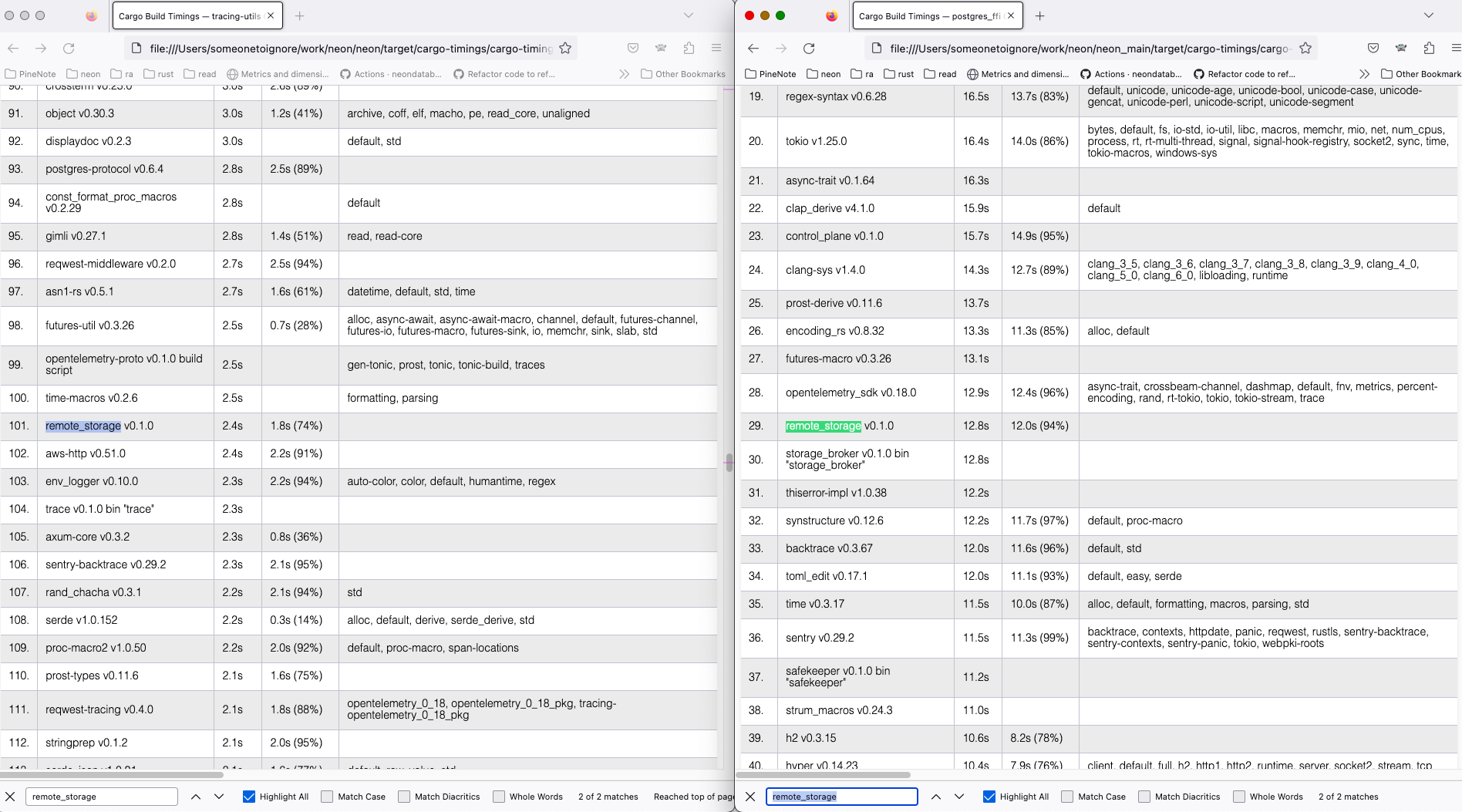
Full cargo reports are available at
[timings.zip](https://github.com/neondatabase/neon/files/11179369/timings.zip)
## Describe your changes
## Issue ticket number and link
## Checklist before requesting a review
- [ ] I have performed a self-review of my code.
- [ ] If it is a core feature, I have added thorough tests.
- [ ] Do we need to implement analytics? if so did you add the relevant
metrics to the dashboard?
- [ ] If this PR requires public announcement, mark it with
/release-notes label and add several sentences in this section.
## Checklist before merging
- [ ] Do not forget to reformat commit message to not include the above
checklist
Old coding here ignored non-wildcard common names and passed None instead. With my recent changes
I started throwing an error in that case. Old logic doesn't seem to be a great choice, so instead
of passing None I actually set non-wildcard common names too. That way it is possible to avoid handling
cases with None in downstream code.
This commit adds an option to start compute without spec and then pass
it a valid spec via `POST /configure` API endpoint. This is a main
prerequisite for maintaining the pool of compute nodes in the
control-plane.
For example:
1. Start compute with
```shell
cargo run --bin compute_ctl -- -i no-compute \
-p http://localhost:9095 \
-D compute_pgdata \
-C "postgresql://cloud_admin@127.0.0.1:5434/postgres" \
-b ./pg_install/v15/bin/postgres
```
2. Configure it with
```shell
curl -d "{\"spec\": $(cat ./compute-spec.json)}" http://localhost:3080/configure
```
Internally, it's implemented using a `Condvar` + `Mutex`. Compute spec
is moved under Mutex, as it's now could be updated in the http handler.
Also `RwLock` was replaced with `Mutex` because the latter works well
with `Condvar`.
First part of the neondatabase/cloud#4433
This allows to skip compatibility tests based on `CHECK_ONDISK_DATA_COMPATIBILITY` environment variable. When the variable is missing (default) compatibility tests wont be run.
Otherwise it can lag a lot, preventing WAL segments cleanup. Also max
wal_backup_lsn on update, pulling it down is pointless.
Should help with https://github.com/neondatabase/neon/issues/3957, but
will not fix it completely.
## Describe your changes
In https://github.com/neondatabase/cloud/issues/4354 we are making
scheduling of projects based on available disk space and overcommit, so
we need to know disk size and just in case instance type of the
pageserver
## Issue ticket number and link
https://github.com/neondatabase/cloud/issues/4354
## Checklist before requesting a review
- [x] I have performed a self-review of my code.
- [ ] ~If it is a core feature, I have added thorough tests.~
- [ ] ~Do we need to implement analytics? if so did you add the relevant
metrics to the dashboard?~
- [ ] ~If this PR requires public announcement, mark it with
/release-notes label and add several sentences in this section.~
in real env testing we noted that the disk-usage based eviction sails 1
percentage point above the configured value, which might be a source of
confusion, so it might be better to get rid of that confusion now.
confusion: "I configured 85% but pageserver sails at 86%".
Co-authored-by: Christian Schwarz <christian@neon.tech>
Make it possible to specify directory where proxy will look up for
extra certificates. Proxy will iterate through subdirs of that directory
and load `key.pem` and `cert.pem` files from each subdir. Certs directory
structure may look like that:
certs
|--example.com
| |--key.pem
| |--cert.pem
|--foo.bar
|--key.pem
|--cert.pem
Actual domain names are taken from certs and key, subdir names are
ignored.
This PR adds posting a comment with test results. Each workflow run
updates the comment with new results.
The layout and the information that we post can be changed to our needs,
right now, it contains failed tests and test which changes status after
rerun (i.e. flaky tests)
This PR adds a plugin that automatically reruns (up to 3 times) flaky
tests. Internally, it uses data from `TEST_RESULT_CONNSTR` database and
`pytest-rerunfailures` plugin.
As the first approximation we consider the test flaky if it has failed on
the main branch in the last 10 days.
Flaky tests are fetched by `scripts/flaky_tests.py` script (it's
possible to use it in a standalone mode to learn which tests are flaky),
stored to a JSON file, and then the file is passed to the pytest plugin.
In S3, pageserver only lists tenants (prefixes) on S3, no other keys.
Remove the list operation from the API, since S3 impl does not seem to
work normally and not used anyway,
For some reason, `tracing::instrument` proc_macro doesn't always print
elements specified via `fields()` or even show that it's impossible
(e.g. there's no Display impl).
Work around this using the `?foo` notation.
Before:
2023-04-03T14:48:06.017504Z INFO handle_client🤝 received SslRequest
After:
2023-04-03T14:51:24.424176Z INFO handle_client{session_id=7bd07be8-3462-404e-8ccc-0a5332bf3ace}🤝 received SslRequest
Leave disk_usage_based_eviction above the current max usage in prod
(82%ish), so that deploying this commit won't trigger
disk_usage_based_eviction.
As indicated in the TODO, we'll decrease the value to 80% later.
Also update the staging YAMLs to use the anchor syntax for
`evictions_low_residence_duration_metric_threshold` like we do in the
prod YAMLs as of this patch.
this will help log analysis with the counterpart of already logging all
remote download needs and downloads. ended up with a easily regexable
output in the final round.
This is the the feedback originating from pageserver, so change previous
confusing names to
s/ReplicationFeedback/PageserverFeedback
s/ps_writelsn/last_receive_lsn
s/ps_flushlsn/disk_consistent_lsn
s/ps_apply_lsn/remote_consistent_lsn
I haven't changed on the wire format to keep compatibility. However,
understanding of new field names is added to compute, so once all computes
receive this patch we can change the wire names as well. Safekeepers/pageservers
are deployed roughly at the same time and it is ok to live without feedbacks
during the short period, so this is not a problem there.
Add a condition to switch walreceiver connection to safekeeper that is
located in the same availability zone. Switch happens when commit_lsn of
a candidate is not less than commit_lsn from the active connection. This
condition is expected not to trigger instantly, because commit_lsn of a
current connection is usually greater than commit_lsn of updates from
the broker. That means that if WAL is written continuously, switch can
take a lot of time, but it should happen eventually.
Now protoc 3.15+ is required for building neon.
Fixes https://github.com/neondatabase/neon/issues/3200
Instead of checking neon.safekeepers GUC value in existing pg node data dir,
just always run sync-safekeepers when safekeepers are configured. Without this
change, creation of new compute didn't run it. That's ok for new
timeline/branch (it doesn't return anything useful anyway, and LSN is known by
pageserver), but restart of compute for existing timeline bore the risk of
getting basebackup not on the latest LSN, i.e. basically broken -- it might not
have prev_lsn, and even if it had, walproposer would complain anyway.
fixes https://github.com/neondatabase/neon/issues/2963
This patch adds a pageserver-global background loop that evicts layers
in response to a shortage of available bytes in the $repo/tenants
directory's filesystem.
The loop runs periodically at a configurable `period`.
Each loop iteration uses `statvfs` to determine filesystem-level space
usage. It compares the returned usage data against two different types
of thresholds. The iteration tries to evict layers until app-internal
accounting says we should be below the thresholds. We cross-check this
internal accounting with the real world by making another `statvfs` at
the end of the iteration. We're good if that second statvfs shows that
we're _actually_ below the configured thresholds. If we're still above
one or more thresholds, we emit a warning log message, leaving it to the
operator to investigate further.
There are two thresholds:
- `max_usage_pct` is the relative available space, expressed in percent
of the total filesystem space. If the actual usage is higher, the
threshold is exceeded.
- `min_avail_bytes` is the absolute available space in bytes. If the
actual usage is lower, the threshold is exceeded.
The iteration evicts layers in LRU fashion with a reservation of up to
`tenant_min_resident_size` bytes of the most recent layers per tenant.
The layers not part of the per-tenant reservation are evicted
least-recently-used first until we're below all thresholds. The
`tenant_min_resident_size` can be overridden per tenant as
`min_resident_size_override` (bytes).
In addition to the loop, there is also an HTTP endpoint to perform one
loop iteration synchronous to the request. The endpoint takes an
absolute number of bytes that the iteration needs to evict before
pressure is relieved. The tests use this endpoint, which is a great
simplification over setting up loopback-mounts in the tests, which would
be required to test the statvfs part of the implementation. We will rely
on manual testing in staging to test the statvfs parts.
The HTTP endpoint is also handy in emergencies where an operator wants
the pageserver to evict a given amount of space _now. Hence, it's
arguments documented in openapi_spec.yml. The response type isn't
documented though because we don't consider it stable. The endpoint
should _not_ be used by Console but it could be used by on-call.
Co-authored-by: Joonas Koivunen <joonas@neon.tech>
Co-authored-by: Dmitry Rodionov <dmitry@neon.tech>
Co-authored-by: Heikki Linnakangas <heikki@neon.tech>
## Describe your changes
Fix prefetch for parallel bitmap scan
## Issue ticket number and link
## Checklist before requesting a review
- [ ] I have performed a self-review of my code.
- [ ] If it is a core feature, I have added thorough tests.
- [ ] Do we need to implement analytics? if so did you add the relevant
metrics to the dashboard?
- [ ] If this PR requires public announcement, mark it with
/release-notes label and add several sentences in this section.
Currently we don't see from the logs, if shutting down tracing takes
long time or not. We do see that shutting down computes gets delayed for
some reason and hits thhe grace period limit. Moving the shutdown
message to slightly later, when we don't have anything else than just
exit left.
## Issue ticket number and link
## Checklist before requesting a review
- [x] I have performed a self-review of my code.
- [ ] If it is a core feature, I have added thorough tests.
- [ ] Do we need to implement analytics? if so did you add the relevant
metrics to the dashboard?
- [ ] If this PR requires public announcement, mark it with
/release-notes label and add several sentences in this section.
Before this patch, the range from which the random delay is picked is at
minimum 10 seconds.
With this patch, they delay is bounded to whatever the given `period`
is, and zero, if period id Duration::ZERO.
Motivation for this: the disk usage eviction tests that we'll add in
https://github.com/neondatabase/neon/pull/3905 need to wait for the disk
usage eviction background loop to do its job.
They set a period of 1s.
It seems wasteful to wait 10 seconds in the tests.
Co-authored-by: Joonas Koivunen <joonas@neon.tech>
## Describe your changes
Get rid of the legacy labeling. Aslo `neon_region_slug` with the same
value as `neon_region` doesn't make much sense, so just drop it. This
allows us to drop the relabeling from zenith to neon in the log
collector.
## Describe your changes
In [this linter
run](https://github.com/neondatabase/cloud/actions/runs/4553032319/jobs/8029101300?pr=4391)
accidentally found out that spec is invalid. Reference other schemas in
properties should be done the way I changed.
Could not find documentation specifically for schemas embedding in
`components.schemas`, but it seems like the approach is inherited from
json schema:
https://json-schema.org/understanding-json-schema/structuring.html#ref
## Issue ticket number and link
-
## Checklist before requesting a review
- [x] I have performed a self-review of my code.
- [ ] ~If it is a core feature, I have added thorough tests.~
- [ ] ~Do we need to implement analytics? if so did you add the relevant
metrics to the dashboard?~
- [ ] ~If this PR requires public announcement, mark it with
/release-notes label and add several sentences in this section.~
With fresh rustc brought by
https://github.com/neondatabase/neon/pull/3902, we can use
`std::pin::pin!` macro instead of the tokio one.
One place did not need the macro at all, other places were adjusted.
neon_local sends SIGQUIT, which otherwise dumps core by default. Also, remove
obsolete install_shutdown_handlers; in all binaries it was overridden by
ShutdownSignals::handle later.
ref https://github.com/neondatabase/neon/issues/3847
## Describe your changes
Monitor free spae in local file system and shrink local file cache size
if it is under watermark.
Neon is using local storage for temp files (temp table + intermediate
results), unlogged relations
and local file cache.
Ideally all space not used for temporary files should be used for local
file cache.
Temporary files and even unlogged relation are intended to have small
life time (because
them can be lost at any moment in case of compute restart).
So the policy is to overcommit local cache size and shrink it if there
is not enough free space.
As far as temporary files are expected to be needed for a short time,
there i no need
to permanently shrink local file cache size. Instead of it, we just
throw away least recently accessed elements
from local file cache, releasing some space on the local disk.
## Issue ticket number and link
## Checklist before requesting a review
- [ ] I have performed a self-review of my code.
- [ ] If it is a core feature, I have added thorough tests.
- [ ] Do we need to implement analytics? if so did you add the relevant
metrics to the dashboard?
- [ ] If this PR requires public announcement, mark it with
/release-notes label and add several sentences in this section.
---------
Co-authored-by: sharnoff <sharnoff@neon.tech>
As of #3867, we do artificial layer accesses to layers that will be
needed after the next restart, but not until then because of caches.
With this patch, we also do that for the accesses that the synthetic
size calculation worker does if consumption metrics are enabled.
The actual size calculation is not of importance, but we need to
calculate all of the sizes, so we only call tenant::size::gather_inputs.
Co-authored-by: Christian Schwarz <christian@neon.tech>
Without this, we run it every p.period, which can be quite low. For
example, the running experiment with 3000 tenants in prod uses a period
of 1 minute.
Doing it once per p.threshold is enough to prevent eviction.
fix synthetic size for (last_record_lsn - gc_horizon) < initdb_lsn
Assume a single-timeline project.
If the gc_horizon covers all WAL (last_record_lsn < gc_horizon)
but we have written more data than just initdb, the synthetic
size calculation worker needs to calculate the logical size
at LSN initdb_lsn (Segment BranchStart).
Before this patch, that calculation would incorrectly return
the initial logical size calculation result that we cache in
the Timeline::initial_logical_size. Presumably, because there
was confusion around initdb_lsn vs. initial size calculation.
The fix is to only hand out the initialized_size() only if
the LSN matches.
The distinction in the metrics between "init logical size" and "logical
size" was also incorrect because of the above. So, remove it.
There was a special case for `size != 0`. This was to cover the case of
LogicalSize::empty_initial(), but `initial_part_end` is `None` in that
case, so the new `LogicalSize::initialized_size()` will return None
in that case as well.
Lastly, to prevent confusion like this in the future, rename all
occurrences of `init_lsn` to either just `lsn` or a more specific name.
Co-authored-by: Joonas Koivunen <joonas@neon.tech>
Co-authored-by: Heikki Linnakangas <heikki@neon.tech>
whoami() was never called, 'is_test' was never set.
'restart()' might be useful, but it wasn't hooked up the CLI so it was
dead code. It's not clear what kind of a restart it should perform,
anyway: just restart Postgres, or re-initialize the data directory
from a fresh basebackup like "stop"+"start" does.
To avoid re-downloading evicted files on restart, re-compute logical
size and partitioning before each threshold based eviction run.
Cc: #3802
Co-authored-by: Christian Schwarz <christian@neon.tech>
* Add the REPOSITORY env to build args to avoid the following error when
executing without the credentials for the repository.
```
ERROR: Service 'compute' failed to build: Head
"https://369495373322.dkr.ecr.eu-central-1.amazonaws.com/v2/compute-node-v15/manifests/2221":
no basic auth credentials
```
* update the tag version in the documentation to support storage broker
## Describe your changes
Added a query param to detach API
Allow to remove local state of a tenant even if its not in the memory
(following ignore API)
## Issue ticket number and link
#3828
## Checklist before requesting a review
- [x] I have performed a self-review of my code.
- [ ] If it is a core feature, I have added thorough tests.
- [ ] Do we need to implement analytics? if so did you add the relevant
metrics to the dashboard?
- [ ] If this PR requires public announcement, mark it with
/release-notes label and add several sentences in this section.
---------
Co-authored-by: Kirill Bulatov <kirill@neon.tech>
The PR enforces current newest `index_part.json` format in the type
system (version `1`), not allowing any previous forms of it, that were
used in the past.
Similarly, the code to mitigate the
https://github.com/neondatabase/neon/issues/3024 issue is now also
removed.
Current code does not produce old formats and extra files in the
index_part.json, in the future we will be able to use
https://github.com/neondatabase/aversion or other approach to make
version transitions more explicit.
See https://neondb.slack.com/archives/C033RQ5SPDH/p1679134185248119 for
the justification on the breaking changes.
We read the pageserver connection string from the spec file, so let's
read the auth token from the same place.
We've been talking about pre-launching compute nodes that are not
associated with any particular tenant at startup, so that the spec
file is delivered to the compute node later. We cannot change the env
variables after the process has been launched.
We still pass the token to 'postgres' binary in the NEON_AUTH_TOKEN
env variable, but compute_ctl is now responsible for setting it.
## Describe your changes
https://neondb.slack.com/archives/C039YKBRZB4/p1679413279637059
## Issue ticket number and link
## Checklist before requesting a review
- [ ] I have performed a self-review of my code.
- [ ] If it is a core feature, I have added thorough tests.
- [ ] Do we need to implement analytics? if so did you add the relevant
metrics to the dashboard?
- [ ] If this PR requires public announcement, mark it with
/release-notes label and add several sentences in this section.
- Remove the neon.safekeeper_token_env GUC. It was used to set the
name of an environment variable, which was then used in pageserver
and safekeeper connection strings to in place of the
password. Instead, always look up the environment variable called
NEON_AUTH_TOKEN. That's what neon.safekeeper_token_env was always
set to in practice, and I don't see the need for the extra level of
indirection or configurability.
- Instead of substituting $NEON_AUTH_TOKEN in the connection strings,
pass $NEON_AUTH_TOKEN "out-of-band" as the password, when we connect
to the pageserver or safekeepers. That's simpler.
- Also use the password from $NEON_AUTH_TOKEN in compute_ctl, when it
connects to the pageserver to get the "base backup".
Walproposer used to live in the backend, while pagestore_smgr was an
extension. But now that both are part of the neon extension,
walproposer can access the same 'neon_tenant' and 'neon_timeline'
variables as the pageserver_smgr code.
This patch adds two metrics that will enable us to detect *thrashing* of
layers, i.e., repetitions of `eviction, on-demand-download, eviction,
... ` for a given layer.
The first metric counts all layer evictions per timeline. It requires no
further explanation. The second metric counts the layer evictions where
the layer was resident for less than a given threshold.
We can alert on increments to the second metric. The first metric will
serve as a baseline, and further, it's generally interesting, outside of
thrashing.
The second metric's threshold is configurable in PageServerConf and
defaults to 24h. The threshold value is reproduced as a label in the
metric because the counter's value is semantically tied to that
threshold. Since changes to the config and hence the label value are
infrequent, this will have low storage overhead in the metrics storage.
The data source to determine the time that the layer was resident is the
file's `mtime`. Using `mtime` is more of a crutch. It would be better if
Pageserver did its own persistent bookkeeping of residence change events
instead of relying on the filesystem. We had some discussion about this:
https://github.com/neondatabase/neon/pull/3809#issuecomment-1470448900
My position is that `mtime` is good enough for now. It can theoretically
jump forward if someone copies files without resetting `mtime`. But that
shouldn't happen in practice. Note that moving files back and forth
doesn't change `mtime`, nor does `chown` or `chmod`. Lastly, `rsync -a`,
which is typically used for filesystem-level backup / restore, correctly
syncs `mtime`.
I've added a label that identifies the data source to keep options open
for a future, better data source than `mtime`. Since this value will
stay the same for the time being, it's not a problem for metrics
storage.
refs https://github.com/neondatabase/neon/issues/3728
The control plane currently only supports EdDSA. We need to either teach
the storage to use EdDSA, or the control plane to use RSA. EdDSA is more
modern, so let's use that.
We could support both, but it would require a little more code and tests,
and we don't really need the flexibility since we control both sides.
This allows you to run without the 'openssl' binary as long as you
don't enable authentication. This becomes more important with the next
commit, which switches the JWT algorithm to EdDSA. LibreSSL does not
support EdDSA, and LibreSSL comes with macOS, so the next commit makes
it much more likely for the key generation to fail for macOS users.
To allow running without a keypair, don't generate the authentication
token in the 'neon_local init' step. Instead, generate a new token on
every request that needs one, using the private key.
Shrinks the total number of metrics collected for each timeline by
about 50%.
See https://github.com/neondatabase/neon/issues/2848. This doesn't fully
solve the problem, we still collect a lot of metrics even with this, but
this gives us a lot of headroom.
## Describe your changes
Add Error enum for tenant state response to allow better error handling
in mgmt api
## Issue ticket number and link
#2238
## Checklist before requesting a review
- [x] I have performed a self-review of my code.
- [ ] If it is a core feature, I have added thorough tests.
- [ ] Do we need to implement analytics? if so did you add the relevant
metrics to the dashboard?
- [ ] If this PR requires public announcement, mark it with
/release-notes label and add several sentences in this section.
Re-enable cgroup shenanigans in VMs, with some special care taken to
make sure that our version of cgroup-tools supports cgroup v2 (debian
bullseye does not, and probably won't because it requires a breaking
change in libcgroup).
This involves manually building libcgroup / cgroup-tools from source,
then copying the output into the final build stage.
We originally considered pulling the package from debian's testing repo
(which is up-to-date), but decided against it. Refer to the PR for more
details.
Prior work, for reference:
* 2153d2e0 - Run compute_ctl in a cgroup in VMs
* 1360361f - Fix missing VM cgconfig.conf
* 8dae8799 - Disable VM cgroup shenanigans
Create `safekeeper_pg_io_bytes_total` metric to track total amount of
bytes written/read in a postgres connections to safekeepers. This metric
has the following labels:
- `client_az` – availability zone of the connection initiator, or
`"unknown"`
- `sk_az` – availability zone of the safekeeper, or `"unknown"`
- `app_name` – `application_name` of the postgres client
- `dir` – data direction, either `"read"` or `"write"`
- `same_az` – `"true"`, `"false"` or `"unknown"`. Can be derived from
`client_az` and `sk_az`, exists purely for convenience.
This is implemented by passing availability zone in the connection
string, like this: `-c tenant_id=AAA timeline_id=BBB
availability-zone=AZ-1`.
Update ansible deployment scripts to add availability_zone argument
to safekeeper and pageserver in systemd service files.
this failure case was probably introduced by b220ba6, because earlier
the gc would always have run fast enough for restart every 1s. however,
test got added later, so we have just been lucky.
fixes#3824 by allowing this error to happen.
## Describe your changes
## Issue ticket number and link
## Checklist before requesting a review
- [x] I have performed a self-review of my code.
- [ ] If it is a core feature, I have added thorough tests.
- [ ] Do we need to implement analytics? if so did you add the relevant
metrics to the dashboard?
- [ ] If this PR requires public announcement, mark it with
/release-notes label and add several sentences in this section.
This makes it possible to enable authentication only for the mgmt HTTP
API or the compute API. The HTTP API doesn't need to be directly
accessible from compute nodes, and it can be secured through network
policies. This also allows rolling out authentication in a piecemeal
fashion.
Otherwise they get lost. Normally buffer is empty before proxy pass, but this is
not the case with pipeline mode of out npm driver; fixes connection hangup
introduced by b80fe41af3 for it.
fixes https://github.com/neondatabase/neon/issues/3822
There was a warning for trailing garbage after end-of-tar archive, but
it didn't always work. The reason is that we created a StreamReader
over the original copyin-stream, but performed the check for garbage
on the copyin-stream. There could be some garbage bytes buffered in
the StreamReader, which were not caught by the warning.
I considered turning the the warning into a fatal error, aborting the
import, but I wasn't sure if we handle aborting the import properly.
Do we clean up the timeline directory on error? If we don't, we should
make that more robust, but that's a different story.
Also, normally a valid tar archive ends with two 512-byte blocks of zeros.
The tokio_tar crate stops at the first all-zeros block. Read and check
the second all-zeros block, and error out if it's not there, or contains
something unexpected.
## Describe your changes
When we perform partitioning of the whole key space, we take in account
actual ranges of relation present in the database. So if we have
relation with relid=1 and size 100 and relation with relid=2 with size
200 then result of KeySpace::partition may contain partitions
<100000000..100000099> and <200000000..200000199>. Generated image
layers will contain the same boundaries.
But when GC is checking image coverage to find out of old layer is fully
covered by newer image layer and so can be deleted, it takes in account
only full key range. I.e. if there is delta layer <100000000..300000000>
then it never be garbage collected because image layers
<100000000..100000099> and <200000000..200000199> are not completely
covering it.This is how it looks in practice:
000000067F000032AC00000A300000000000-000000067F000032AC00000A330000000000__000000000F761828
000000067F000032AC00000A31000000001F-000000067F000032AC00000A620000000005__0000000001696070-000000000442A551
000000067F000032AC00000A3300FFFFFFFF-000000067F000032AC00000A650100000000__000000000F761828
So there are two image layers covering delta layer but ... there is a
hole: A330000000000...A3300FFFFFFFF and as a result delta layer is not
collected.
## Issue ticket number and link
This PR is deeply related with #3673 because it is addressing the same
problem: old layers are not utilized by GC.
The test test_gc_old_layers.py in #3673 can be used to see effect of
this patch.
## Checklist before requesting a review
- [ ] I have performed a self-review of my code.
- [ ] If it is a core feature, I have added thorough tests.
- [ ] Do we need to implement analytics? if so did you add the relevant
metrics to the dashboard?
- [ ] If this PR requires public announcement, mark it with
/release-notes label and add several sentences in this section.
---------
Co-authored-by: Joonas Koivunen <joonas@neon.tech>
- handle automatically fixable future clippies
- tune run-clippy.sh to remove macos specifics which we no longer have
Co-authored-by: Alexander Bayandin <alexander@neon.tech>
## Describe your changes
We have previously changed the neon-proxy to use RollingUpdate. This
should be enabled in legacy proxy too in order to avoid breaking
connections for the clients and allow for example backups to run even
during deployment. (https://github.com/neondatabase/neon/pull/3683)
## Issue ticket number and link
https://github.com/neondatabase/neon/issues/3333
in prev implementation, an `ok_or_else(...)?` is used to cause a
"precondition error" on LayerMap::replace, however we only see this
particular error if an L0 for which replace fails is not in the layermap
because it is not in `l0_delta_layers`. changes or fixes this to be
Replacement::NotFound instead, making it more clear that an error would
only be raised for actual preconditions, like trying to replace layer
with completly unrelated layer.
## Describe your changes
Do not pin current block in BlockCursor
## Issue ticket number and link
See #3712
There are places (see get_reconstruct_data) in our code when thread is
holding read layers lock and then try to read file and so lock page
cache slot. So we have edge in dependency graph layers->page cache slot.
At the same time (as Christian noticed) we can lock page cache slot in
BlockCursor and then try obtain shard lock on layers.
So there is backward edge in dependency graph page cache slot>layers
which forms loop and may cause deadlock.
There are three possible fixes of the problem:
1. Perform compaction under `layers` shared lock. See PR #3732. It fixes
the problem but make it not possible to append any data to pageserver
until compaction is completed.
2. Do not hold `layers` lock while accessing layers (not sure if it is
possible to do because it definitely introduce some new race
conditions).
3. Do not pin current pages in BockCursor (this PR).
My experiments shows that this cache in BlockCursor is not so useful:
the number of hits/misses for cursor cache on pgbench workload (-i -s
10/-c 10 -T 100/-c 10 -S -T 100):
```
hits: 163011
misses: 1023602
```
So number of cache misses is 10x times larger.
And results for read-only pgbench are mostly the same:
```
with cache: 14581
w/out cache: 14429
```
## Checklist before requesting a review
- [ ] I have performed a self-review of my code.
- [ ] If it is a core feature, I have added thorough tests.
- [ ] Do we need to implement analytics? if so did you add the relevant
metrics to the dashboard?
- [ ] If this PR requires public announcement, mark it with
/release-notes label and add several sentences in this section.
I moved management API v2 to ogen and the generated code seems to be
more strict about content type. Let's set it properly as it is json
after all
## Describe your changes
## Issue ticket number and link
## Checklist before requesting a review
- [x] I have performed a self-review of my code.
- [ ] If it is a core feature, I have added thorough tests.
- [ ] Do we need to implement analytics? if so did you add the relevant
metrics to the dashboard?
- [ ] If this PR requires public announcement, mark it with
/release-notes label and add several sentences in this section.
Adds two new *global* metrics:
- pageserver_remote_ondemand_downloaded_layers_total
- pageserver_remote_ondemand_downloaded_bytes_total
An existing test is repurposed once more to check that we do get some
reasonable counts. These are to replace guessing from the nic RX bytes
metric how much was on-demand downloaded.
First part of #3745: This does not add the "(un)?avoidable" metric,
which I plan to add as a new metric, which will be a subset of the
counts of the metrics added here.
After enabling autoscaling, we faced the issue that customers are not
able to get the number of CPUs they use at this moment. Therefore I've
added these two options:
1. Postgresql function to allow customers to call it whenever they want
2. `compute_ctl` endpoint to show these number in console
Recently added `unsafe-postgres` feature allows to build pgx extensions
against postgres forks that decided to change their ABI name (like us).
With that we can build extensions without forking them and using stock
pgx. As this feature is new few manual version bumps were required.
Previously, we only accepted RS256. Seems like a pointless limitation,
and when I was testing it with RS512 tokens, it took me a while to
understand why it wasn't working.
Since we allow switching endpoints between different branches, it is important to use composite key.
Otherwise, we may try to calculate delta between metric values for two different branches.
…start transparent for clients
## Describe your changes
Try to reestablish connection with pageserver if send is failed to be
able to make pageserver restart transparent for client
## Issue ticket number and link
https://github.com/neondatabase/neon/issues/1138
## Checklist before requesting a review
- [ ] I have performed a self-review of my code.
- [ ] If it is a core feature, I have added thorough tests.
- [ ] Do we need to implement analytics? if so did you add the relevant
metrics to the dashboard?
- [ ] If this PR requires public announcement, mark it with
/release-notes label and add several sentences in this section.
---------
Co-authored-by: Heikki Linnakangas <heikki@neon.tech>
1) Remove allocation and data copy during each message read. Instead, parsing
functions now accept BytesMut from which data they form messages, with
pointers (e.g. in CopyData) pointing directly into BytesMut buffer. Accordingly,
move ConnectionError containing IO error subtype into framed.rs providing this
and leave in pq_proto only ProtocolError.
2) Remove anyhow from pq_proto.
3) Move FeStartupPacket out of FeMessage. Now FeStartupPacket::parse returns it
directly, eliminating dead code where user wants startup packet but has to match
for others.
proxy stream.rs is adapted to framed.rs with minimal changes. It also benefits
from framed.rs improvements described above.
- Add support for splitting async postgres_backend into read and write halfes.
Safekeeper needs this for bidirectional streams. To this end, encapsulate
reading-writing postgres messages to framed.rs with split support without any
additional changes (relying on BufRead for reading and BytesMut out buffer for
writing).
- Use async postgres_backend throughout safekeeper (and in proxy auth link
part).
- In both safekeeper COPY streams, do read-write from the same thread/task with
select! for easier error handling.
- Tidy up finishing CopyBoth streams in safekeeper sending and receiving WAL
-- join split parts back catching errors from them before returning.
Initially I hoped to do that read-write without split at all, through polling
IO:
https://github.com/neondatabase/neon/pull/3522
However that turned out to be more complicated than I initially expected
due to 1) borrow checking and 2) anon Future types. 1) required Rc<Refcell<...>>
which is Send construct just to satisfy the checker; 2) can be workaround with
transmute. But this is so messy that I decided to leave split.
To untie cyclic dependency between sync and async versions of postgres_backend,
copy QueryError and some logging/error routines to postgres_backend.rs. This is
temporal glue to make commits smaller, sync version will be dropped by the
upcoming commit completely.
This commit adds a basic HTTP API endpoint that allows scraping the
`pg_stat_statements` data and getting a list of slow queries. New
insights like cache hit rate and so on could be added later.
Extension `pg_stat_statements` is checked / created only if compute
tries to load the corresponding shared library. The latter is configured
by control-plane and currently covered with feature flag.
Co-authored by Eduard Dyckman (bird.duskpoet@gmail.com)
Adds a newtype that creates a span with request_id from
https://github.com/neondatabase/neon/pull/3708 for every HTTP request
served.
Moves request logging and error handlers under the new wrapper, so every request-related event now is logged under the request span.
For compatibility reasons, error handler is left on the general router, since not every service uses the new handler wrappers yet.
We have a few tests that try to set image_creation_threshold, but it
didn't actually have any effect because we were missing some critical
code to load the setting from config file into memory.
The two modified tests in `test_remote_storage.py perform
compaction and GC, and assert that GC removes some layers. That
only happens if new image layers are created by the
compaction. The tests explicitly disabled image layer creation by
setting image_creation_threshold to a high value, but it didn't
take effect because reading image_creation_threshold from config
file was broken, which is why the test worked. Fix the test to
set image_creation_threshold low, instead, so that GC has work to
do.
Change 'test_tenant_conf.py' so that it exercises the added code.
This might explain why we're apparently missing test coverage for GC
(issue #3415), although I didn't try to address that here, nor did I
check if this improves the it.
## Describe your changes
Adds a field to the OpenAPI spec for the page server which describes the
`do_gc` command.
## Issue ticket number and link
#3669
## Checklist before requesting a review
- [x] I have performed a self-review of my code.
- [ ] If it is a core feature, I have added thorough tests.
- [ ] Do we need to implement analytics? if so did you add the relevant
metrics to the dashboard?
- [ ] If this PR requires public announcement, mark it with
/release-notes label and add several sentences in this section.
* Stop allocating and maintaining 128MB hash table for last written
LSN cache as it is not needed in wal-redo.
* Do not require access to the initialized data directory. That
saves few dozens megabytes of empty but initialized data directory.
Currently such directories do occupy about 10% of the disk space
on the pageservers as most of tenants are empty.
* Move shmem-initialization code to the extension instead of postgres
The test already allows the background thread trying to checkpoint to
fail, however the resulting log message is currently not allowed thus
causing flakyness.
Before this patch, persistent peer_horizon_lsn was always sent to walproposer,
making it initially calculate it equal to max of persistent values and in turn
pulling back the in memory value. Send instead in memory value and take max when
safekeeper sets it.
closes https://github.com/neondatabase/neon/issues/3752
## Describe your changes
Adding a timeout handling for the remote download of layers of 120
seconds for each operation
Note that these downloads are being retried for N times
## Issue ticket number and link
Fixes: #3672
## Checklist before requesting a review
- [x] I have performed a self-review of my code.
- [ ] If it is a core feature, I have added thorough tests.
- [ ] Do we need to implement analytics? if so did you add the relevant
metrics to the dashboard?
- [ ] If this PR requires public announcement, mark it with
/release-notes label and add several sentences in this section.
---------
Co-authored-by: Joonas Koivunen <joonas@neon.tech>
## Describe your changes
Restart walredo process an d retry applying walredo records i case of
abnormal walredo process termination
## Issue ticket number and link
See #1700
## Checklist before requesting a review
- [ ] I have performed a self-review of my code.
- [ ] If it is a core feature, I have added thorough tests.
- [ ] Do we need to implement analytics? if so did you add the relevant
metrics to the dashboard?
- [ ] If this PR requires public announcement, mark it with
/release-notes label and add several sentences in this section.
2023-03-06 10:10:58 +02:00
999 changed files with 209664 additions and 47499 deletions
**NB: this PR must be merged only by 'Create a merge commit'!**
### Checklist when preparing for release
- [ ] Read or refresh [the release flow guide](https://github.com/neondatabase/cloud/wiki/Release:-general-flow)
- [ ] Read or refresh [the release flow guide](https://www.notion.so/neondatabase/Release-general-flow-61f2e39fd45d4d14a70c7749604bd70b)
- [ ] Ask in the [cloud Slack channel](https://neondb.slack.com/archives/C033A2WE6BZ) that you are going to rollout the release. Any blockers?
- [ ] Does this release contain any db migrations? Destructive ones? What is the rollback plan?
<!-- List everything that should be done**before** release, any issues / setting changes / etc -->
### Checklist after release
- [ ] Make sure instructions from PRs included in this release and labeled `manual_release_instructions` are executed (either by you or by people who wrote them).
- [ ] Based on the merged commits write release notes and open a PR into `website` repo ([example](https://github.com/neondatabase/website/pull/219/files))
# The path includes a test name (test_create_snapshot) and directory that the test creates (compatibility_snapshot_pg14), keep the path in sync with the test
Howdy! Usual good software engineering practices apply. Write
tests. Write comments. Follow standard Rust coding practices where
possible. Use 'cargo fmt' and 'clippy' to tidy up formatting.
possible. Use `cargo fmt` and `cargo clippy` to tidy up formatting.
There are soft spots in the code, which could use cleanup,
refactoring, additional comments, and so forth. Let's try to raise the
bar, and clean things up as we go. Try to leave code in a better shape
than it was before.
## Pre-commit hook
We have a sample pre-commit hook in `pre-commit.py`.
To set it up, run:
```bash
ln -s ../../pre-commit.py .git/hooks/pre-commit
```
This will run following checks on staged files before each commit:
-`rustfmt`
- checks for Python files, see [obligatory checks](/docs/sourcetree.md#obligatory-checks).
There is also a separate script `./run_clippy.sh` that runs `cargo clippy` on the whole project
and `./scripts/reformat` that runs all formatting tools to ensure the project is up to date.
If you want to skip the hook, run `git commit` with `--no-verify` option.
## Submitting changes
1. Get at least one +1 on your PR before you push.
@@ -27,3 +45,40 @@ your patch's fault. Help to fix the root cause if something else has
broken the CI, before pushing.
*Happy Hacking!*
# How to run a CI pipeline on Pull Requests from external contributors
_An instruction for maintainers_
## TL;DR:
- Review the PR
- If and only if it looks **safe** (i.e. it doesn't contain any malicious code which could expose secrets or harm the CI), then:
- Press the "Approve and run" button in GitHub UI
- Add the `approved-for-ci-run` label to the PR
- Currently draft PR will skip e2e test (only for internal contributors). After turning the PR 'Ready to Review' CI will trigger e2e test
- Add `run-e2e-tests-in-draft` label to run e2e test in draft PR (override above behaviour)
- The `approved-for-ci-run` workflow will add `run-e2e-tests-in-draft` automatically to run e2e test for external contributors
Repeat all steps after any change to the PR.
- When the changes are ready to get merged — merge the original PR (not the internal one)
## Longer version:
GitHub Actions triggered by the `pull_request` event don't share repository secrets with the forks (for security reasons).
So, passing the CI pipeline on Pull Requests from external contributors is impossible.
We're using the following approach to make it work:
- After the review, assign the `approved-for-ci-run` label to the PR if changes look safe
- A GitHub Action will create an internal branch and a new PR with the same changes (for example, for a PR `#1234`, it'll be a branch `ci-run/pr-1234`)
- Because the PR is created from the internal branch, it is able to access repository secrets (that's why it's crucial to make sure that the PR doesn't contain any malicious code that could expose our secrets or intentionally harm the CI)
- The label gets removed automatically, so to run CI again with new changes, the label should be added again (after the review)
For details see [`approved-for-ci-run.yml`](.github/workflows/approved-for-ci-run.yml)
## How do I make build-tools image "pinned"
It's possible to update the `pinned` tag of the `build-tools` image using the `pin-build-tools-image.yml` workflow.
```bash
gh workflow -R neondatabase/neon run pin-build-tools-image.yml \
storage_broker={version="0.1",path="./storage_broker/"}# Note: main broker code is inside the binary crate, so linking with the library shouldn't be heavy.
RUN curl -fsSL "https://github.com/protocolbuffers/protobuf/releases/download/v${PROTOC_VERSION}/protoc-${PROTOC_VERSION}-linux-$(uname -m | sed 's/aarch64/aarch_64/g').zip" -o "protoc.zip"\
RUN curl -sL "https://github.com/peak/s5cmd/releases/download/v${S5CMD_VERSION}/s5cmd_${S5CMD_VERSION}_Linux-$(uname -m | sed 's/x86_64/64bit/g'| sed 's/aarch64/arm64/g').tar.gz"| tar zxvf - s5cmd \
&& chmod +x s5cmd \
&& mv s5cmd /usr/local/bin/s5cmd
# LLVM
ENVLLVM_VERSION=18
RUN curl -fsSL 'https://apt.llvm.org/llvm-snapshot.gpg.key'| apt-key add - \
Neon is a serverless open-source alternative to AWS Aurora Postgres. It separates storage and compute and substitutes the PostgreSQL storage layer by redistributing data across a cluster of nodes.
## Quick start
Try the [Neon Free Tier](https://neon.tech/docs/introduction/technical-preview-free-tier/) to create a serverless Postgres instance. Then connect to it with your preferred Postgres client (psql, dbeaver, etc) or use the online [SQL Editor](https://neon.tech/docs/get-started-with-neon/query-with-neon-sql-editor/). See [Connect from any application](https://neon.tech/docs/connect/connect-from-any-app/) for connection instructions.
Try the [Neon Free Tier](https://neon.tech/github) to create a serverless Postgres instance. Then connect to it with your preferred Postgres client (psql, dbeaver, etc) or use the online [SQL Editor](https://neon.tech/docs/get-started-with-neon/query-with-neon-sql-editor/). See [Connect from any application](https://neon.tech/docs/connect/connect-from-any-app/) for connection instructions.
Alternatively, compile and run the project [locally](#running-local-installation).
@@ -12,10 +16,10 @@ Alternatively, compile and run the project [locally](#running-local-installation
A Neon installation consists of compute nodes and the Neon storage engine. Compute nodes are stateless PostgreSQL nodes backed by the Neon storage engine.
The Neon storage engine consists of two major components:
- Pageserver. Scalable storage backend for the compute nodes.
- Safekeepers. The safekeepers form a redundant WAL service that received WAL from the compute node, and stores it durably until it has been processed by the pageserver and uploaded to cloud storage.
- Pageserver: Scalable storage backend for the compute nodes.
- Safekeepers: The safekeepers form a redundant WAL service that received WAL from the compute node, and stores it durably until it has been processed by the pageserver and uploaded to cloud storage.
See developer documentation in [/docs/SUMMARY.md](/docs/SUMMARY.md) for more information.
See developer documentation in [SUMMARY.md](/docs/SUMMARY.md) for more information.
## Running local installation
@@ -26,31 +30,38 @@ See developer documentation in [/docs/SUMMARY.md](/docs/SUMMARY.md) for more inf
* On Ubuntu or Debian, this set of packages should be sufficient to build the code:
Building Neon requires 3.15+ version of `protoc` (protobuf-compiler). If your distribution provides an older version, you can install a newer version from [here](https://github.com/protocolbuffers/protobuf/releases).
@@ -72,9 +83,9 @@ The project uses [rust toolchain file](./rust-toolchain.toml) to define the vers
This file is automatically picked up by [`rustup`](https://rust-lang.github.io/rustup/overrides.html#the-toolchain-file) that installs (if absent) and uses the toolchain version pinned in the file.
rustup users who want to build with another toolchain can use [`rustup override`](https://rust-lang.github.io/rustup/overrides.html#directory-overrides) command to set a specific toolchain for the project's directory.
rustup users who want to build with another toolchain can use the [`rustup override`](https://rust-lang.github.io/rustup/overrides.html#directory-overrides) command to set a specific toolchain for the project's directory.
non-rustup users most probably are not getting the same toolchain automatically from the file, so are responsible to manually verify their toolchain matches the version in the file.
non-rustup users most probably are not getting the same toolchain automatically from the file, so are responsible to manually verify that their toolchain matches the version in the file.
Newer rustc versions most probably will work fine, yet older ones might not be supported due to some new features used by the project or the crates.
#### Building on Linux
@@ -115,7 +126,7 @@ make -j`sysctl -n hw.logicalcpu` -s
To run the `psql` client, install the `postgresql-client` package or modify `PATH` and `LD_LIBRARY_PATH` to include `pg_install/bin` and `pg_install/lib`, respectively.
To run the integration tests or Python scripts (not required to use the code), install
Python (3.9 or higher), and install python3 packages using `./scripts/pysync` (requires [poetry>=1.3](https://python-poetry.org/)) in the project directory.
Python (3.9 or higher), and install the python3 packages using `./scripts/pysync` (requires [poetry>=1.3](https://python-poetry.org/)) in the project directory.
#### Running neon database
@@ -123,39 +134,41 @@ Python (3.9 or higher), and install python3 packages using `./scripts/pysync` (r
```sh
# Create repository in .neon with proper paths to binaries and data
# Later that would be responsibility of a package install script
> ./target/debug/neon_local init
Starting pageserver at '127.0.0.1:64000' in '.neon'.
> cargo neon init
Initializing pageserver node 1 at '127.0.0.1:64000' in ".neon"
# start pageserver, safekeeper, and broker for their intercommunication
> ./target/debug/neon_local start
Starting neon broker at 127.0.0.1:50051
> cargo neon start
Starting neon broker at 127.0.0.1:50051.
storage_broker started, pid: 2918372
Starting pageserver at '127.0.0.1:64000' in '.neon'.
Starting pageserver node 1 at '127.0.0.1:64000' in ".neon".
pageserver started, pid: 2918386
Starting safekeeper at '127.0.0.1:5454' in '.neon/safekeepers/sk1'.
safekeeper 1 started, pid: 2918437
# create initial tenant and use it as a default for every future neon_local invocation
4. If you want to run tests afterward (see below), you must stop all the running of the pageserver, safekeeper, and postgres instances
4. If you want to run tests afterwards (see below), you must stop all the running pageserver, safekeeper, and postgres instances
you have just started. You can terminate them all with one command:
```sh
> ./target/debug/neon_local stop
> cargo neon stop
```
More advanced usages can be found at [Control Plane and Neon Local](./control_plane/README.md).
#### Handling build failures
If you encounter errors during setting up the initial tenant, it's best to stop everything (`cargo neon stop`) and remove the `.neon` directory. Then fix the problems, and start the setup again.
## Running tests
### Rust unit tests
We are using [`cargo-nextest`](https://nexte.st/) to run the tests in Github Workflows.
Some crates do not support running plain `cargo test` anymore, prefer `cargo nextest run` instead.
You can install `cargo-nextest` with `cargo install cargo-nextest`.
### Integration tests
Ensure your dependencies are installed as described [here](https://github.com/neondatabase/neon#dependency-installation-notes).
```sh
@@ -229,11 +258,34 @@ CARGO_BUILD_FLAGS="--features=testing" make
./scripts/pytest
```
By default, this runs both debug and release modes, and all supported postgres versions. When
testing locally, it is convenient to run just one set of permutations, like this:
You may find yourself in need of flamegraphs for software in this repository.
You can use [`flamegraph-rs`](https://github.com/flamegraph-rs/flamegraph) or the original [`flamegraph.pl`](https://github.com/brendangregg/FlameGraph). Your choice!
>[!IMPORTANT]
> If you're using `lld` or `mold`, you need the `--no-rosegment` linker argument.
> It's a [general thing with Rust / lld / mold](https://crbug.com/919499#c16), not specific to this repository.
> See [this PR for further instructions](https://github.com/neondatabase/neon/pull/6764).
## Cleanup
For cleaning up the source tree from build artifacts, run `make clean` in the source directory.
For removing every artifact from build and configure steps, run `make distclean`, and also consider removing the cargo binaries in the `target` directory, as well as the database in the `.neon` directory. Note that removing the `.neon` directory will remove your database, with all data in it. You have been warned!
## Documentation
[/docs/](/docs/) Contains a top-level overview of all available markdown documentation.
[docs](/docs) Contains a top-level overview of all available markdown documentation.
- [/docs/sourcetree.md](/docs/sourcetree.md) contains overview of source tree layout.
- [sourcetree.md](/docs/sourcetree.md) contains overview of source tree layout.
To view your `rustdoc` documentation in a browser, try running `cargo doc --no-deps --open`
@@ -258,6 +310,6 @@ To get more familiar with this aspect, refer to:
## Join the development
- Read `CONTRIBUTING.md` to learn about project code style and practices.
- To get familiar with a source tree layout, use [/docs/sourcetree.md](/docs/sourcetree.md).
- Read [CONTRIBUTING.md](/CONTRIBUTING.md) to learn about project code style and practices.
- To get familiar with a source tree layout, use [sourcetree.md](/docs/sourcetree.md).
- To learn more about PostgreSQL internals, check http://www.interdb.jp/pg/index.html
Some files were not shown because too many files have changed in this diff
Show More
Reference in New Issue
Block a user
Blocking a user prevents them from interacting with repositories, such as opening or commenting on pull requests or issues. Learn more about blocking a user.


